On Degeneracies of Density, Magnetic, and Pairing Responses: How Competing Orders Echo Underlying Symmetries in the Hubbard Model
Pith reviewed 2026-06-25 22:15 UTC · model grok-4.3
The pith
Pseudospin symmetry in the unfrustrated bipartite Hubbard model enforces exact relations between its charge, spin, and pairing susceptibilities at arbitrary wavevectors.
A machine-rendered reading of the paper's core claim, the machinery that carries it, and where it could break.
Core claim
The unfrustrated bipartite Hubbard model possesses a pseudospin symmetry that directly enforces mutual relations between charge, spin, and pairing susceptibilities for generic spatial modulations; numerical evidence shows this symmetry produces a joint d-wave pairing / d-density-wave instability near the metal-insulator transition in two dimensions.
What carries the argument
Pseudospin symmetry, which rotates between particle and hole operators on the bipartite lattice and thereby maps the different response channels onto one another.
If this is right
- The derived relations between susceptibilities apply to any wavevector and therefore constrain the competition between stripe and superconducting orders.
- A simultaneous d-wave pairing and d-density-wave (loop-current) instability appears near the metal-insulator transition and is driven by short-ranged spin fluctuations.
- Geometrical frustration gradually lifts the degeneracy and favors superconductivity over the density-wave channel.
Where Pith is reading between the lines
- The same symmetry-based relations could be tested in other lattice models that retain a similar particle-hole mapping.
- Material searches might target compounds whose effective models are close to the unfrustrated bipartite limit to look for the predicted near-degeneracy of orders.
- The relations provide a benchmark that any approximate many-body method must satisfy when applied to the Hubbard model.
Load-bearing premise
The lattice is unfrustrated and bipartite, preserving an exact pseudospin symmetry that relates the response functions.
What would settle it
A direct computation of the charge and pairing susceptibilities at a common wavevector in the square-lattice Hubbard model that violates the analytically derived equality between those two channels.
Figures

read the original abstract
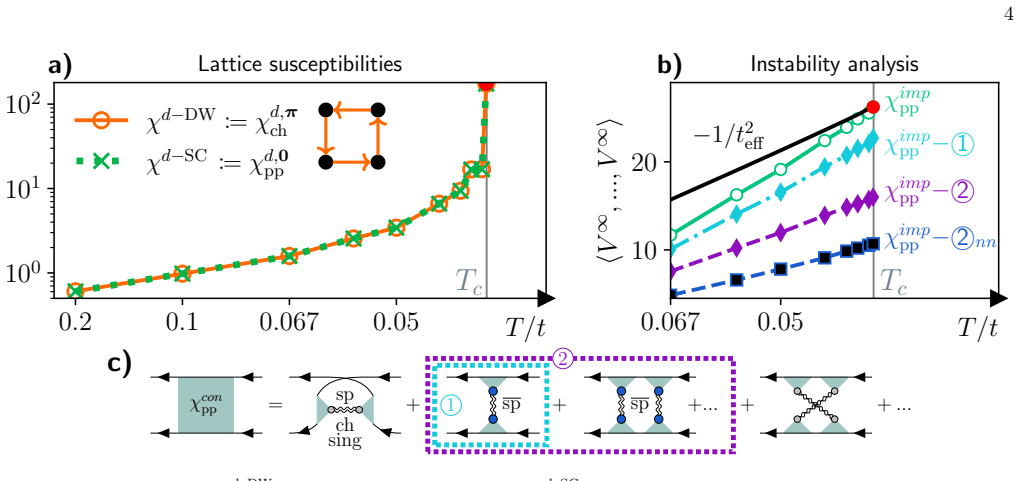
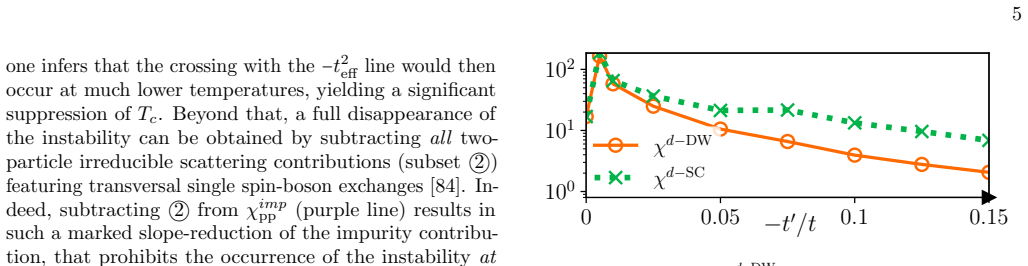
Strongly correlated electron systems often display competing or even intertwined ordering tendencies, hinting to extremely close or degenerate many-electron energies. While degeneracies are directly rooted in the underlying symmetries of the problem under investigation, their multifaceted effects on different response functions and their mutual relations often remain elusive. Here we put this subject on a rigorous basis by investigating the degeneracies of charge, spin, and pairing susceptibilities for the unfrustrated, bipartite Hubbard model. Exploiting its pseudospin symmetry, we analytically derive the mutual relations between these response functions for generic spatial modulations, highly relevant, e.g., for the competition of stripe and superconducting orders. By means of two-particle numerical simulations we demonstrate the occurrence of a simultaneous $d$-wave pairing/$d$-density wave (loop current) instability in the vicinity of the metal-insulator transition, driven by short-ranged spin fluctuations for the two-dimensional case. We show how this degeneracy is gradually lifted by geometrical frustration, which favors superconductivity. Our study provides a general tool for revealing symmetry relations in correlated electron systems and establishes a unifying perspective on the nature of their intermingled charge/loop current, pairing, and spin orders.
Editorial analysis
A structured set of objections, weighed in public.
Referee Report
Summary. The manuscript claims that the pseudospin (charge SU(2)) symmetry of the half-filled unfrustrated bipartite Hubbard model enforces exact mutual relations among charge-density, spin, and pairing susceptibilities for arbitrary spatial modulations Q. These relations are derived analytically and shown to imply degeneracies between, e.g., d-wave pairing and d-density-wave (loop-current) responses. Two-particle numerical simulations are used to demonstrate a simultaneous d-wave pairing / d-density-wave instability near the metal-insulator transition in 2D, driven by short-range spin fluctuations, with the degeneracy lifted by geometrical frustration in favor of superconductivity.
Significance. If the central relations hold, the work supplies a parameter-free, symmetry-based tool that directly links competing orders without fitted parameters or self-referential assumptions. The analytical mapping from pseudospin symmetry to response-function degeneracies for generic Q is a clear strength, as is the explicit demonstration that frustration lifts the degeneracy. This provides a unifying perspective on intertwined charge/loop-current, pairing, and spin orders and is directly relevant to stripe-superconductivity competition.
minor comments (3)
- [§3] §3 (numerical methods): the two-particle solver (DCA, DMFT+2P, or other) and the momentum discretization used for the 2D simulations should be stated explicitly in the main text rather than only in the supplement, to allow immediate assessment of the approximation level.
- [Fig. 4] Fig. 4 caption: the temperature and interaction values at which the simultaneous instability is reported should be listed numerically in the caption for quick reference.
- [Eq. (12)] Eq. (12): the definition of the form factor for the d-density-wave operator should include an explicit statement that it is normalized identically to the d-wave pairing form factor, to make the degeneracy manifest without cross-reference.
Simulated Author's Rebuttal
We thank the referee for the positive assessment of our manuscript, the accurate summary of its central results, and the recommendation to accept. The referee correctly identifies the symmetry-based relations and their implications for competing orders.
Circularity Check
No significant circularity; derivation from standard model symmetry
full rationale
The paper's central analytic step exploits the pseudospin (charge SU(2)) symmetry of the half-filled unfrustrated bipartite Hubbard model to derive exact mutual relations among charge, spin, and pairing susceptibilities for arbitrary wavevectors. This symmetry is a rigorously established, external property of the model Hamiltonian and is not constructed or fitted within the paper. Numerical demonstrations of simultaneous instabilities follow directly as consequences without parameter fitting or self-referential predictions. No self-citation load-bearing steps, ansatze smuggled via citation, or reductions of predictions to inputs by construction are present. The derivation chain is self-contained against external benchmarks.
Axiom & Free-Parameter Ledger
axioms (1)
- domain assumption The unfrustrated bipartite Hubbard model possesses pseudospin symmetry.
Reference graph
Works this paper leans on
-
[1]
Sachdev,Quantum Phase Transitions(Cambridge University Press, 1999)
S. Sachdev,Quantum Phase Transitions(Cambridge University Press, 1999)
1999
-
[2]
H. v. L¨ ohneysen, A. Rosch, M. Vojta, and P. W¨ olfle, Fermi-liquid instabilities at magnetic quantum phase transitions, Rev. Mod. Phys.79, 1015 (2007)
2007
-
[3]
Brando, D
M. Brando, D. Belitz, F. M. Grosche, and T. R. Kirk- patrick, Metallic quantum ferromagnets, Rev. Mod. Phys. 88, 025006 (2016)
2016
-
[4]
L. Savary and L. Balents, Quantum spin liquids: a re- view, Reports on Progress in Physics80, 016502 (2017), arXiv:1601.03742 [cond-mat.str-el]
Pith/arXiv arXiv 2017
-
[5]
Kaminski, S
A. Kaminski, S. Rosenkranz, H. Fretwell, J. Campuzano, Z. Li, H. Raffy, W. Cullen, H. You, C. Olson, C. Varma, and H. H¨ ochst, Spontaneous breaking of time-reversal symmetry in the pseudogap state of a high-tc supercon- ductor, Nature416, 610–613 (2002)
2002
-
[6]
Fradkin, S
E. Fradkin, S. A. Kivelson, and J. M. Tranquada, Collo- quium: Theory of intertwined orders in high temperature superconductors, Rev. Mod. Phys.87, 457 (2015)
2015
-
[7]
L. L. Viteritti, R. Rende, C. Roth, A. Sengupta, G. Car- leo, and A. Georges, Beyond Variational Bias: Resolv- ing Intertwined Orders in the Hubbard Model (2026), arXiv:2604.21978 [cond-mat.str-el]
Pith/arXiv arXiv 2026
-
[8]
Hubbard, Electron Correlations in Narrow Energy Bands, Proceedings of the Royal Society of London
J. Hubbard, Electron Correlations in Narrow Energy Bands, Proceedings of the Royal Society of London. Series A, Mathematical and Physical Sciences276, 238 (1963)
1963
-
[10]
D. P. Arovas, E. Berg, S. A. Kivelson, and S. Raghu, The Hubbard Model, Annual Review of Con- densed Matter Physics13, 10.1146/annurev-conmatphys- 031620-102024 (2022), https://doi.org/10.1146/annurev- conmatphys-031620-102024
-
[11]
E. W. Huang, C. B. Mendl, H.-C. Jiang, B. Moritz, and T. P. Devereaux, Stripe order from the perspec- tive of the Hubbard model, npj Quantum Materials3, 10.1038/s41535-018-0097-0 (2018)
-
[13]
H. Xu, C.-M. Chung, M. Qin, U. Schollw¨ ock, S. R. White, and S. Zhang, Coexistence of superconductivity with partially filled stripes in the Hubbard model, Science 384, 10.1126/science.adh7691 (2024)
-
[14]
S. Chakravarty, Quantum oscillations and key theoretical issues in high temperature superconductors from the perspective of density waves, Reports on Progress in Physics74, 022501 (2011)
2011
-
[15]
Jiang and T
H.-C. Jiang and T. Devereaux, Superconductivity in the doped Hubbard model and its interplay with next-nearest hopping t’, Science365(2019)
2019
-
[16]
Y. Wang, D. F. Agterberg, and A. Chubukov, Inter- play between pair- and charge-density-wave orders in underdoped cuprates, Phys. Rev. B91, 115103 (2015)
2015
-
[17]
Lao and T
J. Lao and T. Zhou, Corner flat bands induced by d density wave and partial corner state modification due to competition with d-wave superconductivity, Phys. Rev. B111, 075169 (2025)
2025
-
[18]
A. Wietek, Y.-Y. He, S. R. White, A. Georges, and E. M. Stoudenmire, Stripes, Antiferromagnetism, and the Pseudogap in the Doped Hubbard Model at Finite Temperature (2020), arXiv:2009.10736 [cond-mat.str-el]
arXiv 2020
-
[19]
R. Scholle, M. Bonetti, W. Metzner, and D. Vilardi, Coexisting magnetic, charge, and superconducting or- ders in the two-dimensional Hubbard model (2026), arXiv:2602.20073
arXiv 2026
-
[20]
P. Worm, M. Reitner, K. Held, and A. Toschi, Fermi and luttinger arcs: Two concepts, realized on one surface, Phys. Rev. Lett.133, 166501 (2024)
2024
- [21]
-
[22]
Rampon, F
L. Rampon, F. ˇSimkovic, and M. Ferrero, Magnetic phase diagram of the three-dimensional doped hubbard model, Phys. Rev. Lett.134, 066502 (2025)
2025
-
[23]
J. P. F. LeBlanc, A. E. Antipov, F. Becca, I. W. Bulik, G. K.-L. Chan, C.-M. Chung, Y. Deng, M. Ferrero, T. M. Henderson, C. A. Jim´ enez-Hoyos, E. Kozik, X.- W. Liu, A. J. Millis, N. V. Prokof’ev, M. Qin, G. E. Scuseria, H. Shi, B. V. Svistunov, L. F. Tocchio, I. S. Tupitsyn, S. R. White, S. Zhang, B.-X. Zheng, Z. Zhu, and E. Gull (Simons Collaboration o...
2015
-
[24]
Sch¨ afer, N
T. Sch¨ afer, N. Wentzell, F.ˇSimkovic, Y.-Y. He, C. Hille, M. Klett, C. J. Eckhardt, B. Arzhang, V. Harkov, F. Le R´ egent, A. Kirsch, Y. Wang, A. J. Kim, E. Kozik, E. A. Stepanov, A. Kauch, S. Andergassen, P. Hansmann, D. Rohe, Y. M. Vilk, J. P. F. LeBlanc, S. Zhang, A.- M. S. Tremblay, M. Ferrero, O. Parcollet, and A. Georges, Tracking the Footprints o...
2021
-
[25]
See Supplemental Material at [URL will be inserted by publisher] for additional details on the model, derivations, and numerical results
-
[26]
Zhang, Pseudospin symmetry and new collective modes of the Hubbard model, Phys
S. Zhang, Pseudospin symmetry and new collective modes of the Hubbard model, Phys. Rev. Lett.65, 120 (1990)
1990
-
[27]
Keller, W
M. Keller, W. Metzner, and U. Schollw¨ ock, Dynamical Mean-Field Theory for Pairing and Spin Gap in the Attractive Hubbard Model, Phys. Rev. Lett.86, 4612 (2001)
2001
-
[28]
Chakravarty, R
S. Chakravarty, R. B. Laughlin, D. K. Morr, and C. Nayak, Hidden order in the cuprates, Phys. Rev. B63, 094503 (2001)
2001
-
[29]
Kotliar, S
G. Kotliar, S. Y. Savrasov, G. P´ alsson, and G. Biroli, Cellular Dynamical Mean Field Approach to Strongly Correlated Systems, Phys. Rev. Lett.87, 186401 (2001)
2001
-
[30]
M. Meixner, M. Reitner, T. Sch¨ afer, and A. Toschi, Non- perturbative effects of short-range spatial correlations at the two-particle level (2026), arXiv:2512.17716 [cond- mat.str-el]
arXiv 2026
-
[31]
Hubbard, Thermodynamic Properties of the One- Dimensional Half-Filled-Band Hubbard Model
H. Hubbard, Thermodynamic Properties of the One- Dimensional Half-Filled-Band Hubbard Model. II, Progress of Theoretical Physics48, 2171 (1972)
1972
-
[32]
R. R. P. Singh and R. T. Scalettar, Exact demonstra- tion of η pairing in the ground state of an attractive-U Hubbard model, Phys. Rev. Lett.66, 3203 (1991)
1991
-
[33]
H. Eßl, M. Reitner, G. Sangiovanni, and A. Toschi, Gen- eral Shiba mapping for on-site four-point correlation functions, Phys. Rev. Res.6, 033061 (2024)
2024
-
[34]
Shen and X
S.-Q. Shen and X. C. Xie, Pseudospin SU(2)-symmetry breaking, charge-density waves and superconductivity in the Hubbard model, J. Phys.: Condens. Matter8, 4805 (1996)
1996
-
[35]
Yang and S
C. Yang and S. Zhang, SO4 symmetry in a Hubbard model, Modern Physics Letters B04, 759 (1990)
1990
-
[36]
Pu and S.-Q
F.-C. Pu and S.-Q. Shen, Relation between pseudospin- rotation invariance and a supersolid, Phys. Rev. B50, 16086 (1994)
1994
-
[37]
Scaletter, Understanding the Hubbard Model with Simple Calculations, inCorrelations and Phase Transi- tions: Modeling and Simulation, Vol
R. Scaletter, Understanding the Hubbard Model with Simple Calculations, inCorrelations and Phase Transi- tions: Modeling and Simulation, Vol. 14 (Forschungszen- trum J¨ ulich, 2024) Chap. 3
2024
-
[38]
J. M. P. Carmelo, Exact results for the Hubbard model on bipartite lattices in spatial dimensions d> 1: Seven theorems from the full [SU(2)×SU(2)×U(1)]/Z2 2 sym- metry, Phys. Rev. B113, 155157 (2026)
2026
-
[39]
(6) by Fourier transforms, where pp and ph sectors are subject to different Fourier conventions [52, 96](see Sec
This momentum space equation is related to the real- space Eq. (6) by Fourier transforms, where pp and ph sectors are subject to different Fourier conventions [52, 96](see Sec. II of [ 41]) to implement the adequate operator ordering
-
[40]
Corresponding to the truncated unity expansion [97]
-
[41]
Affleck and J
I. Affleck and J. B. Marston, Large-n limit of the Heisenberg-Hubbard model: Implications for high- Tc superconductors, Phys. Rev. B37, 3774 (1988)
1988
-
[42]
Nayak, O(4)-invariant formulation of the nodal liquid, Phys
C. Nayak, O(4)-invariant formulation of the nodal liquid, Phys. Rev. B62, R6135 (2000)
2000
-
[43]
Chakravarty, Theory of the d-density wave from a vertex model and its implications, Phys
S. Chakravarty, Theory of the d-density wave from a vertex model and its implications, Phys. Rev. B66, 224505 (2002)
2002
-
[44]
Leeb and J
V. Leeb and J. Knolle, Collinear p-wave magnetism and hidden orbital ferrimagnetism (2026)
2026
-
[45]
We note that an alike relation of d-DW and pairing instability has been discussed in the different context of the t−J model [88, 98] and, recently, the σz-Hubbard model [99]
-
[46]
Anderson, Localized magnetic states in metals, Phys
P. Anderson, Localized magnetic states in metals, Phys. Rev.124, 41 (1961)
1961
-
[47]
E. G. C. P. van Loon and H. U. R. Strand, Dual Bethe- Salpeter equation for the multiorbital lattice suscepti- bility within dynamical mean-field theory, Phys. Rev. B 109, 155157 (2024). 8
2024
-
[48]
Jarrell, T
M. Jarrell, T. Maier, C. Huscroft, and S. Moukouri, Quantum Monte Carlo algorithm for nonlocal corrections to the dynamical mean-field theory, Phys. Rev. B64, 195130 (2001)
2001
-
[49]
Georges and W
A. Georges and W. Krauth, Numerical solution of the d=∞ Hubbard model: Evidence for a Mott transition, Phys. Rev. Lett.69, 1240 (1992)
1992
-
[50]
Kotliar, E
G. Kotliar, E. Lange, and M. J. Rozenberg, Landau Theory of the Finite Temperature Mott Transition, Phys. Rev. Lett.84, 5180 (2000)
2000
-
[51]
The 2×2 CDMFT cell is sufficient to capture the d−wave instability, consequently, the BSE-superlattice vector is set to 0
-
[52]
H. Park, K. Haule, and G. Kotliar, Cluster Dynamical Mean Field Theory of the Mott Transition, Phys. Rev. Lett.101, 186403 (2008)
2008
-
[53]
Fratino, P
L. Fratino, P. S´ emon, G. Sordi, and A. M. S. Tremblay, An organizing principle for two-dimensional strongly correlated superconductivity, Scientific Reports6, 22715 (2016)
2016
-
[54]
C. M. Varma, Non-Fermi-liquid states and pairing insta- bility of a general model of copper oxide metals, Phys. Rev. B55, 14554 (1997)
1997
-
[55]
C. M. Varma, Pseudogap Phase and the Quantum- Critical Point in Copper-Oxide Metals, Phys. Rev. Lett. 83, 3538 (1999)
1999
-
[56]
P. Goswami, A theoretical approach to pseudogap and su- perconducting transitions in hole-doped cuprates, Inter- national Scholarly Research Notices2013, 210384 (2013), https://onlinelibrary.wiley.com/doi/pdf/10.1155/2013/210384
-
[57]
Nayak, Density-wave states of nonzero angular mo- mentum, Phys
C. Nayak, Density-wave states of nonzero angular mo- mentum, Phys. Rev. B62, 4880 (2000)
2000
-
[58]
N. D. Mermin and H. Wagner, Absence of Ferro- magnetism or Antiferromagnetism in One- or Two- Dimensional Isotropic Heisenberg Models, Phys. Rev. Lett.17, 1307 (1966)
1966
-
[59]
P. C. Hohenberg, Existence of Long-Range Order in One and Two Dimensions, Phys. Rev.158, 383 (1967)
1967
-
[60]
Dar´ e, Y
A.-M. Dar´ e, Y. M. Vilk, and A. M. S. Tremblay, Crossover from two- to three-dimensional critical be- havior for nearly antiferromagnetic itinerant electrons, Phys. Rev. B53, 14236 (1996)
1996
-
[61]
Y. M. Vilk and A.-M. S. Tremblay, Non-Perturbative Many-Body Approach to the Hubbard Model and Single- Particle Pseudogap, J. Phys. I France7, 1309 (1997)
1997
-
[62]
Sch¨ afer, F
T. Sch¨ afer, F. Geles, D. Rost, G. Rohringer, E. Arrigoni, K. Held, N. Bl¨ umer, M. Aichhorn, and A. Toschi, Fate of the false Mott-Hubbard transition in two dimensions, Phys. Rev. B91, 125109 (2015)
2015
-
[63]
Mußhoff, A
J. Mußhoff, A. Kiani, and E. Pavarini, Magnetic response trends in cuprates and the t−t ′ Hubbard model, Phys. Rev. B103, 075136 (2021)
2021
-
[64]
Krien, A
F. Krien, A. Valli, and M. Capone, Single-boson ex- change decomposition of the vertex function, Phys. Rev. B100, 155149 (2019)
2019
-
[65]
P. M. Bonetti, A. Toschi, C. Hille, S. Andergassen, and D. Vilardi, Single-boson exchange representation of the functional renormalization group for strongly interacting many-electron systems, Phys. Rev. Res.4, 013034 (2022)
2022
-
[66]
smoking gun
S. Adler, F. Krien, P. Chalupa-Gantner, G. Sangiovanni, and A. Toschi, Non-perturbative intertwining between spin and charge correlations: A “smoking gun” single- boson-exchange result, SciPost Phys.16, 054 (2024)
2024
-
[67]
Gievers,Functional approaches to Fermi polarons in cold atomic gases and solid-state systems, Ph.D
M. Gievers,Functional approaches to Fermi polarons in cold atomic gases and solid-state systems, Ph.D. thesis, Ludwig-Maximilians Universit¨ at M¨ unchen (2025)
2025
-
[68]
This corresponds to applying the SBE decomposition to the two-particle irreducible vertex Γ pp [46, 100]
-
[69]
M. Meixner, M. Kr¨ amer, N. Wentzell, P. M. Bonetti, S. Andergassen, A. Toschi, and T. Sch¨ afer, Disentan- gling real space fluctuations: The diagnostics of metal- insulator transitions beyond single-particle spectral func- tions, Physical Review Research7, 10.1103/1nt5-swsk (2025)
-
[70]
Kyung, J.-S
B. Kyung, J.-S. Landry, and A.-M. S. Tremblay, Antifer- romagnetic fluctuations and d-wave superconductivity in electron-doped high-temperature superconductors, Phys. Rev. B68, 174502 (2003)
2003
-
[71]
S. S. Kancharla, B. Kyung, D. S´ en´ echal, M. Civelli, M. Capone, G. Kotliar, and A.-M. S. Tremblay, Anoma- lous superconductivity and its competition with antifer- romagnetism in doped Mott insulators, Phys. Rev. B77, 184516 (2008)
2008
-
[72]
Kotliar, Resonating valence bonds and d-wave super- conductivity, Phys
G. Kotliar, Resonating valence bonds and d-wave super- conductivity, Phys. Rev. B37, 3664 (1988)
1988
-
[73]
Georges and G
A. Georges and G. Kotliar, Hubbard model in infinite dimensions, Phys. Rev. B45, 6479 (1992)
1992
-
[74]
Parcollet, G
O. Parcollet, G. Biroli, and G. Kotliar, Cluster Dynami- cal Mean Field Analysis of the Mott Transition, Phys. Rev. Lett.92, 226402 (2004)
2004
-
[75]
M. Reitner, P. Chalupa, L. Del Re, D. Springer, S. Ciuchi, G. Sangiovanni, and A. Toschi, Attractive Effect of a Strong Electronic Repulsion: The Physics of Vertex Di- vergences, Physical Review Letters125, 10.1103/phys- revlett.125.196403 (2020)
-
[76]
Sordi, P
G. Sordi, P. S´ emon, K. Haule, and A.-M. S. Tremblay, Strong Coupling Superconductivity, Pseudogap, and Mott Transition, Phys. Rev. Lett.108, 216401 (2012)
2012
-
[77]
Sordi, P
G. Sordi, P. S´ emon, K. Haule, and A.-M. Tremblay, Pseudogap temperature as a Widom line in doped Mott insulators, Scientific reports2, 1 (2012)
2012
-
[78]
Patricolo, M
M. Patricolo, M. Gievers, K. Fraboulet, A. Al-Eryani, S. Heinzelmann, P. M. Bonetti, A. Toschi, D. Vilardi, and S. Andergassen, Single-boson exchange formulation of the Schwinger-Dyson equation and its application to the functional renormalization group, SciPost Phys.18, 078 (2025)
2025
-
[79]
K. Fraboulet, A. Al-Eryani, S. Heinzelmann, A. Kauch, and S. Andergassen, Multiloop functional renormaliza- tion group from single bosons (2025), arXiv:2512.11190
Pith/arXiv arXiv 2025
-
[80]
Rohringer,New routes towards a theoretical treatment of nonlocal electronic correlations, Ph.D
G. Rohringer,New routes towards a theoretical treatment of nonlocal electronic correlations, Ph.D. thesis, Vienna University of Technology (2013)
2013
-
[81]
Lichtenstein, D
J. Lichtenstein, D. S´ anchez de la Pe˜ na, D. Rohe, E. Di Napoli, C. Honerkamp, and S. Maier, High-performance functional renormalization group calculations for inter- acting fermions, Computer Physics Communications213, 100 (2017)
2017
-
[82]
Cappelluti and R
E. Cappelluti and R. Zeyher, Interplay between super- conductivity and flux phase in the t−j model, Phys. Rev. B59, 6475 (1999)
1999
discussion (0)
Sign in with ORCID, Apple, or X to comment. Anyone can read and Pith papers without signing in.