Bright-state source cancellation in dissipative shortcut Raman atom optics
Pith reviewed 2026-06-26 07:43 UTC · model grok-4.3
The pith
Bright-state source cancellation never outperforms detuning chirping in shortcut Raman atom optics
A machine-rendered reading of the paper's core claim, the machinery that carries it, and where it could break.
Core claim
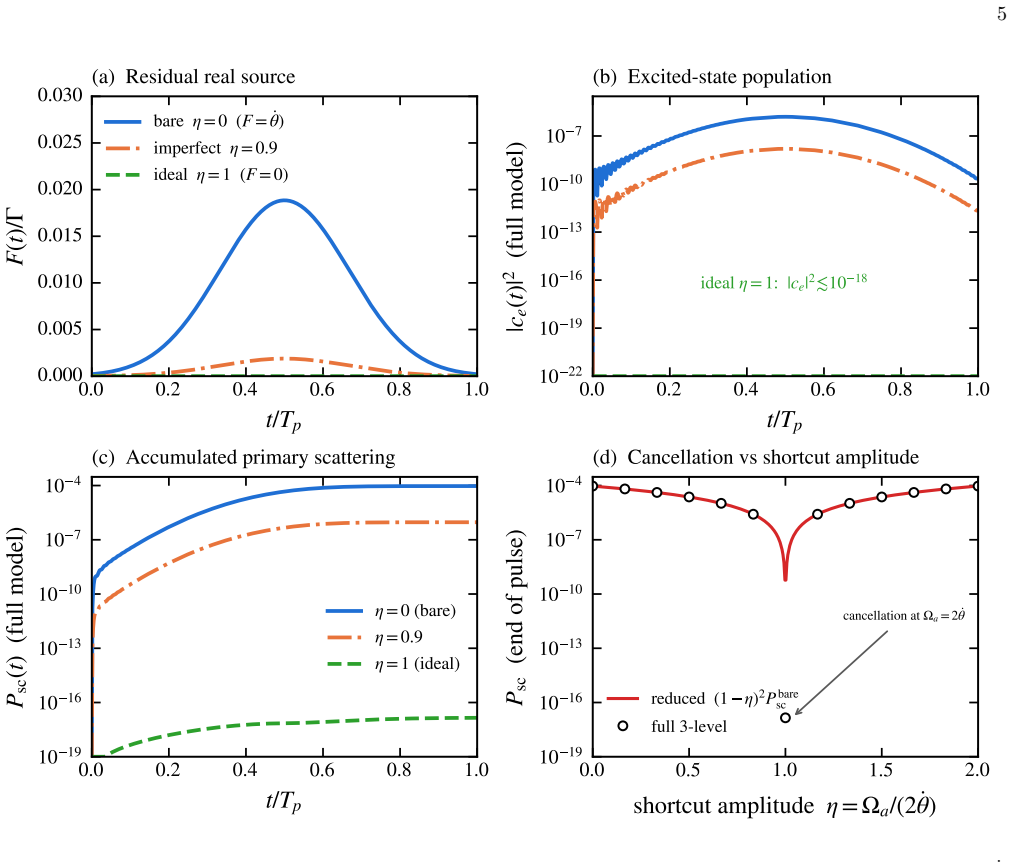
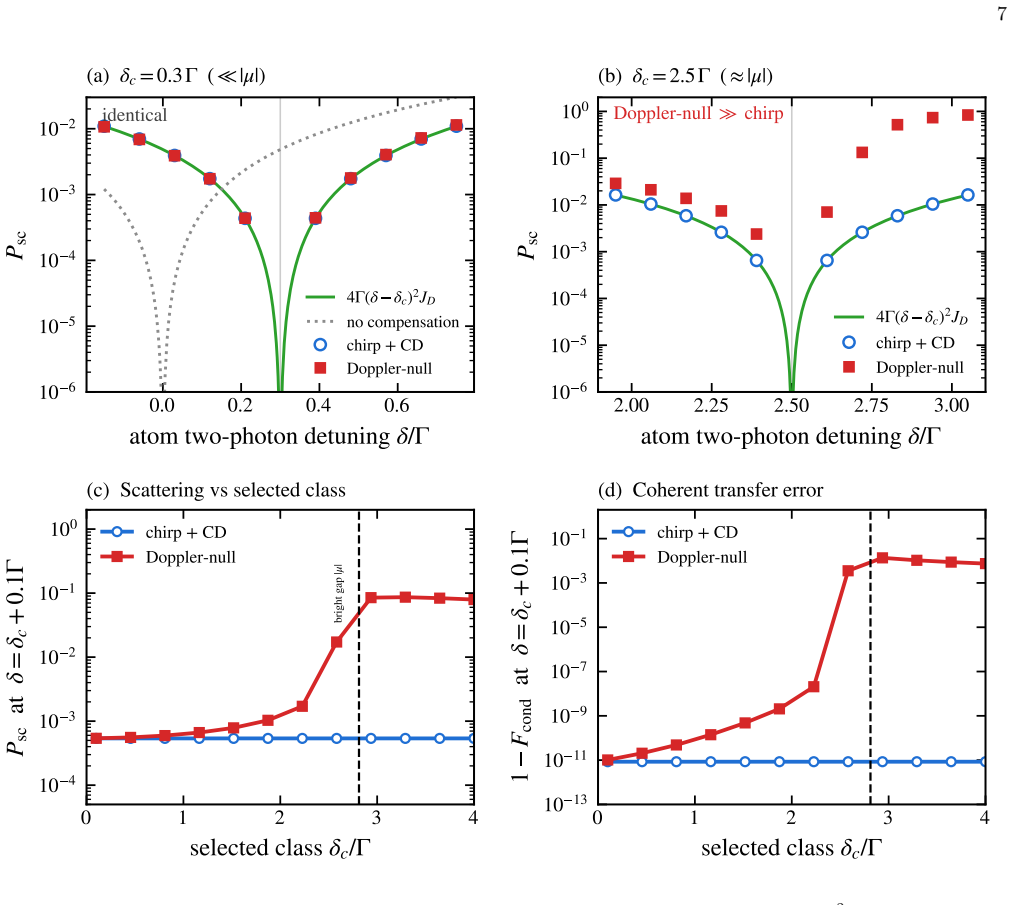
In the instantaneous dark-bright basis the lower-manifold optical source is carried entirely by the bright-state amplitude S=Ωb. Ideal counterdiabatic STIRAP cancels this source exactly for arbitrary one-photon detuning, Rabi frequency, and pulse duration in the full three-level model. The residual source after a non-ideal shortcut splits into orthogonal real (shortcut mismatch) and imaginary (two-photon Doppler detuning) quadratures, allowing a phase-shifted lower-state field to null the Doppler part for a chosen class δ_c. This velocity-selective nulling coincides with two-photon detuning chirping only when δ_c is small compared with the bright-state gap |μ| and degrades as δ_c approaches
What carries the argument
The bright-state source S=Ωb in the instantaneous dark-bright basis, which splits into real (shortcut mismatch) and imaginary (two-photon Doppler detuning) quadratures after a non-ideal shortcut
If this is right
- Source cancellation is exact in the full three-level model at the counterdiabatic point for any one-photon detuning, Rabi frequency, and pulse duration.
- The residual source after a shortcut splits into orthogonal quadratures that can be addressed separately by a phase-shifted field.
- A single-pulse mode-error budget for LMT interferometry can be written entirely in terms of the bright-state source.
- Shortcut-assisted Raman control lowers the total scattering cost once the residual Hamiltonian perturbation is minimized.
Where Pith is reading between the lines
- The result suggests that design effort in atom optics should target the residual Hamiltonian rather than the source amplitude when spontaneous scattering is the dominant loss channel.
- The same quadrature decomposition may apply to other shortcut protocols that adiabatically eliminate an excited state.
- Experiments with launched or warm atomic clouds at high-order LMT would directly test the predicted degradation of nulling at larger δ_c.
Load-bearing premise
The modeling choice that error in LMT interferometry is governed by the magnitude of the residual Hamiltonian perturbation rather than by the size of the residual bright-state source itself.
What would settle it
A calculation or measurement in the regime δ_c approaching |μ| that shows source nulling produces lower scattering loss than detuning chirping would falsify the central result.
Figures
read the original abstract
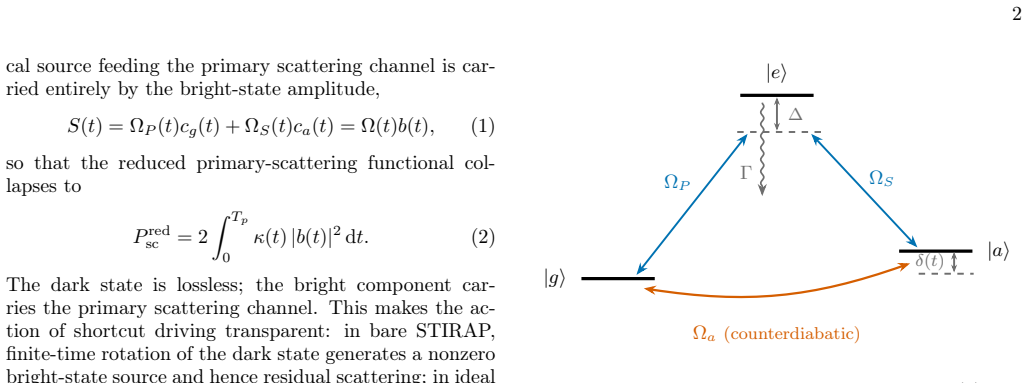
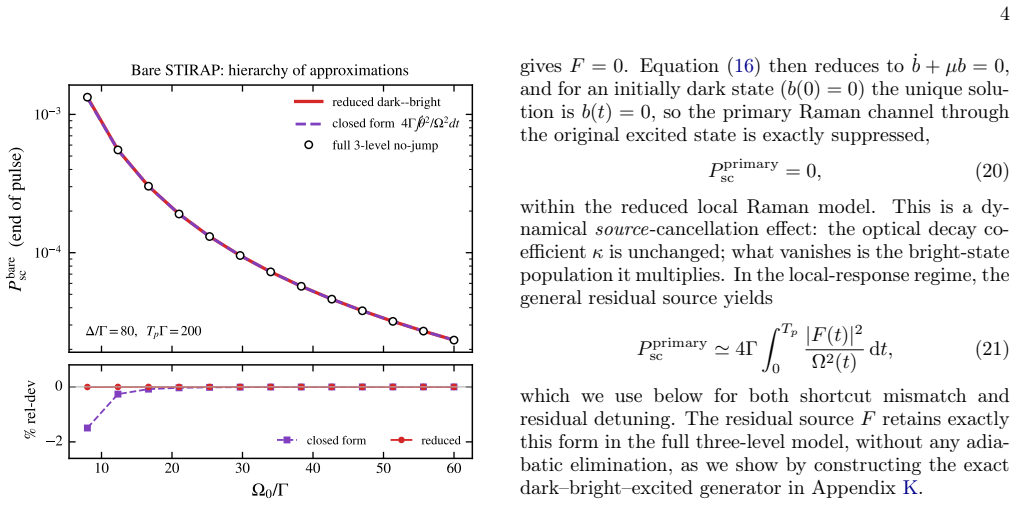
Spontaneous Raman scattering limits shortcut-assisted atom optics, but its microscopic origin is obscured once the lossy excited state is adiabatically eliminated. We organize the problem around a single quantity: in the instantaneous dark-bright basis the lower-manifold optical source is carried entirely by the bright-state amplitude, $S=\Omega b$, so that primary spontaneous scattering reduces to the compact functional. This recovers the known dissipative-STIRAP loss in transparent form and makes the action of a shortcut explicit: ideal counterdiabatic STIRSAP cancels the bright-state \emph{source}, not the optical decay coefficient. We show this cancellation is exact in the full three-level model at the counterdiabatic point, for arbitrary one-photon detuning, Rabi frequency, and pulse duration. The residual source splits into orthogonal quadratures -- shortcut mismatch (real) and two-photon Doppler detuning (imaginary) -- which invites a velocity-selective protocol that nulls the Doppler quadrature for a chosen momentum class with a second, phase-shifted lower-state field. Our central result is that this source nulling is never superior to simply chirping the two-photon detuning: the two coincide only when the selected class $\delta_c$ is small compared with the bright-state gap, and the nulling degrades and then fails as $\delta_c\to|\mu|$ -- precisely the regime of launched or warm clouds and high-order large-momentum-transfer (LMT) optics that motivates velocity selection. The controlling quantity is the magnitude of the residual Hamiltonian perturbation a scheme leaves behind, not the residual source it cancels. As a complement to existing multi-pulse decay budgets, we cast a single-pulse mode-error budget for LMT interferometry entirely in terms of the bright-state source, and delineate when shortcut-assisted Raman control reduces the total scattering cost.
Editorial analysis
A structured set of objections, weighed in public.
Referee Report
Summary. The paper organizes spontaneous Raman scattering in shortcut-assisted atom optics around the bright-state source S=Ωb in the instantaneous dark-bright basis of the lower manifold. It shows that ideal counterdiabatic STIRAP exactly cancels this source in the full three-level model for arbitrary one-photon detuning, Rabi frequency, and pulse duration. The residual source is decomposed into orthogonal quadratures (shortcut mismatch real, two-photon Doppler imaginary), motivating a velocity-selective nulling protocol using a phase-shifted lower-state field. The central claim is that this nulling protocol is never superior to simply chirping the two-photon detuning; the two agree only for small selected class δ_c relative to the bright-state gap |μ|, and nulling degrades as δ_c → |μ|. The controlling quantity for LMT error is asserted to be the magnitude of the residual Hamiltonian perturbation rather than the residual source. A single-pulse mode-error budget for LMT interferometry is cast entirely in terms of the bright-state source.
Significance. If the exact cancellation and the comparison between nulling and chirping hold with the stated controlling quantity, the work supplies a compact functional organization of dissipative effects that recovers known STIRAP loss and makes the action of shortcuts transparent. The single-pulse error budget and the delineation of when shortcut-assisted control reduces scattering cost would be useful for high-order LMT atom interferometry. The exact three-level cancellation result is a clear technical strength.
major comments (2)
- [Abstract, final paragraph] Abstract, final paragraph: the claim that source nulling is never superior to two-photon detuning chirping rests on the modeling assertion that LMT error is governed by the magnitude of the residual Hamiltonian perturbation rather than by the residual bright-state source S=Ωb (or its quadratures). The same abstract states that a single-pulse mode-error budget is cast entirely in terms of the bright-state source. An explicit derivation or error-propagation analysis showing why the interferometric phase error scales with the perturbation Hamiltonian rather than |S| is required to substantiate the superiority conclusion.
- [Abstract] Abstract: the statements that exact cancellation holds in the full three-level model and that the subsequent quadrature splitting and protocol comparison follow directly are presented without reference to the supporting derivation, error analysis, or numerical checks. Because these steps are load-bearing for the central comparison of nulling versus chirping, the manuscript must supply the explicit steps (e.g., the three-level Hamiltonian evolution at the counterdiabatic point and the resulting residual perturbation) to allow verification.
minor comments (2)
- The definition S=Ωb is introduced without an equation number; adding an explicit equation label would improve traceability when the source is later decomposed into quadratures.
- The transition from the three-level cancellation result to the velocity-selective protocol would benefit from a brief statement of the regime of validity (e.g., adiabaticity conditions or pulse-duration constraints) before the central comparison is drawn.
Simulated Author's Rebuttal
We thank the referee for their careful reading and constructive comments. We address the major comments point by point below. Where the comments identify the need for additional explicit derivations, we have incorporated these into the revised manuscript.
read point-by-point responses
-
Referee: [Abstract, final paragraph] Abstract, final paragraph: the claim that source nulling is never superior to two-photon detuning chirping rests on the modeling assertion that LMT error is governed by the magnitude of the residual Hamiltonian perturbation rather than by the residual bright-state source S=Ωb (or its quadratures). The same abstract states that a single-pulse mode-error budget is cast entirely in terms of the bright-state source. An explicit derivation or error-propagation analysis showing why the interferometric phase error scales with the perturbation Hamiltonian rather than |S| is required to substantiate the superiority conclusion.
Authors: We agree that the superiority conclusion requires explicit justification of the error scaling. In the revised manuscript we have added a new subsection deriving the phase-error accumulation for an LMT sequence from the residual perturbation Hamiltonian. The derivation shows that the leading-order interferometric phase shift is set by the time-integrated strength of the perturbation terms (which are fully parameterized by the bright-state source S and its quadratures), rather than by a direct proportionality to |S| itself. The single-pulse budget remains expressed in terms of S because S determines the perturbation; the comparison between nulling and chirping then follows by evaluating the effective perturbation magnitude each protocol leaves. This analysis is now referenced from the abstract. revision: yes
-
Referee: [Abstract] Abstract: the statements that exact cancellation holds in the full three-level model and that the subsequent quadrature splitting and protocol comparison follow directly are presented without reference to the supporting derivation, error analysis, or numerical checks. Because these steps are load-bearing for the central comparison of nulling versus chirping, the manuscript must supply the explicit steps (e.g., the three-level Hamiltonian evolution at the counterdiabatic point and the resulting residual perturbation) to allow verification.
Authors: We have revised the manuscript to supply the requested explicit steps. A new appendix now presents the full three-level Hamiltonian evolution evaluated exactly at the counterdiabatic point, confirming cancellation of the bright-state source for arbitrary one-photon detuning, Rabi frequency, and pulse duration. The residual perturbation is decomposed into the real (shortcut-mismatch) and imaginary (two-photon Doppler) quadratures, and numerical checks across parameter ranges are included. These derivations are referenced from the abstract, and the protocol comparison is tied directly to the resulting perturbation magnitudes. revision: yes
Circularity Check
No circularity; central comparison follows from three-level model analysis
full rationale
The paper organizes the problem around the bright-state source S=Ωb in the dark-bright basis, recovers known STIRAP loss, shows exact cancellation of the source at the counterdiabatic point in the full three-level model, splits the residual into quadratures, and then compares velocity-selective nulling to two-photon detuning chirping. This comparison is presented as following directly from the residual Hamiltonian perturbation magnitude in the model equations, with the single-pulse error budget also cast in terms of the source. No step is self-definitional, no parameter is fitted then renamed as prediction, and no load-bearing self-citation or uniqueness theorem is invoked. The choice that perturbation (not source size) governs LMT error is an explicit modeling assumption, not a reduction by construction. The derivation remains self-contained against the three-level dynamics without circularity.
Axiom & Free-Parameter Ledger
axioms (1)
- domain assumption The system is accurately described by a three-level model with adiabatic elimination of the excited state
invented entities (1)
-
bright-state source S=Ωb
no independent evidence
Reference graph
Works this paper leans on
-
[1]
Bergmann, H
K. Bergmann, H. Theuer, and B. W. Shore, Coherent population transfer among quantum states of atoms and molecules, Reviews of Modern Physics70, 1003 (1998)
1998
-
[2]
N. V. Vitanov, M. Fleischhauer, B. W. Shore, and K. Bergmann, Coherent manipulation of atoms and molecules by sequential laser pulses, inAdvances in atomic, molecular, and optical physics, Vol. 46 (Elsevier,
-
[3]
N. V. Vitanov, A. A. Rangelov, B. W. Shore, and K. Bergmann, Stimulated Raman adiabatic passage in physics, chemistry, and beyond, Reviews of Modern Physics89, 015006 (2017)
2017
-
[4]
J. Oreg, F. T. Hioe, and J. H. Eberly, Adiabatic following in multilevel systems, Physical Review A29, 690 (1984)
1984
-
[5]
J. M. McGuirk, M. J. Snadden, and M. A. Kasevich, Large area light-pulse atom interferometry, Physical Re- view Letters85, 4498 (2000)
2000
-
[6]
Müller, S.-w
H. Müller, S.-w. Chiow, Q. Long, S. Herrmann, and S. Chu, Atom interferometry with up to 24-photon- momentum-transfer beam splitters, Physical Review Let- 12 ters100, 180405 (2008)
2008
-
[7]
Chiow, T
S.-w. Chiow, T. Kovachy, H.-C. Chien, and M. A. Ka- sevich, 102ℏklarge area atom interferometers, Physical Review Letters107, 130403 (2011)
2011
-
[8]
A. D. Cronin, J. Schmiedmayer, and D. E. Pritchard, Optics and interferometry with atoms and molecules, Re- views of Modern Physics81, 1051 (2009)
2009
-
[9]
D. L. Butts, K. Kotru, J. M. Kinast, A. M. Radojevic, B. P. Timmons, and R. E. Stoner, Efficient broadband Ramanpulsesforlarge-areaatominterferometry,Journal of the Optical Society of America B30, 922 (2013)
2013
-
[10]
Kotru, J
K. Kotru, J. M. Brown, D. L. Butts, J. M. Kinast, and R. E. Stoner, Robust Ramsey sequences with Raman adiabatic rapid passage, Physical Review A90, 053611 (2014)
2014
-
[11]
Kotru, D
K. Kotru, D. L. Butts, J. M. Kinast, and R. E. Stoner, Large-area atom interferometry with frequency-swept Raman adiabatic passage, Physical Review Letters115, 103001 (2015)
2015
-
[12]
Dalibard, Y
J. Dalibard, Y. Castin, and K. Mølmer, Wave-function approach to dissipative processes in quantum optics, Physical Review Letters68, 580 (1992)
1992
-
[13]
Mølmer, Y
K. Mølmer, Y. Castin, and J. Dalibard, Monte Carlo wave-function method in quantum optics, Journal of the Optical Society of America B10, 524 (1993)
1993
-
[14]
P. A. Ivanov, N. V. Vitanov, and K. Bergmann, Sponta- neous emission in stimulated Raman adiabatic passage, Physical Review A72, 053412 (2005)
2005
-
[15]
Reiter and A
F. Reiter and A. S. Sørensen, Effective operator formal- ism for open quantum systems, Physical Review A85, 032111 (2012)
2012
-
[16]
Demirplak and S
M. Demirplak and S. A. Rice, Adiabatic population transfer with control fields, The Journal of Physical Chemistry A107, 9937 (2003)
2003
-
[17]
M. V. Berry, Transitionless quantum driving, Journal of Physics A: Mathematical and Theoretical42, 365303 (2009)
2009
-
[18]
Torrontegui, S
E. Torrontegui, S. Ibáñez, S. Martínez-Garaot, M. Mod- ugno, A. del Campo, D. Guéry-Odelin, A. Ruschhaupt, X. Chen, and J. G. Muga, Shortcuts to adiabaticity, inAdvances in atomic, molecular, and optical physics, Vol. 62 (Elsevier, 2013) pp. 117–169
2013
-
[19]
X. Chen, I. Lizuain, A. Ruschhaupt, D. Guéry-Odelin, and J. G. Muga, Shortcut to adiabatic passage in two- and three-level atoms, Physical Review Letters105, 123003 (2010)
2010
-
[20]
Li and X
Y.-C. Li and X. Chen, Shortcut to adiabatic popula- tion transfer in quantum three-level systems: Effective two-level problems and feasible counterdiabatic driving, Physical Review A94, 063411 (2016)
2016
-
[21]
Guéry-Odelin, A
D. Guéry-Odelin, A. Ruschhaupt, A. Kiely, E. Tor- rontegui, S. Martínez-Garaot, and J. G. Muga, Short- cuts to adiabaticity: Concepts, methods, and applica- tions, Reviews of Modern Physics91, 045001 (2019)
2019
-
[22]
Du, Z.-T
Y.-X. Du, Z.-T. Liang, Y.-C. Li, X.-X. Yue, Q.-X. Lv, W. Huang, X. Chen, H. Yan, and S.-L. Zhu, Experimen- tal realization of stimulated Raman shortcut-to-adiabatic passage with cold atoms, Nature Communications7, 12479 (2016)
2016
-
[23]
Blekos, D
K. Blekos, D. Stefanatos, and E. Paspalakis, Performance of superadiabatic stimulated Raman adiabatic passage in the presence of dissipation and Ornstein-Uhlenbeck dephasing, Physical Review A102, 023715 (2020)
2020
-
[24]
Shi and H
X. Shi and H. Q. Zhao, Effect of spontaneous emission on the shortcut to adiabaticity in three-state systems, Physical Review A104, 052221 (2021)
2021
-
[25]
K. Funo, N. Lambert, and F. Nori, General bound on the performance of counter-diabatic driving acting on dissi- pativespinsystems,PhysicalReviewLetters127,150401 (2021)
2021
-
[26]
P. Chrostoski, S. Bisson, D. Farley, F. Narducci, and D. Soh, Error analysis in large area multi-Raman pulse atom interferometry due to undesired spontaneous decay, arXiv preprint arXiv:2403.08913 (2024)
arXiv 2024
-
[27]
A. Ali, H. A. Zad, S. Al-Kuwari, M. I. Hussain, M. T. Rahim, H. Kuniyil, T. Byrnes, J. Q. Quach, and S. Haddadi, Counterdiabatic Raman atom optics for compact high-sensitivity gravimetry, arXiv preprint arXiv:2606.16945 (2026)
arXiv 2026
discussion (0)
Sign in with ORCID, Apple, or X to comment. Anyone can read and Pith papers without signing in.