Characterizing the Formation and Evolution of S0-galaxies (CaFES-0): Revealing the origin of the mass-size relation for S0 galaxies
Pith reviewed 2026-06-25 23:24 UTC · model grok-4.3
The pith
S0 galaxies follow a V-shaped mass-size relation created by two distinct formation channels.
A machine-rendered reading of the paper's core claim, the machinery that carries it, and where it could break.
Core claim
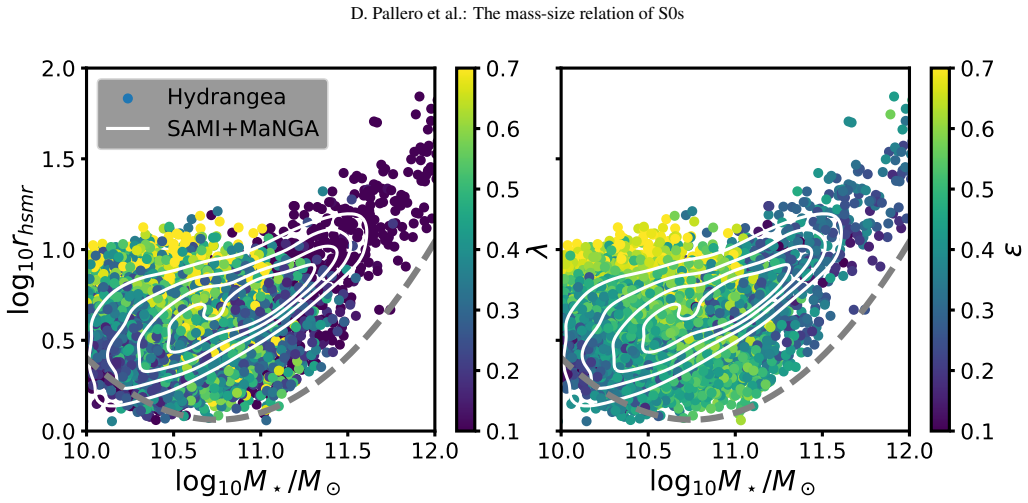
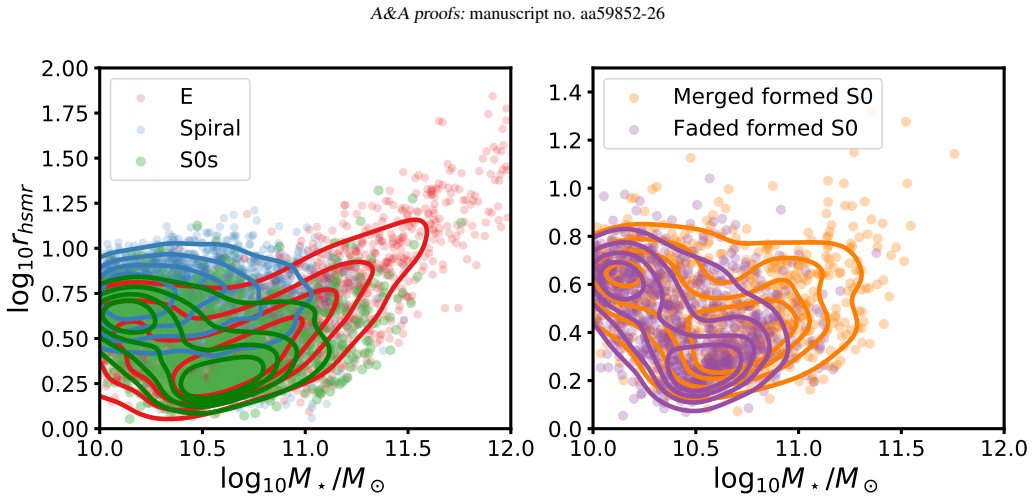
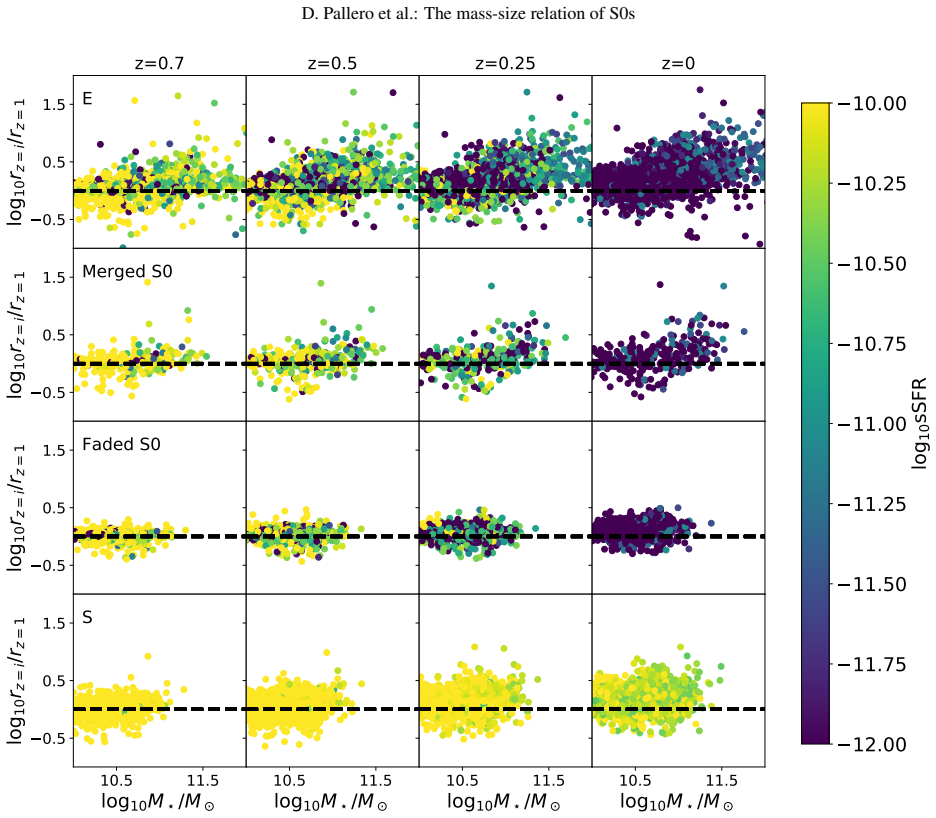
The S0 population occupies a characteristic V-shaped locus in the mass-size plane, which arises from the superposition of two physically distinct channels. Low-mass S0s are predominantly faded-formed S0s, quenched after infall into their present-day host halo and retaining the disk sizes of their star-forming progenitors. In contrast, high-mass S0s formed through mergers exhibit structural properties and size evolution similar to ellipticals, and typically quench before infall, consistent with pre-processing in group environments. By tracing their histories back to z=1, faded-formed S0s experience minimal structural evolution after quenching, whereas merger-formed S0s grow significantly in s
What carries the argument
The V-shaped locus in the mass-size plane produced by the superposition of faded-formed low-mass S0s and merger-formed high-mass S0s.
If this is right
- Faded-formed S0s show little structural change after they quench.
- Merger-formed S0s increase in size through later dissipationless interactions.
- The two channels together produce the observed break in slope and the scatter of the S0 mass-size relation.
- Lenticular galaxies therefore arise from multiple formation mechanisms that leave distinct structural signatures.
Where Pith is reading between the lines
- The same split into faded and merger channels could produce similar V-shaped loci in other morphological types if their quenching and merger histories differ by mass.
- Surveys that separate S0 galaxies by stellar mass could test whether angular momentum and size growth track the two channels separately.
- Comparing S0 sizes in dense clusters versus the field would reveal how much environment drives the low-mass faded channel.
Load-bearing premise
Simulated galaxies accurately reproduce the observed mass-size relation, so the two formation channels identified in the simulations apply to real S0 galaxies.
What would settle it
An absence of the V-shaped locus when S0 galaxies from large surveys are plotted in the mass-size plane, or the discovery that low-mass and high-mass S0s show identical size evolution histories when their star-formation quenching times are measured.
Figures





read the original abstract
We investigate the structural evolution and formation pathways of lenticular (S0) galaxies using the Hydrangea suite of cosmological hydrodynamical simulations. Simulated galaxies reproduce the observed mass-size relation from the SAMI and MaNGA surveys, enabling a direct comparison between morphology, angular momentum, and size growth. We show that the S0 population occupies a characteristic V-shaped locus in the mass-size plane, which arises from the superposition of two physically distinct channels. Low-mass S0s are predominantly faded-formed S0s, quenched after infall into their present-day host halo and retaining the disk sizes of their star-forming progenitors. In contrast, high-mass S0s formed through mergers exhibit structural properties and size evolution similar to ellipticals, and typically quench before infall, consistent with pre-processing in group environments. By tracing their histories back to $z=1$, we find that faded-formed S0s experience minimal structural evolution after quenching, whereas merger-formed S0s grow significantly in size through dissipationless interactions. These divergent evolutionary pathways explain both the slope break and the overall scatter of the S0 mass-size relation, demonstrating that lenticular galaxies arise from multiple formation mechanisms that leave distinct structural imprints.
Editorial analysis
A structured set of objections, weighed in public.
Referee Report
Summary. The manuscript analyzes S0 galaxies in the Hydrangea cosmological hydrodynamical simulations, showing that they reproduce the observed mass-size relation from SAMI and MaNGA surveys. It identifies a V-shaped locus in the mass-size plane arising from two channels: low-mass faded-formed S0s quenched after infall (retaining progenitor disk sizes) and high-mass merger-formed S0s quenched before infall (evolving like ellipticals with significant post-quenching size growth via dissipationless interactions). Tracing histories to z=1 supports divergent evolutionary paths explaining the slope break and scatter.
Significance. If the channel attribution is robust, the result provides a physical basis for the S0 mass-size relation and demonstrates multiple formation pathways with distinct structural signatures. The simulation-based tracing of infall, quenching, and size evolution is a methodological strength that enables falsifiable predictions for observed samples.
major comments (2)
- [Abstract and §3] Abstract and §3: The central claim that the V-shape arises from superposition of the two channels rests on the simulations accurately capturing infall times, quenching epochs, and post-quenching size evolution. However, the global reproduction of the SAMI/MaNGA mass-size relation does not constrain these specific quantities; a direct test (e.g., comparing simulated vs. observed transition mass or channel fractions) is needed to establish that the channel distinction is not an artifact of subgrid physics.
- [§4.1] §4.1 (channel classification): The distinction between faded-formed (post-infall quenching) and merger-formed (pre-infall quenching) S0s is load-bearing for attributing the low-mass and high-mass branches. The manuscript does not report robustness checks against variations in the merger identification or environmental stripping criteria used to label the channels.
minor comments (2)
- [Abstract] The abstract states that simulated galaxies reproduce the observed relation but does not specify the quantitative metrics (slope, scatter, or Kolmogorov-Smirnov test p-values) used for the comparison.
- Figure captions should explicitly state the mass range and selection criteria for the S0 sample to allow direct comparison with SAMI/MaNGA.
Simulated Author's Rebuttal
We thank the referee for their constructive comments on our manuscript. We respond point-by-point to the major comments below, indicating where revisions will be made to address the concerns raised.
read point-by-point responses
-
Referee: [Abstract and §3] Abstract and §3: The central claim that the V-shape arises from superposition of the two channels rests on the simulations accurately capturing infall times, quenching epochs, and post-quenching size evolution. However, the global reproduction of the SAMI/MaNGA mass-size relation does not constrain these specific quantities; a direct test (e.g., comparing simulated vs. observed transition mass or channel fractions) is needed to establish that the channel distinction is not an artifact of subgrid physics.
Authors: We agree that reproducing the global mass-size relation is necessary but insufficient on its own to validate the specific channel attributions. Our analysis does include direct tracing of individual galaxy histories back to z=1, which explicitly connects infall times, quenching epochs, and post-quenching size evolution to the observed V-shape. To further address this point, the revised manuscript will incorporate a direct comparison of the simulated transition mass between the faded-formed and merger-formed channels against available observational estimates from the literature. We note that direct observational measurements of channel fractions are not currently available, limiting that specific test, but the transition mass offers a falsifiable prediction. revision: partial
-
Referee: [§4.1] §4.1 (channel classification): The distinction between faded-formed (post-infall quenching) and merger-formed (pre-infall quenching) S0s is load-bearing for attributing the low-mass and high-mass branches. The manuscript does not report robustness checks against variations in the merger identification or environmental stripping criteria used to label the channels.
Authors: We recognize that explicit robustness checks would strengthen confidence in the channel classification. In the revised version, we will add tests that vary the merger identification criteria (including mass ratio thresholds) and the definitions used for environmental stripping to demonstrate that the separation into faded-formed and merger-formed populations, as well as the resulting V-shaped mass-size relation, remains stable under reasonable variations. revision: yes
Circularity Check
No significant circularity; derivation uses external simulations and surveys
full rationale
The paper's central claim—that the V-shaped mass-size locus arises from two distinct channels (faded post-infall low-mass S0s vs. merger pre-infall high-mass S0s)—is obtained by tracing galaxy histories in the independent Hydrangea cosmological hydrodynamical simulations and comparing the resulting structural properties to the external SAMI and MaNGA observational surveys. The abstract states that the simulations reproduce the observed mass-size relation, but this global match is not used to fit parameters that then define the channel distinction or the V-shape; the channels are identified via direct simulation tracing of infall, quenching, and merger events. No self-citations, self-definitional steps, fitted inputs renamed as predictions, or ansatzes smuggled via prior work appear in the provided text. The derivation is therefore self-contained against external benchmarks.
Axiom & Free-Parameter Ledger
axioms (1)
- standard math Standard Lambda-CDM cosmology and hydrodynamical physics assumptions underlying the Hydrangea simulations
Reference graph
Works this paper leans on
-
[1]
Athanassoula, E., Machado, R. E. G., & Rodionov, S. A. 2013, MNRAS, 429, 1949 Bahé, Y . M., Barnes, D. J., Dalla Vecchia, C., et al. 2017, MNRAS, 470, 4186 Bahé, Y . M., Schaye, J., Barnes, D. J., et al. 2019, MNRAS, 485, 2287
2013
-
[2]
P., Aragón-Salamanca, A., & Milvang-Jensen, B
Bamford, S. P., Aragón-Salamanca, A., & Milvang-Jensen, B. 2006, MNRAS, 366, 308
2006
-
[3]
J., Kay, S
Barnes, D. J., Kay, S. T., Bahé, Y . M., et al. 2017, MNRAS, 471, 1088
2017
-
[4]
G., Aragón-Salamanca, A., & Merrifield, M
Bedregal, A. G., Aragón-Salamanca, A., & Merrifield, M. R. 2006, MNRAS, 373, 1125
2006
-
[5]
& Couch, W
Bekki, K. & Couch, W. J. 2011, MNRAS, 415, 1783
2011
-
[6]
J., & Shioya, Y
Bekki, K., Couch, W. J., & Shioya, Y . 2002, ApJ, 577, 651
2002
-
[7]
Bell, E. F. & de Jong, R. S. 2001, ApJ, 550, 212
2001
-
[8]
R., Kazin, E., Muna, D., Weaver, B
Blanton, M. R., Kazin, E., Muna, D., Weaver, B. A., & Price-Whelan, A. 2011, AJ, 142, 31
2011
-
[9]
2019, A&A, 622, A103
Boquien, M., Burgarella, D., Roehlly, Y ., et al. 2019, A&A, 622, A103
2019
-
[10]
& Gavazzi, G
Boselli, A. & Gavazzi, G. 2006, PASP, 118, 517
2006
-
[11]
2017, MNRAS, 466, 1275
Brown, T., Catinella, B., Cortese, L., et al. 2017, MNRAS, 466, 1275
2017
-
[12]
J., Owers, M
Bryant, J. J., Owers, M. S., Robotham, A. S. G., et al. 2015, MNRAS, 447, 2857
2015
-
[13]
A., Law, D
Bundy, K., Bershady, M. A., Law, D. R., et al. 2015, ApJ, 798, 7
2015
-
[14]
2013, ApJ, 778, L2
Cappellari, M. 2013, ApJ, 778, L2
2013
-
[15]
2016, ARA&A, 54, 597
Cappellari, M. 2016, ARA&A, 54, 597
2016
-
[16]
2011, MNRAS, 416, 1680
Cappellari, M., Emsellem, E., Krajnovi´c, D., et al. 2011, MNRAS, 416, 1680
2011
-
[17]
L., et al
Coccato, L., Fraser-McKelvie, A., Jaffé, Y . L., et al. 2022, MNRAS, 515, 201
2022
-
[18]
Conselice, C. J. 2003, ApJS, 147, 1
2003
-
[19]
2021, PASA, 38, e035
Cortese, L., Catinella, B., & Smith, R. 2021, PASA, 38, e035
2021
-
[20]
Cortese, L., Fogarty, L. M. R., Bekki, K., et al. 2016, MNRAS, 463, 170
2016
-
[21]
A., Schaye, J., Bower, R
Crain, R. A., Schaye, J., Bower, R. G., et al. 2015, MNRAS, 450, 1937
2015
-
[22]
M., Owers, M
Croom, S. M., Owers, M. S., Scott, N., et al. 2021, MNRAS, 505, 991 Dalla Vecchia, C. & Schaye, J. 2008, MNRAS, 387, 1431 Davé, R., Anglés-Alcázar, D., Narayanan, D., et al. 2019, MNRAS, 486, 2827 De Lucia, G., Weinmann, S., Poggianti, B. M., Aragón-Salamanca, A., & Zarit- sky, D. 2012, MNRAS, 423, 1277 de Vaucouleurs, G. 1959, Handbuch der Physik, 53, 275
2021
-
[23]
J., Sweet, S
Deeley, S., Drinkwater, M. J., Sweet, S. M., et al. 2021, MNRAS, 508, 895
2021
-
[24]
1980, ApJ, 236, 351
Dressler, A. 1980, ApJ, 236, 351
1980
-
[25]
1984, ARA&A, 22, 185
Dressler, A. 1984, ARA&A, 22, 185
1984
-
[26]
1987, ApJ, 317, 1
Dressler, A. 1987, ApJ, 317, 1
1987
-
[27]
2016, MNRAS, 463, 3948
Dubois, Y ., Peirani, S., Pichon, C., et al. 2016, MNRAS, 463, 3948
2016
-
[28]
2011, MNRAS, 414, 888
Emsellem, E., Cappellari, M., Krajnovi´c, D., et al. 2011, MNRAS, 414, 888
2011
-
[29]
2007, MNRAS, 379, 401
Emsellem, E., Cappellari, M., Krajnovi´c, D., et al. 2007, MNRAS, 379, 401
2007
-
[30]
Fall, S. M. & Efstathiou, G. 1980, MNRAS, 193, 189
1980
-
[31]
2018, MN- RAS, 481, 5580
Fraser-McKelvie, A., Aragón-Salamanca, A., Merrifield, M., et al. 2018, MN- RAS, 481, 5580
2018
-
[32]
2026, MNRAS, 547, stag428
Frosst, M., Obreschkow, D., Ludlow, A., & Fraser-McKelvie, A. 2026, MNRAS, 547, stag428
2026
-
[33]
2004, PASJ, 56, 29
Fujita, Y . 2004, PASJ, 56, 29
2004
-
[34]
G., Crain, R
Furlong, M., Bower, R. G., Crain, R. A., et al. 2017, MNRAS, 465, 722
2017
-
[35]
2018, MNRAS, 474, 3976
Genel, S., Nelson, D., Pillepich, A., et al. 2018, MNRAS, 474, 3976
2018
-
[36]
& Madau, P
Haardt, F. & Madau, P. 2001, in Clusters of Galaxies and the High Redshift Universe Observed in X-rays, ed. D. M. Neumann & J. T. V . Tran, 64
2001
-
[37]
E., van de Sande, J., Cortese, L., et al
Harborne, K. E., van de Sande, J., Cortese, L., et al. 2020, MNRAS, 497, 2018
2020
-
[38]
Hubble, E. P. 1926, ApJ, 64, 321
1926
-
[39]
2019, MNRAS, 489, 1859
Huertas-Company, M., Rodriguez-Gomez, V ., Nelson, D., et al. 2019, MNRAS, 489, 1859
2019
-
[40]
W., Zaritsky, D., Sand, D
Just, D. W., Zaritsky, D., Sand, D. J., Desai, V ., & Rudnick, G. 2010, ApJ, 711, 192
2010
-
[41]
1977, ApJ, 218, 333
Kormendy, J. 1977, ApJ, 218, 333
1977
-
[42]
& Kennicutt, Jr., R
Kormendy, J. & Kennicutt, Jr., R. C. 2004, ARA&A, 42, 603
2004
-
[43]
D., et al
Lacerna, I., Rodriguez, F., Montero-Dorta, A. D., et al. 2022, MNRAS, 513, 2271
2022
-
[44]
Lagos, C. d. P., Stevens, A. R. H., Bower, R. G., et al. 2018, MNRAS, 473, 4956 Article number, page 11 of 12 A&A proofs:manuscript no. aa59852-26
2018
-
[45]
Lagos, C. d. P., Theuns, T., Stevens, A. R. H., et al. 2017, MNRAS, 464, 3850
2017
-
[46]
P., Robotham, A
Lange, R., Driver, S. P., Robotham, A. S. G., et al. 2015, MNRAS, 447, 2603
2015
-
[47]
B., Tinsley, B
Larson, R. B., Tinsley, B. M., & Caldwell, C. N. 1980, ApJ, 237, 692
1980
-
[48]
& Cooper, A
Liao, L.-W. & Cooper, A. P. 2026, A&A, 705, A84
2026
-
[49]
2021, MNRAS, 500, 1323
Lima-Dias, C., Monachesi, A., Torres-Flores, S., et al. 2021, MNRAS, 500, 1323
2021
-
[50]
2024, MNRAS, 527, 5792
Lima-Dias, C., Monachesi, A., Torres-Flores, S., et al. 2024, MNRAS, 527, 5792
2024
-
[51]
2018, MNRAS, 480, 5113
Marinacci, F., V ogelsberger, M., Pakmor, R., et al. 2018, MNRAS, 480, 5113
2018
-
[52]
J., Mao, S., & White, S
Mo, H. J., Mao, S., & White, S. D. M. 1998, MNRAS, 295, 319
1998
-
[53]
P., Torres-Flores, S., Monachesi, A., et al
Montaguth, G. P., Torres-Flores, S., Monachesi, A., et al. 2023, MNRAS, 524, 5340
2023
-
[54]
Muzzin, A., Wilson, G., Yee, H. K. C., et al. 2012, ApJ, 746, 188
2012
-
[55]
2014, MNRAS, 444, 3357
Naab, T., Oser, L., Emsellem, E., et al. 2014, MNRAS, 444, 3357
2014
-
[56]
P., Pillepich, A., Springel, V ., et al
Naiman, J. P., Pillepich, A., Springel, V ., et al. 2018, MNRAS, 477, 1206
2018
-
[57]
2018, MNRAS, 475, 624
Nelson, D., Pillepich, A., Springel, V ., et al. 2018, MNRAS, 475, 624
2018
-
[58]
2009, A&A, 507, 1793
Noll, S., Burgarella, D., Giovannoli, E., et al. 2009, A&A, 507, 1793
2009
-
[59]
B., et al
Pallero, D., Galaz, G., Tissera, P. B., et al. 2025, A&A, 699, A376
2025
-
[60]
A., Padilla, N
Pallero, D., Gómez, F. A., Padilla, N. D., et al. 2022, MNRAS, 511, 3210
2022
-
[61]
A., Padilla, N
Pallero, D., Gómez, F. A., Padilla, N. D., et al. 2019, MNRAS, 488, 847
2019
-
[62]
L., Fraser-McKelvie, A., et al
Pallero, D., Jaffé, Y . L., Fraser-McKelvie, A., et al. 2026, arXiv e-prints, arXiv:2606.19461
Pith/arXiv arXiv 2026
-
[63]
C., et al
Palma, D., Lacerna, I., Artale, M. C., et al. 2025, A&A, 693, A67
2025
-
[64]
2015, Nature, 521, 192
Peng, Y ., Maiolino, R., & Cochrane, R. 2015, Nature, 521, 192
2015
-
[65]
2018, MNRAS, 475, 648 Planck Collaboration, Ade, P
Pillepich, A., Nelson, D., Hernquist, L., et al. 2018, MNRAS, 475, 648 Planck Collaboration, Ade, P. A. R., Aghanim, N., et al. 2014, A&A, 566, A54
2018
-
[66]
B., Agertz, O., & Renaud, F
Romeo, A. B., Agertz, O., & Renaud, F. 2020, MNRAS, 499, 5656
2020
-
[67]
B., Agertz, O., & Renaud, F
Romeo, A. B., Agertz, O., & Renaud, F. 2023, MNRAS, 518, 1002
2023
-
[68]
Salim, S., Boquien, M., & Lee, J. C. 2018, ApJ, 859, 11
2018
-
[69]
C., Janowiecki, S., et al
Salim, S., Lee, J. C., Janowiecki, S., et al. 2016, ApJS, 227, 2
2016
-
[70]
M., Kolesnikov, I., de Carvalho, R
Sampaio, V . M., Kolesnikov, I., de Carvalho, R. R., Ferreras, I., & Silk, J. 2025, MNRAS, 541, 1164
2025
-
[71]
2015, MNRAS, 454, 2277
Schaller, M., Dalla Vecchia, C., Schaye, J., et al. 2015, MNRAS, 454, 2277
2015
-
[72]
A., Bower, R
Schaye, J., Crain, R. A., Bower, R. G., et al. 2015, MNRAS, 446, 521
2015
-
[73]
& Dalla Vecchia, C
Schaye, J. & Dalla Vecchia, C. 2008, MNRAS, 383, 1210
2008
-
[74]
J., White, S
Shen, S., Mo, H. J., White, S. D. M., et al. 2003, MNRAS, 343, 978
2003
-
[75]
T., Patton, D
Simard, L., Mendel, J. T., Patton, D. R., Ellison, S. L., & McConnachie, A. W. 2011, ApJS, 196, 11
2011
-
[76]
2018, MNRAS, 475, 676
Springel, V ., Pakmor, R., Pillepich, A., et al. 2018, MNRAS, 475, 676
2018
-
[77]
Springel, V ., White, S. D. M., Tormen, G., & Kauffmann, G. 2001, MNRAS, 328, 726
2001
-
[78]
A., Bezanson, R., Nelson, E
Suess, K. A., Bezanson, R., Nelson, E. J., et al. 2022, ApJ, 937, L33
2022
-
[79]
C., Aceves, H., et al
Tapia, T., Eliche-Moral, M. C., Aceves, H., et al. 2017, A&A, 604, A105
2017
-
[80]
W., Theuns, T., Bower, R
Trayford, J. W., Theuns, T., Bower, R. G., et al. 2016, MNRAS, 460, 3925
2016
discussion (0)
Sign in with ORCID, Apple, or X to comment. Anyone can read and Pith papers without signing in.