Solver Exactness, Learned Flexibility: Equivariant Boundary-Correction Operators for Stokes Flow
Pith reviewed 2026-06-25 22:23 UTC · model grok-4.3
The pith
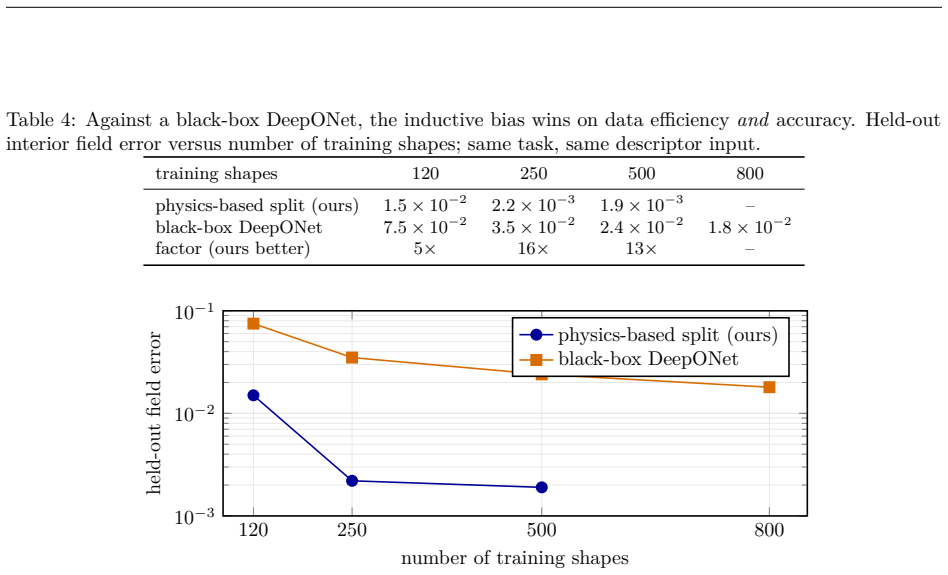
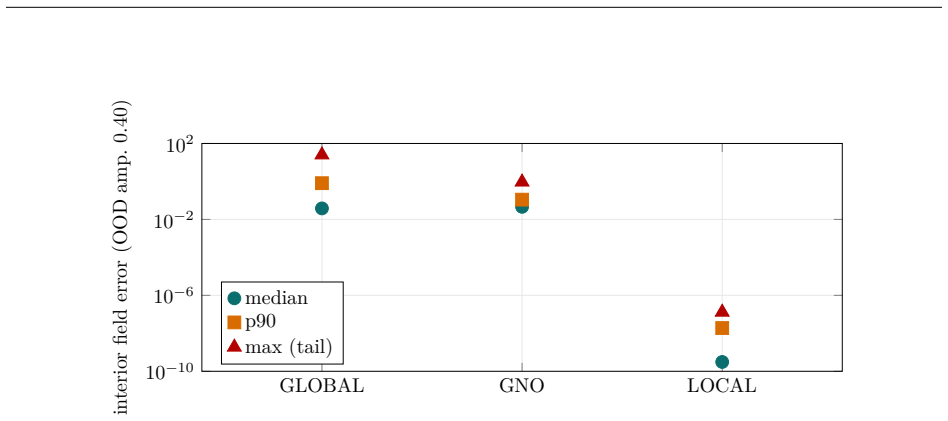
Splitting the Stokes operator into an exact free-space Leray projector and a learned equivariant boundary correction produces a solver with 2e-3 end-to-end error that is 5-16 times more data-efficient than black-box models.
A machine-rendered reading of the paper's core claim, the machinery that carries it, and where it could break.
Core claim
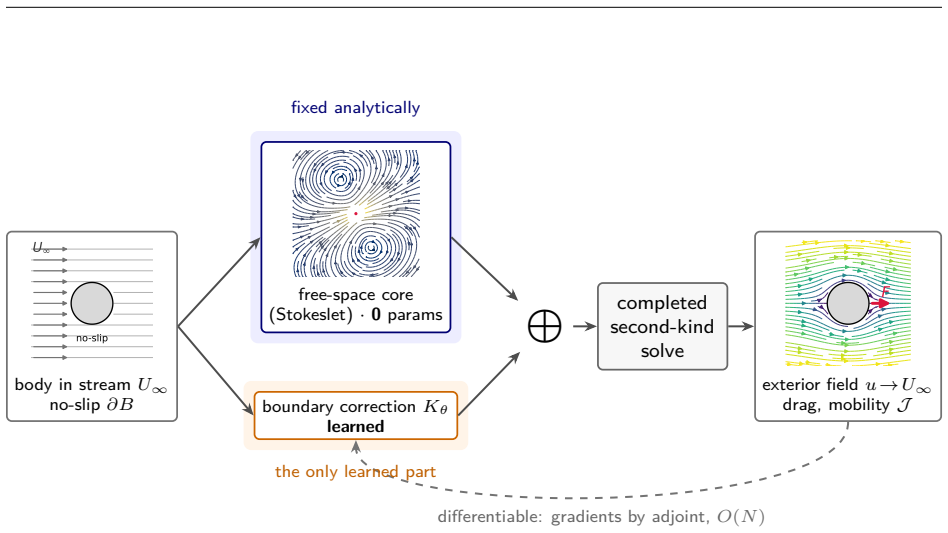
The central claim is that fixing the rotation-equivariant Stokeslet-based Leray projector exactly and learning only the boundary correction as a well-conditioned second-kind operator yields a hybrid solver whose end-to-end error reaches 2 times 10 to the minus 3, whose cross-shape generalization is controlled by descriptor equivariance rather than capacity, and whose worst-case interior error drops from order 10 to roughly 10 to the minus 7 once a local equivariant kernel is used; the same split also supplies a completed double-layer operator that is second-kind, SO(3)-equivariant, and exact on analytic sphere and ellipsoid drag when quadrature by expansion is applied.
What carries the argument
The equivariant boundary-correction operator, learned as a second-kind integral operator on top of the fixed free-space Leray projector.
If this is right
- A 10^16-conditioned first-kind operator and a bounded second-kind operator produce identical end-to-end error, showing conditioning is not the limiting factor.
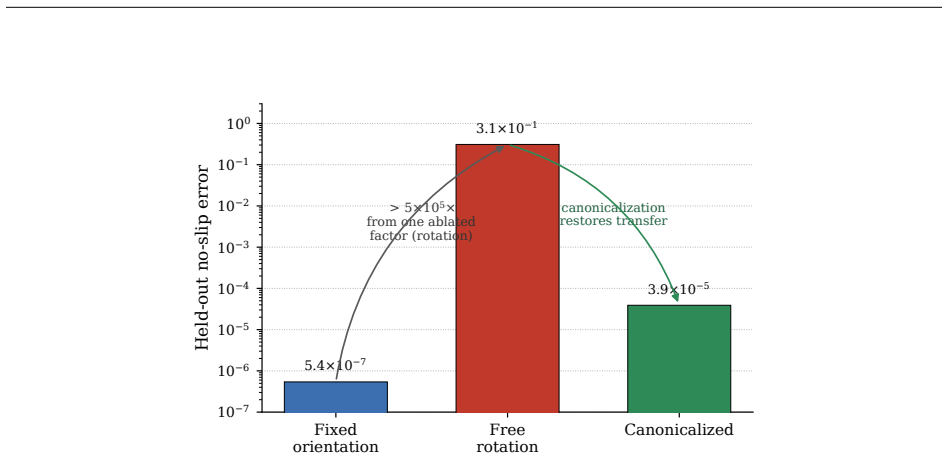
- Cross-shape generalization is governed by the descriptor's equivariance: canonicalization restores near-machine transfer while a noninvariant descriptor collapses.
- A local equivariant kernel removes the heavy out-of-distribution tail, cutting worst-case interior error from order 10 to roughly 10^-7.
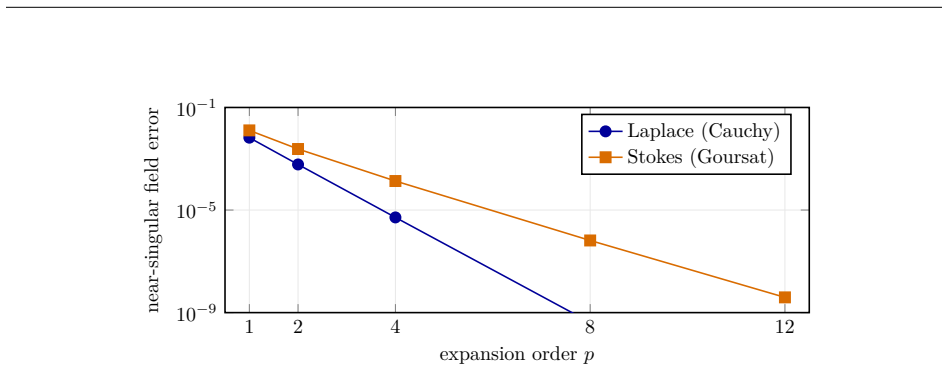
- A completed double-layer operator made exact by quadrature by expansion is second-kind, SO(3)-equivariant, and reproduces analytic drag on spheres and ellipsoids.
Where Pith is reading between the lines
- The same split could be tested on time-dependent or weakly inertial flows by keeping the Stokes core and learning only the correction terms that appear at higher Reynolds number.
- If the boundary correction remains low-rank across many bodies, the learned operator might be composed directly across multiple particles without retraining.
- The emphasis on coverage over expressivity suggests that adding more training shapes with controlled rotations would yield larger gains than widening the network.
- The exterior formulation opens the possibility of learning only the interaction terms between distant bodies while keeping the single-body double layer exact.
Load-bearing premise
The boundary correction can be represented and learned independently as a well-conditioned second-kind operator while the core remains exactly the known free-space Leray projector.
What would settle it
A non-equivariant descriptor producing greater than 10^5 degradation in error under arbitrary rotations of the same shape, or the split solver failing to reproduce the known analytic drag coefficient of an ellipsoid to within reported tolerance.
Figures
read the original abstract
The drag and mobility of bodies in viscous (Stokes) flow govern problems in shape design, suspensions, or microorganism swimming. Classical solvers compute them accurately but expensively; purely learned surrogates are fast but unreliable off their training data. We combine both: a solver's exactness for the part of the solution operator known in closed form, and learning for the part that is not. For incompressible Stokes flow the elliptic-core kernel is already known: in free space the Leray projector is a single rotation-equivariant Stokeslet with no free parameters, and the boundary-integral solver built on it is exact to machine precision at $O(N)$. The one object with no closed form is the boundary correction. We split the operator: fix the core exactly and equivariantly, and learn only that correction, as a well-conditioned second-kind operator. On a Stokes testbed where the exact solve is ground truth, the split gives a working solver ($2 \times 10^{-3}$ end-to-end, $5$-$16\times$ more data-efficient than a black-box DeepONet) and overturns three expectations. (i) Conditioning is not the bottleneck: a $10^{16}$-conditioned first-kind and a bounded second-kind operator give the same error. (ii) Cross-shape generalization is governed by the descriptor's equivariance, not capacity: a noninvariant descriptor degrades by $>10^5\times$ under rotation, while canonicalization restores near-machine transfer. (iii) Coverage, not expressivity, is the lever; a local equivariant kernel removes the heavy out-of-distribution tail, cutting worst-case interior error from $O(10)$ to $\sim 10^{-7}$. We then open the central exterior problem in 3D: a completed double layer, made exact by quadrature by expansion, is second-kind well-conditioned and $SO(3)$-equivariant, reproduces the analytic drag of spheres and ellipsoids, and composes across bodies.
Editorial analysis
A structured set of objections, weighed in public.
Referee Report
Summary. The manuscript proposes splitting the Stokes operator for incompressible flow into an exactly retained free-space Leray projector (a parameter-free, rotation-equivariant Stokeslet kernel) and a learned boundary-correction term represented as an independent second-kind operator. On a testbed with exact ground truth, the hybrid solver achieves 2×10^{-3} end-to-end error, 5–16× data efficiency over black-box DeepONet, and overturns three expectations: conditioning is not limiting, cross-shape generalization is controlled by descriptor equivariance rather than capacity, and coverage (via local equivariant kernels) eliminates heavy OOD tails. The work further introduces a completed double-layer formulation for the 3D exterior problem that is made exact via quadrature-by-expansion, remains second-kind and SO(3)-equivariant, and reproduces analytic drag on spheres and ellipsoids.
Significance. If the central split and numerical claims hold, the approach demonstrates a concrete route to hybrid exact-plus-learned solvers that preserve known analytic structure while learning only the missing correction; this could improve reliability and data efficiency for shape-design and suspension problems. The explicit demonstration that a non-invariant descriptor collapses under rotation while canonicalization restores transfer, and that a local kernel removes the O(10) OOD tail, supplies falsifiable evidence on the relative importance of equivariance versus expressivity.
minor comments (2)
- [§3] §3 (or equivalent methods section): the precise definition of the learned correction operator (its input descriptor, output space, and training loss) should be stated explicitly so that the independence from the fixed Leray projector can be verified without ambiguity.
- Figure captions and Table 1 (or equivalent): report the precise number of training shapes, the rotation angles used in the equivariance test, and the quadrature order in the QBX construction so that the reported 10^5× degradation and machine-precision reproduction can be reproduced.
Simulated Author's Rebuttal
We thank the referee for the positive summary and recommendation of minor revision. The report correctly identifies the core contribution as the exact-plus-learned split that retains the parameter-free Leray projector while learning only the boundary correction. No specific major comments were raised in the report, so we have no point-by-point rebuttals to provide. We will incorporate any minor editorial suggestions in the revised manuscript.
Circularity Check
No significant circularity; derivation self-contained against external benchmarks
full rationale
The paper's argument rests on splitting the Stokes operator into a fixed, exactly known free-space Leray projector (with no free parameters) and a learned boundary correction treated as an independent second-kind operator. This split is motivated by the known closed-form kernel and the lack of closed form for the boundary term, with all error, efficiency, and generalization metrics validated against analytic drag on spheres/ellipsoids and direct comparisons to black-box DeepONet. No self-definitional reductions, fitted inputs renamed as predictions, or load-bearing self-citations appear; the three overturned expectations follow directly from the proposed split once the core is fixed exactly, without reducing to the inputs by construction.
Axiom & Free-Parameter Ledger
axioms (1)
- domain assumption Incompressible Stokes flow has an elliptic-core kernel (Leray projector as rotation-equivariant Stokeslet) known in closed form in free space with no free parameters.
Reference graph
Works this paper leans on
-
[1]
Adaptive Canonicalization with Application to Invariant Anisotropic Geometric Networks. ICLR, 2026. arXiv:2509.24886
Pith/arXiv arXiv 2026
-
[2]
L. af Klinteberg, T. Askham, M. C. Kropinski. A fast integral equation method for the two-dimensional Navier--Stokes equations. J. Comput. Phys. 409:109353, 2020. arXiv:1908.07392
arXiv 2020
-
[3]
L. af Klinteberg, A.-K. Tornberg. A fast integral equation method for solid particles in viscous flow using quadrature by expansion. J. Comput. Phys. 326:420--445, 2016. arXiv:1604.07186
Pith/arXiv arXiv 2016
-
[4]
A. Kl\"ockner, A. Barnett, L. Greengard, M. O'Neil. Quadrature by expansion: a new method for the evaluation of layer potentials. J. Comput. Phys. 252:332--349, 2013. arXiv:1207.4825
Pith/arXiv arXiv 2013
-
[5]
Uber station\
A. Oberbeck. \"Uber station\"are Fl\"ussigkeitsbewegungen mit Ber\"ucksichtigung der inneren Reibung. J. reine angew. Math. 81:62--80, 1876
-
[6]
Bonev et al
B. Bonev et al. Spherical Fourier Neural Operators. ICML, 2023
2023
-
[7]
Boull\'e, C
N. Boull\'e, C. Earls, A. Townsend. Data-driven discovery of Green's functions with deep learning. Scientific Reports 12:4824, 2022
2022
-
[8]
Z. Dulberg, J. Cohen. Learning Canonical Transformations. arXiv:2011.08822, 2020
arXiv 2011
-
[9]
Z. Fang, S. Wang, P. Perdikaris. Learning only on boundaries: a physics-informed neural operator for parametric PDEs in complex geometries. Neural Computation 36(3):475--498, 2024. arXiv:2308.12939
arXiv 2024
-
[10]
Fredholm Integral Equations Neural Operator for Data-Driven Boundary Value Problems. arXiv:2408.12389, 2024
arXiv 2024
-
[11]
CMAME, 2025
Geometry-Aware DeepONet for unsteady flow on arbitrary geometries (FlowBench). CMAME, 2025
2025
-
[12]
Geometry-Informed Neural Operator Transformer for PDEs on arbitrary geometries. Comput. Methods Appl. Mech. Engrg. 451:118668, 2026. arXiv:2504.19452
arXiv 2026
-
[13]
Generalized Spherical Neural Operators: Green's Function Formulation. arXiv:2512.10723, 2026
Pith/arXiv arXiv 2026
-
[14]
M. Han, D. Z. Huang, Y. Wang, Y. Zhang, and J. Zhou. Geometric generalization of neural operators from a kernel-integral perspective. arXiv:2602.01498, 2026
arXiv 2026
-
[15]
Helsing and R
J. Helsing and R. Ojala. Corner singularities for elliptic problems: integral equations, graded meshes, quadrature, and compressed inverse preconditioning. J. Comput. Phys. 227(20):8820--8840, 2008
2008
-
[16]
J. Helsing. Solving integral equations on piecewise smooth boundaries using the RCIP method: a tutorial. Abstract and Applied Analysis 2013:938167, 2013 (enlarged tutorial revised 2018, arXiv:1207.6737)
arXiv 2013
-
[17]
Kovachki et al
N. Kovachki et al. Neural operator: learning maps between function spaces. JMLR 24, 2023
2023
-
[18]
Z. Li et al. Neural operator: graph kernel network for PDEs. arXiv:2003.03485, 2020
Pith/arXiv arXiv 2003
-
[19]
Z. Li et al. Fourier Neural Operator for parametric PDEs. ICLR, 2021. arXiv:2010.08895
Pith/arXiv arXiv 2021
-
[20]
Li et al
Z. Li et al. Multipole Graph Neural Operator for parametric PDEs. NeurIPS, 2020
2020
-
[21]
Z. Li, N. Kovachki, C. Choy, et al. Geometry-informed neural operator for large-scale 3D PDEs. NeurIPS, 2023. arXiv:2309.00583
arXiv 2023
-
[22]
S. Wen, A. Kumbhat, L. Lingsch, et al. Geometry-Aware Operator Transformer as an efficient and accurate neural surrogate for PDEs on arbitrary domains. NeurIPS, 2025. arXiv:2505.18781
arXiv 2025
-
[23]
H. Wu, H. Luo, H. Wang, J. Wang, and M. Long. Transolver: a fast transformer solver for PDEs on general geometries. ICML, 2024. arXiv:2402.02366
Pith/arXiv arXiv 2024
- [24]
-
[25]
Physics-Informed Laplace Neural Operator (virtual inputs). arXiv:2602.12706, 2026
arXiv 2026
-
[26]
Lu et al
L. Lu et al. Learning nonlinear operators via DeepONet. Nature Machine Intelligence 3, 2021
2021
-
[27]
arXiv:2511.01924 (NeurIPS 2025)
Neural Green's Functions. arXiv:2511.01924 (NeurIPS 2025)
arXiv 2025
-
[28]
Zhong, H
W. Zhong, H. Meidani. Physics-Informed Geometry-Aware Neural Operator. CMAME 434:117540, 2025
2025
-
[29]
Shumaylov et al
Z. Shumaylov et al. Lie algebra canonicalization: equivariant neural operators under arbitrary Lie groups. ICLR, 2025
2025
-
[30]
Tahmasebi, S
B. Tahmasebi, S. Jegelka. Generalization bounds for canonicalization. ICLR, 2025
2025
-
[31]
Weiler et al
M. Weiler et al. 3D Steerable CNNs. NeurIPS, 2018
2018
-
[32]
N. Thomas, T. Smidt, S. Kearnes, L. Yang, L. Li, K. Kohlhoff, P. Riley. Tensor field networks: Rotation- and translation-equivariant neural networks for 3D point clouds. arXiv:1802.08219, 2018
Pith/arXiv arXiv 2018
-
[33]
Learning Contractive Integral Operators with Fredholm Integral Neural Operators. arXiv:2604.03034, 2026
Pith/arXiv arXiv 2026
-
[34]
Nature Machine Intelligence, 2024
Learning integral operators via neural integral equations. Nature Machine Intelligence, 2024
2024
-
[35]
Physics-Aligned Canonical Equivariant Fourier Neural Operator under Symmetry-Induced Shifts. arXiv:2605.18606, 2026
Pith/arXiv arXiv 2026
-
[36]
Endowing Deep 3D Models with Rotation Invariance Based on Principal Component Analysis. IEEE ICME, 2020. arXiv:1910.08901
arXiv 2020
-
[37]
P. C. Hansen. Rank-Deficient and Discrete Ill-Posed Problems: Numerical Aspects of Linear Inversion. SIAM, Philadelphia, 1998
1998
-
[38]
M. Kohr. A second-kind integral equation method for Stokes flow past smooth obstacles in a channel. Studia Univ. Babe s --Bolyai Math. 47(70)(2):165--178, 2005
2005
-
[39]
Power, G
H. Power, G. Miranda. Second kind integral equation formulation of Stokes' flows past a particle of arbitrary shape. SIAM J. Appl. Math. 47(4):689--698, 1987
1987
-
[40]
H. Power. The completed double layer boundary integral formulation for two-dimensional Stokes flow. IMA J. Appl. Math. 51(2):123--145, 1993
1993
-
[41]
Pozrikidis
C. Pozrikidis. Boundary Integral and Singularity Methods for Linearized Viscous Flow. Cambridge University Press, 1992
1992
-
[42]
Redhardt et al
F. Redhardt et al. Scaling can lead to compositional generalization. ICLR, 2025
2025
-
[43]
K. Zhang et al. Operator Learning with Domain Decomposition for Geometry Generalization in PDE Solving. ICLR, 2026. arXiv:2504.00510
arXiv 2026
-
[44]
A Hybrid Kernel-Free Boundary Integral Method with Operator Learning for Parametric PDEs in Complex Domains. Commun. Nonlinear Sci. Numer. Simul., 2025. arXiv:2404.15242
arXiv 2025
-
[45]
Variational Green's Functions for Volumetric PDEs. arXiv:2602.12349, 2026
arXiv 2026
-
[46]
Operator learning on domain boundary through combining fundamental-solution-based artificial data and boundary integral techniques. arXiv:2601.11222, 2026
arXiv 2026
-
[47]
Physics-Informed Neural Networks and Neural Operators for Parametric PDEs: A Collaborative Analysis. arXiv:2511.04576, 2025
arXiv 2025
-
[48]
Reduced-Basis Deep Operator Learning for Parametric PDEs with Independently Varying Boundary and Source Data. arXiv:2511.18260, 2025
arXiv 2025
-
[49]
Rethinking Rotation Invariance with Point Cloud Registration. AAAI 37(3):3313--3321, 2023. arXiv:2301.00149
arXiv 2023
-
[50]
A boundary integral equation approach to computing eigenvalues of the Stokes operator. Adv. Comput. Math. 46(2):20, 2020. arXiv:1904.07351
Pith/arXiv arXiv 2020
-
[51]
Conditional Clifford-Steerable CNNs with Complete Kernel Basis for PDE Modeling. arXiv:2510.14007, 2025
arXiv 2025
-
[52]
S. Basu, S. Lohit, and M. Brand. G-RepsNet: A Lightweight Construction of Equivariant Networks for Arbitrary Matrix Groups. Transactions on Machine Learning Research, 2025. arXiv:2402.15413
arXiv 2025
-
[53]
DiSOL: Discrete Solution Operator Learning for Geometry-Dependent PDEs. arXiv:2601.09143, 2026
arXiv 2026
-
[54]
Deep Micro Solvers for Rough-Wall Stokes Flow in a Heterogeneous Multiscale Method. arXiv:2507.13902, 2025
arXiv 2025
-
[55]
A Meshfree Exterior Calculus for Generalizable and Data-Efficient Learning of Physics from Point Clouds. arXiv:2605.08436, 2026
Pith/arXiv arXiv 2026
-
[56]
Greengard, V
L. Greengard, V. Rokhlin. A fast algorithm for particle simulations. J. Comput. Phys., 73(2):325--348, 1987
1987
-
[57]
Duraisamy, G
K. Duraisamy, G. Iaccarino, H. Xiao. Turbulence modeling in the age of data. Annu. Rev. Fluid Mech., 51:357--377, 2019
2019
discussion (0)
Sign in with ORCID, Apple, or X to comment. Anyone can read and Pith papers without signing in.