Symbiotic Magnetogenesis during Radiation Domination
Pith reviewed 2026-06-25 22:17 UTC · model grok-4.3
The pith
A coupled axion-dilaton system sources astrophysically relevant dark magnetic fields during radiation domination.
A machine-rendered reading of the paper's core claim, the machinery that carries it, and where it could break.
Core claim
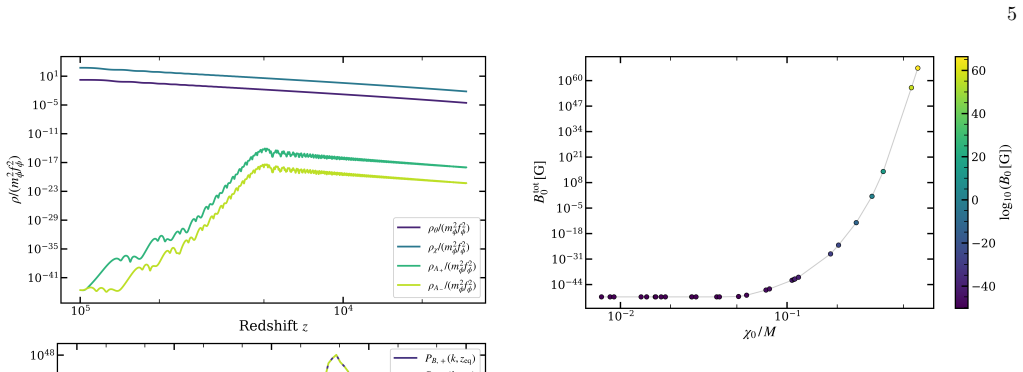
The dilaton's exponential coupling reshapes the instability band to drive tachyonic amplification of both gauge helicities while the axion controls the helicity structure, producing a moderately chiral dark magnetic field generated during radiation domination that reaches B ≈ 0.9 nG on λ0 ∼ 1 Mpc scales.
What carries the argument
Symbiotic axion-dilaton system coupled to a dark U(1) gauge field, where the dilaton supplies exponential tachyonic instability and the axion sets helicity, followed by kinetic mixing transfer.
If this is right
- The generated dark magnetic field transfers to the visible sector over a broad range of mixing parameters.
- Astrophysically relevant amplification persists without fine-tuning across fuzzy-dark-matter and ultralight-axion regimes.
- The field is produced in the dark sector, avoiding plasma-conductivity suppression in the visible sector.
- Numerical evolution confirms the amplification reaches benchmark strengths by matter-radiation equality.
Where Pith is reading between the lines
- The transferred field strength could serve as a seed for present-day galactic magnetic fields if it survives structure formation.
- Limits on primordial magnetic fields could translate into bounds on the allowed axion and dilaton parameter space.
- The same scalar-gauge coupling pattern might apply to magnetogenesis in other cosmological epochs.
Load-bearing premise
The dark U(1) gauge field and its coupling to the axion-dilaton system remain unaffected by any hidden-sector interactions or backreaction that could damp the tachyonic growth.
What would settle it
Numerical evolution from z=10^5 that includes backreaction or hidden-sector damping and shows tachyonic growth suppressed below nG levels on Mpc scales by matter-radiation equality.
Figures




read the original abstract
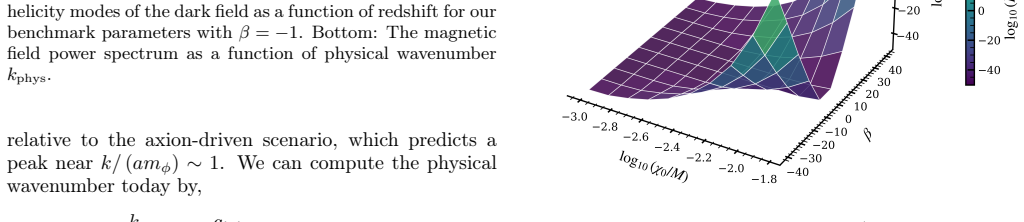
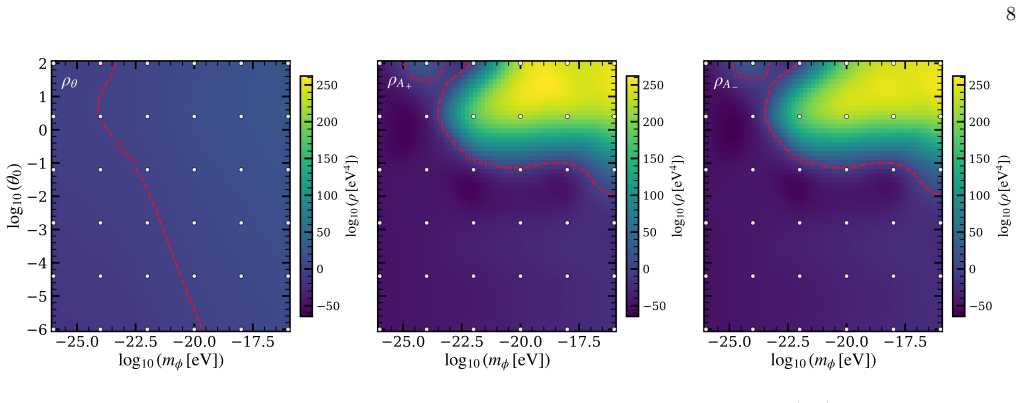
We present a late-time magnetogenesis mechanism in which a coupled axion-dilaton system sources a dark $U(1)$ gauge field. The dilaton's exponential coupling drives tachyonic amplification by reshaping the instability band, while the axion controls the helicity structure of the field. Together, they amplify both gauge helicities and produce a moderately chiral dark magnetic field without fine-tuning in either scalar sector. The field is generated in the dark sector, thus the mechanism avoids plasma-conductivity suppression in the visible sector, while the model remains robust across a broad range of scalar-masses and couplings. Numerical evolution from $z=10^5$ to matter-radiation equality, combined with a parameter search over the axion mass, dilaton initial conditions, and dilaton coupling, shows that astrophysically relevant amplification persists across fuzzy-dark-matter and ultralight-axion regimes. A benchmark case yields $B\approx0.9 ~\mathrm{nG}$ on $\lambda_0\sim1 \mathrm{Mpc}$, with kinetic mixing transferring the field to the visible sector over a broad range of mixing parameters.
Editorial analysis
A structured set of objections, weighed in public.
Referee Report
Summary. The paper proposes a late-time magnetogenesis mechanism during radiation domination in which a coupled axion-dilaton system sources tachyonic amplification of a dark U(1) gauge field. The dilaton's exponential coupling reshapes the instability band while the axion sets the helicity; the resulting moderately chiral dark magnetic field is transferred to the visible sector via kinetic mixing. Numerical evolution of the coupled system from z=10^5 to matter-radiation equality, together with a parameter search over axion mass, dilaton initial conditions and coupling strength, is reported to produce astrophysically relevant fields (benchmark B≈0.9 nG on λ0∼1 Mpc) that remain robust across fuzzy-dark-matter and ultralight-axion regimes without fine-tuning.
Significance. If the numerical results hold, the work supplies a concrete, late-time dark-sector route to Mpc-scale magnetic fields that evades visible-sector plasma suppression and operates without fine-tuning across broad scalar-mass ranges. The combination of analytic instability analysis with direct numerical evolution and parameter exploration would constitute a falsifiable prediction for the amplitude and chirality of intergalactic fields once kinetic mixing is included.
major comments (2)
- [Numerical evolution and parameter search (abstract)] The numerical evolution described in the abstract assumes that gauge-field backreaction on the axion-dilaton background remains negligible, yet no verification is supplied that the gauge-field energy density stays sub-dominant to the scalar energy density from z=10^5 to equality, nor are the backreaction terms stated to be retained in the scalar equations of motion. Because the central claim of B≈0.9 nG amplification rests on sustained tachyonic growth without saturation, this omission renders the reported benchmark an untested upper bound.
- [Numerical evolution and parameter search (abstract)] No information is given on the discretization scheme, spatial resolution, time-stepping method, convergence tests, or error estimation used in the numerical evolution. Without these, the quantitative results of the parameter search and the benchmark field strength cannot be independently validated against known limits or resolution artifacts.
minor comments (1)
- The abstract states that the mechanism is 'robust across a broad range of scalar-masses and couplings' but does not specify the explored intervals or the criteria used to declare robustness; adding this information would improve clarity.
Simulated Author's Rebuttal
We thank the referee for the careful reading and constructive comments on the numerical aspects of our work. We address each major comment below and will revise the manuscript to incorporate the requested clarifications and verifications.
read point-by-point responses
-
Referee: The numerical evolution described in the abstract assumes that gauge-field backreaction on the axion-dilaton background remains negligible, yet no verification is supplied that the gauge-field energy density stays sub-dominant to the scalar energy density from z=10^5 to equality, nor are the backreaction terms stated to be retained in the scalar equations of motion. Because the central claim of B≈0.9 nG amplification rests on sustained tachyonic growth without saturation, this omission renders the reported benchmark an untested upper bound.
Authors: We agree that explicit verification of backreaction is necessary to support the claim of sustained tachyonic amplification. The numerical evolution solves the full coupled system including gauge-field contributions to the scalar equations, but we did not present the energy-density ratio in the original manuscript. In the revision we will add a dedicated panel (or appendix figure) demonstrating that the gauge-field energy density remains sub-dominant (below a few percent) to the axion-dilaton energy density from z=10^5 through equality for the benchmark and representative parameter points. This will confirm that the reported B≈0.9 nG value is not an untested upper bound. revision: yes
-
Referee: No information is given on the discretization scheme, spatial resolution, time-stepping method, convergence tests, or error estimation used in the numerical evolution. Without these, the quantitative results of the parameter search and the benchmark field strength cannot be independently validated against known limits or resolution artifacts.
Authors: We acknowledge that the numerical methods section is insufficiently detailed for independent validation. The revised manuscript will include a new subsection (or appendix) specifying the discretization (second-order finite differences on a uniform 3D comoving grid), the fiducial resolution (N=128^3 with box size chosen to resolve the instability band), the time integrator (fourth-order Runge-Kutta with adaptive step-size controlled by local truncation error), the convergence tests performed by doubling resolution on a subset of runs, and the error metric based on relative violation of the Gauss constraint and total energy conservation (kept below 10^{-4}). These additions will allow direct comparison with known analytic limits. revision: yes
Circularity Check
No circularity: results from direct numerical evolution of coupled system
full rationale
The paper reports numerical integration of the axion-dilaton-U(1) equations from z=10^5 to equality, followed by a parameter scan over masses and initial conditions to obtain benchmark field strengths. No step reduces a claimed prediction to a fitted input by construction, renames a known result, or relies on a self-citation chain for a uniqueness theorem. The central output (B≈0.9 nG on Mpc scales) is generated by the simulation rather than being equivalent to its inputs; the derivation chain is therefore self-contained against external benchmarks.
Axiom & Free-Parameter Ledger
free parameters (3)
- axion mass
- dilaton initial conditions
- dilaton coupling strength
axioms (2)
- domain assumption Radiation domination holds from redshift 10^5 to matter-radiation equality with standard expansion history
- domain assumption The dark U(1) remains decoupled from visible plasma conductivity
invented entities (2)
-
dark U(1) gauge field
no independent evidence
-
coupled axion-dilaton system
no independent evidence
Reference graph
Works this paper leans on
-
[1]
L. M. Widrow, Rev. Mod. Phys.74, 775 (2002), arXiv:astro-ph/0207240
Pith/arXiv arXiv 2002
-
[2]
Z.-R. Wang, S.-Q. Xi, R.-Y. Liu, R. Xue, and X.-Y. Wang, Phys. Rev. D101, 083004 (2020), arXiv:2001.01186 [astro-ph.HE]
arXiv 2020
-
[3]
L. Burmeister, P. Da Vela, F. Longo, G. Marti-Devesa, M. Meyer, F. G. Saturni, A. Stamerra, and P. Veres, Phys. Rev. D113, 043041 (2026), arXiv:2512.11128 [astro-ph.HE]
arXiv 2026
-
[4]
A. M. Taylor, I. Vovk, and A. Neronov, "Astronomy & Astrophysics"529, A144 (2011), arXiv:1101.0932 [astro- ph.HE]
Pith/arXiv arXiv 2011
-
[5]
J. D. Barrow, P. G. Ferreira, and J. Silk, Phys. Rev. Lett. 78, 3610 (1997), arXiv:astro-ph/9701063
Pith/arXiv arXiv 1997
-
[6]
J. Biteau and M. Meyer, Galaxies10, 39 (2022), arXiv:2202.00523 [astro-ph.CO]
arXiv 2022
-
[7]
T. Kahniashvili, A. Brandenburg, and A. G. Tevzadze, Phys. Scripta91, 104008 (2016), arXiv:1507.00510 [astro-ph.CO]
Pith/arXiv arXiv 2016
-
[8]
K. Subramanian, T. R. Seshadri, and J. D. Barrow, Mon. Not. Roy. Astron. Soc.344, L31 (2003), arXiv:astro- ph/0303014. 10
arXiv 2003
- [9]
-
[10]
Aharonianet al.(H.E.S.S., Fermi-LAT), Astrophys
F. Aharonianet al.(H.E.S.S., Fermi-LAT), Astrophys. J. Lett.950, L16 (2023), arXiv:2306.05132 [astro-ph.HE]
arXiv 2023
-
[11]
R. Durrer and A. Neronov, Astron. Astrophys. Rev.21, 62 (2013), arXiv:1303.7121 [astro-ph.CO]
Pith/arXiv arXiv 2013
-
[12]
Ratra, Astrophys
B. Ratra, Astrophys. J. Lett.391, L1 (1992)
1992
-
[13]
M. S. Turner and L. M. Widrow, Phys. Rev. D37, 2743 (1988)
1988
-
[14]
K. Bamba and J. Yokoyama, Phys. Rev. D69, 043507 (2004), arXiv:astro-ph/0310824
Pith/arXiv arXiv 2004
- [15]
-
[16]
V. Demozzi, V. Mukhanov, and H. Rubinstein, JCAP 08, 025, arXiv:0907.1030 [astro-ph.CO]
-
[17]
R. J. Z. Ferreira, R. K. Jain, and M. S. Sloth, JCAP06, 053, arXiv:1403.5516 [astro-ph.CO]
- [18]
-
[19]
T. Fujita, R. Namba, Y. Tada, N. Takeda, and H. Tashiro, JCAP05, 054, arXiv:1503.05802 [astro- ph.CO]
-
[20]
P. Adshead, J. T. Giblin, T. R. Scully, and E. I. Sfakianakis, JCAP09, 039, arXiv:1606.08474 [astro- ph.CO]
-
[21]
D. G. Figueroa, J. Lizarraga, A. Urio, and J. Urrestilla, Phys. Rev. Lett.131, 151003 (2023), arXiv:2303.17436 [astro-ph.CO]
arXiv 2023
-
[22]
D. G. Figueroa, J. Lizarraga, N. Loayza, A. Urio, and J. Urrestilla, Phys. Rev. D111, 063545 (2025), arXiv:2411.16368 [astro-ph.CO]
arXiv 2025
-
[23]
N. Brahma and R. Brandenberger, Parametric Reso- nance and Backreaction Effects in Magnetogenesis from Ultralight Dark Matter (2026), arXiv:2602.04285 [astro- ph.CO]
arXiv 2026
-
[24]
T. C. Bachlechner, M. Dias, J. Frazer, and L. McAllister, Phys. Rev. D91, 023520 (2015)
2015
-
[25]
S. Alexander, T. Manton, and E. McDonough, The Field Theory Axiverse (2024), arXiv:2404.11642 [hep-ph]
arXiv 2024
-
[26]
V. M. Mehta, M. Demirtas, C. Long, D. J. E. Marsh, L. McAllister, and M. J. Stott, JHEP10, 090, arXiv:2011.08693 [hep-th]
arXiv 2011
-
[27]
K. Choi, H. Kim, and T. Sekiguchi, Phys. Rev. Lett.121, 031102 (2018), arXiv:1802.07269 [hep-ph]
Pith/arXiv arXiv 2018
-
[28]
N. Kitajima and F. Takahashi, Phys. Rev. D107, 123518 (2023), arXiv:2303.05492 [hep-ph]
arXiv 2023
- [29]
-
[30]
R. Brandenberger, J. Fröhlich, and H. Jiao, Cosmologi- cal Magnetic Fields from Ultralight Dark Matter (2025), arXiv:2502.19310 [hep-ph]
arXiv 2025
-
[31]
A. Kushwaha and R. Brandenberger, ALP Dark Matter, Cosmological Magnetic Fields and the Direct Collapse Black Hole Formation Scenario (2026), arXiv:2602.22170 [hep-ph]
arXiv 2026
-
[32]
R. D. Peccei and H. R. Quinn, Phys. Rev. D16, 1791 (1977)
1977
-
[33]
S. Alexander, L. Edmond, and C. Niu, Parity-violating Dark Photon Halos (2026), arXiv:2601.04145 [gr-qc]
arXiv 2026
-
[34]
W. D. Garretson, G. B. Field, and S. M. Carroll, Phys. Rev. D46, 5346 (1992), arXiv:hep-ph/9209238 [hep-ph]
Pith/arXiv arXiv 1992
-
[35]
Baym and H
G. Baym and H. Heiselberg, Phys. Rev. D56, 5254 (1997)
1997
-
[36]
Kamali and R
V. Kamali and R. Brandenberger, arXiv e-prints (2026)
2026
-
[37]
Holdom, Phys
B. Holdom, Phys. Lett. B178, 65 (1986)
1986
-
[38]
A. Banerjee, C. Csaki, M. Geller, Z. Heller-Algazi, and A. Ismail, Ultralight dilatonic dark matter (2025), arXiv:2506.21659 [hep-ph]
Pith/arXiv arXiv 2025
-
[39]
P. W. Graham, J. Mardon, and S. Rajendran, Phys. Rev. D93, 103520 (2016), arXiv:1504.02102 [hep-ph]
Pith/arXiv arXiv 2016
-
[40]
Kamada, Y
K. Kamada, Y. Tsai, and T. Vachaspati, Phys. Rev. D 98, 043501 (2018)
2018
-
[41]
L. Di Luzio, B. Gavela, P. Quilez, and A. Ringwald, JHEP05, 184, arXiv:2102.00012 [hep-ph]
-
[42]
N. Aghanimet al.(Planck), Astron. Astrophys.641, A6 (2020), [Erratum: Astron.Astrophys. 652, C4 (2021)], arXiv:1807.06209 [astro-ph.CO]
Pith/arXiv arXiv 2020
-
[43]
D. Nandi and D. Choudhury, arXiv e-prints , arXiv:2605.22174 (2026), arXiv:2605.22174 [astro- ph.CO]
Pith/arXiv arXiv 2026
-
[44]
Caputo, A
A. Caputo, A. J. Millar, C. A. J. O’Hare, and E. Vitagliano, Phys. Rev. D104, 095029 (2021)
2021
-
[45]
S. J. Witte, S. Rosauro-Alcaraz, S. D. McDermott, and V. Poulin, JHEP06, 132, arXiv:2003.13698 [astro- ph.CO]
arXiv 2003
-
[46]
H. An, M. Pospelov, and J. Pradler, Phys. Lett. B725, 190 (2013), arXiv:1302.3884 [hep-ph]
Pith/arXiv arXiv 2013
-
[47]
P. Arias, D. Cadamuro, M. Goodsell, J. Jaeckel, J. Re- dondo, and A. Ringwald, JCAP06, 013, arXiv:1201.5902 [hep-ph]
-
[48]
W. Hu, R. Barkana, and A. Gruzinov, Phys. Rev. Lett. 85, 1158 (2000), arXiv:astro-ph/0003365
Pith/arXiv arXiv 2000
-
[49]
L. Hui, J. P. Ostriker, S. Tremaine, and E. Witten, Phys. Rev. D95, 043541 (2017)
2017
-
[50]
Arvanitaki, S
A. Arvanitaki, S. Dimopoulos, S. Dubovsky, N. Kaloper, and J. March-Russell, Phys. Rev. D81, 123530 (2010)
2010
-
[51]
S. Zelmeret al., Astron. Astrophys.704, A346 (2025), arXiv:2502.03353 [astro-ph.CO]
Pith/arXiv arXiv 2025
- [52]
-
[53]
J. Donnert, F. Vazza, M. Brüggen, and J. ZuHone, Space Sci. Rev.214, 122 (2018), arXiv:1810.09783 [astro- ph.CO]
Pith/arXiv arXiv 2018
-
[54]
A. Brandenburg and K. Subramanian, Phys. Rept.417, 1 (2005), arXiv:astro-ph/0405052
Pith/arXiv arXiv 2005
-
[55]
K. Subramanian, Rept. Prog. Phys.79, 076901 (2016), arXiv:1504.02311 [astro-ph.CO]
Pith/arXiv arXiv 2016
-
[56]
Banerjee and K
R. Banerjee and K. Jedamzik, Phys. Rev. D70, 123003 (2004)
2004
-
[57]
R. M. Kulsrud, R. Cen, J. P. Ostriker, and D. Ryu, As- trophys. J.480, 481 (1997), arXiv:astro-ph/9607141
Pith/arXiv arXiv 1997
-
[58]
Calabreseet al.(Atacama Cosmology Telescope), JCAP11, 063, arXiv:2503.14454 [astro-ph.CO]
E. Calabreseet al.(Atacama Cosmology Telescope), JCAP11, 063, arXiv:2503.14454 [astro-ph.CO]
-
[59]
J. R. Shaw and A. Lewis, Physical Review D81, 10.1103/physrevd.81.043517 (2010)
-
[60]
S. Saga, M. Shiraishi, K. Akitsu, and T. Okumura, Phys. Rev. D109, 043520 (2024), arXiv:2312.16316 [astro- ph.CO]
arXiv 2024
-
[61]
D. R. G. Schleicher, R. Banerjee, and R. S. Klessen, As- trophys. J.692, 236 (2009), arXiv:0808.1461 [astro-ph]
Pith/arXiv arXiv 2009
-
[62]
S. K. Sethi and K. Subramanian, Mon. Not. Roy. Astron. Soc.356, 778 (2005), arXiv:astro-ph/0405413 [astro-ph]
Pith/arXiv arXiv 2005
-
[63]
K.Worku, H.A.G.Cruz,andM.Kamionkowski,Primor- dial Magnetic Fields at Cosmic Dawn: 21-cm Forecasts with HERA and SKA (2026), arXiv:2605.05323 [astro- ph.CO]
Pith/arXiv arXiv 2026
discussion (0)
Sign in with ORCID, Apple, or X to comment. Anyone can read and Pith papers without signing in.