S2-CAR: Segmentation-Supervised Complexity-Adaptive Recommendation
Pith reviewed 2026-06-25 20:29 UTC · model grok-4.3
The pith
Modeling user intent as a continuous latent energy state enables segmentation of interaction sequences that reduces cross-intent interference in sequential recommendation.
A machine-rendered reading of the paper's core claim, the machinery that carries it, and where it could break.
Core claim
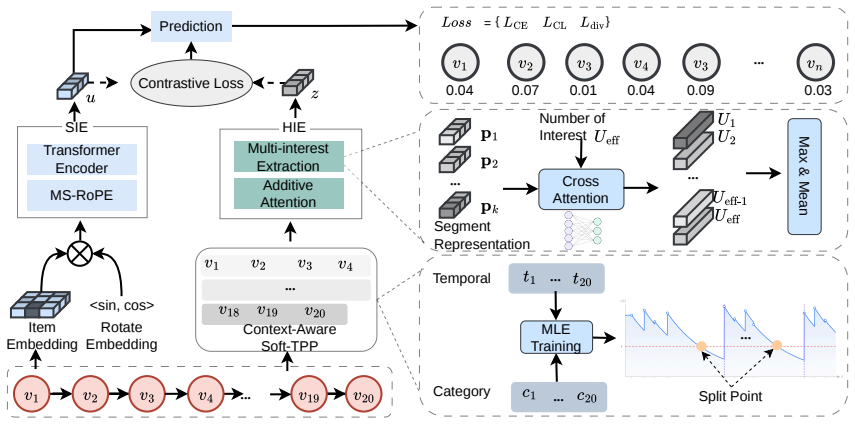
S2-CAR models user intent as a continuous latent energy state and employs the Context-Aware Soft Temporal Point Process (Soft-TPP) to place segment boundaries at points of natural energy decay rather than fixed intervals. This produces intent-coherent segments that a Segment-Count-Adaptive Multi-Intent Extraction module then aggregates into compact multi-interest representations. The resulting framework outperforms 13 state-of-the-art baselines across three public benchmark datasets in movie, e-commerce, and gaming domains on all reported metrics, and the energy-based segmentation improves performance when inserted into other sequential recommendation backbones.
What carries the argument
Context-Aware Soft Temporal Point Process (Soft-TPP) that sets sequence segment boundaries according to the natural decay of a modeled latent energy state representing user intent.
If this is right
- Energy-based segmentation reduces misalignments that mix signals from different user intents.
- The adaptive multi-intent extraction handles heterogeneous behavior patterns more effectively than uniform or rigid-window approaches.
- The segmentation component yields consistent gains when integrated into existing sequential recommendation models.
- Outperformance holds across movie, e-commerce, and gaming recommendation benchmarks.
Where Pith is reading between the lines
- The decay-triggered segmentation could transfer to other sequence tasks where state changes lack explicit markers, such as dialogue modeling or user session analysis.
- If the latent energy construct captures genuine dynamics, it may guide designs for systems that adapt recommendations to slowly evolving goals rather than only recent clicks.
- Testing the same mechanism on larger-scale or streaming interaction data would reveal whether the boundary detection remains stable under higher noise levels.
Load-bearing premise
That modeling user intent as a continuous latent energy state whose natural decay triggers accurate intent boundaries via Soft-TPP avoids cross-intent interference and short-term over-reliance without introducing new fitting artifacts.
What would settle it
Run the model on datasets containing explicitly labeled intent shifts and check whether the energy-decay boundaries align with those labels more closely than fixed time windows or random segmentation, or whether the reported accuracy gains disappear when the decay trigger is disabled.
Figures

read the original abstract
Sequential recommendation aims to predict user preferences from interaction histories, yet existing models often struggle when behavior patterns become complex and heterogeneous. A key reason is that interaction histories are rarely uniform: users' interests shift in a latent way over time, yet existing models either treat the full sequence as a homogeneous context or rely on rigid time-window segmentation that misaligns with true intent boundaries. This mis-segmentation not only introduces cross-intent interference at intermediate sequence positions but also leads to over-reliance on short-term interest signals. To address this, we propose S2-CAR, a segmentation-supervised and complexity-adaptive framework for sequential recommendation that models user intent as a continuous latent energy state. Specifically, it uses the Context-Aware Soft Temporal Point Process (Soft-TPP) to segment boundaries triggered by the natural decay of latent-state energy rather than fixed intervals, enabling intent segmentation without fixed time-gap rules. Next, upon this segmentation, a Segment-Count-Adaptive Multi-Intent Extraction module hierarchically aggregates intent-coherent segments into a compact set of multi-interest representations. Extensive experiments on 3 representative public benchmark datasets spanning movie, e-commerce, and gaming domains across 13 baselines demonstrate that S2-CAR consistently outperforms state-of-the-art methods across all datasets and metrics. Further analysis shows that the proposed energy-based segmentation serves as a plug-and-play module, yielding consistent improvements when integrated into existing sequential recommendation backbones.
Editorial analysis
A structured set of objections, weighed in public.
Referee Report
Summary. The paper proposes S2-CAR, a segmentation-supervised complexity-adaptive framework for sequential recommendation. It models user intent via a continuous latent energy state in a Context-Aware Soft Temporal Point Process (Soft-TPP) whose natural decay determines intent boundaries without fixed time gaps, followed by a Segment-Count-Adaptive Multi-Intent Extraction module that hierarchically aggregates segments into multi-interest representations. The central claim is that this avoids cross-intent interference and short-term over-reliance, yielding consistent outperformance over 13 baselines on three public datasets (movie, e-commerce, gaming) with the segmentation module acting as a plug-and-play improvement for existing backbones.
Significance. If the reported gains can be rigorously attributed to the energy-decay segmentation rather than added model capacity or implicit regularization, the approach could offer a principled alternative to rigid windowing or homogeneous-sequence assumptions in sequential recommendation. The plug-and-play claim, if substantiated with controlled ablations, would be a practical strength for the field.
major comments (3)
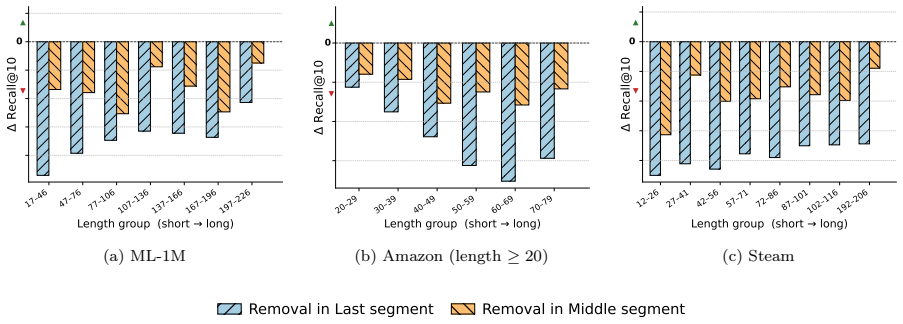
- [Experiments] Experiments section: No direct validation of segmentation quality is provided (e.g., alignment of Soft-TPP boundaries with annotated intent shifts, boundary statistics vs. fixed-window baselines, or ablation isolating the energy-decay trigger from the Segment-Count-Adaptive module). Downstream recommendation metrics alone cannot establish that the claimed mechanism, rather than increased capacity, drives the reported gains over the 13 baselines.
- [Method] Method section (Soft-TPP description): The abstract and text supply no equations, training details, or description of how the energy threshold or segment count is selected or optimized. This leaves open whether the latent energy parameters reduce to quantities fitted on the same recommendation loss, undermining the claim that the segmentation is free of new fitting artifacts.
- [Abstract] Abstract and Experiments: The headline claim of consistent outperformance supplies no numerical results, ablation tables, or statistical tests in the visible text, so the central empirical assertion remains uninspectable and cannot yet support the significance assessment.
minor comments (2)
- [Abstract] The abstract would benefit from one or two key quantitative results (e.g., average improvement over strongest baseline) to allow readers to gauge the effect size without reading the full experiments.
- [Method] Notation for the latent energy state and Soft-TPP intensity function should be introduced with explicit definitions on first use to improve readability for readers outside the temporal point process literature.
Simulated Author's Rebuttal
We thank the referee for the constructive feedback on our manuscript. The comments highlight important areas for strengthening the presentation of our contributions. We address each major comment below and indicate the revisions planned.
read point-by-point responses
-
Referee: [Experiments] Experiments section: No direct validation of segmentation quality is provided (e.g., alignment of Soft-TPP boundaries with annotated intent shifts, boundary statistics vs. fixed-window baselines, or ablation isolating the energy-decay trigger from the Segment-Count-Adaptive module). Downstream recommendation metrics alone cannot establish that the claimed mechanism, rather than increased capacity, drives the reported gains over the 13 baselines.
Authors: We agree that additional direct evidence for the segmentation mechanism would strengthen the paper. Our existing ablations already isolate the contribution of the segmentation module via plug-and-play integration with backbones, but we will add boundary statistics versus fixed-window baselines and further ablations separating the energy-decay trigger from the multi-intent extraction module in the revised Experiments section. revision: yes
-
Referee: [Method] Method section (Soft-TPP description): The abstract and text supply no equations, training details, or description of how the energy threshold or segment count is selected or optimized. This leaves open whether the latent energy parameters reduce to quantities fitted on the same recommendation loss, undermining the claim that the segmentation is free of new fitting artifacts.
Authors: The full manuscript contains the equations and training details for the Context-Aware Soft-TPP in Section 3. We will revise the Method section to more explicitly describe the selection and optimization of the energy threshold and segment count, including how these are handled during joint training with the recommendation objective. revision: yes
-
Referee: [Abstract] Abstract and Experiments: The headline claim of consistent outperformance supplies no numerical results, ablation tables, or statistical tests in the visible text, so the central empirical assertion remains uninspectable and cannot yet support the significance assessment.
Authors: The abstract follows standard conventions for brevity. The full Experiments section includes numerical results, ablation tables, and statistical tests. We will update the abstract to include key numerical highlights and reference to the statistical significance to make the central claims more concrete. revision: partial
- Direct alignment of Soft-TPP boundaries with annotated intent shifts cannot be performed, as the three public benchmark datasets do not contain explicit intent shift annotations.
Circularity Check
No circularity identified; derivation chain not reducible from visible text
full rationale
The manuscript abstract and description introduce S2-CAR with Context-Aware Soft-TPP modeling latent energy decay for segmentation, followed by Segment-Count-Adaptive Multi-Intent Extraction, with gains shown only via downstream recommendation metrics on three datasets. No equations, loss functions, or training procedures are supplied in the provided text, so no self-definitional mapping, fitted-parameter-renamed-as-prediction, or self-citation load-bearing step can be quoted or exhibited. The segmentation is presented as a learned component whose quality is asserted via end-to-end performance rather than direct boundary validation, but this does not constitute a circular reduction by construction. The paper's central claims remain independent of any visible tautology and are therefore scored as self-contained.
Axiom & Free-Parameter Ledger
invented entities (1)
-
latent energy state
no independent evidence
Reference graph
Works this paper leans on
-
[1]
ACM Transactions on Information Systems (TOIS) , volume=
Deep learning for sequential recommendation: Algorithms, influential factors, and evaluations , author=. ACM Transactions on Information Systems (TOIS) , volume=. 2020 , publisher=
2020
-
[2]
Session-based Recommendations with Recurrent Neural Networks
Session-based recommendations with recurrent neural networks , author=. arXiv preprint arXiv:1511.06939 , year=
work page internal anchor Pith review Pith/arXiv arXiv
-
[3]
2018 IEEE international conference on data mining (ICDM) , pages=
Self-attentive sequential recommendation , author=. 2018 IEEE international conference on data mining (ICDM) , pages=. 2018 , organization=
2018
-
[4]
Proceedings of the 28th ACM international conference on information and knowledge management , pages=
BERT4Rec: Sequential recommendation with bidirectional encoder representations from transformer , author=. Proceedings of the 28th ACM international conference on information and knowledge management , pages=
-
[5]
Transactions of the association for computational linguistics , volume=
Lost in the middle: How language models use long contexts , author=. Transactions of the association for computational linguistics , volume=
-
[6]
Advances in Neural Information Processing Systems , volume=
Found in the middle: How language models use long contexts better via plug-and-play positional encoding , author=. Advances in Neural Information Processing Systems , volume=
-
[7]
Proceedings of the 31st ACM international conference on information & knowledge management , pages=
Time lag aware sequential recommendation , author=. Proceedings of the 31st ACM international conference on information & knowledge management , pages=
-
[8]
ACM Computing Surveys (CSUR) , volume=
A survey on session-based recommender systems , author=. ACM Computing Surveys (CSUR) , volume=. 2021 , publisher=
2021
-
[9]
Proceedings of the 47th international ACM SIGIR conference on research and development in information retrieval , pages=
Multi-intent-aware session-based recommendation , author=. Proceedings of the 47th international ACM SIGIR conference on research and development in information retrieval , pages=
-
[10]
Expert Systems with Applications , volume=
Item attribute-aware graph collaborative filtering , author=. Expert Systems with Applications , volume=. 2024 , publisher=
2024
-
[11]
Scientific Reports , year=
Dual denoising contrastive learning with multi-interest fusion for sequential recommendation , author=. Scientific Reports , year=
-
[12]
Proceedings of the eleventh ACM international conference on web search and data mining , pages=
Personalized top-n sequential recommendation via convolutional sequence embedding , author=. Proceedings of the eleventh ACM international conference on web search and data mining , pages=
-
[13]
ACM Transactions on Information Systems , year=
Multi-Interest Recommendation: A Survey , author=. ACM Transactions on Information Systems , year=
-
[14]
Proceedings of the 28th ACM international conference on information and knowledge management , pages=
Multi-interest network with dynamic routing for recommendation at Tmall , author=. Proceedings of the 28th ACM international conference on information and knowledge management , pages=
-
[15]
Proceedings of the 26th ACM SIGKDD international conference on knowledge discovery & data mining , pages=
Controllable multi-interest framework for recommendation , author=. Proceedings of the 26th ACM SIGKDD international conference on knowledge discovery & data mining , pages=
-
[16]
Proceedings of the 14th ACM international conference on web search and data mining , pages=
Sparse-interest network for sequential recommendation , author=. Proceedings of the 14th ACM international conference on web search and data mining , pages=
-
[17]
Proceedings of the 26th ACM SIGKDD international conference on knowledge discovery & data mining , pages=
Disentangled self-supervision in sequential recommenders , author=. Proceedings of the 26th ACM SIGKDD international conference on knowledge discovery & data mining , pages=
-
[18]
Proceedings of the AAAI conference on artificial intelligence , volume=
Noninvasive self-attention for side information fusion in sequential recommendation , author=. Proceedings of the AAAI conference on artificial intelligence , volume=
-
[19]
Proceedings of the 17th ACM international conference on web search and data mining , pages=
Intent contrastive learning with cross subsequences for sequential recommendation , author=. Proceedings of the 17th ACM international conference on web search and data mining , pages=
-
[20]
2003 , publisher=
An introduction to the theory of point processes: volume I: elementary theory and methods , author=. 2003 , publisher=
2003
-
[21]
Biometrika , volume=
Spectra of some self-exciting and mutually exciting point processes , author=. Biometrika , volume=. 1971 , publisher=
1971
-
[22]
Stochastic processes and their applications , volume=
A self-correcting point process , author=. Stochastic processes and their applications , volume=. 1979 , publisher=
1979
-
[23]
Proceedings of the 22nd ACM SIGKDD international conference on knowledge discovery and data mining , pages=
Recurrent marked temporal point processes: Embedding event history to vector , author=. Proceedings of the 22nd ACM SIGKDD international conference on knowledge discovery and data mining , pages=
-
[24]
Advances in neural information processing systems , volume=
The neural hawkes process: A neurally self-modulating multivariate point process , author=. Advances in neural information processing systems , volume=
-
[25]
Proceedings of the 21th ACM SIGKDD international conference on knowledge discovery and data mining , pages=
Seismic: A self-exciting point process model for predicting tweet popularity , author=. Proceedings of the 21th ACM SIGKDD international conference on knowledge discovery and data mining , pages=
-
[26]
Advances in neural information processing systems , volume=
Coevolutionary latent feature processes for continuous-time user-item interactions , author=. Advances in neural information processing systems , volume=
-
[27]
Proceedings of the twelfth ACM international conference on Web search and data mining , pages=
Time is of the essence: a joint hierarchical rnn and point process model for time and item predictions , author=. Proceedings of the twelfth ACM international conference on Web search and data mining , pages=
-
[28]
Econometrica: Journal of the econometric society , pages=
Maximum likelihood estimation of misspecified models , author=. Econometrica: Journal of the econometric society , pages=. 1982 , publisher=
1982
-
[29]
Acm transactions on interactive intelligent systems (tiis) , volume=
The movielens datasets: History and context , author=. Acm transactions on interactive intelligent systems (tiis) , volume=. 2015 , publisher=
2015
-
[30]
proceedings of the 25th international conference on world wide web , pages=
Ups and downs: Modeling the visual evolution of fashion trends with one-class collaborative filtering , author=. proceedings of the 25th international conference on world wide web , pages=
-
[31]
Proceedings of the 30th ACM international conference on information & knowledge management , pages=
Hyperbolic hypergraphs for sequential recommendation , author=. Proceedings of the 30th ACM international conference on information & knowledge management , pages=
-
[32]
BPR: Bayesian Personalized Ranking from Implicit Feedback
BPR: Bayesian personalized ranking from implicit feedback , author=. arXiv preprint arXiv:1205.2618 , year=
work page internal anchor Pith review Pith/arXiv arXiv
-
[33]
Proceedings of the 44th international ACM SIGIR conference on research and development in information retrieval , pages=
Sequential recommendation with graph neural networks , author=. Proceedings of the 44th international ACM SIGIR conference on research and development in information retrieval , pages=
-
[34]
2022 IEEE 38th international conference on data engineering (ICDE) , pages=
Contrastive learning for sequential recommendation , author=. 2022 IEEE 38th international conference on data engineering (ICDE) , pages=. 2022 , organization=
2022
-
[35]
Proceedings of the fifteenth ACM international conference on web search and data mining , pages=
Contrastive learning for representation degeneration problem in sequential recommendation , author=. Proceedings of the fifteenth ACM international conference on web search and data mining , pages=
-
[36]
arXiv preprint arXiv:2108.06479 , year=
Contrastive self-supervised sequential recommendation with robust augmentation , author=. arXiv preprint arXiv:2108.06479 , year=
-
[37]
Proceedings of the AAAI Conference on Artificial Intelligence , volume=
Augmenting sequential recommendation with balanced relevance and diversity , author=. Proceedings of the AAAI Conference on Artificial Intelligence , volume=
-
[38]
Proceedings of the 13th international conference on web search and data mining , pages=
Time interval aware self-attention for sequential recommendation , author=. Proceedings of the 13th international conference on web search and data mining , pages=
-
[39]
Information Sciences , pages=
Dual-channel time-aware graph attention network for session-based recommendation , author=. Information Sciences , pages=. 2026 , publisher=
2026
-
[40]
Proceedings of the 26th ACM SIGKDD international conference on knowledge discovery & data mining , pages=
On sampled metrics for item recommendation , author=. Proceedings of the 26th ACM SIGKDD international conference on knowledge discovery & data mining , pages=
-
[41]
ACM Transactions on Information Systems , volume=
Diffurec: A diffusion model for sequential recommendation , author=. ACM Transactions on Information Systems , volume=. 2023 , publisher=
2023
-
[42]
proceedings of the Eleventh ACM Conference on Recommender Systems , pages=
Personalizing session-based recommendations with hierarchical recurrent neural networks , author=. proceedings of the Eleventh ACM Conference on Recommender Systems , pages=
-
[43]
Ludewig, D
Evaluation of session-based recommendation algorithms: M. Ludewig, D. Jannach , author=. User Modeling and User-Adapted Interaction , volume=. 2018 , publisher=
2018
-
[44]
Proceedings of the AAAI Conference on Artificial Intelligence , volume=
Intent oriented contrastive learning for sequential recommendation , author=. Proceedings of the AAAI Conference on Artificial Intelligence , volume=
-
[45]
Knowledge-Based Systems , volume=
SSE4Rec: Sequential recommendation with subsequence extraction , author=. Knowledge-Based Systems , volume=. 2024 , publisher=
2024
-
[46]
Proceedings of the AAAI conference on artificial intelligence , volume=
Dynamic multi-interest graph neural network for session-based recommendation , author=. Proceedings of the AAAI conference on artificial intelligence , volume=
-
[47]
Neurocomputing , volume=
Roformer: Enhanced transformer with rotary position embedding , author=. Neurocomputing , volume=. 2024 , publisher=
2024
-
[48]
IEEE Transactions on Knowledge and Data Engineering , volume=
Tagrec: Temporal-aware graph contrastive learning with theoretical augmentation for sequential recommendation , author=. IEEE Transactions on Knowledge and Data Engineering , volume=. 2025 , publisher=
2025
-
[49]
Proceedings of the ACM on Web Conference 2025 , pages=
Hierarchical time-aware mixture of experts for multi-modal sequential recommendation , author=. Proceedings of the ACM on Web Conference 2025 , pages=
2025
-
[50]
ACM Computing Surveys , volume=
A survey of graph neural networks for social recommender systems , author=. ACM Computing Surveys , volume=. 2024 , publisher=
2024
-
[51]
Annals of the Institute of Statistical Mathematics , volume=
The asymptotic behaviour of maximum likelihood estimators for stationary point processes , author=. Annals of the Institute of Statistical Mathematics , volume=
-
[52]
Canadian Journal of Statistics , volume=
The weighted likelihood , author=. Canadian Journal of Statistics , volume=. 2002 , publisher=
2002
-
[53]
arXiv preprint arXiv:2601.03259 , year=
LLMDiRec: LLM-Enhanced Intent Diffusion for Sequential Recommendation , author=. arXiv preprint arXiv:2601.03259 , year=
discussion (0)
Sign in with ORCID, Apple, or X to comment. Anyone can read and Pith papers without signing in.