Croc: Training the Next Generation Chip Designers on Domain-Specific End-to-End Open Source Silicon
Pith reviewed 2026-06-25 19:02 UTC · model grok-4.3
The pith
An open-source RISC-V platform called Croc lets students design, tape out, and test functional microcontrollers using only free EDA tools and a 130nm PDK.
A machine-rendered reading of the paper's core claim, the machinery that carries it, and where it could break.
Core claim
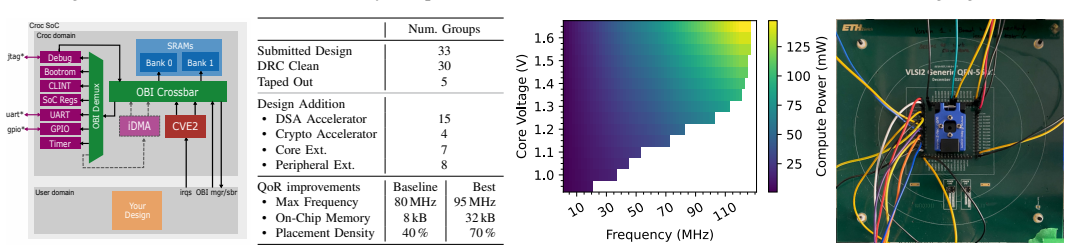
Croc is a highly customizable RISC-V platform integrated with open-source IP and an end-to-end open-source EDA flow in a 130nm open PDK. When used for student tapeout projects, it supports instruction-set extensions, accelerator co-processors, and custom peripherals, resulting in 33 completed projects of which 30 yielded manufacturable layouts, 18 tapeout candidates, five fabricated designs, and one baseline chip that has been successfully characterized in silicon with metrics matching those of comparable closed-source microcontroller products.
What carries the argument
Croc, the customizable RISC-V platform that carries instruction-set extensions, accelerator co-processors, and peripheral customizations through the open-source flow to silicon.
If this is right
- Domain-specific SoCs can be built by students through instruction-set extensions, co-processors, and peripheral additions without proprietary licenses.
- The flow produced 30 manufacturable layouts from 33 student projects and advanced 18 to tapeout.
- Five designs reached fabrication, with one baseline chip already verified in silicon.
- Implementation metrics of the open-source designs are presented as comparable to closed-source equivalents of similar complexity.
Where Pith is reading between the lines
- If the flow scales, universities could run larger cohorts without access to expensive commercial tool licenses.
- Success at the microcontroller level may encourage attempts at more complex domain-specific accelerators in later courses.
- Wider adoption could shift the default training path for VLSI engineers toward open-source stacks.
Load-bearing premise
Open-source EDA tools and the 130nm PDK can produce microcontroller designs whose quality, area, power, speed, and yield match what closed-source commercial flows achieve for the same functional class.
What would settle it
A side-by-side measurement showing that the fabricated baseline chip's measured area, power consumption at a given frequency, or maximum clock speed falls more than 30 percent short of published metrics for commercial microcontrollers of similar complexity fabricated in the same or comparable process nodes.
Figures

read the original abstract
The demand for domain-specific systems-on-chip (SoCs) in artificial intelligence, robotics, and automotive systems is increasing the need for engineers with hands-on expertise on very-large-scale integration (VLSI) design from architecture specification to fabricated silicon. Yet, most VLSI courses rely on restrictively licensed electronic design automation tools and process design kits (PDKs), as well as closed-source hardware designs. We present an end-to-end open-source domain-specific SoC design and fabrication flow built around Croc, a highly customizable RISC-V platform. Built from open-source SystemVerilog intellectual property blocks and integrated with an end-to-end open-source design flow in a 130nm open PDK, Croc enables tapeout projects supporting multiple domain customization options: instruction-set extensions, accelerator co-processors, and peripherals. In our first open-source course experience using Croc, 65 students completed 33 projects, 30 of which produced manufacturable layouts. 18 designs were selected as tapeout candidates, and five were fabricated. A first baseline chip has already been successfully characterized in silicon, demonstrating microcontroller-class functionality and implementation metrics comparable to those of products with similar functional complexity completed with closed-source toolchains and PDKs.
Editorial analysis
A structured set of objections, weighed in public.
Referee Report
Summary. The paper introduces Croc, a customizable open-source RISC-V platform for domain-specific SoC design using open SystemVerilog IP and a 130 nm open PDK. It reports results from a first course deployment in which 65 students completed 33 projects, 30 of which yielded manufacturable layouts; 18 were tapeout candidates and 5 were fabricated. A baseline chip was successfully characterized in silicon and is claimed to exhibit microcontroller-class functionality with implementation metrics comparable to closed-source commercial designs of similar complexity.
Significance. If the quantitative metrics and selection details support the comparability claim, the work would provide concrete evidence that fully open-source EDA flows and PDKs can enable end-to-end student tapeouts that reach functional silicon, directly addressing the documented shortage of hands-on VLSI training. The explicit reporting of actual fabricated and characterized silicon (rather than simulation-only results) is a notable strength.
major comments (2)
- [Abstract] Abstract: the central claim that the characterized baseline chip demonstrates 'implementation metrics comparable to those of products with similar functional complexity completed with closed-source toolchains and PDKs' is unsupported by any numerical values for area, power, frequency, yield, or named commercial comparators; without these data the representativeness of the open 130 nm flow cannot be evaluated.
- [Abstract] Abstract: the outcomes (65 students, 33 projects, 30 manufacturable layouts, 18 tapeout candidates, 5 fabricated) do not specify the selection criteria used to choose the five designs for fabrication from the 18 candidates; this omission is load-bearing for assessing whether the reported silicon success rate reflects the flow's general capability or post-selection effects.
Simulated Author's Rebuttal
We thank the referee for the constructive feedback on our manuscript. The two major comments both concern the abstract; we will revise it to address both points directly while preserving the paper's core contributions on the open-source flow and student outcomes.
read point-by-point responses
-
Referee: [Abstract] Abstract: the central claim that the characterized baseline chip demonstrates 'implementation metrics comparable to those of products with similar functional complexity completed with closed-source toolchains and PDKs' is unsupported by any numerical values for area, power, frequency, yield, or named commercial comparators; without these data the representativeness of the open 130 nm flow cannot be evaluated.
Authors: We agree the abstract statement is insufficiently supported as written. The revised abstract will include concrete metrics from the characterized baseline chip (area, power, frequency, and yield) together with explicit references to comparable commercial microcontroller-class designs fabricated in similar process nodes. If certain commercial numbers remain proprietary we will qualify the language accordingly rather than assert unsupported comparability. revision: yes
-
Referee: [Abstract] Abstract: the outcomes (65 students, 33 projects, 30 manufacturable layouts, 18 tapeout candidates, 5 fabricated) do not specify the selection criteria used to choose the five designs for fabrication from the 18 candidates; this omission is load-bearing for assessing whether the reported silicon success rate reflects the flow's general capability or post-selection effects.
Authors: We concur that the selection criteria must be stated. The revised abstract and the corresponding results section will explicitly describe the criteria applied to choose the five fabricated designs from the 18 tapeout candidates (e.g., verified functionality, layout completeness, and fabrication-slot constraints). This will clarify that the reported silicon results are not the product of undisclosed post-selection. revision: yes
Circularity Check
No significant circularity; empirical results from fabrication and measurement
full rationale
The paper reports an educational flow and empirical outcomes from 65 students producing 33 projects, with 5 fabricated chips and one characterized in silicon. No equations, fitted parameters, predictions, or derivations appear in the provided text. Central claims rest on physical silicon measurements and project counts rather than any reduction to self-defined inputs, self-citations, or ansatzes. The paper is self-contained against external benchmarks (actual tapeouts and characterization), warranting score 0 per the rules for non-derivational empirical work.
Axiom & Free-Parameter Ledger
axioms (1)
- domain assumption Open-source EDA tools and 130nm PDK can produce functional silicon with metrics comparable to closed-source flows for microcontroller-class SoCs.
invented entities (1)
-
Croc RISC-V platform
no independent evidence
Reference graph
Works this paper leans on
-
[1]
Importance of Open-Source EDA Tools for Academia , howpublished =
-
[2]
Edu4Chip , howpublished =
-
[3]
GitHub repository , howpublished =
Didactic-. GitHub repository , howpublished =. 2024 , publisher =
2024
-
[4]
GitHub repository , howpublished =
Croc System-on-Chip , year =. GitHub repository , howpublished =
-
[5]
31st MIXDES , pages =
Reflections on the First European Open Source. 31st MIXDES , pages =. 2024 , organization =
2024
-
[6]
33rd IWLS , year =
Insights from Basilisk: Are Open-Source EDA Tools Ready for a Multi-Million-Gate, Linux-Booting RV64 SoC Design? , author =. 33rd IWLS , year =
-
[7]
RISC-V Summit Europe , year=
Croc: An End-to-End Open-Source Extensible RISC-V MCU Platform to Democratize Silicon , author=. RISC-V Summit Europe , year=
-
[8]
2022 NorCAS , pages =
Open-source chip design in academic education , author =. 2022 NorCAS , pages =. 2022 , organization =
2022
-
[9]
GitHub repository , howpublished =
IIC-OSIC-TOOLS , year =. GitHub repository , howpublished =
-
[10]
GitHub repository , howpublished =
povik , title =. GitHub repository , howpublished =. 2024 , publisher =
2024
-
[11]
and Conti, Francesco and Rossi, Davide and Gautschi, Michael and Pullini, Antonio and Flamand, Eric and Benini, Luca , booktitle =
Schiavone, D. and Conti, Francesco and Rossi, Davide and Gautschi, Michael and Pullini, Antonio and Flamand, Eric and Benini, Luca , booktitle =. Slow and steady wins the race? A comparison of ultra-low-power RISC-V cores for Internet-of-Things applications , year =
-
[12]
Adafruit NeoPixel
Burgess, Phillip , year=. Adafruit NeoPixel
-
[13]
2022 , publisher =
GitHub repository , howpublished =. 2022 , publisher =
2022
-
[14]
2015 , publisher =
GitHub repository , howpublished =. 2015 , publisher =
2015
-
[15]
Yosys+nextpnr: An Open Source Framework from Verilog to Bitstream for Commercial FPGAs , year=
Shah, David and Hung, Eddie and Wolf, Clifford and Bazanski, Serge and Gisselquist, Dan and Milanovic, Miodrag , booktitle=. Yosys+nextpnr: An Open Source Framework from Verilog to Bitstream for Commercial FPGAs , year=
-
[16]
RISC-V Summit Europe , year=
DUTCTL: A Flexible Open-Source Framework for Rapid Bring-Up, Characterization, and Remote Operation of Custom-Silicon RISC-V SoCs , author=. RISC-V Summit Europe , year=
-
[17]
A Multi-Sensor and Parallel Processing SoC for Miniaturized Medical Instrumentation , year=
Schönle, Philipp and Glaser, Florian and Burger, Thomas and Rovere, Giovanni and Benini, Luca and Huang, Qiuting , journal=. A Multi-Sensor and Parallel Processing SoC for Miniaturized Medical Instrumentation , year=
-
[18]
NXP's LPC111X series , howpublished =
-
[19]
and Benini, Luca , booktitle =
Sauter, Philippe and Benz, Thomas and Scheffler, Paul and Poviser, Martin and Gurkaynak, Frank K. and Benini, Luca , booktitle =. 2025 , volume =. doi:10.1109/HCS66204.2025.11154384 , url =
discussion (0)
Sign in with ORCID, Apple, or X to comment. Anyone can read and Pith papers without signing in.