Dissociable Spatial and Temporal Effects of Interaction Latency in Virtual Reality
Pith reviewed 2026-06-25 19:31 UTC · model grok-4.3
The pith
Interaction latency in VR increases endpoint error at short delays while movement time stays stable until longer delays are added.
A machine-rendered reading of the paper's core claim, the machinery that carries it, and where it could break.
Core claim
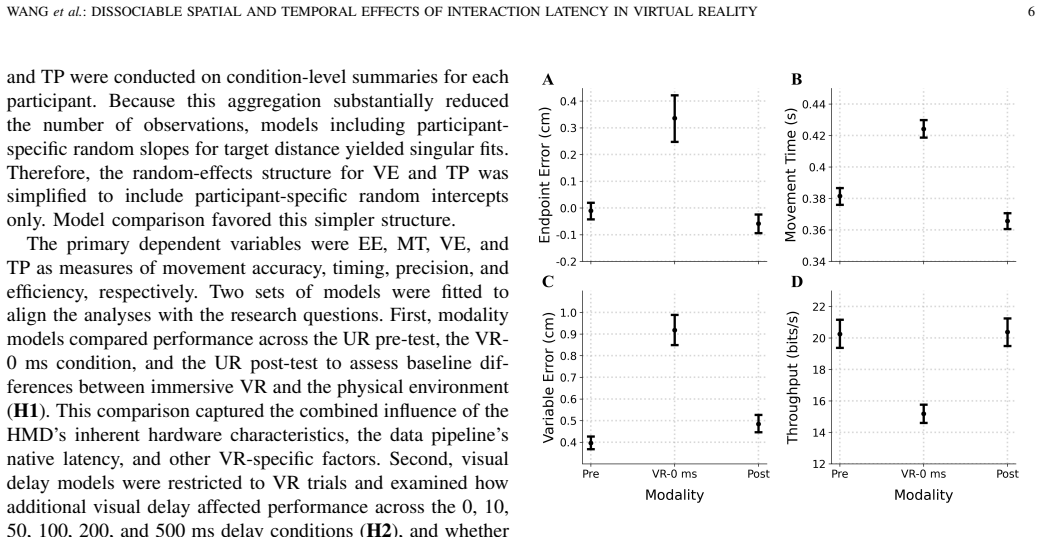
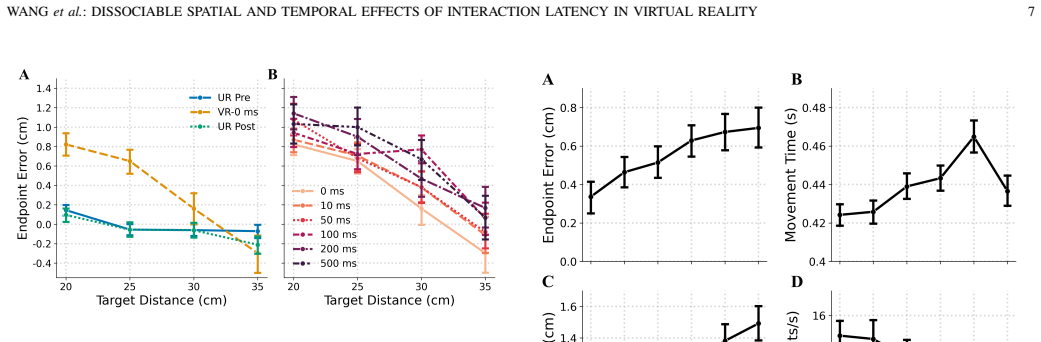
By adding delays in the motion capture pipeline that controls the virtual hand, the study shows that interaction latency produces dissociable effects: endpoint error and variability increase at short delays, movement time increases primarily at longer delays, and throughput declines. Relative to the physical baseline, VR already elevates error, time, variability, and lowers throughput, but the added-latency profiles differ by measure. The authors conclude that latency-sensitive VR interactions cannot be fully evaluated using movement time or efficiency measures alone and that both spatial and temporal performance must be assessed.
What carries the argument
Imposed delays (0-500 ms) between physical hand motion and rendered virtual hand movement in a motion-capture-controlled pointing task.
If this is right
- Endpoint accuracy detects interaction latency effects earlier than movement time in VR pointing tasks.
- HCI evaluations of VR must include spatial performance measures rather than relying only on temporal or throughput metrics.
- For visually guided manual actions, system assessments should check both spatial and temporal consequences of latency.
- Latency limits in VR design cannot be set using time-based measures alone if spatial accuracy is required.
Where Pith is reading between the lines
- Designers could monitor endpoint error as an early warning signal to adjust latency before users experience noticeable timing costs.
- The dissociation may extend to other VR manual tasks such as grasping or object placement where spatial precision matters.
- In training or simulation contexts, prioritizing spatial accuracy checks could improve safety even when movement times appear normal.
Load-bearing premise
The motion capture pipeline plus imposed delays isolate interaction latency without creating other uncontrolled differences in visual feedback or proprioception across conditions.
What would settle it
A replication in which endpoint error rises reliably at 50 ms or 100 ms added delay while movement time and throughput show no reliable change at those same short delays.
Figures


read the original abstract
Motion-to-photon latency is inherent in immersive virtual reality (VR) systems and can arise from multiple sensorimotor loops, including view-contingent latency between head movement and display update and interaction latency between hand movement and the virtual effector. Although prior work shows that interaction latency can impair VR performance, it remains unclear whether common spatial, temporal, and efficiency measures reveal the same latency-related disruption. This study addressed this question by experimentally imposing delays between the physical and virtual hands during manual pointing in VR. Participants pointed to targets on a horizontal surface in VR and in the physical environment as an unmediated baseline. In VR, pointing was performed with a virtual hand avatar controlled by a motion capture pipeline, and additional delays (0-500 ms) were imposed between the participant's hand movement and the rendered movement of the virtual hand. Relative to the baseline, performance in VR showed greater endpoint error, longer movement time, greater endpoint variability, and lower throughput. Within VR, added interaction latency further increased endpoint error and variability, reduced throughput, and altered movement time, but these effects followed different profiles: endpoint error increased even at the shortest delays, whereas movement time remained stable at short delays and increased primarily at longer delays. These findings show that interaction latency produces dissociable spatial and temporal consequences in immersive VR, such that endpoint accuracy revealed disruption before movement time or throughput. Thus, latency-sensitive VR interactions cannot be fully evaluated using movement time or efficiency measures alone. Instead, HCI evaluations should assess both spatial and temporal performance, particularly when VR tasks involve visually guided manual actions.
Editorial analysis
A structured set of objections, weighed in public.
Referee Report
Summary. The paper reports a within-subjects experiment in which participants performed manual pointing to targets on a horizontal surface, once in a physical baseline and once in VR with a motion-capture-controlled virtual hand avatar. Additional delays of 0–500 ms were inserted between physical hand movement and rendered virtual-hand movement. Relative to baseline, VR performance showed increased endpoint error and variability, longer movement times, and reduced throughput. Within the VR conditions, endpoint error rose even at the shortest added delays, whereas movement time remained stable until longer delays; throughput declined with delay. The authors conclude that interaction latency produces dissociable spatial and temporal effects and that HCI evaluations of latency-sensitive VR tasks must therefore include spatial accuracy measures in addition to temporal or efficiency metrics.
Significance. If the experimental manipulation cleanly isolates interaction latency, the dissociation between spatial and temporal measures would be a useful empirical contribution to VR/HCI evaluation methodology, indicating that movement-time or throughput alone can miss early latency effects. The controlled within-subjects design with graded delay levels and multiple dependent variables is a methodological strength.
major comments (1)
- [Abstract / experimental setup] Abstract, paragraph on experimental setup: the description states that delays were imposed 'between the participant's hand movement and the rendered movement of the virtual hand' via the motion-capture pipeline, but provides no information on whether buffering, filtering, avatar update rate, or visual rendering parameters remained constant across the 0–500 ms conditions. Because the central claim attributes the observed dissociation solely to interaction latency, any non-temporal change in the pipeline could introduce uncontrolled visuo-proprioceptive differences that undermine the attribution.
minor comments (1)
- [Abstract] Abstract does not report participant count, statistical tests, or error bars; these details belong in the abstract or a methods/results summary for immediate verifiability.
Simulated Author's Rebuttal
We thank the referee for the positive assessment of the work's significance and for identifying this point of clarification. We address the major comment below.
read point-by-point responses
-
Referee: [Abstract / experimental setup] Abstract, paragraph on experimental setup: the description states that delays were imposed 'between the participant's hand movement and the rendered movement of the virtual hand' via the motion-capture pipeline, but provides no information on whether buffering, filtering, avatar update rate, or visual rendering parameters remained constant across the 0–500 ms conditions. Because the central claim attributes the observed dissociation solely to interaction latency, any non-temporal change in the pipeline could introduce uncontrolled visuo-proprioceptive differences that undermine the attribution.
Authors: We agree that the abstract is concise and does not explicitly address constancy of other pipeline elements. In the Methods section, delays were introduced exclusively by inserting a variable-length buffer into the motion-capture data stream after capture but before avatar rendering; the motion-capture sampling rate, any low-pass filtering, the virtual-hand mesh and shader parameters, and the HMD rendering rate were identical across all VR delay conditions. This design isolates the added interaction latency. To make the isolation explicit for readers who encounter only the abstract, we will revise the abstract to state that other pipeline parameters remained constant. revision: yes
Circularity Check
No circularity: purely empirical study with no derivations or model-based predictions
full rationale
The paper reports an experimental manipulation of interaction latency in VR (imposing 0-500 ms delays via motion capture) and measures resulting changes in endpoint error, movement time, variability, and throughput. No equations, fitted parameters, uniqueness theorems, or predictive models are present. All claims rest directly on observed data patterns from the controlled conditions versus baseline. No load-bearing step reduces to a self-definition, fitted input, or self-citation chain.
Axiom & Free-Parameter Ledger
Reference graph
Works this paper leans on
-
[1]
Tolerance of temporal delay in virtual environments,
R. S. Allison, L. R. Harris, M. Jenkin, U. Jasiobedzka, and J. E. Zacher, “Tolerance of temporal delay in virtual environments,” inProc. IEEE Virtual Reality, 2001, pp. 247–254
2001
-
[2]
A systematic review of Fitts’ law in 3D extended reality,
M. Amini, W. Stuerzlinger, R. J. Teather, and A. U. Batmaz, “A systematic review of Fitts’ law in 3D extended reality,” inProc. CHI Conf. Human Factors in Computing Systems, 2025, pp. 1–25
2025
-
[3]
System latency guidelines then and now–is zero latency really considered necessary?,
C. Attig, N. Rauh, T. Franke, and J. F. Krems, “System latency guidelines then and now–is zero latency really considered necessary?,” inProc. Int. Conf. Engineering Psychology and Cognitive Ergonomics, 2017, pp. 3– 14
2017
-
[4]
The effect of stereo display deficiencies on virtual hand pointing,
M. D. Barrera Machuca and W. Stuerzlinger, “The effect of stereo display deficiencies on virtual hand pointing,” inProc. CHI Conf. Human Factors in Computing Systems, 2019, pp. 1–14
2019
-
[5]
Do head-mounted display stereo deficiencies affect 3D pointing tasks in AR and VR?
A. U. Batmaz, M. D. Barrera Machuca, D. M. Pham, and W. Stuerzlinger, “Do head-mounted display stereo deficiencies affect 3D pointing tasks in AR and VR?” inProc. IEEE Conf. Virtual Reality and 3D User Interfaces (VR), 2019, pp. 585–592
2019
-
[6]
The effect of the vergence-accommodation conflict on virtual hand pointing in immersive displays,
A. U. Batmaz, M. D. Barrera Machuca, J. Sun, and W. Stuerzlinger, “The effect of the vergence-accommodation conflict on virtual hand pointing in immersive displays,” inProc. CHI Conf. Human Factors in Computing Systems, Apr. 2022, pp. 1–15
2022
-
[7]
Re-investigating the effect of the vergence- accommodation conflict on 3D pointing,
A. U. Batmaz, R. Turkmen, M. Sarac, M. D. Barrera Machuca, and W. Stuerzlinger, “Re-investigating the effect of the vergence- accommodation conflict on 3D pointing,” inProc. 29th ACM Symp. Virtual Reality Software and Technology, Oct. 2023, pp. 1–10
2023
-
[8]
bmlTUX: Design and control of experi- ments in virtual reality and beyond,
A. O. Bebko and N. F. Troje, “bmlTUX: Design and control of experi- ments in virtual reality and beyond,”I-Perception, vol. 11, no. 4, 2020
2020
-
[9]
M. S. Ben-Shachar, D. L ¨udecke, and D. Makowski. effectsize: Estimation of effect size indices and standardized parameters.Journal of Open Source Software, 5(56):2815, 2020
2020
-
[10]
Impact of virtual reality training on real-world hockey skill: An intervention trial,
M. Buns, “Impact of virtual reality training on real-world hockey skill: An intervention trial,”Journal of Sports Science, vol. 8, no. 1, pp. 8–16, 2020
2020
-
[11]
Computer response time and user performance,
T. W. Butler, “Computer response time and user performance,” inProc. SIGCHI Conf. Human Factors in Computing Systems, 1983, pp. 58–62
1983
-
[12]
Delays and user performance in human- computer-network interaction tasks,
B. S. Caldwell and E. Wang, “Delays and user performance in human- computer-network interaction tasks,”Human Factors, vol. 51, no. 6, pp. 813–830, 2009
2009
-
[13]
Training of drone pilots through virtual reality environments under the gamification approach in a university context,
H. Cardona-Reyes, C. Trujillo-Espinoza, C. Arevalo-Mercado, and J. Mu ˜noz-Arteaga, “Training of drone pilots through virtual reality environments under the gamification approach in a university context,” Interaction Design and Architecture(s), no. 49, pp. 64–83, 2021
2021
-
[14]
Seamful design and ubicomp infrastructure,
M. Chalmers, “Seamful design and ubicomp infrastructure,” inProc. Ubicomp 2003 Workshop at the Crossroads: The Interaction of HCI and Systems Issues in Ubicomp, 2003, pp. 577–584
2003
-
[15]
Seamful and seamless design in ubiqui- tous computing,
M. Chalmers and I. MacColl, “Seamful and seamless design in ubiqui- tous computing,” inWorkshop at the Crossroads: The Interaction of HCI and Systems Issues in UbiComp, vol. 8, 2003, p. 10
2003
-
[16]
Effects of end-to-end latency on user experience and performance in immersive virtual reality applications,
P. Caserman, M. Martinussen, and S. G ¨obel, “Effects of end-to-end latency on user experience and performance in immersive virtual reality applications,” inProc. Joint Int. Conf. Entertainment Computing and Serious Games, 2019, pp. 57–69
2019
-
[17]
Extending Fitts’ law in three-dimensional virtual environments with current low-cost virtual reality technology,
L. D. Clark, A. B. Bhagat, and S. L. Riggs, “Extending Fitts’ law in three-dimensional virtual environments with current low-cost virtual reality technology,”International Journal of Human-Computer Studies, vol. 139, p. 102413, 2020
2020
-
[18]
Is 100 milliseconds too fast?,
J. Dabrowski and E. Munson, “Is 100 milliseconds too fast?,”Interacting with Computers, vol. 23, no. 5, pp. 555–568, 2011
2011
-
[19]
Keeping users in the flow: Mapping system responsiveness with user experience,
R. A. Doherty and P. Sorenson, “Keeping users in the flow: Mapping system responsiveness with user experience,”Procedia Manufacturing, vol. 3, pp. 4384–4391, 2015
2015
-
[20]
Effects of image scale and system time delay on simulator sickness within head- coupled virtual environments,
M. H. Draper, D. B. Viirre, T. A. Furness, and J. W. Gawron, “Effects of image scale and system time delay on simulator sickness within head- coupled virtual environments,”Human Factors, vol. 43, no. 1, pp. 129– 146, 2001
2001
-
[21]
A century later: Woodworth’s (1899) two-component model of goal-directed aiming,
D. Elliott, W. F. Helsen, and R. Chua, “A century later: Woodworth’s (1899) two-component model of goal-directed aiming,”Psychological Bulletin, vol. 127, no. 3, pp. 342–357, 2001
2001
-
[22]
The ultimate display for physical rehabilita- tion: A bridging review on immersive virtual reality,
A. Elor and S. Kurniawan, “The ultimate display for physical rehabilita- tion: A bridging review on immersive virtual reality,”Frontiers in Virtual Reality, vol. 1, Art. no. 585993, 2020
2020
-
[23]
Monitoring and evaluation of time delay,
A. R. Fischer, F. J. Blommaert, and C. J. Midden, “Monitoring and evaluation of time delay,”International Journal of Human-Computer Interaction, vol. 19, no. 2, pp. 163–180, 2005
2005
-
[24]
The effects of low latency on pointing and steering tasks,
S. Friston, P. Karlstr ¨om, and A. Steed, “The effects of low latency on pointing and steering tasks,”IEEE Transactions on Visualization and Computer Graphics, vol. 22, no. 5, pp. 1605–1615, 2015
2015
-
[25]
Advances in neurosurgical education: Literature review of mixed-reality simulation models and novel mixed-reality spine prototype,
J. P. Giraldo, S. S. Cho, N. B. Eghrari, N. Dholaria, S. H. Farber, R. B. Ehredt, C. Michaels, D. J. Fotias, J. Godzik, V . K. Sonntag,et al., “Advances in neurosurgical education: Literature review of mixed-reality simulation models and novel mixed-reality spine prototype,”Journal of Neurosurgery: Spine, vol. 42, no. 3, pp. 385–398, 2025
2025
-
[26]
Fitts’ law with transmission delay,
E. R. Hoffmann, “Fitts’ law with transmission delay,”Ergonomics, vol. 35, no. 1, pp. 37–48, 1992
1992
-
[27]
Motion prediction and pre-rendering at the edge to enable ultra-low latency mobile 6DoF experiences,
X. Hou and S. Dey, “Motion prediction and pre-rendering at the edge to enable ultra-low latency mobile 6DoF experiences,”IEEE Open Journal of the Communications Society, vol. 1, pp. 1674–1690, 2020
2020
-
[28]
Head and body motion prediction to enable mobile VR experiences with low latency,
X. Hou, J. Zhang, M. Budagavi, and S. Dey, “Head and body motion prediction to enable mobile VR experiences with low latency,” inProc. IEEE Global Communications Conf. (GLOBECOM), 2019, pp. 1–7
2019
-
[29]
Influence of motion speed on the perception of latency in avatar control,
L. Hoyet, C. Spies, P. Plantard, A. Sorel, R. Kulpa, and F. Multon, “Influence of motion speed on the perception of latency in avatar control,” inProc. IEEE Int. Conf. Artificial Intelligence and Virtual Reality (AIVR), 2019, pp. 286–2863
2019
-
[30]
Improving depth perception in immersive media devices by addressing vergence-accommodation conflict,
R. Hussain, M. Chessa, and F. Solari, “Improving depth perception in immersive media devices by addressing vergence-accommodation conflict,”IEEE Transactions on Visualization and Computer Graphics, vol. 30, no. 9, pp. 6334–6346, 2023
2023
-
[31]
Geneva, Switzerland, 2015
International Organization for Standardization,ISO 9241-411:2015 Er- gonomics of human-system interaction – Part 411: Evaluation methods for the design of physical input devices. Geneva, Switzerland, 2015
2015
-
[32]
Modeling the impact of depth on pointing performance,
I. Janzen, V . K. Rajendran, and K. S. Booth, “Modeling the impact of depth on pointing performance,” inProc. CHI Conf. Human Factors in Computing Systems, 2016, pp. 188–199
2016
-
[33]
Vection and visually induced motion sickness: How are they related?,
B. Keshavarz, B. E. Riecke, L. J. Hettinger, and J. L. Campos, “Vection and visually induced motion sickness: How are they related?,”Frontiers in Psychology, vol. 6, Art. no. 472, 2015
2015
-
[34]
Human orientation and movement control in weightless and artificial gravity environments,
J. R. Lackner and P. DiZio, “Human orientation and movement control in weightless and artificial gravity environments,”Experimental Brain Research, vol. 130, no. 1, pp. 2–26, 2000
2000
-
[35]
Head tracking for the Oculus Rift,
S. M. LaValle, A. Yershova, M. Katsev, and M. Antonov, “Head tracking for the Oculus Rift,” inProc. IEEE Int. Conf. Robotics and Automation (ICRA), 2014, pp. 187–194
2014
-
[36]
Lag as a determinant of human performance in interactive systems,
I. S. MacKenzie and C. Ware, “Lag as a determinant of human performance in interactive systems,” inProc. INTERACT’93 and CHI’93 Conf. Human Factors in Computing Systems, 1993, pp. 488–493
1993
-
[37]
D. M. Manzone, X. M. Wang, G. Oancea, S. Jafri, J. X. Manzone, T. N. Welsh, and L. Tremblay, “Exploring sensorimotor efficiency of two- and three-dimensional aiming movements in virtual environments,” PLOS ONE, under review. doi: 10.31234/osf.io/m96d4
-
[38]
Effects of low-range latency on performance and perception in a virtual, unstable second-order control task,
J. Martens, T. Franke, N. Rauh, and J. F. Krems, “Effects of low-range latency on performance and perception in a virtual, unstable second-order control task,”Quality and User Experience, vol. 3, no. 1, p. 10, 2018
2018
-
[39]
The future of telerehabilitation: Embracing virtual reality and augmented reality innovations,
W. M. Naqvi, I. W. Naqvi, G. V . Mishra, and V . D. Vardhan, “The future of telerehabilitation: Embracing virtual reality and augmented reality innovations,”Pan African Medical Journal, vol. 47, no. 1, 2024
2024
-
[40]
A sensorimotor account of vision and visual consciousness,
J. K. O’Regan and A. No ¨e, “A sensorimotor account of vision and visual consciousness,”Behavioral and Brain Sciences, vol. 24, no. 5, pp. 939– 973, 2001
2001
-
[41]
A system to measure, control and minimize end-to-end head tracking latency in immersive simulations,
G. Papadakis, K. Mania, and E. Koutroulis, “A system to measure, control and minimize end-to-end head tracking latency in immersive simulations,” inProc. 10th Int. Conf. Virtual Reality Continuum and Its Applications in Industry, 2011, pp. 581–584
2011
-
[42]
PsychoPy2: Experiments in behavior made easy,
J. Peirce, J. R. Gray, S. Simpson, M. MacAskill, R. H ¨ochenberger, H. Sogo, E. Kastman, and J. K. Lindeløv, “PsychoPy2: Experiments in behavior made easy,”Behavior Research Methods, vol. 51, no. 1, pp. 195– 203, 2019. W ANGet al.: DISSOCIABLE SPATIAL AND TEMPORAL EFFECTS OF INTERACTION LATENCY IN VIRTUAL REALITY 12
2019
-
[43]
Response time and display rate in human performance with computers,
B. Shneiderman, “Response time and display rate in human performance with computers,”ACM Computing Surveys, vol. 16, no. 3, pp. 265–285, 1984
1984
-
[44]
Singmann, B
H. Singmann, B. Bolker, J. Westfall, F. Aust, and M. S. Ben-Shachar, afex: Analysis of factorial experiments, R package version 0.13–145, 2015
2015
-
[45]
Place illusion and plausibility can lead to realistic behaviour in immersive virtual environments,
M. Slater, “Place illusion and plausibility can lead to realistic behaviour in immersive virtual environments,”Philosophical Transactions of the Royal Society B: Biological Sciences, vol. 364, no. 1535, pp. 3549–3557, 2009
2009
-
[46]
The effects of delayed and displaced visual feedback on motor control,
W. M. Smith and K. F. Bowen, “The effects of delayed and displaced visual feedback on motor control,”Journal of Motor Behavior, vol. 12, no. 2, pp. 91–101, 1980
1980
-
[47]
A separate reality: An update on place illusion and plausibility in virtual reality,
M. Slater, D. Banakou, A. Beacco, J. Gallego, F. Macia-Varela, and R. Oliva, “A separate reality: An update on place illusion and plausibility in virtual reality,”Frontiers in Virtual Reality, vol. 3, Art. no. 914392, 2022
2022
-
[48]
Effects of latency jitter on simulator sickness in a search task,
J.-P. Stauffert, F. Niebling, and M. E. Latoschik, “Effects of latency jitter on simulator sickness in a search task,” inProc. IEEE Conf. Virtual Reality and 3D User Interfaces (VR), 2018, pp. 121–127
2018
-
[49]
Latency and cyber- sickness: Impact, causes, and measures. A review,
J.-P. Stauffert, F. Niebling, and M. E. Latoschik, “Latency and cyber- sickness: Impact, causes, and measures. A review,”Frontiers in Virtual Reality, vol. 1, Art. no. 582204, 2020
2020
-
[50]
How virtual hand representations affect the perceptions of dynamic affordances in virtual reality,
R. Venkatakrishnan, R. Venkatakrishnan, B. Raveendranath, C. C. Pagano, A. C. Robb, W.-C. Lin, and S. V . Babu, “How virtual hand representations affect the perceptions of dynamic affordances in virtual reality,” inIEEE Trans. Vis. Comput. Graph., vol. 29, no. 5, pp. 2258–2268, 2023
2023
-
[51]
The impact of latency on perceptual judgments and motor performance in closed-loop interaction in virtual reality,
T. Waltemate, I. Senna, F. H ¨ulsmann, M. Rohde, S. Kopp, M. Ernst, and M. Botsch, “The impact of latency on perceptual judgments and motor performance in closed-loop interaction in virtual reality,” inProc. 22nd ACM Conf. Virtual Reality Software and Technology, 2016, pp. 27–35
2016
-
[52]
Perceptual–Motor Interaction: Some Implications for Human–Computer Interaction,
X. M. Wang, R. Chua, D. J. Weeks, and T. N. Welsh, “Perceptual–Motor Interaction: Some Implications for Human–Computer Interaction,” inThe Human-Computer Interaction Handbook, 4th ed., J. A. Jacko, Ed. Boca Raton, FL, USA: CRC Press, in press
-
[53]
X. M. Wang, J. Liu, T. N. Welsh, and A. Chan, “Development of AI- assisted, immersive virtual reality learning module to enhance operation and procedural accuracy for laboratory education,” presented at the2025 American Society for Engineering Education (ASEE) Annual Conference & Exposition, Montreal, QC, Canada, 2025. doi: 10.18260/1-2–56279
-
[54]
Virtual reality alters perceived functional body size,
X. M. Wang, A. Mazalek, C. M. Sabiston, and T. N. Welsh, “Virtual reality alters perceived functional body size,”Virtual Reality, 2026. doi: 10.1007/s10055-026-01368-5
-
[55]
Mixed reality alters motor planning and control,
X. M. Wang, M. Nitsche, G. Resch, A. Mazalek, and T. N. Welsh, “Mixed reality alters motor planning and control,”Behavioural Brain Research, vol. 480, Art. no. 115373, 2025
2025
-
[56]
Investigating a geometrical solution to the vergence-accommodation conflict for targeted movements in virtual reality,
X. M. Wang, M. Prenevost, A. Tarun, I. Robinson, M. Nitsche, G. Resch, A. Mazalek, and T. N. Welsh, “Investigating a geometrical solution to the vergence-accommodation conflict for targeted movements in virtual reality,”Displays, Art. no. 103382, 2026
2026
-
[57]
Prolonged exposure to mixed reality alters task performance in the unmediated environment,
X. M. Wang, D. Southwick, I. Robinson, M. Nitsche, G. Resch, A. Mazalek, and T. N. Welsh, “Prolonged exposure to mixed reality alters task performance in the unmediated environment,”Scientific Reports, vol. 14, no. 1, Art. no. 18938, 2024
2024
-
[58]
The geometry of vergence-accommodation conflict in mixed reality systems,
X. M. Wang, D. Southwick, I. Robinson, M. Nitsche, G. Resch, A. Mazalek, and T. N. Welsh, “The geometry of vergence-accommodation conflict in mixed reality systems,”Virtual Reality, vol. 28, Art. no. 95,
-
[59]
doi: 10.1007/s10055-024-00991-4
-
[60]
X. M. Wang and N. F. Troje, “Relating visual and pictorial space: Binoc- ular disparity for distance, motion parallax for direction,”Visual Cogni- tion, vol. 31, pp. 107–125, 2023. doi: 10.1080/13506285.2023.2203528
-
[61]
Relating visual and pictorial space: Integration of binocular disparity and motion parallax,
X. M. Wang and N. F. Troje, “Relating visual and pictorial space: Integration of binocular disparity and motion parallax,”Journal of Vision, vol. 24, no. 13, p. 7, 2024
2024
-
[62]
TAT-HUM: Trajectory analysis toolkit for human movements in Python,
X. M. Wang and T. N. Welsh, “TAT-HUM: Trajectory analysis toolkit for human movements in Python,”Behavior Research Methods, 2024. doi: 10.3758/s13428-024-02378-4
-
[63]
Reaching for objects in VR displays: Lag and frame rate,
C. Ware and R. Balakrishnan, “Reaching for objects in VR displays: Lag and frame rate,”ACM Transactions on Computer-Human Interaction, vol. 1, no. 4, pp. 331–356, 1994
1994
-
[64]
Measuring motion-to-photon latency for sensorimotor experiments with virtual reality systems,
M. Warburton, M. Mon-Williams, F. Mushtaq, and J. R. Morehead, “Measuring motion-to-photon latency for sensorimotor experiments with virtual reality systems,”Behavior Research Methods, vol. 55, no. 7, pp. 3658–3678, 2023
2023
-
[65]
Understanding the effect of latency on user performance of target selection in virtual reality,
Y . Weiet al., “Understanding the effect of latency on user performance of target selection in virtual reality,”IEEE Transactions on Visualization and Computer Graphics, vol. 32, no. 2, pp. 2200–2215, 2026
2026
-
[66]
The effect of latency on movement time in path-steering tasks,
S. Yamanaka and W. Stuerzlinger, “The effect of latency on movement time in path-steering tasks,” inProc. CHI Conf. Human Factors in Computing Systems, 2024, pp. 1–19
2024
-
[67]
Dynamic changes of latency perception threshold in virtual reality: Behavioral and EEG evidence,
S. Yang, K. Yue, H. Gao, M. Guo, Y . Liu, D. Zhang, and Y . Liu, “Dynamic changes of latency perception threshold in virtual reality: Behavioral and EEG evidence,”IEEE Transactions on Visualization and Computer Graphics, 2025
2025
-
[68]
M. Yinet al., “MRCoach: A real-time IoT-enabled mixed reality system with semantic-aware transmission for smart sports and personalized coaching,”IEEE Internet of Things Journal, vol. 12, no. 24, pp. 52466– 52473, Dec. 15, 2025, doi: 10.1109/JIOT.2025.3612408
-
[69]
Break the window: Exploring spatial decomposition of webpages in XR,
C. Zhang, T. Wei, H. Yang, M. Gonzalez-Franco, Y . Yang, and E. J. Gon- zalez, “Break the window: Exploring spatial decomposition of webpages in XR,” inProc. Extended Abstracts 2026 CHI Conf. Human Factors Comput. Syst., 2026, pp. 1–6
2026
-
[70]
Estimating the motion-to-photon latency in head mounted displays,
J. Zhao, R. S. Allison, M. Vinnikov, and S. Jennings, “Estimating the motion-to-photon latency in head mounted displays,” inProc. IEEE Virtual Reality (VR), Mar. 2017, pp. 313–314
2017
-
[71]
How to define the user’s tolerance of response time in using mobile applications,
R. Zhou, S. Shao, W. Li, and L. Zhou, “How to define the user’s tolerance of response time in using mobile applications,” inProc. IEEE Int. Conf. Industrial Engineering and Engineering Management (IEEM), 2016, pp. 281–285
2016
discussion (0)
Sign in with ORCID, Apple, or X to comment. Anyone can read and Pith papers without signing in.