Spectroscopic surveys with the SKA probing the ionized and molecular Milky Way
Pith reviewed 2026-06-25 19:57 UTC · model grok-4.3
The pith
SKA spectroscopic surveys will map small molecules and ionized gas across the Milky Way to trace star formation conditions.
A machine-rendered reading of the paper's core claim, the machinery that carries it, and where it could break.
Core claim
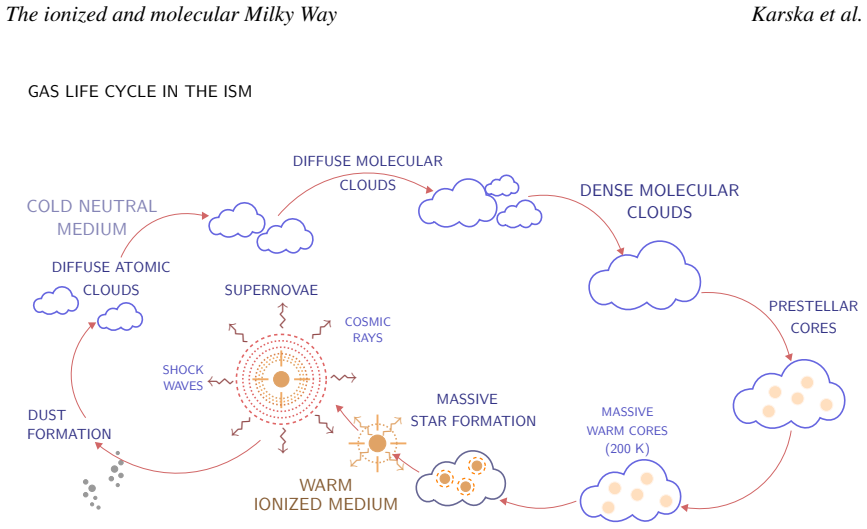
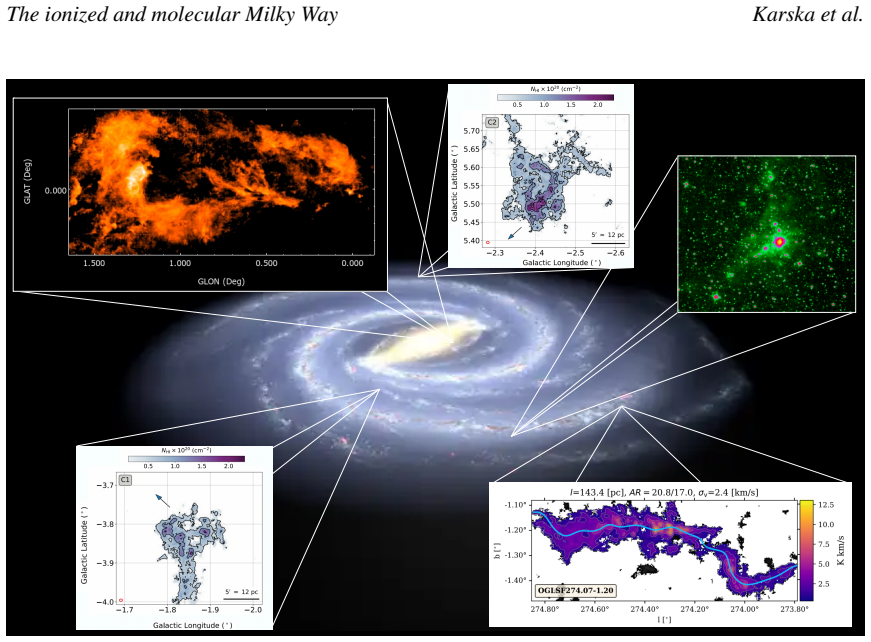
Deep, wide-field SKA observations of small molecules and recombination lines toward the inner and outer Galaxy will constrain the processes forming molecular clouds, the structure of HII regions, and the role of CO-dark gas in star formation, providing a local template for galaxy evolution studies.
What carries the argument
Spectroscopic surveys of small molecules (OH, CH, H2CO) and radio recombination lines, which probe the transition from atomic to molecular phases and the properties of ionized gas across density and metallicity gradients.
If this is right
- OH and CH surveys would directly measure the formation rate of molecular clouds in low-density regimes.
- Radio recombination line maps would trace the large-scale structure of ionized gas and HII regions throughout the disk.
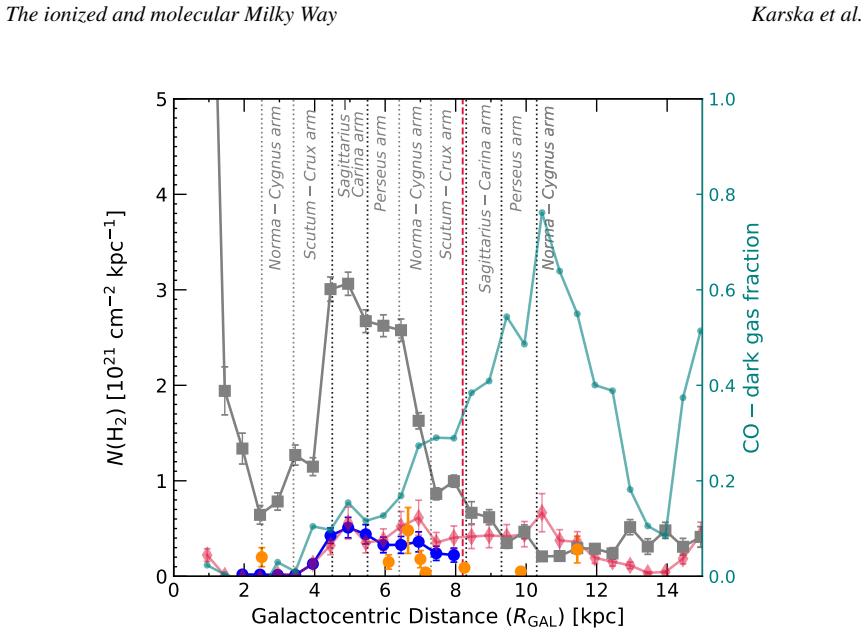
- H2CO observations would quantify the contribution of CO-dark gas to the total molecular reservoir and its link to star formation efficiency.
- The combined dataset would calibrate relations between ISM phases and star formation rates that can be applied to distant galaxies.
Where Pith is reading between the lines
- Such surveys could test whether the Milky Way's metallicity gradient produces measurable changes in molecular formation pathways compared to metal-poor systems.
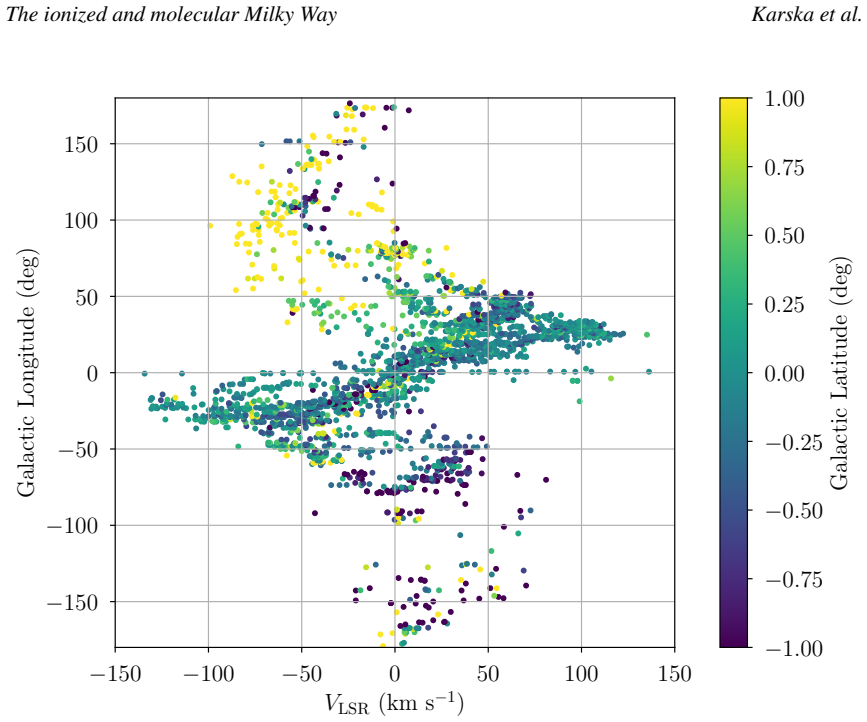
- The same line data might allow kinematic separation of spiral arm and inter-arm gas on scales not previously accessible at these frequencies.
- If successful, the approach would prioritize SKA time allocation toward wide shallow fields rather than deep targeted pointings for ISM studies.
Load-bearing premise
The SKA will achieve the sensitivity, angular resolution, and wide-field coverage needed to detect these lines in sufficient numbers across the full Galactic disk.
What would settle it
If SKA observations of the proposed fields detect far fewer OH or H2CO lines than predicted by current models of cloud formation, or fail to map recombination lines at the expected spatial scales, the case for unique new insights into ISM conditions would not hold.
Figures

read the original abstract
Radio spectroscopic surveys provide us with a comprehensive picture of the Milky Way across many physical and chemical regimes. Spectral lines primarily probe the multi-phase gaseous interstellar medium (ISM) from its ionized to atomic and molecular phases, and constrain both local and galaxy-scale kinematics and structure through Doppler shifts. By investigating the physical and chemical properties and distribution of the ISM, the processes driving star formation and galaxy evolution can be studied in detail. This motivates line surveys of our Galaxy that allow us to use the range of physical conditions found in the Milky Way as a template for understanding star formation in extragalactic environments. In this chapter, we describe the science enabled by the spectroscopy of small molecules and radio recombination lines of atoms toward a range of Galactic environments with the SKA. We address questions concerning the processes that dictate the formation of molecular clouds (OH, CH), the properties of warm, ionized gas and the potential of HII regions in understanding the structure of the Galaxy (radio recombination lines), and the impact of CO-dark molecular gas across various density regimes on star formation and galaxy evolution (OH, H2CO). We propose a survey that includes the inner and outer Galaxy disk, characterized by a broad range of densities, temperatures, and metallicities. Deep, wide-field observations of small molecules will be uniquely accessible with SKA, providing key insights on the condition of interstellar medium in galaxies and its impact on star formation.
Editorial analysis
A structured set of objections, weighed in public.
Referee Report
Summary. The manuscript presents a forward-looking science case for radio spectroscopic surveys with the Square Kilometre Array (SKA) targeting small molecules (OH, CH, H2CO) and radio recombination lines across the inner and outer Milky Way disk. It argues that such observations will probe molecular cloud formation, properties of warm ionized gas and HII regions, the role of CO-dark molecular gas, and their collective impact on star formation, using the Milky Way's range of conditions as a template for extragalactic environments. The central claim is that deep, wide-field observations of these tracers will be uniquely accessible with the SKA.
Significance. If the SKA realizes the required sensitivity, resolution, and wide-field survey speed, the proposed observations could deliver new constraints on multi-phase ISM physics and star-formation processes that are difficult to obtain with existing facilities, thereby strengthening the Milky Way as a local benchmark for galaxy evolution studies.
major comments (2)
- [Abstract] Abstract: the assertion that deep, wide-field observations of small molecules 'will be uniquely accessible with SKA' is load-bearing for the central claim yet is unsupported by any quantitative comparison of SKA sensitivity, survey speed, or resolution against current or planned instruments (e.g., MeerKAT, ngVLA, or ALMA).
- [Full text (survey proposal section)] Science-case description: no survey parameters (integration time per field, total sky coverage, expected line sensitivities, or detection-rate estimates) are supplied for the proposed inner- and outer-disk observations, leaving the feasibility of the 'deep, wide-field' program unquantified.
minor comments (1)
- The manuscript would benefit from a concise table listing the key transitions (rest frequencies, critical densities) of OH, CH, H2CO, and the recombination lines discussed.
Simulated Author's Rebuttal
We thank the referee for the positive overall assessment and the specific comments, which help strengthen the presentation of the science case. We address each major comment below.
read point-by-point responses
-
Referee: [Abstract] Abstract: the assertion that deep, wide-field observations of small molecules 'will be uniquely accessible with SKA' is load-bearing for the central claim yet is unsupported by any quantitative comparison of SKA sensitivity, survey speed, or resolution against current or planned instruments (e.g., MeerKAT, ngVLA, or ALMA).
Authors: We agree that the uniqueness claim benefits from explicit quantitative support. In the revised manuscript we will insert a short paragraph (or table) in the abstract or introduction that compares SKA1-MID expected line sensitivities, survey speed, and field-of-view at the relevant frequencies (1–10 GHz) against MeerKAT, ngVLA, and ALMA for the OH, CH, and H2CO transitions, thereby grounding the statement. revision: yes
-
Referee: [Full text (survey proposal section)] Science-case description: no survey parameters (integration time per field, total sky coverage, expected line sensitivities, or detection-rate estimates) are supplied for the proposed inner- and outer-disk observations, leaving the feasibility of the 'deep, wide-field' program unquantified.
Authors: The chapter is written as a high-level science motivation rather than a technical proposal. We nevertheless accept that indicative numbers improve credibility. We will add a concise new subsection that supplies order-of-magnitude estimates for integration time per pointing, total area, 5-sigma line sensitivities, and rough detection-rate expectations derived from SKA1-MID specifications and existing pilot data. revision: yes
Circularity Check
No circularity: descriptive proposal with no derivations or equations
full rationale
The document is a forward-looking science-case proposal chapter. It contains no equations, derivations, fitted parameters, predictions, or load-bearing self-citations. Claims rest on anticipated SKA instrument performance rather than any internal chain that reduces to its own inputs. No steps meet the criteria for circularity.
Axiom & Free-Parameter Ledger
axioms (1)
- domain assumption SKA will enable unique deep wide-field observations of small molecules and recombination lines
Reference graph
Works this paper leans on
-
[1]
doi: 10.1051/0004-6361/200913474. W. S. Adams. ApJ, 93:11, Jan
-
[2]
doi: 10.1086/144237. R. J. Allen, M. Ivette Rodríguez, J. H. Black, and R. S. Booth. AJ, 143(4):97, Apr
-
[3]
doi: 10.1088/0004-6256/143/ 4/97. R. J. Allen, D. E. Hogg, and P. D. Engelke. AJ, 149(4):123, Apr
-
[4]
doi: 10.1088/0004-6256/149/4/123. K. R. Anantharamaiah.Journal of Astrophysics and Astronomy, 7(3):131–139, Sept
-
[5]
doi: 10.1007/BF02714206. L. D. Anderson and T. M. Bania. ApJ, 690:706–719, Jan
-
[6]
doi: 10.1088/0004-637X/690/1/706. L. D. Anderson, T. M. Bania, D. S. Balser, and R. T. Rood. ApJ, 754:62, July
-
[7]
doi: 10.1088/0004-637X/754/1/62. L. D. Anderson et al. ApJS, 212:1, May
-
[8]
doi: 10.1088/0067-0049/212/1/1. L. D. Anderson et al. ApJS, 221:26, Dec. 2015a. doi: 10.1088/0067-0049/221/2/26. L. D. Anderson et al. ApJ, 810:42, Sept. 2015b. doi: 10.1088/0004-637X/810/1/42. L. D. Anderson et al. ApJS, 254(2):28, June
-
[9]
doi: 10.3847/1538-4365/abef65. P. André et al. In H. Beuther, R. S. Klessen, C. P. Dullemond, and T. Henning, editors,Protostars and Planets VI, page 27, Jan
-
[10]
doi: 10.2458/azu\_uapress\_9780816531240-ch002. E. M. Arnal and W. M. Goss. A&A, 145:369–376, Apr
-
[11]
doi: 10.1051/0004-6361/201116596. A. Asensio Ramos and M. Elitzur. A&A, 616:A131, Sept
-
[12]
doi: 10.1051/0004-6361/201731943. E. Audit and P. Hennebelle. A&A, 433(1):1–13, Apr
-
[13]
doi: 10.1051/0004-6361:20041474. T. M. Bania et al. ApJ, 972(2):192, Sept
-
[14]
doi: 10.3847/1538-4357/ad5f8b. J. E. Barnes, K. Wood, A. S. Hill, and L. M. Haffner. MNRAS, 447:559–566, Feb
-
[15]
L.Barriault,G.Joncas,F.J.Lockman,andP.G.Martin.MNRAS,407:2645–2659,Oct.2010.doi: 10.1111/j.1365-2966
doi: 10.1093/mnras/stu2454. L.Barriault,G.Joncas,F.J.Lockman,andP.G.Martin.MNRAS,407:2645–2659,Oct.2010.doi: 10.1111/j.1365-2966. 2010.17105.x. E. Bellomi et al. A&A, 643:A36, Nov
-
[16]
doi: 10.1051/0004-6361/202038593. H. Beuther et al. A&A, 595:A32, Oct
-
[17]
doi: 10.1051/0004-6361/201629143. H. Beuther et al. A&A, 628:A90, Aug
-
[18]
doi: 10.1051/0004-6361/201935936. S. Bialy, B. Burkhart, and A. Sternberg. ApJ, 843(2):92, July
-
[19]
doi: 10.3847/1538-4357/aa7854. T. G. Bisbas, P. P. Papadopoulos, and S. Viti. ApJ, 803(1):37, Apr
-
[20]
doi: 10.1088/0004-637X/803/1/37. L. Blitz and E. Rosolowsky. ApJ, 650:933–944, Oct
-
[21]
doi: 10.1086/505417. J. B. G. M. Bloemen. ApJ, 317:L15, June
-
[22]
doi: 10.1086/184904. T. L. Bourke et al. InAdvancing Astrophysics with the SKA – II (AASKAII)
-
[23]
URLhttps://arxiv. org/abs/1912.12699. L. Bronfman et al. ApJ, 324:248, Jan
arXiv 1912
-
[24]
doi: 10.1086/165892. C. Brown, J. M. Dickey, J. R. Dawson, and N. M. McClure-Griffiths. ApJS, 211(2):29, Apr
-
[25]
doi: 10.1086/344796. A. Brunthaler et al. A&A, 651:A85, July
-
[26]
doi: 10.1051/0004-6361/202039856. M. P. Busch.ApJ, 967:148, 5
-
[27]
ISSN 0004-637X. doi: 10.3847/1538-4357/AD3AF6. URL https://iopscience.iop.org/article/10.3847/1538-4357/ad3af6https://iopscience.iop.org/ article/10.3847/1538-4357/ad3af6/meta. M. P. Busch et al. ApJ, 883(2):158, Oct
-
[28]
doi: 10.3847/1538-4357/ab3a4b. M. P. Busch, P. D. Engelke, R. J. Allen, and D. E. Hogg. ApJ, 914(1):72, June
-
[29]
doi: 10.3847/1538-4357/abf832. E. Cappellazzo et al. ApJ, 996(1):15, Jan
-
[30]
doi: 10.3847/1538-4357/ae1970. M. Chevance et al. MNRAS, 494(4):5279–5292, June
-
[31]
doi: 10.1093/mnras/staa1106. S. E. Clark, J. E. G. Peek, and M. A. Miville-Deschênes. ApJ, 874(2):171, Apr
-
[32]
doi: 10.3847/1538-4357/ab0b3b. D. Colombo et al. MNRAS, 475(2):1791–1808, Apr
-
[33]
doi: 10.1093/mnras/stx3233. D. Colombo et al. A&A, 644:A97, Dec
-
[34]
doi: 10.1051/0004-6361/202039005. D. Colombo et al. A&A, 655:L2, Nov
-
[35]
doi: 10.1051/0004-6361/202142182. D. Colombo et al. A&A, 658:A54, Feb
-
[36]
doi: 10.1051/0004-6361/202141287. D. Colombo et al. A&A, 699:A367, July
-
[37]
27 The ionized and molecular Milky Way Karska et al
doi: 10.1051/0004-6361/202453217. 27 The ionized and molecular Milky Way Karska et al. D. P. Cox and B. W. Smith. ApJ, 189:L105, May
-
[38]
doi: 10.1086/181476. P. J. Dagdigian. MNRAS, 475(4):5480–5486, Apr
-
[39]
doi: 10.1093/mnras/sty193. J. Darling and B. Zeiger. ApJ, 749(2):L33, Apr
-
[40]
doi: 10.1088/2041-8205/749/2/L33. J. R. Dawson et al. MNRAS, 439(2):1596–1614, Apr
-
[41]
doi: 10.1093/mnras/stu032. J. R. Dawson et al. MNRAS, 512(3):3345–3364, May
-
[42]
doi: 10.1093/mnras/stac636. J. R. Dawson, S. L. Breen, and Gaskap-Oh Team. In T. Hirota, H. Imai, K. Menten, and Y. Pihlström, editors,Cosmic Masers: ProperMotionTowardtheNext-GenerationLargeProjects,volume380ofIAUSymposium,pages486–490, Jan
-
[43]
doi: 10.1017/S1743921323002405. E. M. Di Teodoro et al. ApJ, 855(1):33, Mar
-
[44]
doi: 10.3847/1538-4357/aaad6a. J. M. Dickey and F. J. Lockman. ARA&A, 28:215–261, Jan
-
[45]
doi: 10.1146/annurev.aa.28.090190.001243. B. T. Draine and F. Bertoldi. ApJ, 468:269, Sept
-
[46]
doi: 10.1086/177689. A. Duarte-Cabral et al. MNRAS, 500(3):3027–3049, Jan. 2021a. doi: 10.1093/mnras/staa2480. A. Duarte-Cabral et al. The SEDIGISM survey: molecular clouds in the inner Galaxy. Monthly Notices of the Royal Astronomical Society, Volume 500, Issue 3, pp.3027-3049, Jan. 2021b. Y. Ebisawa, N. Sakai, K. M. Menten, and S. Yamamoto. ApJ, 871(1):89, Jan
-
[47]
doi: 10.3847/1538-4357/aaf72b. D. J. Eden et al. MNRAS, 431(2):1587–1595, May
-
[48]
doi: 10.1093/mnras/stt279. F. Egusa, A. Hirota, J. Baba, and K. Muraoka. ApJ, 854(2):90, Feb
-
[49]
doi: 10.3847/1538-4357/aaa76d. D. Elia et al. MNRAS, 471:100–143, Oct
-
[50]
doi: 10.1093/mnras/stx1357. D. Elia et al. MNRAS, 504(2):2742–2766, June
-
[51]
doi: 10.1093/mnras/stab1038. B. G. Elmegreen. ApJ, 338:178–196, Mar
-
[52]
doi: 10.1086/167192. C. P. Endres et al.Journal of Molecular Spectroscopy, 327:95–104, Sept
-
[53]
doi: 10.1016/j.jms.2016.03.005. N. J. Evans, II, M. L. Kutner, and L. G. Mundy. ApJ, 323:145, Dec
-
[54]
doi: 10.1086/165814. Y. Gao and P. M. Solomon. ApJ, 606(1):271–290, May
-
[55]
doi: 10.1086/382999. Y. M. Georgelin and Y. P. Georgelin. A&A, 49:57–79, May
-
[56]
doi: 10.1051/0004-6361/202449152. S. J. Gibson, A. R. Taylor, L. A. Higgs, and P. E. Dewdney. ApJ, 540(2):851–862, Sept
-
[57]
doi: 10.1086/309364. D. Gigli et al. A&A, 704:A171, Dec
-
[58]
doi: 10.1051/0004-6361/202555956. A. Ginsburg et al. ApJ, 736(2):149, Aug
-
[59]
doi: 10.1088/0004-637X/736/2/149. A. Ginsburg et al. A&A, 573:A106, Jan
-
[60]
doi: 10.1051/0004-6361/201424979. S. C. O. Glover and P. C. Clark. MNRAS, 426:377–388, Oct
-
[61]
doi: 10.1111/j.1365-2966.2012.21737.x. S. C. O. Glover and M.-M. Mac Low. ApJ, 659(2):1317–1337, Apr
-
[62]
doi: 10.1086/512227. S. C. O. Glover and M. M. Mac Low. MNRAS, 412(1):337–350, Mar
-
[63]
doi: 10.1111/j.1365-2966.2010.17907.x. P. F. Goldsmith, D. Li, and M. Krčo. ApJ, 654(1):273–289, Jan
-
[64]
doi: 10.1086/509067. P. F. Goldsmith, U. A. Yıldız, W. D. Langer, and J. L. Pineda. ApJ, 814(2):133, Dec
-
[65]
doi: 10.1088/0004-637X/ 814/2/133. Y. Gong et al. A&A, 678:A130, Oct
-
[66]
doi: 10.1051/0004-6361/202346102. S. R. Gramze et al. ApJ, 959(2):93, Dec
-
[67]
doi: 10.3847/1538-4357/ad01be. GRAVITY Collaboration et al. A&A, 625:L10, May
-
[68]
doi: 10.1051/0004-6361/201935656. I.A.Grenier,J.-M.Casandjian,andR.Terrier.Science,307(5713):1292–1295,Feb.2005.doi: 10.1126/science.1106924. J. Guibert, N. Q. Rieu, and M. Elitzur. A&A, 66(3):395–405, June
-
[69]
doi: 10.48550/arXiv.2203.09562. L. M. Haffner et al. ApJS, 149:405–422, Dec
-
[70]
doi: 10.1086/378850. L. M. Haffner et al.Reviews of Modern Physics, 81:969–997, July
-
[71]
doi: 10.1103/RevModPhys.81.969. A. Hafner, J. R. Dawson, and M. Wardle. MNRAS, 497(4):4066–4076, Oct
-
[72]
doi: 10.1093/mnras/staa2234. A. Hafner et al. PASA, 40:e015, Apr
-
[73]
doi: 10.1017/pasa.2023.8. H. P. Hatchfield et al. ApJS, 251(1):14, Nov
-
[74]
doi: 10.3847/1538-4365/abb610. C. Heiles. In C. E. Woodward, M. D. Bicay, and J. M. Shull, editors,Tetons 4: Galactic Structure, Stars and the Interstellar Medium, volume 231 ofAstronomical Society of the Pacific Conference Series, page 294, Jan
-
[75]
doi: 10.48550/arXiv.astro-ph/0010047. C. Heiles and T. H. Troland. ApJ, 586(2):1067–1093, Apr
work page internal anchor Pith review Pith/arXiv arXiv doi:10.48550/arxiv.astro-ph/0010047
-
[76]
doi: 10.1086/367828. J. D. Henshaw et al. In S. Inutsuka et al., editors,Protostars and Planets VII, volume 534 ofAstronomical Society of the 28 The ionized and molecular Milky Way Karska et al. Pacific Conference Series, page 83, July
-
[77]
doi: 10.48550/arXiv.2203.11223. M. Heyer and T. M. Dame. ARA&A, 53:583–629, Aug
-
[78]
doi: 10.1146/annurev-astro-082214-122324. L. M. Hogarth et al. MNRAS, 528(4):6768–6785, Mar
-
[79]
doi: 10.1093/mnras/stae377. L. Hou et al.Science China Physics, Mechanics, and Astronomy, 65(12):129703, Dec
-
[80]
doi: 10.1007/ s11433-022-2039-8. L. G. Hou and J. L. Han. A&A, 569:A125, Sept
2039
discussion (0)
Sign in with ORCID, Apple, or X to comment. Anyone can read and Pith papers without signing in.