Folds of one curve: the superradiant phase diagram of Dicke modes with interacting matter
Pith reviewed 2026-06-25 19:49 UTC · model grok-4.3
The pith
The photon supplies only a scalar field that creates no phase the interacting matter does not already possess.
A machine-rendered reading of the paper's core claim, the machinery that carries it, and where it could break.
Core claim
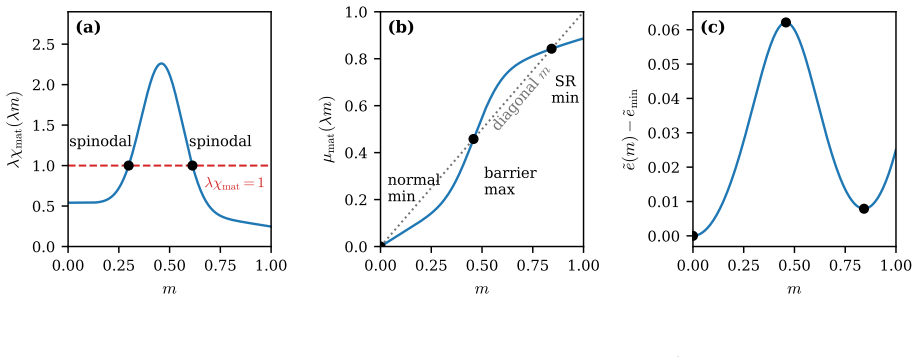
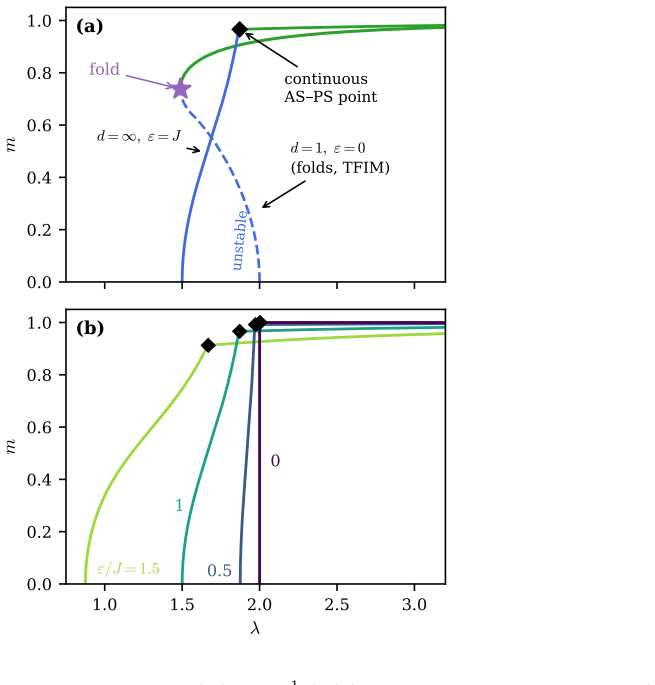
States holding a minimum form one connected curve λ(m) = μ_mat^{-1}(m)/m so that superradiant first-order transitions are folds of one equation of state not crossings of disjoint sheets, and a fold can straighten into a continuous line. The photon creates no phase the matter does not already possess.
What carries the argument
The self-consistent functional ilde e(m) = λ m^2/2 + e_mat(λ m) that reduces all superradiant physics to properties of the bare matter energy e_mat.
If this is right
- The remaining rules for transitions are local, each with a spectral counterpart such as softening polariton for onset.
- Order is determined by the Landau quartic or a divergent susceptibility forcing a Larkin-Pikin fold.
- For the Dicke-Ising model the Landau coefficients are exact, giving closed form boundaries and tricritical points.
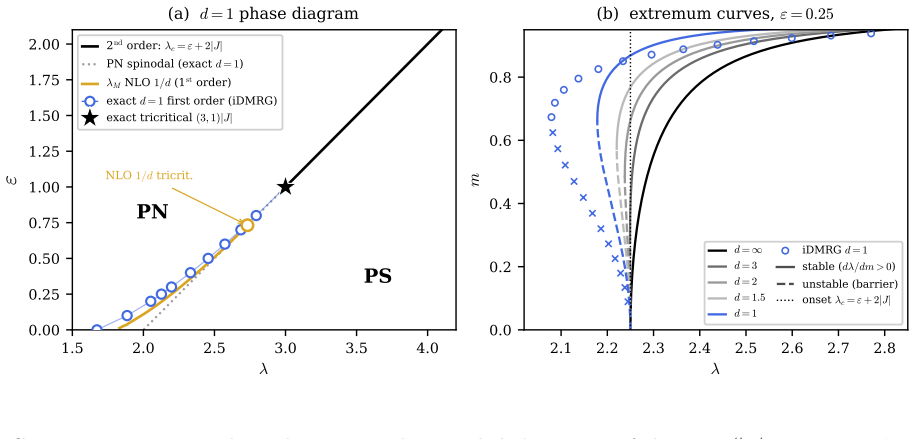
- A 1/d expansion maps all four phases with first order transitions for d ≤ 3.
Where Pith is reading between the lines
- Similar reduction might hold for multi-mode cavities if the integration remains exact.
- The approach could extend to finite-size systems where fluctuations modify the folds.
- Experimental probes of the matter susceptibility could predict the entire superradiant diagram without cavity.
Load-bearing premise
The integration out of the cavity yields an exact self-consistent functional of the magnetisation in the thermodynamic limit with collective coupling.
What would settle it
A matter system exhibiting a superradiant phase transition that has no corresponding minimum in its bare energy functional would contradict the claim.
Figures





read the original abstract
We give a thermodynamic-limit account of Dicke models with one cavity mode coupled collectively to interacting matter. Integrating out the cavity yields an exact self-consistent functional of the magnetisation $m$, $\tilde e(m) = \lambda m^2/2 + e_{\rm mat}(\lambda m)$: a classical penalty on the bare-matter energy $e_{\rm mat}$ in the self-consistent field $h = \lambda m$, with $\lambda = g^2/(2\omega_c)$ the collective coupling. Supplying only that scalar field, the photon creates no phase the matter does not already possess. States holding a minimum form one connected curve, $\lambda(m) = \mu_{\rm mat}^{-1}(m)/m$, so superradiant first-order transitions are folds of one equation of state not crossings of disjoint sheets, and a fold can straighten into a continuous line. The remaining rules are local, each with a spectral counterpart: onset by the leading singularity of $e_{\rm mat}$ (a softening polariton), order by one bare response -- the Landau quartic, or a divergent susceptibility forcing a Larkin-Pikin (LP) fold. For the Dicke-Ising model the Landau coefficients are exact, giving in closed form the second-order boundary and both zero-quartic fields, one tricritical; a $1/d$ expansion maps all four phases, with the AS-PS transition first order for $d\le d_{uc}=3=4-z$ (LP) and tricritical points in the $(d,\epsilon)$ plane above. At the degenerate quadruple point the matter is a Rydberg-blockade chain, solved by strict-blockade iDMRG: the antiferromagnetic superradiant (AS) phase persists as a finite 1D wedge, first order into the corner. Other magnets: the triangular antiferromagnet keeps a continuous superradiant-superradiant line (3D-XY, no fold forced); the compass chain a BKT-functional onset; the Heisenberg and XX chains, via a conserved operator, a spectrally silent first-order onset; and the Dicke-Heisenberg diagram an exact tricritical point at the saturation corner.
Editorial analysis
A structured set of objections, weighed in public.
Referee Report
Summary. The manuscript claims that integrating out the cavity mode in the thermodynamic limit for Dicke models with collective coupling to interacting matter yields an exact self-consistent functional ilde e(m) = \lambda m^2/2 + e_mat(\lambda m), with \lambda = g^2/(2 \omega_c). Consequently, the photon introduces no new phases beyond those already present in the bare matter; superradiant transitions appear as folds of the single connected curve \lambda(m) = \mu_mat^{-1}(m)/m rather than crossings between disjoint sheets. The work supplies closed-form Landau coefficients for the Dicke-Ising model, a 1/d expansion that maps all four phases (with LP first-order behavior for d \le 3), an iDMRG solution of the Rydberg-blockade chain showing a finite AS wedge, and explicit results for triangular antiferromagnets, compass/Heisenberg/XX chains, and the Dicke-Heisenberg tricritical point.
Significance. If the central reduction holds, the result supplies a unifying and simplifying account of superradiant phase structure that reduces the problem to properties of the matter equation of state alone. Explicit constructions—exact Landau coefficients, the 1/d expansion, and strict-blockade iDMRG—are concrete strengths that render the framework directly testable and applicable across multiple magnets.
minor comments (2)
- [§2] §2 (or wherever the thermodynamic-limit integration is performed): the step from the collective-coupling Hamiltonian to the exact functional ilde e(m) would benefit from an explicit intermediate line showing how the photon quadratic term is completed to the square and the self-consistency h = \lambda m is imposed.
- [1/d expansion section] The 1/d expansion paragraph: the upper-critical dimension d_uc = 3 = 4 - z is stated without a short derivation of the dynamical exponent z that enters the hyperscaling relation; a one-sentence reminder would aid readers.
Simulated Author's Rebuttal
We thank the referee for their positive and accurate summary of the manuscript, which correctly captures the central claim that superradiant transitions arise as folds of a single connected equation of state rather than crossings between disjoint sheets. The recommendation for minor revision is noted.
Circularity Check
No significant circularity identified
full rationale
The paper derives the effective functional ilde e(m) = λ m^2/2 + e_mat(λ m) directly from integrating out the cavity mode in the collective-coupling Hamiltonian in the thermodynamic limit, then obtains the self-consistency condition λ(m) = μ_mat^{-1}(m)/m from extremizing that functional. This reduction is a standard exact rewriting for infinite-range collective coupling and does not presuppose the target phase diagram; the subsequent statements that all superradiant transitions are folds of the bare matter equation of state follow immediately from the geometry of that single curve. Explicit constructions for the Dicke-Ising model (closed-form Landau coefficients), 1/d expansion, and iDMRG solution of the Rydberg-blockade chain are performed independently on specific microscopic Hamiltonians and confirm the absence of extra phases without relying on fitted parameters or self-citations. No step matches any enumerated circularity pattern.
Axiom & Free-Parameter Ledger
axioms (1)
- domain assumption The cavity can be integrated out exactly in the thermodynamic limit to yield the self-consistent functional ilde e(m) = λ m^2/2 + e_mat(λ m)
Reference graph
Works this paper leans on
-
[1]
Vacuum, broken symmetry, and the background field The Landau coefficients of eq. (13) are low-field Taylor coefficients of the bare-matter energy: writing the per-site ground-state energy in the fieldhconjugate toσz as emat(h) =e 0 − 1 2 χmat(0)h 2 + a4 λ4 h4 + a6 λ6 h6 +O(h 8),(A1) the substitutionh=λmin eq. (5) returns exactly the Landau series eq. (13)...
-
[2]
One transformation, many names We organise the series in Takahashi’s linked-cluster form [78], built on Kato’s expansion of the perturbed projector ¯P[77]. The projected frame{ ¯P|i⟩}is not orthonormal— ¯P Pis not an isometry—and the canonical repair is Löwdin’s symmetric orthonormalisation [104], T= ¯P P(P ¯P P) −1/2,(A2) the isometry from the model spac...
-
[3]
Clusters, denominators, and the quartic coefficient At orderh 2k each insertion ofV=−h P i σz i flips one spin and the2kinsertions must return to the vacuum, so every site is flipped an even number of times and a connected cluster spans at mostksites: at fourth order a single site or an adjacent pair; at sixth order additionally the three-site path (the b...
-
[4]
The coefficients through sixth order All coefficients and gaps below are written inbareunits (|J|literal). The rescaling J→J/dof section B—under which matter mean field is exact atd=∞—is applied only when converting the barea4 = 0roots and onsets to the tricritical loci quoted in the main text; it is the positive substitution|J| → |J|/d, which moves the l...
-
[5]
in every dimension
Embedding ind: bonds per site, not coordination The per-site assembly on the hypercubic latticeZd is a2k λ2k =W 1 +d W 2 +d(2d−1)W 3 +. . . ,(A11) withW b the reduced contribution of theb-site cluster and the prefactors the embedding numbers ofZ d:dbonds per site and 2d 2 =d(2d−1)three-site paths per site (for the Néel 84 vacuum the paths split evenly int...
-
[6]
The hardcore-boson reading On the product vacuum, flips are hardcore bosonsb† i, and the cavity couples only to their uniform superpositionB=N −1/2P i bi—thek= 0mode. At the quadratic level the cou- pled problem is exactly the effective Dicke model of section IIID—gap∆Es, coupling from the matrix elements ofχmat(0)—and this level is rigorous: the onset is...
-
[7]
One convention flag: our field couples toσz = 2Sz, so the field of the spin-1 2 literature is2hand ourm=⟨σ z⟩is twice theirs (J= 1throughout)
Heisenberg chain in a field: the Bethe working equations Thecurvesµ B(h)ande B(h)ofsectionVD3comefromtheBethesolutionofthechain[76] in its zero-temperature dressed-energy form, the route by which Griffiths first computed the magnetisation curve [87]. One convention flag: our field couples toσz = 2Sz, so the field of the spin-1 2 literature is2hand ourm=⟨σ...
-
[8]
, ρ(θ) + Z B −B dθ′ a2(θ−θ ′)ρ(θ ′) =a 1(θ),(D1) with the Fermi pointB(h)fixed byϵ dr(±B) = 0,ϵ dr <0inside; then µB(h) = 1−2 Z B −B ρdθ, e B(h) = 1 4 −h+ Z B −B ϵdr,0 ρdθ= 1 4 −h+ Z B −B a1 ϵdr dθ,(D2) 8 Atd= 3the matter sitsexactlyat the Ising upper critical dimension (d+1 = 4): the exponents are mean- field (α= 0) but carry multiplicative logarithmic c...
-
[9]
Compass chain: elliptic closed forms The Jordan–Wigner bands of the compass chain in the fieldhareω±(k) = p |Ak|2 + 4h2± |Ak|withA k =J 1 +J 2eik, and the band sum integrates to complete elliptic integrals (K, E; parameter convention): emat(h) =− 2 π √ 1 +h 2 E 1−∆ 2 1 +h 2 , µ mat(h) = 2 π h√ 1 +h 2 K 1−∆ 2 1 +h 2 .(D3) Expanding inh 2, χmat(0) = 2 π K(1...
-
[10]
The antiferromagnet is obtained from the ferromagnetic series byx→ −x, a parameter continuation of the series that requires no bipartiteness
Triangular lattice: the He–Hamer–Oitmaa Padé input The triangular-lattice transverse-field Ising model is not exactly solvable; its matter input for section VD1 is the high-field series of He, Hamer, and Oitmaa [85], resummed as a [7/7]Padé approximant forµ mat(h)inx=J/h. The antiferromagnet is obtained from the ferromagnetic series byx→ −x, a parameter c...
-
[11]
The strict-blockade encoding Reaching the QP requires solving the matter directly in its strict independent-set (Rydberg-blockade) manifold, where no two neighbouring spins are up—and that mani- 93 fold is genuinely awkward for matrix-product methods. It is not a tensor product of on-site spaces, so no local basis spans exactly the allowed states; a pure ...
-
[12]
The bare transition is second order The bare independent-set chain eq. (20) undergoes a single second-order transition in the 2D-Ising universality class along the whole line, and three independent determinations agree 94 118 119 120 121 122 123 φ (deg) 0.00 0.05 0.10 0.15 0.20 1/ξ (a) linear fit: φc = 123.28 ◦ Fendley: φc ≈ 123.2 ◦ 124 125 126 127 128 φ ...
-
[13]
effectively second-order
The dressed jump and its convergence The dressed (self-consistent) transition is, by contrast, first order (section C; sec- tion IIIG). The iDMRG resolves the first-order jump directly—continuing both the polarised and antiferromagnetic branches metastably across the coexistence window (the metastable- branch protocol of Ref. [1]), each seeded from the ot...
-
[14]
The collective Hamiltonian On a bipartite lattice the rescaled antiferromagnetic Ising couplingJ→J/dbecomes, asd→ ∞, an all-to-all coupling between the two sublattice collective spins. Writing the sublattice Pauli sums ˆΣA,B µ = P i∈A,B σµ i (each of lengthN/2) and ˆΣµ = ˆΣA µ + ˆΣB µ, and keeping the paper-wide normalisation in which the cavity couples t...
-
[15]
Withη≡ p 1−λ/2Jthe saddle of eq
Canted mean field and the AS phase In the rotated frame the AS ground state is the canted product state with sublattice Bloch anglesβ±αmeasured from the cavity (σx) axis:⟨σ x⟩A,B = cos(β±α),⟨σ z⟩A,B = sin(β±α), so thatm= cosαcosβandm s = cosβsinα(the uniform cavity magnetisation and the staggered Ising magnetisation respectively). Withη≡ p 1−λ/2Jthe saddl...
-
[16]
Polariton spectrum: the photon kept explicit Rather than eliminate the photon, we keep it and read the polaritons directly. The cavity couples to the uniform (q= 0) matter response, whose closed form on the AS branch has two collective poles, χR mat(ω) = P ω2 L −ω 2 + A ∆2 −ω 2 ,(F4) 101 anoptical(Larmor) magnon at a finite frequencyω L, and astaggeredmag...
-
[17]
cannot soften via the Dicke mechanism
Reduction to the normal phase and attribution Setting the canting to zero (α→0, hencem s →0andA→0) decouples the stag- gered pole from the cavity and the dressed-photon cubic factorises into(∆2 −W)times a photon+uniform-magnon quadratic. The quadratic is the effective Dicke model of the anti- ferromagneticnormalphase: its soft point reproduces the AN–AS o...
-
[18]
Scope This is thed=∞saddle spectrum; theO(1/N)fluctuation corrections are not included. In the physical dimensions the(d+1)-Ising susceptibility diverges and forces the AS–PS transition first order through the cavity Larkin–Pikin mechanism (section IIIF); the soft polariton eq. (F5) is thed=∞object, where the transition is continuous. The fate of the corr...
- [19]
-
[20]
J. A. Koziol, Quantum criticality of the ferromagnetic Dicke-Ising model (2026), arXiv:2605.27484 [cond-mat.str-el]
Pith/arXiv arXiv 2026
-
[21]
C. F. Lee and N. F. Johnson, First-Order Superradiant Phase Transitions in a Multiqubit Cavity System, Phys. Rev. Lett.93, 083001 (2004), arXiv:quant-ph/0403185
Pith/arXiv arXiv 2004
-
[22]
S. Gammelmark and K. Molmer, Phase transitions and Heisenberg limited metrology in an Ising chain interacting with a single-mode cavity field, New J. Phys.13, 053035 (2011), arXiv:1102.1905. 103
Pith/arXiv arXiv 2011
-
[23]
J. Rohn, M. Hörmann, C. Genes, and K. P. Schmidt, Ising model in a light-induced quantized transverse field, Phys. Rev. Res.2, 023131 (2020), arXiv:2003.05804
arXiv 2020
-
[24]
R. H. Dicke, Coherence in Spontaneous Radiation Processes, Phys. Rev.93, 99 (1954)
1954
-
[25]
Hepp and E
K. Hepp and E. H. Lieb, On the superradiant phase transition for molecules in a quantized radiation field: the Dicke maser model, Ann. Phys. (N.Y.)76, 360 (1973)
1973
-
[26]
Hepp and E
K. Hepp and E. H. Lieb, Equilibrium Statistical Mechanics of Matter Interacting with the Quantized Radiation Field, Phys. Rev. A8, 2517 (1973)
1973
-
[27]
Y. K. Wang and F. T. Hioe, Phase Transition in the Dicke Model of Superradiance, Phys. Rev. A7, 831 (1973)
1973
-
[28]
P. Kirton, M. M. Roses, J. Keeling, and E. G. Torre, Introduction to the Dicke model: From equilibrium to nonequilibrium, and vice versa, Adv. Quantum Technol.2, 1800043 (2019), arXiv:1805.09828
Pith/arXiv arXiv 2019
-
[29]
J. M. Fink, R. Bianchetti, M. Baur, M. Göppl, L. Steffen, S. Filipp, P. J. Leek, A. Blais, and A. Wallraff, Dressed collective qubit states and the tavis-cummings model in circuit qed, Phys. Rev. Lett.103, 083601 (2009)
2009
-
[30]
Dimer, B
F. Dimer, B. Estienne, A. S. Parkins, and H. J. Carmichael, Proposed realization of the dicke- model quantum phase transition in an optical cavity qed system, Phys. Rev. A75, 013804 (2007)
2007
-
[31]
K. Baumann, C. Guerlin, F. Brennecke, and T. Esslinger, Dicke quantum phase transition with a superfluid gas in an optical cavity, Nature464, 1301 (2010), arXiv:0912.3261
Pith/arXiv arXiv 2010
-
[32]
Baumann, R
K. Baumann, R. Mottl, F. Brennecke, and T. Esslinger, Exploring symmetry breaking at the dicke quantum phase transition, Phys. Rev. Lett.107, 140402 (2011)
2011
-
[33]
Y. Zhang, L. Yu, J. Q. Liang, G. Chen, S. Jia, and F. Nori, Quantum phases in circuit QED with a superconducting qubit array, Sci. Rep.4, 4083 (2014), arXiv:1308.3948
Pith/arXiv arXiv 2014
-
[34]
J. Román-Roche and D. Zueco, Effective theory for matter in non-perturbative cavity QED, SciPost Phys. Lect. Notes , 50 (2022), arXiv:2110.07632
arXiv 2022
-
[35]
D. S. Shapiro, Y. Weber, T. Bode, F. K. Wilhelm, and D. Bagrets, Digital-Analog Simula- tions of Schrödinger Cat States in the Dicke-Ising Model, Phys. Rev. A112, 042412 (2025), arXiv:2412.14285
arXiv 2025
-
[36]
A. Langheld, M. Hörmann, and K. P. Schmidt, Quantum phase diagrams of Dicke-Ising models by a wormhole algorithm, Phys. Rev. B112, L161123 (2025), arXiv:2409.15082. 104
arXiv 2025
-
[37]
Rzażewski, K
K. Rzażewski, K. Wódkiewicz, and W. Żakowicz, Phase Transitions, Two-Level Atoms, and theA 2 Term, Phys. Rev. Lett.35, 432 (1975)
1975
-
[38]
X.-F. Zhang, Q. Sun, Y.-C. Wen, W.-M. Liu, S. Eggert, and A.-C. Ji, Rydberg Polaritons in a Cavity: A Superradiant Solid, Phys. Rev. Lett.110, 090402 (2013), arXiv:1207.4238
Pith/arXiv arXiv 2013
-
[39]
J. a. P. Mendonça, K. Jachymski, and Y. Wang, Role of Matter Interactions in Superradiant Phenomena, Phys. Rev. Lett.135, 133601 (2025), arXiv:2503.04961
arXiv 2025
-
[40]
A. Schellenberger and K. P. Schmidt, (Almost) everything is a Dicke model - Mapping non- superradiant correlated light-matter systems to the exactly solvable Dicke model, SciPost Phys. Core7, 038 (2024), arXiv:2402.15209
arXiv 2024
-
[41]
N. N. Bogoliubov, Jr.,A Method for Studying Model Hamiltonians: A Minimax Principle for Problems in Statistical Physics(Pergamon Press, Oxford, 1972)
1972
-
[42]
P. A. J. Tindemans and H. W. Capel, On the free energy in systems with separable interac- tions. III, Physica A79, 478 (1975)
1975
-
[43]
L. W. J. den Ouden, H. W. Capel, J. H. H. Perk, and P. A. J. Tindemans, Systems with separable many-particle interactions. I, Physica A85, 51 (1976)
1976
-
[44]
L. W. J. den Ouden, H. W. Capel, and J. H. H. Perk, Systems with separable many-particle interactions. II, Physica A85, 425 (1976)
1976
-
[45]
J. H. H. Perk, H. W. Capel, and L. W. J. den Ouden, Convex-envelope formulation for separable many-particle interactions, Physica A89, 555 (1977)
1977
-
[46]
J. Reslen, L. Quiroga, and N. F. Johnson, Direct equivalence between quantum phase tran- sition phenomena in radiation-matter and magnetic systems: scaling of entanglement, Euro- phys. Lett.69, 8 (2005), arXiv:cond-mat/0406674
Pith/arXiv arXiv 2005
-
[47]
J. Román-Roche, A. Gómez-León, F. Luis, and D. Zueco, Linear response theory for cavity QED materials at arbitrary light-matter coupling strengths, Phys. Rev. B111, 035156 (2025), arXiv:2406.11971
arXiv 2025
-
[48]
Román-Roche, Álvaro Gómez-León, F
J. Román-Roche, Álvaro Gómez-León, F. Luis, and D. Zueco, Bound polariton states in the Dicke–Ising model, Nanophotonics14, 2053 (2025), arXiv:2406.11957
arXiv 2053
-
[49]
A. I. Larkin and S. A. Pikin, Phase transitions of the first order but nearly of the second, Sov. Phys. JETP29, 891 (1969)
1969
-
[50]
S. Sur, Y. Wang, M. Mahankali, S. Paschen, and Q. Si, Amplified response of cavity- coupled quantum-critical systems, Nat. Commun.17, 10.1038/s41467-026-73112-1 (2026), 105 arXiv:2509.26620
work page internal anchor Pith review Pith/arXiv arXiv doi:10.1038/s41467-026-73112-1 2026
-
[51]
F. T. Hioe, Phase Transitions in Some Generalized Dicke Models of Superradiance, Phys. Rev. A8, 1440 (1973)
1973
-
[52]
F. Leyvraz and W. D. Heiss, Large-N Scaling Behavior of the Lipkin-Meshkov-Glick Model, Phys. Rev. Lett.95, 050402 (2005), arXiv:quant-ph/0507004
Pith/arXiv arXiv 2005
-
[53]
P. Ribeiro, J. Vidal, and R. Mosseri, Exact spectrum of the Lipkin-Meshkov-Glick model in the thermodynamic limit and finite-size corrections, Phys. Rev. E78, 021106 (2008), arXiv:0805.4078
Pith/arXiv arXiv 2008
-
[54]
S. Dusuel and J. Vidal, Finite-Size Scaling Exponents of the Lipkin-Meshkov-Glick Model, Phys. Rev. Lett.93, 237204 (2004), cond-mat/0408624
Pith/arXiv arXiv 2004
-
[55]
S. Dusuel and J. Vidal, Continuous unitary transformations and finite-size scaling expo- nents in the Lipkin-Meshkov-Glick model, Phys. Rev. B71, 224420 (2005), arXiv:cond- mat/0412127
arXiv 2005
-
[56]
Mori, Analysis of the exactness of mean-field theory in long-range interacting systems, Phys
T. Mori, Analysis of the exactness of mean-field theory in long-range interacting systems, Phys. Rev. E82, 060103 (2010), arXiv:1004.3622
Pith/arXiv arXiv 2010
-
[57]
J. G. Brankov, V. A. Zagrebnov, and N. S. Tonchev, Asymptotically exact solution of the generalized Dicke model, Theoretical and Mathematical Physics22, 13 (1975)
1975
-
[58]
R. W. Gibberd, Equivalence of the Dicke Maser Model and the Ising Model at Equilibrium, Aust. J. Phys.27, 241 (1974)
1974
-
[59]
J. Román-Roche, F. Luis, and D. Zueco, Photon Condensation and Enhanced Magnetism in Cavity QED, Phys. Rev. Lett.127, 167201 (2021), arXiv:2011.03753
arXiv 2021
-
[60]
K. Lenk, J. Li, P. Werner, and M. Eckstein, Collective theory for an interacting solid in a single-mode cavity (2022), arXiv:2205.05559 [cond-mat.str-el]
arXiv 2022
-
[61]
J. Román-Roche, V. Herráiz-López, and D. Zueco, Exact solution for quantum strong long- range models via a generalized Hubbard-Stratonovich transformation, Phys. Rev. B108, 165130 (2023), arXiv:2305.10482
arXiv 2023
-
[62]
Binder, Theory of first-order phase transitions, Rep
K. Binder, Theory of first-order phase transitions, Rep. Prog. Phys.50, 783 (1987)
1987
-
[63]
Arrott, Criterion for Ferromagnetism from Observations of Magnetic Isotherms, Phys
A. Arrott, Criterion for Ferromagnetism from Observations of Magnetic Isotherms, Phys. Rev.108, 1394 (1957)
1957
-
[64]
B. K. Banerjee, On a generalised approach to first and second order magnetic transitions, Phys. Lett.12, 16 (1964). 106
1964
-
[65]
Gilmore,Catastrophe Theory for Scientists and Engineers(Wiley, New York, 1981)
R. Gilmore,Catastrophe Theory for Scientists and Engineers(Wiley, New York, 1981)
1981
-
[66]
L. S. Schulman, Tricritical Points and Type-Three Phase Transitions, Phys. Rev. B7, 1960 (1973)
1960
-
[67]
Gilmore, Structural stability of the phase transition in Dicke-like models, J
R. Gilmore, Structural stability of the phase transition in Dicke-like models, J. Math. Phys. 18, 17 (1977)
1977
-
[68]
C. P. Bean and D. S. Rodbell, Magnetic Disorder as a First-Order Phase Transformation, Phys. Rev.126, 104 (1962)
1962
-
[69]
J. A. Koziol, A. Langheld, and K. P. Schmidt, Melting of devil’s staircases in the long-range Dicke-Ising model, Phys. Rev. B111, 224427 (2025), arXiv:2503.02734
arXiv 2025
-
[70]
C. Emary and T. Brandes, Chaos and the quantum phase transition in the Dicke model, Phys. Rev. E67, 22 (2003), arXiv:cond-mat/0301273 [cond-mat]
Pith/arXiv arXiv 2003
-
[71]
D. J. Thouless, Vibrational states of nuclei in the random phase approximation, Nucl. Phys. 22, 78 (1961)
1961
-
[72]
M. A. Caprio, P. Cejnar, and F. Iachello, Excited state quantum phase transitions in many- body systems, Ann. Phys.323, 1106 (2008), arXiv:0707.0325
Pith/arXiv arXiv 2008
-
[73]
H. W. Capel, L. W. J. den Ouden, and J. H. H. Perk, Stability of critical behaviour, critical- exponent renormalization and first-order transitions, Physica A95, 371 (1979)
1979
-
[74]
M. E. Fisher, Renormalization of Critical Exponents by Hidden Variables, Phys. Rev.176, 257 (1968)
1968
-
[75]
G. A. Gehring, Pressure-induced quantum phase transitions, EPL82, 60004 (2008), arXiv:0711.2586
Pith/arXiv arXiv 2008
-
[76]
P. Chandra, P. Coleman, M. A. Continentino, and G. G. Lonzarich, Quantum Annealed Criticality (2018), arXiv:1805.11771
arXiv 2018
-
[77]
P. Chandra, P. Coleman, M. A. Continentino, and G. G. Lonzarich, Quantum annealed criticality: A scaling description, Phys. Rev. Research2, 043440 (2020), arXiv:2012.01601
arXiv 2020
- [78]
-
[79]
A. A. Ovchinnikov, D. V. Dmitriev, V. Y. Krivnov, and V. O. Cheranovskii, The antiferro- magnetic Ising chain in a mixed transverse and longitudinal magnetic field, Phys. Rev. B68, 214406 (2003), arXiv:cond-mat/0306468. 107
Pith/arXiv arXiv 2003
-
[80]
O. F. d. A. Bonfim, B. Boechat, and J. Florencio, Ground-state properties of the one- dimensional transverse Ising model in a longitudinal magnetic field, Phys. Rev. E99, 012122 (2019), arXiv:1808.07591
Pith/arXiv arXiv 2019
discussion (0)
Sign in with ORCID, Apple, or X to comment. Anyone can read and Pith papers without signing in.