Universal Hermitian Projective Calculus for CH2
Pith reviewed 2026-06-27 04:42 UTC · model grok-4.3
The pith
Complex hyperbolic two-space reduces to algebraic invariants in a three-dimensional Hermitian vector space.
A machine-rendered reading of the paper's core claim, the machinery that carries it, and where it could break.
Core claim
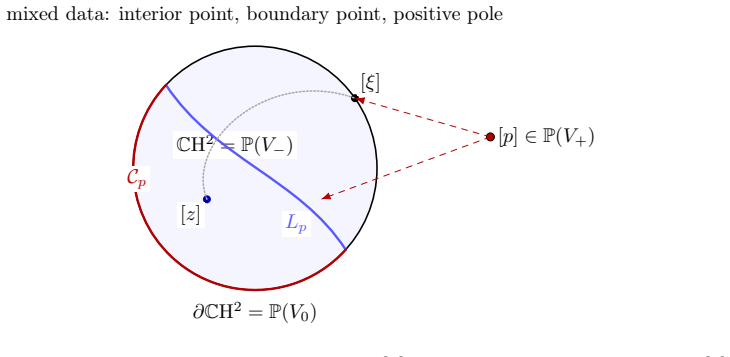
Starting from a three-dimensional Hermitian vector space of signature (2,1), CH² is the projectivized negative cone and its boundary the projectivized null cone. This model yields projectively invariant algebraic data—Hermitian pair moduli, determinant quadrance, polar spread, triple-product phase, cross-ratio invariants, contact boundary forms, and normalized ball kernels—that replace metric quantities. Denominator-cleared identities are established for three-point Gram determinants, triangle trigonometry, complex geodesics, bisectors, spinal spheres, projective-unitary covariance, CR/contact atlas transitions, and kernel boundary limits, with the triple-product phase supplying the algebrai
What carries the argument
The triple-product phase, which supplies the algebraic source of the Cartan angular invariant while pair invariants recover Bergman distance and polar-spread data.
If this is right
- Complex geodesics and bisectors admit explicit algebraic descriptions independent of local metrics.
- The same identities and invariants apply directly to finite Hermitian geometries over starred fields.
- Projective-unitary covariance and CR/contact atlas transitions are realized as algebraic relations.
- Kernel boundary limits and spinal spheres are governed by the same finite set of determinant and phase expressions.
- Triangle trigonometry in CH² reduces to identities among Hermitian determinants and triple products.
Where Pith is reading between the lines
- The algebraic approach may simplify numerical implementations of CH² geometry by avoiding transcendental functions in favor of field operations.
- Similar projective reductions could be tested in higher-dimensional complex hyperbolic spaces by increasing the Hermitian dimension.
- Finite-field instances of the calculus provide discrete models that might approximate continuous CH² structures for computational experiments.
- The contact boundary forms could connect the calculus to existing algebraic treatments of CR manifolds without additional metric assumptions.
Load-bearing premise
Complex hyperbolic two-space can be modeled as the projectivized negative cone of a three-dimensional Hermitian vector space of signature (2,1).
What would settle it
A concrete triple of points in the Hermitian projective model of CH² for which one of the claimed denominator-cleared three-point Gram determinant identities fails to hold.
Figures
read the original abstract
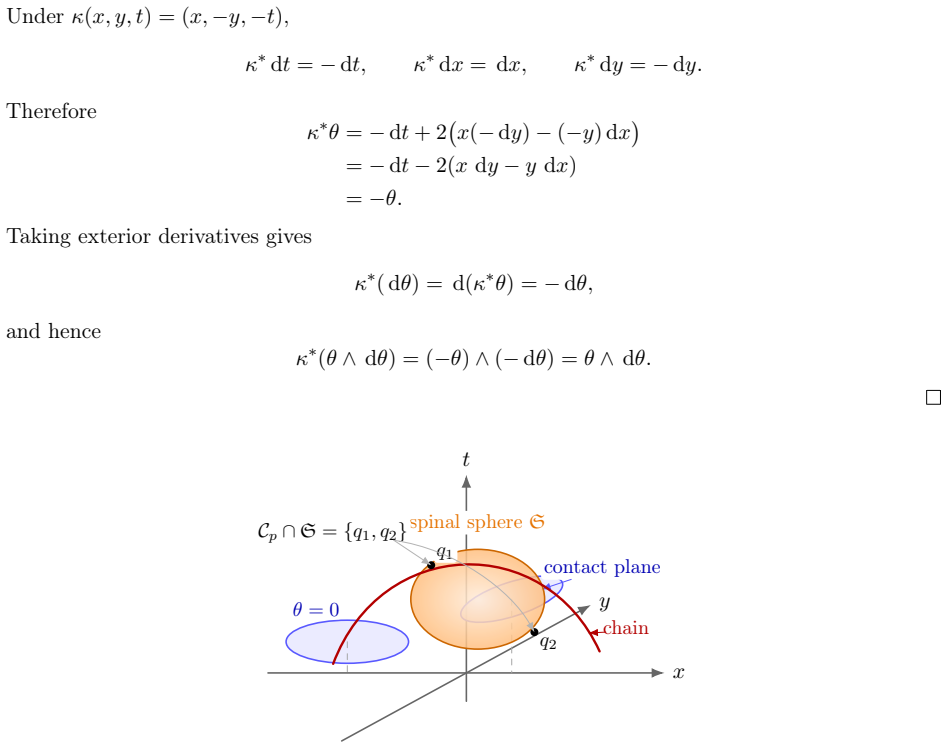
We develop an algebraic invariant calculus for complex hyperbolic two-space $\mathbb{C}\mathrm{H}^2$ in its Hermitian projective model. Starting from a three-dimensional Hermitian vector space of signature $(2,1)$, we treat $\mathbb{C}\mathrm{H}^2$ as the projectivized negative cone and its boundary as the projectivized null cone. The resulting calculus replaces metric and angular quantities by projectively invariant algebraic data: Hermitian pair moduli, determinant quadrance, polar spread, triple-product phase, cross-ratio invariants, contact boundary forms, normalized ball kernels, and finite Hermitian incidence laws. We prove denominator-cleared identities for three-point Gram determinants, triangle trigonometry, complex geodesics, bisectors, spinal spheres, projective-unitary covariance, CR/contact atlas transitions, and kernel boundary limits. The triple-product phase supplies the algebraic source of the Cartan angular invariant, while pair invariants recover the usual Bergman distance and polar-spread data over $\mathbb{C}$. The same formulas are also organized over starred fields, including finite Hermitian geometries, giving a field-uniform projective calculus for complex hyperbolic geometry.
Editorial analysis
A structured set of objections, weighed in public.
Referee Report
Summary. The paper constructs a projective algebraic calculus for complex hyperbolic 2-space CH² modeled as the projectivized negative cone in a 3-dimensional Hermitian vector space of signature (2,1), with boundary the projectivized null cone. It replaces metric quantities by projectively invariant algebraic data (Hermitian pair moduli, determinant quadrance, polar spread, triple-product phase, cross-ratio invariants) and proves denominator-cleared identities for three-point Gram determinants, triangle trigonometry, complex geodesics, bisectors, spinal spheres, projective-unitary covariance, CR/contact transitions, and kernel boundary limits. The triple-product phase is identified as the algebraic source of the Cartan angular invariant, with the same formulas organized over starred fields including finite Hermitian geometries.
Significance. If the algebraic identities hold as stated, the work supplies a field-uniform, denominator-cleared framework that unifies the standard Hermitian model with projective invariants and extends it beyond the complex numbers. This could streamline explicit computations in CH² geometry and support analogous treatments in finite or other Hermitian settings; the explicit recovery of Bergman distance and polar-spread data from pair invariants is a concrete strength.
minor comments (1)
- The abstract states that proofs of the listed identities are supplied, but the provided text does not include explicit derivation steps or verification for the Gram-determinant or trigonometry identities; if these appear only in the full manuscript, a brief pointer in the introduction would help readers locate them.
Simulated Author's Rebuttal
We thank the referee for their careful review and positive recommendation to accept the manuscript. The report accurately captures the scope and contributions of the work.
Circularity Check
No significant circularity; derivation self-contained from standard model
full rationale
The paper begins with the standard definition of CH^2 as the projectivized negative cone in a 3-dimensional Hermitian vector space of signature (2,1), with boundary the projectivized null cone. All subsequent identities (Gram determinants, trigonometry, geodesics, bisectors, spinal spheres, triple-product phase as Cartan invariant source, etc.) are presented as direct algebraic consequences of the Hermitian form, projectivization, and incidence laws. No parameter fitting, self-definitional loops, load-bearing self-citations, or ansatz smuggling via prior work is indicated in the abstract or stated claims. The calculus is field-uniform and organized over starred fields, but remains derived from the initial vector-space setup without reducing to its own outputs by construction.
Axiom & Free-Parameter Ledger
axioms (1)
- domain assumption CH^2 is the projectivized negative cone of a 3D Hermitian vector space of signature (2,1)
Reference graph
Works this paper leans on
-
[1]
N. J. Wildberger.Universal Hyperbolic Geometry I: Trigonometry. arXiv:0909.1377, 2009
Pith/arXiv arXiv 2009
-
[2]
Goldman.Complex Hyperbolic Geometry
William M. Goldman.Complex Hyperbolic Geometry. Oxford University Press, 1999
1999
-
[3]
Parker.Notes on Complex Hyperbolic Geometry
John R. Parker.Notes on Complex Hyperbolic Geometry. Lecture notes
-
[4]
Adam Koranyi and Hans M. Reimann. Foundations for the theory of quasiconformal mappings on the Heisenberg group.Advances in Mathematics, 111(1):1–87, 1995
1995
-
[5]
Kreder III.The Distinguished Reproducing Kernel
Karl J. Kreder III.The Distinguished Reproducing Kernel. Manuscript
-
[6]
Kreder III.No Free Parameters — The Fixed Point Law: The Distinguished Reproducing Kernel
Karl J. Kreder III.No Free Parameters — The Fixed Point Law: The Distinguished Reproducing Kernel. Manuscript. 62
discussion (0)
Sign in with ORCID, Apple, or X to comment. Anyone can read and Pith papers without signing in.