Determining the Structure of Dynamic Factor Models
Pith reviewed 2026-06-26 10:48 UTC · model grok-4.3
The pith
Two procedures determine the number of dynamic factors consistently under weaker conditions than earlier methods.
A machine-rendered reading of the paper's core claim, the machinery that carries it, and where it could break.
Core claim
The paper establishes that its two procedures for selecting the number of dynamic factors are consistent even when lagged factors directly influence the observed variables, under conditions weaker than those required by Bai and Ng (2007) and Amengual and Watson (2007). The alternating least squares algorithm developed as an intermediate step estimates the dynamic factors directly, which in turn supports the joint determination of the factor count and the filter length.
What carries the argument
The alternating least squares algorithm that estimates dynamic factors directly rather than through static representations, enabling joint selection of the factor count and the filter length.
If this is right
- The number of primitive shocks in large macroeconomic panels can be estimated reliably.
- Factor count and lag length can be chosen jointly instead of in separate stages.
- The procedures apply to models where lagged factors affect observables directly.
- Consistency holds under milder assumptions on the data generating process than in prior work.
Where Pith is reading between the lines
- The direct estimation step may reduce errors that accumulate when converting between dynamic and static factor representations.
- The joint selection feature could be tested in forecasting exercises to check whether it improves out-of-sample accuracy.
- Similar alternating least squares steps might be adapted to other high-dimensional time series settings with lagged latent variables.
Load-bearing premise
The data are generated by a dynamic factor model in which lagged factors can directly influence the observed variables, and the required rank or moment conditions hold.
What would settle it
A Monte Carlo simulation in which the lagged factor influence is removed or a known incorrect factor count is imposed would show whether the procedures recover the wrong number of factors.
Figures
read the original abstract
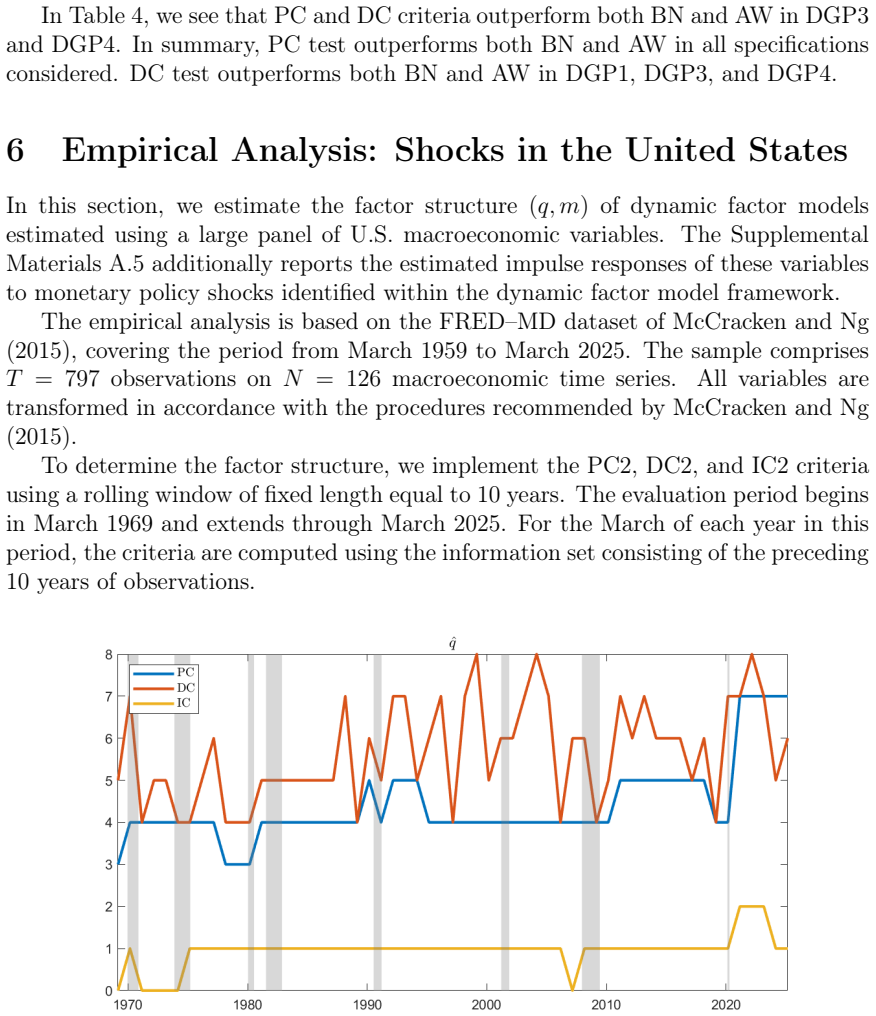
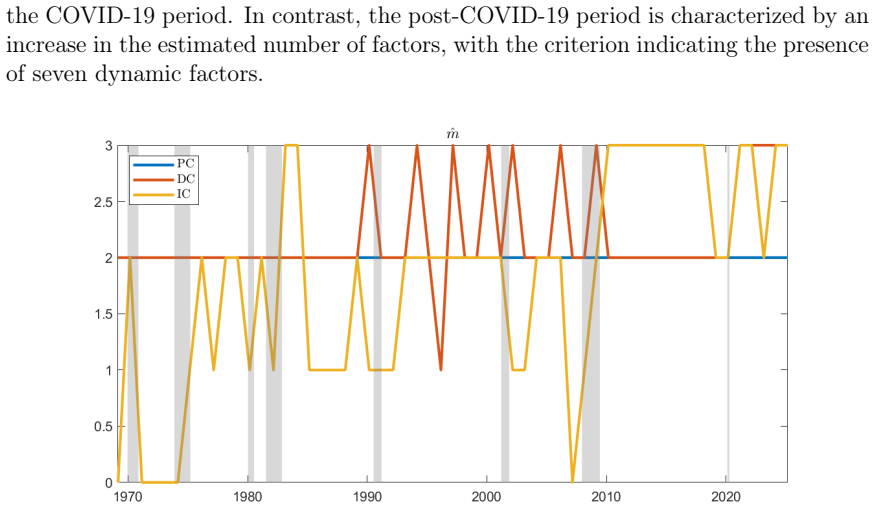
We propose two procedures for determining the number of dynamic factors, extending Bai and Ng (2002) and Ahn and Horenstein (2013) to dynamic factor models where lagged factors may directly influence the observed variables. As an intermediate step, we develop a simple and computationally efficient alternating least squares algorithm that directly estimates the dynamic factors, rather than their static representations. By working with these direct estimates, our approach enables joint determination of the number of factors and the filter length. Our test is shown to be consistent under weaker conditions than those in Bai and Ng (2007) and Amengual and Watson (2007). We apply our procedures to estimate the number of primitive shocks in a large panel of US macroeconomic time series.
Editorial analysis
A structured set of objections, weighed in public.
Referee Report
Summary. The paper proposes two procedures for determining the number of dynamic factors in DFMs where lagged factors may directly affect observables, extending the information-criterion approach of Bai and Ng (2002) and the eigenvalue-ratio method of Ahn and Horenstein (2013). It develops an alternating least squares algorithm for direct estimation of dynamic factors (rather than static representations), enabling joint selection of the number of factors and filter length. The procedures are claimed to be consistent under weaker conditions than Bai and Ng (2007) and Amengual and Watson (2007), with an application to a large US macroeconomic panel to estimate the number of primitive shocks.
Significance. If the consistency results hold, the contribution would be significant for applied macroeconometrics by accommodating more flexible DFM structures with direct lagged effects and providing a computationally efficient ALS procedure for joint determination of factors and lag length. The explicit development of the ALS algorithm for direct dynamic factor estimation is a clear strength that could facilitate reproducible implementations.
minor comments (2)
- [Abstract] The abstract refers to 'our test' while the body describes two procedures; standardize terminology for clarity.
- [Section 5] The application section would benefit from reporting the selected number of factors and filter length alongside the number of primitive shocks for direct comparison with prior studies.
Simulated Author's Rebuttal
We thank the referee for their positive summary of the paper and for recommending minor revision. We appreciate the recognition of the ALS algorithm and the extension of existing methods to more flexible DFM structures.
Circularity Check
No significant circularity; derivation builds on external priors with independent extensions
full rationale
The paper extends Bai and Ng (2002) and Ahn and Horenstein (2013) information-criterion and eigenvalue-ratio methods to dynamic factor models permitting direct lagged-factor effects, introduces a new alternating least squares algorithm for direct (non-static) factor estimation, and establishes consistency under weaker rank/moment conditions than Bai and Ng (2007) or Amengual and Watson (2007). No step reduces by construction to a self-definition, fitted input renamed as prediction, or load-bearing self-citation; all central claims rest on external literature plus novel algorithmic and proof content that does not presuppose the target results. The derivation chain is therefore self-contained against the cited benchmarks.
Axiom & Free-Parameter Ledger
Reference graph
Works this paper leans on
-
[1]
Mark W. Watson and Robert F. Engle , abstract =. Alternative algorithms for the estimation of dynamic factor, mimic and varying coefficient regression models , journal =. 1983 , issn =. doi:https://doi.org/10.1016/0304-4076(83)90066-0 , url =
-
[2]
Jacomy, Mathieu and Venturini, Tommaso and Heymann, Sebastien and Bastian, Mathieu , title =. PLoS ONE , year =. doi:10.1371/journal.pone.0098679 , pmid =
-
[3]
Eichenbaum, Martin and Evans, Charles L. , title =. The Quarterly Journal of Economics , volume =. 1995 , month =. doi:10.2307/2946646 , url =
-
[4]
The dynamic effects of monetary policy: A structural factor model approach , journal =
Mario Forni and Luca Gambetti , keywords =. The dynamic effects of monetary policy: A structural factor model approach , journal =. 2010 , issn =. doi:https://doi.org/10.1016/j.jmoneco.2009.11.009 , url =
-
[5]
Approximate factor models with weaker loadings , journal =
Jushan Bai and Serena Ng , keywords =. Approximate factor models with weaker loadings , journal =. 2023 , issn =. doi:https://doi.org/10.1016/j.jeconom.2023.01.027 , url =
-
[6]
The Review of Economics and Statistics , volume =
Bai, Jushan and Li, Kunpeng , title =. The Review of Economics and Statistics , volume =. 2016 , month =. doi:10.1162/REST_a_00519 , url =
-
[7]
Bai, Jushan , title =. Econometrica , volume =. doi:https://doi.org/10.1111/1468-0262.00392 , url =. https://onlinelibrary.wiley.com/doi/pdf/10.1111/1468-0262.00392 , abstract =
-
[8]
DETERMINING THE NUMBER OF FACTORS FROM EMPIRICAL DISTRIBUTION OF EIGENVALUES , urldate =
Alexei Onatski , journal =. DETERMINING THE NUMBER OF FACTORS FROM EMPIRICAL DISTRIBUTION OF EIGENVALUES , urldate =
-
[9]
Inferential theory for generalized dynamic factor models , journal =
Matteo Barigozzi and Marc Hallin and Matteo Luciani and Paolo Zaffaroni , keywords =. Inferential theory for generalized dynamic factor models , journal =. 2024 , issn =. doi:https://doi.org/10.1016/j.jeconom.2023.02.003 , url =
-
[10]
Dynamic factor models with infinite-dimensional factor space: Asymptotic analysis , journal =
Mario Forni and Marc Hallin and Marco Lippi and Paolo Zaffaroni , keywords =. Dynamic factor models with infinite-dimensional factor space: Asymptotic analysis , journal =. 2017 , issn =. doi:https://doi.org/10.1016/j.jeconom.2017.04.002 , url =
-
[11]
Generalized impulse response analysis in linear multivariate models , journal =
H.Hashem Pesaran and Yongcheol Shin , keywords =. Generalized impulse response analysis in linear multivariate models , journal =. 1998 , issn =. doi:https://doi.org/10.1016/S0165-1765(97)00214-0 , url =
-
[12]
and Liu, Laura and Yilmaz, Kamil , title =
Demirer, Mert and Diebold, Francis X. and Liu, Laura and Yilmaz, Kamil , title =. Journal of Applied Econometrics , volume =. doi:https://doi.org/10.1002/jae.2585 , url =. https://onlinelibrary.wiley.com/doi/pdf/10.1002/jae.2585 , abstract =
-
[13]
McCracken and Serena Ng , title=
Michael W. McCracken and Serena Ng , title=. 2015 , month=. doi:10.20955/wp.2015.012 , url=
-
[14]
Diebold and Kamil Yılmaz , keywords =
Francis X. Diebold and Kamil Yılmaz , keywords =. On the network topology of variance decompositions: Measuring the connectedness of financial firms , journal =. 2014 , note =. doi:https://doi.org/10.1016/j.jeconom.2014.04.012 , url =
-
[15]
Ahn, Seung C. and Horenstein, Alex R. , title =. Econometrica , volume =. doi:https://doi.org/10.3982/ECTA8968 , url =. https://onlinelibrary.wiley.com/doi/pdf/10.3982/ECTA8968 , year =
-
[16]
Large covariance estimation by thresholding principal orthogonal complements , urldate =
Jianqing Fan and Yuan Liao and Martina Mincheva , journal =. Large covariance estimation by thresholding principal orthogonal complements , urldate =
-
[17]
Carhart, Mark M. , title =. The Journal of Finance , volume =. doi:https://doi.org/10.1111/j.1540-6261.1997.tb03808.x , url =. https://onlinelibrary.wiley.com/doi/pdf/10.1111/j.1540-6261.1997.tb03808.x , abstract =
-
[18]
Arbitrage, Factor Structure, and Mean-Variance Analysis on Large Asset Markets , urldate =
Gary Chamberlain and Michael Rothschild , journal =. Arbitrage, Factor Structure, and Mean-Variance Analysis on Large Asset Markets , urldate =
-
[19]
Watson , journal =
Dante Amengual and Mark W. Watson , journal =. Consistent Estimation of the Number of Dynamic Factors in a Large N and T Panel , urldate =
-
[20]
The Generalized Dynamic-Factor Model: Identification And Estimation , volume =
Forni and Reichlin, Lucrezia and Hallin, Marc and Lippi, Marco , year =. The Generalized Dynamic-Factor Model: Identification And Estimation , volume =. The Review of Economics and Statistics , doi =
-
[21]
Journal of the American Statistical Association , volume =
Mario Forni and Marc Hallin and Marco Lippi and Lucrezia Reichlin , title =. Journal of the American Statistical Association , volume =. 2005 , publisher =
2005
-
[22]
2009 , publisher=
A first course in Bayesian statistical methods , author=. 2009 , publisher=
2009
-
[23]
Dynamic functional principal components
Siegfried H \"o rmann and Lukasz Kidziski and Marc Hallin. Dynamic functional principal components. Journal of the Royal Statistical Society / B. 2015
2015
-
[24]
Generalized Dynamic Principal Components , volume =
Pe. Generalized Dynamic Principal Components , volume =. Journal of the American Statistical Association , doi =. 2015 , month =
2015
-
[25]
Krishna Kumar and S
G. Krishna Kumar and S. H. Kulkarni , title =. Annals of Functional Analysis , number =. 2015 , doi =
2015
-
[26]
Storer and Christos Georgakis , keywords =
Wenfu Ku and Robert H. Storer and Christos Georgakis , keywords =. Disturbance detection and isolation by dynamic principal component analysis , journal =. 1995 , note =. doi:https://doi.org/10.1016/0169-7439(95)00076-3 , url =
-
[27]
Stock and Mark W
James H. Stock and Mark W. Watson , journal =. Forecasting Using Principal Components from a Large Number of Predictors , volume =
-
[28]
Bai, Jushan and Ng, Serena , title =. Econometrica , volume =. doi:https://doi.org/10.1111/1468-0262.00273 , url =. https://onlinelibrary.wiley.com/doi/pdf/10.1111/1468-0262.00273 , abstract =
-
[29]
and Tambalotti, Andrea , title =
Bok, Brandyn and Caratelli, Daniele and Giannone, Domenico and Sbordone, Argia M. and Tambalotti, Andrea , title =. Annual Review of Economics , volume =. 2018 , doi =
2018
-
[30]
Local Projections vs
Dake Li and Mikkel Plagborg-M. Local Projections vs. VARs: Lessons From Thousands of DGPs , year =
-
[31]
Opening the Black Box: Structural Factor Models with Large Cross Sections , urldate =
Mario Forni and Domenico Giannone and Marco Lippi and Lucrezia Reichlin , journal =. Opening the Black Box: Structural Factor Models with Large Cross Sections , urldate =
-
[32]
Determining the Number of Factors in the General Dynamic Factor Model , urldate =
Marc Hallin and Roman Liška , journal =. Determining the Number of Factors in the General Dynamic Factor Model , urldate =
-
[33]
Determining the Number of Primitive Shocks in Factor Models , urldate =
Jushan Bai and Serena Ng , journal =. Determining the Number of Primitive Shocks in Factor Models , urldate =
-
[34]
Jushan Bai and Peng Wang , title =. Journal of Business & Economic Statistics , volume =. 2015 , publisher =. doi:10.1080/07350015.2014.941467 , URL =
-
[35]
and Watson, Mark W
Stock, James H. and Watson, Mark W. , title =. NBER Macroeconomics Annual , volume =. 1989 , doi =
1989
-
[36]
The Review of Economics and Statistics , pages =
Baumeister, Christiane and Leiva-León, Danilo and Sims, Eric , title = ". The Review of Economics and Statistics , pages =. 2022 , month =. doi:10.1162/rest_a_01171 , url =
-
[37]
and Boivin, Jean and Eliasz, Piotr , title = "
Bernanke, Ben S. and Boivin, Jean and Eliasz, Piotr , title = ". The Quarterly Journal of Economics , volume =. 2005 , month =. doi:10.1162/0033553053327452 , url =
-
[38]
The Review of Economic Studies , volume =
Chahrour, Ryan and Jurado, Kyle , title = ". The Review of Economic Studies , volume =. 2021 , month =. doi:10.1093/restud/rdab010 , url =
-
[39]
STATISTICAL ANALYSIS OF FACTOR MODELS OF HIGH DIMENSION , urldate =
Jushan Bai and Kunpeng Li , journal =. STATISTICAL ANALYSIS OF FACTOR MODELS OF HIGH DIMENSION , urldate =
-
[40]
Tipping, Michael E. and Bishop, Christopher M. , title = ". Journal of the Royal Statistical Society Series B: Statistical Methodology , volume =. 2002 , month =. doi:10.1111/1467-9868.00196 , url =
-
[41]
Ryan Chahrour and Vito Cormun and Pierre De Leo and Pablo Guerron-Quintana and Rosen Valchev , title=
-
[42]
Dynamic functional principal components , urldate =
Siegfried Hörmann and Łukasz Kidziński and Marc Hallin , journal =. Dynamic functional principal components , urldate =
-
[43]
Journal of the American Statistical Association , volume =
Thomas Kuenzer and Siegfried Hörmann and Piotr Kokoszka , title =. Journal of the American Statistical Association , volume =. 2021 , publisher =. doi:10.1080/01621459.2020.1732395 , URL =
-
[44]
Dynamic factor models with infinite-dimensional factor spaces: One-sided representations , journal =
Mario Forni and Marc Hallin and Marco Lippi and Paolo Zaffaroni , keywords =. Dynamic factor models with infinite-dimensional factor spaces: One-sided representations , journal =. 2015 , issn =. doi:https://doi.org/10.1016/j.jeconom.2013.10.017 , url =
-
[45]
A QUASI—MAXIMUM LIKELIHOOD APPROACH FOR LARGE, APPROXIMATE DYNAMIC FACTOR MODELS , urldate =
Catherine Doz and Domenico Giannone and Lucrezia Reichlin , journal =. A QUASI—MAXIMUM LIKELIHOOD APPROACH FOR LARGE, APPROXIMATE DYNAMIC FACTOR MODELS , urldate =
-
[46]
Identification theory for high dimensional static and dynamic factor models , journal =
Jushan Bai and Peng Wang , keywords =. Identification theory for high dimensional static and dynamic factor models , journal =. 2014 , issn =. doi:https://doi.org/10.1016/j.jeconom.2013.11.001 , url =
-
[47]
DYNAMIC LINEAR PANEL REGRESSION MODELS WITH INTERACTIVE FIXED EFFECTS , volume=. Econometric Theory , author=. 2017 , pages=. doi:10.1017/S0266466615000328 , number=
discussion (0)
Sign in with ORCID, Apple, or X to comment. Anyone can read and Pith papers without signing in.