Modeling the curved dust sublimation front in protoplanetary disks: a potential probe of midplane turbulence
Pith reviewed 2026-06-26 01:23 UTC · model grok-4.3
The pith
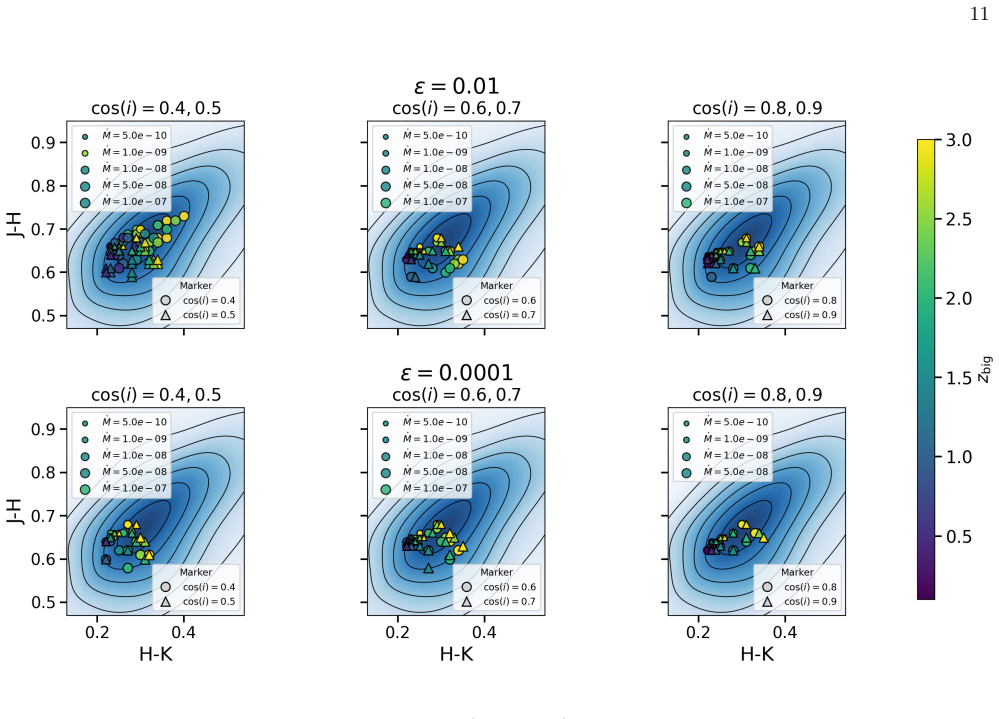
Matching observed JHK colors of T Tauri stars requires millimeter grains to reach 0.5-3 scale heights above the midplane.
A machine-rendered reading of the paper's core claim, the machinery that carries it, and where it could break.
Core claim
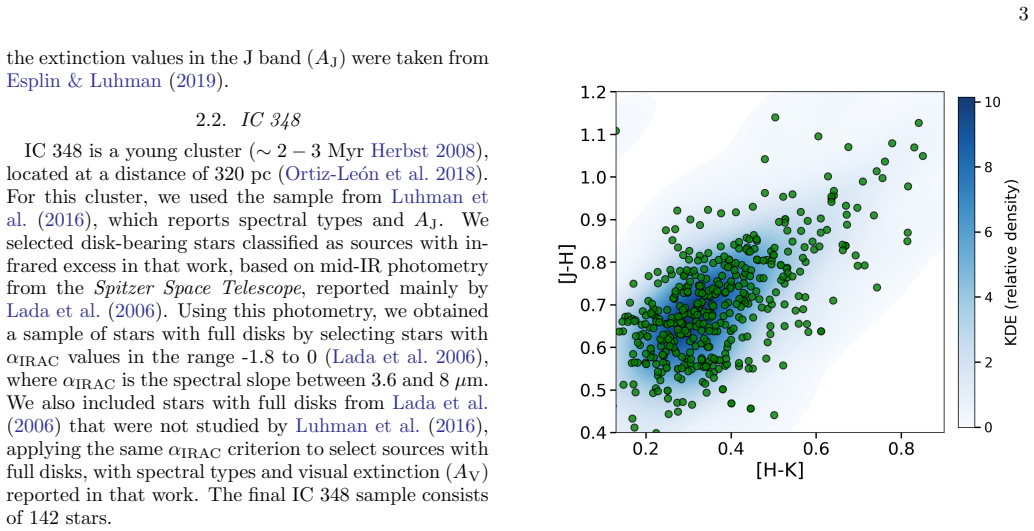
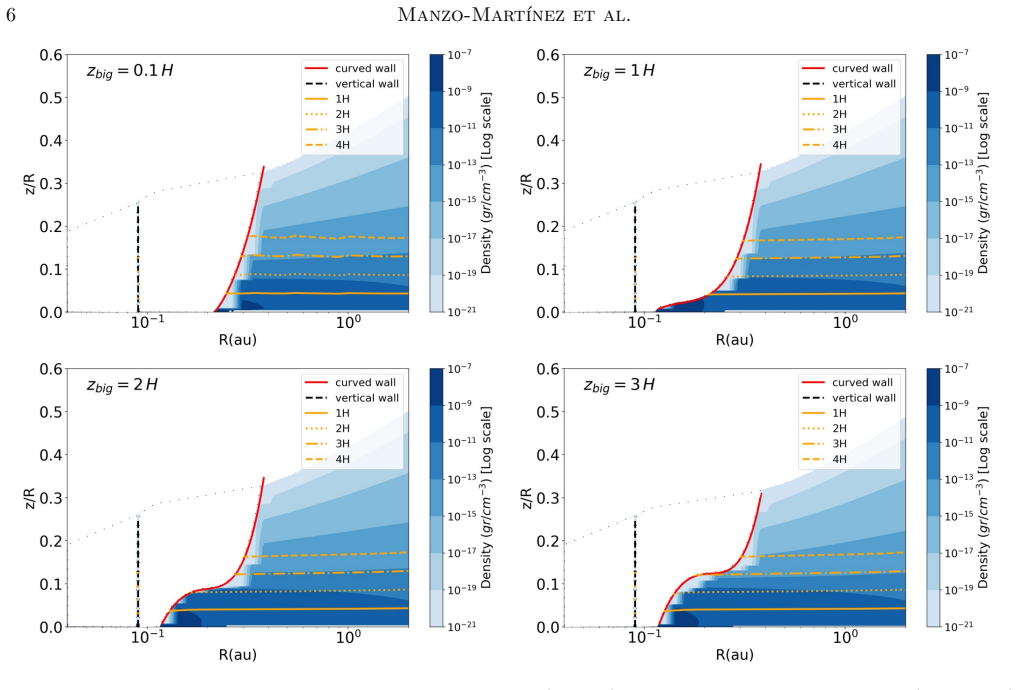
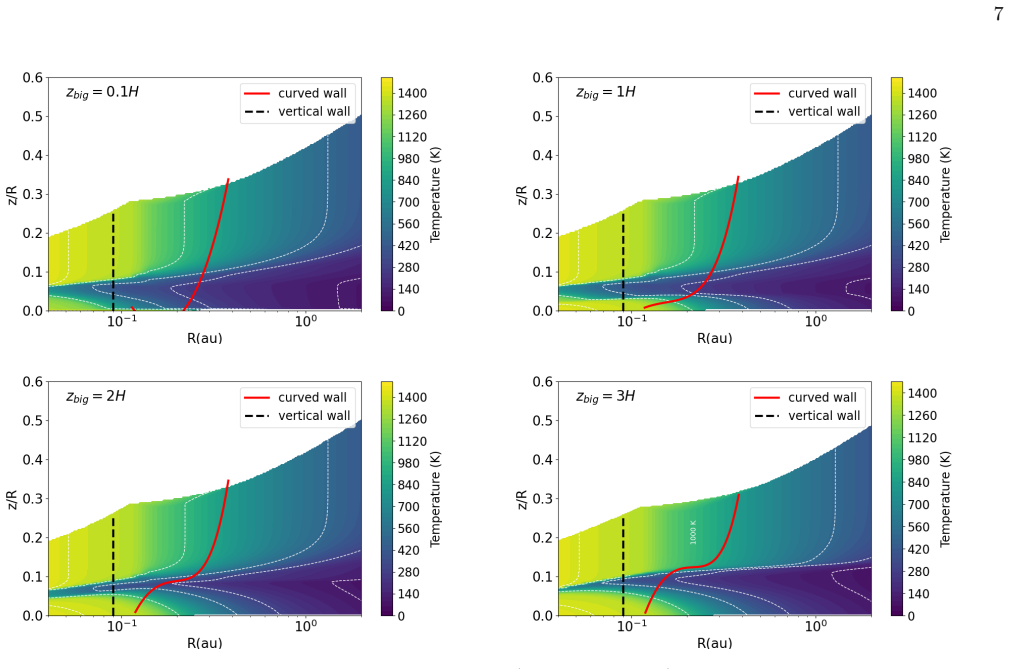
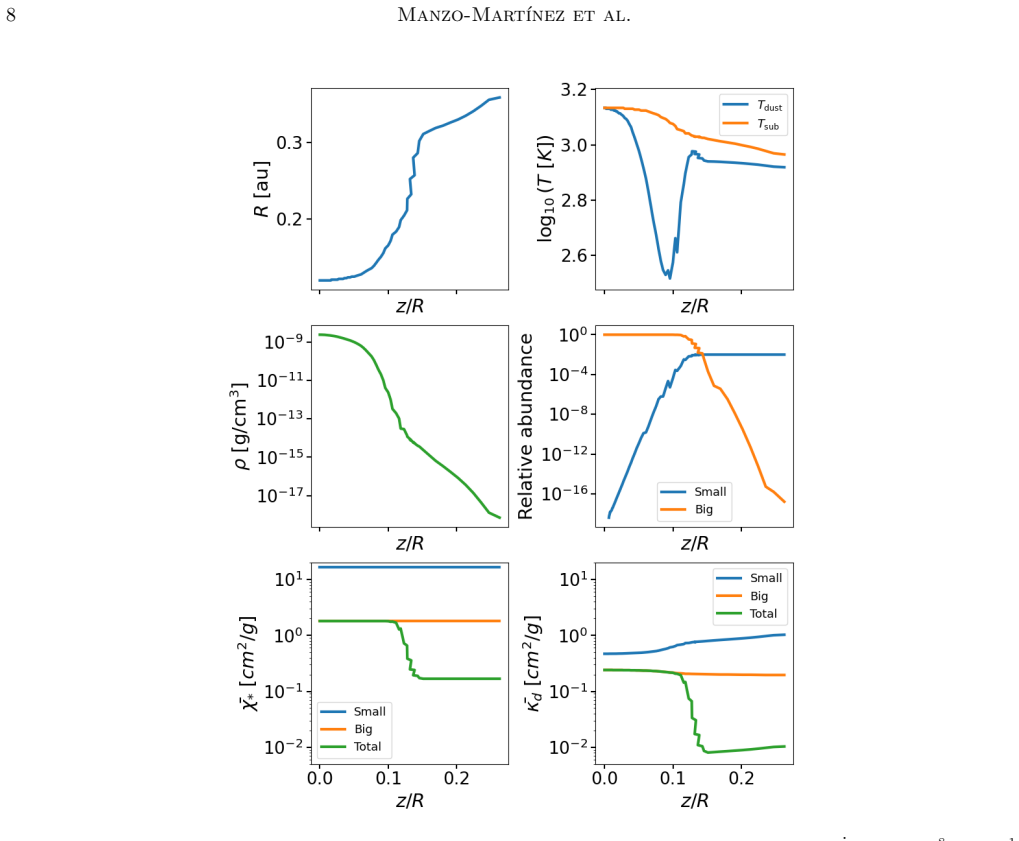
The curved dust inner wall starts at about 0.11 au and reaches 0.38 au; reproducing the concentration of observed JHK colors in a large T Tauri sample requires that millimeter-sized grains be distributed up to 0.5-3 scale heights above the midplane, which contradicts rapid settling and points to high midplane turbulence.
What carries the argument
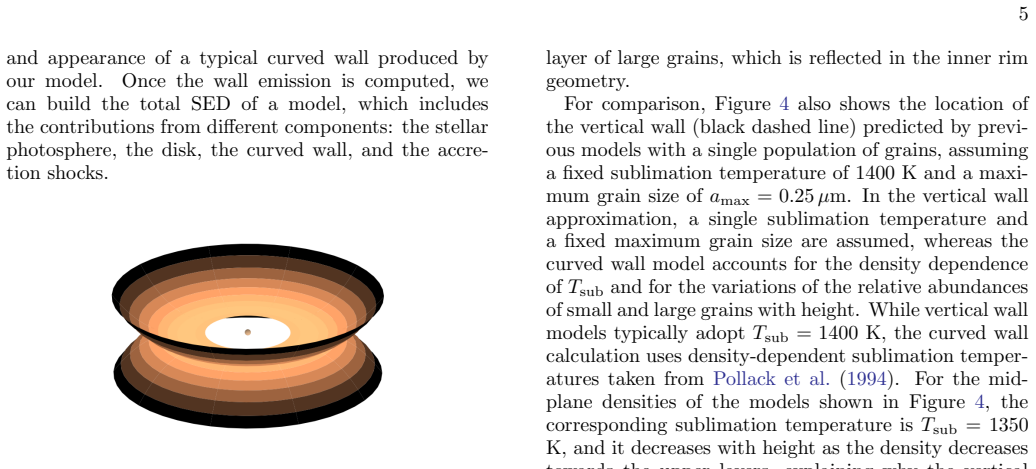
The curved dust inner wall whose radial and vertical extent is fixed self-consistently by the disk density structure and density-dependent sublimation temperature, together with the vertical scale height occupied by the millimeter-grain population.
If this is right
- T Tauri disks must maintain significant turbulence near the star to keep large grains aloft against settling.
- Near-IR color diagnostics can constrain the strength of midplane turbulence in the inner disk.
- SED modeling of the inner wall must incorporate vertically extended large-grain layers to match observations accurately.
- Rapid dust settling is not occurring in the inner regions sampled by JHK emission.
Where Pith is reading between the lines
- Sustained turbulence in the inner disk could slow the early stages of planetesimal formation by keeping solids suspended.
- The same modeling approach could be extended to longer wavelengths to test whether grain lifting persists at larger radii.
- Correlation between required grain heights and independent turbulence tracers such as line widths could be checked with existing data.
Load-bearing premise
The observed JHK colors are produced mainly by emission from the modeled curved wall and the vertical distribution of large grains, rather than other disk regions or unmodeled effects.
What would settle it
Interferometric or scattered-light observations that place millimeter grains below 0.5 scale heights throughout the inner disk would falsify the requirement for extended grain heights.
Figures
read the original abstract
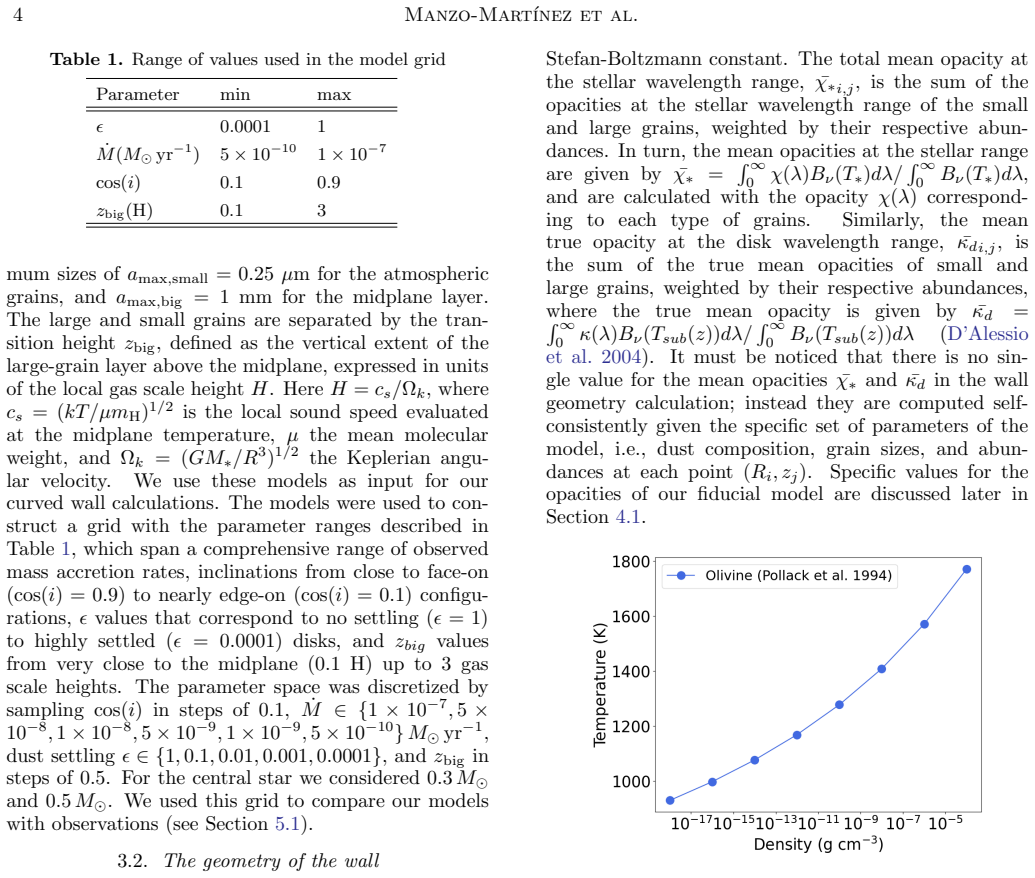
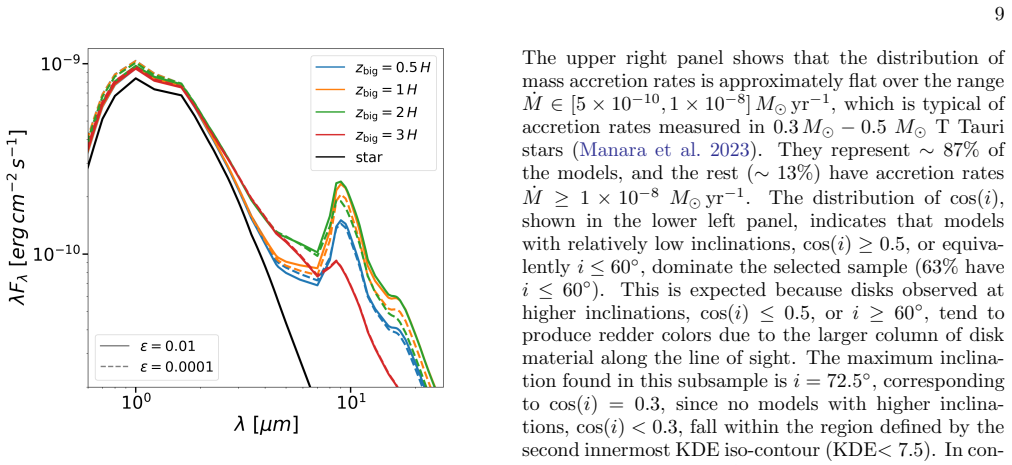
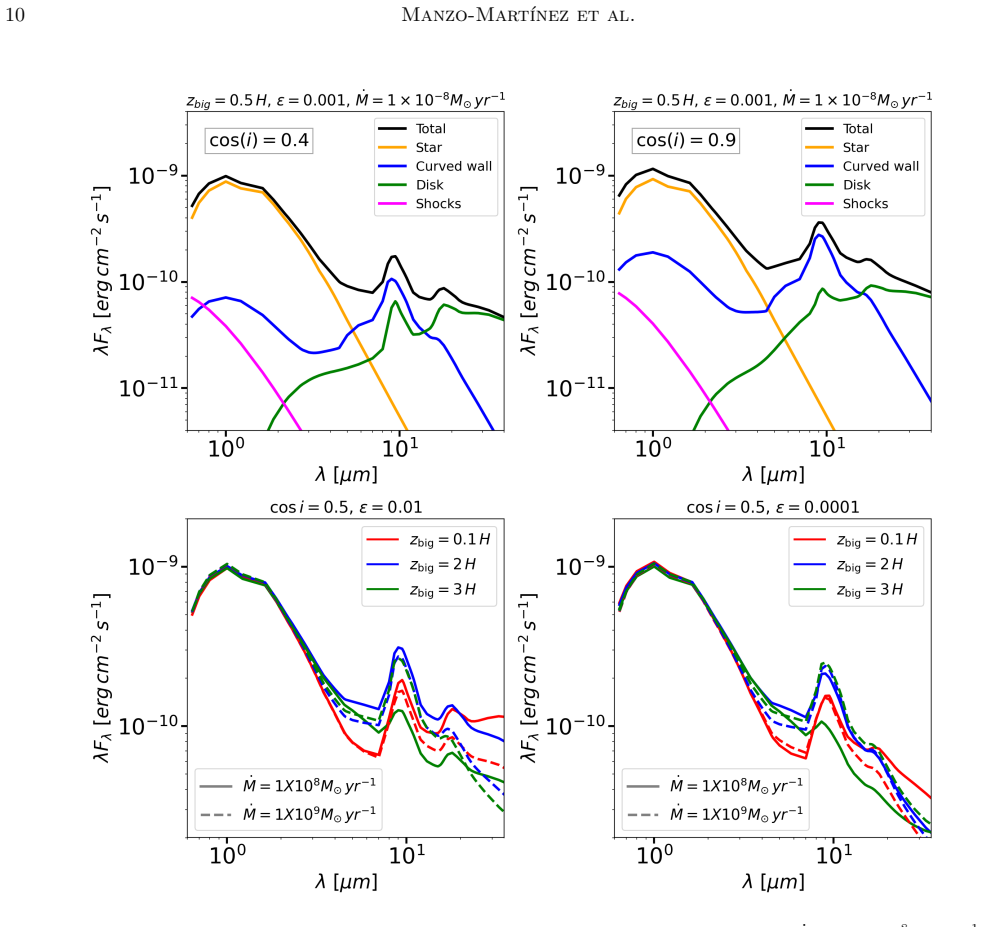
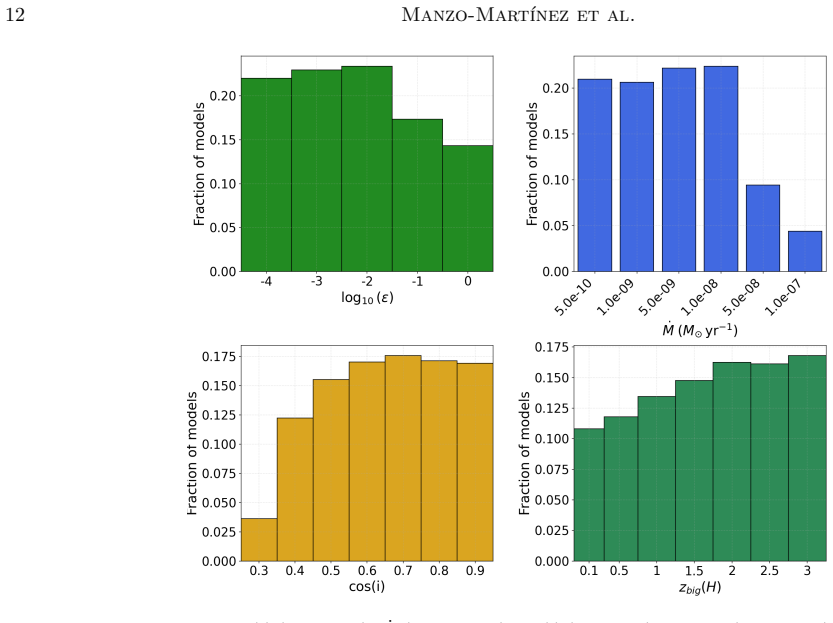
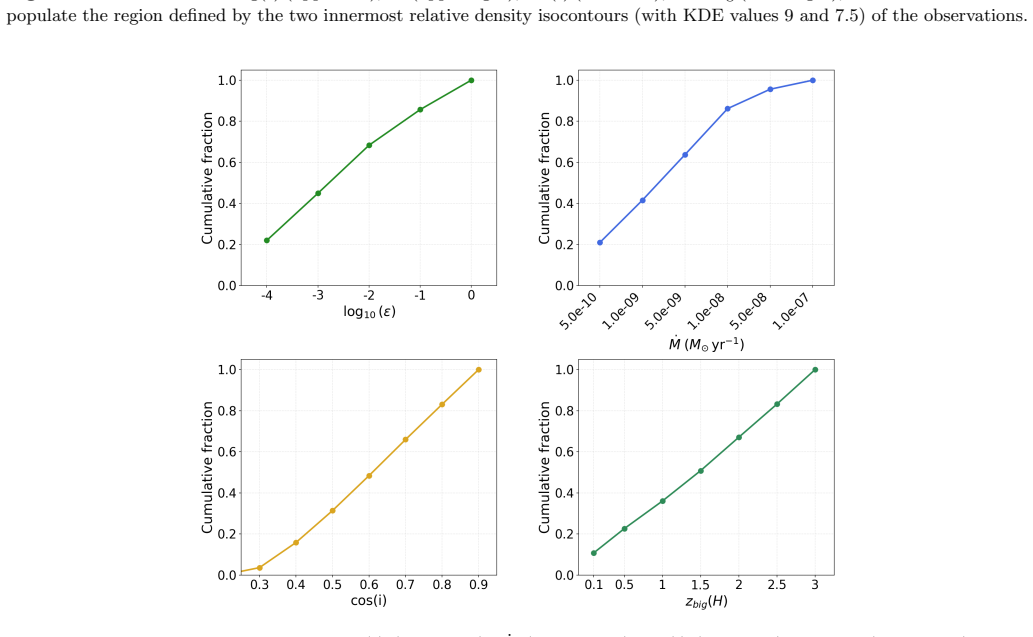
We present a new approach to calculate the geometry and emission of the dust inner wall in disks around T Tauri stars. This calculation follows a self-consistent approach given the disk structure and adopts a density-dependent sublimation temperature for the dust. We built spectral energy distributions (SEDs) of disk models with curved walls around a $0.5\,M_\odot$ star, finding that the curved wall starts at a radius of $\sim 0.11$ au and extends to $\sim 0.38$ au. The dependence on mass accretion rate, dust settling, and disk inclination on the resulting SEDs is explored, as well as the impact of the height of the midplane layer containing large millimeter-sized grains. To test our models, we compare synthetic near-IR colors from a grid of disk models with observed colors for a large sample of disk-bearing T Tauri stars located in Taurus, IC 348, and the Orion complex. Most of the observed colors can be explained by combinations of mass accretion rates, dust settling, and inclinations within the expected ranges for T Tauri stars. However, populating the regions where observed JHK colors are most concentrated, requires the millimeter-size grains be spread up to 0.5--3 scale heights above the midplane. This result contradicts expectations of rapid dust settling and suggests a high degree of turbulence capable of lifting large grains toward the upper disk layers. These findings provide insight into the dynamical conditions of the disk midplane near the star.
Editorial analysis
A structured set of objections, weighed in public.
Referee Report
Summary. The paper presents a self-consistent calculation of the curved dust sublimation front in T Tauri protoplanetary disks that incorporates a density-dependent sublimation temperature. For a 0.5 M⊙ star the resulting wall extends from ~0.11 au to ~0.38 au. SEDs are generated while varying mass-accretion rate, dust-settling parameter, inclination, and the vertical height of the millimeter-grain layer; synthetic JHK colors from this grid are then compared with photometry of disk-bearing T Tauri stars in Taurus, IC 348 and Orion. The authors conclude that most observed colors are reproduced by plausible ranges of the first three parameters, but that the densest observed color loci require millimeter grains lifted to 0.5–3 scale heights, implying a high level of midplane turbulence.
Significance. If the central inference holds, the work supplies an observational diagnostic of midplane turbulence near the star that challenges the standard expectation of rapid dust settling. The self-consistent treatment of the sublimation front geometry and temperature is a clear methodological advance over earlier fixed-wall approximations. The comparison across three star-forming regions adds breadth to the parameter study.
major comments (3)
- [§4] §4 (color comparison and turbulence conclusion): the claim that millimeter grains must reach 0.5–3 scale heights rests on visual inspection of color-color diagrams without reported quantitative fit statistics (e.g., χ², KS-test p-values, or overlap fractions with error bars). Because the turbulence inference is drawn directly from this comparison, the absence of statistical measures is load-bearing.
- [§3] Model assumptions (abstract and §3): the interpretation that the observed JHK colors are dominated by emission from the modeled curved wall plus the vertically extended mm-grain layer is not tested against alternative inner-disk configurations (flat wall, additional hot inner component, or scattering contributions). Without such tests the requirement for elevated grain heights—and therefore turbulence—does not necessarily follow.
- [grid description] Parameter exploration (grid description): the four free parameters (accretion rate, settling, inclination, grain height) are varied, yet no degeneracy analysis is presented showing whether combinations of the first three parameters alone can populate the densest observed loci when grain height is held at the canonical settled value.
minor comments (2)
- [figures] Figure captions for the color-color plots should explicitly state the number of observed stars plotted and the precise definition of the model grid points shown.
- [notation] Notation for the dust-settling parameter and the grain-height parameter should be defined once in the text and used consistently thereafter.
Simulated Author's Rebuttal
We thank the referee for the constructive and detailed report. The comments highlight important areas for strengthening the statistical rigor and scope of the analysis. We address each major comment below and outline the revisions we will make.
read point-by-point responses
-
Referee: [§4] §4 (color comparison and turbulence conclusion): the claim that millimeter grains must reach 0.5–3 scale heights rests on visual inspection of color-color diagrams without reported quantitative fit statistics (e.g., χ², KS-test p-values, or overlap fractions with error bars). Because the turbulence inference is drawn directly from this comparison, the absence of statistical measures is load-bearing.
Authors: We agree that quantitative statistics would make the comparison more rigorous. In the revised manuscript we will add χ² values and fractional overlap metrics (with photometric error bars) between the model grids and the observed color loci in each region. These will be computed both for the full grid and for the subset with canonical settled grain heights, directly quantifying the improvement provided by elevated mm-grain layers. revision: yes
-
Referee: [§3] Model assumptions (abstract and §3): the interpretation that the observed JHK colors are dominated by emission from the modeled curved wall plus the vertically extended mm-grain layer is not tested against alternative inner-disk configurations (flat wall, additional hot inner component, or scattering contributions). Without such tests the requirement for elevated grain heights—and therefore turbulence—does not necessarily follow.
Authors: The manuscript is deliberately scoped to the self-consistent curved-wall geometry; we do not claim the result is unique across all possible inner-disk models. We will add a short paragraph in §4 and the conclusions explicitly noting this scope limitation and stating that the turbulence inference applies within the family of curved-wall models. Full exploration of flat-wall or additional-component models lies outside the present study but could be addressed in follow-up work. revision: partial
-
Referee: [grid description] Parameter exploration (grid description): the four free parameters (accretion rate, settling, inclination, grain height) are varied, yet no degeneracy analysis is presented showing whether combinations of the first three parameters alone can populate the densest observed loci when grain height is held at the canonical settled value.
Authors: We will include a new subsection (or appendix) that fixes grain height at the settled value (h = 0) and shows the resulting color distribution when accretion rate, settling parameter, and inclination are varied over their full ranges. This will demonstrate that the densest observed loci remain under-populated, thereby confirming that the elevated grain heights are required even after accounting for degeneracies among the other parameters. revision: yes
Circularity Check
No significant circularity; central inference drawn from external observational comparison
full rationale
The paper constructs disk models with a density-dependent sublimation temperature to determine the curved inner wall geometry (starting ~0.11 au, extending to ~0.38 au), then varies input parameters (accretion rate, dust settling, inclination, vertical extent of mm-grain layer) to generate synthetic JHK colors. These are compared directly to an external sample of observed colors from Taurus, IC 348, and Orion. The requirement for mm-grains at 0.5-3 scale heights follows from which models populate the densest observed color loci; this step uses the external data as benchmark rather than reducing any quantity to a fitted parameter or self-citation by construction. No load-bearing self-citations, self-definitional steps, or renamed known results are present in the derivation chain. The result is therefore self-contained against external benchmarks.
Axiom & Free-Parameter Ledger
free parameters (4)
- mass accretion rate
- dust settling parameter
- disk inclination
- height of midplane layer containing large grains
axioms (2)
- domain assumption Standard assumptions about the vertical structure and radiative transfer in protoplanetary disks around T Tauri stars
- domain assumption Density-dependent sublimation temperature for dust
Reference graph
Works this paper leans on
-
[1]
Akeson, R. L., Boden, A. F., Monnier, J. D., et al.\ 2005, , 635, 2, 1173. doi:10.1086/497436
-
[2]
doi:10.1051/0004-6361/201424520
Anthonioz, F., M \'e nard, F., Pinte, C., et al.\ 2015, , 574, A41. doi:10.1051/0004-6361/201424520
-
[3]
Armitage, P. J.\ 2011, , 49, 1, 195. doi:10.1146/annurev-astro-081710-102521
-
[4]
Bai, X.-N. & Stone, J. M.\ 2013, , 769, 1, 76. doi:10.1088/0004-637X/769/1/76
-
[5]
Balbus, S. A. & Hawley, J. F.\ 1991, , 376, 214. doi:10.1086/170270
-
[6]
M., Pinilla, P., et al.\ 2015, , 813, 1, L14
Birnstiel, T., Andrews, S. M., Pinilla, P., et al.\ 2015, , 813, 1, L14. doi:10.1088/2041-8205/813/1/L14
-
[7]
Birnstiel, T., Ormel, C. W., & Dullemond, C. P.\ 2011, , 525, A11. doi:10.1051/0004-6361/201015228
-
[8]
doi:10.1051/0004-6361/201424964
Bitsch, B., Johansen, A., Lambrechts, M., et al.\ 2015, , 575, A28. doi:10.1051/0004-6361/201424964
-
[9]
Brice \ n o, C., Calvet, N., Hern \'a ndez, J., et al.\ 2019, , 157, 85. doi:10.3847/1538-3881/aaf79b
-
[10]
Calvet, N. & Gullbring, E.\ 1998, , 509, 2, 802. doi:10.1086/306527
-
[11]
Cardelli, J. A., Clayton, G. C., & Mathis, J. S.\ 1989, , 345, 245. doi:10.1086/167900
-
[12]
& Zhu, Z.\ 2025, , arXiv:2505.03701
Cevallos Soto, A. & Zhu, Z.\ 2025, , arXiv:2505.03701. doi:10.48550/arXiv.2505.03701
-
[13]
Chrenko, O., Flock, M., Ueda, T., et al.\ 2024, , 167, 3, 124. doi:10.3847/1538-3881/ad234d
-
[14]
Colmenares, M. J., Bergin, E. A., Salyk, C., et al.\ 2024, , 977, 2, 173. doi:10.3847/1538-4357/ad8b4f
-
[15]
\ 1998, , 500, 411
D'Alessio, P.; Cant\'o, J.; Calvet, N.; Lizano, S. \ 1998, , 500, 411
1998
-
[16]
D'Alessio, P.; Calvet, N.; Hartmann, L.; Lizano, S.; Cant\'o, J., \ 1999, , 527, 893
1999
-
[17]
\ 2001, , 553, 321
D'Alessio, P.; Calvet, N.; Hartmann, L. \ 2001, , 553, 321
2001
-
[18]
Models of Accretion Disks around Young Stars
D'Alessio, P., Calvet, N., Hartmann, L., et al.\ 2004, Star Formation at High Angular Resolution, 221, 403. doi:10.48550/arXiv.astro-ph/0309590
work page internal anchor Pith review Pith/arXiv arXiv doi:10.48550/arxiv.astro-ph/0309590 2004
-
[19]
\ 2005, , 621, 461
D'Alessio, P.; Hartmann, L.; Calvet, N.; Franco-Hernández, R.; et al. \ 2005, , 621, 461
2005
-
[20]
\ 2006, , 638, 314
D'Alessio, P.; Calvet, N.; Hartmann, L.; Franco-Hernández, R.; Servín, H. \ 2006, , 638, 314
2006
-
[21]
Dullemond, C. P. & Monnier, J. D.\ 2010, , 48, 205. doi:10.1146/annurev-astro-081309-130932
-
[23]
Esplin, T. L. & Luhman, K. L.\ 2019, , 158, 54. doi:10.3847/1538-3881/ab2594
-
[24]
Flaherty, K., Hughes, A. M., Simon, J. B., et al.\ 2020, , 895, 2, 109. doi:10.3847/1538-4357/ab8cc5
-
[25]
Flaherty, K., Hughes, A. M., Simon, J. B., et al.\ 2024, , 532, 1, 363. doi:10.1093/mnras/stae1480
-
[26]
J., et al.\ 2016, , 827, 2, 144
Flock, M., Fromang, S., Turner, N. J., et al.\ 2016, , 827, 2, 144. doi:10.3847/0004-637X/827/2/144
-
[27]
J., et al.\ 2017, , 835, 2, 230
Flock, M., Fromang, S., Turner, N. J., et al.\ 2017, , 835, 2, 230. doi:10.3847/1538-4357/835/2/230
-
[28]
J., Mulders, G
Flock, M., Turner, N. J., Mulders, G. D., et al.\ 2019, , 630, A147
2019
-
[29]
doi:10.1051/0004-6361/202453124 doi:10.1051/0004-6361/201935806
Flock, M., Chrenko, O., Ueda, T., et al.\ 2025, , 701, A259. doi:10.1051/0004-6361/202453124 doi:10.1051/0004-6361/201935806
-
[30]
L., Espaillat, C., et al.\ 2011, , 195, 1, 3
Furlan, E., Luhman, K. L., Espaillat, C., et al.\ 2011, , 195, 1, 3. doi:10.1088/0067-0049/195/1/3
-
[31]
Galli, P. A. B., Loinard, L., Bouy, H., et al.\ 2019, , 630, A137. doi:10.1051/0004-6361/201935928
-
[32]
Gole, D. A., Simon, J. B., Li, R., et al.\ 2020, , 904, 2, 132. doi:10.3847/1538-4357/abc334
-
[33]
doi:10.1051/0004-6361/202141624
GRAVITY Collaboration, Perraut, K., Labadie, L., et al.\ 2021, , 655, A73. doi:10.1051/0004-6361/202141624
-
[34]
Herbst, W.\ 2008, Handbook of Star Forming Regions, Volume I, 4, 372
2008
-
[35]
Hern \'a ndez, J., Hartmann, L., Megeath, T., et al.\ 2007, , 662, 2, 1067. doi:10.1086/513735
-
[36]
Hern \'a ndez, J., Calvet, N., Brice \ n o, C., et al.\ 2007, , 671, 2, 1784. doi:10.1086/522882
-
[37]
D., Kraus, S., et al.\ 2023, , 947, 2, 68
Ibrahim, N., Monnier, J. D., Kraus, S., et al.\ 2023, , 947, 2, 68. doi:10.3847/1538-4357/acb4ea
-
[38]
Ilgner, M. & Nelson, R. P.\ 2006, , 445, 1, 223. doi:10.1051/0004-6361:20053867
-
[39]
doi:10.1051/0004-6361/202346262
Kanwar, J., Kamp, I., Woitke, P., et al.\ 2024, , 681, A22. doi:10.1051/0004-6361/202346262
-
[40]
doi:10.1051/0004-6361/202450078
Kanwar, J., Kamp, I., Jang, H., et al.\ 2024, , 689, A231. doi:10.1051/0004-6361/202450078
-
[41]
Kenyon, S. J. & Hartmann, L.\ 1995, , 101, 117. doi:10.1086/192235
-
[42]
doi:10.1051/0004-6361/201833774
Kluska, J., Berger, J.-P., Malbet, F., et al.\ 2020, , 636, A116. doi:10.1051/0004-6361/201833774
-
[43]
Lada, C. J., Muench, A. A., Luhman, K. L., et al.\ 2006, , 131, 1574. doi:10.1086/499808
-
[44]
Luhman, K. L., Esplin, T. L., & Loutrel, N. P.\ 2016, , 827, 52. doi:10.3847/0004-637X/827/1/52
-
[45]
Luhman, K. L.\ 2023, , 165, 2, 37. doi:10.3847/1538-3881/ac9da3
-
[46]
Lyra, W. & Umurhan, O. M.\ 2019, , 131, 1001, 072001. doi:10.1088/1538-3873/aaf5ff
-
[47]
Isella, A. & Natta, A.\ 2005, , 438, 899. doi:10.1051/0004-6361:20052773
-
[48]
doi:10.1051/0004-6361/200912068
Kama, M., Min, M., & Dominik, C.\ 2009, , 506, 3, 1199. doi:10.1051/0004-6361/200912068
-
[49]
Kounkel, M., Covey, K., Su \'a rez, G., et al.\ 2018, , 156, 3, 84. doi:10.3847/1538-3881/aad1f1
-
[50]
doi:10.1051/0004-6361/201629305
Lazareff, B., Berger, J.-P., Kluska, J., et al.\ 2017, , 599, A85. doi:10.1051/0004-6361/201629305
-
[51]
Long, D. E., Cleeves, L. I., Adams, F. C., et al.\ 2024, , 972, 1, 88. doi:10.3847/1538-4357/ad5c67
-
[52]
Protostars and Planets VII , year = 2023, editor =
Manara, C. F., Ansdell, M., Rosotti, G. P., et al.\ 2023, Protostars and Planets VII, 534, 539. doi:10.48550/arXiv.2203.09930
-
[53]
Manzo-Mart \' nez, E., Calvet, N., Hern \'a ndez, J., et al.\ 2020, , 893, 56. doi:10.3847/1538-4357/ab7ead
-
[54]
K., D'Alessio, P., Calvet, N., et al.\ 2013, , 775, 114
McClure, M. K., D'Alessio, P., Calvet, N., et al.\ 2013, , 775, 114. doi:10.1088/0004-637X/775/2/114
-
[55]
doi:10.1051/0004-6361/202449368
Mendigut \' a, I., Lillo-Box, J., Vioque, M., et al.\ 2024, , 686, L1. doi:10.1051/0004-6361/202449368
-
[56]
doi:10.1051/0004-6361/202453362
Mori, S., Kunitomo, M., & Ogihara, M.\ 2025, , 697, A192. doi:10.1051/0004-6361/202453362
-
[57]
doi:10.1051/0004-6361:20010334
Natta, A., Prusti, T., Neri, R., et al.\ 2001, , 371, 186. doi:10.1051/0004-6361:20010334
-
[58]
Ortiz-Le \'o n, G. N., Loinard, L., Dzib, S. A., et al.\ 2018, , 865, 1, 73. doi:10.3847/1538-4357/aada49
-
[59]
F., Teague, R., et al.\ 2024, , 684, A174
Paneque-Carre \ n o, T., Izquierdo, A. F., Teague, R., et al.\ 2024, , 684, A174. doi:10.1051/0004-6361/202347757
-
[60]
Pollack, J. B., Hollenbach, D., Beckwith, S., et al.\ 1994, , 421, 615. doi:10.1086/173677
-
[61]
Revisiting the viscous disk model and updated disk masses
Ribas, \'A ., Espaillat, C. C., Mac \' as, E., et al.\ 2020, , 642, A171. doi:10.1051/0004-6361/202038352
-
[62]
The Astrophysical Journal , author =
Rilinger, A. M., Espaillat, C. C., Xin, Z., et al.\ 2023, , 944, 1, 66. doi:10.3847/1538-4357/aca905
-
[63]
Shakura, N. I. & Sunyaev, R. A.\ 1973, , 24, 337
1973
-
[64]
Skrutskie, M. F., Cutri, R. M., Stiening, R., et al.\ 2006, , 131, 2, 1163. doi:10.1086/498708
-
[65]
doi:10.1051/0004-6361/202553671
Sun, M.-F., Xie, J.-W., Zhou, J.-L., et al.\ 2025, , 699, A333. doi:10.1051/0004-6361/202553671
-
[66]
Tannirkulam, A., Harries, T. J., & Monnier, J. D.\ 2007, , 661, 1, 374. doi:10.1086/513265
-
[67]
Turner, N. J., Fromang, S., Gammie, C., et al.\ 2014, Protostars and Planets VI, 411. doi:10.2458/azu\_uapress\_9780816531240-ch018
work page doi:10.2458/azu 2014
-
[68]
Ueda, T., Okuzumi, S., & Flock, M.\ 2017, , 843, 1, 49. doi:10.3847/1538-4357/aa74b5
-
[69]
Ueda, T., Flock, M., & Okuzumi, S.\ 2019, , 871, 1, 10. doi:10.3847/1538-4357/aaf3a1
-
[70]
doi:10.1051/0004-6361/202553850
Vaikundaraman, V., Dr k a \.z kowska, J., Binkert, F., et al.\ 2025, , 696, A215. doi:10.1051/0004-6361/202553850
discussion (0)
Sign in with ORCID, Apple, or X to comment. Anyone can read and Pith papers without signing in.