Probing the molecular gas content of galaxies in an over-dense group at z~0.7: a test case for environmental quenching
Pith reviewed 2026-06-26 01:17 UTC · model grok-4.3
The pith
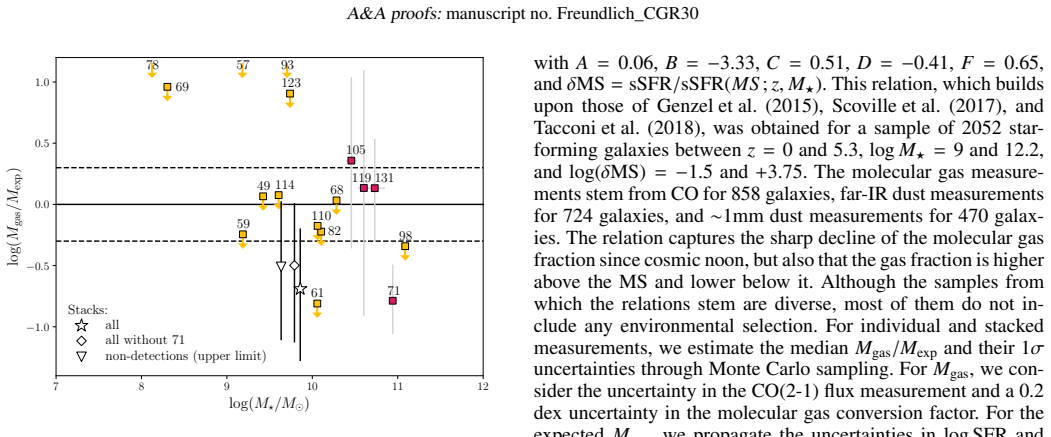
Galaxies in a dense group at z~0.7 show molecular gas contents reduced by 0.5 dex relative to field scaling relations.
A machine-rendered reading of the paper's core claim, the machinery that carries it, and where it could break.
Core claim
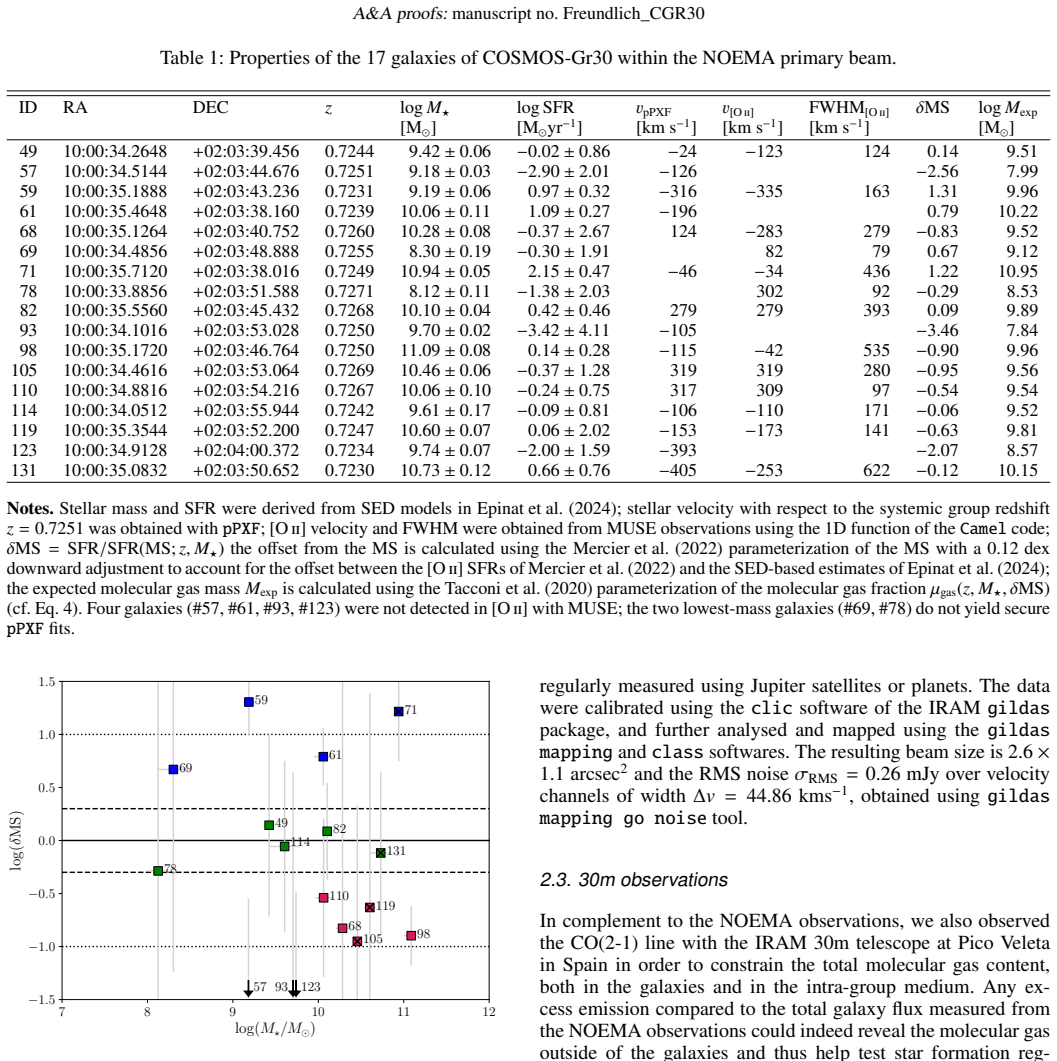
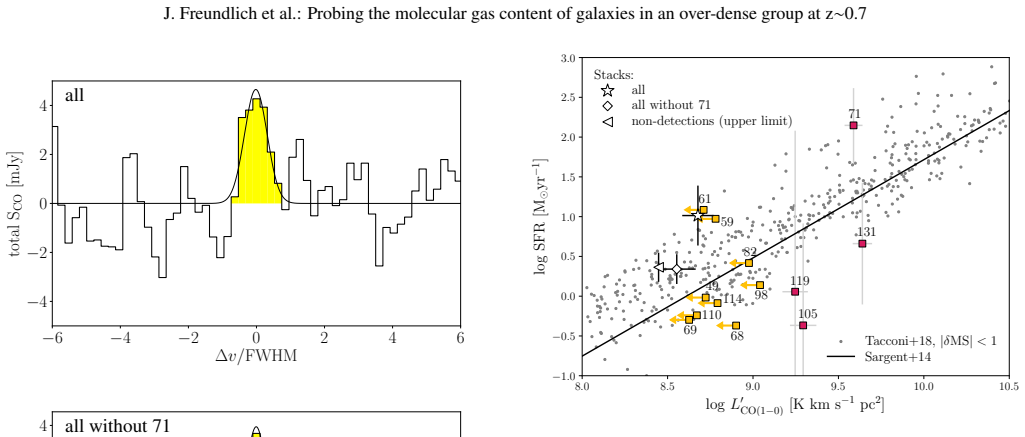
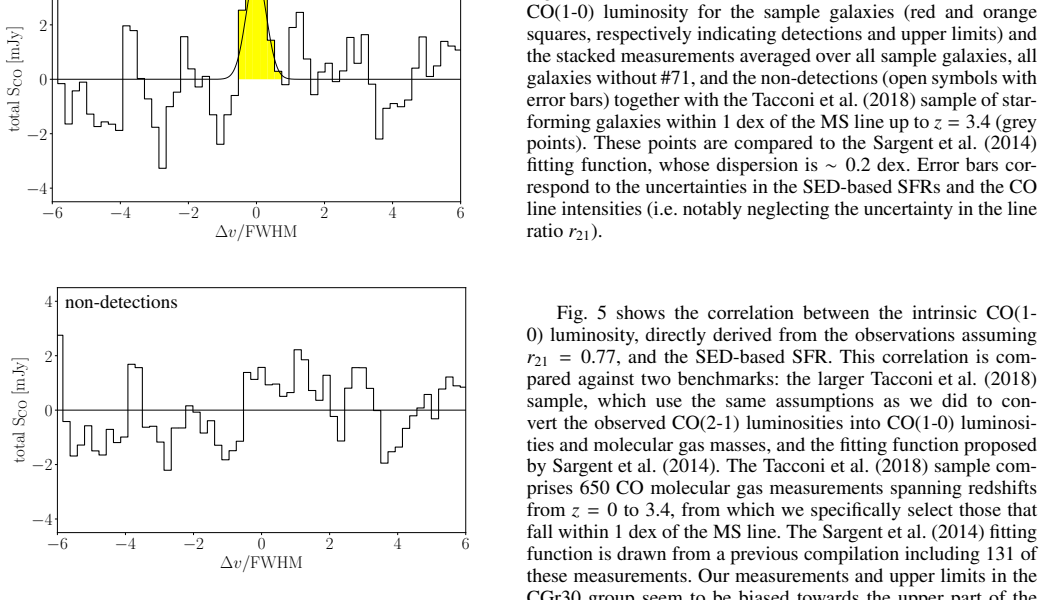
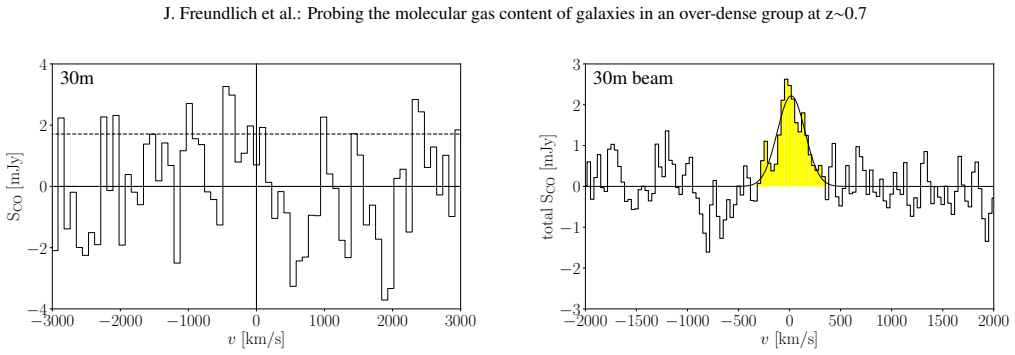
Stacked CO(2-1) measurements of the group members yield molecular gas contents lower by approximately 0.5 dex than predicted by literature field scaling relations, implying gas fractions 20 to 40 percent of those in main-sequence galaxies; the 30 m data additionally constrain the molecular gas mass associated with the large ionized structure to less than 2 times 10^10 solar masses.
What carries the argument
Comparison of stacked CO-derived molecular gas masses against field scaling relations for galaxies of matched stellar mass and star-formation rate.
If this is right
- Environmental processes in this group are removing or suppressing molecular gas on short timescales.
- The group environment captures quenching in action at z approximately 0.7.
- Less than one-third of the gas in the intra-group medium exists in a cold, star-forming phase.
- The reduction applies on average to the full group population, including undetected members.
Where Pith is reading between the lines
- Repeating the same stacking approach on additional groups at similar redshift would test whether the depletion is common or specific to this filament intersection.
- The result supplies a concrete target for simulations that track cold-gas stripping or starvation inside groups.
- If the ionized structure traces ongoing stripping, deeper CO maps could reveal whether the missing molecular gas has already been heated or dispersed.
Load-bearing premise
Literature field scaling relations give an unbiased prediction of molecular gas content for galaxies of the same stellar mass and star-formation rate outside groups.
What would settle it
A re-analysis or new observation showing that the stacked CO flux matches field expectations once selection and stacking biases are fully accounted for would falsify the reported reduction.
Figures
read the original abstract
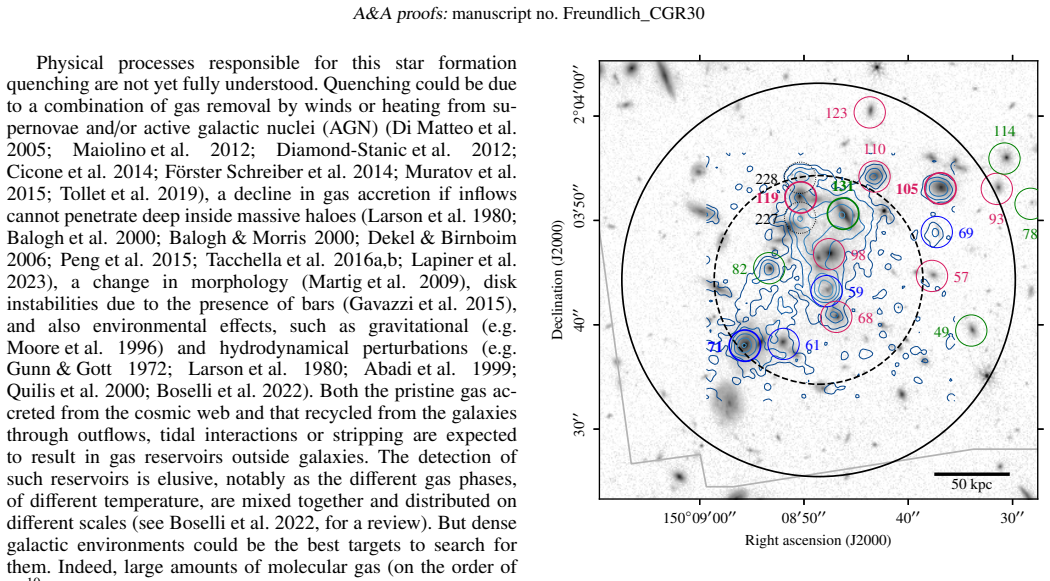
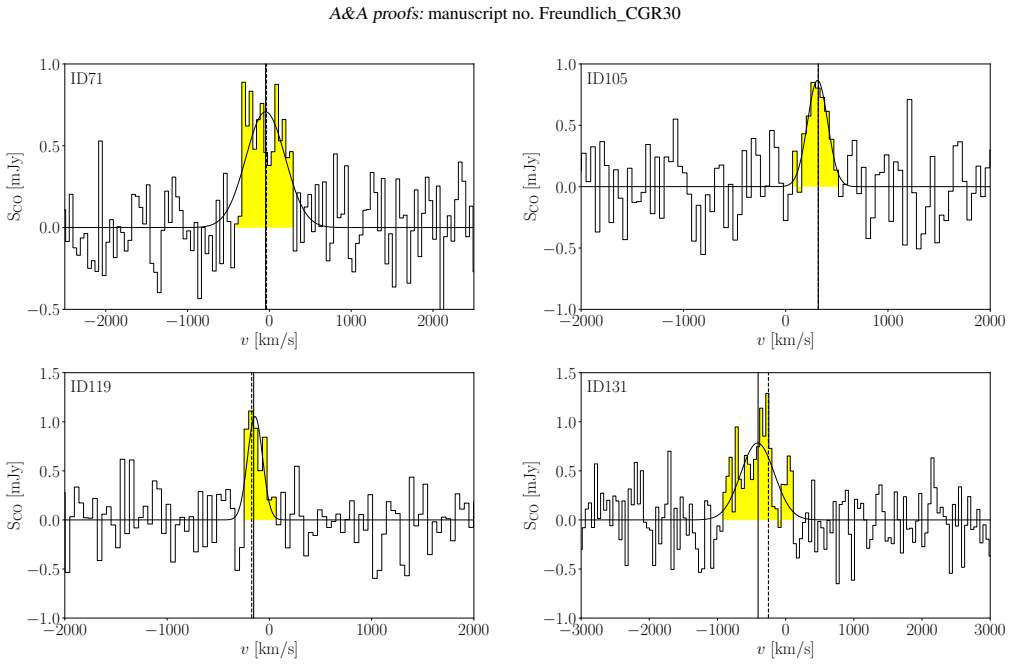
To probe the impact of group environment on molecular gas reservoirs at intermediate redshift, we observed the CO(2-1) emission in the galaxy group COSMOS-Gr30 at $z \sim 0.7$ with IRAM's NOEMA and 30m telescopes. This dense environment, located at the intersection of large-scale cosmic web filaments, has the specificity to host a large ($\sim 10^{4}$ kpc$^{2}$) ionized gas structure revealed by MUSE. We detect CO emission in four galaxies of the group at $\mathrm{S/N} > 5$ and derive upper limits for the remaining group members with secure spectroscopic redshifts. Stacked measurements indicate that group galaxies exhibit on average molecular gas contents reduced by $\sim 0.5$ dex relative to field scaling relations, corresponding to gas fractions that are $20\%$ to $40\%$ of those found in typical main-sequence galaxies. Although the uncertainties are significant, this suggests that environmental processes efficiently deplete molecular gas reservoirs in the galaxies of this group. The 30m observations place an upper limit on the molecular gas associated with the extended ionized structure, $M_{\rm gas} < 2 \times 10^{10} \rm M_\odot$, implying that less than a third of the gas in the intra-group medium is in a cold, star-forming phase. Together, these results contribute to show how environmental mechanisms in dense group environments act to remove or suppress molecular gas within galaxies, capturing quenching processes in action.
Editorial analysis
A structured set of objections, weighed in public.
Referee Report
Summary. The paper reports NOEMA and IRAM 30m CO(2-1) observations of the COSMOS-Gr30 galaxy group at z~0.7. Four group members are detected at S/N>5, with upper limits for the remainder; stacking yields an average molecular gas content ~0.5 dex below field scaling relations (gas fractions 20-40% of main-sequence values), interpreted as evidence for environmental depletion. An upper limit M_gas < 2e10 M_sun is placed on the extended ionized structure seen by MUSE, implying <1/3 of intra-group gas is in a cold phase.
Significance. If the offset holds after accounting for baselines and systematics, the work supplies a useful test case of environmental effects on molecular gas at intermediate redshift in a filament-intersection group. The multi-telescope approach and constraint on the intra-group medium are strengths. The small detection count and external-relation comparison keep the quantitative claim provisional, consistent with the abstract's own caveats on uncertainties.
major comments (2)
- [Abstract] Abstract and results section: the headline 0.5 dex deficit (and 20-40% gas-fraction claim) is derived from a stack of four detections plus upper limits; without an explicit table or subsection comparing the group's M*–SFR distribution to the exact literature calibration samples used for the field relations, it is impossible to rule out a selection-driven offset in the baseline.
- [Methods] Methods/results: the stacking weights, handling of non-detections, and adopted CO-to-H2 conversion factor (listed as a free parameter in the axiom ledger) are not specified with sufficient quantitative detail to demonstrate that the procedure does not systematically underestimate the mean; this is load-bearing for the reported environmental depletion.
minor comments (2)
- [Abstract] Abstract: the statement that uncertainties are 'significant' should be accompanied by the actual error on the 0.5 dex offset and on the gas-fraction range.
- [Results] The 30 m upper limit on the extended structure is a useful ancillary result but would benefit from a short dedicated paragraph clarifying the assumed line width and excitation.
Simulated Author's Rebuttal
We thank the referee for the constructive report and the recommendation for major revision. We address the two major comments below by expanding the manuscript with the requested comparisons and quantitative details on the analysis. These changes will strengthen the presentation without altering the core results or conclusions.
read point-by-point responses
-
Referee: [Abstract] Abstract and results section: the headline 0.5 dex deficit (and 20-40% gas-fraction claim) is derived from a stack of four detections plus upper limits; without an explicit table or subsection comparing the group's M*–SFR distribution to the exact literature calibration samples used for the field relations, it is impossible to rule out a selection-driven offset in the baseline.
Authors: We agree that an explicit side-by-side comparison of the M*–SFR distribution is necessary to address potential selection effects. In the revised manuscript we will add a dedicated subsection (in Results) and an accompanying table that tabulates the stellar masses, SFRs, and sSFRs for all COSMOS-Gr30 members with secure redshifts, together with the median values and ranges from the precise field samples used to construct the scaling relations (e.g., the Tacconi et al. or Genzel et al. compilations referenced in the text). This will allow direct assessment of whether the group galaxies occupy the same locus as the field calibration set. revision: yes
-
Referee: [Methods] Methods/results: the stacking weights, handling of non-detections, and adopted CO-to-H2 conversion factor (listed as a free parameter in the axiom ledger) are not specified with sufficient quantitative detail to demonstrate that the procedure does not systematically underestimate the mean; this is load-bearing for the reported environmental depletion.
Authors: We acknowledge that the current description of the stacking procedure lacks the quantitative detail required. The revised Methods section will explicitly state: (i) the weighting scheme applied to the four detections and upper limits (inverse-variance weighting with the precise formula), (ii) the statistical treatment of non-detections (including whether a Kaplan–Meier estimator, survival analysis, or conservative upper-limit substitution was used), and (iii) the adopted CO-to-H2 conversion factor together with its justification, the range explored, and how its uncertainty is propagated into the final 0.5 dex offset. These additions will demonstrate that the mean is not systematically underestimated. revision: yes
Circularity Check
No significant circularity; comparison relies on external literature scaling relations
full rationale
The paper's central result is a direct observational comparison: stacked CO-derived molecular gas masses for the group galaxies are reported ~0.5 dex below published field scaling relations for M_H2 vs. M* and SFR. No internal equations, fitted parameters, or self-citations are used to define or force this offset; the deficit is measured against independent external calibrations. The stacking procedure and upper-limit handling are described as standard and do not reduce the reported gas fractions to a quantity defined inside the paper. This is the most common honest non-finding for observational papers that benchmark against literature relations.
Axiom & Free-Parameter Ledger
free parameters (1)
- CO-to-H2 conversion factor
axioms (1)
- domain assumption Field scaling relations for molecular gas content versus stellar mass and SFR provide an unbiased reference population.
Reference graph
Works this paper leans on
-
[1]
G., Moore , B., & Bower , R
Abadi , M. G., Moore , B., & Bower , R. G. 1999, , 308, 947
1999
-
[2]
2022, , 927, 235
Alberts , S., Adams , J., Gregg , B., et al. 2022, , 927, 235
2022
-
[3]
2010, , 718, 177
Aravena , M., Carilli , C., Daddi , E., et al. 2010, , 718, 177
2010
-
[4]
2015, , 575, A75
Bacon , R., Brinchmann , J., Richard , J., et al. 2015, , 575, A75
2015
-
[5]
Balogh , M. L. & Morris , S. L. 2000, , 318, 703
2000
-
[6]
L., Navarro , J
Balogh , M. L., Navarro , J. F., & Morris , S. L. 2000, , 540, 113
2000
-
[7]
K., Pope , A., Scoville , N., et al
Betti , S. K., Pope , A., Scoville , N., et al. 2019, , 874, 53
2019
-
[8]
D., Wolfire , M., & Leroy , A
Bolatto , A. D., Wolfire , M., & Leroy , A. K. 2013, , 51, 207
2013
-
[9]
A., van der Werf , P., Weiss , A., et al
Boogaard , L. A., van der Werf , P., Weiss , A., et al. 2020, , 902, 109
2020
-
[10]
2019, , 622, A103
Boquien , M., Burgarella , D., Roehlly , Y., et al. 2019, , 622, A103
2019
-
[11]
2019, , 631, A114
Boselli , A., Epinat , B., Contini , T., et al. 2019, , 631, A114
2019
-
[12]
2022, , 30, 3
Boselli , A., Fossati , M., & Sun , M. 2022, , 30, 3
2022
-
[13]
S., Smail , I., Chapman , S
Bothwell , M. S., Smail , I., Chapman , S. C., et al. 2013, , 429, 3047
2013
-
[14]
2010, , 718, 1001
Bouch \'e , N., Dekel , A., Genzel , R., et al. 2010, , 718, 1001
2010
-
[15]
& Charlot , S
Bruzual , G. & Charlot , S. 2003, , 344, 1000
2003
-
[16]
C., et al
Calzetti , D., Armus , L., Bohlin , R. C., et al. 2000, , 533, 682
2000
-
[17]
2017, , 466, 798
Cappellari , M. 2017, , 466, 798
2017
-
[18]
2023, MNRAS, 526, 3273
Cappellari , M. 2023, MNRAS, 526, 3273
2023
-
[19]
& Emsellem , E
Cappellari , M. & Emsellem , E. 2004, , 116, 138
2004
-
[20]
A., Clayton , G
Cardelli , J. A., Clayton , G. C., & Mathis , J. S. 1989, , 345, 245
1989
-
[21]
M., Kartaltepe , J
Casey , C. M., Kartaltepe , J. S., Drakos , N. E., et al. 2023, , 954, 31
2023
-
[22]
2019, , 623, A48
Castignani , G., Combes , F., Salom \'e , P., et al. 2019, , 623, A48
2019
-
[23]
2025, , 700, A197
Castignani , G., Combes , F., Salom \'e , P., Edge , A., & Jablonka , P. 2025, , 700, A197
2025
-
[24]
2020 a , , 635, A32
Castignani , G., Combes , F., Salom \'e , P., & Freundlich , J. 2020 a , , 635, A32
2020
-
[25]
2020 b , , 640, A64
Castignani , G., Jablonka , P., Combes , F., et al. 2020 b , , 640, A64
2020
-
[26]
2022, , 667, A52
Castignani , G., Radovich , M., Combes , F., et al. 2022, , 667, A52
2022
-
[27]
2023, , 672, A139
Castignani , G., Radovich , M., Combes , F., et al. 2023, , 672, A139
2023
-
[28]
2003, , 115, 763
Chabrier , G. 2003, , 115, 763
2003
-
[29]
M., Lilly , S
Cibinel , A., Carollo , C. M., Lilly , S. J., et al. 2013, , 777, 116
2013
-
[30]
2014, , 562, A21
Cicone , C., Maiolino , R., Sturm , E., et al. 2014, , 562, A21
2014
-
[31]
2021, , 653, A6
Ciesla , L., Buat , V., Boquien , M., et al. 2021, , 653, A6
2021
-
[32]
2017, , 608, A41
Ciesla , L., Elbaz , D., & Fensch , J. 2017, , 608, A41
2017
-
[33]
& Gunn , J
Conroy , C. & Gunn , J. E. 2010, , 712, 833
2010
-
[34]
T., Daddi , E., Sargent , M
Coogan , R. T., Daddi , E., Sargent , M. T., et al. 2018, , 479, 703
2018
-
[35]
2012, , 542, A32
Corbelli , E., Bianchi , S., Cortese , L., et al. 2012, , 542, A32
2012
-
[36]
2010, , 713, 686
Daddi , E., Bournaud , F., Walter , F., et al. 2010, , 713, 686
2010
-
[37]
2015, , 577, A46
Daddi , E., Dannerbauer , H., Liu , D., et al. 2015, , 577, A46
2015
-
[38]
2007, , 670, 156
Daddi , E., Dickinson , M., Morrison , G., et al. 2007, , 670, 156
2007
-
[39]
A., Helou , G., Magdis , G
Dale , D. A., Helou , G., Magdis , G. E., et al. 2014, , 784, 83
2014
-
[40]
A., et al
Dannerbauer , H., Daddi , E., Riechers , D. A., et al. 2009, , 698, L178
2009
-
[41]
M., Combes , F., Salom \'e , P., & Braine , J
Dasyra , K. M., Combes , F., Salom \'e , P., & Braine , J. 2012, , 540, A112
2012
-
[42]
Dav \'e , R., Finlator , K., & Oppenheimer , B. D. 2012, , 421, 98
2012
-
[43]
& Birnboim , Y
Dekel , A. & Birnboim , Y. 2006, , 368, 2
2006
-
[44]
2009, , 457, 451
Dekel , A., Birnboim , Y., Engel , G., et al. 2009, , 457, 451
2009
-
[45]
2005, , 433, 604
Di Matteo , T., Springel , V., & Hernquist , L. 2005, , 433, 604
2005
-
[46]
M., Moustakas , J., Tremonti , C
Diamond-Stanic , A. M., Moustakas , J., Tremonti , C. A., et al. 2012, , 755, L26
2012
-
[47]
A., Webb , T
Dunne , D. A., Webb , T. M. A., Noble , A., et al. 2021, , 909, L29
2021
-
[48]
Edge , A. C. 2001, , 328, 762
2001
-
[49]
2007, , 468, 33
Elbaz , D., Daddi , E., Le Borgne , D., et al. 2007, , 468, 33
2007
-
[50]
Emonts , B. H. C., Lehnert , M. D., Dannerbauer , H., et al. 2018, , 477, L60
2018
-
[51]
Emonts , B. H. C., Lehnert , M. D., Villar-Mart \' n , M., et al. 2016, Science, 354, 1128
2016
-
[52]
2018, , 609, A40
Epinat , B., Contini , T., Finley , H., et al. 2018, , 609, A40
2018
-
[53]
2024, , 683, A205
Epinat , B., Contini , T., Mercier , W., et al. 2024, , 683, A205
2024
-
[54]
2025, arXiv e-prints, arXiv:2503.15333
Euclid Collaboration: Laigle , C., Gouin , C., Sarron , F., et al. 2025, arXiv e-prints, arXiv:2503.15333
arXiv 2025
-
[55]
2019, , 879, 103
Fogarty , K., Postman , M., Li , Y., et al. 2019, , 879, 103
2019
-
[56]
M., Genzel , R., Newman , S
F \"o rster Schreiber , N. M., Genzel , R., Newman , S. F., et al. 2014, , 787, 38
2014
-
[57]
J., et al
Freundlich , J., Combes , F., Tacconi , L. J., et al. 2013, , 553, A130
2013
-
[58]
J., et al
Freundlich , J., Combes , F., Tacconi , L. J., et al. 2019, , 622, A105
2019
-
[59]
& Gavazzi , G
Fumagalli , M. & Gavazzi , G. 2008, , 490, 571
2008
-
[60]
2015, , 580, A116
Gavazzi , G., Consolandi , G., Dotti , M., et al. 2015, , 580, A116
2015
-
[61]
2010, , 719, 229
Genel , S., Bouch \'e , N., Naab , T., Sternberg , A., & Genzel , R. 2010, , 719, 229
2010
-
[62]
J., Combes , F., et al
Genzel , R., Tacconi , L. J., Combes , F., et al. 2012, , 746, 69
2012
-
[63]
J., Lutz , D., et al
Genzel , R., Tacconi , L. J., Lutz , D., et al. 2015, , 800, 20
2015
-
[64]
G., Baldry , I
Gilbank , D. G., Baldry , I. K., Balogh , M. L., Glazebrook , K., & Bower , R. G. 2010, , 405, 2594
2010
-
[65]
G., Baldry , I
Gilbank , D. G., Baldry , I. K., Balogh , M. L., Glazebrook , K., & Bower , R. G. 2011, , 412, 2111
2011
-
[66]
A., Pavesi , R., et al
G \'o mez-Guijarro , C., Riechers , D. A., Pavesi , R., et al. 2019, , 872, 117
2019
-
[67]
2012, , 749, 158
Guillard , P., Boulanger , F., Pineau des For \^e ts , G., et al. 2012, , 749, 158
2012
-
[68]
Gunn , J. E. & Gott , J. Richard, I. 1972, , 176, 1
1972
-
[69]
C., et al
Gururajan , G., Cucciati , O., Lemaux , B. C., et al. 2025, , 698, A312
2025
-
[70]
2018, , 856, 118
Hayashi , M., Tadaki , K.-i., Kodama , T., et al. 2018, , 856, 118
2018
-
[71]
2016, , 592, A78
Iovino , A., Petropoulou , V., Scodeggio , M., et al. 2016, , 592, A78
2016
-
[72]
J \'a chym , P., Sun , M., Kenney , J. D. P., et al. 2017, , 839, 114
2017
-
[73]
2026, arXiv e-prints, arXiv:2602.21890
Jego , B., B \'e thermin , M., Kraljic , K., et al. 2026, arXiv e-prints, arXiv:2602.21890
Pith/arXiv arXiv 2026
-
[74]
Kennicutt , Jr., R. C. 1998, , 36, 189
1998
-
[75]
H., & Dav \'e , R
Kere s , D., Katz , N., Weinberg , D. H., & Dav \'e , R. 2005, , 363, 2
2005
-
[76]
J., Iovino , A., et al
Knobel , C., Lilly , S. J., Iovino , A., et al. 2012, , 753, 121
2012
-
[77]
1997, IRAM internal report, https://publicwiki.iram.es/CalibrationPapers?action=AttachFile&do=view&target=kramer_1997_cali_rep.pdf
Kramer , C. 1997, IRAM internal report, https://publicwiki.iram.es/CalibrationPapers?action=AttachFile&do=view&target=kramer_1997_cali_rep.pdf
1997
-
[78]
2013, IRAM internal report, https://publicwiki.iram.es/CalibrationPapers?action=AttachFile&do=view&target=eb2013-v8.2.pdf
Kramer , C., Pe nalver , J., & Greve , A. 2013, IRAM internal report, https://publicwiki.iram.es/CalibrationPapers?action=AttachFile&do=view&target=eb2013-v8.2.pdf
2013
-
[79]
G., Labb \'e , I., et al
Kriek , M., van Dokkum , P. G., Labb \'e , I., et al. 2009, , 700, 221
2009
-
[80]
2018, , 474, 5437
Laigle , C., Pichon , C., Arnouts , S., et al. 2018, , 474, 5437
2018
discussion (0)
Sign in with ORCID, Apple, or X to comment. Anyone can read and Pith papers without signing in.