Phonetic and semantic analyses of spoken corpora of Beijing and Taiwan Mandarin indicate that the neutral tone is a lexical tone
Pith reviewed 2026-06-26 01:24 UTC · model grok-4.3
The pith
The neutral tone in Mandarin is a lexical tone with its own target and word-specific signatures.
A machine-rendered reading of the paper's core claim, the machinery that carries it, and where it could break.
Core claim
The neutral tone possesses its own tonal target, exhibits first-syllable-dependent contours in disyllabic words, and carries word-specific pitch signatures predictable from contextualized embeddings, properties that together establish it as a lexical tone in Beijing and Taiwan Mandarin.
What carries the argument
Independent tonal target plus first-syllable dependence and embedding-correlated word-specific pitch signatures
If this is right
- Neutral-tone words should be modeled with the same tonal inventory and sandhi rules as other lexical-tone words.
- Variability observed in neutral-tone realizations is expected to match the range seen for the four standard tones.
- Some differences in neutral-tone realization between Beijing and Taiwan corpora may be traceable to differences in word meanings across the two datasets.
- Single-syllable neutral-tone words fit the same lexical pattern as disyllabic ones.
Where Pith is reading between the lines
- Tone-acquisition studies may need to treat the neutral tone as one of five lexical tones rather than a separate reduced category.
- Speech technology systems could improve by generating neutral-tone contours from the same embedding-based mechanisms used for lexical tones.
- Re-examination of other putatively toneless or reduced syllables in Mandarin and related languages becomes testable with the same embedding-correlation method.
Load-bearing premise
Possession of an independent tonal target, first-syllable-dependent contours, and word-specific pitch signatures correlated with embeddings is sufficient to classify a tone as lexical rather than reduced or toneless.
What would settle it
A new corpus or controlled experiment showing that neutral-tone syllables lack an independent tonal target or that their pitch signatures fail to correlate with contextualized embeddings would falsify the lexical classification.
Figures

read the original abstract
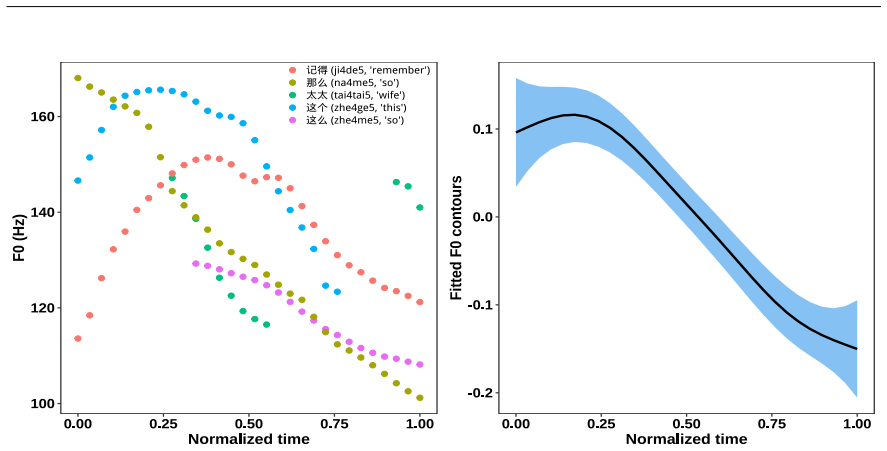
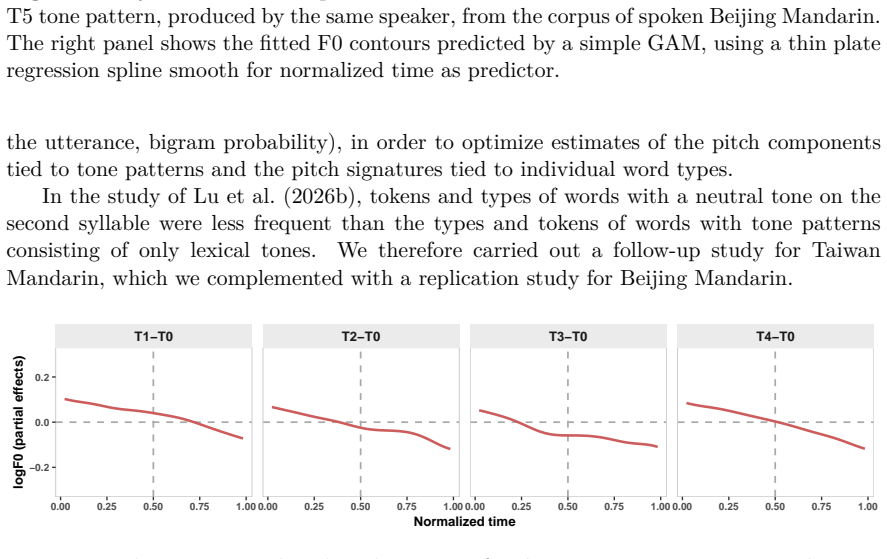
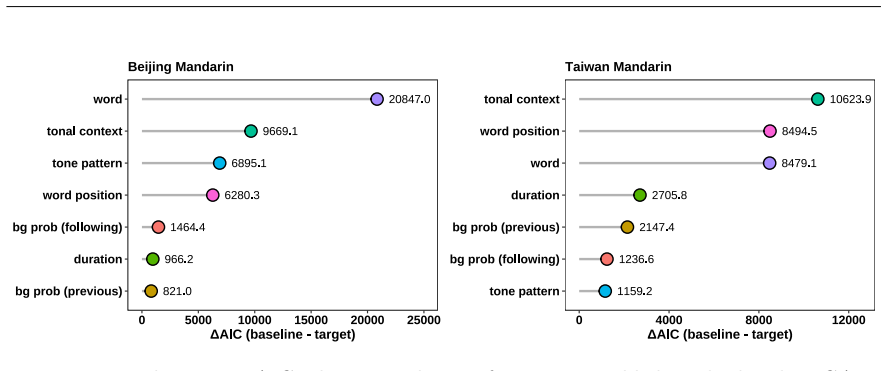
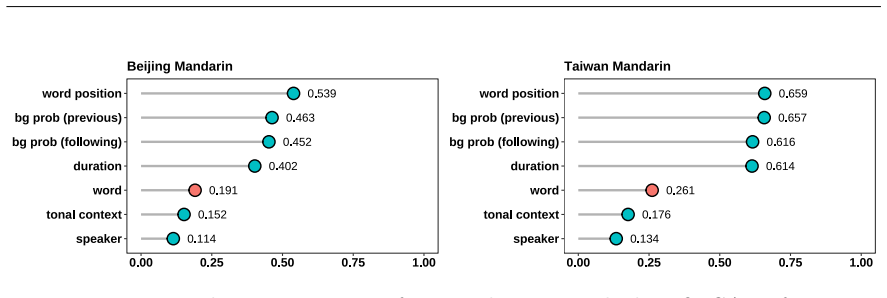
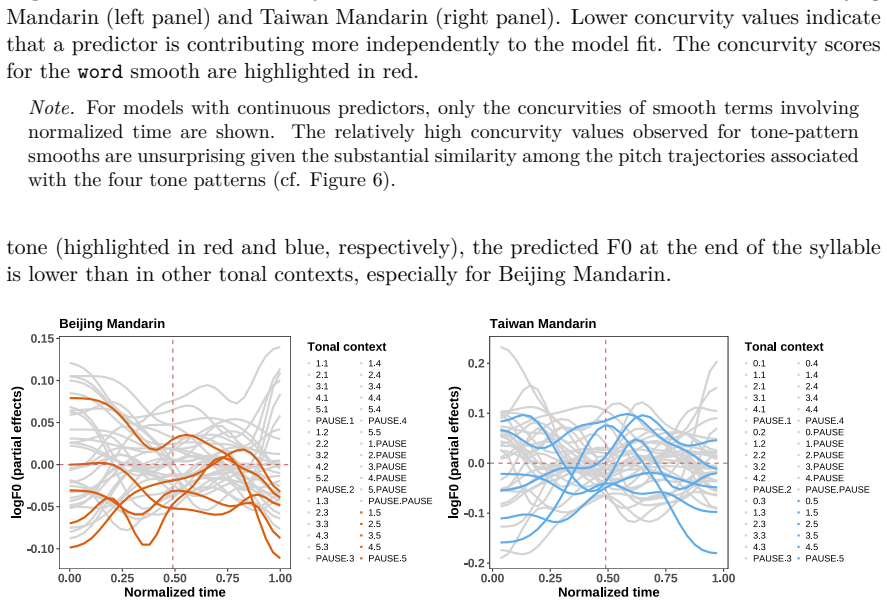
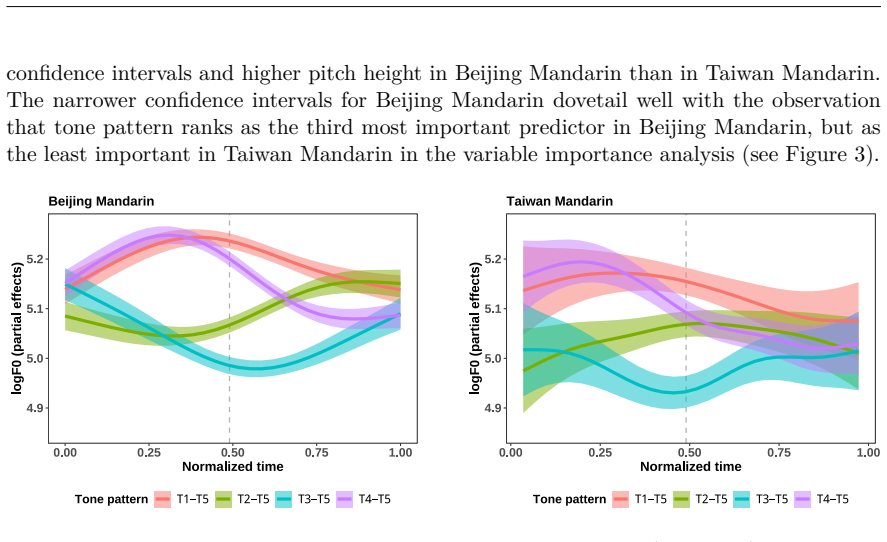
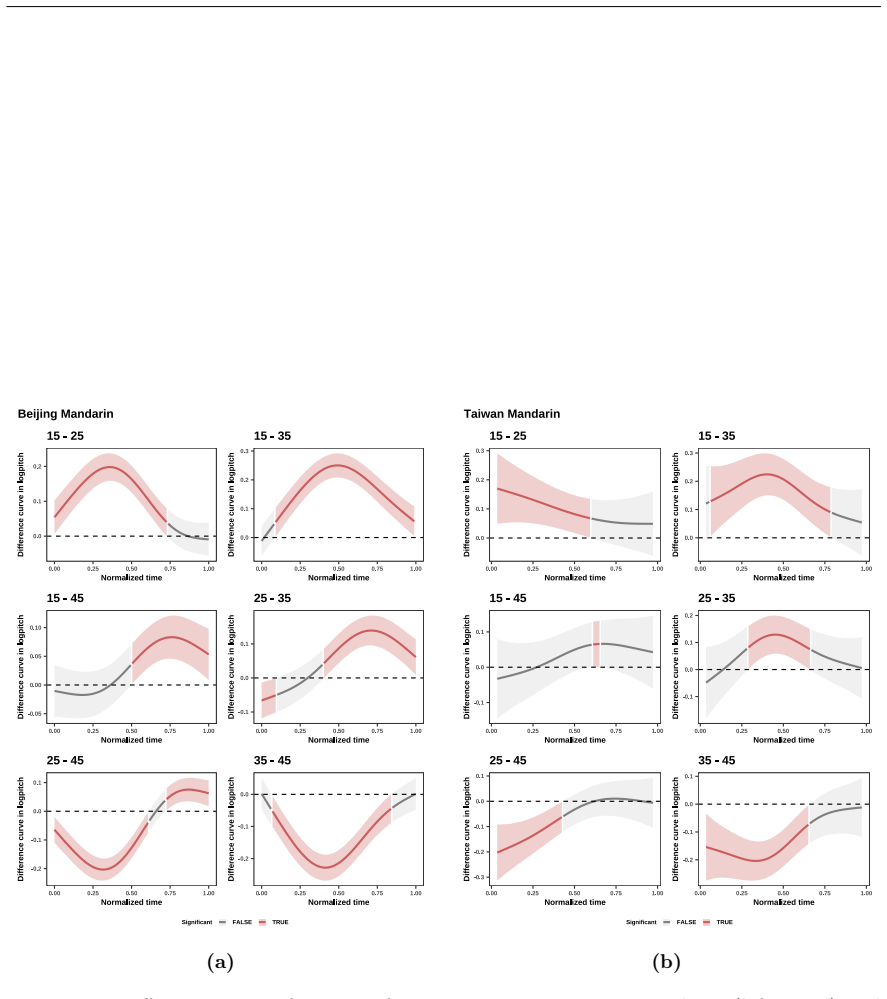
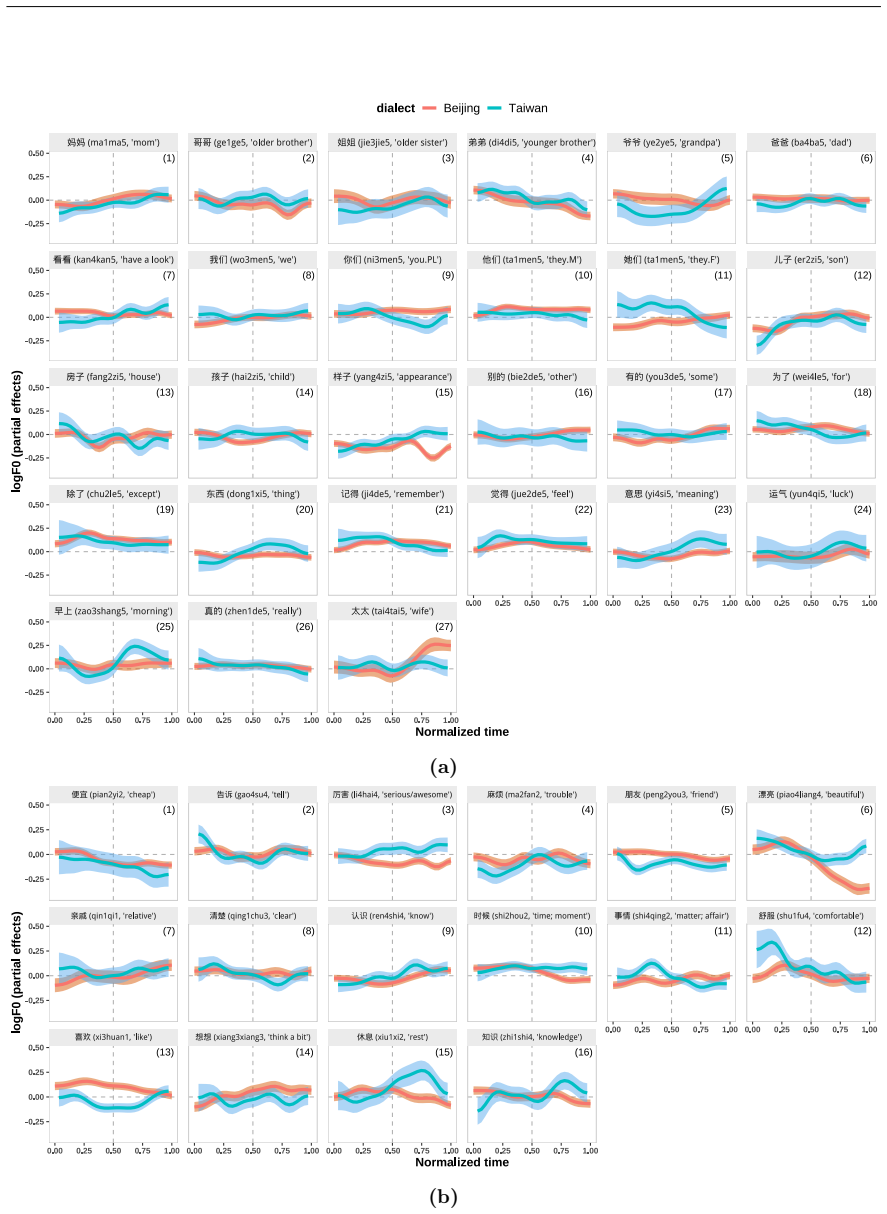
The neutral, or floating, tone of Mandarin Chinese is a tone with an enigmatic set of properties. It has been described as a reduced tone, or as a tone that sometimes is lexically fixed but that can also be toneless. In two-syllable words, it is found only on the second syllable, but single-syllable words can also have the neutral tone. We present a corpus-based study of the phonetic realization of the neutral tone in spontaneous conversational speech corpora of Beijing Mandarin and Taiwan Mandarin. We show that the neutral tone has its own tonal target, just as the four lexical tones of Mandarin. We also show that disyllabic words with a neutral tone have pitch contours that have a pitch component that depends on the tone on the first syllable, just as has been observed for two-syllable words with a lexical tone on the second syllable (Chuang et al., 2026). Furthermore, words with a floating tone have word-specific pitch signatures, which have also been documented for single-syllable words (Jin et al., 2026) as well as two-syllable words (Lu et al., 2026b). These word-specific pitch signatures are shown to be predictable to some extent from words' contextualized embeddings, as previously reported for lexical tones (Chuang et al., 2026; Lu et al., 2026b). As there is also considerable variability in the realization of lexical tones, we propose that the neutral tone is, in fact, a lexical tone in both Taiwan Mandarin and Beijing Mandarin. We document both similarities and differences in the realization of the floating tone in these two varieties and provide evidence, using contextualized embeddings, that some of the observed differences may arise from differences in the meanings of the words as used in the two corpora.
Editorial analysis
A structured set of objections, weighed in public.
Referee Report
Summary. The paper claims, based on phonetic analyses of spontaneous speech corpora from Beijing and Taiwan Mandarin, that the neutral (floating) tone has an independent tonal target, exhibits first-syllable-dependent pitch contours in disyllables, and shows word-specific pitch signatures predictable from contextualized embeddings—properties also documented for lexical tones. Citing variability in lexical-tone realizations, the authors conclude that the neutral tone is in fact a lexical tone in both varieties, while documenting cross-variety differences that may stem from semantic usage differences.
Significance. If the central claim holds, the result would reclassify the neutral tone within Mandarin phonology, treating it as lexically specified rather than reduced or toneless and thereby affecting models of tone inventory and realization. The corpus approach across two varieties, combined with embedding-based predictability, supplies a potential diagnostic for lexical status and highlights semantic contributions to phonetic variation.
major comments (2)
- [final proposal paragraph] The central inference—that possession of an independent target, first-syllable dependence, and embedding-predictable word signatures suffices to reclassify neutral tone as lexical—rests on an untested sufficiency assumption. No explicit criterion is supplied that would rule out a reduced or toneless category displaying the same properties (see the proposal paragraph following the embedding results).
- [corpus analysis and embedding sections] Comparisons establishing that neutral-tone contours match lexical-tone patterns in first-syllable dependence and embedding predictability are referenced to Chuang et al. (2026) and Lu et al. (2026b) without reporting here the sample sizes, exclusion criteria, or statistical controls used in those baselines or in the current neutral-tone data, leaving the claimed equivalence difficult to evaluate.
minor comments (2)
- [abstract and methods] The abstract and methods description omit quantitative details on token counts per variety, speaker numbers, and pitch-extraction parameters.
- [discussion of Beijing–Taiwan differences] Clarify how the reported cross-variety semantic differences were quantified via embeddings and whether they survive controls for lexical frequency.
Simulated Author's Rebuttal
We thank the referee for the constructive comments, which help clarify the strength of our central claim. We respond to each major comment below and indicate the revisions planned for the next version of the manuscript.
read point-by-point responses
-
Referee: [final proposal paragraph] The central inference—that possession of an independent target, first-syllable dependence, and embedding-predictable word signatures suffices to reclassify neutral tone as lexical—rests on an untested sufficiency assumption. No explicit criterion is supplied that would rule out a reduced or toneless category displaying the same properties (see the proposal paragraph following the embedding results).
Authors: We agree that the reclassification argument would be strengthened by an explicit criterion for lexical-tone status that rules out a reduced or toneless analysis. The manuscript currently infers lexical status from the combination of an independent target, first-syllable dependence, embedding-predictable word signatures, and the documented variability of lexical tones. In revision we will expand the proposal paragraph to state a set of diagnostic properties drawn from the phonological literature on tone, explain why these properties are taken to favor a lexical rather than reduced analysis, and note the remaining inferential gap. This change directly addresses the sufficiency assumption. revision: yes
-
Referee: [corpus analysis and embedding sections] Comparisons establishing that neutral-tone contours match lexical-tone patterns in first-syllable dependence and embedding predictability are referenced to Chuang et al. (2026) and Lu et al. (2026b) without reporting here the sample sizes, exclusion criteria, or statistical controls used in those baselines or in the current neutral-tone data, leaving the claimed equivalence difficult to evaluate.
Authors: We agree that the absence of these methodological details makes the claimed equivalence hard to assess. In the revised manuscript we will add, in the relevant sections, the sample sizes, exclusion criteria, and statistical controls reported in Chuang et al. (2026) and Lu et al. (2026b), together with the corresponding details for the neutral-tone data analyzed here. This will allow readers to evaluate the comparisons directly. revision: yes
Circularity Check
Neutral tone reclassified as lexical by matching properties whose diagnostic status for lexical tones is established only via self-citations to overlapping authors' prior work
specific steps
-
self citation load bearing
[Abstract]
"disyllabic words with a neutral tone have pitch contours that have a pitch component that depends on the tone on the first syllable, just as has been observed for two-syllable words with a lexical tone on the second syllable (Chuang et al., 2026)"
The property invoked to align neutral tone with lexical tone is taken directly from the authors' own prior paper; the similarity claim therefore reduces to that self-citation rather than an independent observation within the present study.
-
self citation load bearing
[Abstract]
"These word-specific pitch signatures are shown to be predictable to some extent from words' contextualized embeddings, as previously reported for lexical tones (Chuang et al., 2026; Lu et al., 2026b)"
The embedding-predictability property used as evidence that neutral tone behaves like lexical tone is referenced exclusively to the authors' own earlier papers, rendering the diagnostic equivalence dependent on the self-citation chain.
-
self citation load bearing
[Abstract]
"As there is also considerable variability in the realization of lexical tones, we propose that the neutral tone is, in fact, a lexical tone in both Taiwan Mandarin and Beijing Mandarin"
The final classificatory step equates the documented variability of neutral tone with that of lexical tones, but the characterization of lexical-tone variability itself rests on the same self-cited prior results; the reclassification therefore collapses to the self-citation load.
full rationale
The paper's central inference proceeds by documenting three properties for neutral tone (independent target, first-syllable dependence, embedding-predictable word signatures) and asserting these suffice for lexical status because the same properties hold for lexical tones. Each of the three comparison points is supported only by direct citation to Chuang et al. 2026 and Lu et al. 2026b (plus Jin et al. 2026), works whose author overlap with the present paper is evident from the citation list and author names. The final sentence then equates the observed variability with lexical-tone variability to reach the reclassification. No independent, non-self-cited criterion is supplied that would rule out a reduced/toneless analysis while preserving the same phonetic facts. This satisfies the self-citation-load-bearing pattern at the load-bearing step of the argument.
Axiom & Free-Parameter Ledger
axioms (2)
- domain assumption Pitch contours observed in spontaneous speech reliably reflect underlying tonal targets.
- domain assumption Contextualized embeddings encode semantic information that can influence or correlate with phonetic realization of tones.
Reference graph
Works this paper leans on
-
[1]
Foundation for Statistical Computing , author =
-
[2]
Cross-dialectal perspectives on
Xu, Chenzi , journal=. Cross-dialectal perspectives on. 2024 , publisher=
2024
-
[3]
A grammar of spoken
Chao, Yuen Ren , year=. A grammar of spoken
-
[4]
Praat: doing phonetics by computer [
Boersma, Paul and Weenink, David , year =. Praat: doing phonetics by computer [
-
[5]
, year =
Fon, J. , year =. A preliminary construction of
-
[6]
Ruan, Feifei and Song, Qiong and Li, Ke and Hao, Yufeng , title =
-
[7]
, year =
Wood, Simon N. , year =. Generalized additive models: an introduction with
-
[8]
Speech Communication , volume=
Mandarin lexical tone duration: Impact of speech style, word length, syllable position and prosodic position , author=. Speech Communication , volume=. 2023 , publisher=
2023
-
[9]
, author=
Visualizing data using t-SNE. , author=. Journal of machine learning research , volume=
-
[10]
Manual of clinical phonetics , pages=
Analyzing phonetic data with generalized additive mixed models , author=. Manual of clinical phonetics , pages=. 2021 , publisher=
2021
-
[11]
The realization of tones in spontaneous spoken
Lu, Yuxin and Chuang, Yu-Ying and Baayen, R Harald , journal=. The realization of tones in spontaneous spoken. 2026 , doi=
2026
-
[12]
Form and meaning co-determine the realization of tone in
Lu, Yuxin and Chuang, Yu-Ying and Baayen, R Harald , journal=. Form and meaning co-determine the realization of tone in. 2026 , doi=
2026
-
[13]
A new kid on the block:
Jin, Xiaoyun and Ernestus, Mirjam and Baayen, R Harald , journal=. A new kid on the block:. 2026 , doi=
2026
-
[14]
Chuang, Yu-Ying and Bell, M. J. and Tseng, Yu-Hsiang and Baayen, R. H. , year =. Word-specific tonal realizations in. Language , doi=
-
[15]
Contextual tonal variations in
Xu, Yi , journal=. Contextual tonal variations in. 1997 , publisher=
1997
-
[16]
Harald , year=
Gahl, Susanne and Baayen, R. Harald , year=. Language , volume =
-
[17]
Complexity , author =
The discriminative lexicon:. Complexity , author =. 2019 , doi=
2019
-
[18]
The Discriminative Lexicon: Theory, implementation in the
Heitmeier, Maria and Chuang, Yu-Ying and Baayen, R Harald , year=. The Discriminative Lexicon: Theory, implementation in the
-
[19]
EasyAlign: An Automatic Phonetic Alignment Tool Under
Goldman, Jean-Philippe , booktitle=. EasyAlign: An Automatic Phonetic Alignment Tool Under
-
[20]
Applied Acoustics , volume=
Putonghua qingsheng yinjie texing fenxi , author=. Applied Acoustics , volume=
-
[21]
On neutral-tone syllables in
Cao, Jianfen , journal=. On neutral-tone syllables in
-
[22]
A preliminary study of
Chao, Yuen Ren , year=. A preliminary study of. The Tsai Yuan P'ei anniversary volume (supplementary Vol. I of the Bulletin of the Institute of History and Philology) , page =
-
[23]
Chen, Matthew Y. , year=. Tone Sandhi:. doi:10.1017/CBO9780511486364 , place=
-
[24]
Production of weak elements in speech -- Evidence from
Chen, Yiya and Xu, Yi , journal=. Production of weak elements in speech -- Evidence from. 2006 , publisher=
2006
-
[25]
Chirkova, Ekaterina and Chen, Yiya , journal=. Beijing
-
[26]
Neutral Tone Variation in
Dong, Xiao and Liu, Fengming and Lin, Chien-Jer and Nesbitt, Monica and Shi, Shuju , booktitle=. Neutral Tone Variation in
-
[27]
and Lee, Pao-Ch'en , journal=
Dreher, John J. and Lee, Pao-Ch'en , journal=. Instrumental investigation of single and paired. 1968 , publisher=
1968
-
[28]
arXiv preprint arXiv:2203.05794 , year=
BERTopic: Neural topic modeling with a class-based TF-IDF procedure , author=. arXiv preprint arXiv:2203.05794 , year=
-
[29]
A STUDY OF THE PHONETICS AND PHONOLOGY OF NEUTRAL TONES IN
Hsieh, Feng-Fan and Chuang, Ching-Ting , journal=. A STUDY OF THE PHONETICS AND PHONOLOGY OF NEUTRAL TONES IN
-
[30]
, journal=
Hsu, H.-C. , journal=. Revisiting tone and prominence in
-
[31]
, title=
Hu, M. , title=. 1987 , address=
1987
-
[32]
轻声与非轻声之间轻重的连续统关系 , doi =
Huang, Jingwen and Li, Aijun , year =. 轻声与非轻声之间轻重的连续统关系 , doi =
-
[33]
Phonological identity of the neutral-tone syllables in
Huang, Karen , journal=. Phonological identity of the neutral-tone syllables in
-
[34]
, journal=
Kubler, Cornelius C. , journal=. The influence of Southern Min on the. 1985 , publisher=
1985
-
[35]
A phonetic study of the neutral tone in
Lee, Wai-Sum , booktitle=. A phonetic study of the neutral tone in
-
[36]
Prosodic characteristics of the neutral tone in
Lee, Wai-Sum and Zee Eric , journal=. Prosodic characteristics of the neutral tone in. 2008 , publisher=
2008
-
[37]
The preliminary study about neutral tone: Dialect effect between North Official
Li, Jennifer , journal=. The preliminary study about neutral tone: Dialect effect between North Official. 2005 , publisher=
2005
-
[38]
Prosodically conditioned neutral-tone realization in
Li, Qian and Chen, Yiya , journal=. Prosodically conditioned neutral-tone realization in. 2019 , publisher=
2019
-
[39]
Disyllabic Tone Sandhi and Neutral Tone Patterns in
Li, Yan and Wu, Zhiyi , booktitle=. Disyllabic Tone Sandhi and Neutral Tone Patterns in. 2018 , organization=
2018
-
[40]
Production of neutral tones in three
Li, Yang and Thompson, Arthur L , journal=. Production of neutral tones in three. 2016 , publisher=
2016
-
[41]
and Tyler, Michael D
Li, Yanping and Best, Catherine T. and Tyler, Michael D. and Burnham, Denis , booktitle=. Tone Variations in Regionally Accented
-
[42]
Beijinghua qingsheng de shengxue xingzhi (The acoustic features of the neutral tone in
Lin, Maocan and Yan, Jingzhu , journal=. Beijinghua qingsheng de shengxue xingzhi (The acoustic features of the neutral tone in
-
[43]
The neutral tone in question intonation in
Liu, Fang and Xu, Yi , booktitle=. The neutral tone in question intonation in
-
[44]
Putonghua de qingsheng he erhua [Neutral tone and rhotacization in
Lu, Yunzhong , year=. Putonghua de qingsheng he erhua [Neutral tone and rhotacization in
-
[45]
and Wang, J
Luo, C. and Wang, J. , title =. 1957 , publisher =
1957
-
[46]
Introduction to
Ma, Wei-Yun and Chen, Keh-Jiann , booktitle=. Introduction to
-
[47]
, author=
Montreal forced aligner: Trainable text-speech alignment using kaldi. , author=. Interspeech , volume=
-
[48]
论普通话的轻声词和儿化词 [On neutral tone words and erhua in
Qian, Xuelie , journal=. 论普通话的轻声词和儿化词 [On neutral tone words and erhua in
-
[49]
2025 , eprint=
Qwen2.5 Technical Report , author=. 2025 , eprint=
2025
-
[50]
The phonetics of the
Shih, Chilin , journal=. The phonetics of the
-
[51]
Boundary-conditioned anticipatory tonal coarticulation in
Sun, Yan and Shih, Chilin , journal=. Boundary-conditioned anticipatory tonal coarticulation in. 2021 , publisher=
2021
-
[52]
Prosodic properties of intonation in two major varieties of
Tseng, Chin-Chin , booktitle=. Prosodic properties of intonation in two major varieties of
-
[53]
, title =
Wei, Y. , title =. Journal of Southwest Agricultural University (Social Science Edition) 西南农业大学学报(社会科学版) , volume =
-
[54]
Xu, Chenzi , journal=. Plastic. 2025 , doi=
2025
-
[55]
On word stress in
Yan, Fang , journal=. On word stress in. 2024 , publisher=
2024
-
[56]
2006 , publisher=
Tone: Phonology , author=. 2006 , publisher=
2006
-
[57]
Zhang, Qing , journal=. A. 2005 , publisher=
2005
-
[58]
Neutral Tone in
Zhang, Zhenrui and Hu, Fang , booktitle=. Neutral Tone in
discussion (0)
Sign in with ORCID, Apple, or X to comment. Anyone can read and Pith papers without signing in.