A Spitzer Space Telescope Exploration Science Program to Search for Y Dwarf Variability
Pith reviewed 2026-06-26 00:46 UTC · model grok-4.3
The pith
Spitzer observations of Y dwarfs combined with L and T dwarf data give weak support to condensate cloud structure changes as the driver of brown dwarf mid-infrared variability.
A machine-rendered reading of the paper's core claim, the machinery that carries it, and where it could break.
Core claim
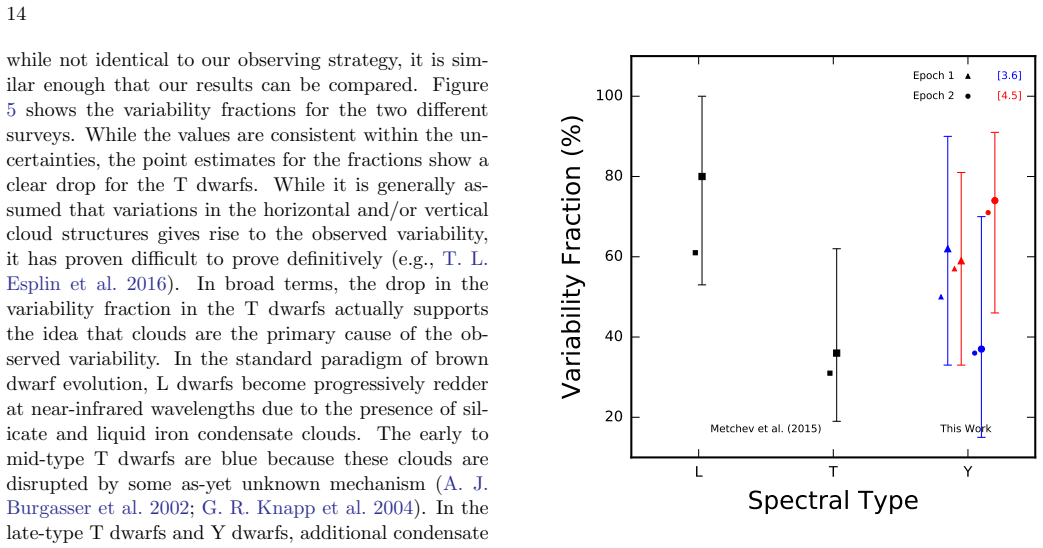
By measuring mid-infrared variability fractions in Y dwarfs and combining them with prior L and T dwarf results, the mid-infrared variability fraction of L, T, and Y dwarfs weakly supports the hypothesis that brown dwarf variability is caused by variations in the horizontal and/or vertical structure of condensate clouds.
What carries the argument
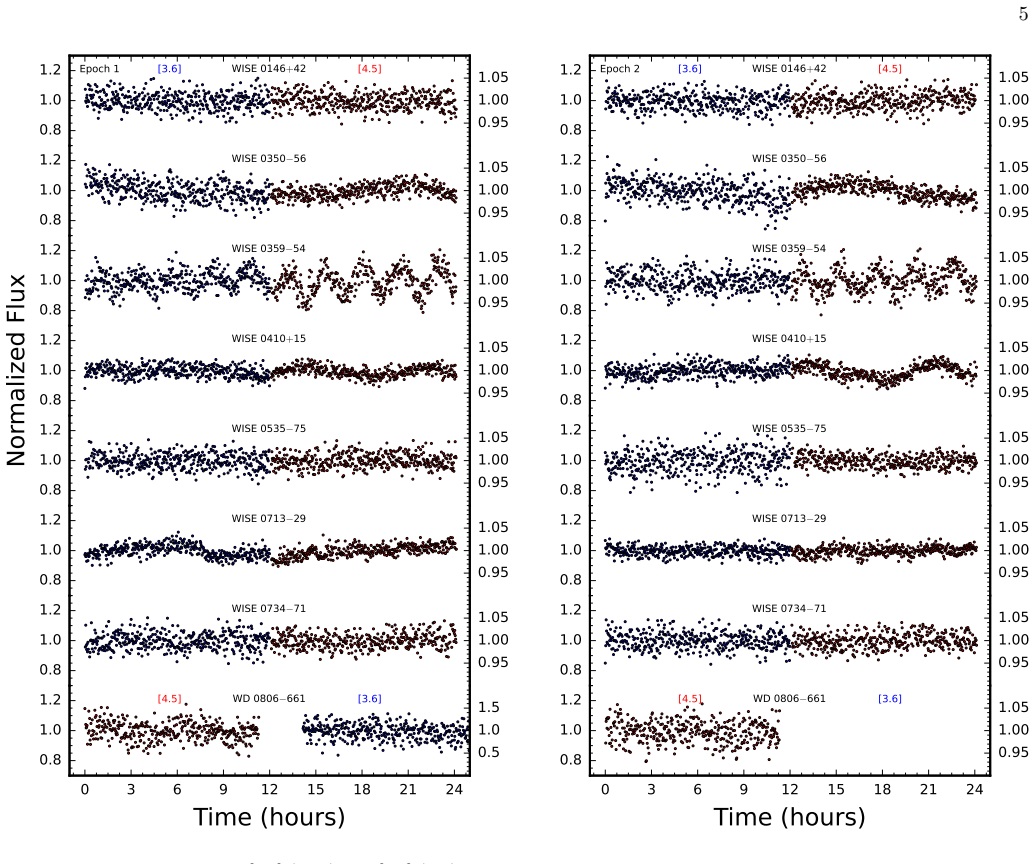
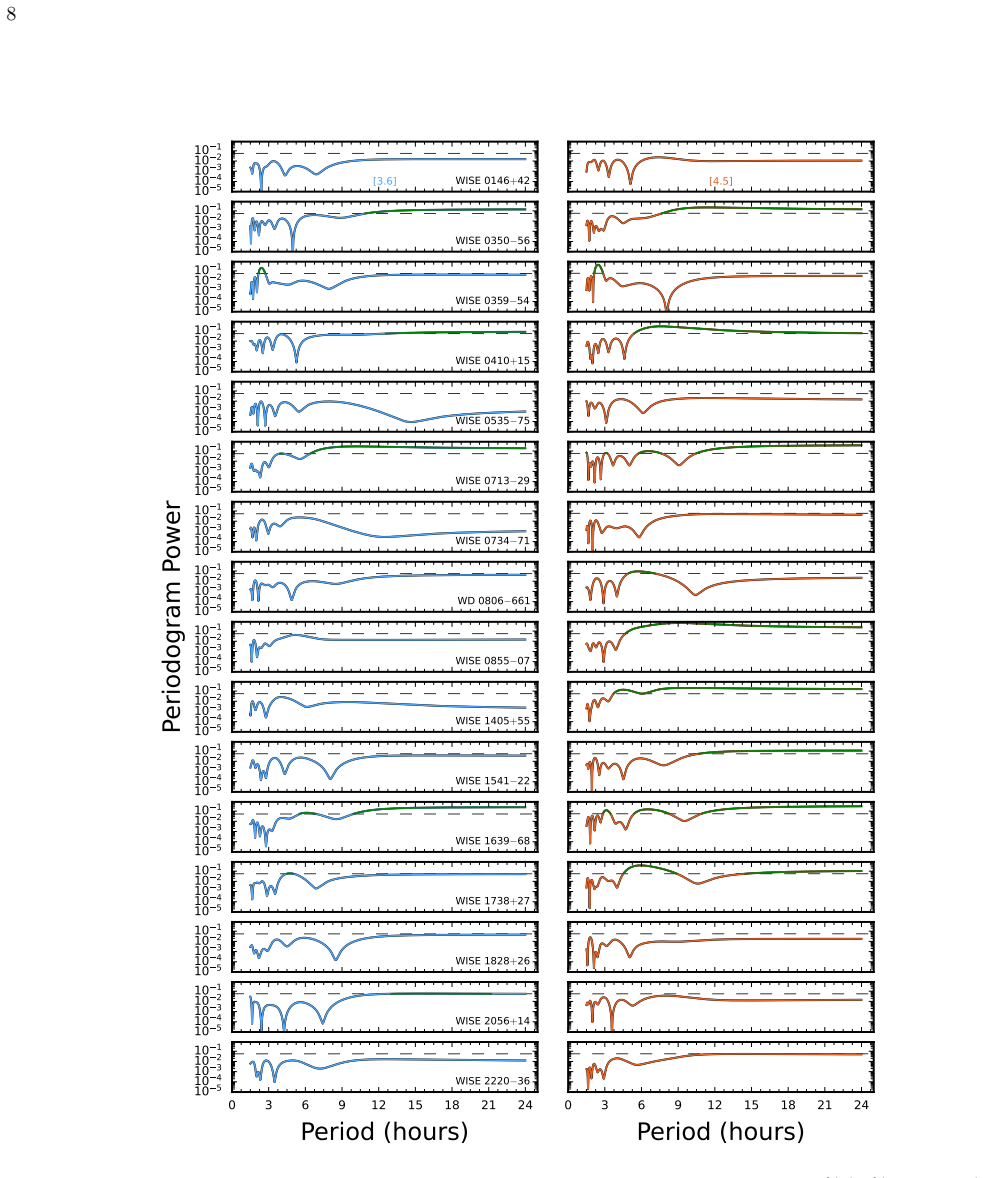
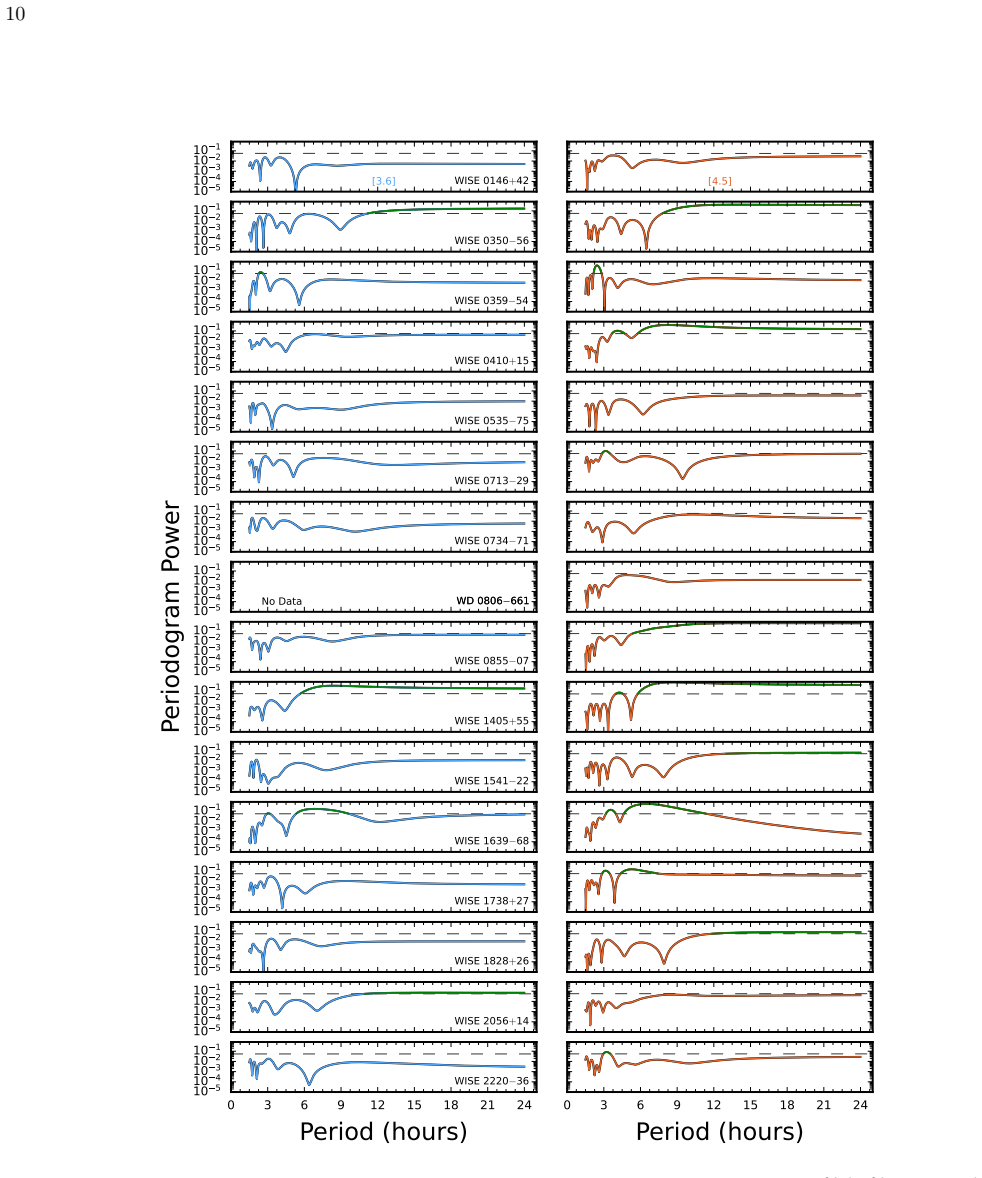
24-hour Spitzer [3.6] and [4.5] photometric light curves used to detect and quantify variability fractions across Y dwarfs.
If this is right
- Y dwarf variability fractions are comparable in magnitude to those measured for L and T dwarfs.
- Most Y dwarf light curves remain stable in shape and amplitude over intervals of several months.
- A subset of Y dwarfs exhibit clear changes in variability amplitude between the two epochs.
- The combined L-T-Y sample shows a spectral-type dependence consistent with cloud-driven mechanisms.
Where Pith is reading between the lines
- Atmospheric circulation models that include both cloud patchiness and vertical mixing could be tested directly against the reported amplitude changes.
- Multi-epoch monitoring longer than 24 hours would help separate rotational modulation from longer-term weather patterns in the coldest objects.
- The same observational approach could be applied to directly imaged exoplanets that occupy similar temperature ranges.
Load-bearing premise
The 24-hour Spitzer light curves without extra atmospheric modeling or longer time baselines are enough to separate cloud-driven variability from temperature fluctuations or instrumental effects.
What would settle it
If detailed atmospheric models of the same Y dwarfs show that temperature fluctuations alone reproduce the observed light-curve amplitudes and periods while cloud structure changes do not, the cloud-variability interpretation would be ruled out.
Figures


read the original abstract
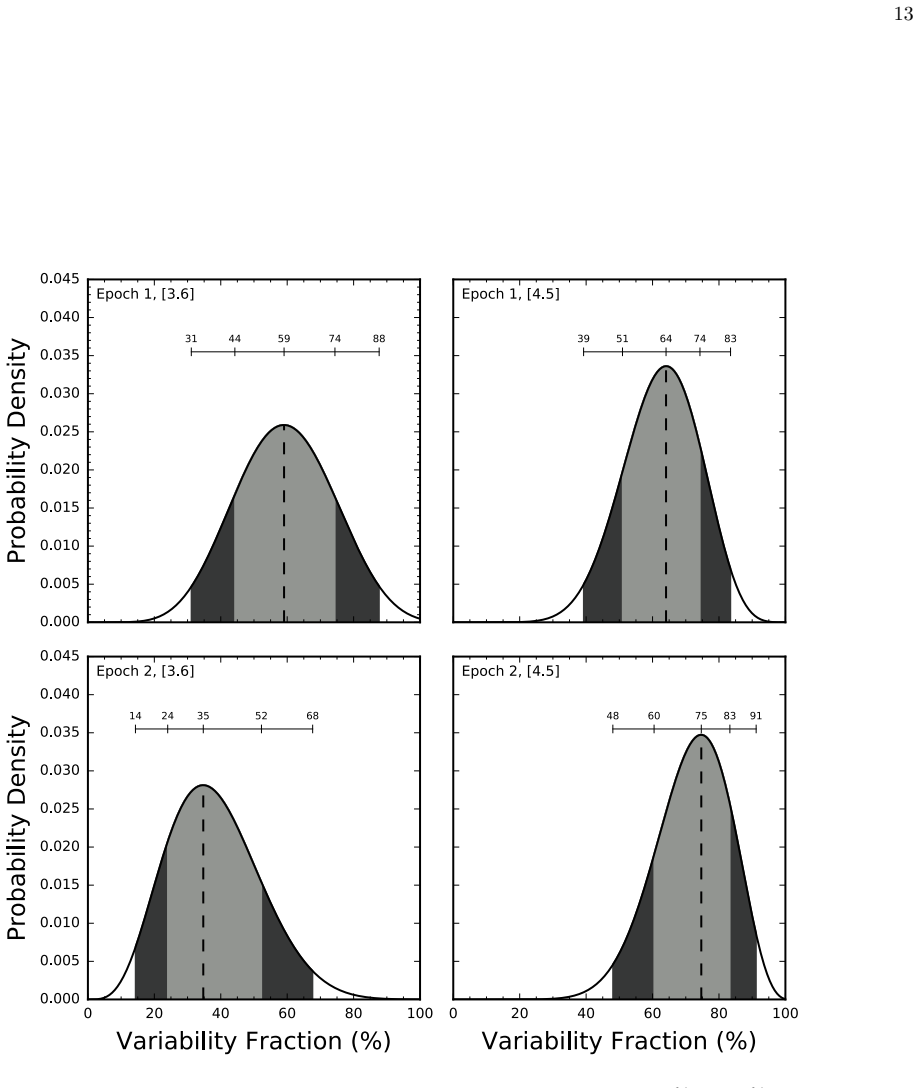
We present the results of a Spitzer Space Telescope Exploration Science Program to search for and characterize variability in Y dwarfs. We observed 14 Y dwarfs over a 24 hr period at [3.6] and [4.5] and then repeated the observations a few months later. We add two Y dwarfs, WD 0806-661B and WISE J085510.83-071442.5, that were also observed with Spitzer so that our sample includes all Y dwarfs observed for variability with Spitzer. We infer variability fractions of 59%+-15% and 64%+10%-13% for [3.6], and [4.5], in the first epoch, and 35%+17% -11% and 75%+8% -15% in the second epoch. We also find that Y dwarf Spitzer light curves are generally stable over timescales of months, but in some cases can show clear changes in amplitude. Combining our results with a similar Spitzer survey of L and T dwarfs by Metchev et al. (2015), we find the mid-infrared variability fraction of L, T, and Y dwarfs weakly supports the hypothesis that brown dwarf variability is caused by variations in the horizontal and/or vertical structure of condensate clouds.
Editorial analysis
A structured set of objections, weighed in public.
Referee Report
Summary. The manuscript presents Spitzer Space Telescope observations of 16 Y dwarfs (14 from the Exploration Science Program plus WD 0806-661B and WISE J085510.83-071442.5) at [3.6] and [4.5] over 24-hour periods in two epochs separated by months. It reports variability fractions of 59%±15% and 64%+10%/-13% in epoch 1 and 35%+17%/-11% and 75%+8%/-15% in epoch 2, notes general stability over monthly timescales with occasional amplitude changes, and combines the Y-dwarf fractions with the L/T-dwarf survey of Metchev et al. (2015) to conclude that the mid-infrared variability fraction of L, T, and Y dwarfs weakly supports the hypothesis that brown dwarf variability is caused by variations in the horizontal and/or vertical structure of condensate clouds.
Significance. If the reported fractions prove robust, the work supplies a valuable empirical extension of mid-IR variability statistics into the Y-dwarf regime and completes the Spitzer-observed Y-dwarf sample. This observational completeness is a clear strength. The interpretive claim of even weak support for the condensate-cloud hypothesis, however, adds limited new insight because the fractions alone do not discriminate mechanisms.
major comments (2)
- [Abstract and results section] Abstract and results: the variability fractions (59%±15% at [3.6] epoch 1, etc.) are presented without any definition of the detection threshold, without an error budget on the individual light curves, and without stating how many objects were excluded from the sample. These omissions are load-bearing for the central reported percentages.
- [Abstract and discussion section] Abstract (final sentence) and discussion: the claim that the combined LTY fractions 'weakly supports the hypothesis that brown dwarf variability is caused by variations in the horizontal and/or vertical structure of condensate clouds' is not justified by the data. No forward modeling of cloud patchiness, no comparison to alternative mechanisms (temperature fluctuations, magnetic spots, or instrumental effects), and no quantification of false-positive rates are provided, so the fractions remain mechanism-agnostic.
minor comments (1)
- [Abstract] Abstract: error notation is inconsistent ('59%+-15%' versus '+10%-13%'); adopt a uniform format for symmetric and asymmetric uncertainties.
Simulated Author's Rebuttal
We thank the referee for their careful reading and constructive comments. We respond to each major comment below.
read point-by-point responses
-
Referee: [Abstract and results section] Abstract and results: the variability fractions (59%±15% at [3.6] epoch 1, etc.) are presented without any definition of the detection threshold, without an error budget on the individual light curves, and without stating how many objects were excluded from the sample. These omissions are load-bearing for the central reported percentages.
Authors: We agree that the abstract and results section should explicitly define the detection threshold, summarize the error budget, and confirm the sample composition. We will revise these sections to include the missing details from the methods analysis. revision: yes
-
Referee: [Abstract and discussion section] Abstract (final sentence) and discussion: the claim that the combined LTY fractions 'weakly supports the hypothesis that brown dwarf variability is caused by variations in the horizontal and/or vertical structure of condensate clouds' is not justified by the data. No forward modeling of cloud patchiness, no comparison to alternative mechanisms (temperature fluctuations, magnetic spots, or instrumental effects), and no quantification of false-positive rates are provided, so the fractions remain mechanism-agnostic.
Authors: We agree that the fractions alone are mechanism-agnostic and that the claim of even weak support for condensate clouds is not justified without modeling or comparisons to alternatives. We will revise the abstract and discussion to remove this interpretive statement. revision: yes
Circularity Check
No circularity: purely observational fractions with external citation
full rationale
The paper reports measured variability detection rates from 24-hour Spitzer [3.6] and [4.5] light curves on 14 Y dwarfs (plus two additional objects) across two epochs, then combines the resulting fractions (59%±15%, 64%+10%−13%, etc.) with the independent Metchev et al. (2015) L/T survey to state that the combined mid-IR variability fraction “weakly supports” a cloud-structure hypothesis. No equations, fitted parameters, ansatzes, or derivations are present. The Metchev citation is to an external team and is used only for sample extension, not as a load-bearing uniqueness theorem or self-referential justification. The central claim is therefore an empirical summary rather than a reduction of any result to its own inputs by construction.
Axiom & Free-Parameter Ledger
Reference graph
Works this paper leans on
-
[1]
S., & Marley , M
Ackerman , A. S., & Marley , M. S. 2001, title Precipitating Condensation Clouds in Substellar Atmospheres , , 556, 872
2001
-
[2]
Apai , D., Karalidi , T., Marley , M. S., et al. 2017, title Zones, spots, and planetary-scale waves beating in brown dwarf atmospheres , Science, 357, 683, 10.1126/science.aam9848
-
[3]
Bailer-Jones , C. A. L. 2005, in ESA Special Publication, Vol. 560, 13th Cambridge Workshop on Cool Stars, Stellar Systems and the Sun, ed. F. Favata, G. A. J. Hussain, & B. Battrick , 429
2005
-
[4]
Bailer-Jones , C. A. L. 2012, title A Bayesian method for the analysis of deterministic and stochastic time series , , 546, A89, 10.1051/0004-6361/201220109
-
[5]
Bailer-Jones , C. A. L., & Mundt , R. 2001, title Variability in ultra cool dwarfs: Evidence for the evolution of surface features , , 367, 218, 10.1051/0004-6361:20000416
-
[6]
Bailey , J. 2014, title The Dawes Review 3: The Atmospheres of Extrasolar Planets and Brown Dwarfs , , 31, 43, 10.1017/pasa.2014.38
-
[7]
Baluev , R. V. 2008, title Assessing the statistical significance of periodogram peaks , , 385, 1279, 10.1111/j.1365-2966.2008.12689.x
-
[8]
Biller , B. 2017, title The time domain for brown dwarfs and directly imaged giant exoplanets: the power of variability monitoring , The Astronomical Review, 13, 1, 10.1080/21672857.2017.1303105
-
[9]
Buenzli , E., Apai , D., Morley , C. V., et al. 2012, title Vertical Atmospheric Structure in a Variable Brown Dwarf: Pressure-dependent Phase Shifts in Simultaneous Hubble Space Telescope-Spitzer Light Curves , , 760, L31, 10.1088/2041-8205/760/2/L31
-
[10]
Burgasser , A. J., Marley , M. S., Ackerman , A. S., et al. 2002, title Evidence of Cloud Disruption in the L/T Dwarf Transition , , 571, L151, 10.1086/341343
-
[11]
Crossfield , I. J. M. 2014, title Doppler imaging of exoplanets and brown dwarfs , , 566, A130, 10.1051/0004-6361/201423750
-
[12]
Cushing , M. C. 2014, in Astrophysics and Space Science Library, Vol. 401, 50 Years of Brown Dwarfs, ed. V. Joergens , 113, 10.1007/978-3-319-01162-2_7
-
[13]
Cushing , M. C., Marley , M. S., Saumon , D., et al. 2008, title Atmospheric Parameters of Field L and T Dwarfs , , 678, 1372, 10.1086/526489
-
[14]
Cushing , M. C., Kirkpatrick , J. D., Gelino , C. R., et al. 2011, title The Discovery of Y Dwarfs using Data from the Wide-field Infrared Survey Explorer (WISE) , , 743, 50, 10.1088/0004-637X/743/1/50
-
[15]
Cushing , M. C., Hardegree-Ullman , K. K., Trucks , J. L., et al. 2016, title The First Detection of Photometric Variability in a Y Dwarf: WISE J140518.39+553421.3 , , 823, 152, 10.3847/0004-637X/823/2/152
-
[16]
Cushing , M. C., Schneider , A. C., Kirkpatrick , J. D., et al. 2021, title An Improved Near-infrared Spectrum of the Archetype Y Dwarf WISEP J182831.08+265037.8 , , 920, 20, 10.3847/1538-4357/ac12cb
-
[17]
M., Wright , E
Cutri , R. M., Wright , E. L., Conrow , T., et al. 2013, title Explanatory Supplement to the AllWISE Data Release Products , , Tech. rep
2013
-
[18]
Dupuy , T. J., Liu , M. C., & Leggett , S. K. 2015, title Discovery of a Low-luminosity, Tight Substellar Binary at the T/Y Transition , , 803, 102, 10.1088/0004-637X/803/2/102
-
[19]
Esplin , T. L., Luhman , K. L., Cushing , M. C., et al. 2016, title Photometric Monitoring of the Coldest Known Brown Dwarf with the Spitzer Space Telescope , , 832, 58, 10.3847/0004-637X/832/1/58
-
[20]
Fazio , G. G., Hora , J. L., Allen , L. E., et al. 2004, title The Infrared Array Camera (IRAC) for the Spitzer Space Telescope , , 154, 10, 10.1086/422843
-
[21]
and Lang, Dustin and Goodman, Jonathan , year=
Foreman-Mackey , D., Hogg , D. W., Lang , D., & Goodman , J. 2013, title emcee: The MCMC Hammer , , 125, 306, 10.1086/670067
-
[22]
2000, in Astronomical Society of the Pacific Conference Series, Vol
Gelino , C., & Marley , M. 2000, in Astronomical Society of the Pacific Conference Series, Vol. 212, From Giant Planets to Cool Stars, ed. C. A. Griffith & M. S. Marley , 322
2000
-
[23]
R., Marley , M
Gelino , C. R., Marley , M. S., Holtzman , J. A., Ackerman , A. S., & Lodders , K. 2002, title L Dwarf Variability: I-Band Observations , , 577, 433
2002
-
[24]
Gizis , J. E., Burgasser , A. J., Berger , E., et al. 2013, title Kepler Monitoring of an L Dwarf I. The Photometric Period and White Light Flares , , 779, 172, 10.1088/0004-637X/779/2/172
-
[25]
O., & Corbally , J., C
Gray , R. O., & Corbally , J., C. 2009, Stellar Spectral Classification
2009
-
[26]
Hogg , D. W., Bovy , J., & Lang , D. 2010, title Data analysis recipes: Fitting a model to data , ArXiv e-prints. 1008.4686
Pith/arXiv arXiv 2010
-
[27]
Hogg , D. W., & Foreman-Mackey , D. 2018, title Data Analysis Recipes: Using Markov Chain Monte Carlo , The Astrophysical Journal Supplement Series, 236, 11, 10.3847/1538-4365/aab76e
-
[28]
Kirkpatrick , J. D. 2005, title New Spectral Types L and T , , 43, 195, 10.1146/annurev.astro.42.053102.134017
-
[29]
Kirkpatrick , J. D., Gelino , C. R., Cushing , M. C., et al. 2012, title Further Defining Spectral Type ''Y'' and Exploring the Low-mass End of the Field Brown Dwarf Mass Function , , 753, 156, 10.1088/0004-637X/753/2/156
-
[30]
Kirkpatrick , J. D., Martin , E. C., Smart , R. L., et al. 2019, title Preliminary Trigonometric Parallaxes of 184 Late-T and Y Dwarfs and an Analysis of the Field Substellar Mass Function into the Planetary Mass Regime , , 240, 19. 1812.01208
Pith/arXiv arXiv 2019
-
[31]
Knapp , G. R., Leggett , S. K., Fan , X., et al. 2004, title Near-Infrared Photometry and Spectroscopy of L and T Dwarfs: The Effects of Temperature, Clouds, and Gravity , , 127, 3553, 10.1086/420707
-
[32]
2007, title The Gemini Deep Planet Survey , , 670, 1367, 10.1086/522826
Lafreni \`e re , D., Doyon , R., Marois , C., et al. 2007, title The Gemini Deep Planet Survey , , 670, 1367, 10.1086/522826
-
[33]
Leggett , S. K., Cushing , M. C., Hardegree-Ullman , K. K., et al. 2016, title Observed Variability at 1 and 4 m in the Y0 Brown Dwarf WISEP J173835.52+273258.9 , , 830, 141, 10.3847/0004-637X/830/2/141
-
[34]
Luhman , K. L. 2014, title Discovery of a \ 250 K Brown Dwarf at 2 pc from the Sun , , 786, L18, 10.1088/2041-8205/786/2/L18
-
[35]
Luhman , K. L., Burgasser , A. J., & Bochanski , J. J. 2011, title Discovery of a Candidate for the Coolest Known Brown Dwarf , , 730, L9, 10.1088/2041-8205/730/1/L9
-
[36]
Luhman , K. L., Burgasser , A. J., Labb \'e , I., et al. 2012, title Confirmation of One of the Coldest Known Brown Dwarfs , , 744, 135, 10.1088/0004-637X/744/2/135
-
[37]
L., Tremblin , P., Alves de Oliveira , C., et al
Luhman , K. L., Tremblin , P., Alves de Oliveira , C., et al. 2024, title JWST/NIRSpec Observations of the Coldest Known Brown Dwarf , , 167, 5, 10.3847/1538-3881/ad0b72
-
[38]
Mace , G. N. 2015, in Cambridge Workshop on Cool Stars, Stellar Systems, and the Sun, Vol. 18, 18th Cambridge Workshop on Cool Stars, Stellar Systems, and the Sun, 997--1012. 1408.4379
Pith/arXiv arXiv 2015
-
[39]
2000, in Astronomical Society of the Pacific Conference Series, Vol
Marley , M. 2000, in Astronomical Society of the Pacific Conference Series, Vol. 212, From Giant Planets to Cool Stars, ed. C. A. Griffith & M. S. Marley , 152
2000
-
[40]
A., Heinze , A., Apai , D., et al
Metchev , S. A., Heinze , A., Apai , D., et al. 2015, title Weather on Other Worlds. II. Survey Results: Spots are Ubiquitous on L and T Dwarfs , , 799, 154, 10.1088/0004-637X/799/2/154
-
[41]
Mohanty , S., Basri , G., Shu , F., Allard , F., & Chabrier , G. 2002, title Activity in Very Cool Stars: Magnetic Dissipation in Late M and L Dwarf Atmospheres , , 571, 469, 10.1086/339911
-
[42]
Morley , C. V., Fortney , J. J., Marley , M. S., et al. 2012, title Neglected Clouds in T and Y Dwarf Atmospheres , , 756, 172, 10.1088/0004-637X/756/2/172
-
[43]
Morley , C. V., Marley , M. S., Fortney , J. J., & Lupu , R. 2014, title Spectral Variability from the Patchy Atmospheres of T and Y Dwarfs , , 789, L14, 10.1088/2041-8205/789/1/L14
-
[44]
A., & Cavanaugh , J
Neath , A. A., & Cavanaugh , J. E. 2012, title The Bayesian information criterion: background, derivation, and applications, Wiley Interdisciplinary Reviews: Computational Statistics, 4, 199
2012
-
[45]
Radigan , J., Lafreni \`e re , D., Jayawardhana , R., & Artigau , E. 2014, title Strong Brightness Variations Signal Cloudy-to-clear Transition of Brown Dwarfs , , 793, 75, 10.1088/0004-637X/793/2/75
-
[46]
Rajan , A., Patience , J., Wilson , P. A., et al. 2015, title The brown dwarf atmosphere monitoring (BAM) project - II. Multi-epoch monitoring of extremely cool brown dwarfs , , 448, 3775, 10.1093/mnras/stv181
-
[47]
Reach , W. T., Megeath , S. T., Cohen , M., et al. 2005, title Absolute Calibration of the Infrared Array Camera on the Spitzer Space Telescope , , 117, 978, 10.1086/432670
-
[48]
Robinson , T. D., & Marley , M. S. 2014, title Temperature Fluctuations as a Source of Brown Dwarf Variability , , 785, 158, 10.1088/0004-637X/785/2/158
-
[49]
Schlawin , E., Burgasser , A. J., Karalidi , T., Gizis , J. E., & Teske , J. 2017, title Spectral Variability of Two Rapidly Rotating Brown Dwarfs: 2MASS J08354256-0819237 and 2MASS J18212815+1414010 , , 849, 163, 10.3847/1538-4357/aa90b8
-
[50]
Schneider , A. C., Cushing , M. C., Kirkpatrick , J. D., et al. 2015, title Hubble Space Telescope Spectroscopy of Brown Dwarfs Discovered with the Wide-field Infrared Survey Explorer , , 804, 92, 10.1088/0004-637X/804/2/92
-
[51]
1978, The Annals of Statistics, 6, 461 , 10.1214/aos/1176344136
Schwarz, G. 1978, title Estimating the Dimension of a Model, Ann. Statist., 6, 461, 10.1214/aos/1176344136
-
[52]
Stephens , D. C., Leggett , S. K., Cushing , M. C., et al. 2009, title The 0.8-14.5 m Spectra of Mid-L to Mid-T Dwarfs: Diagnostics of Effective Temperature, Grain Sedimentation, Gas Transport, and Surface Gravity , , 702, 154. 0906.2991
Pith/arXiv arXiv 2009
-
[53]
Tremblin , P., Amundsen , D. S., Chabrier , G., et al. 2016, title Cloudless Atmospheres for L/T Dwarfs and Extrasolar Giant Planets , , 817, L19, 10.3847/2041-8205/817/2/L19
-
[54]
Tremblin , P., Amundsen , D. S., Mourier , P., et al. 2015, title Fingering Convection and Cloudless Models for Cool Brown Dwarf Atmospheres , , 804, L17, 10.1088/2041-8205/804/1/L17
-
[55]
2005, title Dust in the Photospheric Environment
Tsuji , T. 2005, title Dust in the Photospheric Environment. III. A Fundamental Element in the Characterization of Ultracool Dwarfs , , 621, 1033, 10.1086/427747
-
[56]
VanderPlas , J. T. 2018, title Understanding the Lomb─Scargle Periodogram , The Astrophysical Journal Supplement Series, 236, 16, 10.3847/1538-4365/aab766
work page internal anchor Pith review doi:10.3847/1538-4365/aab766 2018
-
[57]
Vos , J. M., Biller , B. A., Bonavita , M., et al. 2019, title A search for variability in exoplanet analogues and low-gravity brown dwarfs , , 483, 480, 10.1093/mnras/sty3123
-
[58]
Westphal , J. A. 1969, title Observations of localised 5-micron radiation from Jupiter , , 157, L63, 10.1086/180386
-
[59]
A., Rajan , A., & Patience , J
Wilson , P. A., Rajan , A., & Patience , J. 2014, title The brown dwarf atmosphere monitoring (BAM) project. I. The largest near-IR monitoring survey of L and T dwarfs , , 566, A111, 10.1051/0004-6361/201322995
-
[60]
Witte , S., Helling , C., Barman , T., Heidrich , N., & Hauschildt , P. H. 2011, title Dust in brown dwarfs and extra-solar planets. III. Testing synthetic spectra on observations , , 529, A44, 10.1051/0004-6361/201014105
-
[61]
Yang , H., Apai , D., Marley , M. S., et al. 2016, title Extrasolar Storms: Pressure-dependent Changes in Light-curve Phase in Brown Dwarfs from Simultaneous HST and Spitzer Observations , , 826, 8, 10.3847/0004-637X/826/1/8
-
[62]
Zapatero Osorio , M. R., Mart \' n , E. L., Bouy , H., et al. 2006, title Spectroscopic Rotational Velocities of Brown Dwarfs , , 647, 1405, 10.1086/505484
-
[63]
Zhang , X., & Showman , A. P. 2014, title Atmospheric Circulation of Brown Dwarfs: Jets, Vortices, and Time Variability , , 788, L6, 10.1088/2041-8205/788/1/L6
discussion (0)
Sign in with ORCID, Apple, or X to comment. Anyone can read and Pith papers without signing in.