Columba: isolated dwarf galaxy populations in diverse cosmological environments simulated with a cold interstellar medium
Pith reviewed 2026-06-26 01:10 UTC · model grok-4.3
The pith
Large-scale environment sets dwarf galaxy numbers but halo concentration controls their stellar masses and ages.
A machine-rendered reading of the paper's core claim, the machinery that carries it, and where it could break.
Core claim
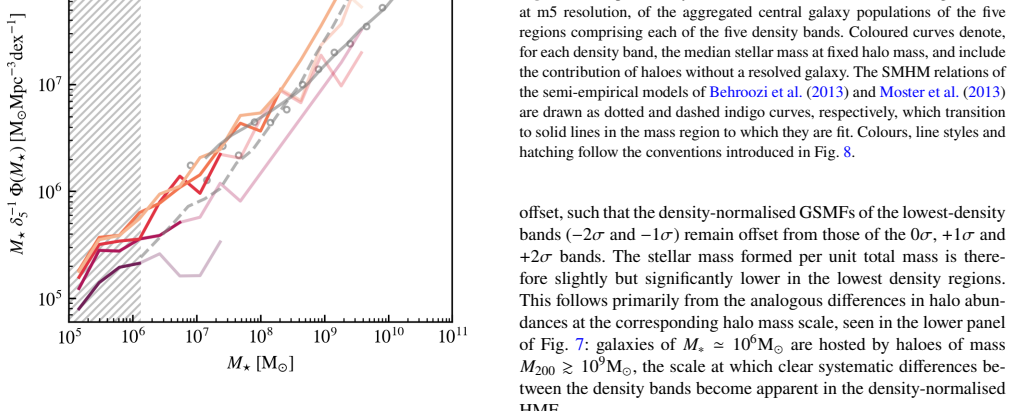
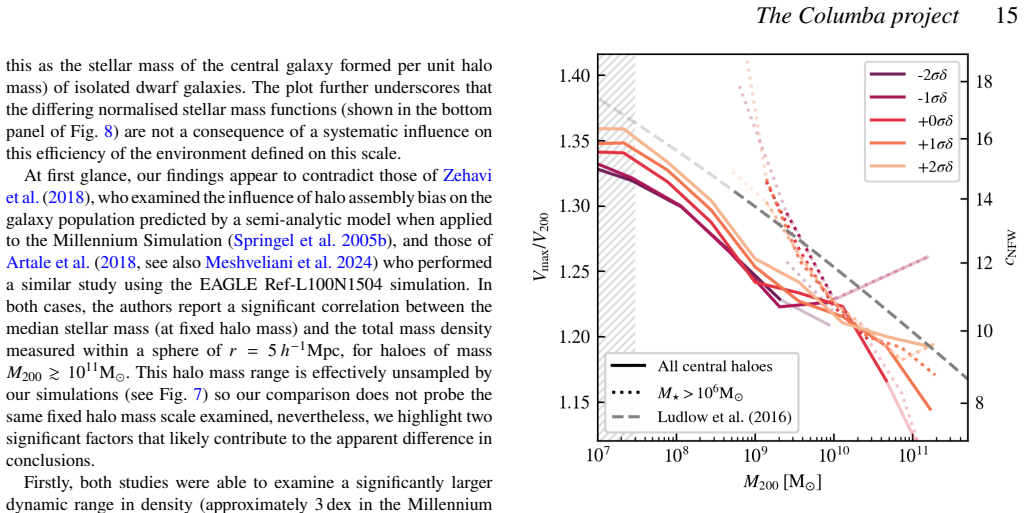
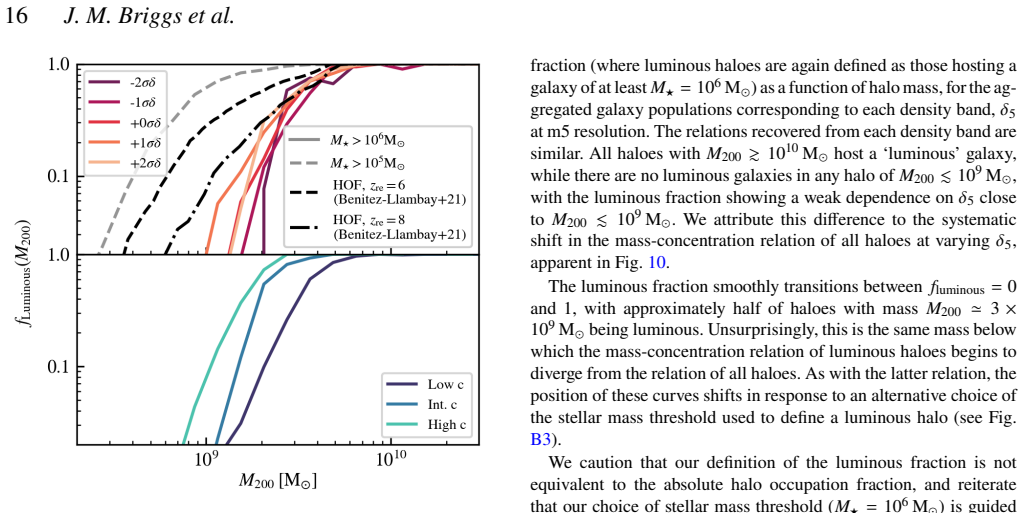
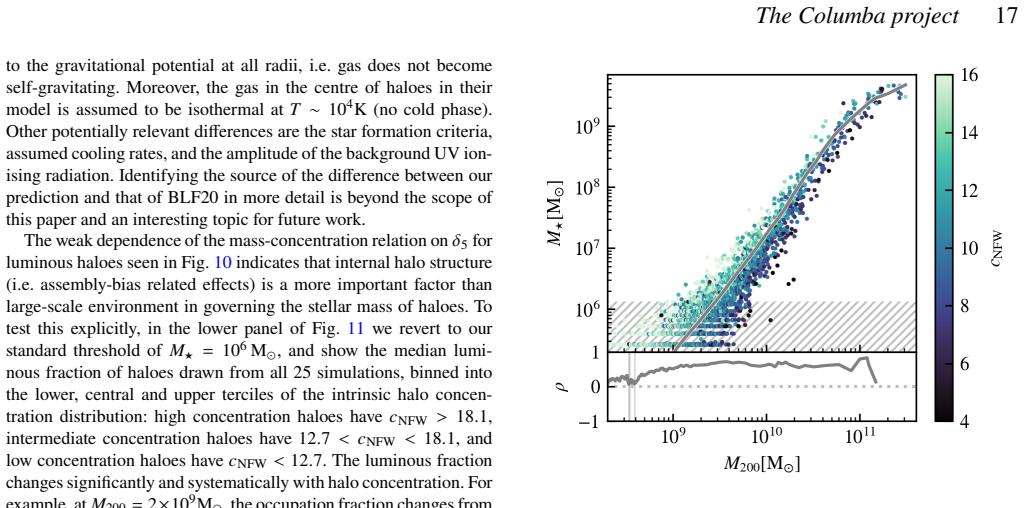
The 5 cMpc environment influences the normalisation of the halo and galaxy mass functions, but does not significantly affect the stellar mass-halo mass relation and halo occupation fraction for galaxies with M⋆=10^6-10^9 solar masses. Host halo concentration, estimated from DM-only counterparts, is more important: both the fraction of haloes hosting a resolved galaxy and the scatter about the SMHM relation correlate positively with concentration. Owing to halo assembly bias, concentration also influences galaxy formation times, such that at fixed halo mass more concentrated haloes host galaxies that are both older and more massive. The offset from the mean SMHM relation also anti-correlates
What carries the argument
Host halo concentration measured from matched dark-matter-only simulations, which drives occupation fraction, SMHM scatter, and formation timing via assembly bias.
If this is right
- The total number of dwarf galaxies varies with large-scale density on 5 cMpc scales.
- At fixed halo mass, more concentrated haloes contain galaxies with higher stellar mass and earlier formation times.
- Scatter around the mean stellar mass-halo mass relation increases with halo concentration.
- The time when 90 percent of stellar mass assembles anti-correlates with the offset from the mean relation.
- Halo occupation fraction rises with concentration for these low-mass systems.
Where Pith is reading between the lines
- Surveys that measure both local density and halo concentration proxies could separate the two effects on dwarf galaxy properties.
- The same concentration-driven trends might appear in the ages and metallicities of observed dwarf satellites.
- Extending the same simulations to higher halo masses would test whether concentration remains dominant outside the dwarf regime.
Load-bearing premise
The subgrid stellar feedback, calibrated only to match the z=0 galaxy stellar mass function, correctly represents the relevant baryonic processes in these dwarf galaxies across all tested environments.
What would settle it
Observational samples of dwarf galaxies in the 10^6-10^9 solar mass range that show no correlation between host halo concentration proxies and either stellar mass at fixed halo mass or stellar population age.
Figures




read the original abstract
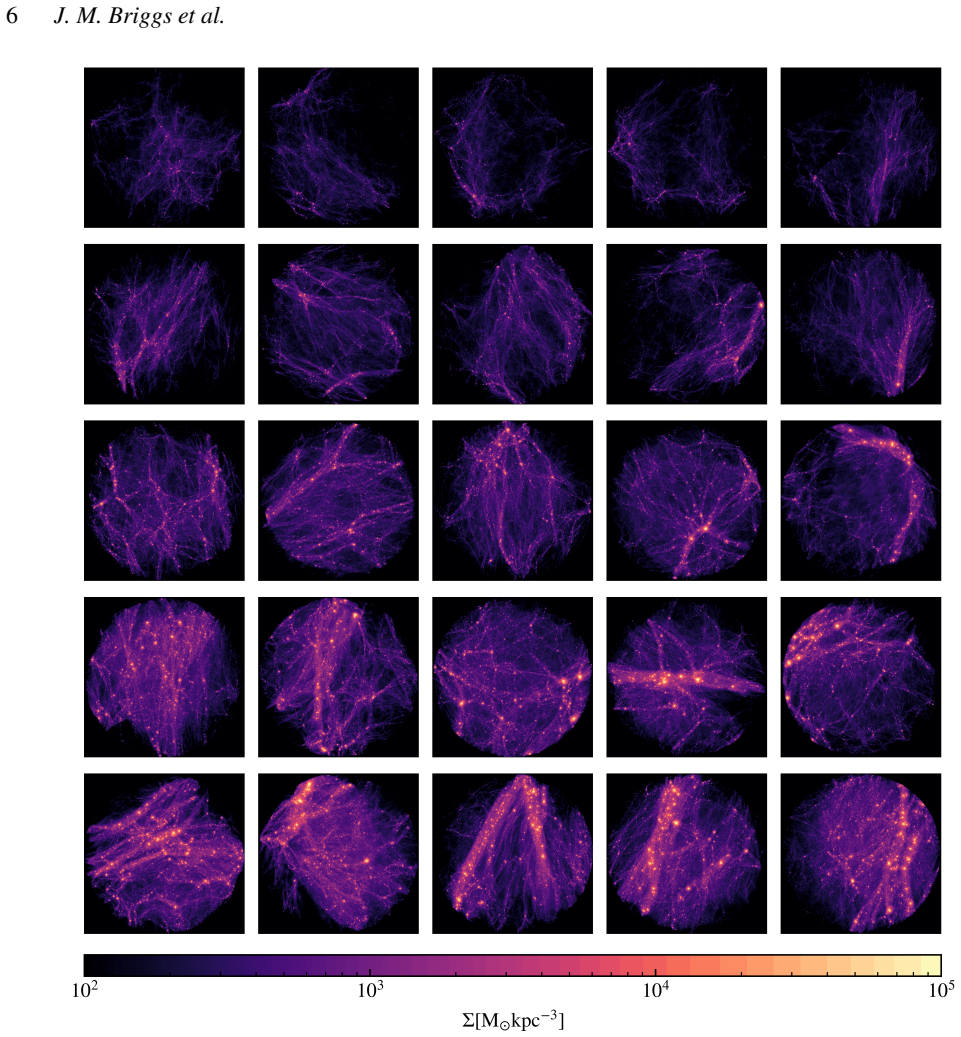
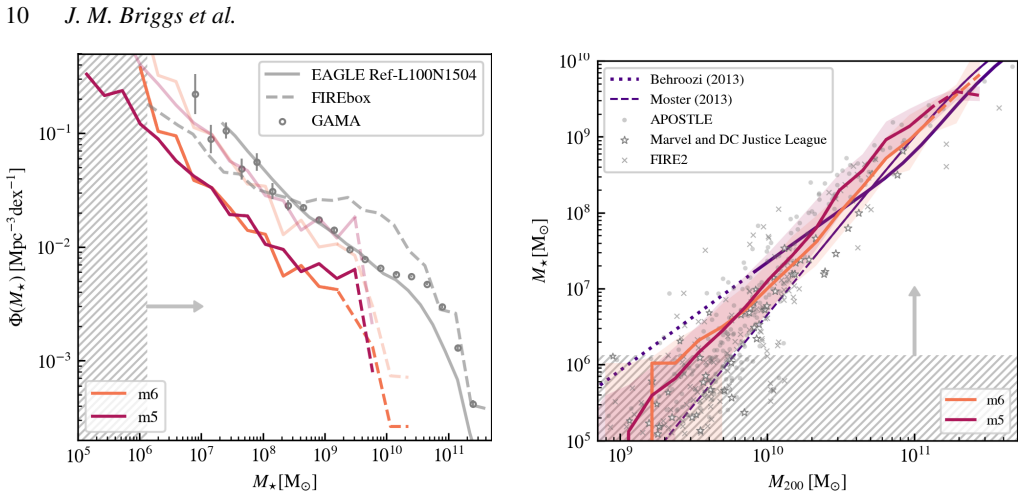
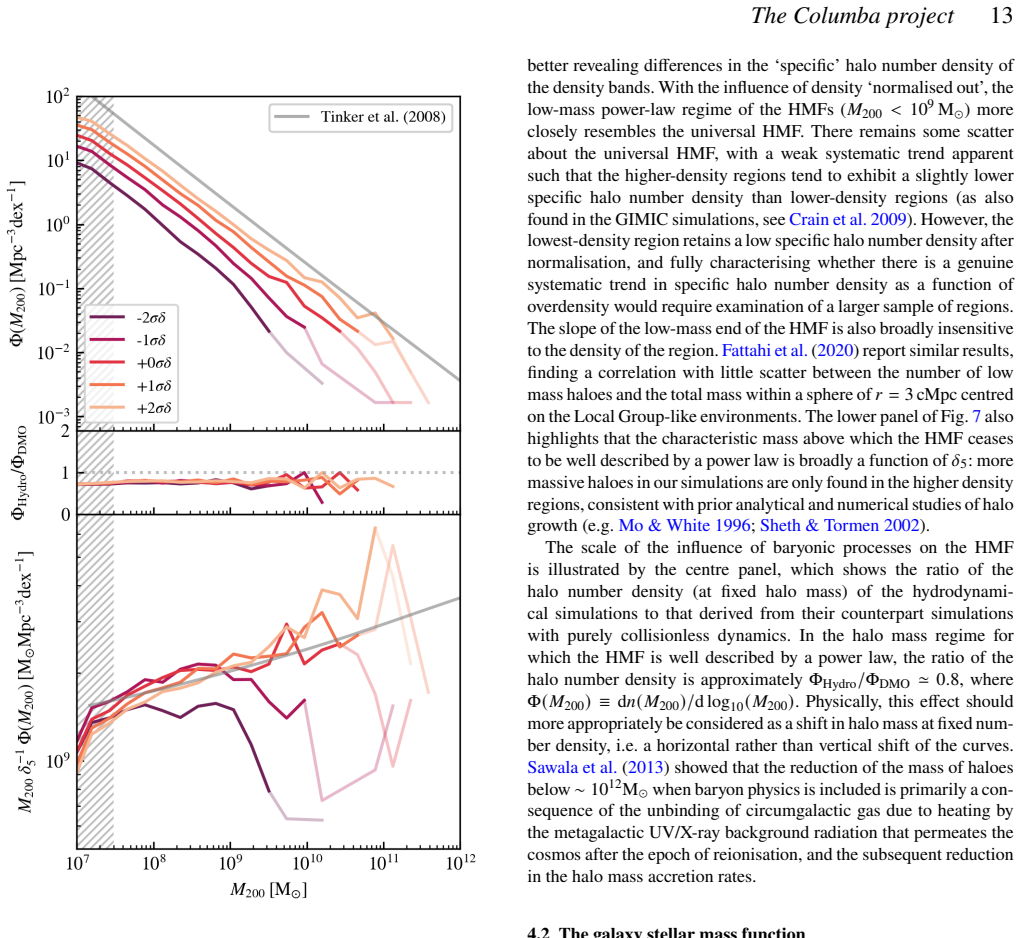
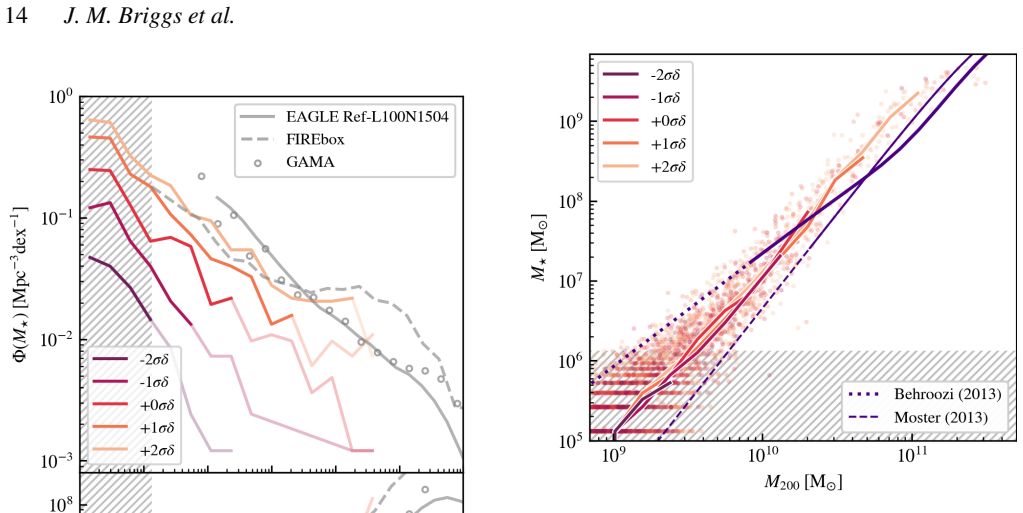
We introduce a suite of LambdaCDM cosmological, hydrodynamical simulations that track the evolution of a large population of dwarf galaxies. The suite comprises zoom-in simulations of 25 spherical, under-dense regions of r=5cMpc, selected to span $\approx1.5$ dex in mean enclosed density, covering voids to filamentary structures, whilst excluding haloes of Milky Way-mass or larger. The simulations achieve a mass resolution of $\sim 10^5$ solar masses with a galaxy formation model including cold, dense interstellar gas and whose subgrid stellar feedback efficiency reproduces the z=0 galaxy stellar mass function. We investigate the impact of the cosmic environment on dwarf galaxy formation and evolution. We find that the 5 cMpc environment influences the normalisation of the halo and galaxy mass functions, but does not significantly affect the stellar mass - halo mass (SMHM) relation and halo occupation fraction for galaxies with $M_{\star}=10^6-10^9$ solar masses. Instead, host halo concentration, estimated from DM-only counterparts, is more important: both the fraction of haloes hosting a resolved galaxy and the scatter about the SMHM relation correlate positively with concentration. Owing to halo assembly bias, concentration also influences galaxy formation times, such that at fixed halo mass more concentrated haloes host galaxies that are both older and more massive. The offset from the mean SMHM relation also anti-correlates with $t_{90}$, the time at which 90 percent of a galaxy's stellar mass has assembled. These correlations between halo properties and galaxy star formation histories present testable predictions for forthcoming observational surveys.
Editorial analysis
A structured set of objections, weighed in public.
Referee Report
Summary. The paper presents a suite of zoom-in hydrodynamical ΣCDM simulations of 25 spherical 5 cMpc regions spanning ~1.5 dex in mean density (voids to filaments), excluding MW-mass halos. With ~10^5 M⊙ mass resolution and a galaxy formation model that includes cold dense ISM and tunes subgrid stellar feedback efficiency to reproduce the z=0 galaxy stellar mass function, the authors report that 5 cMpc-scale environment affects the normalization of halo and galaxy mass functions but does not significantly alter the stellar mass-halo mass (SMHM) relation or halo occupation fraction for M★ = 10^6–10^9 M⊙ galaxies. Host halo concentration (measured in DM-only counterparts) instead correlates positively with occupation fraction and SMHM scatter; due to assembly bias, more concentrated halos at fixed mass host older, more massive galaxies, and the SMHM offset anti-correlates with t90 (time of 90% stellar mass assembly). These yield testable predictions for surveys.
Significance. If robust, the results isolate halo concentration and assembly bias as the dominant drivers of dwarf galaxy properties over large-scale environment in this mass range, while the high-resolution treatment of cold ISM provides concrete, observationally testable correlations between halo properties and star-formation histories. The fixed-parameter approach and direct simulation outputs are strengths for reproducibility within the model.
major comments (1)
- [Abstract and galaxy formation model] Abstract and galaxy formation model description: the subgrid stellar feedback efficiency is tuned once to the global z=0 GSMF and held fixed across all 25 regions. No variation of this parameter or environment-specific recalibration is reported, so the claimed absence of environmental influence on the SMHM relation and occupation fraction for M★=10^6–10^9 M⊙ could be partly by construction; any environment-dependent effective feedback (via differing densities or accretion) would be suppressed. A robustness test varying the efficiency or comparing to alternative feedback implementations is needed to establish that the null environmental result is physical rather than model-dependent.
Simulated Author's Rebuttal
We thank the referee for their constructive comments and positive assessment of our work. We address the major comment below.
read point-by-point responses
-
Referee: [Abstract and galaxy formation model] Abstract and galaxy formation model description: the subgrid stellar feedback efficiency is tuned once to the global z=0 GSMF and held fixed across all 25 regions. No variation of this parameter or environment-specific recalibration is reported, so the claimed absence of environmental influence on the SMHM relation and occupation fraction for M★=10^6–10^9 M⊙ could be partly by construction; any environment-dependent effective feedback (via differing densities or accretion) would be suppressed. A robustness test varying the efficiency or comparing to alternative feedback implementations is needed to establish that the null environmental result is physical rather than model-dependent.
Authors: We thank the referee for highlighting this point. The subgrid stellar feedback efficiency is tuned once to the global z=0 GSMF and held fixed, as stated in the manuscript. This choice implements a single, universal model across all regions without any environment-specific recalibration. Consequently, the simulations test whether this fixed prescription produces environment-independent SMHM relations and occupation fractions when the resolved physics respond to the varying densities and accretion histories present in voids versus filaments. The null result on large-scale environment is therefore a prediction of the model rather than an imposed outcome. As the referee notes in their summary, the fixed-parameter approach is a strength for reproducibility within the model. We agree that varying the efficiency or testing alternative feedback schemes would further assess model dependence, but such tests require new simulation suites and lie beyond the current scope. We will add a short discussion of this limitation to the revised manuscript. revision: partial
Circularity Check
No significant circularity; results emerge from simulation outputs
full rationale
The paper runs a suite of hydrodynamical zoom-in simulations with a fixed subgrid stellar feedback efficiency calibrated once to reproduce the global z=0 galaxy stellar mass function. It then reports that the 5 cMpc environment affects mass function normalizations but not the SMHM relation or occupation fraction for M⋆=10^6–10^9 M⊙, while concentration (from DM-only counterparts) correlates with occupation fraction, scatter, and formation times. These outcomes are measured directly from the simulation data across different initial density regions; no equations, definitions, or claims reduce the reported correlations or environmental independence to the feedback tuning parameter by construction. No self-citations, ansatzes, or renamings are invoked as load-bearing steps. The derivation chain is self-contained.
Axiom & Free-Parameter Ledger
free parameters (1)
- subgrid stellar feedback efficiency
axioms (2)
- standard math LambdaCDM cosmology
- domain assumption Cold dense interstellar gas component in the galaxy formation model
Reference graph
Works this paper leans on
-
[1]
appendix lastpage document
-
[2]
Accurate masses for dispersion-supported galaxies. , keywords =. doi:10.1111/j.1365-2966.2010.16753.x , archivePrefix =. 0908.2995 , primaryClass =
-
[3]
Statistical Properties of X-Ray Clusters: Analytic and Numerical Comparisons. , keywords =. doi:10.1086/305262 , archivePrefix =. astro-ph/9710107 , primaryClass =
-
[4]
FLAMINGO: calibrating large cosmological hydrodynamical simulations with machine learning. , keywords =. doi:10.1093/mnras/stad2540 , archivePrefix =. 2306.05492 , primaryClass =
-
[5]
Monthly Notices of the Royal Astronomical Society , volume =
Schaye, Joop and Chaikin, Evgenii and Schaller, Matthieu and Ploeckinger, Sylvia and Huško, Filip and McGibbon, Robert J and Trayford, James W and Benítez-Llambay, Alejandro and Correa, Camila and Frenk, Carlos S and Richings, Alexander J and Forouhar Moreno, Victor J and Bahé, Yannick M and Borrow, Josh and Durrant, Anna and Gebek, Andrea and Helly, John...
-
[6]
Monthly Notices of the Royal Astronomical Society , volume =
Chaikin, Evgenii and Schaye, Joop and Schaller, Matthieu and Ploeckinger, Sylvia and Benítez-Llambay, Alejandro and Frenk, Carlos S and Huško, Filip and McGibbon, Robert J and Richings, Alexander J and Trayford, James W , title =. Monthly Notices of the Royal Astronomical Society , volume =. 2026 , month =. doi:10.1093/mnras/stag740 , url =
-
[7]
HYBRID-CHIMES: a model for radiative cooling and the abundances of ions and molecules in simulations of galaxy formation. , keywords =. doi:10.1093/mnras/staf1402 , archivePrefix =. 2506.15773 , primaryClass =
-
[8]
Monthly Notices of the Royal Astronomical Society , volume =
Benítez-Llambay, Alejandro and Ploeckinger, Sylvia and Schaye, Joop and Richings, Alexander J and Chaikin, Evgenii and Schaller, Matthieu and Trayford, James W and Frenk, Carlos S and Huško, Filip and Correa, Camila , title =. Monthly Notices of the Royal Astronomical Society , volume =. 2026 , month =. doi:10.1093/mnras/stag268 , url =
-
[9]
The hidden giant: discovery of an enormous Galactic dwarf satellite in Gaia DR2. , keywords =. doi:10.1093/mnras/stz1624 , archivePrefix =. 1811.04082 , primaryClass =
-
[10]
A cosmic UV/X-ray background model update. , keywords =. doi:10.1093/mnras/staa302 , archivePrefix =. 1903.08657 , primaryClass =
-
[11]
The 2017 Release Cloudy. , keywords =. doi:10.48550/arXiv.1705.10877 , archivePrefix =. 1705.10877 , primaryClass =
-
[12]
The Physics of the Far-infrared-Radio Correlation. I. Calorimetry, Conspiracy, and Implications. , keywords =. doi:10.1088/0004-637X/717/1/1 , archivePrefix =. 0907.4161 , primaryClass =
-
[13]
Small-Scale Challenges to the CDM Paradigm. , keywords =. doi:10.1146/annurev-astro-091916-055313 , archivePrefix =. 1707.04256 , primaryClass =
-
[14]
The Impact of Assembly Bias on the Galaxy Content of Dark Matter Halos. , keywords =. doi:10.3847/1538-4357/aaa54a , archivePrefix =. 1706.07871 , primaryClass =
-
[15]
The impact of assembly bias on the halo occupation in hydrodynamical simulations. , keywords =. doi:10.1093/mnras/sty2110 , archivePrefix =. 1805.06938 , primaryClass =
-
[16]
The detailed structure and the onset of galaxy formation in low-mass gaseous dark matter haloes. , keywords =. doi:10.1093/mnras/staa2698 , archivePrefix =. 2004.06124 , primaryClass =
-
[17]
Bent by baryons: the low-mass galaxy-halo relation. , keywords =. doi:10.1093/mnras/stu2753 , archivePrefix =. 1404.3724 , primaryClass =
-
[18]
The chosen few: the low-mass haloes that host faint galaxies. , keywords =. doi:10.1093/mnras/stv2597 , archivePrefix =. 1406.6362 , primaryClass =
-
[19]
ApJ , fjournal=
Placeholder, Paul , title=. ApJ , fjournal=
-
[20]
The Connection Between Galaxies and Their Dark Matter Halos. , keywords =. doi:10.1146/annurev-astro-081817-051756 , archivePrefix =. 1804.03097 , primaryClass =
-
[21]
The Dependence of Halo Clustering on Halo Formation History, Concentration, and Occupation. , keywords =. doi:10.1086/507120 , archivePrefix =. astro-ph/0512416 , primaryClass =
-
[22]
Baryonic solutions and challenges for cosmological models of dwarf galaxies. Nature Astronomy , keywords =. doi:10.1038/s41550-022-01689-w , archivePrefix =. 2206.05295 , primaryClass =
-
[23]
Caught in the cosmic web: Environmental effect on halo concentrations, shape, and spin. , keywords =. doi:10.1103/PhysRevD.103.063517 , archivePrefix =. 2011.08840 , primaryClass =
-
[24]
Baryon effects on the internal structure of CDM haloes in the EAGLE simulations. , keywords =. doi:10.1093/mnras/stv1067 , archivePrefix =. 1409.8617 , primaryClass =
-
[25]
Hierarchical Galaxy Formation: Overmerging and the Formation of an X-Ray Cluster. , keywords =. doi:10.1086/172935 , adsurl =
-
[26]
Schaye, Joop and Crain, Robert A. and Bower, Richard G. and Furlong, Michelle and Schaller, Matthieu and Theuns, Tom and Dalla Vecchia, Claudio and Frenk, Carlos S. and McCarthy, I. G. and Helly, John C. and et al. , year=. The EAGLE project: simulating the evolution and assembly of galaxies and their environments , volume=. Monthly Notices of the Royal A...
-
[27]
The FLAMINGO project: cosmological hydrodynamical simulations for large-scale structure and galaxy cluster surveys. , keywords =. doi:10.1093/mnras/stad2419 , archivePrefix =. 2306.04024 , primaryClass =
-
[28]
and Schaye, Joop and Bower, Richard G
Crain, Robert A. and Schaye, Joop and Bower, Richard G. and Furlong, Michelle and Schaller, Matthieu and Theuns, Tom and Dalla Vecchia, Claudio and Frenk, Carlos S. and McCarthy, Ian G. and Helly, John C. and et al. , year=. The EAGLE simulations of galaxy formation: calibration of subgrid physics and model variations , volume=. Monthly Notices of the Roy...
-
[29]
, year = 2024, month = may, volume =
SWIFT: A modern highly-parallel gravity and smoothed particle hydrodynamics solver for astrophysical and cosmological applications. , year = 2024, month = may, volume =. doi:10.1093/mnras/stae922 , archivePrefix =. 2305.13380 , primaryClass =
-
[30]
doi:10.1093/mnras/stab3166 , url =
Josh Borrow and Matthieu Schaller and Richard G Bower and Joop Schaye , title =. doi:10.1093/mnras/stab3166 , url =
-
[31]
and Cañas, Rodrigo and Poulton, Rhys J
Elahi, Pascal J. and Cañas, Rodrigo and Poulton, Rhys J. J. and Tobar, Rodrigo J. and Willis, James S. and Lagos, Claudia del P. and Power, Chris and Robotham, Aaron S. G. , year=. Hunting for galaxies and halos in simulations with VELOCIraptor , volume=. doi:10.1017/pasa.2019.12 , journal=
-
[32]
Josh Borrow and Alexei Borrisov , title =. 2020 , publisher =. doi:10.21105/joss.02430 , url =
-
[33]
and Schaye, Joop and Schaller, Matthieu and Vandenbroucke, Bert , title =
McGibbon, Robert and Helly, John C. and Schaye, Joop and Schaller, Matthieu and Vandenbroucke, Bert , title =. 2025 , publisher =. doi:10.21105/joss.08252 , url =
-
[34]
2013 , eprint=
Panphasia: a user guide , author=. 2013 , eprint=
2013
-
[35]
Monthly Notices of the Royal Astronomical Society , volume =
Jenkins, Adrian , title = ". Monthly Notices of the Royal Astronomical Society , volume =. 2013 , month =. doi:10.1093/mnras/stt1154 , url =
-
[36]
The Cosmic Linear Anisotropy Solving System (CLASS) I: Overview. arXiv e-prints , keywords =. doi:10.48550/arXiv.1104.2932 , archivePrefix =. 1104.2932 , primaryClass =
-
[37]
Lesgourgues, Julien and Tram, Thomas , year=. The Cosmic Linear Anisotropy Solving System (CLASS) IV: efficient implementation of non-cold relics , volume=. Journal of Cosmology and Astroparticle Physics , publisher=. doi:10.1088/1475-7516/2011/09/032 , number=
-
[38]
Ludlow, Aaron D and Schaye, Joop and Schaller, Matthieu and Richings, Jack , year=. Energy equipartition between stellar and dark matter particles in cosmological simulations results in spurious growth of galaxy sizes , volume=. Monthly Notices of the Royal Astronomical Society: Letters , publisher=. doi:10.1093/mnrasl/slz110 , number=
-
[39]
Numerical convergence of hydrodynamical simulations of galaxy formation: the abundance and internal structure of galaxies and their cold dark matter haloes. , keywords =. doi:10.1093/mnras/staa316 , archivePrefix =. 1908.05019 , primaryClass =
-
[40]
A high-resolution cosmological simulation of a strong gravitational lens , volume=
Richings, Jack and Frenk, Carlos and Jenkins, Adrian and Robertson, Andrew and Schaller, Matthieu , year=. A high-resolution cosmological simulation of a strong gravitational lens , volume=. Monthly Notices of the Royal Astronomical Society , publisher=. doi:10.1093/mnras/staa4013 , number=
-
[41]
Tests of subgrid models for star formation using simulations of isolated disc galaxies. , keywords =. doi:10.1093/mnras/stae1390 , archivePrefix =. 2309.13750 , primaryClass =
-
[42]
Slow Star Formation in Dense Gas: Evidence and Implications. , keywords =. doi:10.1086/509101 , archivePrefix =. astro-ph/0606277 , primaryClass =
-
[43]
Evgenii Chaikin and Joop Schaye and Matthieu Schaller and Alejandro Ben. A thermal. doi:10.1093/mnras/stad1626 , url =
-
[44]
Galactic Stellar and Substellar Initial Mass Function. , keywords =. doi:10.1086/376392 , archivePrefix =. astro-ph/0304382 , primaryClass =
-
[45]
Galactic chemical enrichment with new metallicity dependent stellar yields. , keywords =. doi:10.48550/arXiv.astro-ph/9711337 , archivePrefix =. astro-ph/9711337 , primaryClass =
-
[46]
Simulating galactic outflows with kinetic supernova feedback. , keywords =. doi:10.1111/j.1365-2966.2008.13322.x , archivePrefix =. 0801.2770 , primaryClass =
-
[47]
Binary Population and Spectral Synthesis Version 2.1: Construction, Observational Verification, and New Results. , keywords =. doi:10.1017/pasa.2017.51 , archivePrefix =. 1710.02154 , primaryClass =
-
[48]
Re-evaluating old stellar populations. , keywords =. doi:10.1093/mnras/sty1353 , archivePrefix =. 1805.08784 , primaryClass =
-
[49]
, year = 1939, month = may, volume =
The Physical State of Interstellar Hydrogen. , year = 1939, month = may, volume =. doi:10.1086/144074 , adsurl =
doi:10.1086/144074 1939
-
[50]
, year = 1959, month = mar, volume =
The Rate of Star Formation. , year = 1959, month = mar, volume =. doi:10.1086/146614 , adsurl =
doi:10.1086/146614 1959
-
[51]
Resolution criteria to avoid artificial clumping in Lagrangian hydrodynamic simulations with a multiphase interstellar medium. , keywords =. doi:10.1093/mnras/stad3935 , archivePrefix =. 2310.10721 , primaryClass =
-
[52]
Radiative cooling rates, ion fractions, molecule abundances, and line emissivities including self-shielding and both local and metagalactic radiation fields. , keywords =. doi:10.1093/mnras/staa2172 , archivePrefix =. 2006.14322 , primaryClass =
-
[53]
Simulating galactic outflows with thermal supernova feedback. , keywords =. doi:10.1111/j.1365-2966.2012.21704.x , archivePrefix =. 1203.5667 , primaryClass =
-
[54]
The importance of the way in which supernova energy is distributed around young stellar populations in simulations of galaxies. , keywords =. doi:10.1093/mnras/stac1132 , archivePrefix =. 2203.07134 , primaryClass =
-
[55]
Non-equilibrium chemistry and cooling in the diffuse interstellar medium - I. Optically thin regime. , keywords =. doi:10.1093/mnras/stu525 , archivePrefix =. 1401.4719 , primaryClass =
-
[56]
Non-equilibrium chemistry and cooling in the diffuse interstellar medium - II. Shielded gas. , keywords =. doi:10.1093/mnras/stu1046 , archivePrefix =. 1403.6155 , primaryClass =
-
[57]
Chemical enrichment in cosmological, smoothed particle hydrodynamics simulations. , keywords =. doi:10.1111/j.1365-2966.2009.15331.x , archivePrefix =. 0902.1535 , primaryClass =
-
[58]
The importance of black hole repositioning for galaxy formation simulations. , keywords =. doi:10.1093/mnras/stac1339 , archivePrefix =. 2109.01489 , primaryClass =
-
[59]
Cosmological simulations of the growth of supermassive black holes and feedback from active galactic nuclei: method and tests. , keywords =. doi:10.1111/j.1365-2966.2009.15043.x , archivePrefix =. 0904.2572 , primaryClass =
-
[60]
The impact of stochastic modelling on the predictive power of galaxy formation simulations. , keywords =. doi:10.1093/mnras/stad2928 , archivePrefix =. 2211.08442 , primaryClass =
-
[61]
Navarro, Julio F. and Frenk, Carlos S. and White, Simon D. M. , year=. The Structure of Cold Dark Matter Halos , volume=. doi:10.1086/177173 , journal=
-
[62]
Profiles of dark haloes: evolution, scatter and environment. , keywords =. doi:10.1046/j.1365-8711.2001.04068.x , archivePrefix =. astro-ph/9908159 , primaryClass =
-
[63]
Galaxy formation as a function of large-scale environment
Galaxies-intergalactic medium interaction calculation - I. Galaxy formation as a function of large-scale environment. , keywords =. doi:10.1111/j.1365-2966.2009.15402.x , archivePrefix =. 0906.4350 , primaryClass =
-
[64]
Toward a Halo Mass Function for Precision Cosmology: The Limits of Universality. , keywords =. doi:10.1086/591439 , archivePrefix =. 0803.2706 , primaryClass =
-
[65]
Halo mass function: baryon impact, fitting formulae, and implications for cluster cosmology. , keywords =. doi:10.1093/mnras/stv2657 , archivePrefix =. 1502.07357 , primaryClass =
-
[66]
Galaxy And Mass Assembly (GAMA): Data Release 4 and the z < 0.1 total and z < 0.08 morphological galaxy stellar mass functions. , keywords =. doi:10.1093/mnras/stac472 , archivePrefix =. 2203.08539 , primaryClass =
-
[67]
FIREbox: simulating galaxies at high dynamic range in a cosmological volume. , keywords =. doi:10.1093/mnras/stad1205 , archivePrefix =. 2205.15325 , primaryClass =
-
[68]
Structures of Dwarf Satellites of Milky Way-like Galaxies: Morphology, Scaling Relations, and Intrinsic Shapes. , keywords =. doi:10.3847/1538-4357/ac2581 , archivePrefix =. 2105.03435 , primaryClass =
-
[69]
xGASS: characterizing the slope and scatter of the stellar mass-angular momentum relation for nearby galaxies. , keywords =. doi:10.1093/mnras/stab3261 , archivePrefix =. 2111.15048 , primaryClass =
-
[70]
A physically motivated definition for the size of galaxies in an era of ultradeep imaging. , keywords =. doi:10.1093/mnras/staa236 , archivePrefix =. 2001.02689 , primaryClass =
-
[71]
William S. Cleveland , title =. Journal of the American Statistical Association , volume =. 1979 , publisher =. doi:10.1080/01621459.1979.10481038 , URL =
-
[72]
The stellar mass-halo mass relation of isolated field dwarfs: a critical test of CDM at the edge of galaxy formation. , keywords =. doi:10.1093/mnras/stx147 , archivePrefix =. 1607.03127 , primaryClass =
-
[73]
Galactic star formation and accretion histories from matching galaxies to dark matter haloes. , keywords =. doi:10.1093/mnras/sts261 , archivePrefix =. 1205.5807 , primaryClass =
-
[74]
The origin of scatter in the stellar mass-halo mass relation of central galaxies in the EAGLE simulation. , keywords =. doi:10.1093/mnras/stw2884 , archivePrefix =. 1608.08218 , primaryClass =
-
[75]
Environment Matters: Predicted Differences in the Stellar Mass Halo Mass Relation and History of Star Formation for Dwarf Galaxies. , keywords =. doi:10.3847/1538-4357/ad0c5a , archivePrefix =. 2311.04975 , primaryClass =
-
[76]
Engler, Christoph and Pillepich, Annalisa and Joshi, Gandhali D and Nelson, Dylan and Pasquali, Anna and Grebel, Eva K and Lisker, Thorsten and Zinger, Elad and Donnari, Martina and Marinacci, Federico and Vogelsberger, Mark and Hernquist, Lars , year=. The distinct stellar-to-halo mass relations of satellite and central galaxies: insights from the Illust...
-
[77]
Quenching and ram pressure stripping of simulated Milky Way satellite galaxies. , keywords =. doi:10.1093/mnras/sty774 , archivePrefix =. 1705.03018 , primaryClass =
-
[78]
, year = 1972, month = aug, volume =
On the Infall of Matter Into Clusters of Galaxies and Some Effects on Their Evolution. , year = 1972, month = aug, volume =. doi:10.1086/151605 , adsurl =
doi:10.1086/151605 1972
-
[79]
The APOSTLE simulations: solutions to the Local Group's cosmic puzzles. , keywords =. doi:10.1093/mnras/stw145 , archivePrefix =. 1511.01098 , primaryClass =
-
[80]
The Auriga Project: the properties and formation mechanisms of disc galaxies across cosmic time. , keywords =. doi:10.1093/mnras/stx071 , archivePrefix =. 1610.01159 , primaryClass =
discussion (0)
Sign in with ORCID, Apple, or X to comment. Anyone can read and Pith papers without signing in.