Content-Based Smart E-Mail Dispatcher Using Large Language Models
Pith reviewed 2026-06-26 05:09 UTC · model grok-4.3
The pith
Large language models prompted by agents can analyze email content and route messages to the correct student WhatsApp groups without any labeled training data.
A machine-rendered reading of the paper's core claim, the machinery that carries it, and where it could break.
Core claim
The central claim is that a structured agent prompt containing the full email text, routing instructions, and context about student groups of various semesters and programs allows large language models to identify the appropriate WhatsApp groups for dispatch, thereby automating the process and eliminating the need for any labeled dataset while delivering timely information and lowering the manual workload.
What carries the argument
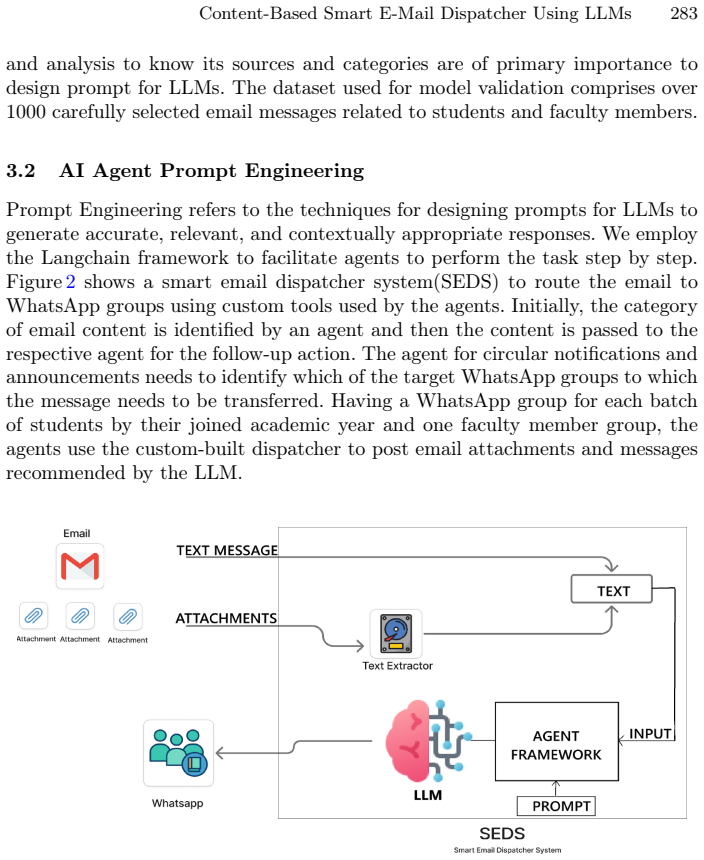
The agent framework that supplies large language models with email content plus group-context instructions and receives back the list of target WhatsApp groups.
If this is right
- Email forwarding moves from manual reading and selection to automatic dispatch based on content analysis.
- No labeled dataset is required to start or maintain the routing decisions.
- Staff cognitive load from reviewing every email drops because the model handles the initial classification.
- Students in the selected groups receive relevant notices on time without delays from human processing.
- The same prompt-based method could handle attachments or additional context fields if included in the agent instructions.
Where Pith is reading between the lines
- The method might be tested on archived emails from past semesters to quantify how often the model selects the groups that staff would have chosen.
- Extending the same prompt structure to other chat platforms besides WhatsApp would require only changing the output format while keeping the classification logic unchanged.
- If group descriptions change over time, the system would need updated context supplied to the model rather than retraining any component.
- Privacy considerations arise because each email is sent to an external model for decision-making before any forwarding occurs.
Load-bearing premise
An LLM given only the raw email text and a list of group descriptions will choose the correct recipient groups every time without mistakes or invented groups.
What would settle it
Feed a collection of real emails whose correct target groups are already known into the system and measure whether a substantial fraction of outputs list the wrong groups or include nonexistent ones.
Figures
read the original abstract
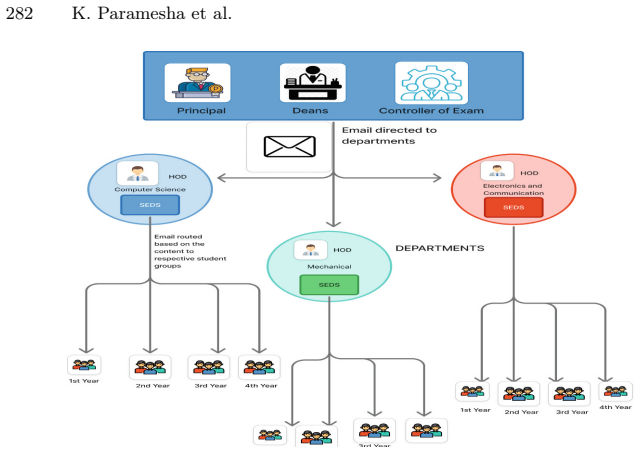
Email communication has become an integral part of personal and professional life, but handling its vast volume is still a significant issue for large organisations. Manual perusal of emails and forwarding their contents and attachments to intended recipients using other instant messaging platforms has proved to be error-prone and time-consuming leading to losses in terms of productivity and creating undue stress. The main objective of this paper is to explore an alternative mechanism that is to automate the task of dispatching emails based on their contents to the respective WhatsApp groups of students of various semesters of programs in an engineering college, facilitating a smooth flow of information from one end to another end in an organisation. The dispatcher system is built using agents querying large language models (LLMs) to enable it to analyze the contents of emails and route them to the relevant groups of students for their information and consumption. The system harnesses the capabilities of LLMs in analysing the textual contents for decision-making. With a well-structured agent framework prompt that includes email content as input with instructions and context, the system figures out the relevant groups to which the email message is dispatched, thus providing the required information on time. The proposed system does not rely on labelled datasets and provides several benefits, including enhanced productivity and a reduction in the cognitive load associated with reading emails.
Editorial analysis
A structured set of objections, weighed in public.
Referee Report
Summary. The manuscript proposes a content-based email dispatcher that uses LLM-querying agents to analyze email text and route messages to relevant student WhatsApp groups in an engineering college. The system is described as prompt-driven, requiring no labeled datasets, and is claimed to improve productivity while reducing cognitive load from manual forwarding.
Significance. If the routing accuracy holds under real-world conditions, the zero-shot LLM approach could offer a low-overhead automation method for organizational email handling that avoids the need for training data collection. The architectural description is clear at a high level, but the absence of any supporting evidence limits the assessed impact.
major comments (2)
- [Abstract] Abstract: The central claims that the system 'figures out the relevant groups' and delivers 'enhanced productivity' and 'reduction in the cognitive load' rest on an untested premise; the manuscript contains no accuracy metrics, test cases, ground-truth mappings, error analysis, or baseline comparisons to support reliable routing performance.
- [System description] System description (agent framework): The description of the prompt structure (email content plus instructions and context) provides no details on LLM selection, prompt engineering choices, handling of ambiguous or multi-topic emails, or mitigation of hallucinations, leaving the reproducibility and robustness of the routing decision process unassessable.
minor comments (1)
- The manuscript would benefit from at least one concrete example showing an input email, the generated prompt, and the resulting group assignments to illustrate the decision process.
Simulated Author's Rebuttal
We thank the referee for the constructive comments highlighting the need for clearer scoping and additional details. The manuscript describes a prompt-driven LLM agent architecture for email routing as a conceptual system that avoids labeled data requirements. We address each major comment below and will incorporate revisions to improve clarity and reproducibility.
read point-by-point responses
-
Referee: [Abstract] Abstract: The central claims that the system 'figures out the relevant groups' and delivers 'enhanced productivity' and 'reduction in the cognitive load' rest on an untested premise; the manuscript contains no accuracy metrics, test cases, ground-truth mappings, error analysis, or baseline comparisons to support reliable routing performance.
Authors: We agree that the manuscript contains no empirical evaluation, accuracy metrics, or comparisons, as it focuses on the system design and architecture rather than a completed experimental study. The claims of productivity gains and reduced cognitive load follow from replacing manual forwarding with automated routing, but we acknowledge these are unquantified expectations. We will revise the abstract to frame these as anticipated benefits of the zero-shot approach and add a brief note on planned future evaluation with ground-truth mappings. revision: yes
-
Referee: [System description] System description (agent framework): The description of the prompt structure (email content plus instructions and context) provides no details on LLM selection, prompt engineering choices, handling of ambiguous or multi-topic emails, or mitigation of hallucinations, leaving the reproducibility and robustness of the routing decision process unassessable.
Authors: The manuscript provides only a high-level description of the agent framework. To address reproducibility, we will expand the relevant section to specify the LLM used, include sample prompt templates, describe handling of ambiguous or multi-topic emails via sequential classification steps within the agent, and outline hallucination mitigation through post-processing validation against a predefined list of valid student groups. revision: yes
Circularity Check
No circularity: purely descriptive architecture with no derivations or fitted claims
full rationale
The manuscript is a high-level system description of an LLM-agent framework for routing emails to WhatsApp groups. It contains no equations, no parameter fitting, no predictions derived from data, and no self-citation chains. The central claim (zero-shot LLM routing without labelled data) is presented as an unvalidated architectural proposal rather than a derived result, so no step reduces to its own inputs by construction. This matches the default non-circular case for descriptive papers.
Axiom & Free-Parameter Ledger
axioms (1)
- domain assumption LLMs can perform reliable content-based routing decisions from a single prompt containing email text and group context without any fine-tuning or labeled examples.
Reference graph
Works this paper leans on
-
[1]
Analysis of email management strategies and their effects on email management performance. Omega124(2024). https://doi.org/10.1016/j.omega.2023.103002
-
[3]
Technovation133, 103002 (2024)
Chiarello, F., Giordano, V., Spada, I., Barandoni, S., Fantoni, G.: Future appli- cations of generative large language models: a data-driven case study on Chat- GPT. Technovation133, 103002 (2024). https://doi.org/10.1016/j.technovation. 2024.103002
-
[4]
Gaitan, N.C.: Performance and accuracy research of the large language models. Int. J. Adv. Comput. Sci. Appl.15(8) (2024)
2024
-
[5]
Heakl, A., Zaghloul, Y., Ali, M., Hossam, R., Gomaa, W.: Arzen-LLM: code- switched Egyptian Arabic-English translation and s peech recognition using LLMs. Procedia Comput. Sci.244, 113–120 (2024). https://doi.org/10.1016/j.procs.2024. 10.184
-
[6]
Expert Syst
Jáñez-Martino, F., Barrón-Cedeño, A., Alaiz-Rodríguez, R., González-Castro, V., Muti, A.: On persuasion in spam email: a m ulti-granularity text analysis. Expert Syst. Appl.265, 125767 (2025). https://www.sciencedirect.com/science/article/ pii/S0957417424026344
2025
-
[7]
In: Proceedings of the 2016 CHI Conference on Human Factors in Computing Systems, CHI ’16, p
Mark, G., Iqbal, S.T., Czerwinski, M., Johns, P., Sano, A., Lutchyn, Y.: Email duration, batching and self-interruption: patterns of email use on productivity and stress. In: P roceedings of the 2016 CHI Conference on Human Factors in Computing Systems, pp. 1717–1728. Association for Computing Machinery (2016). https://doi.org/10.1145/2858036.2858262
-
[8]
https://www.pabbly.com/connect/inr/
pabbly: Easily Connect Multiple Applications — A utomate your Tasks! (2025). https://www.pabbly.com/connect/inr/
2025
-
[9]
Patsakis, C., Casino, F., Lykousas, N.: Assessing LLMs in malicious code deobfus- cation of real-world malware campaigns. Expert Syst. Appl.256, 124912 (2024). https://doi.org/10.1016/j.eswa.2024.124912
-
[10]
Rashid, F., Ranaweera, N., Doyle, B., Seneviratne, S.: LLMs are one-shot URL classifiers and explainers. Comput. Netw.258, 111004 (2025). https://doi.org/10. 1016/j.comnet.2024.111004
arXiv 2025
-
[11]
In: ACAS Research P apers, vol
Russell, E.: Strategies for effectively managing email at work. In: ACAS Research P apers, vol. 6, p. 17 (2017)
2017
-
[12]
Tan, Y., et al.: Medchatzh: a tuning LLM for traditional Chinese medicine con- sultations. Comput. Biol. Med.172, 108290 (2024). https://doi.org/10.1016/j. compbiomed.2024.108290 286 K. Paramesha et al
work page doi:10.1016/j 2024
-
[13]
Wang, Y., Wu, Z., Yao, J., Su, J.: TDAG: a multi-agent framework based on dynamic task d ecomposition and agent generation. Neural Netw. 185 , 107200 (2025). https://doi.org/10.1016/j.neunet.2025.107200, https://www.sciencedirect. com/science/article/pii/S0893608025000796
-
[14]
https://wassenger.com/
Wassenger: WhatsApp communication and automation for all businesses made easy (2025). https://wassenger.com/
2025
-
[15]
Zapier: Send new Gmail emails as WhatsApp messages in Tellephant (2025). https://zapier.com/apps/gmail/integrations/tellephant/809733/send-new-gmail- emails-as-whatsapp-messages-in-tellephant Open Access This chapter is licensed under the terms of the Creative Commons Attribution 4.0 International License (http://creativecommons.org/licenses/by/4.0/), whi...
2025
discussion (0)
Sign in with ORCID, Apple, or X to comment. Anyone can read and Pith papers without signing in.