Cascaded Multi-Granularity Pruning for On-Device LLM Inference in Industrial IoT
Pith reviewed 2026-06-26 04:55 UTC · model grok-4.3
The pith
Cascaded multi-granularity pruning reaches 13.8 times compression on MHA+GELU LLMs for IIoT edge devices.
A machine-rendered reading of the paper's core claim, the machinery that carries it, and where it could break.
Core claim
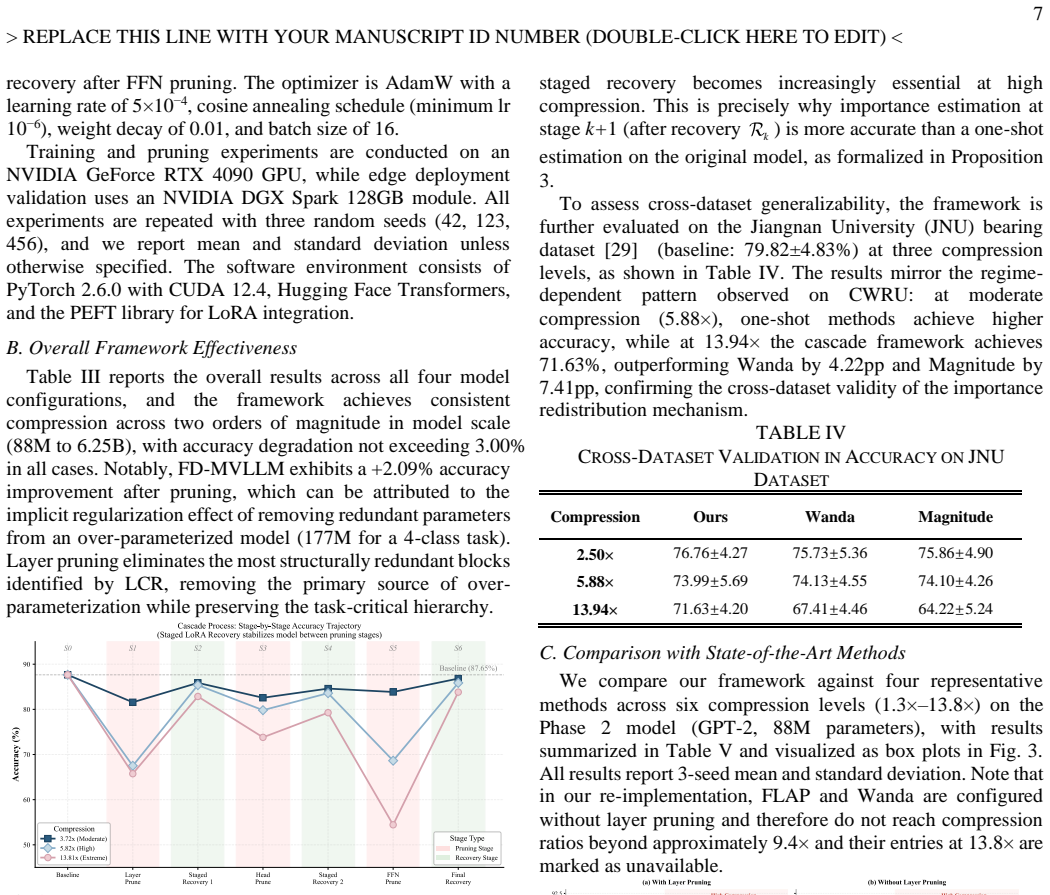
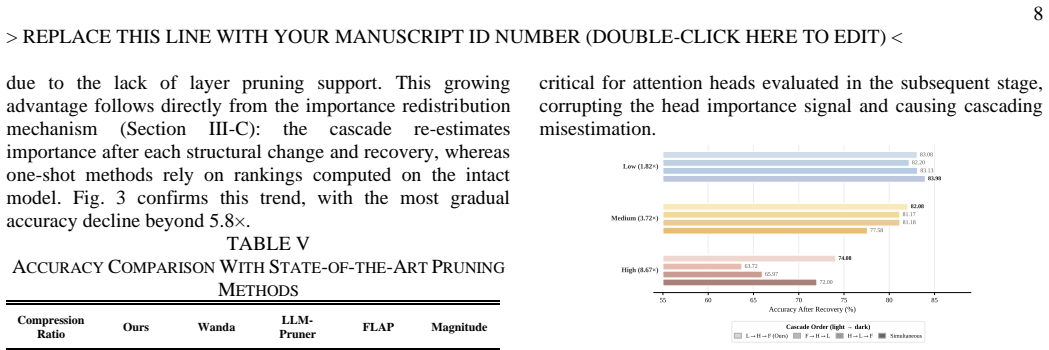
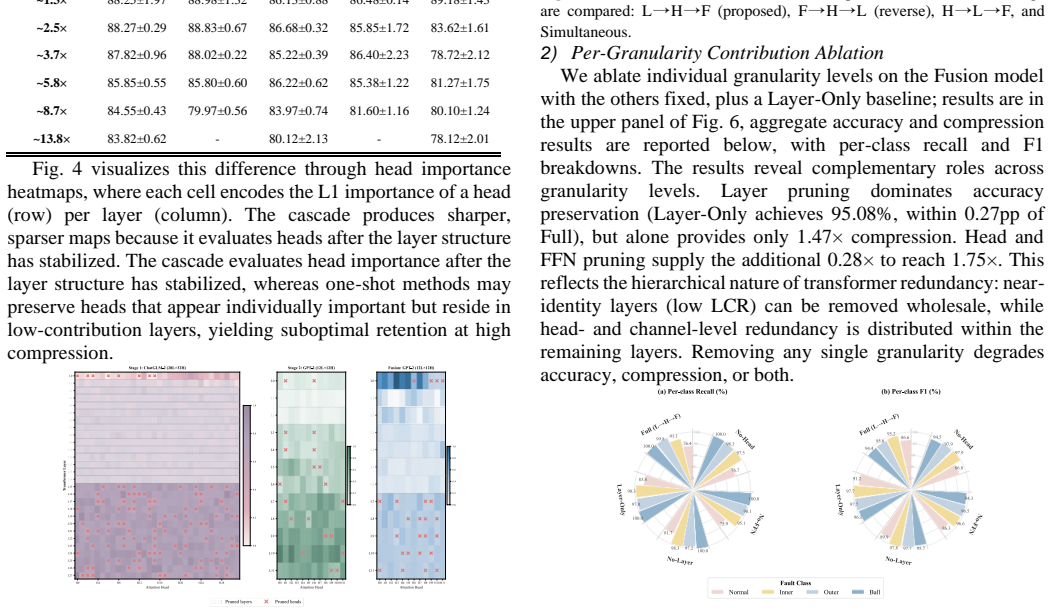
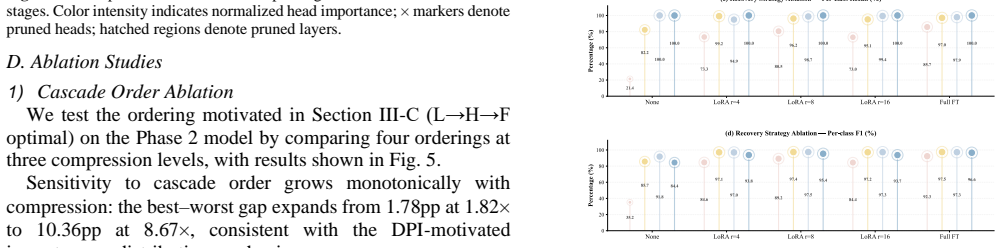
The cascaded multi-granularity pruning framework removes layers, attention heads, and feed-forward channels in coarse-to-fine order with lightweight low-rank recovery between stages; an information-theoretic analysis supplies the ordering, and the Structural Independence Assumption predicts that per-component pruning criteria remain reliable precisely when the architecture satisfies SIA, which MHA+GELU models do and GQA+SwiGLU models do not, yielding 13.8 times compression at 83.82 percent accuracy on the former class and a roughly 74 percentage-point accuracy drop on the latter.
What carries the argument
The cascaded multi-granularity pruning procedure ordered by information-theoretic analysis and conditioned on the Structural Independence Assumption, which determines whether component-wise importance scores stay reliable across pruning stages.
If this is right
- Higher compression ratios become usable on SIA-satisfying architectures without the accuracy collapse seen in one-shot methods.
- Architecture selection can be guided by a checkable SIA test before pruning is applied.
- Inter-stage low-rank recovery improves importance re-estimation enough to support 13.8 times overall reduction.
- Inference latency drops up to 67.2 percent and peak memory by 62.5 percent on the target industrial hardware once the pruned model is deployed.
- The same staged procedure scales across model sizes from 88 million to 6.25 billion parameters in the bearing-fault domain.
Where Pith is reading between the lines
- Designers could deliberately choose MHA+GELU blocks when the goal is extreme structured pruning for edge devices.
- The SIA test itself might be turned into an automated pre-pruning diagnostic for any new transformer variant.
- Low-rank recovery inserted between pruning stages could be generalized to other iterative compression pipelines.
- The 74-point collapse on violating architectures indicates that architecture-specific recovery modules may be needed when SIA fails.
Load-bearing premise
The Structural Independence Assumption correctly flags which architectures keep per-component pruning criteria reliable.
What would settle it
A direct measurement showing that GQA+SwiGLU models retain accuracy under the cascaded procedure at the same compression ratios where MHA+GELU models succeed.
Figures

read the original abstract
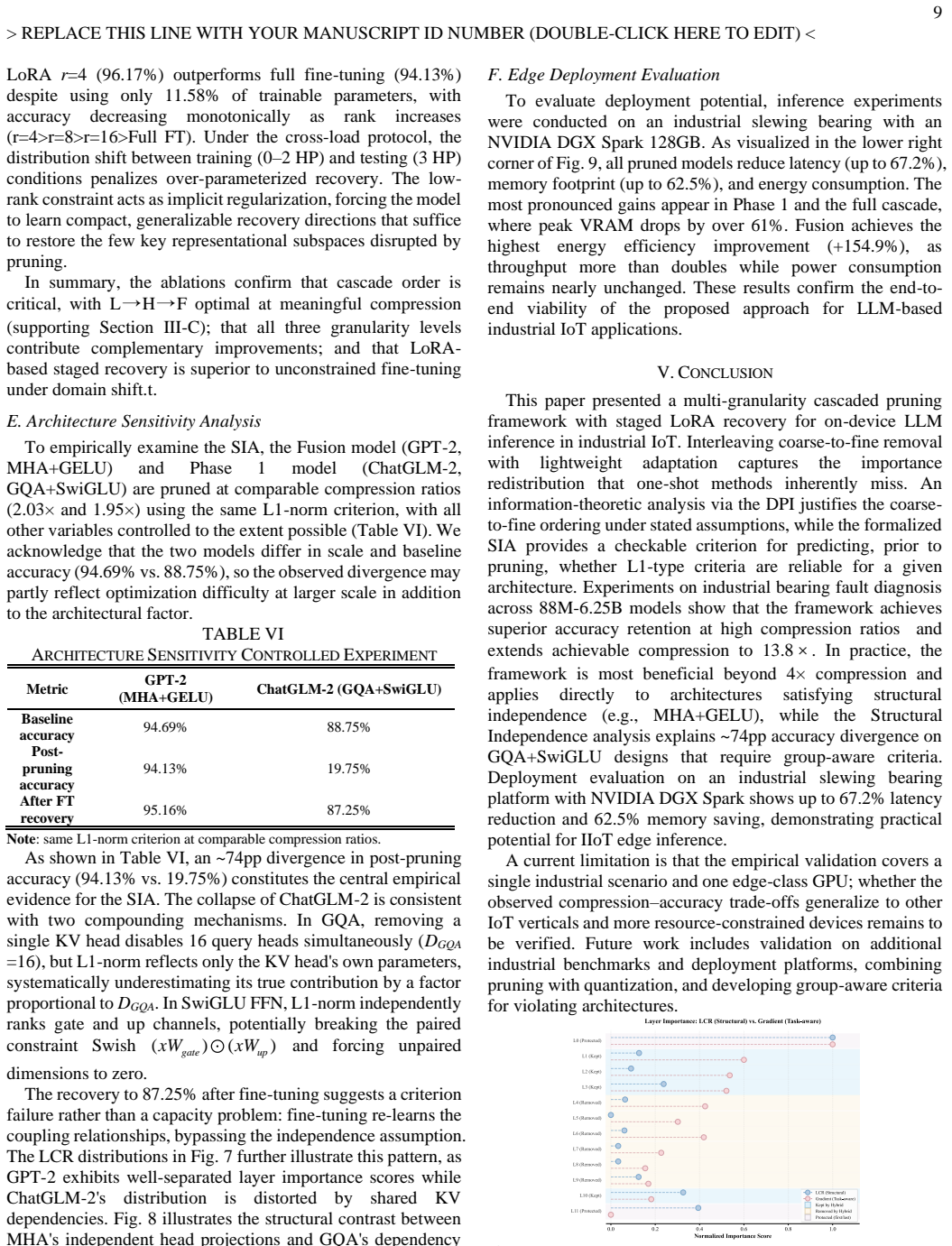
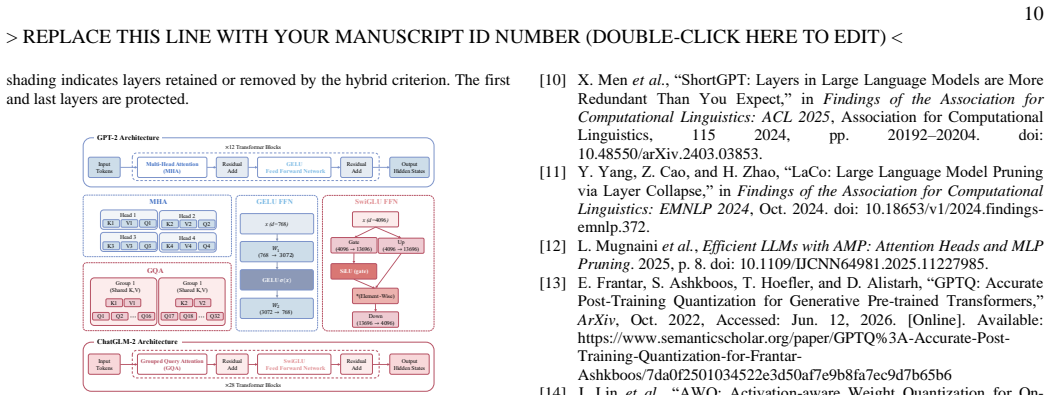
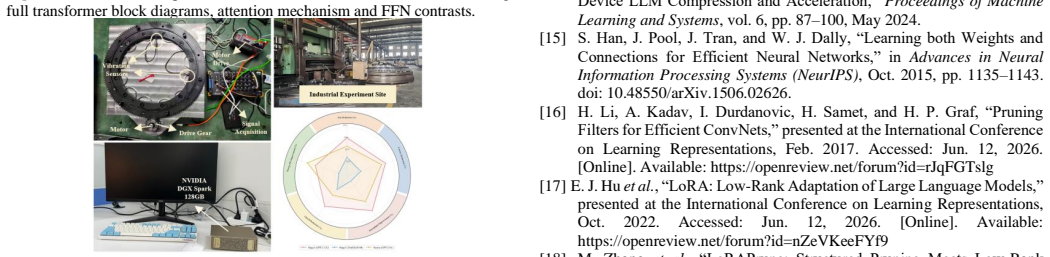
Deploying large language models (LLMs) on Industrial Internet of Things (IIoT) edge devices demands extreme compression, yet existing structured pruning methods collapse at high compression ratios due to one-shot importance estimation, and their cross-architecture behavior remains unpredictable. This article presents a cascaded multi-granularity pruning framework that removes layers, attention heads, and feed-forward channels in coarse-to-fine order, with lightweight low-rank recovery between stages to re-estimate component importance. An information-theoretic analysis motivates this ordering, and the Structural Independence Assumption (SIA) is formalized as a checkable condition predicting whether per-component pruning criteria are reliable for a given architecture: Multi-Head Attention (MHA)+GELU designs satisfy the SIA, whereas Grouped Query Attention (GQA)+SwiGLU designs violate it. On bearing fault diagnosis spanning 88M to 6.25B-parameter models, the framework extends achievable compression to 13.8 times on MHA+GELU architectures with 83.82% accuracy (+3.70 percentage points (pp) over the strongest baseline), while exposing a ~74pp accuracy collapse on GQA+SwiGLU architectures that violate the SIA. Deployed on an industrial slewing bearing fault diagnosis platform with NVIDIA DGX Spark, compressed models reduce inference latency by up to 67.2% and peak memory by 62.5%, demonstrating viability for IIoT edge inference.
Editorial analysis
A structured set of objections, weighed in public.
Referee Report
Summary. The paper introduces a cascaded multi-granularity pruning framework for extreme compression of LLMs on IIoT edge devices. It performs layer-, head-, and channel-level pruning in coarse-to-fine order with lightweight low-rank recovery between stages. An information-theoretic analysis motivates the ordering, and the Structural Independence Assumption (SIA) is defined as an architecture-dependent checkable condition: MHA+GELU models satisfy SIA while GQA+SwiGLU models violate it. Experiments on bearing fault diagnosis (88M–6.25B parameter models) report 13.8× compression at 83.82% accuracy (+3.70 pp over baseline) for SIA-satisfying architectures and a ~74 pp accuracy collapse for violating ones; hardware deployment shows up to 67.2% latency and 62.5% memory reduction.
Significance. If reproducible, the empirical demonstration of architecture-specific pruning reliability and the SIA concept would be useful for guiding structured pruning choices in resource-constrained industrial settings. The reported compression ratios and hardware gains on real IIoT hardware are practically relevant, but the absence of error bars, dataset details, and the full SIA derivation limits the strength of the contribution.
major comments (3)
- [Abstract] Abstract: The central accuracy (83.82%) and compression (13.8×) claims are reported without error bars, number of runs, or dataset split details for the bearing fault diagnosis task; this directly affects the reliability of the +3.70 pp improvement and the architecture-dependent contrast.
- [Abstract] Abstract: The SIA is presented as an independent, checkable condition derived from information-theoretic analysis that predicts pruning reliability, yet the manuscript provides neither the derivation nor the explicit checkable criterion; without this it is impossible to confirm that SIA is not circular with the reported outcomes.
- [Abstract] Abstract: Full experimental methods, model architectures, and baseline implementations are stated to be unavailable for inspection, preventing verification of the low-rank recovery step and the cross-architecture comparison that underpins the SIA claim.
Simulated Author's Rebuttal
We thank the referee for their detailed review and constructive comments. We will revise the manuscript to improve the clarity and completeness of the reported results, the SIA derivation, and the experimental details as outlined below.
read point-by-point responses
-
Referee: [Abstract] Abstract: The central accuracy (83.82%) and compression (13.8×) claims are reported without error bars, number of runs, or dataset split details for the bearing fault diagnosis task; this directly affects the reliability of the +3.70 pp improvement and the architecture-dependent contrast.
Authors: We agree that the absence of error bars and run details limits the assessment of result reliability. In the revised version, we will report the mean and standard deviation over 5 independent runs for all accuracy figures, including the 83.82% and the +3.70 pp improvement. We will also specify the dataset splits (e.g., 70/15/15 for train/val/test) used in the bearing fault diagnosis experiments to allow full reproducibility of the claims. revision: yes
-
Referee: [Abstract] Abstract: The SIA is presented as an independent, checkable condition derived from information-theoretic analysis that predicts pruning reliability, yet the manuscript provides neither the derivation nor the explicit checkable criterion; without this it is impossible to confirm that SIA is not circular with the reported outcomes.
Authors: The full manuscript includes a formal definition of the SIA as a checkable condition based on whether component importance scores remain stable under pruning (derived from mutual information considerations between layers and components). However, to address this concern, we will expand the main text with the complete information-theoretic derivation, including the mathematical steps showing why MHA+GELU satisfies SIA while GQA+SwiGLU violates it, ensuring it is not circular but predictive. revision: yes
-
Referee: [Abstract] Abstract: Full experimental methods, model architectures, and baseline implementations are stated to be unavailable for inspection, preventing verification of the low-rank recovery step and the cross-architecture comparison that underpins the SIA claim.
Authors: We apologize for any difficulty in locating the details; the full manuscript and supplementary material describe the model architectures (e.g., specific MHA and GQA configurations from 88M to 6.25B parameters), the low-rank recovery implementation using SVD-based approximation, and the baseline pruning methods. To facilitate verification, in the revision we will add a dedicated section or appendix with pseudocode for the cascaded pruning and low-rank recovery, and clarify that code will be released upon acceptance. revision: yes
Circularity Check
No significant circularity detected
full rationale
The paper motivates the cascaded ordering via an information-theoretic analysis and formalizes SIA as an independent checkable condition that predicts architecture-dependent reliability of pruning criteria. Central results are empirical (13.8× compression on MHA+GELU, ~74pp collapse on GQA+SwiGLU). No quoted equations or self-citations reduce the SIA definition, ordering choice, or reported outcomes to fitted inputs or prior self-work by construction. The derivation chain remains self-contained against external benchmarks.
Axiom & Free-Parameter Ledger
axioms (1)
- domain assumption Structural Independence Assumption (SIA) is a valid checkable condition that determines reliability of per-component pruning criteria for a given architecture.
Reference graph
Works this paper leans on
-
[1]
hen IoT Meet LLMs: A lications and Challenges,
I. Kok, O. De irci, and . Ozde ir, “ hen IoT Meet LLMs: A lications and Challenges,” ov. 20, 2024, arXiv: arXiv:2411.17722. doi: 10.48550/arXiv.2411.17722
-
[2]
dge hard: fficient LLM Inference via Colla orative dge Co uting,
M. Zhang, X. hen, J. Cao, Z. Cui, and . Jiang, “ dge hard: fficient LLM Inference via Colla orative dge Co uting,” IEEE Internet of Things Journal , vol. 12, no. 10, pp. 13119 –13131, May 2025, doi: 10.1109/JIOT.2024.3524255
-
[3]
LLM-based fra ework for earing fault diagnosis,
L. Tao, . Liu, G. ing, . Cao, . uang, and C. Lu, “LLM-based fra ework for earing fault diagnosis,” Mechanical Systems and Signal Processing, vol. 224, p. 112127, Feb. 2025, doi: 10.1016/j.ymssp.2024.112127
-
[4]
D. Li et al. , “FD-MVLLM: Fault diagnosis based on multimodal vi ration data and large language odel for earing syste ,” Mechanical Systems and Signal Processing , vol. 239, p. 113226, Oct. 2025, doi: 10.1016/j.ymssp.2025.113226
-
[5]
A Simple and Effective Pruning Approach for Large Language Models
M. un, Z. Liu, A. air, and J. Z. Kolter, “A i le and ffective Pruning A roach for Large Language Models,” May 06, 2024, arXiv: arXiv:2306.11695. doi: 10.48550/arXiv.2306.11695
work page internal anchor Pith review Pith/arXiv arXiv doi:10.48550/arxiv.2306.11695 2024
-
[6]
arseGPT: Massive Language Models Can be Accurately Pruned in One - hot,
Frantar and D. Alistarh, “ arseGPT: Massive Language Models Can be Accurately Pruned in One - hot,” in Proceedings of the 40th International Conference on Machine Learning , PMLR, Jul. 2023, pp. 10323–10337. Accessed: Jun. 12, 2026. [Online]. Available: https://proceedings.mlr.press/v202/frantar23a.html
2023
-
[7]
LLM-Pruner: On the Structural Pruning of Large Language Models,
X. Ma, G. Fang, and X. ang, “LLM-Pruner: On the Structural Pruning of Large Language Models,” Advances in Neural Information Processing Systems, vol. 36, pp. 21702–21720, Dec. 2023
2023
-
[8]
Fluctuation -Based Adaptive tructured Pruning for Large Language Models,
An, X. Zhao, T. u, M. Tang, and J. ang, “Fluctuation -Based Adaptive tructured Pruning for Large Language Models,” AAAI, vol. 38, no. 10, pp. 10865–10873, Mar. 2024, doi: 10.1609/aaai.v38i10.28960
-
[9]
S. Ashkboos, M. L. Croci, M. G. do Nascimento, T. Hoefler, and J. ens an, “ liceGPT: Co ress Large Language Models y Deleting ows and Colu ns,” resented at the The Twelfth International Conference on Learning Representations, Jan. 2024. doi: 10.48550/arXiv.2401.15024
-
[10]
hortGPT: Layers in Large Language Models are More edundant Than ou x ect,
X. Men et al., “ hortGPT: Layers in Large Language Models are More edundant Than ou x ect,” in Findings of the Association for Computational Linguistics: ACL 2025 , Association for Computational Linguistics, 115 2024, pp. 20192 –20204. doi: 10.48550/arXiv.2403.03853
-
[11]
LaCo: Large Language Model Pruning via Layer Colla se,
ang, Z. Cao, and . Zhao, “LaCo: Large Language Model Pruning via Layer Colla se,” in Findings of the Association for Computational Linguistics: EMNLP 2024 , Oct. 2024. doi: 10.18653/v1/2024.findings - emnlp.372
-
[12]
A study on quantum reservoir recurrent models for time-constrained volatile sequence forecasting,
L. Mugnaini et al., Efficient LLMs with AMP: Attention Heads and MLP Pruning. 2025, p. 8. doi: 10.1109/IJCNN64981.2025.11227985
-
[13]
GPTQ: Accurate Post-Training Quantization for Generative Pre -trained Transfor ers,
Frantar, . Ashk oos, T. oefler, and D. Alistarh, “GPTQ: Accurate Post-Training Quantization for Generative Pre -trained Transfor ers,” ArXiv, Oct. 202 2, Accessed: Jun. 12, 2026. [Online]. Available: https://www.semanticscholar.org/paper/GPTQ%3A-Accurate-Post- Training-Quantization-for-Frantar- Ashkboos/7da0f2501034522e3d50af7e9b8fa7ec9d7b65b6
2026
-
[14]
A Q: Activation -aware Weight Quantization for On - Device LLM Co ression and Acceleration,
J. Lin et al., “A Q: Activation -aware Weight Quantization for On - Device LLM Co ression and Acceleration,” Proceedings of Machine Learning and Systems, vol. 6, pp. 87–100, May 2024
2024
-
[15]
Learning both Weights and Connections for Efficient Neural Networks
an, J. Pool, J. Tran, and . J. Dally, “Learning oth eights and Connections for fficient eural etworks,” in Advances i n Neural Information Processing Systems (NeurIPS) , Oct. 2015, pp. 1135 –1143. doi: 10.48550/arXiv.1506.02626
work page internal anchor Pith review Pith/arXiv arXiv doi:10.48550/arxiv.1506.02626 2015
-
[16]
Pruning Filters for fficient Conv ets,
Li, A. Kadav, I. Durdanovic, . a et, and . P. Graf, “Pruning Filters for fficient Conv ets,” resented at the International Conference on Learning Representations, Feb. 2017. Accessed: Jun. 12, 2026. [Online]. Available: https://openreview.net/forum?id=rJqFGTslg
2017
-
[17]
Lo A: Low- ank Ada tation of Large Language Models,
E. J. Hu et al., “Lo A: Low- ank Ada tation of Large Language Models,” presented at the International Conference on Learnin g Representations, Oct. 2022. Accessed: Jun. 12, 2026. [Online]. Available: https://openreview.net/forum?id=nZeVKeeFYf9
2022
-
[18]
Lo APrune: tructured Pruning Meets Low-Rank Parameter-Efficient Fine-Tuning,
M. Zhang et al., “Lo APrune: tructured Pruning Meets Low-Rank Parameter-Efficient Fine-Tuning,” Oct. 2023, Accessed: Jun. 12, 2026. [Online]. Available: https://openreview.net/forum?id=9KVT1e1qf7
2023
-
[19]
Phyelds: A pythonic framework for aggregate computing,
T. Chen, T. Ding, . adav, I. Zharkov, and L. Liang, “Lo A hear: Efficient Large Language Model Structured Pruning and Knowledge ecovery,” 2023, doi: 10.48550/A XIV.2310.18356
work page doi:10.48550/a 2023
-
[20]
Dutta, R
O. Dutta, R. Gupta, and S. Agarwal, VTrans: Accelerating Transformer Compression with Variational Information Bottleneck based Pruning
-
[21]
doi: 10.48550/arXiv.2406.05276
-
[22]
The Lottery Ticket y othesis: Finding Sparse, Trai na le eural etworks,
J. Frankle and M. Car in, “The Lottery Ticket y othesis: Finding Sparse, Trai na le eural etworks,” resented at the International Conference on Learning Representations, Sep. 2018. Accessed: Jun. 12,
2018
-
[23]
Available: https://openreview.net/forum?id=rJl-b3RcF7
[Online]. Available: https://openreview.net/forum?id=rJl-b3RcF7
-
[24]
Deep learning and the information bottleneck principle
Tish y and . Zaslavsky, “Dee learning and the infor mation ottleneck rinci le,” in 2015 IEEE Information Theory Workshop (ITW), Apr. 2015, pp. 1–5. doi: 10.1109/ITW.2015.7133169
-
[25]
T. M. Cover and J. A. Thomas, Elements of Information Theory, 2nd ed. John Wiley & Sons, Ltd, 2006. doi: 10.1002/047174882X.ch17
-
[26]
GQA: Training Generalized Multi-Query Transformer Models from Multi- ead Check oints,
J. Ainslie, J. Lee-Thorp, M. de Jong, Y. Zemlyanskiy, F. Lebron, and S. anghai, “GQA: Training Generalized Multi-Query Transformer Models from Multi- ead Check oints,” resented at the The 2023 Conference on Empirical Methods in Natural Langu age Processing, Dec. 2023. Accessed: Jun. 12, 2026. [Online]. Available: https://openreview.net/forum?id=hmOwOZWzYE
2023
-
[27]
GLU Variants Improve Transformer
N. Shazeer, GLU Variants Improve Transformer . 2020. doi: 10.48550/arXiv.2002.05202
work page internal anchor Pith review Pith/arXiv arXiv doi:10.48550/arxiv.2002.05202 2020
-
[28]
Progressive Knowledge-Guided Large Language Model Framework for Bearing Fault Diagnosis,
J. Wang, G. Peng, Y. Chen, W. Zhang, W. Wu, and T. Liu, “Progressive Knowledge-Guided Large Language Model Framework for Bearing Fault Diagnosis,” Jun. 15, 2026, arXiv: arXiv:2606.16684. doi: 10.48550/arXiv.2606.16684
-
[29]
Y. Polyanskiy and Y. Wu, Information Theory: From Coding to Learning. Cambridge University Press, 2025. doi: 10.1017/9781108966351
-
[30]
Download a Data File | Case chool of ngineering
“Download a Data File | Case chool of ngineering.” Accessed: Jun. 15,
-
[31]
Available: https://engineering.case.edu/bearingdatacenter/download-data-file
[Online]. Available: https://engineering.case.edu/bearingdatacenter/download-data-file
-
[32]
K. Li, X. Ping, H. Wang, P. Chen, and . Cao, “ equential Fuzzy Diagnosis Method for Motor Roller Bearing in Variable Operating Conditions ased on Vi ration Analysis,” Sensors, vol. 13, no. 6, pp. 8013–8041, Jun. 2013, doi: 10.3390/s130608013. In ut Tokens esidual Add esidual Add Out ut idden tates In ut Tokens esidual Add esidual Add Out ut idden tates Q1...
discussion (0)
Sign in with ORCID, Apple, or X to comment. Anyone can read and Pith papers without signing in.