Exact Comparison of Explanatory Strength of Two Dependent Predictors
Pith reviewed 2026-06-26 02:47 UTC · model grok-4.3
The pith
A Paired Swap Permutation Test delivers exact comparison of which of two dependent predictors has greater explanatory strength.
A machine-rendered reading of the paper's core claim, the machinery that carries it, and where it could break.
Core claim
The Paired Swap Permutation Test, grounded in the principle of functional exchangeability under the null hypothesis, utilizes a symmetric within-subject swapping mechanism for categorical data together with an Empirical Cumulative Distribution Function mapping step for continuous domains; this copula-based transposition generates the exact null distribution while perfectly preserving marginal densities and empirical support, thereby furnishing an exact non-parametric procedure for comparing the explanatory strength of two dependent predictors.
What carries the argument
The Paired Swap Permutation Test, which implements symmetric within-subject swapping and ECDF mapping under functional exchangeability to produce the exact null distribution.
If this is right
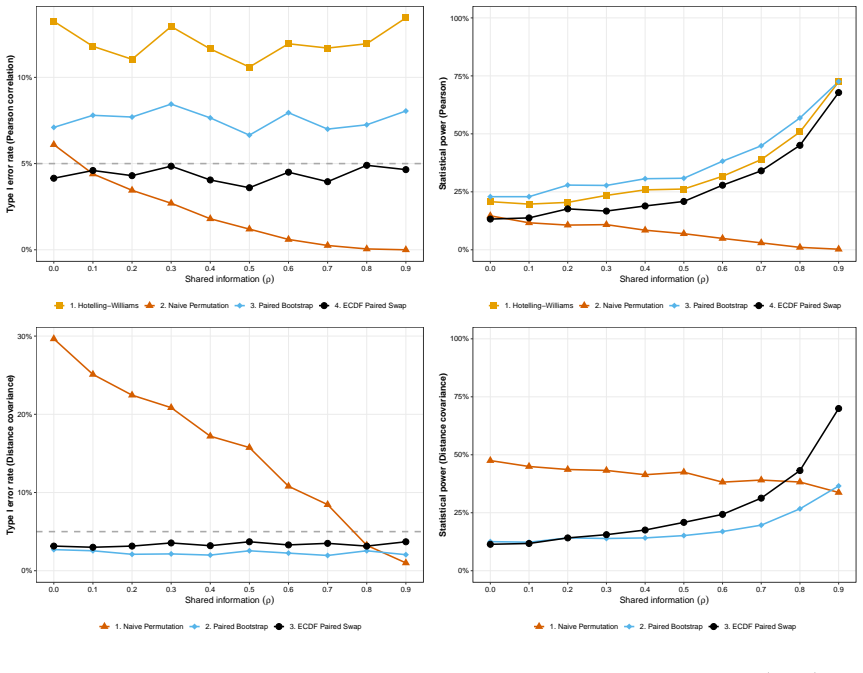
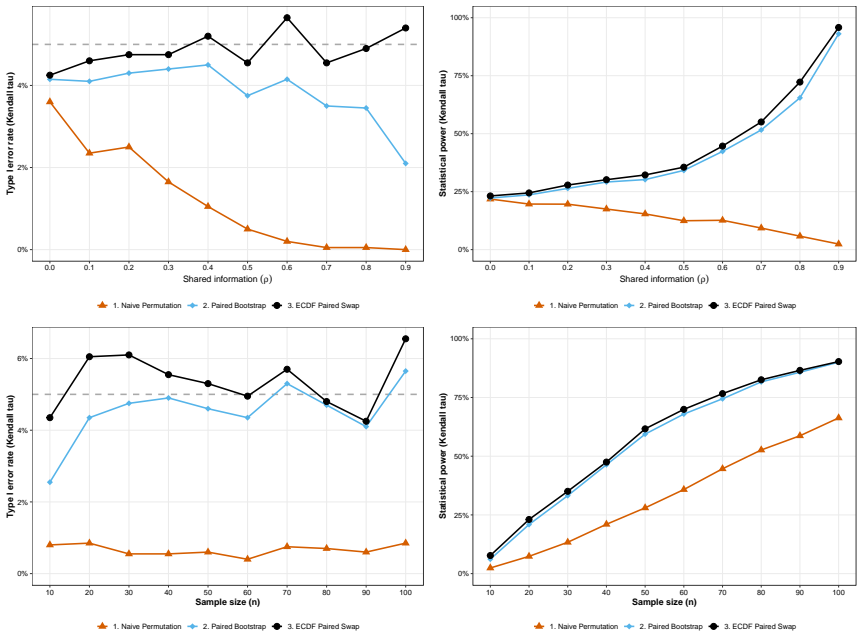
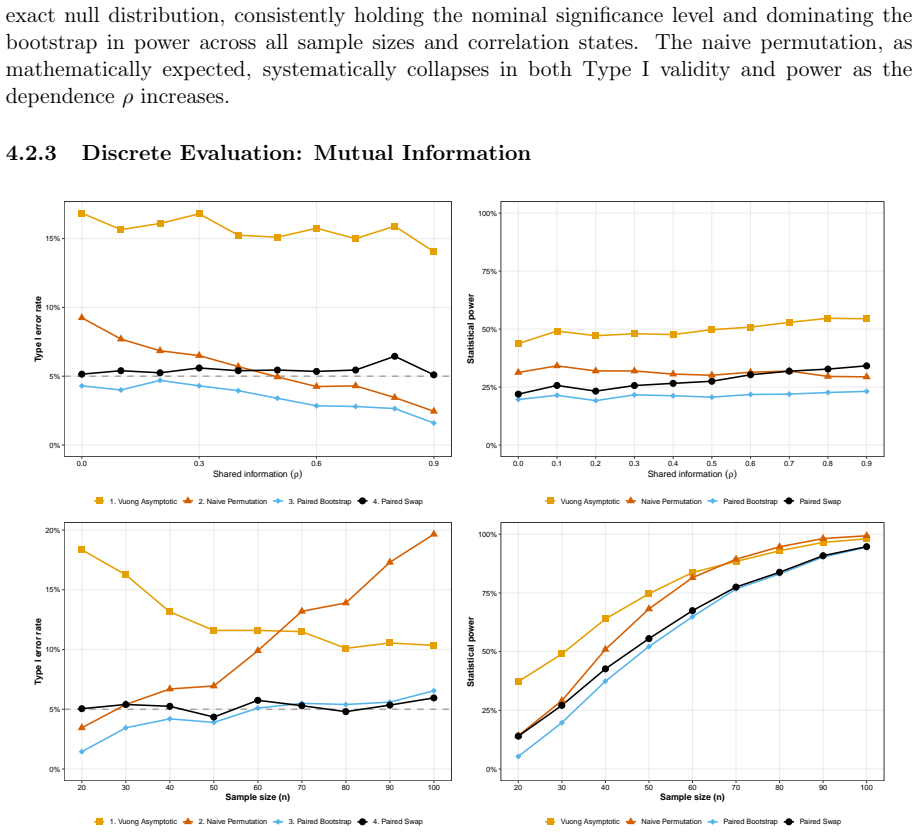
- The test strictly maintains the nominal significance level across the simulated conditions examined.
- The test attains higher statistical power than Vuong, Hotelling-Williams, naive permutation, and paired bootstrap procedures under heavy-tailed and sparse-categorical regimes.
- The procedure produces usable p-values on a high-dimensional linguistic corpus of noun-noun compounds where classical methods are unreliable.
Where Pith is reading between the lines
- The same swapping-plus-ECDF construction could be reused to obtain exact tests for other symmetric functionals of paired predictors.
- Because the method preserves the joint empirical distribution, it may be directly applicable to paired observations arising in longitudinal or matched-pair designs outside linguistics.
Load-bearing premise
Functional exchangeability under the null hypothesis is sufficient for the symmetric swapping and ECDF mapping steps to generate the exact null distribution while preserving marginal densities.
What would settle it
A Monte Carlo experiment under the null hypothesis in which the empirical rejection rate at nominal level alpha deviates systematically from alpha, or in which power falls below that of a correctly calibrated competitor, would falsify the exactness and optimality claims.
Figures
read the original abstract
Comparing the relative explanatory power of two dependent predictors regarding a common target variable is a fundamental challenge across scientific disciplines. Classical asymptotic procedures, such as Vuong's closeness test or the Hotelling-Williams test, frequently collapse under pathological data conditions, including heavy-tailed distributions and extreme categorical sparsity. To bypass these limitations, practitioners often turn to non-parametric resampling. However, naive permutation tests destroy the natural covariance structure of dependent predictors, while the paired bootstrap evaluating variance around the alternative hypothesis and introducing artificial ties suffers from metric space compression and categorical omission, rendering it highly unreliable in finite samples. In this paper, we introduce the Paired Swap Permutation Test, a novel and exact non-parametric methodology. Grounded in the principle of functional exchangeability under the null hypothesis, our algorithm utilizes a symmetric within-subject swapping mechanism for categorical data, and introduces an Empirical Cumulative Distribution Function (ECDF) mapping step for continuous domains. This copula-based transposition perfectly preserves marginal densities and the empirical support without introducing resampling ties. Through extensive Monte Carlo simulations, we demonstrate that the proposed test strictly maintains the nominal significance level and maximizes statistical power under conditions where standard methods become catastrophically liberal or pathologically conservative. Finally, we apply the framework to a high-dimensional linguistic dataset of Italian noun-noun compounds, proving its capacity to deliver robust, exact inference in environments where conventional analytical methods inherently fail.
Editorial analysis
A structured set of objections, weighed in public.
Referee Report
Summary. The manuscript introduces the Paired Swap Permutation Test for comparing the explanatory strength of two dependent predictors X1 and X2 for a response Y. The method relies on a symmetric within-subject swap (for categorical data) combined with ECDF mapping (for continuous data) to generate an exact null distribution under the principle of functional exchangeability when the predictors have equal explanatory power. It claims that Monte Carlo simulations show strict type-I error control at the nominal level and power advantages over Vuong, Hotelling-Williams, naive permutation, and paired bootstrap procedures, especially under heavy tails or categorical sparsity; an application to Italian noun-noun compound data is also presented.
Significance. A genuinely exact, non-asymptotic procedure that preserves marginals while respecting dependence would be valuable in statistical methodology, particularly for the pathological regimes where classical tests are known to fail. The copula-style transposition idea is technically interesting and could, if valid, address a real gap; however, the paper provides no machine-checked proofs or closed-form derivations, and the simulation evidence is asserted rather than quantified in the abstract.
major comments (1)
- [Abstract (method description) and the section defining the Paired Swap Permutation Test] The central exactness claim rests on the assertion that functional exchangeability holds under the null of equal explanatory strength (equal association or R² with Y). The swapping-plus-ECDF construction generates a reference distribution only if the joint law of (X1,X2,Y) is invariant under within-subject transposition once marginals are matched. Nothing in the null forces this invariance when dependence structures are asymmetric; equal marginal associations can arise without exchangeability. Consequently the generated null need not coincide with the true sampling distribution of the test statistic, so type-I error control is not guaranteed to be exact. This issue is load-bearing for the title claim of 'Exact Comparison' and for the simulation-based assertion of strict level control.
minor comments (2)
- [Abstract] The abstract states that 'extensive Monte Carlo simulations' demonstrate control and power advantages, yet supplies no design parameters (sample sizes, dependence strengths, tail indices, sparsity levels) or quantitative results (empirical rejection rates, power curves). These details belong in the main text or a dedicated simulation section with tables.
- [Introduction / Method] Notation for the test statistic and the precise definition of 'explanatory strength' (e.g., whether it is R², mutual information, or another measure) should be introduced earlier and used consistently.
Simulated Author's Rebuttal
We thank the referee for their careful reading and constructive comments on our manuscript. The central issue raised concerns the justification for functional exchangeability under the null of equal explanatory strength. We respond point-by-point below and propose revisions to clarify the null hypothesis.
read point-by-point responses
-
Referee: [Abstract (method description) and the section defining the Paired Swap Permutation Test] The central exactness claim rests on the assertion that functional exchangeability holds under the null of equal explanatory strength (equal association or R² with Y). The swapping-plus-ECDF construction generates a reference distribution only if the joint law of (X1,X2,Y) is invariant under within-subject transposition once marginals are matched. Nothing in the null forces this invariance when dependence structures are asymmetric; equal marginal associations can arise without exchangeability. Consequently the generated null need not coincide with the true sampling distribution of the test statistic, so type-I error control is not guaranteed to be exact. This issue is load-bearing for the title claim of 'Exact Comparison' and for the simulation-based assertion of strict level control.
Authors: We agree that equal marginal associations (such as identical R² values) do not automatically entail functional exchangeability when the dependence structure between (X1, X2, Y) is asymmetric. Our procedure is constructed to be exact under the null that the predictors are functionally exchangeable with respect to Y after marginal matching via ECDF mapping. We view this exchangeability null as the appropriate operationalization of 'equal explanatory strength' for a symmetric comparison test, because it directly encodes the idea that the two predictors play interchangeable roles in their joint relationship with Y. Under this null the within-subject swaps generate the exact reference distribution by construction. We will revise the abstract, the definition of the test, and the discussion of the null hypothesis to make this distinction explicit, including a note on the distinction between marginal association equality and exchangeability. We will also add a brief remark on the scope of the exactness claim. This addresses the load-bearing concern for the title while preserving the method's validity under the stated null. revision: yes
Circularity Check
No circularity; derivation rests on explicit exchangeability assumption without reduction to inputs
full rationale
The paper defines the Paired Swap Permutation Test by direct construction from the stated principle of functional exchangeability under the null, using within-subject swapping for categorical data and ECDF mapping for continuous data to produce the reference distribution. No equations, test statistic, or null distribution is shown to equal a fitted quantity or prior self-citation by construction. Monte Carlo results are presented only as empirical confirmation of type-I error control, not as the source of the exactness claim. The chain is therefore self-contained against the external exchangeability premise.
Axiom & Free-Parameter Ledger
axioms (1)
- domain assumption functional exchangeability under the null hypothesis
Reference graph
Works this paper leans on
-
[1]
Econometrica: Journal of the Econometric Society , volume=
Likelihood ratio tests for model selection and non-nested hypotheses , author=. Econometrica: Journal of the Econometric Society , volume=. 1989 , publisher=
1989
-
[2]
The Annals of Statistics , volume=
Measuring and testing dependence by correlation of distances , author=. The Annals of Statistics , volume=. 2007 , publisher=
2007
-
[3]
Statistical Science , volume=
Permutation methods: a basis for exact inference , author=. Statistical Science , volume=. 2004 , publisher=
2004
-
[4]
2010 , publisher=
Permutation tests for complex data: theory, applications and software , author=. 2010 , publisher=
2010
-
[5]
1993 , publisher=
An introduction to the bootstrap , author=. 1993 , publisher=
1993
-
[6]
The Annals of Mathematical Statistics , volume=
The selection of variates for use in prediction with some comments on the general problem of nuisance parameters , author=. The Annals of Mathematical Statistics , volume=. 1940 , publisher=
1940
-
[7]
Journal of the Royal Statistical Society: Series B (Methodological) , volume=
The comparison of regression variables , author=. Journal of the Royal Statistical Society: Series B (Methodological) , volume=. 1959 , publisher=
1959
-
[8]
Psychological Bulletin , volume=
Tests for comparing elements of a correlation matrix , author=. Psychological Bulletin , volume=. 1980 , publisher=
1980
-
[9]
BMC bioinformatics , volume=
Conditional variable importance for random forests , author=. BMC bioinformatics , volume=. 2008 , publisher=
2008
-
[10]
The American Journal of Human Genetics , volume=
Permutation testing in the presence of polygenic variation , author=. The American Journal of Human Genetics , volume=. 2015 , publisher=
2015
-
[11]
Australian & New Zealand Journal of Statistics , volume=
Permutation tests for linear models , author=. Australian & New Zealand Journal of Statistics , volume=. 2001 , publisher=
2001
-
[12]
Journal of the American Statistical Association , volume =
Joseph P Romano and Michael Wolf , title =. Journal of the American Statistical Association , volume =. 2005 , publisher =. doi:10.1198/016214504000000539 , URL =
-
[13]
Abramowicz, Konrad and Pini, Alessia and Schelin, Lina and Sjöstedt de Luna, Sara and Stamm, Aymeric and Vantini, Simone , title =. Biometrics , volume =. doi:https://doi.org/10.1111/biom.13669 , url =. https://onlinelibrary.wiley.com/doi/pdf/10.1111/biom.13669 , abstract =
-
[14]
Journal of Machine Learning Reserch , volume =
Glenn Shafer and Vladimir Vovk , title =. Journal of Machine Learning Reserch , volume =
-
[15]
, Author =
False discovery rate envelopes. , Author =. Statistics and Computing , Year =
-
[16]
Dawid, Philip A. , title =. Journal of the Royal Statistical Society Series A: Statistics in Society , volume =. 2021 , month =. doi:10.1111/rssa.12648 , url =
-
[17]
Journal of the Royal Statistical Society Series A: Statistics in Society , volume =
Henning, C Christian , title =. Journal of the Royal Statistical Society Series A: Statistics in Society , volume =. 2021 , month =. doi:10.1111/rssa.12657 , url =
-
[18]
Journal of the Royal Statistical Society Series A: Statistics in Society , volume =
Shafer, Glenn , title =. Journal of the Royal Statistical Society Series A: Statistics in Society , volume =. 2021 , month =. doi:10.1111/rssa.12647 , url =
-
[19]
Second-generation p-values: Improved rigor, reproducibility, & transparency in statistical analyses , year =. PLOS ONE , publisher =. doi:10.1371/journal.pone.0188299 , author =
-
[20]
Robert E. Kass and Adrian E. Raftery , title =. Journal of the American Statistical Association , volume =. 1995 , publisher =. doi:10.1080/01621459.1995.10476572 , URL =
-
[21]
Ann Intern Med
Tyler J VanderWeele and Peng Ding , title =. Ann Intern Med. , volume =. 2017 , doi =
2017
-
[22]
J Grad Med Educ
Gail M Sullivan and Richard Feinn , title =. J Grad Med Educ. , volume =. 2012 , doi =
2012
-
[23]
Ronald L. Wasserstein and Nicole A. Lazar , title =. The American Statistician , volume =. 2016 , publisher =. doi:10.1080/00031305.2016.1154108 , URL =
work page internal anchor Pith review Pith/arXiv arXiv doi:10.1080/00031305.2016.1154108 2016
-
[24]
and Hastie, Trevor , title =
Viladomat, Júlia and Mazumder, Rahul and McInturff, Alex and McCauley, Douglas J. and Hastie, Trevor , title =. Biometrics , volume =
-
[25]
Wenlin Dai and Tomáš Mrkvička and Ying Sun and Marc G. Genton , keywords =. Functional outlier detection and taxonomy by sequential transformations , journal =. 2020 , issn =. doi:https://doi.org/10.1016/j.csda.2020.106960 , url =
-
[26]
and Pini, Alessia and Vantini, Simone , journal =
Olsen, Niels L. and Pini, Alessia and Vantini, Simone , journal =. False discovery rate for functional data , volume =. 2021 , doi =
2021
-
[27]
and Shaikh, Azeem M
Romano, Joseph P. and Shaikh, Azeem M. and Wolf, Michael. , journal =. Control of the false discovery rate under dependence using the bootstrap and subsampling , volume =
-
[28]
Tony Cai , journal =
Wenguang Sun and T. Tony Cai , journal =. Large-Scale Multiple Testing under Dependence , volume =
-
[29]
Schwartzman, Armin and Lin, Xihong , title = ". Biometrika , volume =. 2011 , month =. doi:10.1093/biomet/asq075 , url =
-
[30]
and Tibshirani, Robert , title =
Storey, John D. and Tibshirani, Robert , title =. 2003 , doi =. https://www.pnas.org/content/100/16/9440.full.pdf , journal =
2003
-
[31]
Jiao, Shuo and Zhang, Shunpu , title = ". Bioinformatics , volume =. 2008 , month =. doi:10.1093/bioinformatics/btn310 , url =
-
[32]
Xie, Yang and Pan, Wei and Khodursky, Arkady B. , title = ". Bioinformatics , volume =. 2005 , month =. doi:10.1093/bioinformatics/bti685 , url =
-
[33]
Dynamic adaptive multiple tests with finite sample FDR control
Philipp Heesen and Arnold Janssen. Dynamic adaptive multiple tests with finite sample FDR control. Journal of Statistical Planning and Inference. 2016. doi:https://doi.org/10.1016/j.jspi.2015.06.007
-
[34]
Journal of the Royal Statistical Society: Series B (Statistical Methodology) , author =
Liang, Kun and Nettleton, Dan , title =. Journal of the Royal Statistical Society: Series B (Statistical Methodology) , volume =. doi:10.1111/j.1467-9868.2011.01001.x , url =. https://rss.onlinelibrary.wiley.com/doi/pdf/10.1111/j.1467-9868.2011.01001.x , abstract =
-
[35]
Comparison of Methods for Estimating the Number of True Null Hypotheses in Multiplicity Testing , journal =. 2003 , publisher =. doi:10.1081/BIP-120024202 , note =
-
[36]
Journal of Statistical Computation and Simulation , volume =
Yi-Ting Hwang , title =. Journal of Statistical Computation and Simulation , volume =. 2011 , publisher =. doi:10.1080/00949650903260855 , URL =
-
[37]
Chen, Xiongzhi and Doerge, Rebecca W. and Heyse, Joseph F. , title =. Biometrical Journal , volume =. doi:10.1002/bimj.201700157 , url =. https://onlinelibrary.wiley.com/doi/pdf/10.1002/bimj.201700157 , abstract =
-
[38]
Chen, Xiongzhi , title =. Biometrical Journal , year =. doi:10.1002/bimj.201900163 , url =. https://onlinelibrary.wiley.com/doi/pdf/10.1002/bimj.201900163 , abstract =
-
[39]
Sealfon and Terence P
Yongchao Ge and Stuart C. Sealfon and Terence P. Speed , journal =. SOME STEP-DOWN PROCEDURES CONTROLLING THE FALSE DISCOVERY RATE UNDER DEPENDENCE , volume =
-
[40]
Goeman, Jelle J. and Solari, Aldo , title =. Statistics in Medicine , volume =. doi:10.1002/sim.6082 , url =. https://onlinelibrary.wiley.com/doi/pdf/10.1002/sim.6082 , abstract =
-
[41]
A. Pini and S. Vantini , title =. Journal of Nonparametric Statistics , volume =. 2017 , publisher =. doi:10.1080/10485252.2017.1306627 , URL =
-
[42]
Resampling-based multiple testing for microarray data analysis
Ge, Youngchao and Dudoit, Sandrine and Speed, Terence P. Resampling-based multiple testing for microarray data analysis. Test. 2003
2003
-
[43]
A unified approach to false discovery rate estimation
Strimmer, Korbinian. A unified approach to false discovery rate estimation. BMC Bioinformatics. 2008
2008
-
[44]
and Pollard, Katherine S
Gilbert, Houston N. and Pollard, Katherine S. and van der Laan, Mark J. and Dudoit, Sandrine. Resampling-Based Multiple Hypothesis Testing with Applications to Genomics: New Developments in the R/Bioconductor Package multtest. U.C. Berkeley Division of Biostatistics Working Paper Series. Working Paper 249. 2009
2009
-
[45]
Dudoit, Sandrine and Gilbert1, Houston N. and van der Laan, Mark J. , title =. Biometrical Journal , volume =. doi:10.1002/bimj.200710473 , url =. https://onlinelibrary.wiley.com/doi/pdf/10.1002/bimj.200710473 , abstract =
-
[46]
Daniel Yekutieli and Yoav Benjamini. Resampling-based false discovery rate controlling multiple test procedures for correlated test statistics. Journal of Statistical Planning and Inference. 1999. doi:https://doi.org/10.1016/S0378-3758(99)00041-5
-
[47]
Storey, John D. , title =. Journal of the Royal Statistical Society: Series B (Statistical Methodology) , volume =. doi:10.1111/1467-9868.00346 , url =. https://rss.onlinelibrary.wiley.com/doi/pdf/10.1111/1467-9868.00346 , abstract =
-
[48]
and Tibshirani, Robert , title =
Storey, John D. and Tibshirani, Robert , title =. Tech. Rep. 2001-28, Department of Statistics, Stanford University. , year =
2001
-
[49]
Krieger and Daniel Yekutieli , title=
Yoav Benjamini and Abba M. Krieger and Daniel Yekutieli , title=. Biometrika , year=2006, volume=. doi:, abstract=
2006
-
[50]
Journal of Educational and Behavioral Statistics , volume =
Yoav Benjamini and Yosef Hochberg , title =. Journal of Educational and Behavioral Statistics , volume =. 2000 , doi =. https://doi.org/10.3102/10769986025001060 , abstract =
-
[51]
The control of the false discovery rate in multiple testing under dependency
Benjamini, Yoav and Yekutieli, Daniel. The control of the false discovery rate in multiple testing under dependency. Ann. Statist. 2001. doi:10.1214/aos/1013699998
-
[52]
Milne and Gopalan Nair and Suman Rakshit
Adrian Baddeley and Andrew Hardegen and Thomas Lawrence and Robin K. Milne and Gopalan Nair and Suman Rakshit. On two-stage M onte C arlo tests of composite hypotheses. Computational Statistics & Data Analysis. 2017. doi:https://doi.org/10.1016/j.csda.2017.04.003
-
[53]
Grammatici certant Rodney Huddleston & Geoffrey K. Pullum (in collaboration with Laurie Bauer, Betty Birner, Ted Briscoe, Peter Collins, David Denison, David Lee, Anita Mittwoch, Geoffrey Nunberg, Frank Palmer, John Payne, Peter Peterson, Lesley Stirling and Gregory Ward), The Cambridge grammar of the English language. Cambridge: Cambridge University Pres...
-
[54]
Journal of Statistical Planning and Inference , Year =
Testing in mixed-effects \ FANOVA\ models , Author =. Journal of Statistical Planning and Inference , Year =. doi:http://dx.doi.org/10.1016/j.jspi.2005.06.002 , ISSN =
-
[55]
2009 , Edition =
Random Fields and Geometry , Author =. 2009 , Edition =
2009
-
[56]
2007 , Edition =
Random Fields and Geometry , Author =. 2007 , Edition =
2007
-
[57]
Journal of Microscopy , Year =
The estimation of neuronal population density by a robust distance method , Author =. Journal of Microscopy , Year =. doi:10.1111/j.1365-2818.1978.tb00138.x , ISSN =
-
[58]
and Clayton, D
Aitkin, M. and Clayton, D. , Journal =. The fitting of exponential,. 1980 , Number =
1980
-
[59]
Image and Signal Processing and Analysis (ISPA), 2013 8th International Symposium on , Year =
Comparison of the spatial organization in colorectal tumors using second-order statistics and functional ANOVA , Author =. Image and Signal Processing and Analysis (ISPA), 2013 8th International Symposium on , Year =
2013
-
[60]
2008 , Month = dec, Lccn =
A Functional Data Based Method for Time Series Classification , Author =. 2008 , Month = dec, Lccn =
2008
-
[61]
Computational Statistics & Data Analysis , Year =
Supervised classification for functional data: A weighted distance approach , Author =. Computational Statistics & Data Analysis , Year =. doi:10.1016/j.csda.2012.01.013 , ISSN =
-
[62]
G. Arbia and G. Espa and D. Giuliani and A. Mazzitelli. Clusters of firms in an inhomogeneous space: The high-tech industries in Milan. Economic Modelling. 2012. doi:https://doi.org/10.1016/j.econmod.2011.01.012
-
[63]
Robust depth-based estimation in the time warping model , Author =. Biostatistics , Year =. doi:10.1093/biostatistics/kxr037 , ISSN =
-
[64]
and Dutech, Cyril and Klein, Etienne K
Austerlitz, Frederic and Dick, Christopher W. and Dutech, Cyril and Klein, Etienne K. and Oddou‐Muratorio, Sylvie and Smouse, Peter E. and Sork, Victoria L. , title =. Molecular Ecology , volume =. doi:10.1111/j.1365-294X.2004.02100.x , url =. https://onlinelibrary.wiley.com/doi/pdf/10.1111/j.1365-294X.2004.02100.x , abstract =
-
[65]
Baccelli, Francois and Li, Junyi and Richardson, Thomas and Shakkottai, Sanjay and Subramanian, Sundar and Wu, Xinzhou , Journal =. On optimizing. 2012 , Number =. doi:10.1007/s11134-012-9289-7 , ISSN =
-
[66]
Handbook of Spatial Statistics , Publisher =
Multivariate and Marked Point Processes , Author =. Handbook of Spatial Statistics , Publisher =. 2010 , Edition =
2010
-
[67]
Handbook of Spatial Statistics , Publisher =
Modeling Strategies , Author =. Handbook of Spatial Statistics , Publisher =. 2010 , Edition =
2010
-
[68]
Statistics and Its Interface , Year =
Nonparametric estimation of the dependence of a spatial point process on spatial covariates , Author =. Statistics and Its Interface , Year =
-
[69]
and Coeurjolly, J.-F
Baddeley, A. and Coeurjolly, J.-F. and Rubak, E. and Waagepetersen, R. , Journal =. A logistic regression estimating function for spatial. 2014 , Number =
2014
-
[70]
Ecological Monographs , Year =
On tests of spatial pattern based on simulation envelopes , Author =. Ecological Monographs , Year =. doi:http://dx.doi.org/10.1890/13-2042.1 , Owner =
-
[71]
2006 , Volume =
Case studies in spatial point process modeling , Author =. 2006 , Volume =
2006
-
[72]
spatstat: An
Baddeley, Adrian and Turner, Rolf , Journal =. spatstat: An. 2005 , Number =
2005
-
[73]
Australian & New Zealand Journal of Statistics , Year =
Practical Maximum Pseudolikelihood for Spatial Point Patterns , Author =. Australian & New Zealand Journal of Statistics , Year =. doi:10.1111/1467-842X.00128 , ISSN =
-
[74]
Australian & New Zealand Journal of Statistics , Year =
Practical Maximum Pseudolikelihood for Spatial Point Patterns , Author =. Australian & New Zealand Journal of Statistics , Year =
-
[75]
Residual analysis for spatial point processes (with discussion) , Author =. Journal of the Royal Statistical Society: Series B. 2005 , Number =. doi:10.1111/j.1467-9868.2005.00519.x , ISSN =
-
[76]
Journal of Statistical Software , Year =
Hybrids of Gibbs Point Process Models and Their Implementation , Author =. Journal of Statistical Software , Year =
-
[77]
Baddeley, A. J. and Kerscher, M. and Schladitz, K. and Scott, B. T. , Journal =. Estimating the. 2000 , Pages =
2000
-
[78]
Statistica Neerlandica , Year =
Non- and semi-parametric estimation of interaction in inhomogeneous point patterns , Author =. Statistica Neerlandica , Year =
-
[79]
Applied Statistics , Year =
Analysis of a Three-Dimensional Point Pattern with Replication , Author =. Applied Statistics , Year =
-
[80]
Biometrics , Year =
A Cautionary Example on the Use of Second-Order Methods for Analyzing Point Patterns , Author =. Biometrics , Year =
discussion (0)
Sign in with ORCID, Apple, or X to comment. Anyone can read and Pith papers without signing in.