MUSE Imaging Spectroscopy of the Fullerene Planetary Nebula Tc 1
Pith reviewed 2026-06-26 03:09 UTC · model grok-4.3
The pith
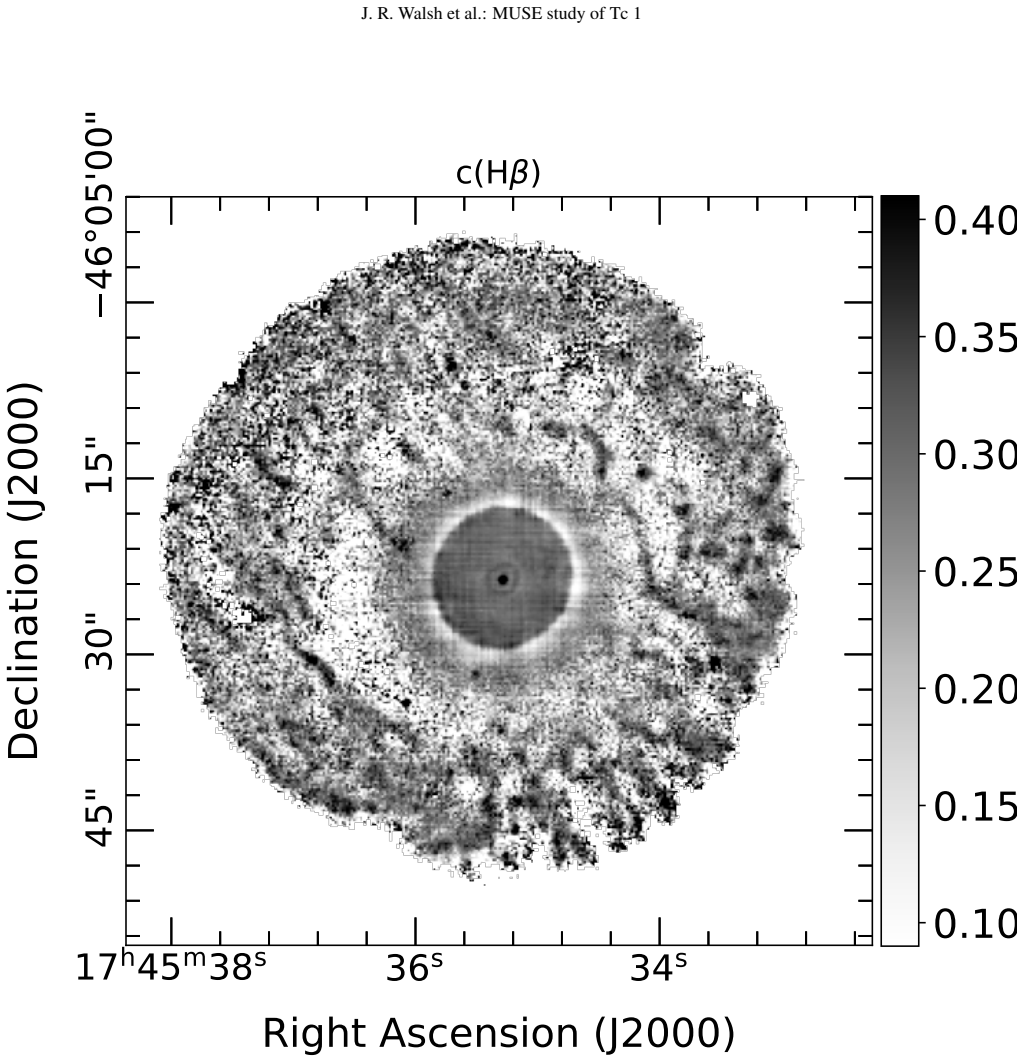
MUSE observations of Tc 1 reveal an annulus of low extinction explained by a local non-standard dust reddening law.
A machine-rendered reading of the paper's core claim, the machinery that carries it, and where it could break.
Core claim
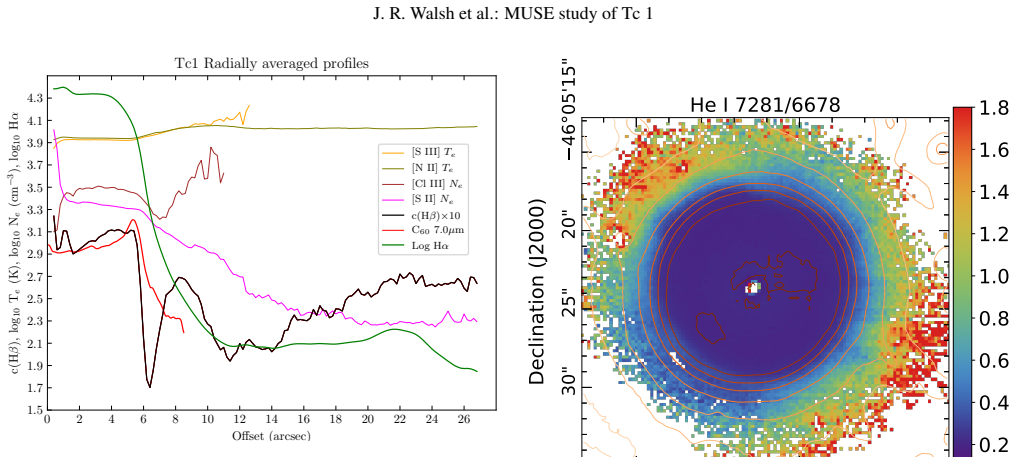
The annulus of low extinction occurs outside the region of strongest fullerene emission, in the zone where N_e declines and T_e rises. A change in dust properties linked to conditions in this transition region between the higher density core nebula and lower density halo is deduced.
What carries the argument
The optical extinction image constructed from H Balmer line ratios, which reveals the structured low-extinction annulus adjacent to the core.
If this is right
- The dust reddening law varies locally within the nebula due to changing conditions.
- The transition region between core and halo hosts altered dust that affects observed line ratios.
- Fullerene emission is strongest in the high-density core, separate from the altered dust zone.
- The central star is an O7.5I(f) star with effective temperature of 31000 K.
Where Pith is reading between the lines
- If dust properties change in transition zones, abundance analyses in other planetary nebulae may need to account for variable extinction laws.
- Similar low-extinction features might be detectable in other fullerene PNe using integral field spectroscopy.
- The continuum enhancement over extended regions could indicate scattered light or other emission processes common in PNe.
Load-bearing premise
That instrumental effects and the intrinsic scattering properties of the nebular dust have been completely investigated and cannot explain the anomalously low extinction region.
What would settle it
A direct measurement or model of the dust grain properties in the low-extinction annulus that matches a standard reddening law, or the identification of a specific contaminating emission line that accounts for the anomalous He I line ratio.
Figures





read the original abstract
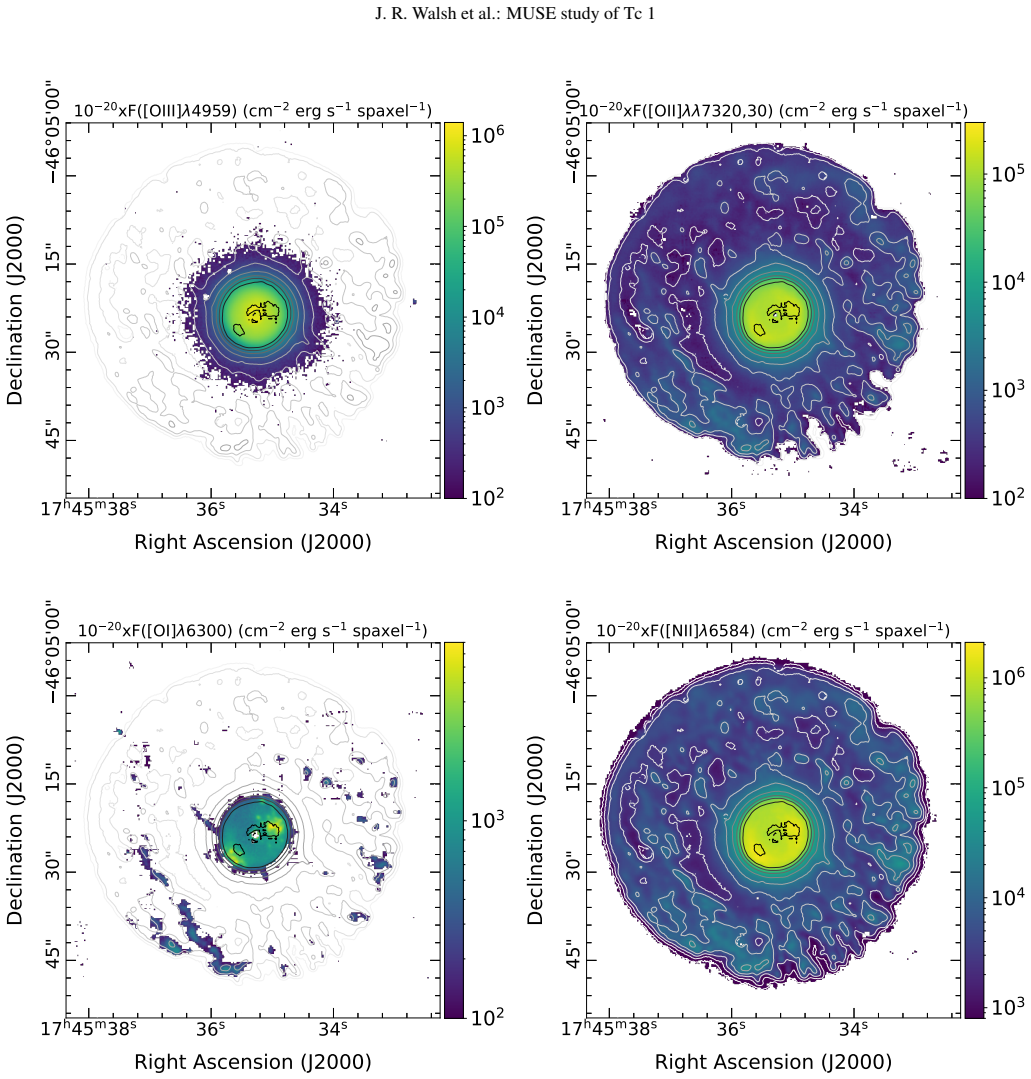
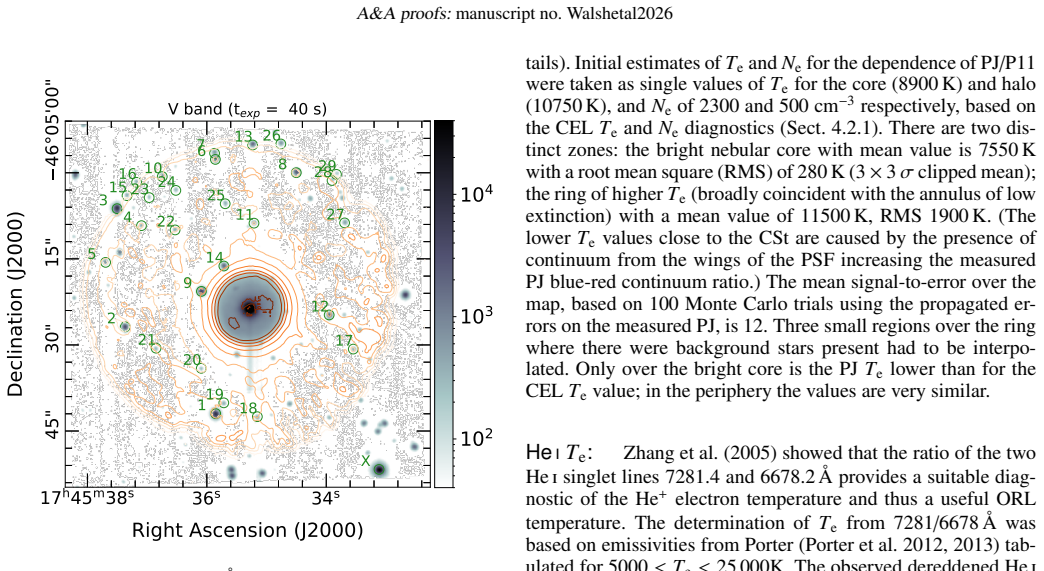
The planetary nebula Tc 1 (PN G345.2 -08.8), one of the rare group of Galactic PNe showing fullerene emission in the infrared, was observed with MUSE wide field mode with adaptive optics, wavelength range 4750-9300A. Extinction, electron temperature (T_e) and density (N_e) images are presented from collisionally excited and recombination line ratios. The nebula has a high surface brightness 12 arcsec core, an elliptical ring of major axis 2.8 arcsec around the central star and some low ionization knots, and an extended halo 55 arcsec in size; between the core and halo is an annulus with intermediate properties, including higher T_e and lower N_e than in the core. The image of optical extinction from H Balmer line ratios is highly structured, and shows an annulus, adjacent to the core, of low extinction, lower than the line-of-sight interstellar extinction. Instrumental effects to account for this anomalously low extinction area are investigated and intrinsic effects from the scattering properties of nebular dust; neither can entirely explain the low-extinction region and the most likely cause is a local non-standard dust reddening law. This low extinction region also shows an anomalously high He I 7281/6678A line ratio, possibly caused by a contaminating line, but none were conclusively identified. The spectrum of the central star was extracted and fitted by a 31000K model atmosphere and is of type O7.5I(f). Over extended regions an enhancement of the detected continuum above the nebular continuum was found, as also seen in some other PNe observed with MUSE. The annulus of low extinction occurs outside the region of strongest fullerene emission, in the zone where N_e declines and T_e rises. A change in dust properties linked to conditions in this transition region between the higher density core nebula and lower density halo is deduced. (Abridged)
Editorial analysis
A structured set of objections, weighed in public.
Referee Report
Summary. The paper reports MUSE wide-field adaptive optics integral-field spectroscopy (4750-9300 Å) of the fullerene planetary nebula Tc 1. It derives spatially resolved maps of extinction (from Balmer decrements), electron temperature, and density, revealing a high-brightness core, elliptical ring, low-ionization knots, and extended halo, with an intermediate annulus showing higher Te and lower Ne. The extinction map exhibits a low-extinction annulus adjacent to the core (below the line-of-sight interstellar value); after checking instrumental effects and nebular dust scattering, the authors conclude this indicates a local non-standard reddening law tied to the core-halo transition. The central star is extracted and fitted as O7.5I(f) at 31000 K, with additional notes on He I line ratios and continuum enhancement.
Significance. If the non-standard reddening conclusion is robust, the work demonstrates spatially varying dust properties in a fullerene PN linked to the density-temperature transition zone, offering a concrete observational constraint on dust evolution models in the circumstellar environment. The MUSE data products (extinction, Te, Ne images) provide a useful template for similar IFU studies of structured PNe.
major comments (2)
- [extinction image analysis] Extinction image analysis (abstract): the central claim that instrumental effects and intrinsic scattering cannot account for the anomalously low-extinction annulus rests on qualitative investigations; no end-to-end simulation of the MUSE pipeline (including AO PSF, flat-fielding residuals, and wavelength-dependent throughput) is described that injects a standard R_V=3.1 law and recovers the measured Balmer decrement, leaving the residual deviation unquantified.
- [line ratio analysis] Results on line ratios (abstract): the anomalously high He I 7281/6678 ratio in the low-extinction region is noted as possibly due to a contaminating line, but the text provides no quantitative upper limits on potential contaminants or alternative excitation mechanisms, weakening the link to the reddening interpretation.
minor comments (1)
- [abstract] The abstract states that the low-extinction annulus 'occurs outside the region of strongest fullerene emission' but does not specify the spatial registration or quantitative overlap metric used between the optical extinction map and the IR fullerene data.
Simulated Author's Rebuttal
We thank the referee for their constructive review and for recognizing the potential significance of our MUSE observations of Tc 1. We respond point-by-point to the major comments below.
read point-by-point responses
-
Referee: [extinction image analysis] Extinction image analysis (abstract): the central claim that instrumental effects and intrinsic scattering cannot account for the anomalously low-extinction annulus rests on qualitative investigations; no end-to-end simulation of the MUSE pipeline (including AO PSF, flat-fielding residuals, and wavelength-dependent throughput) is described that injects a standard R_V=3.1 law and recovers the measured Balmer decrement, leaving the residual deviation unquantified.
Authors: We acknowledge that our checks for instrumental effects (AO PSF variations, flat-fielding residuals, and wavelength-dependent throughput) were qualitative assessments based on the observed data properties and known MUSE instrument characteristics, without a full end-to-end simulation that injects a standard reddening law. This is a fair observation, and the residual deviation is not quantified in a formal statistical sense. In revision we will expand the methods section to detail the specific checks performed, explicitly state the lack of such a simulation as a limitation, and discuss why a complete pipeline injection test was beyond the scope of the current analysis while still supporting our multi-indicator interpretation of locally altered dust properties. revision: partial
-
Referee: [line ratio analysis] Results on line ratios (abstract): the anomalously high He I 7281/6678 ratio in the low-extinction region is noted as possibly due to a contaminating line, but the text provides no quantitative upper limits on potential contaminants or alternative excitation mechanisms, weakening the link to the reddening interpretation.
Authors: We agree that quantitative upper limits on possible contaminants and a discussion of alternative excitation mechanisms would strengthen the analysis. We will revise the relevant section to provide estimates of potential line blends within the MUSE spectral resolution and to evaluate contributions from fluorescence or other processes, thereby clarifying the connection to the reddening interpretation. revision: yes
Circularity Check
No significant circularity; purely observational analysis
full rationale
The paper reports MUSE observations of Tc 1, constructs extinction/Te/Ne maps from standard Balmer and CEL ratios, and compares the low-extinction annulus against checks for instrumental and scattering effects. No equations, fitted parameters, or predictions appear that reduce by construction to the input data or to self-citations. The central claim (non-standard local reddening) rests on direct empirical comparison to known diagnostics rather than any self-referential derivation. This matches the expected non-circular outcome for an observational study with no load-bearing self-citation chains or ansatz smuggling.
Axiom & Free-Parameter Ledger
free parameters (1)
- Central star effective temperature =
31000 K
axioms (2)
- domain assumption Ratios of collisionally excited lines and recombination lines yield maps of electron temperature and density.
- domain assumption Balmer decrement provides a reliable measure of optical extinction.
Reference graph
Works this paper leans on
-
[1]
IUE observations of the low-excitation planetary nebula Tc-1. , keywords =. doi:10.1086/131266 , adsurl =
-
[2]
Winds in Central Stars of Planetary Nebulae. , keywords =. doi:10.1086/173161 , adsurl =
-
[3]
Abundances in planetary nebulae: NGC1535, NGC6629, He2-108, and Tc1
Abundances in planetary nebulae: NGC 1535, NGC 6629, He2-108, and Tc1. , keywords =. doi:10.1051/0004-6361/201116669 , archivePrefix =. 1107.4041 , primaryClass =
work page internal anchor Pith review Pith/arXiv arXiv doi:10.1051/0004-6361/201116669
-
[4]
The detection of C60 in the well-characterized planetary nebula M1-11
The Detection of C60 in the Well-characterized Planetary Nebula M1-11. , keywords =. doi:10.1088/0004-637X/764/1/77 , archivePrefix =. 1301.7104 , primaryClass =
work page internal anchor Pith review Pith/arXiv arXiv doi:10.1088/0004-637x/764/1/77
-
[5]
Physical Properties of Fullerene-containing Galactic Planetary Nebulae
Physical properties of fullerene-containing Galactic planetary nebulae. , keywords =. doi:10.1093/mnras/stt2070 , archivePrefix =. 1310.7711 , primaryClass =
work page internal anchor Pith review Pith/arXiv arXiv doi:10.1093/mnras/stt2070
-
[6]
A search for diffuse bands in fullerene planetary nebulae: evidence of diffuse circumstellar bands
A search for diffuse bands in fullerene planetary nebulae: evidence of diffuse circumstellar bands. , keywords =. doi:10.1051/0004-6361/201424710 , archivePrefix =. 1411.7669 , primaryClass =
work page internal anchor Pith review Pith/arXiv arXiv doi:10.1051/0004-6361/201424710
-
[7]
A search for hydrogenated fullerenes in fullerene-containing planetary nebulae
A search for hydrogenated fullerenes in fullerene-containing planetary nebulae. , keywords =. doi:10.1051/0004-6361/201527727 , archivePrefix =. 1602.07481 , primaryClass =
work page internal anchor Pith review Pith/arXiv arXiv doi:10.1051/0004-6361/201527727
-
[8]
The Formation of Fullerenes in Planetary Nebulae. Galaxies , keywords =. doi:10.3390/galaxies6040101 , adsurl =
-
[9]
Hydrogenated amorphous carbon grains as an alternative carrier of the 9-13 m plateau feature in the fullerene planetary nebula Tc 1. , keywords =. doi:10.1051/0004-6361/202349087 , archivePrefix =. 2402.14943 , primaryClass =
-
[10]
An ultraviolet spectral study of fullerene-rich planetary nebulae. , keywords =. doi:10.1093/mnras/stae218 , archivePrefix =. 2401.09868 , primaryClass =
-
[11]
GALACSI The ground layer adaptive optics system for MUSE. , keywords =. doi:10.1016/j.newar.2005.10.015 , adsurl =
-
[12]
Adaptive Optics Systems III , year = 2012, editor =
GALACSI system design and analysis. Adaptive Optics Systems III , year = 2012, editor =. doi:10.1117/12.926110 , adsurl =
-
[13]
Detection and Implications of Laser-Induced Raman Scattering at Astronomical Observatories
Detection and Implications of Laser-Induced Raman Scattering at Astronomical Observatories. Physical Review X , keywords =. doi:10.1103/PhysRevX.7.021044 , archivePrefix =. 1706.07050 , primaryClass =
work page internal anchor Pith review Pith/arXiv arXiv doi:10.1103/physrevx.7.021044
-
[14]
Applications to the SPHERE/ZIMPOL and MUSE instruments
Physics-based model of the adaptive-optics-corrected point spread function. Applications to the SPHERE/ZIMPOL and MUSE instruments. , keywords =. doi:10.1051/0004-6361/201935830 , adsurl =
-
[15]
, year = 1969, month = dec, volume =
A Theoretical Investigation of Focal Stellar Images in the Photographic Emulsion and Application to Photographic Photometry. , year = 1969, month = dec, volume =
1969
-
[16]
Flux calibration of medium-resolution spectra from 300 nm to 2500 nm: Model reference spectra and telluric correction. , keywords =. doi:10.1051/0004-6361/201423790 , archivePrefix =. 1408.1797 , primaryClass =
work page internal anchor Pith review Pith/arXiv arXiv doi:10.1051/0004-6361/201423790
-
[17]
Light scattering by small particles
-
[18]
A Dust-Scattering Model for M1-92: A Revised Estimate of the Mass Distribution and Inclination. Galaxies , keywords =. doi:10.3390/galaxies12040044 , archivePrefix =. 2408.03136 , primaryClass =
-
[19]
Shape and Clustering Effects on the Optical Properties of Amorphous Carbon. , keywords =. doi:10.1086/170382 , adsurl =
-
[20]
The Herschel Planetary Nebula Survey (HerPlaNS). I. Data overview and analysis demonstration with NGC 6781. , keywords =. doi:10.1051/0004-6361/201423395 , adsurl =
-
[21]
Growth and ellipsometric studies on thin films for solar cell applications. J. Appl. Phys. , keywords =. doi:10.1063/1.3239853 , adsurl =
-
[22]
Ellipsometric determination of the optical constants of C60 (Buckminsterfullerene) films. Appl. Phys. Lett. , keywords =. doi:10.1063/1.105907 , adsurl =
-
[23]
, keywords =
On central star luminosities and optical thicknesses in planetary nebulae. , keywords =
-
[24]
I - Basic atmospheric parameters and their interpretation
High resolution spectroscopy of central stars of planetary nebulae. I - Basic atmospheric parameters and their interpretation. , keywords =
-
[25]
Measuring Reddening with Sloan Digital Sky Survey Stellar Spectra and Recalibrating SFD. , archivePrefix = "arXiv", eprint =. doi:10.1088/0004-637X/737/2/103 , adsurl =
work page internal anchor Pith review doi:10.1088/0004-637x/737/2/103
-
[26]
Integral field spectroscopy of planetary nebulae: mapping the line diagnostics and hydrogen-poor zones with VLT FLAMES. , archivePrefix = "arXiv", eprint =. doi:10.1111/j.1365-2966.2008.13051.x , adsurl =
-
[27]
A deep survey of heavy element lines in planetary nebulae - II. Recombination-line abundances and evidence for cold plasma. , eprint =. doi:10.1111/j.1365-2966.2004.08140.x , adsurl =
-
[28]
Ground-based and Airborne Instrumentation for Astronomy III , year = 2010, editor =
The MUSE second-generation VLT instrument. Ground-based and Airborne Instrumentation for Astronomy III , year = 2010, series =. doi:10.1117/12.856027 , adsurl =
-
[29]
The Messenger , year = 2014, month = sep, volume =
MUSE Commissioning. The Messenger , year = 2014, month = sep, volume =
2014
-
[30]
The MUSE Data Reduction Pipeline: Status after Preliminary Acceptance Europe
The MUSE Data Reduction Pipeline: Status after Preliminary Acceptance Europe. Astronomical Data Analysis Software and Systems XXIII , year = 2014, editor =. doi:10.48550/arXiv.1507.00034 , archivePrefix =. 1507.00034 , primaryClass =
work page internal anchor Pith review Pith/arXiv arXiv doi:10.48550/arxiv.1507.00034 2014
-
[31]
Issue 1.3.1
MUSE User manual. Issue 1.3.1. VLT-‐MAN-‐ESO-‐14670-‐1477 , publisher =
-
[32]
Issue 8.1
MUSE User Manual. Issue 8.1. ESO--261650 , publisher =
-
[33]
The data processing pipeline for the MUSE instrument. , keywords =. doi:10.1051/0004-6361/202037855 , archivePrefix =. 2006.08638 , primaryClass =
-
[34]
Astronomical Data Analysis Software and Systems XXVI , year = 2019, editor =
MPDAF - A Python Package for the Analysis of VLT/MUSE Data. Astronomical Data Analysis Software and Systems XXVI , year = 2019, editor =
2019
-
[35]
Total recombination coefficients and machine-readable tables for Z=1 to 8
Recombination line intensities for hydrogenic ions-IV. Total recombination coefficients and machine-readable tables for Z=1 to 8. , keywords =
-
[36]
FLIERs and Other Microstructures in Planetary Nebulae. IV. Images of Elliptical PNs from the Hubble Space Telescope. , keywords =. doi:10.1086/300429 , adsurl =
-
[37]
Journal of the Optical Society of America (1917-1983) , year = 1966, month = oct, volume = 56, pages =
Optical Resolution Through a Randomly Inhomogeneous Medium for Very Long and Very Short Exposures. Journal of the Optical Society of America (1917-1983) , year = 1966, month = oct, volume = 56, pages =
1917
-
[38]
, archivePrefix = "arXiv", eprint =
The Chandra X-Ray Survey of Planetary Nebulae (CHANPLANS): Probing Binarity, Magnetic Fields, and Wind Collisions. , archivePrefix = "arXiv", eprint =. doi:10.1088/0004-6256/144/2/58 , adsurl =
-
[39]
Maps of Dust IR Emission for Use in Estimation of Reddening and CMBR Foregrounds
Maps of Dust Infrared Emission for Use in Estimation of Reddening and Cosmic Microwave Background Radiation Foregrounds. , eprint =. doi:10.1086/305772 , adsurl =
work page internal anchor Pith review doi:10.1086/305772
-
[40]
Three-dimensional extinction maps: Inverting inter-calibrated extinction catalogues. , keywords =. doi:10.1051/0004-6361/202243319 , archivePrefix =. 2205.09087 , primaryClass =
-
[41]
An IUE survey of interstellar H I LY alpha absorption. 1: Column densities. , keywords =. doi:10.1086/192052 , adsurl =
-
[42]
Electron temperatures and densities of planetary nebulae determined from the nebular hydrogen recombination spectrum and temperature and density variations. , eprint =. doi:10.1111/j.1365-2966.2004.07838.x , adsurl =
-
[43]
, keywords =
Interstellar extinction in the UV. , keywords =
-
[44]
, keywords =
LMC and galactic extinction. , keywords =
-
[45]
, keywords =
Evidence for intrinsic polarization in the optical radiation of planetary nebulae. , keywords =
-
[46]
A centimetre-wave excess over free-free emission in planetary nebulae. , archivePrefix = "arXiv", eprint =. doi:10.1111/j.1365-2966.2007.12366.x , adsurl =
-
[47]
Planck intermediate results. XVIII. The millimetre and sub-millimetre emission from planetary nebulae. , archivePrefix = "arXiv", eprint =. doi:10.1051/0004-6361/201423836 , adsurl =
-
[48]
, keywords =
Electron temperature determination from nebular continuum emission in planetary nebulae and the importance of temperature fluctuations. , keywords =
-
[49]
The size distribution of interstellar grains. , keywords =. doi:10.1086/155591 , adsurl =
-
[50]
I - Destruction by sputtering
The destruction and growth of dust grains in interstellar space. I - Destruction by sputtering. , keywords =
-
[51]
Destruction by grain surface reactions, grain-grain collisions and photodesorption
The destruction and growth of dust grains in interstellar space - II. Destruction by grain surface reactions, grain-grain collisions and photodesorption. , year = 1978, month = may, volume = 183, pages =
1978
-
[52]
Grain Destruction in Shocks in the Interstellar Medium. , keywords =. doi:10.1086/174689 , adsurl =
-
[53]
Results for a range of clump densities
Dust survival rates in clumps passing through the Cas A reverse shock - I. Results for a range of clump densities. , keywords =. doi:10.1093/mnras/stz2399 , archivePrefix =. 1908.10875 , primaryClass =
-
[54]
Monthly Notices of the Royal Astronomical Society , volume =
X-ray emission by a shocked fast wind from the central stars of planetary nebulae. , eprint =. doi:10.1111/j.1365-2966.2006.10234.x , adsurl =
-
[55]
The evolution of planetary nebulae. V. The diffuse X-ray emission. , archivePrefix = "arXiv", eprint =. doi:10.1051/0004-6361:200809677 , adsurl =
-
[56]
Formation and X-ray emission from hot bubbles in planetary nebulae - I. Hot bubble formation. , archivePrefix = "arXiv", eprint =. doi:10.1093/mnras/stu1360 , adsurl =
-
[57]
A Compilation of Interstellar Column Densities. , keywords =. doi:10.1088/0067-0049/199/1/8 , adsurl =
-
[58]
Physics of Plasmas , archivePrefix = "arXiv", eprint =
Thermal instability of an expanding dusty plasma with equilibrium cooling. Physics of Plasmas , archivePrefix = "arXiv", eprint =. doi:10.1063/1.2907374 , adsurl =
-
[59]
The temperature structure of dusty planetary nebulae. , eprint =. doi:10.1051/0004-6361:20011403 , adsurl =
-
[60]
Light from Reflection Nebulae.IV. Scattering by Silicate Grains. , year = 1971, month = mar, volume = 164, pages =. doi:10.1086/150857 , adsurl =
-
[61]
Photoelectric Emission from Dust Grains Exposed to Extreme Ultraviolet and X-Ray Radiation. , eprint =. doi:10.1086/504420 , adsurl =
-
[62]
Destruction mechanisms for interstellar dust. , keywords =. doi:10.1086/157206 , adsurl =
-
[63]
Optical properties of interstellar graphite and silicate grains. , keywords =. doi:10.1086/162480 , adsurl =
-
[64]
, archivePrefix = "arXiv", eprint =
A Three-dimensional Map of Milky Way Dust. , archivePrefix = "arXiv", eprint =. doi:10.1088/0004-637X/810/1/25 , adsurl =
-
[65]
Physics of the Interstellar and Intergalactic Medium by Bruce T
Physics of the Interstellar and Intergalactic Medium. Physics of the Interstellar and Intergalactic Medium by Bruce T. Draine. Princeton University Press, 2011. ISBN: 978-0-691-12214-4 , year = 2011, adsurl =
2011
-
[66]
, keywords =
Hydrodynamical models of planetary nebulae and the problem of abundance determinations. , keywords =
-
[67]
Planetary Nebulae in the Solar Neighbourhood: Statistics, Distance Scale and Luminosity Function
-
[68]
Interactions between asymptotic giant branch star winds and the interstellar magnetic field
Eyes in the sky. Interactions between asymptotic giant branch star winds and the interstellar magnetic field. , archivePrefix = "arXiv", eprint =. doi:10.1051/0004-6361/201424452 , adsurl =
-
[69]
The evolution of planetary nebulae. I. A radiation-hydrodynamics parameter study. , keywords =. doi:10.1051/0004-6361:20031653 , adsurl =
-
[70]
, archivePrefix = "arXiv", eprint =
The extinction and dust-to-gas structure of the planetary nebula NGC 7009 observed with MUSE. , archivePrefix = "arXiv", eprint =. doi:10.1051/0004-6361/201527988 , adsurl =
-
[71]
Spatially resolved spectroscopy of planetary nebulae and their halos. I. Five galactic disk objects. , archivePrefix = "arXiv", eprint =. doi:10.1051/0004-6361:200809635 , adsurl =
-
[72]
, keywords =
Mid-infrared spectral images of planetary nebulae with ISOCAM. , keywords =
-
[73]
VLT/near-infrared integral field spectrometer observations of molecular hydrogen lines in the knots of the planetary nebula NGC 7293 (the Helix Nebula). , archivePrefix = "arXiv", eprint =. doi:10.1111/j.1365-2966.2007.12496.x , adsurl =
-
[74]
, archivePrefix = "arXiv", eprint =
A self-consistent stellar and 3D nebular model of planetary nebula IC 418. , archivePrefix = "arXiv", eprint =. doi:10.1051/0004-6361/200912413 , adsurl =
-
[75]
, archivePrefix = "arXiv", eprint =
Spatially resolved physical and chemical properties of the planetary nebula NGC 3242. , archivePrefix = "arXiv", eprint =. doi:10.1051/0004-6361/201322220 , adsurl =
-
[76]
Working with VIMOS-IFU data: Searching and characterizing the faint haloes of planetary nebulae. , keywords =. doi:10.1016/j.newar.2006.02.009 , adsurl =
-
[77]
Minuit: A System for Function Minimization and Analysis of the Parameter Errors and Correlations. Comput.Phys.Commun. , year = 1975, volume = 10, pages =. doi:10.1016/0010-4655(75)90039-9 , adsnote =
-
[78]
Noncollisional excitation of low-lying states in gaseous nebulae. , keywords =. doi:10.1086/164606 , adsurl =
-
[79]
Adaptive spatial binning of integral-field spectroscopic data using Voronoi tessellations. , eprint =. doi:10.1046/j.1365-8711.2003.06541.x , adsurl =
-
[80]
Polarized Emission Line Profiles in the Core and Halo of NGC7027. , keywords =. doi:10.1093/mnras/268.1.L41 , adsurl =
discussion (0)
Sign in with ORCID, Apple, or X to comment. Anyone can read and Pith papers without signing in.