Direct imaging of enantiomer-specific orientation dynamics in unidirectionally rotating chiral molecules
Pith reviewed 2026-06-29 01:00 UTC · model grok-4.3
The pith
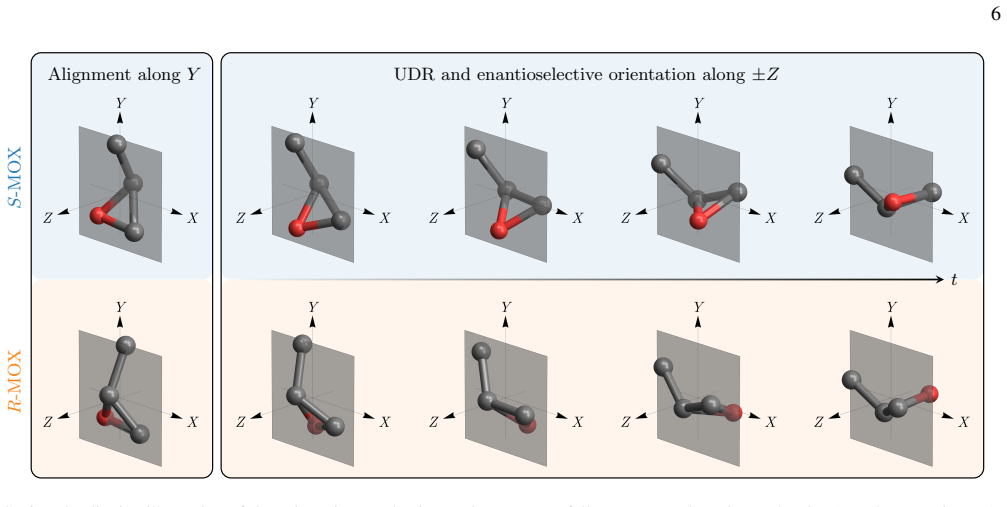
A femtosecond laser-pulse pair induces identical unidirectional rotation in both enantiomers of a chiral molecule but produces equal and opposite out-of-plane orientations.
A machine-rendered reading of the paper's core claim, the machinery that carries it, and where it could break.
Core claim
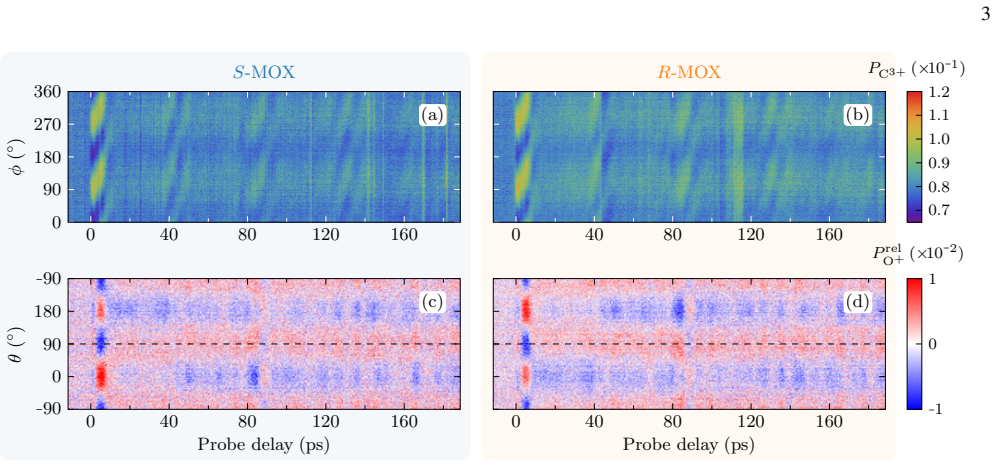
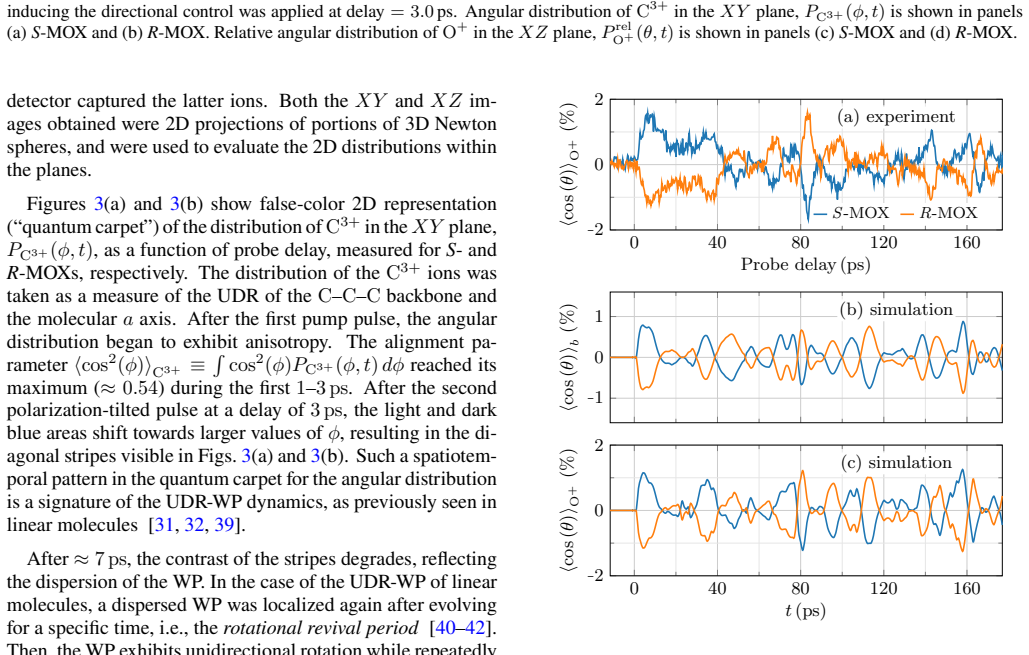
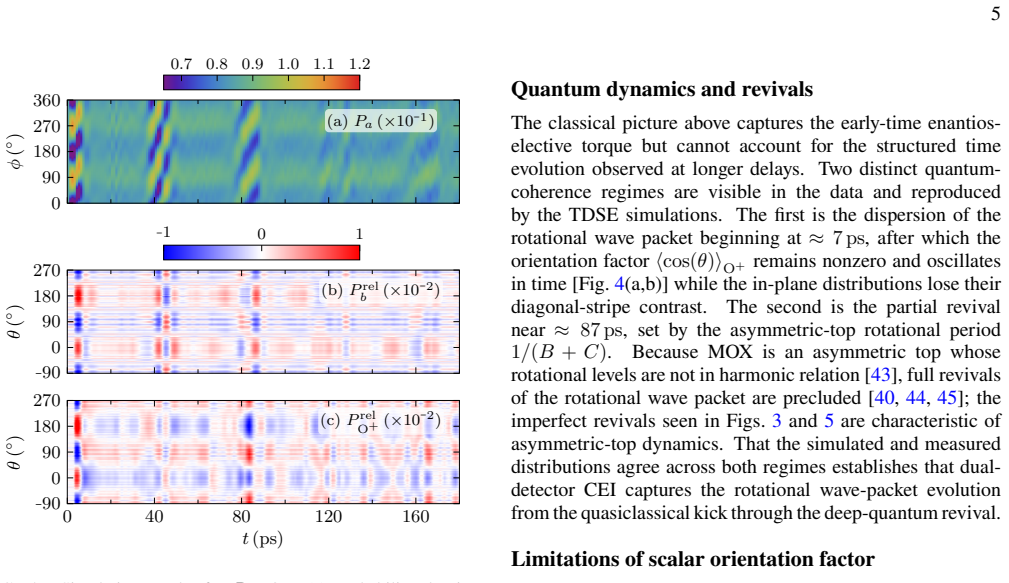
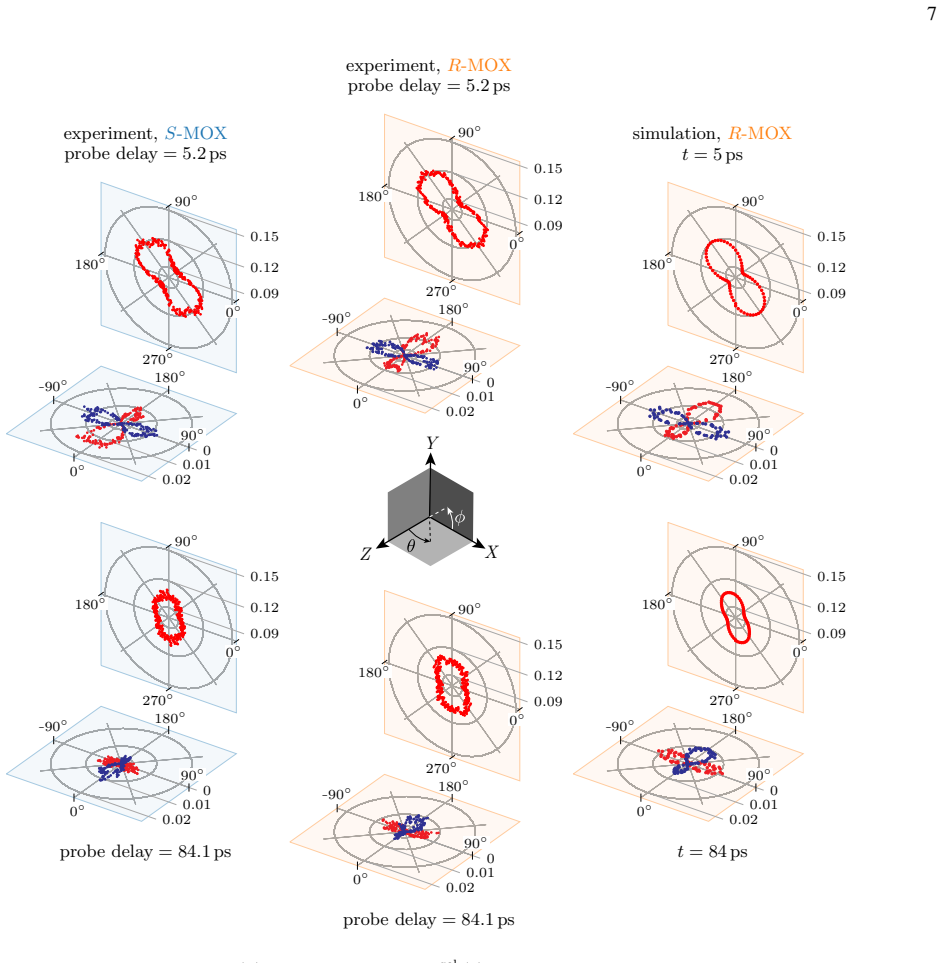
Unidirectional coherent rotation induced by a femtosecond laser-pulse pair generates equal and opposite out-of-plane orientations of the two enantiomers. Applying this scheme to 2-methyloxirane, time-resolved Coulomb explosion imaging with two orthogonally arranged detectors shows that the unidirectional rotation is identical for both enantiomers while the out-of-plane orientations are mirror images that persist through early-time quasi-classical and quantum dynamics regimes, in quantitative agreement with simulations. Full angular distributions supply richer dynamical information than integrated orientation factors alone.
What carries the argument
Unidirectional coherent rotation induced by a femtosecond laser-pulse pair, which produces enantiomer-specific out-of-plane orientations tracked via time-resolved Coulomb explosion imaging.
If this is right
- The unidirectional rotation remains identical for both enantiomers while their out-of-plane orientations are exact mirror images.
- These opposite orientations persist through both quasi-classical and quantum dynamics regimes.
- Full angular distributions reveal dynamical details that integrated orientation factors can miss.
- The method provides a route to real-time observation and control of chiral dynamics in the gas phase.
Where Pith is reading between the lines
- The technique could be applied to larger or more complex chiral molecules to test whether the mirror-image orientation persists.
- It opens the possibility of using the opposite tilts for enantiomer-selective photodissociation or reaction control in vacuum.
- The agreement between experiment and simulation suggests the imaging method can serve as a benchmark for other ultrafast chiral-control schemes.
Load-bearing premise
The Coulomb explosion imaging with two orthogonally arranged detectors faithfully reconstructs the true out-of-plane molecular orientations without significant distortion from ionization and fragmentation.
What would settle it
Measured angular distributions that fail to show mirror-image out-of-plane orientations for the two enantiomers or that deviate quantitatively from the simulations across the observed time range.
Figures

read the original abstract
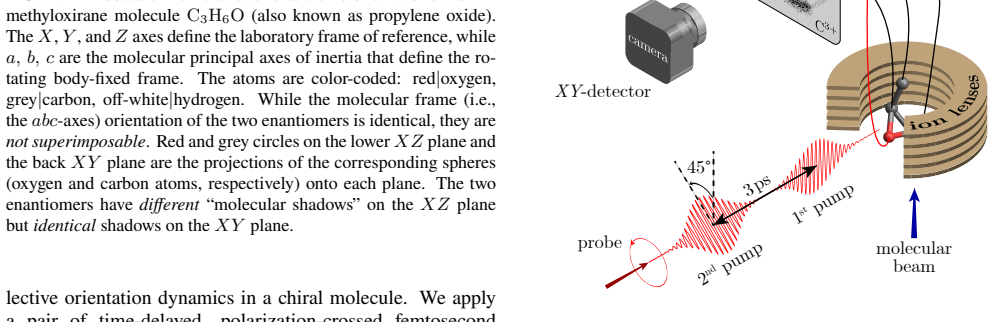
Selectively controlling the dynamics of molecular enantiomers underlies advances across chemistry, biology, and physics, yet direct imaging of enantiomer-specific motion has so far remained elusive. Here, we image ultrafast enantioselective orientation dynamics in isolated chiral molecules. Unidirectional coherent rotation induced by a femtosecond laser-pulse pair generates equal and opposite out-of-plane orientations of the two enantiomers. Applying this scheme to 2-methyloxirane, we follow the rotational wave packets by time-resolved Coulomb explosion imaging with two orthogonally arranged detectors. The measured angular distributions reveal that the unidirectional rotation is identical for both enantiomers, while the out-of-plane orientations are mirror images that persist through both early-time quasi-classical and quantum dynamics regimes, in quantitative agreement with simulations. We demonstrate that full angular distributions provide richer dynamical information, with some qualitatively different distributions yielding similar orientation factors upon integration. Our approach opens a route to real-time observation and control of chiral dynamics in the gas phase.
Editorial analysis
A structured set of objections, weighed in public.
Referee Report
Summary. The manuscript reports direct imaging of enantiomer-specific orientation dynamics in isolated 2-methyloxirane using a femtosecond laser-pulse pair to induce unidirectional coherent rotation, generating equal and opposite out-of-plane orientations for the two enantiomers. Time-resolved Coulomb explosion imaging with two orthogonally arranged detectors tracks the rotational wave packets, showing identical unidirectional rotation but mirror-image out-of-plane orientations persisting through early-time quasi-classical and quantum regimes, with quantitative agreement to simulations. Full angular distributions are shown to yield richer dynamical information than integrated orientation factors.
Significance. If the Coulomb explosion imaging faithfully reconstructs out-of-plane orientations without significant fragmentation artifacts, the result would be a notable advance in ultrafast chiral dynamics, providing the first direct visualization of enantiomer-specific motion in the gas phase and demonstrating the value of full angular distributions over scalar metrics. The quantitative match to independent simulations adds credibility and supports the approach for future real-time observation and control of chiral systems.
major comments (2)
- [Abstract and experimental methods] Abstract and experimental methods: The central claim that the angular distributions from the two-detector Coulomb explosion imaging directly map to true enantiomer-specific out-of-plane orientations (mirror images persisting across regimes) rests on the unvalidated assumption that ionization and multi-body fragmentation introduce no orientation-dependent biases or channel mixing that could distort the reconstructed angles differently for each enantiomer. Explicit validation, error analysis, detector calibration details, and post-selection criteria are required to support the quantitative agreement with simulations.
- [Results] Results (quantitative comparison): The abstract reports 'quantitative agreement with simulations' for the angular distributions, but without specified metrics (e.g., goodness-of-fit values, uncertainties on the distributions), full datasets, or robustness checks against the imaging response, the strength of this agreement cannot be assessed. This is load-bearing for the claim that the observed mirror symmetry reflects molecular dynamics rather than imaging artifacts.
minor comments (1)
- The manuscript would benefit from a dedicated subsection or supplementary material explicitly addressing potential systematic effects in the two-detector geometry and momentum correlation assumptions used for out-of-plane reconstruction.
Simulated Author's Rebuttal
We thank the referee for their thorough review and constructive feedback. We address the two major comments below and have prepared revisions to strengthen the manuscript.
read point-by-point responses
-
Referee: [Abstract and experimental methods] The central claim that the angular distributions from the two-detector Coulomb explosion imaging directly map to true enantiomer-specific out-of-plane orientations (mirror images persisting across regimes) rests on the unvalidated assumption that ionization and multi-body fragmentation introduce no orientation-dependent biases or channel mixing that could distort the reconstructed angles differently for each enantiomer. Explicit validation, error analysis, detector calibration details, and post-selection criteria are required to support the quantitative agreement with simulations.
Authors: We agree that explicit validation of the imaging fidelity is essential. In the revised manuscript we add a new subsection in the Methods and an expanded Supplementary Note detailing: (i) detector calibration using isotropic reference distributions and known alignment signals, (ii) Monte Carlo simulations of possible orientation-dependent fragmentation channels showing bias <5% in the relevant angular range, (iii) post-selection criteria based on total momentum conservation, and (iv) cross-checks between the two-detector geometry and single-detector data. These additions directly address the concern and support the reported mirror symmetry. revision: yes
-
Referee: [Results] The abstract reports 'quantitative agreement with simulations' for the angular distributions, but without specified metrics (e.g., goodness-of-fit values, uncertainties on the distributions), full datasets, or robustness checks against the imaging response, the strength of this agreement cannot be assessed. This is load-bearing for the claim that the observed mirror symmetry reflects molecular dynamics rather than imaging artifacts.
Authors: We accept that the strength of the agreement should be quantified. The revised manuscript now reports chi-squared per degree of freedom and Kolmogorov-Smirnov statistics for the angular distributions in both the main text and Supplementary Information, together with experimental uncertainties derived from multiple runs and Poisson statistics. We also include robustness tests in which the imaging response function is varied within its experimental bounds; the enantiomer-specific mirror symmetry remains intact. The full binned angular datasets are provided in the supplement. revision: yes
Circularity Check
No circularity: experimental imaging results compared to independent simulations
full rationale
The paper presents an experimental study using laser-induced unidirectional rotation and time-resolved Coulomb explosion imaging to observe enantiomer-specific orientations in 2-methyloxirane, reporting quantitative agreement with simulations. No derivation chain, equations, fitted parameters called predictions, or self-citation load-bearing steps are present in the provided text. The central claims rest on direct measurements and external simulations rather than any self-definitional reduction or ansatz smuggled via citation. This is a standard non-circular experimental report.
Axiom & Free-Parameter Ledger
Reference graph
Works this paper leans on
-
[1]
G. H. Wagni `ere,On Chirality and the Universal Asymmetry (Wiley-VCH, 2007)
2007
-
[2]
D. G. Blackmond, The origin of biological homochirality, Cold Spring Harbor Perspect. Biol.2, a002147 (2020)
2020
-
[3]
Ma and A
B. Ma and A. Bianco, Regulation of biological processes by intrinsically chiral engineered materials, Nat. Rev. Materials8, 403 (2023)
2023
-
[4]
Senkuttuvan, B
N. Senkuttuvan, B. Komarasamy, R. Krishnamoorthy, S. Sarkar, S. Dhanasekaran, and P. Anaikutti, The significance of chirality in contemporary drug discovery -– a mini review, RSC Adv.14, 33429 (2024)
2024
-
[5]
Noyori, Asymmetric catalysis: Science and opportunities (nobel lecture), Angew
R. Noyori, Asymmetric catalysis: Science and opportunities (nobel lecture), Angew. Chem. Int. Ed.41, 2008 (2002)
2008
-
[6]
Fanourakis, P
A. Fanourakis, P. J. Docherty, P. Chuentragool, and R. J. Phipps, Recent developments in enantioselective transition metal catal- ysis featuring attractive noncovalent interactions between ligand and substrate, ACS Catalysis10, 10672 (2020)
2020
-
[7]
M. S. Safronova, D. Budker, D. Demille, D. F. Jackson Kimball, A. Derevianko, and C. W. Clark, Search for new physics with atoms and molecules, Rev. Mod. Phys.90, 025008 (2018)
2018
-
[8]
Quack, G
M. Quack, G. Seyfang, and G. Wichmann, Perspectives on parity violation in chiral molecules: theory, spectroscopic experiment and biomolecular homochirality, Chem. Sci.13, 10598 (2022)
2022
-
[9]
Ayuso, A
D. Ayuso, A. F. Ordonez, and O. Smirnova, Ultrafast chirality: the road to efficient chiral measurements, Phys. Chem. Chem. Phys.24, 26962 (2022)
2022
-
[10]
A. A. Milner, J. A. M. Fordyce, I. MacPhail-Bartley, W. Wasser- man, V. Milner, I. Tutunnikov, and I. Sh. Averbukh, Controlled enantioselective orientation of chiral molecules with an optical centrifuge, Phys. Rev. Lett.122, 223201 (2019)
2019
-
[11]
Saribal, A
C. Saribal, A. Owens, A. Yachmenev, and J. K¨ upper, Detecting handedness of spatially oriented molecules by Coulomb explo- sion imaging, J. Chem. Phys.154, 071101 (2021)
2021
-
[12]
B ¨owering, T
N. B ¨owering, T. Lischke, B. Schmidtke, N. M¨ uller, T. Khalil, and U. Heinzmann, Asymmetry in photoelectron emission from chiral molecules induced by circularly polarized light, Phys. Rev. Lett.86, 1187 (2001)
2001
-
[13]
C. Lux, M. Wollenhaupt, T. Bolze, Q. Liang, J. K¨ohler, C. Sarpe, and T. Baumert, Circular dichroism in the photoelectron angular distributions of camphor and fenchone from multiphoton ion- ization with femtosecond laser pulses, Angew. Chem.51, 5001 (2012)
2012
-
[14]
M. H. M. Janssen and I. Powis, Detecting chirality in molecules by imaging photoelectron circular dichroism, Phys. Chem. Chem. Phys.16, 856 (2014)
2014
-
[15]
Rozen, A
S. Rozen, A. Comby, E. Bloch, S. Beauvarlet, D. Descamps, B. Fabre, S. Petit, V. Blanchet, B. Pons, N. Dudovich, and Y. Mairesse, Controlling subcycle optical chirality in the pho- toionization of chiral molecules, Phys. Rev. X9, 031004 (2019)
2019
-
[16]
Sparling and D
C. Sparling and D. Townsend, Two decades of imaging pho- toelectron circular dichroism: from first principles to future perspectives, Phys. Chem. Chem. Phys.27, 2888 (2025)
2025
-
[17]
Cireasa, A
R. Cireasa, A. E. Boguslavskiy, B. Pons, M. C. H. Wong, D. Descamps, S. Petit, H. Ruf, N. Thir ´e, A. Ferr ´e, J. Suarez, J. Higuet, B. E. Schmidt, A. F. Alharbi, F. L´egar´e, V. Blanchet, B. Fabre, S. Patchkovskii, O. Smirnova, Y. Mairesse, and V. R. Bhardwaj, Probing molecular chirality on a sub-femtosecond timescale, Nat. Phys.11, 654 (2015)
2015
-
[18]
Baykusheva and H
D. Baykusheva and H. J. H. J. W ¨orner, Chiral discrimination through bielliptical high-harmonic spectroscopy, Phys. Rev. X 8, 031060 (2018)
2018
-
[19]
Pitzer, M
M. Pitzer, M. Kunitski, A. S. Johnson, T. Jahnke, H. Sann, F. Sturm, L. P. H. Schmidt, H. Schmidt-B ¨ocking, R. D ¨orner, J. Stohner, J. Kiedrowski, M. Reggelin, S. Marquardt, A. Schießer, R. Berger, and M. S. Sch ¨offler, Direct Determi- nation of Absolute Molecular Stereochemistry in Gas Phase by Coulomb Explosion Imaging, Science341, 1096 (2013)
2013
-
[20]
Herwig, K
P. Herwig, K. Zawatzky, M. Grieser, O. Heber, B. Jordon- Thaden, C. Krantz, O. Novotn´ y, R. Repnow, V. Schurig, D. Schwalm, Z. Vager, A. Wolf, O. Trapp, and H. Kreckel, Imaging the absolute configuration of a chiral epoxide in the gas phase, Science342, 1084 (2013)
2013
-
[21]
Hirota, Triple resonance for a three-level system of a chiral molecule, Proc
E. Hirota, Triple resonance for a three-level system of a chiral molecule, Proc. Jpn. Acad., Ser. B88, 120 (2012)
2012
-
[22]
Patterson, M
D. Patterson, M. Schnell, and J. M. Doyle, Enantiomer-specific detection of chiral molecules via microwave spectroscopy, Na- ture497, 475 (2013)
2013
-
[23]
Patterson and J
D. Patterson and J. M. Doyle, Sensitive chiral analysis via microwave three-wave mixing, Phys. Rev. Lett.111, 023008 (2013)
2013
-
[24]
Patterson and M
D. Patterson and M. Schnell, New studies on molecular chirality in the gas phase: enantiomer differentiation and determination of enantiomeric excess, Phys. Chem. Chem. Phys.16, 11114 (2014)
2014
-
[25]
Yachmenev and S
A. Yachmenev and S. N. Yurchenko, Detecting chirality in molecules by linearly polarized laser fields, Phys. Rev. Lett. 117, 033001 (2016)
2016
-
[26]
Gershnabel and I
E. Gershnabel and I. Sh. Averbukh, Orienting asymmetric molecules by laser fields with twisted polarization, Phys. Rev. Lett.120, 083204 (2018)
2018
-
[27]
Tutunnikov, E
I. Tutunnikov, E. Gershnabel, S. Gold, and I. Sh. Averbukh, Selective orientation of chiral molecules by laser fields with twisted polarization, J. Phys. Chem. Lett.9, 1105 (2018)
2018
-
[28]
Tutunnikov, L
I. Tutunnikov, L. Xu, R. W. Field, K. A. Nelson, Y. Prior, and I. Sh. Averbukh, Enantioselective orientation of chiral molecules induced by terahertz pulses with twisted polarization, Phys. Rev. Res.3, 013249 (2021)
2021
-
[29]
Fleischer, Y
S. Fleischer, Y. Khodorkovsky, Y. Prior, and I. Sh. Averbukh, Controlling the sense of molecular rotation, New J. Phys.11, 105039 (2009)
2009
-
[30]
Kitano, H
K. Kitano, H. Hasegawa, and Y. Ohshima, Ultrafast angular momentum orientation by linearly polarized laser fields, Phys. Rev. Lett.103, 223002 (2009)
2009
-
[31]
Mizuse, K
K. Mizuse, K. Kitano, H. Hasegawa, and Y. Ohshima, Quantum unidirectional rotation directly imaged with molecules, Sci. Adv. 1, e1400185 (2015)
2015
-
[32]
K. Lin, Q. Song, X. Gong, Q. Ji, H. Pan, J. Ding, H. Zeng, and J. Wu, Visualizing molecular unidirectional rotation, Phys. Rev. A92, 013410 (2015)
2015
-
[33]
Karczmarek, J
J. Karczmarek, J. Wright, P. Corkum, and M. Ivanov, Optical centrifuge for molecules, Phys. Rev. Lett.82, 3420 (1999)
1999
-
[34]
D. M. Villeneuve, S. A. Aseyev, P. Dietrich, M. Spanner, M. Y. Ivanov, and P. B. Corkum, Forced molecular rotation in an op- tical centrifuge, Phys. Rev. Lett.85, 542 (2000)
2000
-
[35]
L. Yuan, S. W. Teitelbaum, A. Robinson, and A. S. Mullin, Dynamics of molecules in extreme rotational states, Proc. Natl. Acad. Sci.108, 6872 (2011)
2011
-
[36]
Korobenko, A
A. Korobenko, A. A. Milner, and V. Milner, Direct observation, study, and control of molecular superrotors, Phys. Rev. Lett. 112, 113004 (2014)
2014
-
[37]
Karras, M
G. Karras, M. Ndong, E. Hertz, D. Sugny, F. Billard, B. La- vorel, and O. Faucher, Polarization shaping for unidirectional 10 rotational motion of molecules, Phys. Rev. Lett.114, 103001 (2015)
2015
-
[38]
Mizuse, R
K. Mizuse, R. Fujimoto, N. Mizutani, and Y. Ohshima, Direct imaging of laser-driven ultrafast molecular rotation, J. Vis. Exp. 120, e54917 (2017)
2017
-
[39]
L. Xu, I. Tutunnikov, L. Zhou, K. Lin, J. Qiang, P. Lu, Y. Prior, I. Sh. Averbukh, and J. Wu, Echoes in unidirectionally rotating molecules, Phys. Rev. A102, 043116 (2020)
2020
-
[40]
Seideman and E
T. Seideman and E. Hamilton, Nonadiabatic Alignment by In- tense Pulses. Concepts, Theory, and Directions, Adv. At. Mol. Opt. Phys.52, 289 (2005)
2005
-
[41]
Ohshima and H
Y. Ohshima and H. Hasegawa, Coherent rotational excitation by intense nonresonant laser fields, Int. Rev. Phys. Chem.29, 619 (2010)
2010
-
[42]
C. P. Koch, M. Lemeshko, and D. Sugny, Quantum control of molecular rotation, Rev. Mod. Phys.91, 035005 (2019)
2019
-
[43]
R. N. Zare,Angular Momentum: Understanding Spatial Aspects in Chemistry and Physics(John Wiley & Sons, New York, 1988)
1988
-
[44]
P. M. Felker, Rotational coherence spectroscopy: studies of the geometries of large gas-phase species by picosecond time- domain methods, J. Phys. Chem.96, 7844 (1992)
1992
-
[45]
M. D. Poulsen, E. P ´eronne, H. Stapelfeldt, C. Z. Bisgaard, S. S. Viftrup, E. Hamilton, and T. Seideman, Nonadiabatic alignment of asymmetric top molecules: Rotational revivals, J. Chem. Phys.121, 783 (2004)
2004
-
[46]
Lemeshko, R
M. Lemeshko, R. V. Krems, J. M. Doyle, and S. Kais, Manipu- lation of molecules with electromagnetic fields, Mol. Phys.111, 1648 (2013)
2013
-
[47]
Korech, U
O. Korech, U. Steinitz, R. J. Gordon, I. Sh. Averbukh, and Y. Prior, Observing molecular spinning via the rotational Doppler effect, Nat. Photonics7, 711 (2013)
2013
-
[48]
S. Y. T. van de Meerakker, H. L. Bethlem, and G. Meijer, Taming molecular beams, Nat. Phys.4, 595 (2008)
2008
-
[49]
Filsinger, J
F. Filsinger, J. K¨ upper, G. Meijer, L. Holmegaard, J. H. Nielsen, I. Nevo, J. L. Hansen, and H. Stapelfeldt, Quantum-state selec- tion, alignment, and orientation of large molecules using static electric and laser fields, J. Chem. Phys.131, 064309 (2009)
2009
-
[50]
S. Falcinelli, F. Vecchiocattivi, M. Alagia, L. Schio, R. Richter, S. Stranges, D. Catone, M. S. Arruda, L. A. V. Mendes, F. Palazzetti, V. Aquilanti, and F. Pirani, Double photoionization of propylene oxide: A coincidence study of the ejection of a pair of valence-shell electrons, J. Chem. Phys.148, 114302 (2018). Acknowledgments The authors thank Mr. Hi...
discussion (0)
Sign in with ORCID, Apple, or X to comment. Anyone can read and Pith papers without signing in.