SBridge: Identifying Source-to-Binary Function Similarity via Cross-Domain Control Block Matching
Pith reviewed 2026-06-29 03:37 UTC · model grok-4.3
The pith
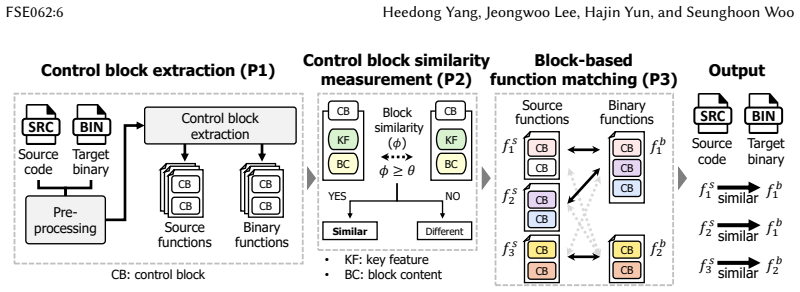
SBridge segments functions into control blocks to match source code to binaries despite inlining and stripping.
A machine-rendered reading of the paper's core claim, the machinery that carries it, and where it could break.
Core claim
SBridge treats control blocks as the cross-domain unit for similarity measurement, allowing functions to be compared even when inlining merges them or when binaries lack symbols.
What carries the argument
Control block segmentation, which breaks functions into conditionals, loops and similar structures to serve as the matching representation between source and binary domains.
If this is right
- Reused vulnerable code can be located in binaries by direct reference to the original source rather than compiled artifacts.
- Detection remains possible on stripped binaries that lack debug information or symbol tables.
- Fewer false matches occur compared with methods that compare entire functions or rely on embedded strings.
- The same block-level representation supports ranking multiple candidate binaries for a single source function.
Where Pith is reading between the lines
- The same block segmentation might be tested on languages beyond C/C++ to check whether control-flow units transfer across different compiler pipelines.
- If control blocks prove stable, the method could be applied to partial binaries or to code that has undergone heavy optimization passes not covered in the current evaluation.
- Control-block matching could be combined with data-flow features to handle cases where control structure is altered but behavior is preserved.
Load-bearing premise
Segmenting functions into control blocks yields units that remain identifiable and comparable after compilation even when many functions are inlined.
What would settle it
A collection of source-binary pairs in which control-block sequences differ substantially after compilation yet the functions perform identical work, or pairs in which blocks match but the functions are unrelated.
Figures



read the original abstract
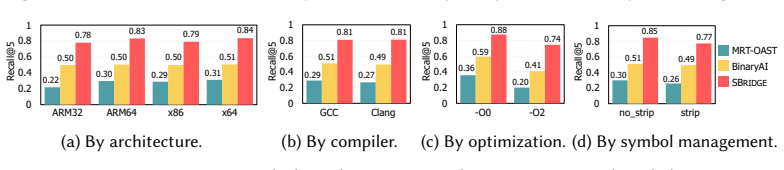
We present SBridge, a precise approach for identifying functions in binaries that are similar to the given source code functions. Identifying reused code in binaries is critical for security, particularly for detecting propagated vulnerabilities. Although binary-to-binary comparison is feasible, leveraging source code as the reference is more practical because source code is easier to collect and analyze directly without compilation. However, significant gaps between source and binary representations, including function inlining, create challenges in cross-domain function detection. Existing approaches primarily rely on string literals or structural similarities between entire functions, failing to capture detailed code behavior and generating many false alarms. SBridge addresses these limitations through a key innovation: control block-based function matching, which encapsulates essential functional features by segmenting functions into meaningful units such as conditionals and loops. Leveraging control blocks as a cross-domain representation, SBridge enables precise measurement of function similarity between source and binary code, effectively overcoming challenges posed by function inlining and stripped binaries. For evaluation, we collected 3,904 real-world C/C++ binaries from BinKit. In experiments identifying binary functions identical to input source functions, despite approximately 40% of binary functions being inlined, SBridge achieved 75.13% recall@1 and 80.98% recall@5, outperforming existing approaches, which achieved up to 43.31% recall@1 and 50.2% recall@
Editorial analysis
A structured set of objections, weighed in public.
Referee Report
Summary. The paper presents SBridge, a technique for source-to-binary function similarity detection that segments functions into control blocks (conditionals, loops) as a cross-domain representation. It claims this overcomes function inlining (~40% of functions) and stripping, evaluated on 3,904 real-world C/C++ binaries from BinKit, achieving 75.13% recall@1 and 80.98% recall@5 while outperforming baselines (up to 43.31% recall@1).
Significance. If the control-block matching is shown to preserve correspondence under inlining, the work could meaningfully advance practical binary vulnerability detection by enabling direct use of source references. The scale of the BinKit evaluation is a positive factor, but the absence of verifiable methodology details limits assessment of whether the reported gains are robust.
major comments (2)
- [Abstract] Abstract: the central claim that 'control block-based function matching... effectively overcoming challenges posed by function inlining' is load-bearing for the recall numbers, yet the text supplies no description of binary CFG block extraction, no mechanism for merged or flattened blocks after inlining, and no partial-match or alignment logic. Inlining changes block count and nesting, so the representation's robustness is asserted without supporting detail or evidence.
- [Abstract] Abstract: the reported recall@1 (75.13%) and recall@5 (80.98%) are presented without methodology, baseline definitions, data exclusion rules, error bars, or statistical tests, rendering the performance claims unverifiable from the given text and undermining the comparison to the 43.31% baseline.
minor comments (1)
- [Abstract] Abstract: the final sentence is truncated ('50.2% recall@').
Simulated Author's Rebuttal
We thank the referee for the constructive feedback on our manuscript. We address each major comment point by point below, providing clarifications from the full paper and indicating where revisions to the abstract will strengthen the presentation.
read point-by-point responses
-
Referee: [Abstract] Abstract: the central claim that 'control block-based function matching... effectively overcoming challenges posed by function inlining' is load-bearing for the recall numbers, yet the text supplies no description of binary CFG block extraction, no mechanism for merged or flattened blocks after inlining, and no partial-match or alignment logic. Inlining changes block count and nesting, so the representation's robustness is asserted without supporting detail or evidence.
Authors: The abstract summarizes the key innovation at a high level, as is conventional. The full manuscript provides the requested details: binary CFG block extraction is described in Section 3.1 (parsing source ASTs and binary disassembly to identify control blocks for conditionals/loops), while the handling of merged/flattened blocks and changes in nesting/count due to inlining is addressed via the cross-domain alignment algorithm in Section 3.3, which performs partial sequence matching on control block features to tolerate inlining (noted as affecting ~40% of functions). We will revise the abstract to briefly note the use of alignment-based partial matching for robustness under inlining. revision: partial
-
Referee: [Abstract] Abstract: the reported recall@1 (75.13%) and recall@5 (80.98%) are presented without methodology, baseline definitions, data exclusion rules, error bars, or statistical tests, rendering the performance claims unverifiable from the given text and undermining the comparison to the 43.31% baseline.
Authors: The metrics are the primary results from the evaluation on the 3,904 BinKit binaries (detailed in Section 5), with baselines explicitly compared (the 43.31% recall@1 from the strongest prior method), data processing rules (including inlined/stripped functions), and experimental protocol described in that section. The abstract reports headline figures due to length limits. We will revise the abstract to reference the evaluation dataset scale, inlining rate, and baseline comparisons more explicitly; error bars and statistical tests can be incorporated if space allows in a revised version. revision: partial
Circularity Check
No circularity in derivation chain
full rationale
The paper describes an empirical method for cross-domain function similarity detection via control-block segmentation and reports recall metrics from evaluation on the BinKit dataset. No equations, first-principles derivations, fitted parameters presented as predictions, or self-citation chains appear in the abstract or description. The central claim is justified by experimental results rather than by construction or tautological reduction to inputs.
Axiom & Free-Parameter Ledger
Reference graph
Works this paper leans on
-
[1]
Vector 35. 2024. Binary Ninja. https://binary.ninja/
2024
-
[2]
National Security Agency. 2024. Ghidra. https://ghidra-sre.org
2024
-
[3]
Sunwoo Ahn, Seonggwan Ahn, Hyungjoon Koo, and Yunheung Paek. 2022. Practical Binary Code Similarity Detection with BERT-based Transferable Similarity Learning. InProceedings of the 38th Annual Computer Security Applications Conference. 361–374. https://doi.org/10.1145/3564625.3567975
-
[4]
Gu Ban, Lili Xu, Yang Xiao, Xinhua Li, Zimu Yuan, and Wei Huo. 2021. B2SMatcher: fine-Grained version identification of open-Source software in binary files.Cybersecurity4 (2021), 1–21. https://doi.org/10.1186/s42400-021-00085-7
-
[5]
Martial Bourquin, Andy King, and Edward Robbins. 2013. BinSlayer: Accurate Comparison of Binary Executables. In Proceedings of the 2nd ACM SIGPLAN Program Protection and Reverse Engineering Workshop. 1–10. https://doi.org/10. 1145/2430553.2430557
arXiv 2013
-
[6]
Ctags. 2024. Universal Ctags. https://github.com/universal-ctags/ctags
2024
-
[7]
Yaniv David, Nimrod Partush, and Eran Yahav. 2017. Similarity of binaries through re-optimization. InProceedings of the 38th ACM SIGPLAN conference on programming language design and implementation. 79–94. https://doi.org/10. 1145/3140587.3062387
arXiv 2017
-
[8]
Alessandro Di Federico, Mathias Payer, and Giovanni Agosta. 2017. rev.ng: a unified binary analysis framework to recover CFGs and function boundaries. InProceedings of the 26th International Conference on Compiler Construction. 131–141
2017
-
[9]
Chaopeng Dong, Siyuan Li, Shougou Yang, Yang Xiao, Yongpan Wang, Hong Li, Zhi Li, and Limin Sun. 2024. LibvDiff: Library Version Difference Guided OSS Version Identification in Binaries. InProceedings of the 46th International Conference on Software Engineering (ICSE). 791–802. https://doi.org/10.1145/3597503.3623336
-
[10]
Ruian Duan, Ashish Bijlani, Meng Xu, Taesoo Kim, and Wenke Lee. 2017. Identifying Open-Source License Violation and 1-day Security Risk at Large Scale. InProceedings of the 2017 ACM SIGSAC Conference on Computer and Communications Security(Dallas, Texas, USA)(CCS ’17). Association for Computing Machinery, New York, NY, USA, 2169–2185. https://doi.org/10.1...
-
[11]
Muyue Feng, Zimu Yuan, Feng Li, Gu Ban, Yang Xiao, Shiyang Wang, Qian Tang, He Su, Chendong Yu, Jiahuan Xu, Aihua Piao, Jingling Xue, and Wei Huo. 2020. B2SFinder: Detecting Open-Source Software Reuse in COTS Software. In Proceedings of the 34th IEEE/ACM International Conference on Automated Software Engineering(San Diego, California) (ASE ’19). IEEE Pres...
-
[12]
Debin Gao, Michael K Reiter, and Dawn Song. 2008. BinHunt: Automatically Finding Semantic Differences in Binary Programs. InInternational Conference on Information and Communications Security. Springer, 238–255. https: //doi.org/10.1007/978-3-540-88625-9_16 Proc. ACM Softw. Eng., Vol. 3, No. FSE, Article FSE062. Publication date: July 2026. SBridge: Ident...
-
[13]
Haojie He, Xingwei Lin, Ziang Weng, Ruijie Zhao, Shuitao Gan, Libo Chen, Yuede Ji, Jiashui Wang, and Zhi Xue. 2024. Code is not natural language: unlock the power of semantics-oriented graph representation for binary code similarity detection. InProceedings of the 33rd USENIX Conference on Security Symposium(Philadelphia, PA, USA)(SEC ’24). USENIX Associa...
2024
-
[14]
Xu He, Shu Wang, Pengbin Feng, Xinda Wang, Shiyu Sun, Qi Li, and Kun Sun. 2024. BinGo: Identifying Security Patches in Binary Code with Graph Representation Learning. InProceedings of the 19th ACM Asia Conference on Computer and Communications Security. 1186–1199. https://doi.org/10.1145/3634737.3637666
-
[15]
Hex-Rays. 2024. IDA Pro. https://hex-rays.com/ida-pro/
2024
-
[16]
IBM. 2025. Standard C Library Functions Table, By Name. https://www.ibm.com/docs/en/i/7.6.0?topic=extensions- standard-c-library-functions-table-by-name
2025
-
[17]
Ang Jia, Ming Fan, Wuxia Jin, Xi Xu, Zhaohui Zhou, Qiyi Tang, Sen Nie, Shi Wu, and Ting Liu. 2023. 1-to-1 or 1-to-n? Investigating the Effect of Function Inlining on Binary Similarity Analysis.ACM Transactions on Software Engineering and Methodology32, 4 (2023), 1–26. https://doi.org/10.1145/3561385
-
[18]
Ang Jia, Ming Fan, Xi Xu, Wuxia Jin, Haijun Wang, and Ting Liu. 2024. Cross-Inlining Binary Function Similarity Detection. InProceedings of the IEEE/ACM 46th International Conference on Software Engineering(Lisbon, Portugal) (ICSE ’24). Association for Computing Machinery, New York, NY, USA, Article 223, 13 pages. https://doi.org/10.1145/ 3597503.3639080
arXiv 2024
-
[19]
Lichen Jia, Chenggang Wu, Peihua Zhang, and Zhe Wang. 2024. CodeExtract: Enhancing Binary Code Similarity Detection with Code Extraction Techniques. InProceedings of the 25th ACM SIGPLAN/SIGBED International Conference on Languages, Compilers, and Tools for Embedded Systems(Copenhagen, Denmark)(LCTES 2024). Association for Computing Machinery, New York, N...
-
[20]
Ling Jiang, Junwen An, Huihui Huang, Qiyi Tang, Sen Nie, Shi Wu, and Yuqun Zhang. 2024. BinaryAI: Binary Software Composition Analysis via Intelligent Binary Source Code Matching. InProceedings of the IEEE/ACM 46th International Conference on Software Engineering(Lisbon, Portugal)(ICSE ’24). Association for Computing Machinery, New York, NY, USA, Article ...
-
[21]
Ling Jiang, Hengchen Yuan, Qiyi Tang, Sen Nie, Shi Wu, and Yuqun Zhang. 2023. Third-party library dependency for large-scale sca in the c/c++ ecosystem: How far are we?. InProceedings of the 32nd ACM SIGSOFT International Symposium on Software Testing and Analysis. 1383–1395. https://doi.org/10.1145/3597926.3598143
-
[22]
Dongkwan Kim, Eunsoo Kim, Sang Kil Cha, Sooel Son, and Yongdae Kim. 2023. Revisiting Binary Code Similarity Analysis Using Interpretable Feature Engineering and Lessons Learned.IEEE Transactions on Software Engineering49, 4 (2023), 1661–1682. https://doi.org/10.1109/TSE.2022.3187689
-
[23]
Seulbae Kim, Seunghoon Woo, Heejo Lee, and Hakjoo Oh. 2017. VUDDY: A Scalable Approach for Vulnerable Code Clone Discovery. InProceedings of the 38th IEEE Symposium on Security and Privacy (SP). 595–614. https: //doi.org/10.1109/SP.2017.62
-
[24]
Siyuan Li, Yongpan Wang, Chaopeng Dong, Shouguo Yang, Hong Li, Hao Sun, Zhe Lang, Zuxin Chen, Weijie Wang, Hongsong Zhu, and Limin Sun. 2023. LibAM: An Area Matching Framework for Detecting Third-Party Libraries in Binaries.ACM Trans. Softw. Eng. Methodol.(sep 2023). https://doi.org/10.1145/3625294
-
[25]
Bingchang Liu, Wei Huo, Chao Zhang, Wenchao Li, Feng Li, Aihua Piao, and Wei Zou. 2018. 𝛼Diff: cross-version binary code similarity detection with DNN. InProceedings of the 33rd ACM/IEEE international conference on automated software engineering. 667–678. https://doi.org/10.1145/3238147.3238199
-
[26]
2025.LLVM Project Doxygen Documentation
LLVM Project. 2025.LLVM Project Doxygen Documentation. LLVM Foundation. https://llvm.org/doxygen/
2025
-
[27]
Stallman, Roland McGrath, Andrew Oram, and Ulrich Drepper
Sandra Loosemore, Richard M. Stallman, Roland McGrath, Andrew Oram, and Ulrich Drepper. 2025.The GNU C Library Reference Manual, for version 2.42. https://sourceware.org/glibc/manual/2.42/pdf/libc.pdf
2025
-
[28]
Luca Massarelli, Giuseppe Antonio Di Luna, Fabio Petroni, Roberto Baldoni, and Leonardo Querzoni. 2019. SAFE: Self-Attentive Function Embeddings for Binary Similarity. InDetection of Intrusions and Malware, and Vulnerability Assessment: 16th International Conference, DIMV A 2019, Gothenburg, Sweden, June 19–20, 2019, Proceedings 16. Springer, 309–329. htt...
-
[29]
Jiang Ming, Dongpeng Xu, Yufei Jiang, and Dinghao Wu. 2017. {BinSim}: Trace-based semantic binary diffing via system call sliced segment equivalence checking. In26th USENIX Security Symposium (USENIX Security 17). Vancouver, BC, 253–270
2017
-
[30]
Yoonjong Na, Seunghoon Woo, Joomyeong Lee, and Heejo Lee. 2024. CNEPS: A Precise Approach for Examining Dependencies Among Third-Party C/C++ Open-Source Components. InProceedings of the 46th International Conference on Software Engineering (ICSE). 2918–2929. https://doi.org/10.1145/3597503.3639209
-
[31]
Hitesh Sajnani, Vaibhav Saini, Jeffrey Svajlenko, Chanchal K Roy, and Cristina V Lopes. 2016. SourcererCC: Scaling Code Clone Detection to Big-Code. InProceedings of the 38th International Conference on Software Engineering (ICSE). 1157–1168. https://doi.org/10.1145/2884781.2884877
- [32]
-
[33]
Wei Tang, Ping Luo, Jialiang Fu, and Dan Zhang. 2020. LibDX: A Cross-Platform and Accurate System to Detect Third-Party Libraries in Binary Code. In2020 IEEE 27th International Conference on Software Analysis, Evolution and Reengineering (SANER). 104–115. https://doi.org/10.1109/SANER48275.2020.9054845
-
[34]
Wei Tang, Yanlin Wang, Hongyu Zhang, Shi Han, Ping Luo, and Dongmei Zhang. 2022. LibDB: an effective and efficient framework for detecting third-party libraries in binaries. InProceedings of the 19th International Conference on Mining Software Repositories(Pittsburgh, Pennsylvania)(MSR ’22). Association for Computing Machinery, New York, NY, USA, 423–434....
-
[35]
Hao Wang, Wenjie Qu, Gilad Katz, Wenyu Zhu, Zeyu Gao, Han Qiu, Jianwei Zhuge, and Chao Zhang. 2022. jTrans: Jump-Aware Transformer for Binary Code Similarity. InProceedings of the 31st ACM SIGSOFT International Symposium on Software Testing and Analysis. 1–13. https://doi.org/10.1145/3533767.3534367
-
[36]
Pengcheng Wang, Jeffrey Svajlenko, Yanzhao Wu, Yun Xu, and Chanchal K Roy. 2018. CCAligner: A Token Based Large-Gap Clone Detector. InProceedings of the 40th International Conference on Software Engineering (ICSE). 1066–1077. https://doi.org/10.1145/3180155.3180179
-
[37]
Seunghoon Woo, Eunjin Choi, and Heejo Lee. 2025. A large-scale analysis of the effectiveness of publicly reported security patches.Computers & Security148 (2025), 104181. https://doi.org/10.1016/j.cose.2024.104181
-
[38]
Seunghoon Woo, Eunjin Choi, Heejo Lee, and Hakjoo Oh. 2023. V1SCAN: Discovering 1-day Vulnerabilities in Reused C/C++ Open-source Software Components Using Code Classification Techniques. InProceedings of the 32nd USENIX Security Symposium (Security). 6541–6556
2023
-
[39]
Seunghoon Woo, Hyunji Hong, Eunjin Choi, and Heejo Lee. 2022. MOVERY: A Precise Approach for Modified Vulnerable Code Clone Discovery from Modified Open-Source Software Components. InProceedings of the 31st USENIX Security Symposium (Security). 3037–3053
2022
-
[40]
Seunghoon Woo, Dongwook Lee, Sunghan Park, Heejo Lee, and Sven Dietrich. 2021. V0Finder: Discovering the Correct Origin of Publicly Reported Software Vulnerabilities. InProceedings of the 30th USENIX Security Symposium (Security). 3041–3058
2021
-
[41]
Seunghoon Woo, Sunghan Park, Seulbae Kim, Heejo Lee, and Hakjoo Oh. 2021. CENTRIS: A Precise and Scalable Approach for Identifying Modified Open-Source Software Reuse. InProceedings of the IEEE/ACM 43rd International Conference on Software Engineering (ICSE). 860–872. https://doi.org/10.1109/ICSE43902.2021.00083
-
[42]
Yang Xiao, Bihuan Chen, Chendong Yu, Zhengzi Xu, Zimu Yuan, Feng Li, Binghong Liu, Yang Liu, Wei Huo, Wei Zou, and Wenchang Shi. 2020. MVP: detecting vulnerabilities using patch-enhanced vulnerability signatures. InProceedings of the 29th USENIX Security Symposium (Security). 1165–1182
2020
-
[43]
Yang Xiao, Zhengzi Xu, Weiwei Zhang, Chendong Yu, Longquan Liu, Wei Zou, Zimu Yuan, Yang Liu, Aihua Piao, and Wei Huo. 2021. VIVA: Binary Level Vulnerability Identification via Partial Signature. In2021 IEEE International Conference on Software Analysis, Evolution and Reengineering (SANER). 213–224. https://doi.org/10.1109/SANER50967.2021.00028
-
[44]
Xiangzhe Xu, Shiwei Feng, Yapeng Ye, Guangyu Shen, Zian Su, Siyuan Cheng, Guanhong Tao, Qingkai Shi, Zhuo Zhang, and Xiangyu Zhang. 2023. Improving Binary Code Similarity Transformer Models by Semantics-Driven Instruction Deemphasis. InProceedings of the 32nd ACM SIGSOFT International Symposium on Software Testing and Analysis. 1106–1118. https://doi.org/...
-
[45]
Xiangzhe Xu, Zhou Xuan, Shiwei Feng, Siyuan Cheng, Yapeng Ye, Qingkai Shi, Guanhong Tao, Le Yu, Zhuo Zhang, and Xiangyu Zhang. 2023. PEM: Representing Binary Program Semantics for Similarity Analysis via a Probabilistic Execution Model. InProceedings of the 31st ACM Joint European Software Engineering Conference and Symposium on the Foundations of Softwar...
-
[46]
Xi Xu, Qinghua Zheng, Zheng Yan, Ming Fan, Ang Jia, and Ting Liu. 2021. Interpretation-enabled Software Reuse Detection Based on a Multi-Level Birthmark Model. InProceedings of the 43rd International Conference on Software Engineering (ICSE). https://doi.org/10.1109/ICSE43902.2021.00084
-
[47]
Yifei Xu, Zhengzi Xu, Bihuan Chen, Fu Song, Yang Liu, and Ting Liu. 2020. Patch Based Vulnerability Matching for Binary Programs. InProceedings of the 29th ACM SIGSOFT International Symposium on Software Testing and Analysis (ISSTA). 376–387. https://doi.org/10.1145/3395363.3397361
-
[48]
Fabian Yamaguchi, Nico Golde, Daniel Arp, and Konrad Rieck. 2014. Modeling and Discovering Vulnerabilities with Code Property Graphs. InProceedings of the 35th IEEE Symposium on Security and Privacy (SP). IEEE, 590–604. https://doi.org/10.1109/SP.2014.44
-
[49]
Can Yang, Zhengzi Xu, Hongxu Chen, Yang Liu, Xiaorui Gong, and Baoxu Liu. 2022. ModX: binary level partially imported third-party library detection via program modularization and semantic matching. InProceedings of the 44th International Conference on Software Engineering. 1393–1405. https://doi.org/10.1145/3510003.3510627
-
[50]
Gaoqing Yu, Jing An, Jiuyang Lyu, Wei Huang, Wenqing Fan, Yixuan Cheng, and Aina Sui. 2025. CrossCode2Vec: A unified representation across source and binary functions for code similarity detection.Neurocomputing620 (2025), 129238. https://doi.org/10.1016/j.neucom.2024.129238 Proc. ACM Softw. Eng., Vol. 3, No. FSE, Article FSE062. Publication date: July 20...
-
[51]
Zeping Yu, Rui Cao, Qiyi Tang, Sen Nie, Junzhou Huang, and Shi Wu. 2020. Order Matters: Semantic-Aware Neural Networks for Binary Code Similarity Detection. InProceedings of the AAAI conference on artificial intelligence, Vol. 34. 1145–1152. https://doi.org/10.1609/aaai.v34i01.5466
-
[52]
Zeping Yu, Wenxin Zheng, Jiaqi Wang, Qiyi Tang, Sen Nie, and Shi Wu. 2020. CodeCMR: cross-modal retrieval for function-level binary source code matching. InProceedings of the 34th International Conference on Neural Information Processing Systems(Vancouver, BC, Canada)(NIPS ’20). Curran Associates Inc., Red Hook, NY, USA, Article 326, 12 pages
2020
-
[53]
Yu, Tianchen and Yuan, Li and Lin, Liannan and He, Hongkui. 2025. A Multiple Representation Transformer with Optimized Abstract Syntax Tree for Efficient Code Clone Detection. In2025 IEEE/ACM 47th International Conference on Software Engineering (ICSE). IEEE Computer Society, 587–587. https://doi.org/10.1109/ICSE55347.2025.00050
-
[54]
Qi Zhan, Xing Hu, Zhiyang Li, Xin Xia, David Lo, and Shanping Li. 2024. Ps3: Precise patch presence test based on semantic symbolic signature. InProceedings of the IEEE/ACM 46th International Conference on Software Engineering. 1–12. https://doi.org/10.1145/3597503.3639134
-
[55]
Qi Zhan, Xing Hu, Xin Xia, and Shanping Li. 2024. REACT: IR-Level Patch Presence Test for Binary. InProceedings of the 39th IEEE/ACM International Conference on Automated Software Engineering. 381–392. https://doi.org/10.1145/ 3691620.3695012
arXiv 2024
-
[56]
Wenyu Zhu, Hao Wang, Yuchen Zhou, Jiaming Wang, Zihan Sha, Zeyu Gao, and Chao Zhang. 2023. kTrans: Knowledge- Aware Transformer for Binary Code Embedding.arXiv preprint arXiv:2308.12659(2023). Received 2025-09-12; accepted 2025-12-22 Proc. ACM Softw. Eng., Vol. 3, No. FSE, Article FSE062. Publication date: July 2026
arXiv 2023
discussion (0)
Sign in with ORCID, Apple, or X to comment. Anyone can read and Pith papers without signing in.