Hybrid quantum-classical neural network for sample-efficient recognition of topological phases
Pith reviewed 2026-06-29 03:39 UTC · model grok-4.3
The pith
A hybrid quantum-classical neural network with a shallow circuit distinguishes topological phases using roughly ten times fewer samples than classical networks.
A machine-rendered reading of the paper's core claim, the machinery that carries it, and where it could break.
Core claim
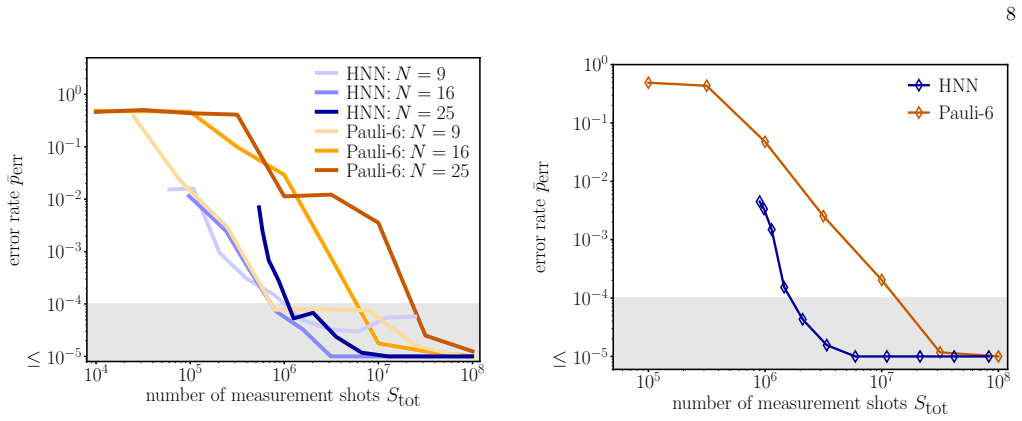
The hybrid quantum-classical neural network, built from a shallow parameterized quantum circuit that performs a nonlocal transformation of the measurement basis, measurements, and a classical neural network, is jointly trained to maximize statistical distance between data from different states. Using supervised learning it identifies the topological phase of the surface code, and it lowers both training and inference sample complexity by approximately one order of magnitude relative to a classical network trained on randomized Pauli measurements.
What carries the argument
The hybrid quantum-classical neural network in which a shallow parameterized quantum circuit applies a jointly trained nonlocal transformation of the measurement basis before classical processing.
If this is right
- The hybrid network separates the surface-code topological phase from a symmetry-enriched topological phase and from random product states under supervised learning.
- Both training and inference require roughly ten times fewer samples than a classical network on randomized Pauli measurements.
- The approach works with shallow circuits that current quantum devices can execute.
- It lowers the overall measurement cost for characterizing complex quantum states.
Where Pith is reading between the lines
- The same joint-training idea could be applied to recognize other many-body phases where direct measurement is expensive.
- Hybrid preprocessing of this kind might reduce sample needs in related tasks such as quantum state certification.
- Testing the trained circuit on actual hardware would show whether noise alters the observed sample-efficiency gain.
Load-bearing premise
Jointly training the shallow quantum circuit and the classical network will produce a reliable order-of-magnitude drop in the number of samples needed to recognize the topological phase.
What would settle it
A direct comparison experiment in which the hybrid network requires the same number of samples as the classical randomized-Pauli network on the same surface-code phase recognition task would falsify the claimed reduction.
Figures





read the original abstract
With increasing maturity of quantum computers, standard methods for characterizing global properties of their output quantum states via direct measurements and classical post-processing are becoming increasingly impractical due to large measurement costs. Although quantum neural networks could directly process quantum states to identify underlying characteristics with reduced measurement efforts, they often require deep quantum circuits that cannot be implemented on existing devices. To overcome these challenges, we introduce a hybrid quantum-classical neural network that consists of a shallow parameterized quantum circuit, measurements, and a classical neural network. The parameterized quantum circuit performs a nonlocal transformation of the measurement basis, which is jointly trained with the classical neural network to maximize the statistical distance between data obtained by measuring different quantum states. Using supervised learning, we demonstrate that the hybrid neural network distinguishes the topological phase of the surface code from a symmetry-enriched topological phase and random product states. Moreover, this hybrid neural network reduces both inference and training sample complexities of recognizing the topological phase by approximately one order of magnitude compared to a classical neural network trained on randomized Pauli measurements. As this hybrid neural network features a shallow quantum circuit that can be readily implemented on existing quantum computers, it enables the efficient characterization of complex quantum states.
Editorial analysis
A structured set of objections, weighed in public.
Referee Report
Summary. The manuscript introduces a hybrid quantum-classical neural network consisting of a shallow parameterized quantum circuit that performs a nonlocal transformation of the measurement basis, followed by measurements and a classical neural network. The components are jointly trained via supervised learning to maximize statistical distance between measurement data from different states. The central claim is that this architecture distinguishes the topological phase of the surface code from a symmetry-enriched topological phase and random product states, while reducing both training and inference sample complexities by approximately one order of magnitude relative to a classical neural network trained on randomized Pauli measurements. The approach is positioned as implementable on near-term quantum hardware.
Significance. If the reported empirical results hold, the work demonstrates a practical route to sample-efficient recognition of topological phases using shallow quantum circuits, which is a clear strength given current hardware constraints. The hybrid training strategy for enhancing measurement distinguishability contributes to quantum machine learning methods for state characterization with reduced overhead. Credit is due for the explicit comparison to a classical baseline and the focus on hardware-feasible circuit depths.
minor comments (3)
- [§4.2] §4.2: The protocol for measuring sample complexity (both training and inference) should explicitly define the criterion used to determine the minimal number of samples required for a given accuracy threshold, including any statistical tests or error-bar conventions applied across runs.
- [Figure 4] Figure 4: The plots comparing hybrid and classical performance would benefit from an inset or separate panel showing the ratio of sample complexities to make the claimed order-of-magnitude reduction visually immediate and directly comparable across the three state classes.
- [§5] §5: The discussion of the hybrid model's advantages could briefly address whether the observed efficiency gain persists when the classical network is replaced by a stronger baseline (e.g., a deeper classical NN or one with access to the same transformed basis).
Simulated Author's Rebuttal
We thank the referee for their positive assessment of our work and the recommendation for minor revision. The referee's summary accurately reflects the manuscript's contributions regarding the hybrid quantum-classical neural network and its sample-efficiency advantages for topological phase recognition. No specific major comments were raised in the report.
Circularity Check
No significant circularity
full rationale
The paper presents an empirical demonstration via supervised learning experiments on a jointly trained hybrid quantum-classical network. The claimed order-of-magnitude reduction in sample complexity is a measured performance outcome relative to a classical baseline on randomized Pauli measurements, not a mathematical derivation or prediction that reduces to the model's own fitted parameters or self-citations by construction. No equations, ansatzes, or uniqueness theorems are invoked that collapse the central claim into its inputs. The result is self-contained against the external benchmark of classical NN performance.
Axiom & Free-Parameter Ledger
Reference graph
Works this paper leans on
-
[1]
with gradient descent using the Adam optimizer [ 59]. Additionally, we train the feedforward neural network on datasets of bit strings obtained for stochastic pertur- bations of the parameters ϕ(k) + δϕ(k), which are referred to as a population. In each iteration k, these stochastic perturbations δϕ(k) are drawn from a normal distribu- tion with zero mean...
-
[2]
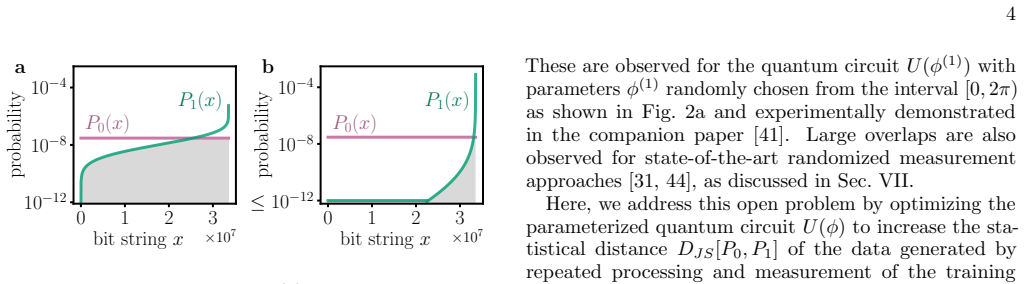
By training the quantum circuit, we reduce the statistical overlap between the datasets D(m) 1 and D(m) 0 and, thereby, facilitate their classification
Classical neural network tuning To tune the hyperparameters of the feedforward neural network, we train it on datasets D(m) L measured for 10 dif- ferent instances of random initial circuit parameters ϕ(1), which are harder to classify than measurement outcomes obtained in subsequent iterations k > 1. By training the quantum circuit, we reduce the statist...
-
[3]
To this end, we analytically determine the probability yopt(x) for every possible measurement outcome x from the full probability distributions P1(x) and P0(x) according to Eq
Evolution strategy tuning To isolate the effects of the evolution strategy hyper- parameters on the quantum circuit training, we replace the feedforward neural network with the optimal ana- lytical postprocessing procedure [ 50]. To this end, we analytically determine the probability yopt(x) for every possible measurement outcome x from the full probabili...
-
[4]
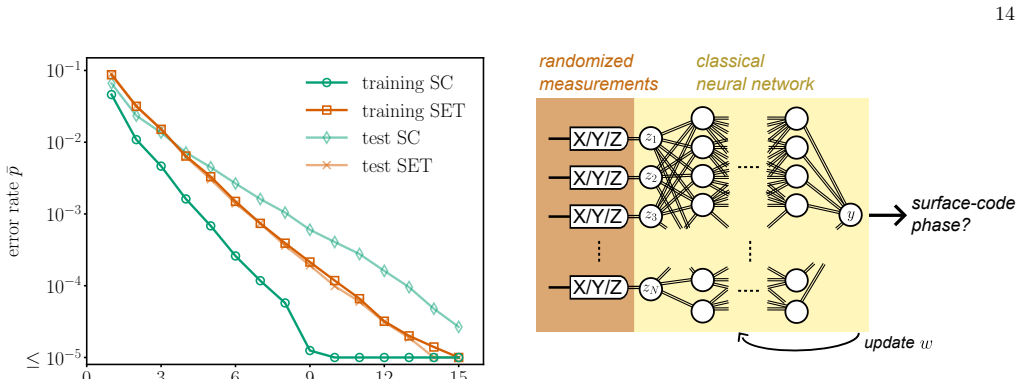
Randomized Pauli-6 POVM measurements We employ the Pauli-6 POVM, which is defined for a sin- gle qubit i by the elements Π(i) zi ∈ {Π(i) 0 = 1 3 |+⟩⟨+|, Π(i) 1 = randomized measurements classical neural network X/Y/Z X/Y/Z X/Y/Z X/Y/Z update surface-code phase? FIG. 15. Classical neural network trained on randomized Pauli measurements. Each qubit is measu...
-
[5]
Similarly to the hybrid neural network, the classical benchmark network learns linear functions of the input quantum state|ψ (m) L ⟩
Classical benchmark network training The classical feedforward neural network consists of an input layer with N nodes, followed by l fully-connected hidden layers with n nodes and rectified linear unit acti- vation functions, and a single-node output layer with a sigmoid activation function. Similarly to the hybrid neural network, the classical benchmark ...
-
[6]
The network parameters w are optimized by minimizing the binary cross-entropy cost (1) over all datasets D(m) L
The measurement outcomes zi are standardized as zi 7→ (zi −¯zi)/si, where ¯zi and si denote the mean and standard deviation of the training datasets D(m) L,tr for all Landm. The network parameters w are optimized by minimizing the binary cross-entropy cost (1) over all datasets D(m) L . In contrast to the hybrid neural network, no measure- ments are perfo...
-
[7]
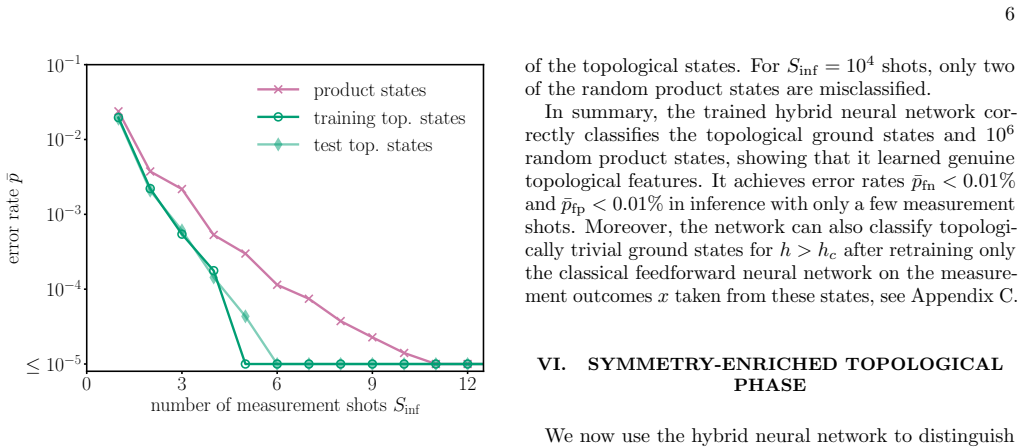
T opological phase recognition First, we investigate the phase classification perfor- mance of the benchmark network trained on Stot = 108 randomized measurements of the surface code in a mag- netic field and the 1-design for N = 25. In Fig. 16, we plot the multi-shot false negative error rate ¯pfn as a func- tion of the inference shot number Sinf for the...
-
[8]
Acharyaet al., Quantum error correction below the surface code threshold, Nature638, 920 (2025)
R. Acharyaet al., Quantum error correction below the surface code threshold, Nature638, 920 (2025)
2025
-
[9]
Bluvstein, S
D. Bluvstein, S. J. Evered, A. A. Geim, S. H. Li, H. Zhou, T. Manovitz, S. Ebadi, M. Cain, M. Kalinowski, D. Hangleiter,et al., Logical quantum processor based on reconfigurable atom arrays, Nature626, 58 (2024)
2024
-
[10]
Morvan, B
A. Morvan, B. Villalonga, X. Mi, S. Mandr` a, A. Bengts- son, P. V. Klimov, Z. Chen, S. Hong, C. Erickson, I. K. Drozdov,et al., Phase transitions in random circuit sam- pling, Nature634, 328 (2024)
2024
-
[11]
Huang, R
H.-Y. Huang, R. Kueng, and J. Preskill, Predicting many properties of a quantum system from very few measure- ments, Nat. Phys.16, 1050 (2020)
2020
-
[12]
Elben, S
A. Elben, S. T. Flammia, H.-Y. Huang, R. Kueng, J. Preskill, B. Vermersch, and P. Zoller, The random- ized measurement toolbox, Nat. Rev. Phys.5, 9 (2023)
2023
-
[13]
Biamonte, P
J. Biamonte, P. Wittek, N. Pancotti, P. Rebentrost, N. Wiebe, and S. Lloyd, Quantum machine learning, Na- ture549, 195 (2017)
2017
-
[14]
Lloyd, M
S. Lloyd, M. Mohseni, and P. Rebentrost, Quantum prin- cipal component analysis, Nat. Phys.10, 631 (2014)
2014
-
[15]
Romero, J
J. Romero, J. P. Olson, and A. Aspuru-Guzik, Quantum autoencoders for efficient compression of quantum data, Quantum Sci. Technol.2, 045001 (2017)
2017
-
[16]
Wiebe, C
N. Wiebe, C. Granade, C. Ferrie, and D. G. Cory, Hamil- tonian learning and certification using quantum resources, Phys. Rev. Lett.112, 190501 (2014)
2014
-
[17]
A. A. Gentile, B. Flynn, S. Knauer, N. Wiebe, S. Paesani, C. E. Granade, J. G. Rarity, R. Santagati, and A. Laing, Learning models of quantum systems from experiments, Nat. Phys.17, 837 (2021)
2021
-
[18]
Ghosh, A
S. Ghosh, A. Opala, M. Matuszewski, T. Paterek, and T. C. H. Liew, Quantum reservoir processing, npj Quan- tum Inf.5, 35 (2019)
2019
-
[19]
E. Farhi and H. Neven, Classification with quantum neural networks on near term processors, arXiv:1802.06002
-
[20]
I. Cong, S. Choi, and M. D. Lukin, Quantum convolutional neural networks, Nat. Phys.15, 1273 (2019)
2019
-
[21]
K. Beer, D. Bondarenko, T. Farrelly, T. J. Osborne, R. Salzmann, D. Scheiermann, and R. Wolf, Training deep quantum neural networks, Nat. Commun.11, 808 (2020)
2020
-
[22]
Kottmann, F
K. Kottmann, F. Metz, J. Fraxanet, and N. Baldelli, Variational quantum anomaly detection: Unsupervised mapping of phase diagrams on a physical quantum com- puter, Phys. Rev. Res.3, 043184 (2021)
2021
-
[23]
M. C. Caro, H.-Y. Huang, M. Cerezo, K. Sharma, A. Sorn- borger, L. Cincio, and P. J. Coles, Generalization in quan- tum machine learning from few training data, Nat. Com- mun.13, 4919 (2022)
2022
-
[24]
Gong, H.-L
M. Gong, H.-L. Huang, S. Wang, C. Guo, S. Li, Y. Wu, Q. Zhu, Y. Zhao, S. Guo, H. Qian,et al., Quantum 17 neuronal sensing of quantum many-body states on a 61- qubit programmable superconducting processor, Sci. Bull. 68, 906 (2023)
2023
-
[25]
K. J. Satzinger, Y. Liu, A. Smith, C. Knapp, M. Newman, C. Jones, Z. Chen, C. Quintana, X. Mi, A. Dunsworth, et al., Realizing topologically ordered states on a quantum processor, Science374, 1237 (2021)
2021
-
[26]
M. Will, T. A. Cochran, E. Rosenberg, B. Jobst, N. M. Eassa, P. Roushan, M. Knap, A. Gammon-Smith, and F. Pollmann, Probing non-equilibrium topological order on a quantum processor, Nature645, 348 (2025)
2025
-
[27]
S. J. Evered, M. Kalinowski, A. A. Geim, T. Manovitz, D. Bluvstein, S. H. Li, N. Maskara, H. Zhou, S. Ebadi, M. Xu,et al., Probing the Kitaev honeycomb model on a neutral-atom quantum computer, Nature645, 341 (2025)
2025
-
[28]
Zheng, C.-M
B.-X. Zheng, C.-M. Chung, P. Corboz, G. Ehlers, M.-P. Qin, R. M. Noack, H. Shi, S. R. White, S. Zhang, and G. K.-L. Chan, Stripe order in the underdoped region of the two-dimensional Hubbard model, Science358, 1155 (2017)
2017
-
[29]
Hangleiter, I
D. Hangleiter, I. Roth, D. Nagaj, and J. Eisert, Easing the Monte Carlo sign problem, Sci. Adv.6, eabb8341 (2020)
2020
-
[30]
Haller, W.-T
L. Haller, W.-T. Xu, Y.-J. Liu, and F. Pollmann, Quan- tum phase transition between symmetry enriched topo- logical phases in tensor-network states, Phys. Rev. Res. 5, 043078 (2023)
2023
-
[31]
Y.-J. Liu, K. Shtengel, and F. Pollmann, Simulating two- dimensional topological quantum phase transitions on a digital quantum computer, Phys. Rev. Res.6, 043256 (2024)
2024
-
[32]
Carrasquilla and R
J. Carrasquilla and R. G. Melko, Machine learning phases of matter, Nat. Phys.13, 431 (2017)
2017
-
[33]
E. P. L. van Nieuwenburg, Y.-H. Liu, and S. D. Huber, Learning phase transitions by confusion, Nat. Phys.13, 435 (2017)
2017
-
[34]
B. S. Rem, N. K¨ aming, M. Tarnowski, L. Asteria, N. Fl¨ aschner, C. Becker, K. Sengstock, and C. Weitenberg, Identifying quantum phase transitions using artificial neu- ral networks on experimental data, Nat. Phys.15, 917 (2019)
2019
-
[35]
Bohrdt, S
A. Bohrdt, S. Kim, A. Lukin, M. Rispoli, R. Schittko, M. Knap, M. Greiner, and J. L´ eonard, Analyzing nonequi- librium quantum states through snapshots with artificial neural networks, Phys. Rev. Lett.127, 150504 (2021)
2021
-
[36]
K¨ aming, A
N. K¨ aming, A. Dawid, K. Kottmann, M. Lewenstein, K. Sengstock, A. Dauphin, and C. Weitenberg, Unsuper- vised machine learning of topological phase transitions from experimental data, Mach. Learn.: Sci. Technol.2, 035037 (2021)
2021
-
[37]
Miles, R
C. Miles, R. Samajdar, S. Ebadi, T. T. Wang, H. Pichler, S. Sachdev, M. D. Lukin, M. Greiner, K. Q. Weinberger, and E.-A. Kim, Machine learning discovery of new phases in programmable quantum simulator snapshots, Phys. Rev. Res.5, 013026 (2023)
2023
-
[38]
Huang, R
H.-Y. Huang, R. Kueng, G. Torlai, V. V. Albert, and J. Preskill, Provably efficient machine learning for quan- tum many-body problems, Science377, eabk3333 (2022)
2022
-
[39]
Semeghini, H
G. Semeghini, H. Levine, A. Keesling, S. Ebadi, T. T. Wang, D. Bluvstein, R. Verresen, H. Pichler, M. Kali- nowski, R. Samajdar,et al., Probing topological spin liquids on a programmable quantum simulator, Science 374, 1242 (2021)
2021
-
[40]
A. Yu. Kitaev, Fault-tolerant quantum computation by anyons, Ann. Phys.303, 2 (2003)
2003
-
[41]
A. J. Scott, Tight informationally complete quantum measurements, J. Phys. A: Math. Gen.39, 13507 (2006)
2006
-
[42]
Y.-J. Liu, A. Smith, M. Knap, and F. Pollmann, Model- independent learning of quantum phases of matter with quantum convolutional neural networks, Phys. Rev. Lett. 130, 220603 (2023)
2023
-
[43]
Herrmann, S
J. Herrmann, S. M. Llima, A. Remm, P. Zapletal, N. A. McMahon, C. Scarato, F. Swiadek, C. K. Andersen, C. Hellings, S. Krinner,et al., Realizing quantum convo- lutional neural networks on a superconducting quantum processor to recognize quantum phases, Nat. Commun. 13, 4144 (2022)
2022
-
[44]
J. Chen, Y. Wu, Z. Yang, S. Xu, X. Ye, D. Li, K. Wang, C. Zhang, F. Jin, X. Zhu,et al., Quantum ensemble learning with a programmable superconducting processor, npj Quantum Inf.11, 83 (2025)
2025
-
[45]
I. P. McCulloch, Infinite size density matrix renormaliza- tion group, revisited, arXiv:0804.2509
-
[46]
L. C. Sander, N. A. McMahon, P. Zapletal, and M. J. Hartmann, Quantum convolutional neural network for phase recognition in two dimensions, Phys. Rev. Res.7, L042032 (2025)
2025
- [47]
-
[48]
Scarato, J
C. Scarato, J. Kn¨ orzer, M. K. Hoffmann, L. C. Sander, L. Hofele, S. Wang, K. Hanke, A. Sathe, D. Hagmann, A. Flasby, M. J. Hartmann, P. Zapletal, A. Wallraff, and C. Hellings, Hybrid quantum-classical neural networks for recognizing quantum phases, companion paper
-
[49]
Zapletal, N
P. Zapletal, N. A. McMahon, and M. J. Hartmann, Error-tolerant quantum convolutional neural networks for symmetry-protected topological phases, Phys. Rev. Res.6, 033111 (2024)
2024
-
[50]
Cerezo, M
M. Cerezo, M. Larocca, D. Garc´ ıa-Mart´ ın, N. L. Diaz, P. Braccia, E. Fontana, M. S. Rudolph, P. Bermejo, A. Ijaz, S. Thanasilp,et al., Does provable absence of bar- ren plateaus imply classical simulability?, Nat. Commun. 16, 7907 (2025)
2025
-
[51]
Bermejo, P
P. Bermejo, P. Braccia, M. S. Rudolph, Z. Holmes, L. Cin- cio, and M. Cerezo, Quantum convolutional neural net- works are effectively classically simulable, PRX Quantum 7, 020304 (2026)
2026
-
[52]
Scarato, K
C. Scarato, K. Hanke, A. Remm, S. Laz˘ ar, N. Lacroix, D. Colao Zanuz, A. Flasby, A. Wallraff, and C. Hellings, Realizing a continuous set of two-qubit gates parameter- ized by an idle time, PRX Quantum6, 040317 (2025)
2025
-
[53]
Krinner, N
S. Krinner, N. Lacroix, A. Remm, A. Di Paolo, E. Genois, C. Leroux, C. Hellings, S. Lazar, F. Swiadek, J. Herrmann, et al., Realizing repeated quantum error correction in a distance-three surface code, Nature605, 669 (2022)
2022
-
[54]
J. R. Johansson, P. D. Nation, and F. Nori, QuTiP 2: A Python framework for the dynamics of open quantum systems, Comput. Phys. Commun.184, 1234 (2013)
2013
-
[55]
T. Salimans, J. Ho, X. Chen, S. Sidor, and I. Sutskever, Evolution strategies as a scalable alternative to reinforce- ment learning, arXiv:1703.03864
-
[56]
Cholletet al., Keras, https://github.com/fchollet/keras (2015)
F. Cholletet al., Keras, https://github.com/fchollet/keras (2015)
2015
-
[57]
Arnold and F
J. Arnold and F. Sch¨ afer, Replacing neural networks by optimal analytical predictors for the detection of phase transitions, Phys. Rev. X12, 031044 (2022)
2022
- [58]
-
[59]
Trebst, P
S. Trebst, P. Werner, M. Troyer, K. Shtengel, and C. Nayak, Breakdown of a topological phase: Quantum phase transition in a loop gas model with tension, Phys. Rev. Lett.98, 070602 (2007)
2007
-
[60]
For h = 0, we consider the ground state continuously connected to the ground state family for h > 0 in the limith→0 +
The ground state is two-fold degenerate for h = 0 and the degeneracy is lifted by a finite magnetic field h > 0. For h = 0, we consider the ground state continuously connected to the ground state family for h > 0 in the limith→0 +
-
[61]
Their ten- sor products PN = {|0⟩,| 1⟩,| +⟩,|−⟩,| + i⟩,| −i⟩} ⊗N yield an N-qubit 1-design, since 1 6N P |ψ⟩∈PN |ψ⟩ ⟨ψ| = NN j=1 1 6 P |ψj ⟩∈P |ψj⟩ ⟨ψj| = 1 2N I
The six eigenstates P = {|0⟩,| 1⟩,| +⟩,|−⟩,| + i⟩,| − i⟩} of the Pauli operators form a 1-design of a single qubit as 1 6 P |ψ⟩∈P |ψ⟩ ⟨ψ| = 1 2 I. Their ten- sor products PN = {|0⟩,| 1⟩,| +⟩,|−⟩,| + i⟩,| −i⟩} ⊗N yield an N-qubit 1-design, since 1 6N P |ψ⟩∈PN |ψ⟩ ⟨ψ| = NN j=1 1 6 P |ψj ⟩∈P |ψj⟩ ⟨ψj| = 1 2N I
-
[62]
Kitaev and J
A. Kitaev and J. Preskill, Topological entanglement en- tropy, Phys. Rev. Lett.96, 110404 (2006)
2006
-
[63]
I. Cong, N. Maskara, M. C. Tran, H. Pichler, G. Semegh- ini, S. F. Yelin, S. Choi, and M. D. Lukin, Enhancing detection of topological order by local error correction, Nat. Commun.15, 1527 (2024)
2024
-
[64]
Carrasquilla, G
J. Carrasquilla, G. Torlai, R. G. Melko, and L. Aolita, Reconstructing quantum states with generative models, Nat. Mach. Intell.1, 155 (2019)
2019
-
[65]
A. G. Baydin, B. A. Pearlmutter, A. A. Radul, and J. M. Siskind, Automatic differentiation in machine learning: A Survey, Journal of Machine Learning Research18, 1 (2018)
2018
-
[66]
D. P. Kingma and J. Ba, Adam: A method for stochastic optimization, arXiv:1412.6980
-
[67]
Goodfellow, Y
I. Goodfellow, Y. Bengio, and A. Courville,Deep Learning (MIT Press, 2016)
2016
-
[68]
A. Mari, T. R. Bromley, J. Izaac, M. Schuld, and N. Killo- ran, Transfer learning in hybrid classical-quantum neural networks, Quantum4, 340 (2020)
2020
discussion (0)
Sign in with ORCID, Apple, or X to comment. Anyone can read and Pith papers without signing in.