A perfectly matched layer for damping vertically propagating waves in the compressible Boussinesq equations
Pith reviewed 2026-06-29 02:33 UTC · model grok-4.3
The pith
The perfectly matched layer damps vertically propagating waves in the compressible Boussinesq equations without reflections at the damping layer onset.
A machine-rendered reading of the paper's core claim, the machinery that carries it, and where it could break.
Core claim
The paper claims that at the continuous level the PML is free of wave reflection at the onset of the damping layer for the Boussinesq system. This enables effective damping with thin layers. For the nonlinear system a novel formulation damps only perturbations from the reference state. Numerical tests confirm better performance than sponge layers in absorbing acoustic waves and avoiding standing waves from gravity wave reflections.
What carries the argument
The perfectly matched layer (PML) formulation that damps perturbations from a hydrostatically balanced reference state in the nonlinear Boussinesq equations, shown to be reflection-free at the continuous level.
Load-bearing premise
The PML equations remain stable and reflection-free after discretization by the compatible finite-element method, particularly when the nonlinear version damps only perturbations from the hydrostatically balanced reference state.
What would settle it
A numerical simulation of the discretized nonlinear Boussinesq system with a thin PML layer that exhibits measurable wave reflection or instability at the layer onset would falsify the central claim.
Figures

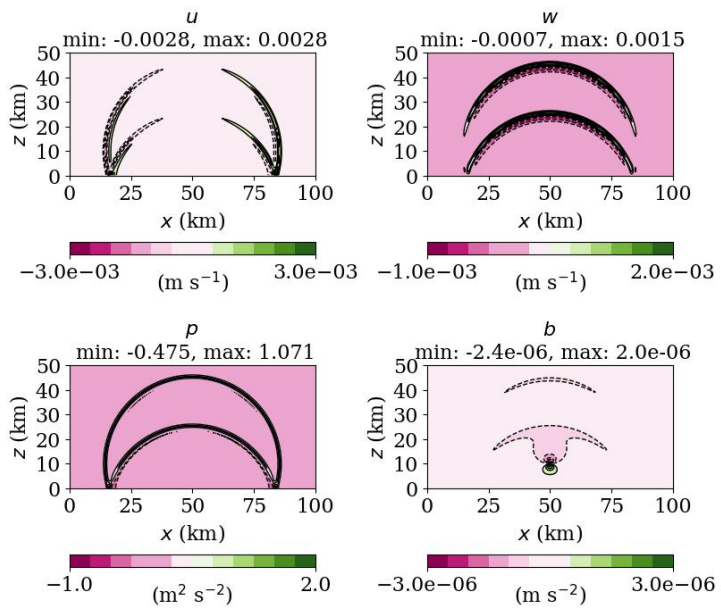
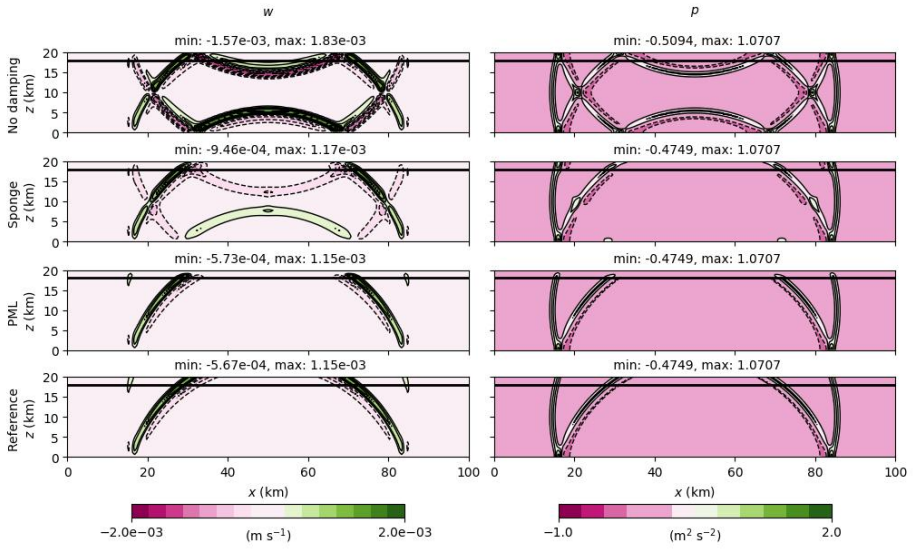
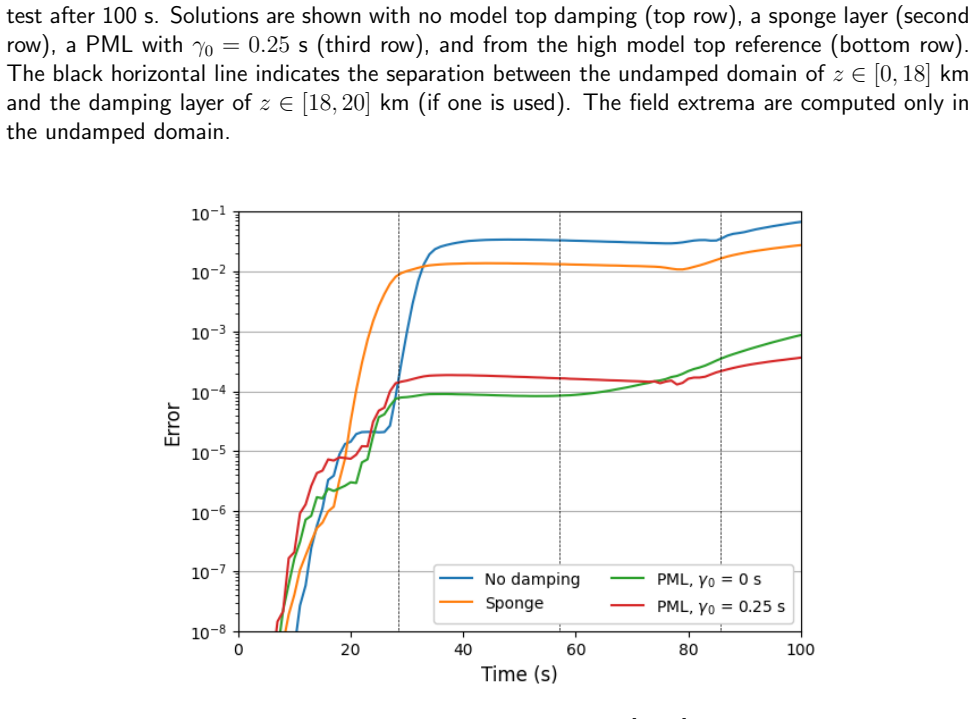


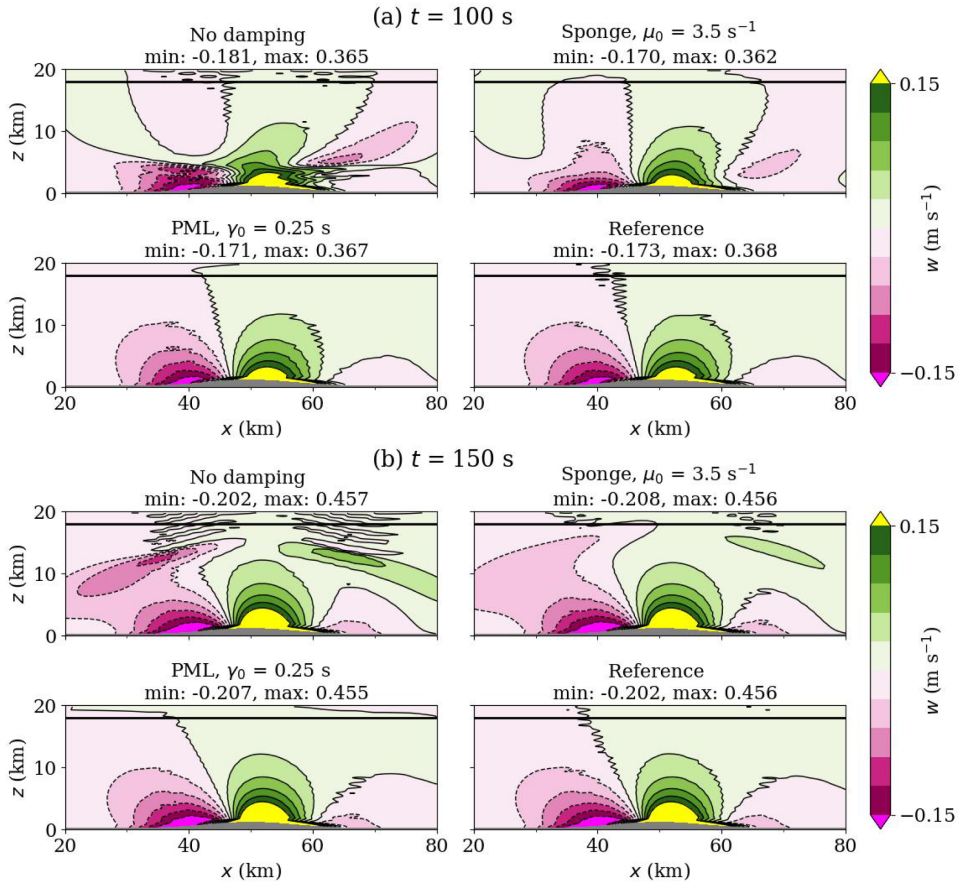



read the original abstract
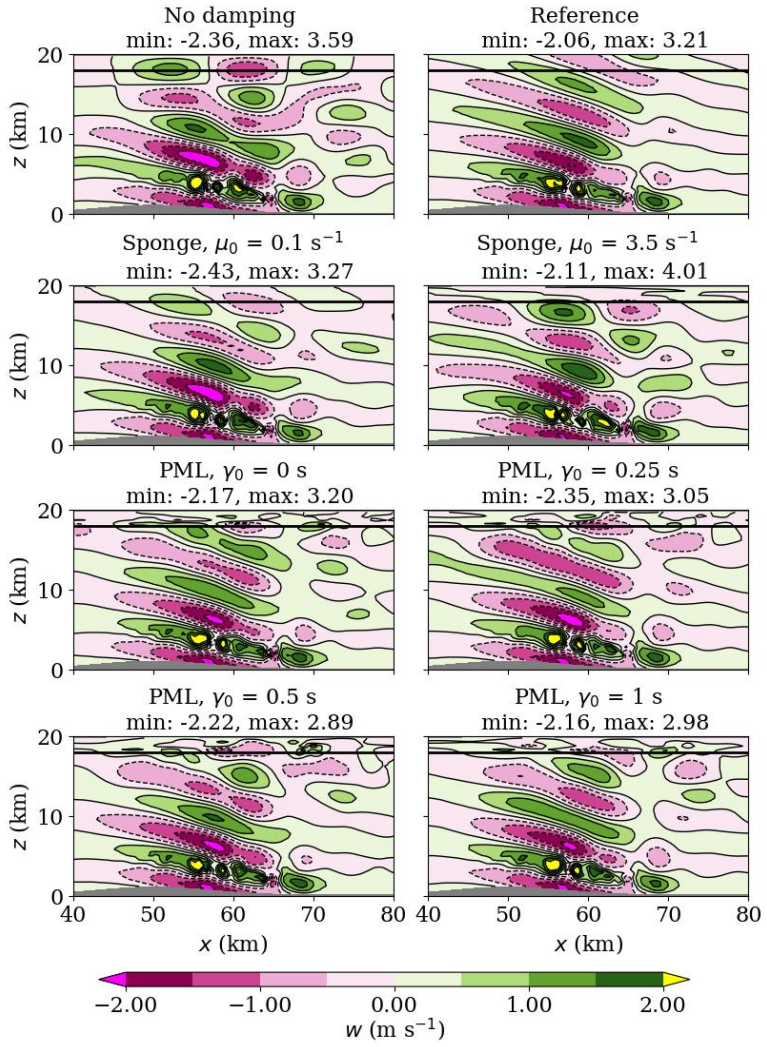
This paper introduces a new application of the perfectly matched layer (PML) for mitigating model top wave reflections in geophysical fluid models. Typically, a strong Laplacian or Rayleigh damping sponge layer is used near the upper boundary, but these often need many vertical levels or a high model top to be sufficiently effective. An advantage of the PML is that, at the continuous level, it is free of wave reflection at the onset of the damping layer. This enables the PML to be effective even with a thin damping layer. We derive PMLs for the linear and nonlinear versions of the Boussinesq equations, which are a simplified model for vertical dynamics in the atmosphere. In the nonlinear system, we define a novel PML that damps perturbations from a hydrostatically balanced reference state. We approximate the PML equations using the compatible finite element method for numerical experiments. First, tests with the linear Boussinesq system show that the PML is more effective than a typical sponge layer in absorbing acoustic waves near the model top. Next, tests in the nonlinear system show that i) the PML can damp acoustic waves even when they are under-resolved by the time discretisation, and ii) the PML can avoid the standing wave pattern caused by model top reflection of orographic gravity waves. We propose that the PML is worth further development and investigation as a sponge layer alternative in dynamical cores for atmospheric modelling.
Editorial analysis
A structured set of objections, weighed in public.
Referee Report
Summary. The paper derives perfectly matched layer (PML) formulations for the linear and nonlinear compressible Boussinesq equations to absorb vertically propagating acoustic and gravity waves at the model top. At the continuous level the PML is constructed to be reflection-free at the interface with the physical domain, enabling effective damping with thin layers. For the nonlinear system a novel variant damps only perturbations from a hydrostatically balanced reference state. The equations are discretized with a compatible finite-element method and tested on linear acoustic-wave absorption and nonlinear orographic gravity-wave cases, where the PML outperforms a standard sponge layer.
Significance. If the continuous-level reflection-free property is preserved under the chosen discretization, the approach supplies a mathematically systematic alternative to ad-hoc Laplacian or Rayleigh sponges. This could reduce the vertical extent required for damping regions in atmospheric dynamical cores, lowering computational cost while maintaining hydrostatic balance in the reference state. The perturbation-damping construction for the nonlinear system is a concrete, reusable extension of standard PML techniques.
major comments (2)
- [Derivation sections (linear and nonlinear PML)] The central continuous-level claim (reflection-free onset) is standard for PML constructions and appears to follow from the usual complex-coordinate stretching applied to the Boussinesq system; however, the manuscript supplies no explicit verification (e.g., plane-wave analysis or energy-flux calculation) that the chosen stretching functions indeed cancel the reflected component at the interface for the compressible case.
- [Numerical experiments] Numerical experiments report qualitative improvement over sponges but provide no quantitative absorption metrics (reflection coefficient, transmitted energy, or L2-norm error against a reference solution with a higher model top). Without these, the claim that the PML remains effective for thin layers after discretization cannot be assessed.
minor comments (2)
- [Nonlinear PML formulation] The definition of the reference hydrostatic state and the precise form of the perturbation variables in the nonlinear PML should be stated explicitly (e.g., as an equation) rather than described only in prose.
- [Figures] Figure captions and axis labels for the wave-propagation snapshots should include the nondimensional time and the precise location of the PML interface so that the thin-layer claim can be visually verified.
Simulated Author's Rebuttal
We thank the referee for their positive assessment and constructive comments. We address each major comment below.
read point-by-point responses
-
Referee: [Derivation sections (linear and nonlinear PML)] The central continuous-level claim (reflection-free onset) is standard for PML constructions and appears to follow from the usual complex-coordinate stretching applied to the Boussinesq system; however, the manuscript supplies no explicit verification (e.g., plane-wave analysis or energy-flux calculation) that the chosen stretching functions indeed cancel the reflected component at the interface for the compressible case.
Authors: We agree that an explicit verification would strengthen the presentation. Although the PML is constructed via the standard complex stretching (which is known to yield a reflection-free interface for hyperbolic systems), we will add a brief plane-wave analysis confirming cancellation of the reflected component for the compressible Boussinesq equations in the revised manuscript. revision: yes
-
Referee: [Numerical experiments] Numerical experiments report qualitative improvement over sponges but provide no quantitative absorption metrics (reflection coefficient, transmitted energy, or L2-norm error against a reference solution with a higher model top). Without these, the claim that the PML remains effective for thin layers after discretization cannot be assessed.
Authors: We agree that quantitative metrics would allow a more rigorous assessment. In the revision we will add reflection-coefficient estimates and L2-norm errors relative to reference solutions on domains with extended vertical extent. revision: yes
Circularity Check
No significant circularity; derivation is self-contained
full rationale
The paper constructs PML equations for linear and nonlinear Boussinesq systems by direct extension of standard PML techniques (complex coordinate stretching or auxiliary variables) to the target PDEs. The reflection-free property at the continuous level follows mathematically from the PML ansatz itself and is verified by the derivation rather than assumed or fitted. The novel nonlinear variant damps perturbations around a hydrostatic reference by explicit construction, not by redefining inputs. No self-citations are invoked to justify uniqueness or load-bearing steps; numerical tests with compatible FEM are independent validation. The central claim reduces to the standard PML property applied to this model, with no reduction to fitted parameters or self-referential definitions.
Axiom & Free-Parameter Ledger
axioms (1)
- domain assumption Boussinesq equations model vertical atmospheric dynamics
Reference graph
Works this paper leans on
-
[1]
A scientific description of the
Harris, Lucas and Chen, Xi and Putman, William and Zhou, Linjiong and Chen, Jan-Huey , institution=. A scientific description of the
-
[2]
Journal of Computational Physics , volume=
Finite-volume transport on various cubed-sphere grids , author=. Journal of Computational Physics , volume=. 2007 , publisher=
2007
-
[3]
Multidimensional flux-form semi-
Lin, Shian-Jiann and Rood, Richard B , journal=. Multidimensional flux-form semi-
-
[4]
An explicit flux-form semi-
Lin, Shian-Jiann and Rood, Richard B , journal=. An explicit flux-form semi-. 1997 , publisher=
1997
-
[5]
A “vertically
Lin, Shian-Jiann , journal=. A “vertically. 2004 , publisher=
2004
-
[6]
Chen, Xi , journal=. The. 2021 , publisher=
2021
-
[7]
Quarterly Journal of the Royal Meteorological Society , volume=
Choice of function spaces for thermodynamic variables in mixed finite-element methods , author=. Quarterly Journal of the Royal Meteorological Society , volume=. 2018 , publisher=
2018
-
[8]
A nonhydrostatic version of the
Dudhia, Jimy , journal=. A nonhydrostatic version of the
-
[9]
A compatible finite-element discretisation for the moist compressible
Bendall, Thomas M and Gibson, Thomas H and Shipton, Jemma and Cotter, Colin J and Shipway, Ben , journal=. A compatible finite-element discretisation for the moist compressible. 2020 , publisher=
2020
-
[10]
2017 , publisher=
Atmospheric and oceanic fluid dynamics , author=. 2017 , publisher=
2017
-
[11]
2013 , publisher=
An introduction to dynamic meteorology , author=. 2013 , publisher=
2013
-
[12]
GEM-International Journal on Geomathematics , volume=
A compatible finite element discretisation for the nonhydrostatic vertical slice equations , author=. GEM-International Journal on Geomathematics , volume=. 2023 , publisher=
2023
-
[13]
An inherently mass-conserving iterative semi-implicit semi-
Melvin, Thomas and Dubal, Mark and Wood, Nigel and Staniforth, Andrew and Zerroukat, Mohamed , journal=. An inherently mass-conserving iterative semi-implicit semi-. 2010 , publisher=
2010
-
[14]
Quarterly Journal of the Royal Meteorological Society , volume=
Multigrid preconditioners for the mixed finite element dynamical core of the LFRic atmospheric model , author=. Quarterly Journal of the Royal Meteorological Society , volume=. 2020 , publisher=
2020
-
[15]
Quarterly Journal of the Royal Meteorological Society , volume=
Hybridised multigrid preconditioners for a compatible finite-element dynamical core , author=. Quarterly Journal of the Royal Meteorological Society , volume=. 2023 , publisher=
2023
-
[16]
Dynamics and Statistics of the Climate System , volume=
Compatible finite element spaces for geophysical fluid dynamics , author=. Dynamics and Statistics of the Climate System , volume=. 2016 , publisher=
2016
-
[17]
Journal of Computational Physics , volume=
A perfectly matched layer for the absorption of electromagnetic waves , author=. Journal of Computational Physics , volume=. 1994 , publisher=
1994
-
[18]
Numerical methods for fluid dynamics:
Durran, Dale R , volume=. Numerical methods for fluid dynamics:. 2010 , publisher=
2010
-
[19]
A mixed finite-element, finite-volume, semi-implicit discretization for atmospheric dynamics:
Melvin, Thomas and Benacchio, Tommaso and Shipway, Ben and Wood, Nigel and Thuburn, John and Cotter, Colin , journal=. A mixed finite-element, finite-volume, semi-implicit discretization for atmospheric dynamics:. 2019 , publisher=
2019
-
[20]
A mixed finite-element, finite-volume, semi-implicit discretisation for atmospheric dynamics:
Melvin, Thomas and Shipway, Ben and Wood, Nigel and Benacchio, Tommaso and Bendall, Thomas and Boutle, Ian and Brown, Alex and Johnson, Christine and Kent, James and Pring, Stephen and others , journal=. A mixed finite-element, finite-volume, semi-implicit discretisation for atmospheric dynamics:. 2024 , publisher=
2024
-
[21]
Efficiency and accuracy of the
Skamarock, William C and Klemp, Joseph B , journal=. Efficiency and accuracy of the
-
[22]
Compatible finite element methods for geophysical flows:
Gibson, Thomas H and McRae, Andrew TT and Cotter, Colin J and Mitchell, Lawrence and Ham, David A , year=. Compatible finite element methods for geophysical flows:
-
[23]
Vertical slice modelling of nonlinear
Yamazaki, Hiroe and Shipton, Jemma and Cullen, Michael JP and Mitchell, Lawrence and Cotter, Colin J , journal=. Vertical slice modelling of nonlinear. 2017 , publisher=
2017
-
[24]
Numerical techniques for global atmospheric models , pages=
The pros and cons of diffusion, filters and fixers in atmospheric general circulation models , author=. Numerical techniques for global atmospheric models , pages=. 2011 , publisher=
2011
-
[25]
2023 , month =
Firedrake User Manual , author =. 2023 , month =
2023
-
[26]
Monthly Weather Review , volume=
A perfectly matched layer approach to the linearized shallow water equations models , author=. Monthly Weather Review , volume=
-
[27]
International Journal for Numerical Methods in Fluids , volume=
Absorbing boundary conditions: a spectral collocation approach , author=. International Journal for Numerical Methods in Fluids , volume=. 2013 , publisher=
2013
-
[28]
On the analysis and construction of perfectly matched layers for the linearized
Hesthaven, Jan S , journal=. On the analysis and construction of perfectly matched layers for the linearized. 1998 , publisher=
1998
-
[29]
Stabilized perfectly matched layer for advective acoustics , author=. Mathematical and Numerical Aspects of Wave Propagation WAVES 2003: Proceedings of The Sixth International Conference on Mathematical and Numerical Aspects of Wave Propagation Held at Jyv. 2003 , organization=
2003
-
[30]
Kuzuoglu and R
M. Kuzuoglu and R. Mittra , title =. IEEE Microwave and Guided Wave Letters , volume =
-
[31]
Communications in Computational Physics , year =
Kenneth Duru and Gunilla Kreiss , title =. Communications in Computational Physics , year =
-
[32]
A stable discontinuous
Duru, Kenneth and Rannabauer, Leonhard and Gabriel, Alice-Agnes and Kreiss, Gunilla and Bader, Michael , Da =. A stable discontinuous. Numerische Mathematik , Number =
-
[33]
Perfectly Matched Layers and High Order Difference Methods for Wave Equations , year =
Duru, Kenneth , institution =. Perfectly Matched Layers and High Order Difference Methods for Wave Equations , year =
-
[34]
Journal of Computational Physics , volume =
On Absorbing Boundary Conditions for Linearized. Journal of Computational Physics , volume =. 1996 , issn =
1996
-
[35]
Journal of Computational Physics , volume =
A Stable, Perfectly Matched Layer for Linearized. Journal of Computational Physics , volume =. 2001 , issn =
2001
-
[36]
Hagstrom
T. Hagstrom. New results on absorbing layers and radiation boundary conditions
-
[37]
Chew, Weng Cho and Weedon, William H. , title =. Microwave and Optical Technology Letters , volume =. doi:10.1002/mop.4650071304 , year =
-
[38]
The perfectly matched layer (
Kenneth Duru and Gunilla Kreiss , year=. The perfectly matched layer (
-
[39]
Darblade, Gilles , year=. M
-
[40]
Unsplit variables perfectly matched layers for the shallow water equations with
Abarbanel, S and Stanescu, D and Hussaini, MY , journal=. Unsplit variables perfectly matched layers for the shallow water equations with. 2003 , publisher=
2003
-
[41]
Monthly Weather Review , volume=
The stability of time-split numerical methods for the hydrostatic and the nonhydrostatic elastic equations , author=. Monthly Weather Review , volume=
-
[42]
Damping acoustic modes in compressible horizontally explicit vertically implicit (
Klemp, Joseph B and Skamarock, William C and Ha, Soyoung , journal=. Damping acoustic modes in compressible horizontally explicit vertically implicit (
-
[43]
A multiscale nonhydrostatic atmospheric model using centroidal
Skamarock, William C and Klemp, Joseph B and Duda, Michael G and Fowler, Laura D and Park, Sang-Hun and Ringler, Todd D , journal=. A multiscale nonhydrostatic atmospheric model using centroidal
-
[44]
Perfectly Matched Layers for the Convected
B\'. Perfectly Matched Layers for the Convected. SIAM Journal on Numerical Analysis , volume =. 2004 , doi =
2004
-
[45]
Advances in geophysics , volume=
Hydrostatic airflow over mountains , author=. Advances in geophysics , volume=. 1989 , publisher=
1989
-
[46]
2007 , publisher=
Mesoscale dynamics , author=. 2007 , publisher=
2007
-
[47]
Cockburn, Bernardo and Shu, Chi-Wang , journal=. Runge--. 2001 , publisher=
2001
-
[48]
2012 , publisher=
Dennis, John M and Edwards, Jim and Evans, Katherine J and Guba, Oksana and Lauritzen, Peter H and Mirin, Arthur A and St-Cyr, Amik and Taylor, Mark A and Worley, Patrick H , journal=. 2012 , publisher=
2012
-
[49]
2018 , publisher=
Lauritzen, Peter Hjort and Nair, Ram D and Herrington, AR and Callaghan, P and Goldhaber, S and Dennis, JM and Bacmeister, JT and Eaton, BE and Zarzycki, CM and Taylor, Mark A and others , journal=. 2018 , publisher=
2018
-
[50]
Description of the
Neale, Richard B and Chen, Chih-Chieh and Gettelman, Andrew and Lauritzen, Peter H and Park, Sungsu and Williamson, David L and Conley, Andrew J and Garcia, Rolando and Kinnison, Doug and Lamarque, Jean-Francois and others , institution =. Description of the
-
[51]
An energetically balanced, quasi-
Lee, D , journal =. An energetically balanced, quasi-. 2021 , publisher=
2021
-
[52]
Journal of Computational Physics , volume=
Exact spatial and temporal balance of energy exchanges within a horizontally explicit/vertically implicit non-hydrostatic atmosphere , author=. Journal of Computational Physics , volume=. 2021 , publisher=
2021
-
[53]
Acta Numerica , volume=
Compatible finite element methods for geophysical fluid dynamics , author=. Acta Numerica , volume=
-
[54]
Journal of the atmospheric sciences , volume=
Numerical simulation of hydrostatic mountain waves , author=. Journal of the atmospheric sciences , volume=
-
[55]
An inherently mass-conserving semi-implicit semi-
Wood, Nigel and Staniforth, Andrew and White, Andy and Allen, Thomas and Diamantakis, Michail and Gross, Markus and Melvin, Thomas and Smith, Chris and Vosper, Simon and Zerroukat, Mohamed and others , journal=. An inherently mass-conserving semi-implicit semi-. 2014 , publisher=
2014
-
[56]
Hu, F. Q. , booktitle=. On the construction of
-
[57]
Absorbing boundary condition for nonlinear
Lin, DK and Li, XD and Hu, Fang Q , journal=. Absorbing boundary condition for nonlinear. 2011 , publisher=
2011
-
[58]
Monthly Weather Review , volume=
An upper boundary condition permitting internal gravity wave radiation in numerical mesoscale models , author=. Monthly Weather Review , volume=
-
[59]
Monthly Weather Review , volume=
An adaptive vertical coordinate formulation for a nonhydrostatic model with flux-form equations , author=. Monthly Weather Review , volume=
-
[60]
Klemp, J. B. and Dudhia, J. and Hassiotis, A. D. , journal=. An upper gravity-wave absorbing layer for
-
[61]
Z. The. Quarterly Journal of the Royal Meteorological Society , volume=. 2015 , publisher=
2015
-
[62]
Geophysical Research Letters , volume=
Tropospheric response to stratospheric perturbations in a relatively simple general circulation model , author=. Geophysical Research Letters , volume=. 2002 , publisher=
2002
-
[63]
Vertical differencing of the primitive equations based on the
Arakawa, Akio and Konor, Celal S , journal=. Vertical differencing of the primitive equations based on the
-
[64]
Journal of Computational Physics , volume=
Well-posed perfectly matched layers for advective acoustics , author=. Journal of Computational Physics , volume=. 1999 , publisher=
1999
-
[65]
Journal of Computational Physics , pages=
On the stability analysis of the perfectly matched layer for the elastic wave equation in layered media , author=. Journal of Computational Physics , pages=. 2025 , publisher=
2025
-
[66]
Convolution
Roden, J Alan and Gedney, Stephen D , journal=. Convolution. 2000 , publisher=
2000
-
[67]
Geophysical Journal International , volume=
An unsplit convolutional perfectly matched layer technique improved at grazing incidence for the viscoelastic wave equation , author=. Geophysical Journal International , volume=. 2009 , publisher=
2009
-
[68]
Monthly Weather Review , volume=
A new terrain-following vertical coordinate formulation for atmospheric prediction models , author=. Monthly Weather Review , volume=
-
[69]
Improving the accuracy of discretisations of the vector transport equation on the lowest-order quadrilateral
Bendall, Thomas M and Wimmer, Golo A , journal=. Improving the accuracy of discretisations of the vector transport equation on the lowest-order quadrilateral. 2023 , publisher=
2023
-
[70]
Journal of Computational Physics , volume=
Mixed finite elements for numerical weather prediction , author=. Journal of Computational Physics , volume=. 2012 , publisher=
2012
-
[71]
SIAM Journal on Scientific Computing , volume=
Automated generation and symbolic manipulation of tensor product finite elements , author=. SIAM Journal on Scientific Computing , volume=. 2016 , publisher=
2016
-
[72]
Andrews, T. C. and Jablonowski, C. and Hughes, O. K. and Bendall, T. M. , TITLE =. EGUsphere , VOLUME =. 2026 , PAGES =
2026
discussion (0)
Sign in with ORCID, Apple, or X to comment. Anyone can read and Pith papers without signing in.