Modelling Emotional Memory in Children with Tensor Networks
Pith reviewed 2026-06-30 01:02 UTC · model grok-4.3
The pith
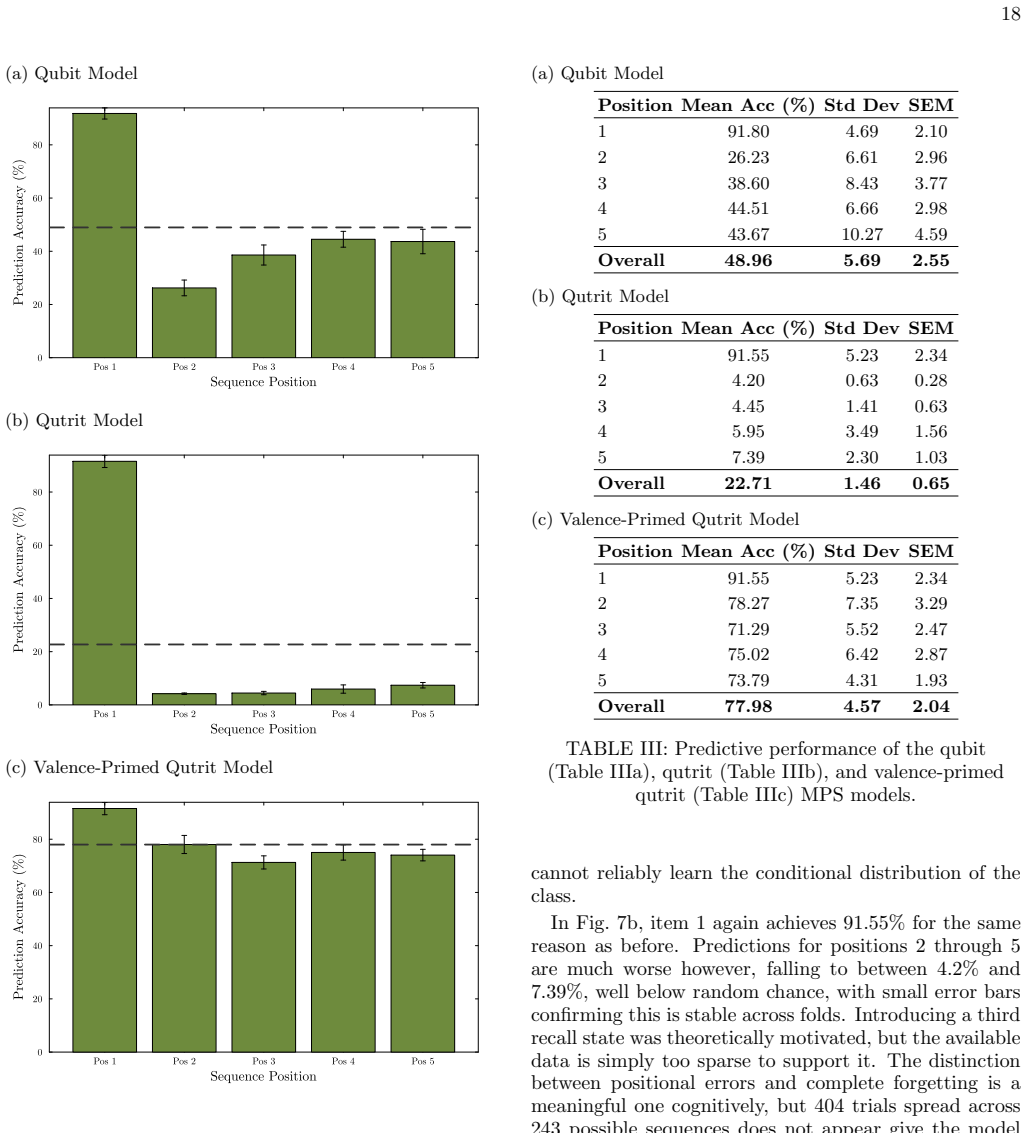
A tensor network that factors emotional valence models children's recognition memory at 77.98 percent accuracy by capturing order effects.
A machine-rendered reading of the paper's core claim, the machinery that carries it, and where it could break.
Core claim
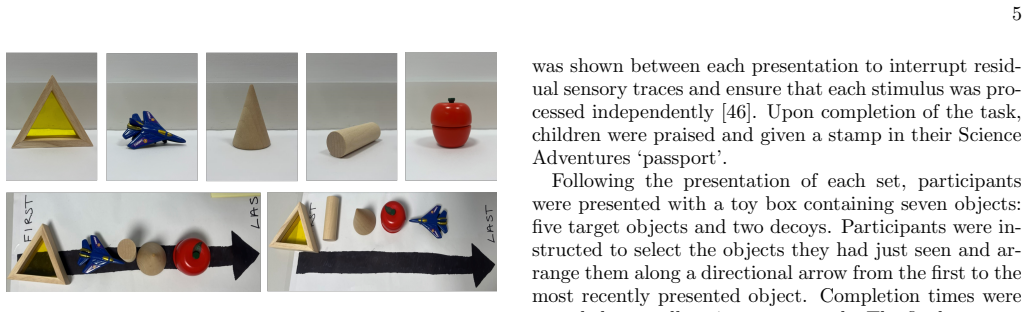
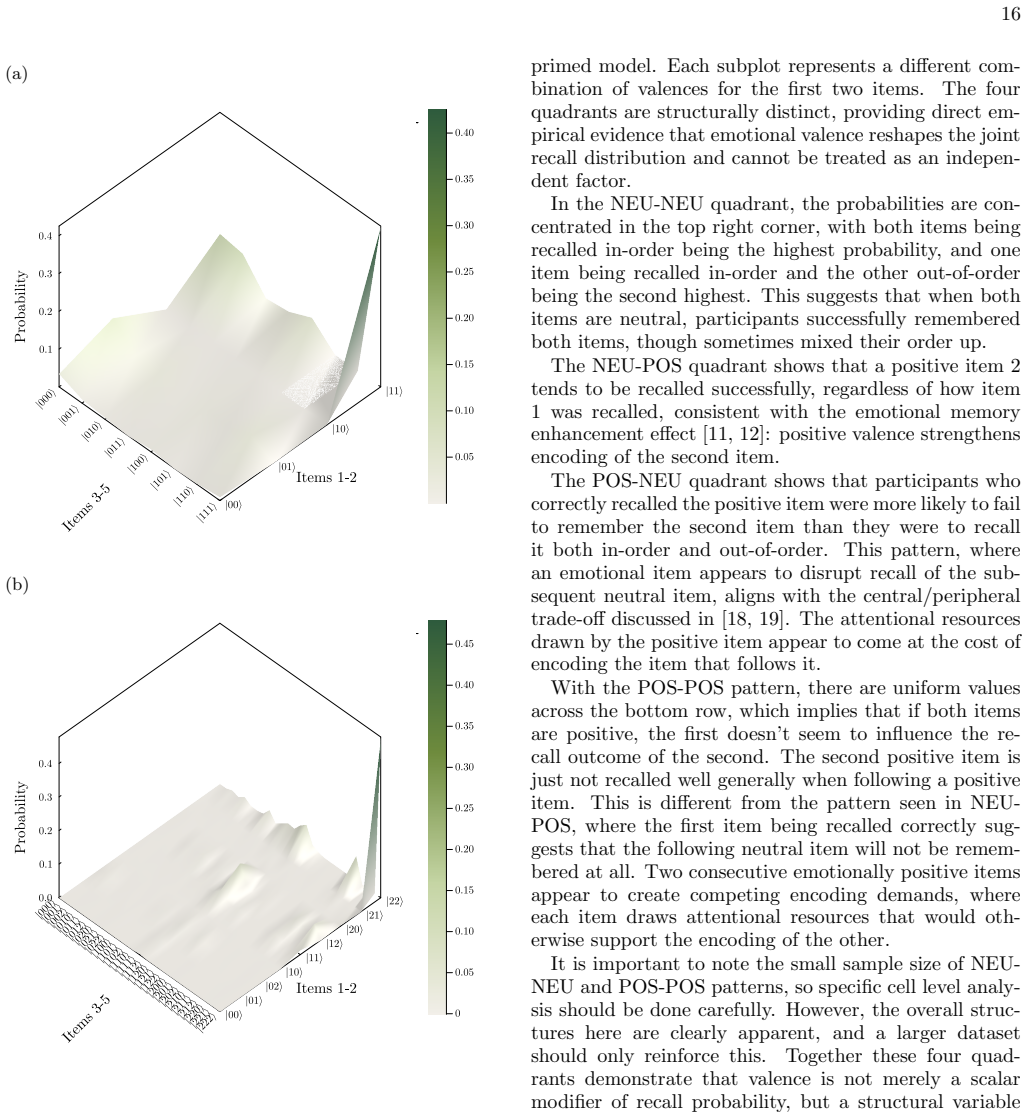
Emotional valence influences the order-dependent structure of children's recognition memory: correct recall of a sequence of emotionally-valenced toys depended not just on the valence of a given toy itself, but also on the valence of the toys shown before and after it. A classical tensor network model factoring in valence achieves 77.98 percent accuracy, a substantial improvement over standard psychological models that do not reflect how memory for an emotional object influences others in the set.
What carries the argument
Classical tensor network model that factors valence into the representation of sequential memory to capture order dependence.
If this is right
- Order dependence in emotional memory can be represented through tensor network factorization of valence.
- The introduced task protocol supplies a repeatable method for collecting data on how surrounding emotional context affects recall.
- Quantum-inspired classical models can deliver high accuracy on order-dependent cognitive phenomena without requiring quantum hardware.
- Memory for an individual emotional item is shaped by the valence pattern of the entire sequence rather than by isolated item properties.
Where Pith is reading between the lines
- Tensor network representations of valence could be tested on adult emotional memory or on non-emotional but still ordered sequences such as word lists.
- If the model generalizes beyond the original toy set, it could be used to predict how classroom materials with varying emotional tones affect learning order.
- The gap between standard models and the tensor network suggests that explicit modeling of cross-item influences is a necessary addition to accounts of recognition memory.
Load-bearing premise
The chosen tensor network structure and the specific way valence is incorporated correctly reflect the psychological mechanisms of order dependence instead of merely matching the collected data.
What would settle it
Apply the same tensor network to a fresh set of children's recall data collected with different sequences or age groups and measure whether accuracy stays near 78 percent or drops sharply.
Figures



read the original abstract
We demonstrate how emotional valence influences the order-dependent structure of children's recognition memory: correct recall of a sequence of emotionally-valenced toys depended not just on the valence of a given toy itself, but also on the valence of the toys shown before and after it. Whilst standard psychological models confirm that order-dependence differs across an event (a set of toys shown in sequence), accuracy is low and the model does not reflect how memory for an emotional object influences others in the set. A classical tensor network model factoring in valence is able to achieve a 77.98\% accuracy in modelling the results of the study. While not strictly a ``quantum cognition'' model, this massive increase in accuracy shows the value of quantum-inspired methods for modelling order-dependent phenomena, such as emotional memory. Further, the task protocol we introduce presents a novel, real-world tool for exploring emotional temporal memory in children for analysis using classical and quantum-like models of cognition.
Editorial analysis
A structured set of objections, weighed in public.
Referee Report
Summary. The manuscript claims that emotional valence influences the order-dependent structure of children's recognition memory, where correct recall of a toy depends on the valences of preceding and following toys in the sequence. Standard psychological models exhibit low accuracy and fail to capture inter-object memory influences, whereas a classical tensor network model that factors in valence achieves 77.98% accuracy. This is presented as evidence for the value of quantum-inspired methods in modeling order-dependent phenomena, alongside a new experimental protocol for studying emotional temporal memory in children.
Significance. Should the reported accuracy prove robust, the work would demonstrate that tensor network models can substantially outperform traditional approaches in capturing valence-mediated order effects in memory, highlighting the utility of quantum-inspired techniques for cognitive modeling and providing a practical new tool for developmental psychology research.
major comments (2)
- [Abstract] Abstract: The 77.98% accuracy figure is stated without accompanying details on the tensor network architecture (e.g., bond dimensions, contraction order), number of parameters, training procedure, cross-validation strategy, or statistical error bars. This information is necessary to determine if the model captures the claimed psychological order-dependence or overfits the experimental data.
- [Abstract] Abstract: No quantitative comparison is provided for the 'standard psychological models' mentioned, including their specific accuracies or how they were implemented, which undermines the claim of a 'massive increase in accuracy'.
minor comments (1)
- The abstract uses British spellings ('modelling', 'whilst') consistently, but verify uniform usage and expand the methods description in the main text to support reproducibility of the accuracy result.
Simulated Author's Rebuttal
We thank the referee for their constructive comments, which highlight opportunities to improve the clarity of the abstract. We address each point below and have revised the manuscript to incorporate the suggested details.
read point-by-point responses
-
Referee: [Abstract] Abstract: The 77.98% accuracy figure is stated without accompanying details on the tensor network architecture (e.g., bond dimensions, contraction order), number of parameters, training procedure, cross-validation strategy, or statistical error bars. This information is necessary to determine if the model captures the claimed psychological order-dependence or overfits the experimental data.
Authors: We agree that the abstract would benefit from additional context on the model. The full manuscript details the tensor network architecture (including bond dimensions and contraction order), number of parameters, training procedure, cross-validation strategy, and statistical error bars in the Methods and Results sections. We will revise the abstract to briefly reference these elements and report the accuracy with error bars for improved transparency. revision: yes
-
Referee: [Abstract] Abstract: No quantitative comparison is provided for the 'standard psychological models' mentioned, including their specific accuracies or how they were implemented, which undermines the claim of a 'massive increase in accuracy'.
Authors: The manuscript provides quantitative comparisons, including specific accuracies and implementation details for the standard psychological models, in the Results section. To address the concern directly in the abstract, we will revise it to include the accuracy figures for these models alongside the tensor network result. revision: yes
Circularity Check
No circularity: reported accuracy is an empirical modelling result with no derivation chain reducing to inputs by construction
full rationale
The paper presents an empirical result: a tensor network model with valence factoring reaches 77.98% accuracy on the collected recognition-memory sequences, contrasted with low accuracy from standard psychological models. No equations, parameter-fitting procedure, or self-citation chain is supplied in the provided text that would make the accuracy a tautological renaming or forced fit of the same data. The central claim is therefore an in-sample performance number rather than a first-principles derivation that collapses to its own inputs. No self-definitional, fitted-input-called-prediction, or uniqueness-imported-from-authors pattern appears. The modelling result stands as an independent empirical observation on the given dataset.
Axiom & Free-Parameter Ledger
Reference graph
Works this paper leans on
-
[1]
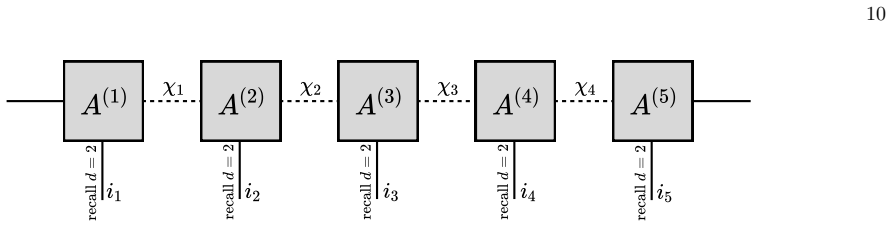
ReshapeTinto a matrixM (1) of size 2×16: M(1) (i1),(i2i3i4i5) =T i1,i2,i3,i4,i5
-
[2]
Perform SVD onM (1): M(1) =U (1)Σ(1)V(1)†
-
[3]
Determineχ 1: χ1 = X i δσi>ϵ
-
[4]
Define the first node of the MPS,A (1), as the past singular vectors, whereα i is the virtual index con- necting the next node of dimensionχ i: A(1) i1,α1 =U (1) i1,α1
-
[5]
entangled
Calculate the residual matrix,R (1), by multiplying the singular values into the future singular vectors. This contains the dependent (“entangled”) future of the sequence. R(1) α1,(i2i3i4i5) = (Σ(1)V(1)†)α1,(i2i3i4i5) The size ofR (1) isχ 1 ×16. Cuts 2–4The process is repeated iteratively. At each cutk, the next physical indexi k is absorbed into the past...
-
[6]
An initial ‘toy’ tensor network, which just models outcomes as forgotten/remembered
-
[7]
An expanded tensor network which introduces a third outcome (remembered but in the incorrect order)
-
[8]
entanglement
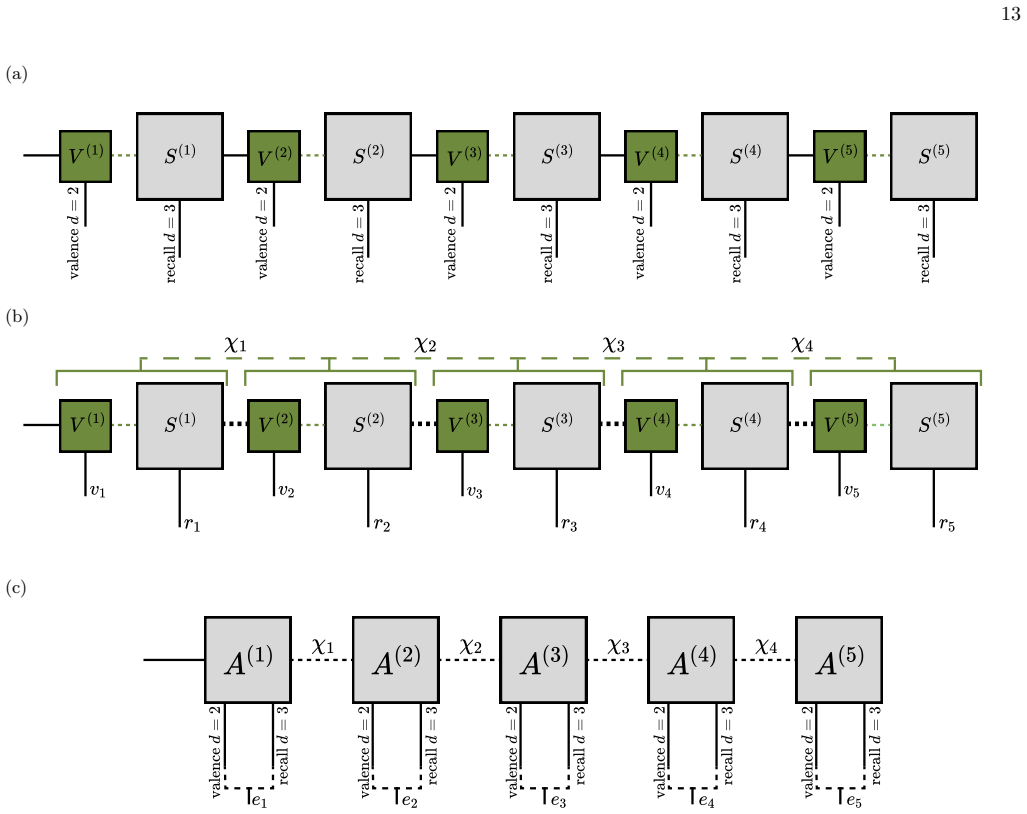
A tensor network with valence, which adds a prim- ing step based on the item’s emotional valence. For each model, a cross-validation process was used to prevent overfitting. Prediction accuracy was calculated for all individual sequence positions, and for the overall sequence. Individual recall classes were also examined, to see whether models are better ...
-
[9]
Mara Mather and Matthew R. Sutherland. Arousal- biased competition in perception and memory.Per- spectives on Psychological Science, 6(2):114–133, 2011. doi:10.1177/1745691611400234
-
[10]
Leonard Faul, Maureen Ritchey, and Elizabeth A. Kensinger. The relationship between subjective vivid- ness and remembered visual characteristics of emotional stimuli across the lifespan.Emotion, 25(6):1579–1595, 2025.doi:10.1037/emo0001518
-
[11]
John T. West, Neil W. Mulligan, and Kristen A. Lindquist. Putting emotional memories in context: The constructionist model of emotional memory.Perspectives on Psychological Science, 0(0):17456916261425152, 2026. doi:10.1177/17456916261425152
-
[12]
Daniel L. Schacter. Adaptive constructive processes and the future of memory.American Psychologist, 67(8):603– 613, 2012.doi:10.1037/a0029869
-
[13]
Daniel L Schacter and Donna Rose Addis. The cogni- tive neuroscience of constructive memory: remember- ing the past and imagining the future.Philosophi- cal Transactions of the Royal Society B: Biological Sci- ences, 362(1481):773–786, 2007.doi:10.1098/rstb. 2007.2087
-
[14]
Raymond P. Kesner and Michael R. Hunsaker. The tem- poral attributes of episodic memory.Behavioural Brain Research, 215(2):299–309, 2010. Special issue on episodic memory.doi:10.1016/j.bbr.2009.12.029
-
[15]
Deborah Talmi and Daniela J. Palombo. Emotional time travel: the role of emotion in temporal memory.Cog- nition and Emotion, 39(1):1–17, 2025.doi:10.1080/ 02699931.2024.2421395
arXiv 2025
-
[16]
Jeff Loucks and Heather L. Price. Memory for tempo- ral order in action is slow developing, sensitive to de- viant input, and supported by foundational cognitive pro- cesses.Developmental Psychology, 55(2):263–273, Feb 2019.doi:10.1037/dev0000637
-
[17]
Kathleen M. Bettencourt, Laurel H. Everett, Yixin Chen, and Thanujeni Pathman. Examining the development of 24 memory for temporal context and its underlying neural processes using event-related potentials.Developmental Cognitive Neuroscience, 48:100932, 2021.doi:10.1016/ j.dcn.2021.100932
arXiv 2021
-
[18]
Blankenship, and Elizabeth Redcay
Tracy Riggins, Fengji Geng, Sarah L. Blankenship, and Elizabeth Redcay. Hippocampal functional connectivity and episodic memory in early childhood.Developmental Cognitive Neuroscience, 19:58–69, 2016.doi:10.1016/ j.dcn.2016.02.002
2016
-
[19]
Anderson, Yuki Yamaguchi, Wojtek Grab- ski, and Dominika Lacka
Adam K. Anderson, Yuki Yamaguchi, Wojtek Grab- ski, and Dominika Lacka. Emotional memories are not all created equal: Evidence for selective memory en- hancement.Learning & Memory, 13(6):711–718, 2006. doi:10.1101/lm.388906
-
[20]
Kelly A. Bennion, Jaclyn H. Ford, Brendan D. Murray, and Elizabeth A. Kensinger. Oversimplification in the study of emotional memory.Journal of the International Neuropsychological Society, 19(9):953–961, 2013.doi: 10.1017/S1355617713000945
-
[21]
James L. McGaugh. The amygdala modulates the consol- idation of memories of emotionally arousing experiences. Annual Review of Neuroscience, 27(1):1–28, 2004-07-21. doi:10.1146/annurev.neuro.27.070203.144157
-
[22]
C. J. Brainerd and S. H. Bookbinder. The semantics of emotion in false memory.Emotion, 19(1):146–159, 2019. doi:10.1037/emo0000431
-
[23]
Maureen Ritchey, Kevin S. LaBar, and Roberto Cabeza. Level of processing modulates the neural correlates of emotional memory formation.Journal of Cognitive Neuroscience, 23(4):757–771, 2011.doi:10.1162/jocn. 2010.21487
-
[24]
Katherine Schmidt, Pooja Patnaik, and Elizabeth A. Kensinger. Emotion’s influence on memory for spatial and temporal context.Cognition & Emotion, 25(2):229– 243, 2011.doi:10.1080/02699931.2010.483123
-
[25]
J. A. Easterbrook. The effect of emotion on cue uti- lization and the organization of behavior.Psychological Review, 66(3):183–201, 1959.doi:10.1037/h0047707
-
[26]
Tiziana Lanciano and Antonietta Curci. Memory for emotional events: The accuracy of central and periph- eral details.Europe’s Journal of Psychology, 7(2):323– 336, 2011.doi:10.5964/ejop.v7i2.132
-
[27]
The impact of stress on neutral and emotional aspects of episodic memory.Memory, 14(1):1–16, 2006.doi:10.1080/ 09658210500139176
Jessica Payne, Eric Jackson, Lee Ryan, Siobhan Hoscheidt, Jake Jacobs, and Lynn Nadel. The impact of stress on neutral and emotional aspects of episodic memory.Memory, 14(1):1–16, 2006.doi:10.1080/ 09658210500139176
2006
-
[28]
Kaplan, Ilse Van Damme, and Linda J
Robin L. Kaplan, Ilse Van Damme, and Linda J. Levine. Motivation matters: Differing effects of pre-goal and post-goal emotions on attention and memory.Frontiers in Psychology, 3, 2012.doi:10.3389/fpsyg.2012.00404
-
[29]
Lina Deker and Thanujeni Pathman. Did i visit the polar bear before the giraffe? examining memory for temporal order and the temporal distance effect in early to middle childhood.Applied Cognitive Psychology, 35(3):785–794, 2021.doi:10.1002/acp.3804
-
[30]
Martha E. Arterberry and Eliana J. Albright. Chil- dren’s memory for temporal information: The roles of temporal language and executive function.The Jour- nal of Genetic Psychology, 181(4):191–205, 2020.doi: 10.1080/00221325.2020.1741503
-
[31]
Aria S. Petrucci and Daniela J. Palombo. A matter of time: how does emotion influence temporal aspects of remembering?Cognition and Emotion, 35(8):1499–1515, 2021.doi:10.1080/02699931.2021.1976733
-
[32]
Jingyi Wang and Regina C. Lapate. Emotional state dynamics impacts temporal memory.Cognition and Emotion, 39(1):136–155, 2025.doi:10.1080/02699931. 2024.2349326
-
[33]
Deea K Dev, Victoria Wardell, Katherine J. Check- nita, Alessandra A. Te, Aria S. Petrucci, M. Lindy Le, Christopher R. Madan, and Daniela J. Palombo. Neg- ative emotion enhances memory for the sequential un- folding of a naturalistic experience.Journal of Applied Research in Memory and Cognition, 11(4):510–521, 2022. doi:10.1037/mac0000015
-
[34]
Murray Murray Glanzer and Anita R. Cunitz. Two storage mechanisms in free recall.Journal of Verbal Learning and Verbal Behavior, 5(4):351–360, 1966.doi: 10.1016/S0022-5371(66)80044-0
-
[35]
Cappa, and Simone Rossi
Fabio Giovannelli, Iglis Innocenti, Emiliano Santarnec- chi, Elisa Tatti, Stefano F. Cappa, and Simone Rossi. Emotional context shapes the serial position curve.Brain Sciences, 12(5):581, 2022.doi:10.3390/ brainsci12050581
2022
-
[36]
Busemeyer, Harald At- manspacher, and Emmanuel M
Zheng Wang, Jerome R. Busemeyer, Harald At- manspacher, and Emmanuel M. Pothos. The poten- tial of using quantum theory to build models of cogni- tion.Topics in Cognitive Science, 5(4):672–688, 2013. doi:10.1111/tops.12043
-
[37]
Die plancksche entdeckung und die philosophischen grundfragen der atomlehre.Naturwis- senschaften, 45(10):227–234, Jan 1958.doi:10.1007/ BF00602689
Werner Heisenberg. Die plancksche entdeckung und die philosophischen grundfragen der atomlehre.Naturwis- senschaften, 45(10):227–234, Jan 1958.doi:10.1007/ BF00602689
1958
-
[38]
Emmanuel M. Pothos and Jerome R. Busemeyer. Can quantum probability provide a new direction for cog- nitive modeling?Behavioral and Brain Sciences, 36(3):255–274, 2013.doi:10.1017/S0140525X12001525
-
[39]
Rasinski, Lisa Lee, and Parvati Krishna- murty.Question order effects., pages 229–248
Kenneth A. Rasinski, Lisa Lee, and Parvati Krishna- murty.Question order effects., pages 229–248. APA handbooks in psychology®. American Psychological As- sociation, Washington, DC, US, 2012.doi:10.1037/ 13619-014
2012
-
[40]
Masanao Ozawa and Andrei Khrennikov. Nondistributiv- ity of human logic and violation of response replicability effect in cognitive psychology.Journal of Mathemati- cal Psychology, 112:102739, 2023.doi:10.1016/j.jmp. 2022.102739
-
[41]
Naotsugu Tsuchiya, Peter Bruza, Makiko Yamada, Hay- ato Saigo, and Emmanuel M. Pothos. Quantum-like qualia hypothesis: from quantum cognition to quan- tum perception.Frontiers in Psychology, Volume 15 - 2024(1406459), 2025.doi:10.3389/fpsyg.2024. 1406459
-
[42]
An act-r model of order effects
Christopher R Fisher, Lorraine Borghetti, Joseph W Houpt, and Christopher Stevens. An act-r model of order effects. InProceedings of the 19th interna- tional conference on cognitive modeling, 2021. URL: https://iccm-conference.neocities.org/2021/ papers/567.pdf
2021
-
[43]
White, Albert Barqu´ e-Duran, and Emmanuel M
Lee C. White, Albert Barqu´ e-Duran, and Emmanuel M. Pothos. An investigation of a quantum probability model for the constructive effect of affective evalua- tion.Philosophical Transactions of the Royal Society A: Mathematical, Physical and Engineering Sciences, 374(2058):20150142, 01 2016.doi:10.1098/rsta.2015. 0142
-
[44]
Busemeyer and Peter D
Jerome R. Busemeyer and Peter D. Bruza.Quantum 25 Models of Cognition and Decision. Cambridge University Press, 2012
2012
-
[45]
Lee C. White, Emmanuel M. Pothos, and Jerome R. Busemeyer. Sometimes it does hurt to ask: The con- structive role of articulating impressions.Cognition, 133(1):48–64, 2014.doi:10.1016/j.cognition.2014. 05.015
-
[46]
Masanao Ozawa and Andrei Khrennikov. Modeling com- bination of question order effect, response replicabil- ity effect, and QQ-equality with quantum instruments. Journal of Mathematical Psychology, 100:102491, 2021. doi:10.1016/j.jmp.2020.102491
-
[47]
Miho Fuyama, Andrei Khrennikov, and Masanao Ozawa. Quantum-like cognition and decision making in the light of quantum measurement theory.Philosophical Trans- actions of the Royal Society A: Mathematical, Physi- cal and Engineering Sciences, 383(2309):20240372, 2025. doi:10.1098/rsta.2024.0372
-
[48]
Busemeyer, Masanao Ozawa, Emmanuel Pothos, and Nao Tsuchiya
Jerome R. Busemeyer, Masanao Ozawa, Emmanuel Pothos, and Nao Tsuchiya. Incorporating episodic memory into quantum models of judgement and de- cision.Philosophical Transactions of the Royal So- ciety A: Mathematical, Physical and Engineering Sci- ences, 383(2309):20240387, 2025.doi:10.1098/rsta. 2024.0387
-
[49]
Steven R. White. Density matrix formulation for quan- tum renormalization groups.Physical Review Letters, 69(19):2863–2866, 1992.doi:10.1103/PhysRevLett.69. 2863
-
[50]
Vidal, Efficient Classical Simulation of Slightly Entangled Quantum Computations , Phys
Guifr´ e Vidal. Efficient classical simulation of slightly en- tangled quantum computations.Physical Review Letters, 91(14), 2003.doi:10.1103/physrevlett.91.147902
-
[51]
D. Perez-Garcia, F. Verstraete, M. M. Wolf, and J. I. Cirac. Matrix product state representations.arXiv preprint arXiv:quant-ph/0608197, 2007. URL:https: //arxiv.org/abs/quant-ph/0608197
Pith/arXiv arXiv 2007
-
[52]
A practical introduction to tensor net- works: Matrix product states and projected entangled pair states.Annals of Physics, 349, 2013.doi:10.1016/ j.aop.2014.06.013
Roman Orus. A practical introduction to tensor net- works: Matrix product states and projected entangled pair states.Annals of Physics, 349, 2013.doi:10.1016/ j.aop.2014.06.013
2013
-
[53]
Gray, Sol Simpson, Michael MacAskill, Richard H¨ ochenberger, Hiroyuki Sogo, Erik Kastman, and Jonas Kristoffer Lindeløv
Jonathan Peirce, Jeremy R. Gray, Sol Simpson, Michael MacAskill, Richard H¨ ochenberger, Hiroyuki Sogo, Erik Kastman, and Jonas Kristoffer Lindeløv. Psychopy2: Experiments in behavior made easy.Behavior Re- search Methods, 51(1):195–203, Feb 2019.doi:10.3758/ s13428-018-01193-y
2019
-
[54]
Sligte, H
Ilja G. Sligte, H. Steven Scholte, and Victor A. F. Lamme. Are there multiple visual short-term memory stores?PLOS ONE, 3(2):1–9, 02 2008.doi:10.1371/ journal.pone.0001699
2008
-
[55]
Tensor- network-based machine learning of non-markovian quan- tum processes.Phys
Chu Guo, Kavan Modi, and Dario Poletti. Tensor- network-based machine learning of non-markovian quan- tum processes.Phys. Rev. A, 102:062414, Dec 2020. doi:10.1103/PhysRevA.102.062414
-
[56]
Carl Eckart and Gale Young. The approximation of one matrix by another of lower rank.Psychometrika, 1(3):211–218, 1936.doi:10.1007/BF02288367
-
[57]
L. Mirsky. Symmetric gauge functions and unitarily in- variant norms.The Quarterly Journal of Mathematics, 11(1):50–59, 1960.doi:10.1093/qmath/11.1.50
-
[58]
Applications of negative dimensional ten- sors
Roger Penrose. Applications of negative dimensional ten- sors. In D. J. A. Welsh, editor,Combinatorial Mathemat- ics and its Applications, pages 221–244. Academic Press, 1971
1971
-
[59]
Oxford University Press, Oxford, 1983
Endel Tulving.Elements of Episodic Memory. Oxford University Press, Oxford, 1983
1983
-
[60]
Diana, Andrew P
Rachel A. Diana, Andrew P. Yonelinas, and Charan Ran- ganath. Imaging recollection and familiarity in the me- dial temporal lobe: a three-component model.Trends in Cognitive Sciences, 11(9):379–386, 2007
2007
-
[61]
Kensinger
Elizabeth A. Kensinger. Remembering the details: Ef- fects of emotion on memory.Emotion Review, 1(2):99– 113, 2009
2009
-
[62]
Emmanuel M. Pothos and Jerome R. Buse- meyer. Quantum cognition.Annual Re- view of Psychology, 73(1):749–778, 2021.doi: 10.1146/annurev-psych-033020-123501
-
[63]
Supervised learning with tensor networks
Edwin Stoudenmire and David Schwab. Supervised learning with tensor networks. In D. Lee, M. Sugiyama, U. Luxburg, I. Guyon, and R. Garnett, editors,Ad- vances in Neural Information Processing Systems, volume 29. Curran Associates, Inc., 2016. URL:https: //proceedings.neurips.cc/paper_files/paper/2016/ file/5314b9674c86e3f9d1ba25ef9bb32895-Paper.pdf
2016
-
[64]
Busemeyer, Zheng Wang, and James T
Jerome R. Busemeyer, Zheng Wang, and James T. Townsend. Quantum dynamics of human decision- making.Journal of Mathematical Psychology, 50(3):220– 241, 2006. Special Issue: Jean-Claude Falmagne: Part II.doi:10.1016/j.jmp.2006.01.003
-
[65]
Enhanced emotional memory: Cogni- tive and neural mechanisms.Current Directions in Psy- chological Science, 22(6):430–436, 2013.doi:10.1177/ 0963721413498893
Deborah Talmi. Enhanced emotional memory: Cogni- tive and neural mechanisms.Current Directions in Psy- chological Science, 22(6):430–436, 2013.doi:10.1177/ 0963721413498893
2013
-
[66]
C. J. Brainerd and V. F. Reyna, editors.The Science of False Memory. Oxford University Press, 05 2005.doi: 10.1093/acprof:oso/9780195154054.001.0001
work page doi:10.1093/acprof:oso/9780195154054.001.0001 2005
-
[67]
Susan E. Gathercole, Susan J. Pickering, Benjamin Am- bridge, and Hannah Wearing. The structure of working memory from 4 to 15 years of age.Developmental Psy- chology, 40(2):177–190, 2004.doi:10.1037/0012-1649. 40.2.177
-
[68]
Lang and Margaret M
Peter J. Lang and Margaret M. Bradley. Emotion and the motivational brain.Biological Psychology, 84(3):437–450,
-
[69]
The biopsychology of emotion: Current theoretical and empirical perspectives.doi:10.1016/j.biopsycho. 2009.10.007
-
[70]
Executive functions.Annual Re- view of Psychology, 64:135–168, 2013.doi:10.1146/ annurev-psych-113011-143750
Adele Diamond. Executive functions.Annual Re- view of Psychology, 64:135–168, 2013.doi:10.1146/ annurev-psych-113011-143750
2013
-
[71]
The density-matrix renormalization group in the age of matrix product states
Ulrich Schollw¨ ock. The density-matrix renormalization group in the age of matrix product states.Annals of Physics, 326(1):96–192, 2011.doi:10.1016/j.aop. 2010.09.012
-
[72]
J. Eisert, M. Cramer, and M. B. Plenio. Colloquium: Area laws for the entanglement entropy.Rev. Mod. Phys., 82(1):277–306, 2010.doi:10.1103/RevModPhys.82.277
-
[73]
M B Hastings. An area law for one-dimensional quan- tum systems.Journal of Statistical Mechanics: The- ory and Experiment, 2007(8):P08024–P08024, 2007.doi: 10.1088/1742-5468/2007/08/p08024. Appendix A: Area Law Violation MPSs were originally developed in the context of the Density Matrix Renormalisation Group (DMRG) algo- rithm in quantum physics, which i...
discussion (0)
Sign in with ORCID, Apple, or X to comment. Anyone can read and Pith papers without signing in.