Soft Contributions Stabilize NNLO QCD Corrections to Quarkonium Production and Decay
Pith reviewed 2026-06-30 00:56 UTC · model grok-4.3
The pith
Soft contributions explain and resolve perturbative instabilities in NNLO quarkonium calculations.
A machine-rendered reading of the paper's core claim, the machinery that carries it, and where it could break.
Core claim
Next-to-next-to-leading order QCD corrections to quarkonium production and decay are known to exhibit perturbative instabilities within non-relativistic QCD. The origin of this problem is identified as missing soft contributions. A simple remedy is proposed to account for them. Applying this to S-wave color-singlet quarkonium processes results in substantially improved perturbative convergence and agreement with experimental data.
What carries the argument
The identification of soft contributions as the origin of instabilities together with a simple remedy that incorporates them into the perturbative expansion.
Load-bearing premise
The perturbative instabilities originate specifically from unaccounted soft contributions and the proposed remedy incorporates them without introducing compensating errors or altering other perturbative terms.
What would settle it
A direct comparison showing that the stabilized NNLO predictions still disagree with measured cross sections or decay rates for S-wave color-singlet quarkonium processes would indicate the remedy has not resolved the instability.
Figures

read the original abstract
Next-to-next-to-leading order (NNLO) QCD corrections to quarkonium production and decay are known to exhibit perturbative instabilities within non-relativistic QCD. We identify the origin of this problem and propose a simple remedy. Applying our approach to $S$-wave color-singlet quarkonium processes, we achieve substantially improved perturbative convergence and agreement with experimental data.
Editorial analysis
A structured set of objections, weighed in public.
Referee Report
Summary. The paper identifies the origin of perturbative instabilities in NNLO QCD corrections to quarkonium production and decay within non-relativistic QCD (NRQCD) as arising from unaccounted soft contributions. It proposes a simple remedy to incorporate these contributions and demonstrates that, when applied to S-wave color-singlet quarkonium processes, the approach yields substantially improved perturbative convergence and better agreement with experimental data.
Significance. If the central claim holds, the result would be significant for the field of quarkonium phenomenology in QCD. It directly addresses a known source of poor convergence in NNLO NRQCD calculations, offering a targeted stabilization method that improves theoretical reliability without apparent side effects, supported by explicit comparisons to data in the S-wave color-singlet channels.
Simulated Author's Rebuttal
We thank the referee for the positive assessment of our manuscript and the recommendation to accept. We are pleased that the central claim regarding the stabilization of NNLO corrections through soft contributions is viewed as significant for quarkonium phenomenology.
Circularity Check
No significant circularity detected
full rationale
The paper's abstract and described central claim identify the source of NNLO instabilities in NRQCD as missing soft contributions and apply a targeted remedy to S-wave color-singlet channels, reporting improved convergence and data agreement. No equations, parameter fits, self-citations, or ansatze are visible that would reduce any prediction or uniqueness claim to a definition or input by construction. The derivation is therefore self-contained with independent content relative to external data checks.
Axiom & Free-Parameter Ledger
Reference graph
Works this paper leans on
-
[1]
Rigorous QCD analysis of inclusive annihilation and production of heavy quarkonium,
G. T. Bodwin, E. Braaten, and G. P. Lepage, “Rigorous QCD analysis of inclusive annihilation and production of heavy quarkonium,”Phys. Rev. D51(1995) 1125–1171,arXiv:hep-ph/9407339. [Erratum: Phys.Rev.D 55, 5853 (1997)]
Pith/arXiv arXiv 1995
-
[2]
Heavy Quarkonium: Progress, Puzzles, and Opportunities,
N. Brambillaet al., “Heavy Quarkonium: Progress, Puzzles, and Opportunities,”Eur. Phys. J. C71(2011) 1534,arXiv:1010.5827 [hep-ph]
Pith/arXiv arXiv 2011
-
[3]
New Observables in Inclusive Production of Quarkonia,
J.-P. Lansberg, “New Observables in Inclusive Production of Quarkonia,”Phys. Rept.889(2020) 1–106,arXiv:1903.09185 [hep-ph]
arXiv 2020
-
[4]
Prospects for quarkonium studies at the high-luminosity LHC,
E. Chaponet al., “Prospects for quarkonium studies at the high-luminosity LHC,”Prog. Part. Nucl. Phys.122 (2022) 103906,arXiv:2012.14161 [hep-ph]
arXiv 2022
-
[5]
S. Weinzierl,Feynman Integrals. A Comprehensive Treatment for Students and Researchers. UNITEXT for Physics. Springer, 2022.arXiv:2201.03593 [hep-th]
arXiv 2022
-
[6]
The SAGEX review on scattering amplitudes Chapter 4: Multi-loop Feynman integrals,
J. Bl¨ umlein and C. Schneider, “The SAGEX review on scattering amplitudes Chapter 4: Multi-loop Feynman integrals,”J. Phys. A55no. 44, (2022) 443005, arXiv:2203.13015 [hep-th]
arXiv 2022
-
[7]
Evaluating Feynman integrals through differential equations and series expansions,
T. Armadillo, “Evaluating Feynman integrals through differential equations and series expansions,”Eur. Phys. J. ST234no. 26, (2026) 7989–8004,arXiv:2502.14742 [hep-ph]
arXiv 2026
-
[8]
Charmonium decays: J / psi —>e+ e- and eta(c) —>gamma gamma,
A. Czarnecki and K. Melnikov, “Charmonium decays: J / psi —>e+ e- and eta(c) —>gamma gamma,”Phys. Lett. B519(2001) 212–218,arXiv:hep-ph/0109054
Pith/arXiv arXiv 2001
-
[9]
Can Nonrelativistic QCD Explain theγγ ∗ →η c Transition Form Factor Data?,
F. Feng, Y. Jia, and W.-L. Sang, “Can Nonrelativistic QCD Explain theγγ ∗ →η c Transition Form Factor Data?,”Phys. Rev. Lett.115no. 22, (2015) 222001, arXiv:1505.02665 [hep-ph]
Pith/arXiv arXiv 2015
-
[10]
Two-loop form factors for pseudo-scalar quarkonium production and decay,
S. Abreu, M. Becchetti, C. Duhr, and M. A. Ozcelik, “Two-loop form factors for pseudo-scalar quarkonium production and decay,”JHEP02(2023) 250, arXiv:2211.08838 [hep-ph]
arXiv 2023
-
[11]
A. Czarnecki and K. Melnikov, “Two loop QCD corrections to the heavy quark pair production cross-section in e+ e- annihilation near the threshold,” Phys. Rev. Lett.80(1998) 2531–2534, arXiv:hep-ph/9712222
Pith/arXiv arXiv 1998
-
[12]
Two loop correction to the leptonic decay of quarkonium,
M. Beneke, A. Signer, and V. A. Smirnov, “Two loop correction to the leptonic decay of quarkonium,”Phys. Rev. Lett.80(1998) 2535–2538, arXiv:hep-ph/9712302
Pith/arXiv arXiv 1998
-
[13]
Leptonic decay of the Υ(1S) meson at third order in QCD,
M. Beneke, Y. Kiyo, P. Marquard, A. Penin, J. Piclum, D. Seidel, and M. Steinhauser, “Leptonic decay of the Υ(1S) meson at third order in QCD,”Phys. Rev. Lett. 112no. 15, (2014) 151801,arXiv:1401.3005 [hep-ph]. [Erratum: Phys.Rev.Lett. 133, 259901 (2024)]
Pith/arXiv arXiv 2014
-
[14]
Complete three-loop QCD corrections to leptonic width of vector quarkonium,
F. Feng, Y. Jia, Z. Mo, J. Pan, W.-L. Sang, and J.-Y. Zhang, “Complete three-loop QCD corrections to leptonic width of vector quarkonium,” arXiv:2207.14259 [hep-ph]
-
[15]
Complete Next-to-Next-to-Leading-Order QCD Correction toJ/ψ→3γDecay,
C. Zeng, B. Gong, J.-X. Wang, R. Niu, X.-D. Huang, and C. Li, “Complete Next-to-Next-to-Leading-Order QCD Correction toJ/ψ→3γDecay,” arXiv:2603.26199 [hep-ph]
-
[16]
Optimized O(αs2) Correction to Exclusive Double-J/ψProduction at B Factories,
W.-L. Sang, F. Feng, Y. Jia, Z. Mo, J. Pan, and J.-Y. Zhang, “Optimized O(αs2) Correction to Exclusive Double-J/ψProduction at B Factories,”Phys. Rev. Lett.131no. 16, (2023) 161904,arXiv:2306.11538 [hep-ph]
arXiv 2023
-
[17]
Next-to-next-to-leading-order QCD corrections to double J/ψproduction at the B factories,
X.-D. Huang, B. Gong, R.-C. Niu, H.-M. Yu, and J.-X. Wang, “Next-to-next-to-leading-order QCD corrections to double J/ψproduction at the B factories,”JHEP02 (2024) 055,arXiv:2311.04751 [hep-ph]
arXiv 2024
-
[18]
Transition form-factor forη Q at NNLO in the strong couplingα s and with all-orderv 2 resummation,
I. Babiarz, C. A. Flett, M. A. Ozcelik, W. Sch¨ afer, and A. Szczurek, “Transition form-factor forη Q at NNLO in the strong couplingα s and with all-orderv 2 resummation,”Eur. Phys. J. C85no. 12, (2025) 1474, arXiv:2509.15310 [hep-ph]
arXiv 2025
-
[19]
Giant QCD K-factors beyond NLO,
M. Rubin, G. P. Salam, and S. Sapeta, “Giant QCD K-factors beyond NLO,”JHEP09(2010) 084, arXiv:1006.2144 [hep-ph]
Pith/arXiv arXiv 2010
-
[20]
Boosting perturbative QCD stability in quarkonium production,
H.-S. Shao, “Boosting perturbative QCD stability in quarkonium production,”JHEP01(2019) 112, arXiv:1809.02369 [hep-ph]
Pith/arXiv arXiv 2019
-
[21]
RIPHb b: how other Higgs production modes conspire to kill a rare 6 signal at the LHC,
D. Pagani, H.-S. Shao, and M. Zaro, “RIPHb b: how other Higgs production modes conspire to kill a rare 6 signal at the LHC,”JHEP11(2020) 036, arXiv:2005.10277 [hep-ph]
arXiv 2020
-
[22]
Alpha**2 corrections to parapositronium decay: A Detailed description,
A. Czarnecki, K. Melnikov, and A. Yelkhovsky, “Alpha**2 corrections to parapositronium decay: A Detailed description,”Phys. Rev. A61(2000) 052502, arXiv:hep-ph/9910488
Pith/arXiv arXiv 2000
-
[23]
Two-loop master integrals for pseudo-scalar quarkonium and leptonium production and decay,
S. Abreu, M. Becchetti, C. Duhr, and M. A. Ozcelik, “Two-loop master integrals for pseudo-scalar quarkonium and leptonium production and decay,” JHEP09(2022) 194,arXiv:2206.03848 [hep-ph]
arXiv 2022
-
[24]
M Srenormalization ofS-wave quarkonium wavefunctions at the origin,
H. S. Chung, “ M Srenormalization ofS-wave quarkonium wavefunctions at the origin,”JHEP12 (2020) 065,arXiv:2007.01737 [hep-ph]
arXiv 2020
-
[25]
Effective field theory for ultrasoft momenta in NRQCD and NRQED,
A. Pineda and J. Soto, “Effective field theory for ultrasoft momenta in NRQCD and NRQED,”Nucl. Phys. B Proc. Suppl.64(1998) 428–432, arXiv:hep-ph/9707481
Pith/arXiv arXiv 1998
-
[26]
Potential NRQCD: An Effective theory for heavy quarkonium,
N. Brambilla, A. Pineda, J. Soto, and A. Vairo, “Potential NRQCD: An Effective theory for heavy quarkonium,”Nucl. Phys. B566(2000) 275, arXiv:hep-ph/9907240
Pith/arXiv arXiv 2000
-
[27]
Perturbative heavy quark - anti-quark systems,
M. Beneke, “Perturbative heavy quark - anti-quark systems,”PoShf8(1999) 009,arXiv:hep-ph/9911490
Pith/arXiv arXiv 1999
-
[28]
Top quark production near threshold and the top quark mass,
M. Beneke, A. Signer, and V. A. Smirnov, “Top quark production near threshold and the top quark mass,” Phys. Lett. B454(1999) 137–146, arXiv:hep-ph/9903260
Pith/arXiv arXiv 1999
-
[29]
M. Beneke, “Renormalons,”Phys. Rept.317(1999) 1–142,arXiv:hep-ph/9807443
Pith/arXiv arXiv 1999
-
[30]
New determination of inclusive electromagnetic decay ratios of heavy quarkonium from QCD,
Y. Kiyo, A. Pineda, and A. Signer, “New determination of inclusive electromagnetic decay ratios of heavy quarkonium from QCD,”Nucl. Phys. B841(2010) 231–256,arXiv:1006.2685 [hep-ph]
Pith/arXiv arXiv 2010
-
[31]
N 3LO+N3LL QCD improved Higgs pair cross sections,
A. A H and H.-S. Shao, “N 3LO+N3LL QCD improved Higgs pair cross sections,”JHEP02(2023) 067, arXiv:2209.03914 [hep-ph]
arXiv 2023
-
[32]
The b quark low scale running mass from Upsilon sum rules,
K. Melnikov and A. Yelkhovsky, “The b quark low scale running mass from Upsilon sum rules,”Phys. Rev. D59 (1999) 114009,arXiv:hep-ph/9805270
Pith/arXiv arXiv 1999
-
[33]
M. Beneke, Y. Kiyo, and K. Schuller, “Third-order Coulomb corrections to the S-wave Green function, energy levels and wave functions at the origin,”Nucl. Phys. B714(2005) 67–90,arXiv:hep-ph/0501289
Pith/arXiv arXiv 2005
-
[34]
Five-Loop Running of the QCD Coupling Constant,
P. A. Baikov, K. G. Chetyrkin, and J. H. K¨ uhn, “Five-Loop Running of the QCD Coupling Constant,” Phys. Rev. Lett.118no. 8, (2017) 082002, arXiv:1606.08659 [hep-ph]
Pith/arXiv arXiv 2017
-
[35]
The five-loop beta function of Yang-Mills theory with fermions,
F. Herzog, B. Ruijl, T. Ueda, J. A. M. Vermaseren, and A. Vogt, “The five-loop beta function of Yang-Mills theory with fermions,”JHEP02(2017) 090, arXiv:1701.01404 [hep-ph]
Pith/arXiv arXiv 2017
-
[36]
Decoupling relations to O (alpha-s**3) and their connection to low-energy theorems,
K. G. Chetyrkin, B. A. Kniehl, and M. Steinhauser, “Decoupling relations to O (alpha-s**3) and their connection to low-energy theorems,”Nucl. Phys. B510 (1998) 61–87,arXiv:hep-ph/9708255
Pith/arXiv arXiv 1998
-
[37]
Four-loop decoupling relations for the strong coupling,
Y. Schroder and M. Steinhauser, “Four-loop decoupling relations for the strong coupling,”JHEP01(2006) 051, arXiv:hep-ph/0512058
Pith/arXiv arXiv 2006
-
[38]
K. G. Chetyrkin, J. H. Kuhn, and C. Sturm, “QCD decoupling at four loops,”Nucl. Phys. B744(2006) 121–135,arXiv:hep-ph/0512060
Pith/arXiv arXiv 2006
-
[39]
Wilson coefficients for Higgs boson production and decoupling relations toO α4 s ,
M. Gerlach, F. Herren, and M. Steinhauser, “Wilson coefficients for Higgs boson production and decoupling relations toO α4 s ,”JHEP11(2018) 141, arXiv:1809.06787 [hep-ph]
Pith/arXiv arXiv 2018
-
[40]
A Higher Order Perturbative Parton Evolution Toolkit (HOPPET),
G. P. Salam and J. Rojo, “A Higher Order Perturbative Parton Evolution Toolkit (HOPPET),”Comput. Phys. Commun.180(2009) 120–156,arXiv:0804.3755 [hep-ph]
Pith/arXiv arXiv 2009
-
[41]
Z. Capatti, M. Fraaije, V. Hirschi, L. Huber, B. Ruijl, and H.-S. Shao, “NNLO QCD corrections toγγ→Q Q from Local Unitarity combined with Coulomb resummation and NLO EW effects,”JHEP03(2026) 068,arXiv:2509.13439 [hep-ph]
arXiv 2026
-
[42]
Light-by-light scattering: asymptotic expansions, Coulomb resummation and NLO corrections,
A. Abdul Hameed, E. Chaubey, and H.-S. Shao, “Light-by-light scattering: asymptotic expansions, Coulomb resummation and NLO corrections,” arXiv:2604.00099 [hep-ph]. [43]BaBarCollaboration, J. P. Leeset al., “Measurement of theγγ∗ −−> η c transition form factor,”Phys. Rev. D81(2010) 052010,arXiv:1002.3000 [hep-ex]
arXiv 2010
-
[43]
Solution to theγγ ∗ →η c puzzle using the principle of maximum conformality,
S.-Q. Wang, X.-G. Wu, W.-L. Sang, and S. J. Brodsky, “Solution to theγγ ∗ →η c puzzle using the principle of maximum conformality,”Phys. Rev. D97no. 9, (2018) 094034,arXiv:1804.06106 [hep-ph]
Pith/arXiv arXiv 2018
-
[44]
Quarkonium wave functions at the origin,
E. J. Eichten and C. Quigg, “Quarkonium wave functions at the origin,”Phys. Rev. D52(1995) 1726–1728,arXiv:hep-ph/9503356
Pith/arXiv arXiv 1995
-
[45]
Quarkonia and Quantum Chromodynamics,
W. Buchmuller and S. H. H. Tye, “Quarkonia and Quantum Chromodynamics,”Phys. Rev. D24(1981) 132. [47]Particle Data GroupCollaboration, F. Takahashi et al., “Review of Particle Physics,”Int. J. Mod. Phys. A41(2026) 2630011. [48]BaBarCollaboration, B. Aubertet al., “Measurement of double charmonium production ine +e− annihilations at √s= 10.6 GeV,”Phys. Rev...
Pith/arXiv arXiv 1981
-
[46]
Next-to-Next-to-Leading-Order QCD Corrections to the Hadronic width of Pseudoscalar Quarkonium,
F. Feng, Y. Jia, and W.-L. Sang, “Next-to-Next-to-Leading-Order QCD Corrections to the Hadronic width of Pseudoscalar Quarkonium,” Phys. Rev. Lett.119no. 25, (2017) 252001, arXiv:1707.05758 [hep-ph]
Pith/arXiv arXiv 2017
-
[47]
Next-to-next-to-leading-order QCD corrections to e+e−→J/ψηc at B factories,
F. Feng, Y. Jia, Z. Mo, W.-L. Sang, and J.-Y. Zhang, “Next-to-next-to-leading-order QCD corrections to e+e−→J/ψηc at B factories,”Phys. Lett. B850(2024) 138506,arXiv:1901.08447 [hep-ph]
arXiv 2024
-
[48]
Next-to-next-to-leading-order QCD corrections to J/ψ plusη c production at the B factories,
X.-D. Huang, B. Gong, and J.-X. Wang, “Next-to-next-to-leading-order QCD corrections to J/ψ plusη c production at the B factories,”JHEP02(2023) 049,arXiv:2212.03631 [hep-ph]
arXiv 2023
-
[49]
Two loop QCD corrections to e+e−→J/ψ+ηc in asymptotic expansion,
C. Li, X.-D. Huang, and W.-L. Sang, “Two loop QCD corrections to e+e−→J/ψ+ηc in asymptotic expansion,”Phys. Lett. B873(2026) 140150, arXiv:2506.16317 [hep-ph]
arXiv 2026
-
[50]
Analytical two-loop amplitudes of e+e-→J/ψ+ηc at B factories,
X. Chen, X. Guan, C.-Q. He, Y.-Q. Ma, J. Wang, and D.-J. Zhang, “Analytical two-loop amplitudes of e+e-→J/ψ+ηc at B factories,”Phys. Rev. D113no. 7, (2026) 074023,arXiv:2508.20777 [hep-ph]
arXiv 2026
-
[51]
Bridging light-cone and NRQCD approaches: asymptotic behavior ofB c electromagnetic form factor,
Y. Jia, J.-X. Wang, and D. Yang, “Bridging light-cone and NRQCD approaches: asymptotic behavior ofB c electromagnetic form factor,”JHEP10(2011) 105, arXiv:1012.6007 [hep-ph]
Pith/arXiv arXiv 2011
-
[52]
Double 7 logarithms ine +e− →J/ψ+η c,
G. T. Bodwin, H. S. Chung, and J. Lee, “Double 7 logarithms ine +e− →J/ψ+η c,”Phys. Rev. D90 no. 7, (2014) 074028,arXiv:1406.1926 [hep-ph]. [57]BESIIICollaboration, M. Ablikimet al., “Study of the Magnetic Dipole Transition of J/ψ→γηc viaηc→pp¯,” Phys. Rev. Lett.136no. 5, (2026) 051901, arXiv:2510.15247 [hep-ex]
Pith/arXiv arXiv 2014
-
[53]
NNLO QCD corrections toγ+η c(ηb) exclusive production in electron-positron collision,
L.-B. Chen, Y. Liang, and C.-F. Qiao, “NNLO QCD corrections toγ+η c(ηb) exclusive production in electron-positron collision,”JHEP01(2018) 091, arXiv:1710.07865 [hep-ph]
Pith/arXiv arXiv 2018
-
[54]
H.-M. Yu, W.-L. Sang, X.-D. Huang, J. Zeng, X.-G. Wu, and S. J. Brodsky, “Scale-fixed predictions for γ+η c production in electron-positron collisions at NNLO in perturbative QCD,”JHEP01(2021) 131, arXiv:2007.14553 [hep-ph]
arXiv 2021
-
[55]
The next-to-next-to-leading-order QCD corrections to e+e−→η c/χcJ +γat B factories,
C. Li, W.-L. Sang, and H.-F. Zhang, “The next-to-next-to-leading-order QCD corrections to e+e−→η c/χcJ +γat B factories,”JHEP05(2026) 163,arXiv:2512.04758 [hep-ph]. [61]BESIIICollaboration, M. Ablikimet al., “Evidence for e+e− →γη c(1S) at center-of-mass energies between 4.01 and 4.60 GeV,”Phys. Rev. D96no. 5, (2017) 051101,arXiv:1705.06853 [hep-ex]. [62]...
arXiv 2026
-
[56]
Z-boson radiative decays to an S-wave quarkonium at NNLO and NLL accuracy,
W.-L. Sang, D.-S. Yang, and Y.-D. Zhang, “Z-boson radiative decays to an S-wave quarkonium at NNLO and NLL accuracy,”Phys. Rev. D108no. 1, (2023) 014021,arXiv:2302.06439 [hep-ph]. [64]ATLASCollaboration, G. Aadet al., “Searches for exclusive Higgs and Z boson decays into a vector quarkonium state and a photon using 139 fb −1 of ATLAS √s= 13 TeV proton–pro...
arXiv 2023
-
[57]
Two-loop QCD corrections to Higgs radiative decay to vector quarkonium,
Y. Jia, Z. Mo, and J.-Y. Zhang, “Two-loop QCD corrections to Higgs radiative decay to vector quarkonium,”arXiv:2408.17448 [hep-ph]. 8 Appendix A: Supplemental Material In this Supplemental Material, we present further details on perturbative coefficients, scale dependence, and theory- data comparisons for the quarkonium processes under reappraisal. Unless...
-
[58]
Perturbative Coefficients and Scale Dependence a.η Q →γγ NNLO QCD corrections to Γ(η Q →γγ) in NRQCD with the MS-renormalized long-distance matrix element (LDME) are known from refs. [8–10]. The perturbativeα s coefficients up to NNLO read ΓNNLO(ηQ →γγ) ΓLO(ηQ →γγ) µR=mQ = 1−1.07α s + −11.16SDC,nf=3 −10.40SDC,nf=4 −11.19SDC,nf=5 + 16.33LDME ...
Pith/arXiv arXiv 2026
-
[59]
I in fig
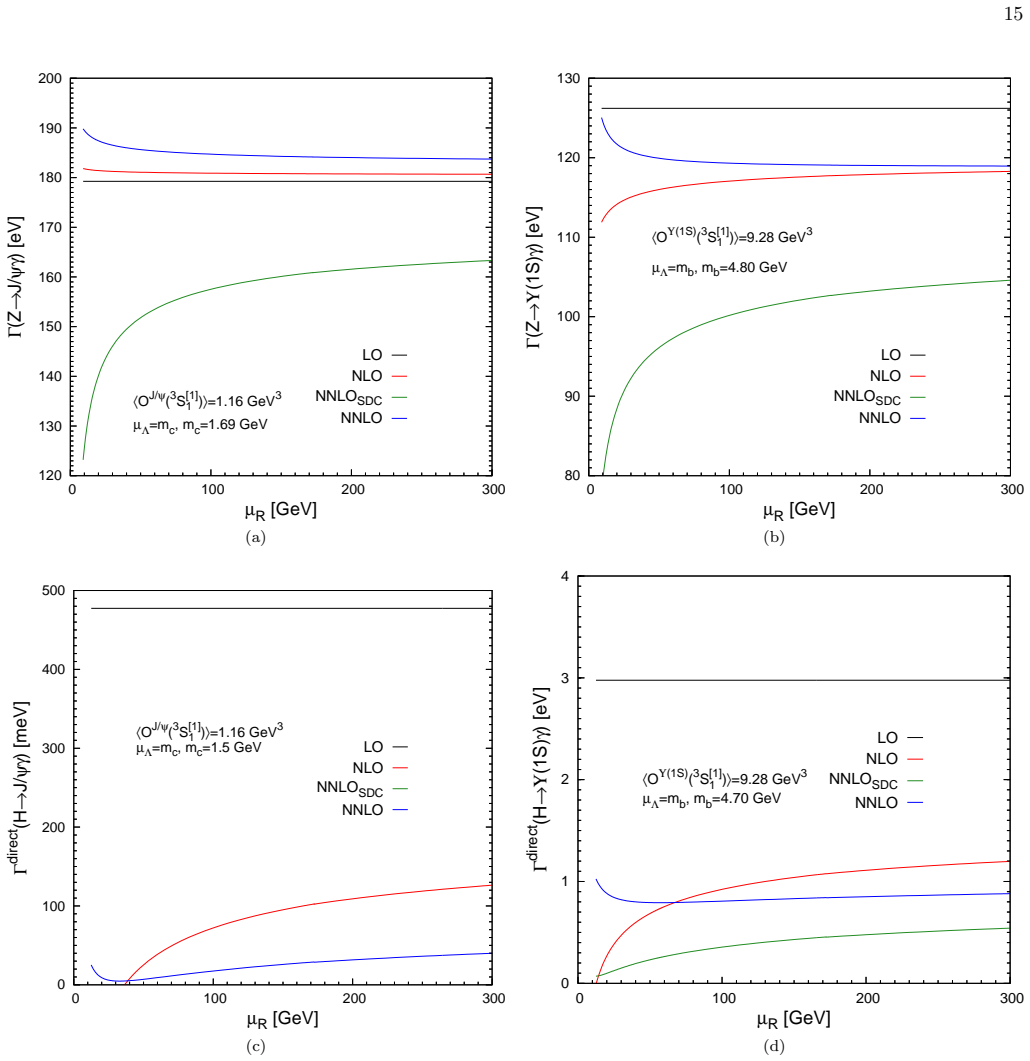
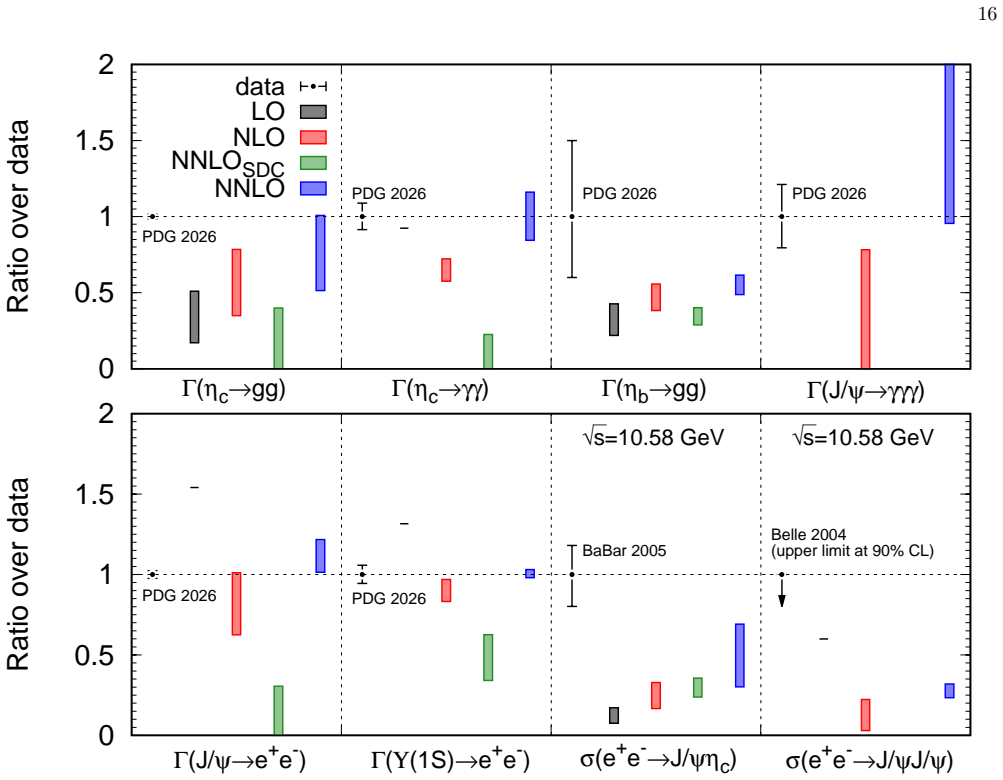
Theory-Data Comparison To facilitate the comparison between theory and data, we present the results of tab. I in fig. 7, where the theoretical predictions are normalized to the central values of the experimental data [47–49]. 15 〈OJ/ψ(3S1 [1])〉=1.16 GeV3 µΛ=mc, mc=1.69 GeV Γ(Z→J/ψγ) [eV] µR [GeV] LO NLO NNLOSDC NNLO 120 130 140 150 160 170 180 190 200 0 1...
2026
discussion (0)
Sign in with ORCID, Apple, or X to comment. Anyone can read and Pith papers without signing in.