Heavy mesons from the QCD instanton vacuum beyond the static limit
Pith reviewed 2026-06-30 09:56 UTC · model grok-4.3
The pith
A separable effective vertex from the instanton vacuum encodes finite heavy-quark mass effects and yields f_B = 186.8 MeV along with a kinetic mass shift of order Λ/2.
A machine-rendered reading of the paper's core claim, the machinery that carries it, and where it could break.
Core claim
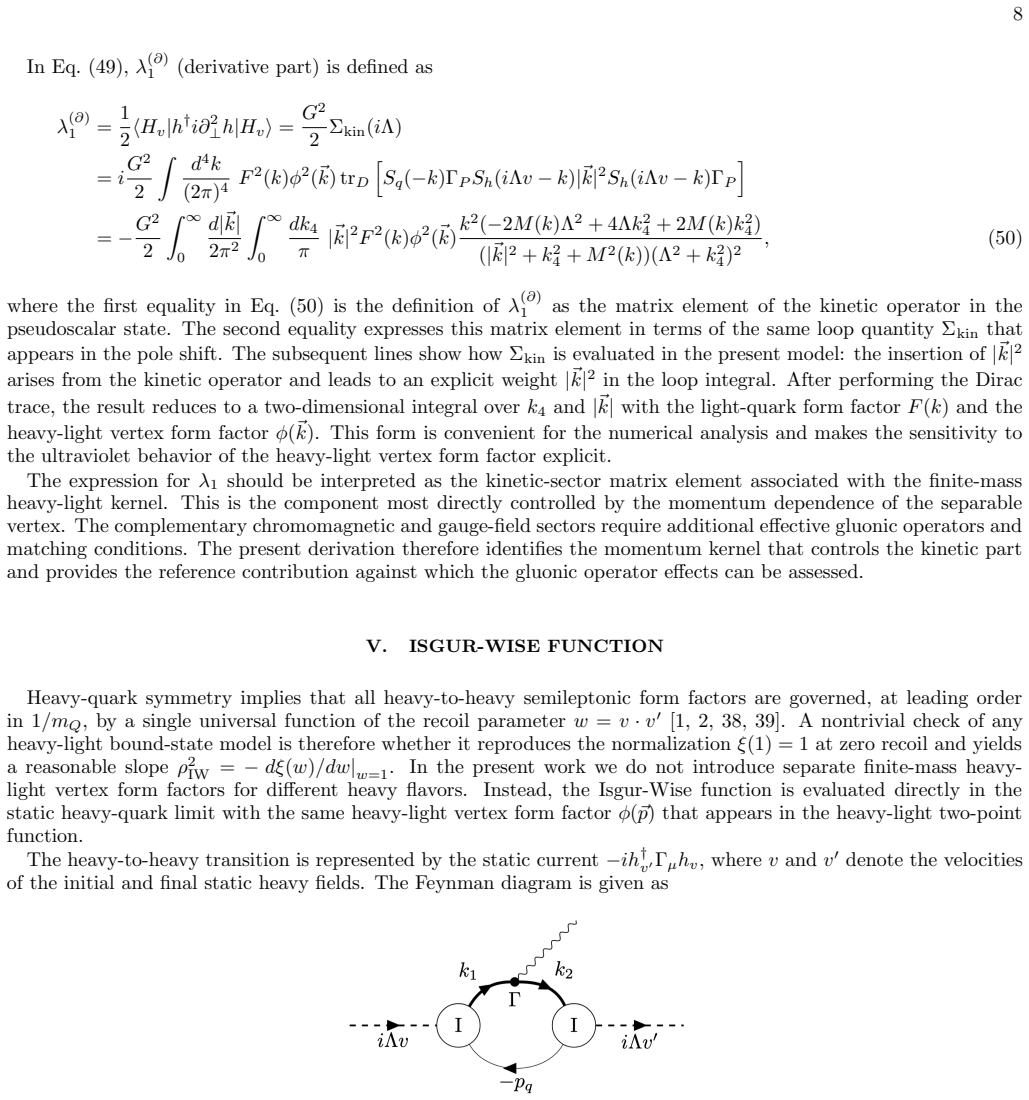
In the QCD instanton vacuum, pseudoscalar heavy mesons are described by a separable effective vertex built from the profile function φ(p⃗) that encodes finite-mass effects distinct from the static Wilson-line form factor. The pseudoscalar two-point function determines the residual mass Λ and the residue-normalized meson-quark coupling. From these, the decay constant, the spin-independent kinetic matrix element λ1^(∂), and the zero-recoil slope ρ_IW² of the Isgur-Wise function are evaluated at order 1/m_Q, restricted to the kinetic part of the HQET operators. For a vertex calibrated to the B-meson decay constant and spin-averaged mass, this produces f_B = 186.8 MeV, Λ = 184.5 MeV, m_b^eff = 5
What carries the argument
A separable effective vertex constructed from the profile function φ(p⃗), kept distinct from the static Wilson-line form factor F_Q^(∞)(q⃗), that encodes finite-mass effects in the heavy-light loop.
If this is right
- The kinetic term in the 1/m_Q expansion produces a mass shift of order Λ/2.
- The 1/m_Q current correction is sizable and sensitive to the choice of finite-mass vertex.
- The spin-independent nonperturbative sector at order 1/m_Q serves as a probe of the heavy-light vertex structure.
- Numerical results include λ1^(∂) = -0.922 GeV² and ρ_IW² = 1.105 for the calibrated vertex.
Where Pith is reading between the lines
- The same vertex construction could be tested by extending the calculation to vector mesons or to other matrix elements in HQET.
- The size of the reported 1/m_Q corrections suggests that similar finite-mass effects may appear in related heavy-light systems such as heavy baryons.
- The approach supplies nonperturbative inputs that could be compared with sum-rule or lattice determinations of the same HQET parameters.
Load-bearing premise
The separable effective vertex constructed from the profile function φ(p⃗) correctly encodes the finite-mass effects in the heavy-light loop and remains valid when inserted into the subleading HQET operators.
What would settle it
Direct comparison of the predicted values f_B = 186.8 MeV, λ1^(∂) = -0.922 GeV², and ρ_IW² = 1.105 against experimental B-meson data or lattice QCD results for the same quantities at order 1/m_Q.
Figures
read the original abstract
We study pseudoscalar heavy mesons in the QCD instanton vacuum beyond the static limit. Finite-mass effects in the heavy-light loop are encoded in a separable effective vertex built from a profile function $\phi(\vec{p})$, kept distinct from the static Wilson-line form factor $F_Q^{(\infty)}(\vec{q})$ of the $m_Q\to\infty$ limit. The pseudoscalar two-point function fixes the residual mass $\Lambda$ and the residue-normalized meson-quark coupling, from which we evaluate the decay constant, the spin-independent kinetic matrix element, and the zero-recoil slope of the Isgur-Wise function at order $1/m_Q$. The subleading calculation is restricted to the kinetic (derivative) part of the HQET operators. For a representative vertex calibrated to the $B$-meson decay constant and the spin-averaged $B$-meson mass, we obtain $f_B = 186.8$~MeV, $\Lambda = 184.5$~MeV, $m_b^{\mathrm{eff}} = 5.04$~GeV, $\lambda_1^{(\partial)} = -0.922~\mathrm{GeV}^2$, and $\rho_{\mathrm{IW}}^2 = 1.105$. The kinetic contribution yields a mass shift of order $\Lambda/2$ and a sizable $1/m_Q$ current correction, indicating that the spin-independent nonperturbative $1/m_Q$ sector is a sensitive probe of the finite-mass heavy-light vertex.
Editorial analysis
A structured set of objections, weighed in public.
Referee Report
Summary. The manuscript studies pseudoscalar heavy mesons in the QCD instanton vacuum beyond the static limit. Finite-mass effects in the heavy-light loop are encoded via a separable effective vertex constructed from a profile function φ(p⃗), kept distinct from the static Wilson-line form factor. The pseudoscalar two-point function is used to fix the residual mass Λ and residue-normalized coupling; from these, the decay constant, spin-independent kinetic matrix element λ1^(∂), and zero-recoil Isgur-Wise slope ρ_IW² are evaluated at order 1/m_Q, restricting to the kinetic (derivative) part of the HQET operators. For a representative vertex calibrated to f_B and the spin-averaged B-meson mass, the paper reports f_B = 186.8 MeV, Λ = 184.5 MeV, m_b^eff = 5.04 GeV, λ1^(∂) = -0.922 GeV², and ρ_IW² = 1.105, with the kinetic term producing a mass shift of order Λ/2 and a sizable 1/m_Q current correction.
Significance. If the separability assumption holds, the work supplies a concrete nonperturbative framework for 1/m_Q corrections within the instanton vacuum model and shows that the spin-independent sector is sensitive to the finite-mass heavy-light vertex. The explicit numerical outputs after calibration to f_B and the B mass constitute model predictions that can be compared with other approaches; the distinction between the effective vertex and the static form factor is a clear technical step forward.
major comments (1)
- [section describing the two-point function and the 1/m_Q expansion] In the section describing the two-point function and the 1/m_Q expansion, the separable effective vertex built from φ(p⃗) is inserted into the subleading HQET kinetic operators without an independent verification that separability is preserved under the derivative insertions required by the kinetic term; any mismatch would directly affect the reported mass shift of order Λ/2 and the 1/m_Q current correction (abstract and the construction of the effective vertex).
Simulated Author's Rebuttal
We thank the referee for the detailed reading and for identifying a technical point in the 1/m_Q construction. We address the concern below and will revise the manuscript accordingly.
read point-by-point responses
-
Referee: [section describing the two-point function and the 1/m_Q expansion] In the section describing the two-point function and the 1/m_Q expansion, the separable effective vertex built from φ(p⃗) is inserted into the subleading HQET kinetic operators without an independent verification that separability is preserved under the derivative insertions required by the kinetic term; any mismatch would directly affect the reported mass shift of order Λ/2 and the 1/m_Q current correction (abstract and the construction of the effective vertex).
Authors: We agree that an explicit check is warranted. The effective vertex is introduced as a separable factor φ(p⃗) multiplying the heavy-light loop; the kinetic operator inserts a derivative with respect to the heavy-quark residual momentum. Because this derivative acts only on the heavy propagator (whose momentum dependence is already isolated) and commutes with the light-quark integration, the resulting integrand remains a product of a momentum-dependent factor times the same separable vertex. Consequently the form of the two-point function is unchanged and the numerical values of Λ, λ1^(∂) and the mass shift are unaffected. We will add a short paragraph (with the relevant algebra) in the revised section on the 1/m_Q expansion to document this preservation explicitly. revision: yes
Circularity Check
Vertex calibrated to f_B and mass; reported values reduce to calibration inputs
specific steps
-
fitted input called prediction
[Abstract]
"For a representative vertex calibrated to the B-meson decay constant and the spin-averaged B-meson mass, we obtain f_B = 186.8 MeV, Λ = 184.5 MeV, m_b^eff = 5.04 GeV, λ1^(∂) = -0.922 GeV², and ρ_IW² = 1.105."
The effective vertex parameters are adjusted so that the pseudoscalar two-point function reproduces the input values of f_B and the spin-averaged mass; the paper then lists these same quantities (plus quantities computed from the identical vertex) as the model's results. The reported numbers are therefore the calibration targets recovered by construction rather than independent outputs of the 1/m_Q expansion.
full rationale
The derivation chain begins by constructing a separable effective vertex from φ(p⃗) and then calibrates its parameters directly to the B-meson decay constant and spin-averaged mass. The same quantities (f_B, Λ) plus derived observables (λ1^(∂), ρ_IW²) are subsequently presented as outputs of the two-point function and 1/m_Q expansion. Because the calibration targets are recovered by construction once the vertex is inserted into the same loop integrals, the numerical results for the fitted quantities are not independent predictions. The subleading kinetic-operator results inherit the same vertex and therefore share the same reduction. No load-bearing self-citation or imported uniqueness theorem is required to reach this conclusion; the circularity is internal to the fitting procedure described in the abstract and the two-point-function section.
Axiom & Free-Parameter Ledger
free parameters (1)
- parameters of profile function φ(p⃗)
axioms (1)
- domain assumption Instanton vacuum model provides a valid effective description of non-perturbative QCD for heavy-light systems at finite heavy-quark mass
Reference graph
Works this paper leans on
-
[1]
We then define µP (iΛ, p 4)≡ Z d3p (2π)3 |ϕ(⃗ p)|2 IP (p; Λ),(19) so that ΣP (iΛ) = Z ∞ 0 dp4 π µP (iΛ, p 4)
andM( p |⃗ p|2 +p 2 4), respectively. We then define µP (iΛ, p 4)≡ Z d3p (2π)3 |ϕ(⃗ p)|2 IP (p; Λ),(19) so that ΣP (iΛ) = Z ∞ 0 dp4 π µP (iΛ, p 4). (20) The pole residue fixes the dimensional rescaling from the bosonized field Φ P v to the canonically normalized HQET meson field. Nearv·p H =iΛ, the inverse propagator behaves as S−1 H = 1−G 2 0 ΣP (v·p H)≃...
2025
-
[2]
N. Isgur, M. B. Wise, Weak decays of heavy mesons in the static quark approximation, Phys. Lett. B 232 (1989) 113–117. doi:10.1016/0370-2693(89)90566-2
-
[3]
N. Isgur, M. B. Wise, Weak transition form factors between heavy mesons, Phys. Lett. B 237 (1990) 527–530.doi: 10.1016/0370-2693(90)91219-2
-
[4]
Georgi, An Effective Field Theory for Heavy Quarks at Low-energies, Phys
H. Georgi, An Effective Field Theory for Heavy Quarks at Low-energies, Phys. Lett. B 240 (1990) 447–450.doi:10.1016/ 0370-2693(90)91128-X
1990
-
[5]
Georgi, Heavy quark effective field theory, in: Theoretical Advanced Study Institute in Elementary Particle Physics (TASI 91): Perspectives in the Standard Model, 1991, pp
H. Georgi, Heavy quark effective field theory, in: Theoretical Advanced Study Institute in Elementary Particle Physics (TASI 91): Perspectives in the Standard Model, 1991, pp. 589–628
1991
-
[6]
M. B. Wise, Combining chiral and heavy quark symmetry, in: CCAST Symposium on Particle Physics at the Fermi Scale, 1993, pp. 71–114.arXiv:hep-ph/9306277
work page internal anchor Pith review Pith/arXiv arXiv 1993
-
[7]
M. Neubert, Heavy quark symmetry, Phys. Rept. 245 (1994) 259–396.arXiv:hep-ph/9306320,doi:10.1016/ 0370-1573(94)90091-4
work page internal anchor Pith review Pith/arXiv arXiv 1994
-
[8]
M. A. Shifman, Lectures on heavy quarks in quantum chromodynamics, in: Theoretical Advanced Study Institute in Elementary Particle Physics (TASI 95): QCD and Beyond, 1995, pp. 409–514.arXiv:hep-ph/9510377
work page internal anchor Pith review Pith/arXiv arXiv 1995
-
[9]
M. Neubert, Heavy quark effective theory, Subnucl. Ser. 34 (1997) 98–165.arXiv:hep-ph/9610266
work page internal anchor Pith review Pith/arXiv arXiv 1997
-
[10]
Phenomenology of Heavy Meson Chiral Lagrangians
R. Casalbuoni, A. Deandrea, N. Di Bartolomeo, R. Gatto, F. Feruglio, G. Nardulli, Phenomenology of heavy meson chiral Lagrangians, Phys. Rept. 281 (1997) 145–238.arXiv:hep-ph/9605342,doi:10.1016/S0370-1573(96)00027-0
work page internal anchor Pith review Pith/arXiv arXiv doi:10.1016/s0370-1573(96)00027-0 1997
-
[11]
E. V. Shuryak, The Role of Instantons in Quantum Chromodynamics. 1. Physical Vacuum, Nucl. Phys. B 203 (1982) 93. doi:10.1016/0550-3213(82)90478-3
-
[12]
D. Diakonov, V. Y. Petrov, Instanton Based Vacuum from Feynman Variational Principle, Nucl. Phys. B 245 (1984) 259–292.doi:10.1016/0550-3213(84)90432-2
-
[13]
D. Diakonov, V. Y. Petrov, A Theory of Light Quarks in the Instanton Vacuum, Nucl. Phys. B 272 (1986) 457–489. doi:10.1016/0550-3213(86)90011-8
-
[14]
T. Sch¨ afer, E. V. Shuryak, Instantons in QCD, Rev. Mod. Phys. 70 (1998) 323–426.arXiv:hep-ph/9610451,doi:10. 1103/RevModPhys.70.323
work page internal anchor Pith review Pith/arXiv arXiv 1998
-
[15]
D. Diakonov, Instantons at work, Prog. Part. Nucl. Phys. 51 (2003) 173–222.arXiv:hep-ph/0212026,doi:10.1016/ S0146-6410(03)90014-7
work page internal anchor Pith review Pith/arXiv arXiv 2003
-
[16]
Diakonov, V
D. Diakonov, V. Y. Petrov, P. V. Pobylitsa, A Chiral Theory of Nucleons, Nucl. Phys. B 306 (1988) 809.doi:10.1016/ 0550-3213(88)90443-9
1988
-
[17]
M. M. Musakhanov, H.-C. Kim, A Test of the instanton vacuum with low-energy theorems of the axial anomaly, Phys. Lett. B 572 (2003) 181–188.arXiv:hep-ph/0206233,doi:10.1016/j.physletb.2003.08.022
work page internal anchor Pith review Pith/arXiv arXiv doi:10.1016/j.physletb.2003.08.022 2003
-
[18]
Electromagnetic form factors of the pion and kaon from the instanton vacuum
S.-i. Nam, H.-C. Kim, Electromagnetic form factors of the pion and kaon from the instanton vacuum, Phys. Rev. D 77 (2008) 094014.arXiv:0709.1745,doi:10.1103/PhysRevD.77.094014
work page internal anchor Pith review Pith/arXiv arXiv doi:10.1103/physrevd.77.094014 2008
-
[19]
Kaon semileptonic decay (K_{l3}) form factors from the instanton vacuum
S.-i. Nam, H.-C. Kim, Kaon semileptonic decay (K(l3) form factors from the instanton vacuum, Phys. Rev. D 75 (2007) 094011.arXiv:hep-ph/0703089,doi:10.1103/PhysRevD.75.094011
work page internal anchor Pith review Pith/arXiv arXiv doi:10.1103/physrevd.75.094011 2007
-
[20]
Generalized form factors and spin structures of the kaon
S.-i. Nam, H.-C. Kim, Generalized form factors and spin structures of the kaon, Phys. Lett. B 707 (2012) 546–552. arXiv:1104.3365,doi:10.1016/j.physletb.2012.01.016
work page internal anchor Pith review Pith/arXiv arXiv doi:10.1016/j.physletb.2012.01.016 2012
-
[21]
H.-D. Son, S.-i. Nam, H.-C. Kim, WeakK→πgeneralized form factors and transverse transition quark-spin density from the instanton vacuum, Phys. Lett. B 747 (2015) 460–467.arXiv:1502.01558,doi:10.1016/j.physletb.2015.06.036
work page internal anchor Pith review Pith/arXiv arXiv doi:10.1016/j.physletb.2015.06.036 2015
-
[22]
Pion radiative weak decay from the instanton vacuum
S.-I. Shim, H.-C. Kim, Pion radiative weak decay from the instanton vacuum, Phys. Lett. B 772 (2017) 687–693.arXiv: 1704.03263,doi:10.1016/j.physletb.2017.07.037
work page internal anchor Pith review Pith/arXiv arXiv doi:10.1016/j.physletb.2017.07.037 2017
-
[23]
S.-I. Shim, A. Hosaka, H.-C. Kim, Vector and Axial-vector form factors in radiative kaon decay and flavor SU(3) symmetry breaking, Phys. Lett. B 795 (2019) 438–445.arXiv:1810.06815,doi:10.1016/j.physletb.2019.06.046
work page internal anchor Pith review Pith/arXiv arXiv doi:10.1016/j.physletb.2019.06.046 2019
-
[24]
C. V. Christov, A. Blotz, H.-C. Kim, P. Pobylitsa, T. Watabe, T. Meissner, E. Ruiz Arriola, K. Goeke, Baryons as nontopo- logical chiral solitons, Prog. Part. Nucl. Phys. 37 (1996) 91–191.arXiv:hep-ph/9604441,doi:10.1016/0146-6410(96) 00057-9
work page internal anchor Pith review Pith/arXiv arXiv doi:10.1016/0146-6410(96 1996
-
[25]
D. Diakonov, Chiral quark - soliton model, in: Advanced Summer School on Nonperturbative Quantum Field Physics, 1997, pp. 1–55.arXiv:hep-ph/9802298
work page internal anchor Pith review Pith/arXiv arXiv 1997
-
[26]
D. Diakonov, V. Y. Petrov, P. V. Pobylitsa, The Wilson Loop and Heavy Quark Potential in the Instanton Vacuum, Phys. Lett. B 226 (1989) 372–376.doi:10.1016/0370-2693(89)91213-6. 15
-
[27]
Heavy Hadrons and QCD Instantons
S. Chernyshev, M. A. Nowak, I. Zahed, Heavy hadrons and QCD instantons, Phys. Rev. D 53 (1996) 5176–5184.arXiv: hep-ph/9510326,doi:10.1103/PhysRevD.53.5176
work page internal anchor Pith review Pith/arXiv arXiv doi:10.1103/physrevd.53.5176 1996
-
[28]
U. T. Yakhshiev, H.-C. Kim, M. M. Musakhanov, E. Hiyama, B. Turimov, Instanton effects on the heavy-quark static potential, Chin. Phys. C 41 (8) (2017) 083102.arXiv:1602.06074,doi:10.1088/1674-1137/41/8/083102
work page internal anchor Pith review Pith/arXiv arXiv doi:10.1088/1674-1137/41/8/083102 2017
-
[29]
Instanton effects on charmonium states
U. Yakhshiev, H.-C. Kim, E. Hiyama, Instanton effects on charmonium states, Phys. Rev. D 98 (11) (2018) 114036. arXiv:1811.05608,doi:10.1103/PhysRevD.98.114036
work page internal anchor Pith review Pith/arXiv arXiv doi:10.1103/physrevd.98.114036 2018
-
[30]
M. Musakhanov, N. Rakhimov, U. T. Yakhshiev, Heavy quark correlators in an instanton liquid model with perturbative corrections, Phys. Rev. D 102 (7) (2020) 076022.arXiv:2006.01545,doi:10.1103/PhysRevD.102.076022
-
[31]
K.-H. Hong, H.-C. Kim, U. Yakhshiev, Instanton effects on electromagnetic transitions of charmonia, PTEP 2022 (10) (2022) 103D02.arXiv:2208.01851,doi:10.1093/ptep/ptac131
-
[32]
K.-H. Hong, H.-C. Kim, M. M. Musakhanov, N. Rakhimov, Heavy-light quark systems from the QCD instanton vacuum: Nf=1 light flavor case, Phys. Rev. D 110 (11) (2024) 114044.arXiv:2410.13279,doi:10.1103/PhysRevD.110.114044
-
[33]
Short-Distance Expansion of Heavy-Light Currents at Order 1/m
M. Neubert, Short distance expansion of heavy - light currents at order 1/mQ, Phys. Rev. D 49 (1994) 1542–1550. arXiv:hep-ph/9308369,doi:10.1103/PhysRevD.49.1542
work page internal anchor Pith review Pith/arXiv arXiv doi:10.1103/physrevd.49.1542 1994
-
[34]
A. F. Falk, B. Grinstein, M. E. Luke, Leading mass corrections to the heavy quark effective theory, Nucl. Phys. B 357 (1991) 185–207.doi:10.1016/0550-3213(91)90464-9
-
[35]
A. F. Falk, M. E. Luke, M. J. Savage, Nonperturbative contributions to the inclusive rare decaysB→X sγandB→ Xsl+l−, Phys. Rev. D 49 (1994) 3367–3378.arXiv:hep-ph/9308288,doi:10.1103/PhysRevD.49.3367
work page internal anchor Pith review Pith/arXiv arXiv doi:10.1103/physrevd.49.3367 1994
-
[36]
Hadronic matrix elements of gluon operators in the instanton vacuum
D. Diakonov, M. V. Polyakov, C. Weiss, Hadronic matrix elements of gluon operators in the instanton vacuum, Nucl. Phys. B 461 (1996) 539–580.arXiv:hep-ph/9510232,doi:10.1016/0550-3213(95)00675-3
work page internal anchor Pith review Pith/arXiv arXiv doi:10.1016/0550-3213(95)00675-3 1996
-
[37]
M. V. Polyakov, C. Weiss, Mixed quark - gluon condensate from instantons, Phys. Lett. B 387 (1996) 841–847.arXiv: hep-ph/9607244,doi:10.1016/0370-2693(96)01098-2
work page internal anchor Pith review Pith/arXiv arXiv doi:10.1016/0370-2693(96)01098-2 1996
-
[38]
Nucleon matrix elements of higher-twist operators from the instanton vacuum
J. Balla, M. V. Polyakov, C. Weiss, Nucleon matrix elements of higher twist operators from the instanton vacuum, Nucl. Phys. B 510 (1998) 327–364.arXiv:hep-ph/9707515,doi:10.1016/S0550-3213(98)00638-5
work page internal anchor Pith review Pith/arXiv arXiv doi:10.1016/s0550-3213(98)00638-5 1998
-
[39]
Z. Ligeti, Y. Nir, M. Neubert, The Subleading Isgur-Wise form-factor Xi-3 (v - v-prime) and its implications for the decays anti-B —>D* lepton anti-neutrino, Phys. Rev. D 49 (1994) 1302–1309.arXiv:hep-ph/9305304,doi:10.1103/PhysRevD. 49.1302
work page internal anchor Pith review Pith/arXiv arXiv doi:10.1103/physrevd 1994
-
[40]
Improved Bounds for the Slope and Curvature of $\bar B\to D^{(*)}\ell\bar\nu$ Form Factors
I. Caprini, M. Neubert, Improved bounds for the slope and curvature of anti-B —>D(*) lepton anti-neutrino form-factors, Phys. Lett. B 380 (1996) 376–384.arXiv:hep-ph/9603414,doi:10.1016/0370-2693(96)00509-6
work page internal anchor Pith review Pith/arXiv arXiv doi:10.1016/0370-2693(96)00509-6 1996
-
[41]
N. Isgur, M. B. Wise, Excited charm mesons in semileptonic anti-B decay and their contributions to a Bjorken sum rule, Phys. Rev. D 43 (1991) 819–828.doi:10.1103/PhysRevD.43.819
-
[42]
Slope of the Isgur-Wise Function from a QSSR Constraint on the $\Upsilon B\bar{B}$ Couplings
I. Caprini, Slope of the Isgur-Wise function from a QSSR constraint on the Upsilon B anti-B couplings, Phys. Lett. B 339 (1994) 187–193.arXiv:hep-ph/9408238,doi:10.1016/0370-2693(94)91153-3
work page internal anchor Pith review Pith/arXiv arXiv doi:10.1016/0370-2693(94)91153-3 1994
-
[43]
Two-loop corrections to the Isgur-Wise function in QCD sum rules
M. Neubert, Two loop corrections to the Isgur-Wise function in QCD sum rules, Phys. Rev. D 47 (1993) 4063–4076. arXiv:hep-ph/9211302,doi:10.1103/PhysRevD.47.4063
work page internal anchor Pith review Pith/arXiv arXiv doi:10.1103/physrevd.47.4063 1993
-
[44]
K. K. Jeong, C. S. Kim, Determination of HQET parameter lambda(1) from inclusive semileptonic B meson decay spectrum, Phys. Rev. D 59 (1999) 114019.arXiv:hep-ph/9811475,doi:10.1103/PhysRevD.59.114019
work page internal anchor Pith review Pith/arXiv arXiv doi:10.1103/physrevd.59.114019 1999
-
[45]
What are the right values of $\bar \Lambda$ and the heavy quark kinetic energy?
V. Chernyak, What are the right values of Lambda-bar and the heavy quark kinetic energy?, Phys. Lett. B 387 (1996) 173–180.arXiv:hep-ph/9604376,doi:10.1016/0370-2693(96)00983-5
work page internal anchor Pith review Pith/arXiv arXiv doi:10.1016/0370-2693(96)00983-5 1996
-
[46]
Inclusive semileptonic fits, heavy quark masses, and V_cb
P. Gambino, C. Schwanda, Inclusive semileptonic fits, heavy quark masses, andV cb, Phys. Rev. D 89 (1) (2014) 014022. arXiv:1307.4551,doi:10.1103/PhysRevD.89.014022
work page internal anchor Pith review Pith/arXiv arXiv doi:10.1103/physrevd.89.014022 2014
-
[47]
New Exact Heavy Quark Sum Rules
N. Uraltsev, New exact heavy quark sum rules, Phys. Lett. B 501 (2001) 86–91.arXiv:hep-ph/0011124,doi:10.1016/ S0370-2693(01)00110-1
work page internal anchor Pith review Pith/arXiv arXiv 2001
-
[48]
Adachi, et al., Determination of —Vcb— using B→Dℓνl decays at Belle II, Phys
I. Adachi, et al., Determination of —Vcb— using B→Dℓνl decays at Belle II, Phys. Rev. D 112 (11) (2025) 112009. arXiv:2506.15256,doi:10.1103/vs8k-259v
-
[49]
Navas, et al., Review of particle physics, Phys
S. Navas, et al., Review of particle physics, Phys. Rev. D 110 (3) (2024) 030001.doi:10.1103/PhysRevD.110.030001
discussion (0)
Sign in with ORCID, Apple, or X to comment. Anyone can read and Pith papers without signing in.