Degree-restricted semi-saturation numbers of cliques and its applications
Pith reviewed 2026-06-30 09:41 UTC · model grok-4.3
The pith
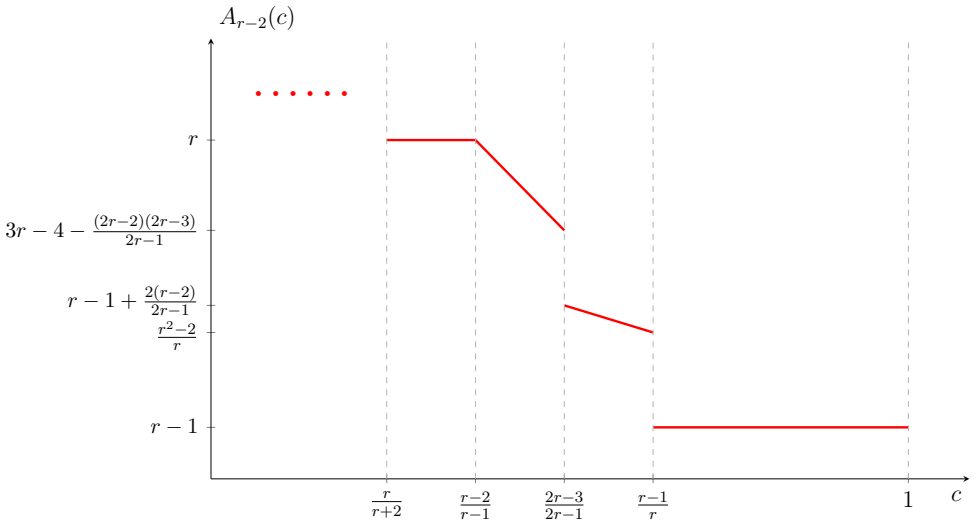
The normalized semi-saturation number of K_r with linear degree bound cn converges for all but a sparse sequence of c values.
A machine-rendered reading of the paper's core claim, the machinery that carries it, and where it could break.
Core claim
For arbitrary r ≥ 4, the limit lim_{n→∞} ssat^{cn}(n,K_r)/n exists for all 0 < c ≤ 1, except for some sparse values of c contained in a countable and rational sequence c_i → 0. Moreover, the asymptotic behaviour of this limit is established for r/(r+2) < c <1 and the exact value of ssat^Δ(n,K_r) is determined for some specific Δ. As an application, the relation between the saturation number of the join graph K_r ∨ F and that of F is determined for a large class of pairs (r,F).
What carries the argument
The degree-restricted semi-saturation number ssat^Δ(n,K_r), the minimum edges in an n-vertex K_r-semi-saturated graph whose maximum degree is at most Δ.
If this is right
- The normalized minimum edge count converges for every linear degree bound except those sparse rationals.
- The limit admits an explicit asymptotic expression whenever the bound fraction exceeds r/(r+2).
- Exact values of ssat^Δ(n,K_r) are known for certain concrete choices of Δ.
- Saturation numbers of K_r ∨ F are determined by those of F for a broad family of graphs F.
Where Pith is reading between the lines
- The exceptional rational values of c likely mark points where the optimal construction family changes.
- The same convergence technique may apply to semi-saturation problems for other forbidden subgraphs under degree constraints.
- The join-graph relation provides a template for transferring saturation results across other graph products or operations.
Load-bearing premise
Graph constructions exist that remain K_r-semi-saturated while respecting the degree cap cn and attaining the claimed minimum edge count.
What would settle it
For some c outside the exceptional sequence, the sequence ssat^{cn}(n,K_r)/n fails to converge to any single number as n increases through integers.
Figures
read the original abstract
A graph $G$ is said to be $F$-semi-saturated if the addition of any nonedge $e \not \in E(G)$ would create a new copy of $F$ in $G+e$. The semi-saturation number $ssat(n,F)$ is the minimum number of edges in an $F$-semi-saturated graph of order $n$. In this paper we investigate the semi-saturation number of $K_r$ on $n$ vertices with maximal degree at most $\Delta$, denoted by $ssat^{\Delta}(n,K_r)$. This investigation was suggested by Erd\H os, R\'enyi and S\'os, who in 1966 considered the graph of diameter 2 with degree restrictions, equivalently $ssat^{\Delta}(n,K_3)$. The following are some of our results. For arbitrary $r \geq 4$, we show that the limit $ \lim_{n \rightarrow \infty} ssat^{cn}(n,K_r)/n$ exists for all $0 < c \leq 1$, except for some sparse values of $c$ contained in a countable and rational sequence $c_i \rightarrow 0$. Moreover, we establish the asymptotic behaviour of this limit for $\frac{r}{r+2} < c <1$ and determine the exact value of $ssat^{\Delta}(n,K_r)$ for some specific $\Delta$. As an application, we determine the relation between the saturation number of the join graph $K_r \vee F$ and that of $F$ for a large class of pairs $(r,F)$.
Editorial analysis
A structured set of objections, weighed in public.
Referee Report
Summary. The paper defines the degree-restricted semi-saturation number ssat^Δ(n, K_r) and proves, for r ≥ 4, that lim_{n→∞} ssat^{cn}(n, K_r)/n exists for every 0 < c ≤ 1 except a countable sequence of rational values c_i → 0. It determines the asymptotic value of the limit on the interval r/(r+2) < c < 1, obtains exact values of ssat^Δ(n, K_r) for certain specific Δ, and derives a relation between sat(n, K_r ∨ F) and sat(n, F) for a large class of pairs (r, F). The proofs rely on explicit blow-up constructions that respect the linear degree bound cn together with a counting argument that produces a matching lower bound.
Significance. If the stated constructions and counting arguments are correct, the work supplies the first systematic treatment of linear degree restrictions on semi-saturation numbers for cliques larger than K_3, confirming the existence of the normalized limit outside an explicitly described exceptional set and giving matching asymptotics on a positive-density interval of c. The application to saturation numbers of joins extends the reach of the method to a broader family of forbidden graphs. The combination of explicit, degree-controlled constructions with a direct counting lower bound constitutes a concrete technical contribution to extremal graph theory.
minor comments (3)
- [§2] §2, Definition 1.1: the phrase “the addition of any nonedge e ∉ E(G) would create a new copy of F” should be accompanied by an explicit statement that the new copy must contain the added edge, to avoid any ambiguity with the classical saturation definition.
- [Theorem 1.3] Theorem 1.3 (the asymptotic statement for r/(r+2) < c < 1): the leading coefficient is stated only up to o(1) terms; if the authors possess a more precise second-order expansion, it would strengthen the result and could be recorded as a remark.
- [Introduction] The sequence c_i is described as “countable and rational” but its explicit recursive definition or generating function is not displayed in the introduction; a short displayed formula would improve readability.
Simulated Author's Rebuttal
We thank the referee for their positive assessment of the manuscript, recognition of its technical contributions, and recommendation to accept.
Circularity Check
No significant circularity detected
full rationale
The paper derives existence of the limit lim ssat^{cn}(n,K_r)/n, its asymptotics for r/(r+2)<c<1, and exact values for specific Δ via explicit blow-up constructions of semi-saturated graphs respecting the degree cap cn together with a counting lower bound on K_r copies. These steps rely on independent graph-theoretic constructions and counting arguments rather than any self-definition, fitted parameter renamed as prediction, or load-bearing self-citation chain. No equations or reductions in the provided text equate a claimed result to its own inputs by construction. The derivation is self-contained against external graph constructions.
Axiom & Free-Parameter Ledger
axioms (1)
- standard math Standard axioms of finite undirected simple graphs and the definition of F-semi-saturation
Reference graph
Works this paper leans on
-
[1]
N. Alon, P. Erd¨ os, R. Holzman and M. Krivelevich, Onk-saturated graphs with restrictions on the degrees. J. Graph Theory, 23 (1996), pp. 1-20
1996
-
[2]
K. Amin, J. Faudree, R.J. Gould and E. Sidorowicz, On the non-(p−1)-partiteK p-free graphs. Discuss. Math. Graph Theory, 33(1) (2013), pp. 9-23
2013
-
[3]
Currie, J.R
B.L. Currie, J.R. Faudree, R. J. Faudree and J. R. Schmitt, A survey of minimum saturated graphs, Electron. J. Combin., 18 (2011), DS19
2011
-
[4]
Duffus and D
D.A. Duffus and D. Hanson, Minimalk-saturated and color critical graphs of prescribed minimum degree, J. Graph Theory, 10 (1986), pp. 55-67
1986
-
[5]
Erd˝ os, A
P. Erd˝ os, A. Hajnal and J.W. Moon, A problem in graph theory, Amer. Math. Monthly 71 (1964), pp. 1107-1110
1964
-
[6]
Erd˝ os and R
P. Erd˝ os and R. Holzman, On maximal triangle-free graphs, J. Graph Theory, 18 (1994), pp. 585-594
1994
-
[7]
Erd˝ os, A
P. Erd˝ os, A. R´ enyi and V. T. S´ os, On a problem of graph theory, Studia Sci. Math. Hungar. 1 (1966), pp. 215-235
1966
-
[8]
Erd˝ os and R
P. Erd˝ os and R. Rado, Intersection theorems for systems of sets, J. London Math. Soc. 35 (1960), pp. 85–90
1960
-
[9]
F¨ uredi and A
Z. F¨ uredi and A. Seress, Maximal triangle-free graphs with restrictions on the degrees, J. Graph Theory, 18 (1994), pp. 11-24
1994
-
[10]
F¨ uredi, Intersecting designs from linear programming and graphs of diameter two, Discrete Math
Z. F¨ uredi, Intersecting designs from linear programming and graphs of diameter two, Discrete Math. 127 (1994), no. 1-3, pp. 187-207
1994
-
[11]
Hajnal, A theorem onk-saturated graphs, Canad
A. Hajnal, A theorem onk-saturated graphs, Canad. J. Math. 17 (1965), pp. 720-724
1965
-
[12]
Hanson and K
D. Hanson and K. Seyffarth,k-saturated graphs of prescribed maximum degree, Congres. Numer. 42 (1984), pp. 169-182
1984
-
[13]
J. Hu, S. Ji, and Q. Cui, (K 1 ∨P t)-saturated graphs with minimum number of edges. J. Combin. Optim. 49 (2025), no. 2, Paper No. 23
2025
-
[14]
S. Hu, Z. Luo and Y. Peng, Saturation numbers of joins of graphs, Discrete Appl. Math. 357 (2024), pp. 300–309. 25
2024
-
[15]
Pach and L
J. Pach and L. Sur´ anyi, Graphs of diameter 2 and linear programming, inAlgebraic methods in graph theory, Vol. I, II (Szeged, 1978), pp. 599–629, Colloq. Math. Soc. J´ anos Bolyai, 25, North-Holland, Amsterdam-New York
1978
-
[16]
Pach and L
J. Pach and L. Sur´ anyi, On graphs of diameter 2, Ars Combin. 11 (1981), pp. 61-78
1981
-
[17]
Y. Qiu, Z. He, M. Lu and Y. Xu, The saturation number of wheels, Discrete Appl. Math. 379 (2026), pp. 542–550
2026
-
[18]
N. Song, J. Hu, S. Ji and Q. Cui, The saturation number ofW 4, Discrete Math. 349 (8) (2026), 115107
2026
-
[19]
Vˇ rˇto and ˇS
I. Vˇ rˇto and ˇS. Zn´ am, Minimal graphs of diameter two and given maximal degree, Studia Sci. Math. Hungar. 17 (1982), no. 1-4, pp. 283-290
1982
-
[20]
Zhang, Q
C. Zhang, Q. Cui, J. Hu, E. Yue and S. Ji, Some results on minimum saturated graphs, Discrete Appl. Math. 384 (2026), pp. 23–33
2026
- [21]
-
[22]
Zn´ am, Minimal graphs of diameter two, Studia Sci
ˇS. Zn´ am, Minimal graphs of diameter two, Studia Sci. Math. Hungar. 19 (1984), no. 2-4, pp. 187-191. 26
1984
discussion (0)
Sign in with ORCID, Apple, or X to comment. Anyone can read and Pith papers without signing in.