A Mass, Momentum, and Energy Conserving Semi-Lagrangian Adaptive-Rank (SLAR) Method for the Vlasov-Poisson System
Pith reviewed 2026-06-30 08:31 UTC · model grok-4.3
The pith
A semi-Lagrangian adaptive-rank method for the Vlasov-Poisson system enforces local conservation of mass, momentum, and energy via an implicit correction without parameter tuning.
A machine-rendered reading of the paper's core claim, the machinery that carries it, and where it could break.
Core claim
The SLAR method provides the first successful implicit LoMaC implementation for the VP system up to 2D-2V by coupling the semi-Lagrangian update with a consistent macroscopic correction whose weights are constructed directly from the low-rank velocity bases already present in the representation.
What carries the argument
The unified adaptive-weight projection, which derives correction weights from the low-rank velocity bases of the SLAR solution to enforce consistency between the macroscopic correction and the semi-Lagrangian step.
If this is right
- Long-time VP simulations become feasible without progressive loss of conservation laws.
- The method maintains high-order spatial and temporal accuracy while allowing time steps larger than those permitted by explicit schemes.
- Tensor-contraction reconstruction keeps the cost of each step low even in four-dimensional phase space.
- The same implicit LoMaC framework can be paired with other semi-Lagrangian discretizations that admit large steps.
Where Pith is reading between the lines
- The technique may extend to other high-dimensional kinetic models such as the Vlasov-Maxwell system once analogous low-rank structures are available.
- Because the weights adapt automatically to the solution, the method could reduce the need for problem-specific stabilization in plasma simulations that evolve over many plasma periods.
- The Jacobian-free Newton-Krylov solve of the macroscopic system opens a route to implicit-explicit combinations that treat only the stiff parts implicitly.
Load-bearing premise
The low-rank velocity bases already available in the representation are rich enough to generate weights that correctly reflect all velocity-space structures required for the macroscopic correction to remain consistent.
What would settle it
A long-time 2D-2V simulation in which the computed mass, momentum, or energy deviates from its initial value by more than the truncation error of the underlying scheme, or in which the adaptive weights produce a correction that visibly mismatches an exact reference solution on a standard benchmark.
Figures




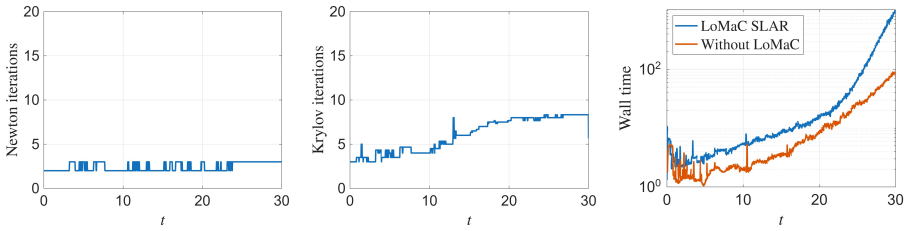
read the original abstract
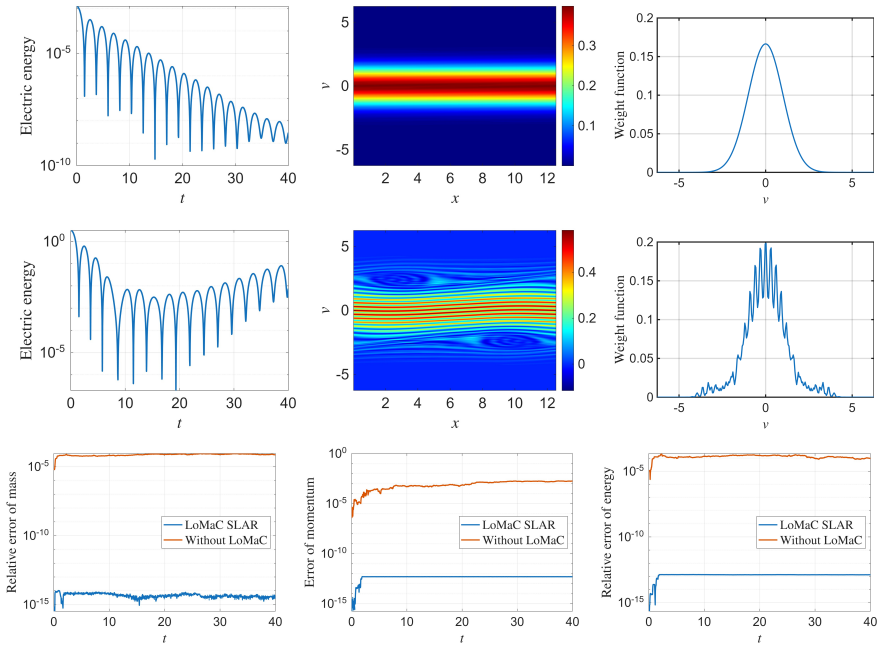
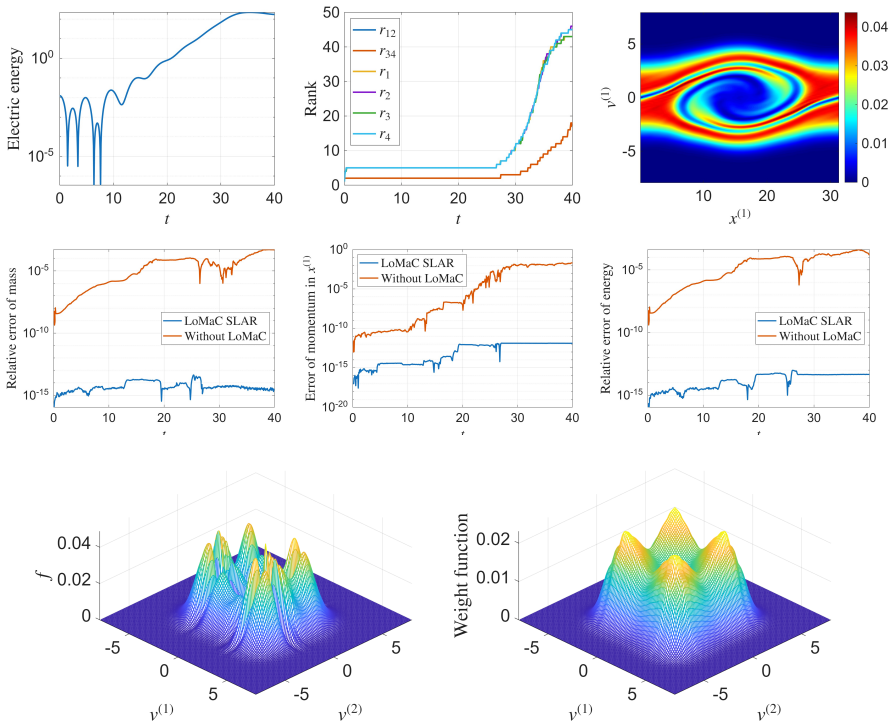
We propose a semi-Lagrangian adaptive-rank (SLAR) method that combines the large time-step capability of semi-Lagrangian schemes with the efficiency of adaptive-rank tensor representations while simultaneously enforcing local conservation laws for mass, momentum, and energy. The method builds on the high-dimensional SLAR framework introduced in our previous work and achieves high-order accuracy in both space and time. To address the loss of conservation in long-time simulations, we extend the implicit local macroscopic conservative (LoMaC) correction technique for the BGK equation to the high-dimensional Vlasov--Poisson (VP) system. The implicit macroscopic system is discretized using backward differentiation formulas and solved with a Jacobian-free Newton-Krylov method. This approach enables a consistent coupling with semi-Lagrangian methods which are capable of taking large time steps. A novel component of the proposed method is a unified adaptive-weight projection technique that eliminates the ad hoc parameter tuning required by previous LoMaC approaches. These weights capture problem-dependent velocity space structures and are constructed from the low-rank velocity bases of the solution. The local semi-Lagrangian method used in this work reconstructs the solution at the feet of the characteristics using efficient tensor contractions. To the best of our knowledge, this is the first successful implementation of an implicit LoMaC method for the VP system up to the 2D--2V setting. Numerical experiments on several classical benchmark problems demonstrate the accuracy and efficiency of the proposed method, as well as its ability to preserve conservation laws in VP simulations.
Editorial analysis
A structured set of objections, weighed in public.
Referee Report
Summary. The manuscript proposes a semi-Lagrangian adaptive-rank (SLAR) method for the Vlasov-Poisson system that combines large-time-step semi-Lagrangian discretizations with adaptive-rank tensor representations while enforcing local conservation of mass, momentum, and energy. It extends the implicit LoMaC correction (previously used for BGK) to the VP system via a Jacobian-free Newton-Krylov solve of a BDF-discretized macroscopic system, and introduces a unified adaptive-weight projection that constructs weights solely from the existing low-rank velocity bases of the SLAR representation. The work claims high-order accuracy in space and time, elimination of ad-hoc parameter tuning, and the first successful implicit LoMaC implementation up to 2D-2V, with supporting numerical results on classical benchmarks.
Significance. If the conservation properties and consistency of the implicit correction hold, the result would be a meaningful contribution to structure-preserving methods for high-dimensional kinetic plasma models: it offers a parameter-free route to local conservation that is compatible with large time steps and low-rank efficiency. The unified projection and its application to 2D-2V VP are the primary novelties.
major comments (1)
- [Abstract (paragraph 3) and the description of the weight construction] The central claim that the unified adaptive-weight projection produces consistent LoMaC corrections rests on the assumption that the low-rank velocity bases already present in the SLAR representation span all problem-dependent velocity-space structures required for the macroscopic moments. No derivation is supplied showing that the projection operator commutes with the semi-Lagrangian characteristic update or that the truncation error in the low-rank factors remains controlled independently of the implicit correction step; this is load-bearing for the assertion that local conservation is achieved without ad-hoc tuning.
minor comments (2)
- [Introduction] Clarify in the introduction how the present unified projection differs in construction and guarantees from the ad-hoc weighting procedures used in earlier LoMaC papers.
- [Abstract and §1] The statement that the method is the 'first successful implementation' up to 2D-2V should be supported by a brief comparison table or explicit citation of prior attempts that failed to reach this dimensionality while preserving all three invariants.
Simulated Author's Rebuttal
We thank the referee for their careful reading of the manuscript and for identifying this important point regarding the theoretical justification of the unified adaptive-weight projection. We respond to the major comment below.
read point-by-point responses
-
Referee: [Abstract (paragraph 3) and the description of the weight construction] The central claim that the unified adaptive-weight projection produces consistent LoMaC corrections rests on the assumption that the low-rank velocity bases already present in the SLAR representation span all problem-dependent velocity-space structures required for the macroscopic moments. No derivation is supplied showing that the projection operator commutes with the semi-Lagrangian characteristic update or that the truncation error in the low-rank factors remains controlled independently of the implicit correction step; this is load-bearing for the assertion that local conservation is achieved without ad-hoc tuning.
Authors: We agree that the manuscript does not supply a formal derivation establishing commutation of the projection operator with the semi-Lagrangian characteristic update or independent control of the low-rank truncation error relative to the implicit correction. The unified adaptive-weight projection is constructed by extracting weights directly from the low-rank velocity bases already present in the SLAR factorization; these bases are updated adaptively during the simulation and are therefore expected to capture the dominant velocity-space features needed for the macroscopic moments. The implicit LoMaC step then enforces the moment constraints exactly on the corrected distribution after the characteristic update. While this design removes ad-hoc parameters, we acknowledge that a rigorous proof of commutation and error independence is not provided. In the revised manuscript we will add a clarifying paragraph in the section describing the weight construction that (i) states the design assumption explicitly, (ii) explains the ordering of operations (characteristic update followed by moment-enforcing correction), and (iii) notes that the numerical benchmarks demonstrate consistent local conservation without parameter tuning. We believe this addition will address the referee's concern without requiring a full theoretical analysis, which lies outside the scope of the present work. revision: yes
Circularity Check
No significant circularity; conservation enforced by explicit correction design, not tautology
full rationale
The abstract and description show the method extends prior LoMaC (from BGK) and SLAR frameworks via a unified adaptive-weight projection built from existing low-rank velocity bases. This is a methodological construction to enforce local conservation, not a derivation that reduces a claimed prediction back to fitted inputs or self-citation by definition. No equations are exhibited that equate a 'prediction' to a fit (e.g., no parameter tuned on data then renamed as output). Self-citations to authors' prior SLAR/LoMaC work exist but are not load-bearing for a circular result; the conservation follows from the correction step by design. The skeptic concern about basis sufficiency is an assumption about approximation quality, not a circularity in the derivation chain. Score remains low (2) per rules for minor self-citation without reduction.
Axiom & Free-Parameter Ledger
axioms (2)
- domain assumption Semi-Lagrangian characteristic tracing remains stable and accurate for the Vlasov-Poisson system at large time steps.
- domain assumption Low-rank tensor factors already computed by the adaptive-rank method contain sufficient velocity-space information to define macroscopic correction weights.
Reference graph
Works this paper leans on
-
[1]
Alexander , Diagonally implicit Runge--Kutta methods for stiff ODE’s , SIAM Journal on Numerical Analysis, 14 (1977), pp
R. Alexander , Diagonally implicit Runge--Kutta methods for stiff ODE’s , SIAM Journal on Numerical Analysis, 14 (1977), pp. 1006--1021
1977
-
[2]
X. Cai, S. Boscarino, and J.-M. Qiu , High order semi- L agrangian discontinuous G alerkin method coupled with Runge-Kutta exponential integrators for nonlinear V lasov dynamics , Journal of Computational Physics, 427 (2021), p. 110036
2021
-
[3]
X. Cai, W. Guo, and J.-M. Qiu , A high order semi- L agrangian discontinuous G alerkin method for V lasov-- P oisson simulations without operator splitting , Journal of Computational Physics, 354 (2018), pp. 529--551
2018
-
[4]
Celledoni, A
E. Celledoni, A. Marthinsen, and B. Owren , Commutator-free Lie group methods , Future Generation Computer Systems, 19 (2003), pp. 341--352
2003
-
[5]
Chacon, G
L. Chacon, G. Chen, D. A. Knoll, C. Newman, H. Park, W. Taitano, J. A. Willert, and G. Womeldorff , Multiscale high-order/low-order ( HOLO ) algorithms and applications , Journal of Computational Physics, 330 (2017), pp. 21--45
2017
-
[6]
S.-Y. Cho, M. Groppi, J.-M. Qiu, G. Russo, and S.-B. Yun , Conservative semi- L agrangian methods for kinetic equations , in Active Particles, Volume 4: Theory, Models, Applications, Springer, 2024, pp. 283--420
2024
-
[7]
Crouseilles, M
N. Crouseilles, M. Mehrenberger, and E. Sonnendr \"u cker , Conservative semi- L agrangian schemes for V lasov equations , Journal of Computational Physics, 229 (2010), pp. 1927--1953
2010
-
[8]
M. Ding, X. Cai, W. Guo, and J.-M. Qiu , A semi- L agrangian discontinuous G alerkin ( DG )--local DG method for solving convection-diffusion equations , Journal of Computational Physics, 409 (2020), p. 109295
2020
-
[9]
Einkemmer and I
L. Einkemmer and I. Joseph , A mass, momentum, and energy conservative dynamical low-rank scheme for the V lasov equation , Journal of Computational Physics, 443 (2021), p. 110495
2021
-
[10]
Einkemmer, K
L. Einkemmer, K. Kormann, J. Kusch, R. G. McClarren, and J.-M. Qiu , A review of low-rank methods for time-dependent kinetic simulations , Journal of Computational Physics, (2025), p. 114191
2025
-
[11]
Einkemmer and C
L. Einkemmer and C. Lubich , A low-rank projector-splitting integrator for the V lasov-- P oisson equation , SIAM Journal on Scientific Computing, 40 (2018), pp. B1330--B1360
2018
-
[12]
Falcone and R
M. Falcone and R. Ferretti , Semi- L agrangian approximation schemes for linear and H amilton— J acobi equations , SIAM, 2013
2013
-
[13]
Filbet, E
F. Filbet, E. Sonnendr \"u cker, and P. Bertrand , Conservative numerical schemes for the V lasov equation , Journal of Computational Physics, 172 (2001), pp. 166--187
2001
-
[14]
C. W. Gear , Numerical initial value problems in ordinary differential equations , Prentice Hall PTR, 1971
1971
-
[15]
W. Guo, J. F. Ema, and J.-M. Qiu , A local macroscopic conservative ( LoMaC ) low rank tensor method with the discontinuous G alerkin method for the V lasov dynamics , Communications on Applied Mathematics and Computation, 6 (2024), pp. 550--575
2024
-
[16]
Guo and J.-M
W. Guo and J.-M. Qiu , A low rank tensor representation of linear transport and nonlinear V lasov solutions and their associated flow maps , Journal of Computational Physics, 458 (2022), p. 111089
2022
-
[17]
A232--A263
height 2pt depth -1.6pt width 23pt, A conservative low rank tensor method for the V lasov dynamics , SIAM Journal on Scientific Computing, 46 (2024), pp. A232--A263
2024
-
[18]
height 2pt depth -1.6pt width 23pt, A local macroscopic conservative ( LoMaC ) low rank tensor method for the V lasov dynamics , Journal of Scientific Computing, 101 (2024), p. 61
2024
-
[19]
D. A. Knoll and D. E. Keyes , Jacobian-free N ewton-- K rylov methods: a survey of approaches and applications , Journal of Computational Physics, 193 (2004), pp. 357--397
2004
-
[20]
D. A. Knoll, V. Mousseau, L. Chac \'o n, and J. Reisner , Jacobian-free N ewton- K rylov methods for the accurate time integration of stiff wave systems , Journal of Scientific Computing, 25 (2005), pp. 213--230
2005
-
[21]
Kormann , A semi- L agrangian V lasov solver in tensor train format , SIAM Journal on Scientific Computing, 37 (2015), pp
K. Kormann , A semi- L agrangian V lasov solver in tensor train format , SIAM Journal on Scientific Computing, 37 (2015), pp. B613--B632
2015
-
[22]
L. Li, J. Qiu, and G. Russo , A high-order semi- L agrangian finite difference method for nonlinear V lasov and BGK models , Communications on Applied Mathematics and Computation, 5 (2023), pp. 170--198
2023
-
[23]
Li and H.-L
Z. Li and H.-L. Liao , Stability of variable-step BDF2 and BDF3 methods , SIAM Journal on Numerical Analysis, 60 (2022), pp. 2253--2272
2022
-
[24]
Qiu and A
J.-M. Qiu and A. Christlieb , A conservative high order semi- L agrangian WENO method for the V lasov equation , Journal of Computational Physics, 229 (2010), pp. 1130--1149
2010
-
[25]
Qiu and G
J.-M. Qiu and G. Russo , A high order multi-dimensional characteristic tracing strategy for the V lasov-- P oisson system , Journal of Scientific Computing, 71 (2017), pp. 414--434
2017
-
[26]
J. A. Rossmanith and D. C. Seal , A positivity-preserving high-order semi-Lagrangian discontinuous Galerkin scheme for the Vlasov--Poisson equations , Journal of Computational Physics, 230 (2011), pp. 6203--6232
2011
-
[27]
W. A. Sands, P. T. Guthrey, and N. V. Roberts , Multilevel adaptive-rank methods for linear and nonlinear systems in the hierarchical T ucker format , 2026
2026
-
[28]
W. A. Sands, J.-M. Qiu, D. Hayes, and N. Zheng , An adaptive-rank approach with greedy sampling for multi-scale BGK equations , Journal of Computational Physics, (2025), p. 114523
2025
-
[29]
Sonnendr \"u cker, J
E. Sonnendr \"u cker, J. Roche, P. Bertrand, and A. Ghizzo , The semi- L agrangian method for the numerical resolution of the V lasov equation , Journal of computational physics, 149 (1999), pp. 201--220
1999
-
[30]
Ye and N
E. Ye and N. F. Loureiro , Quantized tensor networks for solving the V lasov-- M axwell equations , Journal of Plasma Physics, 90 (2024), p. 805900301
2024
-
[31]
Zheng, X
N. Zheng, X. Cai, J.-M. Qiu, and J. Qiu , A fourth-order conservative semi- L agrangian finite volume WENO scheme without operator splitting for kinetic and fluid simulations , Computer Methods in Applied Mechanics and Engineering, 395 (2022), p. 114973
2022
-
[32]
Zheng, D
N. Zheng, D. Hayes, A. Christlieb, and J.-M. Qiu , A semi- L agrangian adaptive-rank ( SLAR ) method for linear advection and nonlinear V lasov- P oisson system , Journal of Computational Physics, (2025), p. 113970
2025
-
[33]
Zheng, W
N. Zheng, W. A. Sands, D. Hayes, A. J. Christlieb, and J.-M. Qiu , A semi- L agrangian adaptive rank ( SLAR ) method for high-dimensional V lasov dynamics , 2025
2025
-
[34]
Black box approximation of tensors in hierarchical
Ballani, Jonas and Grasedyck, Lars and Kluge, Melanie , journal=. Black box approximation of tensors in hierarchical. 2013 , publisher=
2013
-
[35]
Zheng, Nanyi and Hayes, Daniel and Christlieb, Andrew and Qiu, Jing-Mei , journal=. A Semi-. 2025 , publisher=
2025
-
[36]
Kressner, Daniel and Tobler, Christine , journal=
-
[37]
Grasedyck, Lars , journal=
-
[38]
SIAM journal on matrix analysis and applications , volume=
Hierarchical singular value decomposition of tensors , author=. SIAM journal on matrix analysis and applications , volume=. 2010 , publisher=
2010
-
[39]
Numerische Mathematik , volume=
Approximation of boundary element matrices , author=. Numerische Mathematik , volume=. 2000 , publisher=
2000
-
[40]
RPI Comp Sci Dept TR , pages=
Finding maximum volume sub-matrices of a matrix , author=. RPI Comp Sci Dept TR , pages=. 2007 , publisher=
2007
-
[41]
Computer Physics Communications , volume=
Parallel cross interpolation for high-precision calculation of high-dimensional integrals , author=. Computer Physics Communications , volume=. 2020 , publisher=
2020
-
[42]
Chebyshev and
Boyd, John P , year=. Chebyshev and
-
[43]
An adaptive-rank approach with greedy sampling for multi-scale
Sands, William A and Qiu, Jing-Mei and Hayes, Daniel and Zheng, Nanyi , journal=. An adaptive-rank approach with greedy sampling for multi-scale. 2025 , publisher=
2025
-
[44]
Conservative Semi-
Cho, Seung-Yeon and Groppi, Maria and Qiu, Jing-Mei and Russo, Giovanni and Yun, Seok-Bae , booktitle=. Conservative Semi-. 2024 , publisher=
2024
-
[45]
Falcone, Maurizio and Ferretti, Roberto , year=. Semi-
-
[46]
Conservative multi-dimensional semi-
Xiong, Tao and Russo, Giovanni and Qiu, Jing-Mei , journal=. Conservative multi-dimensional semi-. 2019 , publisher=
2019
-
[47]
A high order time splitting method based on integral deferred correction for semi-
Christlieb, Andrew and Guo, Wei and Morton, Maureen and Qiu, Jing-Mei , journal=. A high order time splitting method based on integral deferred correction for semi-. 2014 , publisher=
2014
-
[48]
A high-order semi-
Li, Linjin and Qiu, Jingmei and Russo, Giovanni , journal=. A high-order semi-. 2023 , publisher=
2023
-
[49]
A fourth-order conservative semi-
Zheng, Nanyi and Cai, Xiaofeng and Qiu, Jing-Mei and Qiu, Jianxian , journal=. A fourth-order conservative semi-. 2022 , publisher=
2022
-
[50]
A high order semi-
Cai, Xiaofeng and Guo, Wei and Qiu, Jing-Mei , journal=. A high order semi-. 2018 , publisher=
2018
-
[51]
High order semi-
Cai, Xiaofeng and Boscarino, Sebastiano and Qiu, Jing-Mei , journal=. High order semi-. 2021 , publisher=
2021
-
[52]
Journal of Computational Physics , pages=
A review of low-rank methods for time-dependent kinetic simulations , author=. Journal of Computational Physics , pages=. 2025 , publisher=
2025
-
[53]
Ding, Mingchang and Cai, Xiaofeng and Guo, Wei and Qiu, Jing-Mei , journal=. A semi-. 2020 , publisher=
2020
-
[54]
Conservative high order semi-
Qiu, Jing-Mei and Shu, Chi-Wang , journal=. Conservative high order semi-. 2011 , publisher=
2011
-
[55]
A conservative high order semi-
Qiu, Jing-Mei and Christlieb, Andrew , journal=. A conservative high order semi-. 2010 , publisher=
2010
-
[56]
Kormann, Katharina , journal=. A semi-. 2015 , publisher=
2015
-
[57]
A low rank tensor representation of linear transport and nonlinear
Guo, Wei and Qiu, Jing-Mei , journal=. A low rank tensor representation of linear transport and nonlinear. 2022 , publisher=
2022
-
[58]
A Local Macroscopic Conservative (
Guo, Wei and Qiu, Jing-Mei , journal=. A Local Macroscopic Conservative (. 2024 , publisher=
2024
-
[59]
A conservative low rank tensor method for the
Guo, Wei and Qiu, Jing-Mei , journal=. A conservative low rank tensor method for the. 2024 , publisher=
2024
-
[60]
Linear algebra and its applications , volume=
A theory of pseudoskeleton approximations , author=. Linear algebra and its applications , volume=. 1997 , publisher=
1997
-
[61]
Energy-conserving discontinuous
Cheng, Yingda and Christlieb, Andrew J and Zhong, Xinghui , journal=. Energy-conserving discontinuous. 2014 , publisher=
2014
-
[62]
An efficient energy conserving semi-
Liu, Hongtao and Cai, Xiaofeng and Cao, Yong and Lapenta, Giovanni , journal=. An efficient energy conserving semi-. 2023 , publisher=
2023
-
[63]
An efficient energy conserving semi-
Liu, Hongtao and Lu, Chang and Xia, Guangqing and Keppens, Rony and Lapenta, Giovanni , journal=. An efficient energy conserving semi-. 2025 , publisher=
2025
-
[64]
Jacobian-free
Knoll, Dana A and Keyes, David E , journal=. Jacobian-free. 2004 , publisher=
2004
-
[65]
Jacobian-free
Knoll, Dana A and Mousseau, VA and Chac. Jacobian-free. Journal of Scientific Computing , volume=. 2005 , publisher=
2005
-
[66]
Journal of Computational Physics , volume =
Efficient Implementation of Weighted. Journal of Computational Physics , volume =. 1996 , author =
1996
-
[67]
A local macroscopic conservative (
Guo, Wei and Ema, Jannatul Ferdous and Qiu, Jing-Mei , journal=. A local macroscopic conservative (. 2024 , publisher=
2024
-
[68]
Diagonally implicit
Alexander, Roger , journal=. Diagonally implicit. 1977 , publisher=
1977
-
[69]
Solving ordinary differential equations
Wanner, Gerhard and Hairer, Ernst , volume=. Solving ordinary differential equations. 1996 , publisher=
1996
-
[70]
Commutator-free
Celledoni, Elena and Marthinsen, Arne and Owren, Brynjulf , journal=. Commutator-free. 2003 , publisher=
2003
-
[71]
The semi-
Sonnendr. The semi-. Journal of computational physics , volume=. 1999 , publisher=
1999
-
[72]
Conservative semi-
Crouseilles, Nicolas and Mehrenberger, Michel and Sonnendr. Conservative semi-. Journal of Computational Physics , volume=. 2010 , publisher=
2010
-
[73]
Conservative numerical schemes for the
Filbet, Francis and Sonnendr. Conservative numerical schemes for the. Journal of Computational Physics , volume=. 2001 , publisher=
2001
-
[74]
Quantized tensor networks for solving the
Ye, Erika and Loureiro, Nuno F , journal=. Quantized tensor networks for solving the. 2024 , publisher=
2024
-
[75]
A low-rank projector-splitting integrator for the
Einkemmer, Lukas and Lubich, Christian , journal=. A low-rank projector-splitting integrator for the. 2018 , publisher=
2018
-
[76]
A mass, momentum, and energy conservative dynamical low-rank scheme for the
Einkemmer, Lukas and Joseph, Ilon , journal=. A mass, momentum, and energy conservative dynamical low-rank scheme for the. 2021 , publisher=
2021
-
[77]
Multiscale high-order/low-order (
Chacon, Luis and Chen, Guangye and Knoll, Dana A and Newman, C and Park, H and Taitano, William and Willert, Jeff A and Womeldorff, Geoffrey , journal=. Multiscale high-order/low-order (. 2017 , publisher=
2017
-
[78]
A high order multi-dimensional characteristic tracing strategy for the
Qiu, Jing-Mei and Russo, Giovanni , journal=. A high order multi-dimensional characteristic tracing strategy for the. 2017 , publisher=
2017
-
[79]
1994 , publisher=
Nonnegative matrices in the mathematical sciences , author=. 1994 , publisher=
1994
-
[80]
A positivity-preserving high-order
Rossmanith, James A and Seal, David C , journal=. A positivity-preserving high-order. 2011 , publisher=
2011
discussion (0)
Sign in with ORCID, Apple, or X to comment. Anyone can read and Pith papers without signing in.