A Two-Stage Reflection and Reprompting Framework for LLM-Based Solution of Petri Net Reachability Problems in Industrial Applications
Pith reviewed 2026-06-30 01:44 UTC · model grok-4.3
The pith
A two-stage reflection and reprompting process makes LLMs more accurate at generating feasible sequences for Petri net reachability.
A machine-rendered reading of the paper's core claim, the machinery that carries it, and where it could break.
Core claim
The combined effects of reflection and re-clarification improve the accuracy of feasible sequence generation. The proposed strategy is assessed on six solvable reachability configurations under a fixed Petri net structure. The results demonstrate improved reliability and stability in solving Petri net reachability problems. The proposed framework is further evaluated across multiple LLMs, which indicates that the framework is not tied to any specific model.
What carries the argument
The two-stage reflection and reprompting mechanism, which first has the LLM reflect on its initial sequence proposal and then issues a clarification prompt to revise it before accepting a final answer.
If this is right
- More accurate feasible sequences are produced for the tested reachability problems.
- Reliability and stability increase compared with direct LLM use on the industrial Petri net model.
- The approach works without fine-tuning and transfers across different LLMs.
- It provides a way to handle concurrency and resource contention in manufacturing scheduling and verification.
Where Pith is reading between the lines
- The same prompting stages might be tested on reachability problems whose solutions are not known in advance.
- If the stages reduce invalid outputs, they could be combined with existing graph-search tools to filter candidates.
- The method suggests that LLMs already encode enough structure about Petri net firing rules for prompting alone to surface it.
Load-bearing premise
Reflection and reprompting will systematically fix LLM mistakes on reachability without creating new invalid sequences or needing any domain-specific training.
What would settle it
Running the framework on the same six reachability configurations and finding that accuracy does not rise or that invalid sequences appear more often than with direct prompting.
Figures

read the original abstract
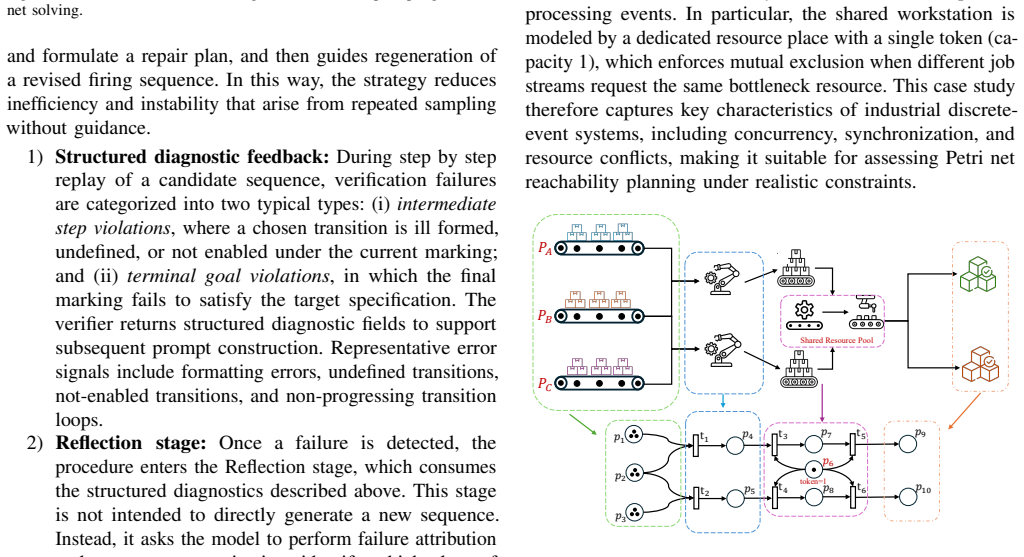
Manufacturing systems exhibit strong concurrency, synchronization, and contention for shared reusable resources, which makes fast and reliable scheduling and verification challenging. Petri nets provide a rigorous formalism for modeling such discrete-event manufacturing systems, but reachability analysis and solving remain difficult for conventional graph search or optimization-based solvers, particularly under state-space explosion and evolving production requirements. Recently, Large language models (LLMs) have shown promise as flexible planners that can generate candidate action sequences from textual specifications. However, direct use of LLMs for Petri net reachability remains unreliable. This paper proposes an LLM-based solving framework augmented with a two-stage reflection and reprompting mechanism. The combined effects of reflection and re-clarification improve the accuracy of feasible sequence generation. The proposed method is evaluated on an industrial case modeled as a Petri net. Under a fixed Petri net structure, the proposed strategy is assessed on six solvable reachability configurations. The results demonstrate improved reliability and stability in solving Petri net reachability problems. The proposed framework is further evaluated across multiple LLMs, which indicates that the framework is not tied to any specific model.
Editorial analysis
A structured set of objections, weighed in public.
Referee Report
Summary. The paper proposes a two-stage reflection and reprompting framework to augment LLMs for solving Petri net reachability problems in manufacturing systems. It claims that the combined reflection and re-clarification stages improve the accuracy of feasible sequence generation, with the strategy evaluated on six solvable reachability configurations under a fixed industrial Petri net structure. The framework is further tested across multiple LLMs to demonstrate generality, and the results are said to show improved reliability and stability compared to direct LLM use.
Significance. If the empirical results hold under proper validation, the approach could offer a flexible, model-agnostic method for handling reachability queries in complex concurrent systems where state-space explosion limits conventional solvers. The explicit multi-LLM evaluation is a strength, as it provides evidence that the framework is not tied to any specific model and supports the claim of improved reliability without domain-specific fine-tuning.
major comments (3)
- [Abstract] Abstract and evaluation description: The central claim that reflection and reprompting improve accuracy of feasible sequence generation rests on an evaluation of six solvable cases, yet the manuscript provides no quantitative metrics, error bars, baseline comparisons (e.g., vs. direct prompting or standard reachability algorithms), or details on how success was measured. This is load-bearing because the improvement is presented as an empirical observation without supporting data.
- [Evaluation] Evaluation section (implied by abstract): No indication is given of cross-validation of the generated sequences against a standard reachability tool, invariant checker, or explicit firing simulation to confirm that each transition is enabled in sequence and the final marking is reached. Without this, it is impossible to distinguish verified correctness from LLM self-consistency on the fixed net.
- [Abstract] The assumption that the two stages systematically correct LLM errors without introducing new invalid sequences is invoked for the six test cases but is not supported by any independent formal check or counter-example analysis, which is required to substantiate the reliability claim.
Simulated Author's Rebuttal
We thank the referee for the constructive feedback highlighting gaps in the evaluation. We will revise the manuscript to strengthen the empirical claims with additional metrics, verification details, and clarifications while preserving the core contribution of the two-stage framework.
read point-by-point responses
-
Referee: [Abstract] Abstract and evaluation description: The central claim that reflection and reprompting improve accuracy of feasible sequence generation rests on an evaluation of six solvable cases, yet the manuscript provides no quantitative metrics, error bars, baseline comparisons (e.g., vs. direct prompting or standard reachability algorithms), or details on how success was measured. This is load-bearing because the improvement is presented as an empirical observation without supporting data.
Authors: We agree the current abstract and evaluation lack quantitative support. The revised manuscript will include a table reporting success rates across the six configurations (e.g., fraction of valid sequences), explicit success criteria (sequence enables all transitions in order and reaches target marking), direct-prompting baselines, and variance measures from repeated LLM queries where applicable. revision: yes
-
Referee: [Evaluation] Evaluation section (implied by abstract): No indication is given of cross-validation of the generated sequences against a standard reachability tool, invariant checker, or explicit firing simulation to confirm that each transition is enabled in sequence and the final marking is reached. Without this, it is impossible to distinguish verified correctness from LLM self-consistency on the fixed net.
Authors: We accept this point. The revision will add an explicit verification subsection describing use of a Petri-net firing simulator (or equivalent reachability checker) to independently confirm each transition is enabled at its step and the final marking matches the target for all reported sequences. revision: yes
-
Referee: [Abstract] The assumption that the two stages systematically correct LLM errors without introducing new invalid sequences is invoked for the six test cases but is not supported by any independent formal check or counter-example analysis, which is required to substantiate the reliability claim.
Authors: The framework's benefit is presented as an empirical observation on the six cases rather than a formal guarantee. The revision will incorporate the independent simulation check noted above and will report any counter-examples or failure modes observed during testing; a general formal proof lies outside the paper's scope given the heuristic character of LLMs. revision: partial
Circularity Check
No circularity: empirical evaluation on fixed test cases
full rationale
The paper advances an empirical claim that a two-stage reflection and reprompting framework improves LLM-generated sequence accuracy for Petri net reachability, demonstrated via direct assessment on six solvable configurations of one fixed industrial net and across multiple LLMs. No equations, parameter fittings, or derivations appear in the provided text; the central result is presented as an observed outcome of the evaluation rather than a constructed prediction. No self-citations are invoked as load-bearing premises, and the evaluation does not reduce any reported improvement to its own inputs by definition. The work is therefore self-contained as an empirical study.
Axiom & Free-Parameter Ledger
Reference graph
Works this paper leans on
-
[1]
Industry 4.0: smart scheduling,
D. A. Rossit, F. Tohm´e, and M. Frutos, “Industry 4.0: smart scheduling,” International Journal of Production Research, vol. 57, no. 12, pp. 3802– 3813, 2019
2019
-
[2]
Petri nets: Properties, analysis and applications,
T. Murata, “Petri nets: Properties, analysis and applications,”Proceed- ings of the IEEE, vol. 77, no. 4, pp. 541–580, 2002
2002
-
[3]
Petri nets and industrial applications: A tutorial,
R. Zurawski and M. Zhou, “Petri nets and industrial applications: A tutorial,”IEEE Transactions on industrial electronics, vol. 41, no. 6, pp. 567–583, 1994
1994
-
[4]
Deadlock analysis of petri nets using siphons and mathematical programming,
F. Chu and X.-L. Xie, “Deadlock analysis of petri nets using siphons and mathematical programming,”IEEE Transactions on Robotics and Automation, vol. 13, no. 6, pp. 793–804, 1997
1997
-
[5]
From automated to autonomous process operations,
M. Baldea, A. T. Georgiou, B. Gopaluni, M. Mercang ¨oz, C. C. Pan- telides, K. Sheth, V . M. Zavala, and C. Georgakis, “From automated to autonomous process operations,”Computers & Chemical Engineering, vol. 196, p. 109064, 2025
2025
-
[6]
Leveraging llm agents and digital twins for fault handling in process plants,
M. S. Gill, J. Vyas, A. Markaj, F. Gehlhoff, and M. Mercang ¨oz, “Leveraging llm agents and digital twins for fault handling in process plants,” in2025 IEEE 30th International Conference on Emerging Technologies and Factory Automation (ETFA). IEEE, 2025, pp. 1–8
2025
-
[7]
Factuality challenges in the era of large language models and opportunities for fact-checking,
I. Augenstein, T. Baldwin, M. Cha, T. Chakraborty, G. L. Ciampaglia, D. Corney, R. DiResta, E. Ferrara, S. Hale, A. Halevyet al., “Factuality challenges in the era of large language models and opportunities for fact-checking,”Nature Machine Intelligence, vol. 6, no. 8, pp. 852–863, 2024
2024
-
[8]
Petri nets and industrial applications: A tutorial,
R. Zurawski and M. Zhou, “Petri nets and industrial applications: A tutorial,”IEEE Transactions on Industrial Electronics, vol. 41, no. 6, p. 567–583, Dec. 1994
1994
-
[9]
Applications of petri nets in produc- tion scheduling: a review,
G. Tuncel and G. M. Bayhan, “Applications of petri nets in produc- tion scheduling: a review,”The International Journal of Advanced Manufacturing Technology, vol. 34, no. 7, pp. 762–773, 2007
2007
-
[10]
Petri nets and deadlock-free scheduling of open shop manufacturing systems,
G. Mejia, J. P. Caballero-Villalobos, and C. Montoya, “Petri nets and deadlock-free scheduling of open shop manufacturing systems,”IEEE Transactions on Systems, Man, and Cybernetics: Systems, vol. 48, no. 6, p. 1017–1028, Jun. 2018
2018
-
[11]
Modeling, analysis, simulation, scheduling, and control of semiconductor manufacturing systems: A petri net approach,
M. Zhou, “Modeling, analysis, simulation, scheduling, and control of semiconductor manufacturing systems: A petri net approach,”IEEE Transactions on Semiconductor Manufacturing, vol. 11, no. 3, pp. 333–357, 1998
1998
-
[12]
Scheduling flexible manufacturing systems using petri nets and heuristic search,
D. Y . Lee and F. DiCesare, “Scheduling flexible manufacturing systems using petri nets and heuristic search,”IEEE Transactions on Robotics and Automation, vol. 10, no. 2, p. 123–132, Apr. 1994
1994
-
[13]
Introducing petrirl: An innovative framework for jssp resolution integrating petri nets and event-based reinforcement learning,
S. Lassoued and A. Schwung, “Introducing petrirl: An innovative framework for jssp resolution integrating petri nets and event-based reinforcement learning,”Journal of Manufacturing Systems, vol. 74, pp. 690–702, 2024
2024
-
[14]
Petri-net- based dynamic scheduling of flexible manufacturing system via deep reinforcement learning with graph convolutional network,
L. Hu, Z. Liu, W. Hu, Y . Wang, J. Tan, and F. Wu, “Petri-net- based dynamic scheduling of flexible manufacturing system via deep reinforcement learning with graph convolutional network,”Journal of Manufacturing Systems, vol. 55, pp. 1–14, 2020
2020
-
[15]
Petri-net-based deep reinforcement learning for real-time scheduling of automated manufacturing systems,
J. Luo, S. Yi, Z. Lin, H. Zhang, and J. Zhou, “Petri-net-based deep reinforcement learning for real-time scheduling of automated manufacturing systems,”Journal of Manufacturing Systems, vol. 74, pp. 995–1008, 2024
2024
-
[16]
Deadlock-free scheduling of flexible assembly systems based on petri nets and local search,
J. Luo, Z. Liu, M. Zhou, and K. Xing, “Deadlock-free scheduling of flexible assembly systems based on petri nets and local search,”IEEE Transactions on Systems, Man, and Cybernetics: Systems, vol. 50, no. 10, pp. 3658–3669, 2018
2018
-
[17]
A petri net-based particle swarm optimization approach for scheduling deadlock-prone flexible manufacturing systems,
L. Han, K. Xing, X. Chen, and F. Xiong, “A petri net-based particle swarm optimization approach for scheduling deadlock-prone flexible manufacturing systems,”Journal of Intelligent Manufacturing, vol. 29, no. 5, pp. 1083–1096, 2018
2018
-
[18]
Petri nets and deadlock-free scheduling of open shop manufacturing systems,
G. Mej´ıa, J. P. Caballero-Villalobos, and C. Montoya, “Petri nets and deadlock-free scheduling of open shop manufacturing systems,”IEEE Transactions on Systems, Man, and Cybernetics: Systems, vol. 48, no. 6, pp. 1017–1028, 2017
2017
-
[19]
Scheduling fms with alternative routings using petri nets and near admissible heuristic search,
B. Huang, X.-X. Shi, and N. Xu, “Scheduling fms with alternative routings using petri nets and near admissible heuristic search,”The International Journal of Advanced Manufacturing Technology, vol. 63, no. 9, pp. 1131–1136, 2012
2012
-
[20]
Iterative configuration of t-timed colored petri nets by a milp model for rail freight volume and rolling stock planning,
G. F. da Silva, L. S. M. Guedes, R. R. Saldanha, C. Andrey Maia, and T. B. F. Tamantini, “Iterative configuration of t-timed colored petri nets by a milp model for rail freight volume and rolling stock planning,” IEEE Access, vol. 13, p. 130066–130087, 2025
2025
-
[21]
Industrial foundation model,
L. Ren, H. Wang, J. Dong, Z. Jia, S. Li, Y . Wang, Y . Laili, D. Huang, L. Zhang, and B. Li, “Industrial foundation model,”IEEE Transactions on Cybernetics, 2025
2025
-
[22]
A large language model-based manufacturing process planning approach under industry 5.0,
M. Ni, T. Wang, J. Leng, C. Chen, and L. Cheng, “A large language model-based manufacturing process planning approach under industry 5.0,”International Journal of Production Research, pp. 1–20, 2025
2025
-
[23]
Leveraging error-assisted fine-tuning large language models for manufacturing excellence,
L. Xia, C. Li, C. Zhang, S. Liu, and P. Zheng, “Leveraging error-assisted fine-tuning large language models for manufacturing excellence,” Robotics and Computer-Integrated Manufacturing, vol. 88, p. 102728, 2024
2024
-
[24]
Llm-planner: Few-shot grounded planning for embodied agents with large language models,
C. H. Song, J. Wu, C. Washington, B. M. Sadler, W.-L. Chao, and Y . Su, “Llm-planner: Few-shot grounded planning for embodied agents with large language models,” inProceedings of the IEEE/CVF international conference on computer vision, 2023, pp. 2998–3009
2023
-
[25]
Y . Zhen, S. Bi, L. Xing-Tong, P. Wei-Qin, S. Hai-Peng, C. Zi-Rui, and F. Yi-Shu, “Robot task planning based on large language model representing knowledge with directed graph structures,”arXiv preprint arXiv:2306.05171, 2023
-
[26]
Masc: Large language model-based multi-agent scheduling chain for flexible job shop scheduling problem,
Z. Wang, C. Wan, J. Liu, X. Zhang, H. Wang, Y . Hu, and Z. Hu, “Masc: Large language model-based multi-agent scheduling chain for flexible job shop scheduling problem,”Advanced Engineering Informatics, vol. 67, p. 103527, 2025
2025
-
[27]
Reflecsched: Solving dynamic flexible job-shop scheduling via llm-powered hierarchical reflection,
S. Cao and Y . Yuan, “Reflecsched: Solving dynamic flexible job-shop scheduling via llm-powered hierarchical reflection,”arXiv preprint arXiv:2508.01724, 2025
discussion (0)
Sign in with ORCID, Apple, or X to comment. Anyone can read and Pith papers without signing in.