Beyond Local Independence: High-Dimensional Latent Class Graphical Models with Shared Block Structure
Pith reviewed 2026-06-30 01:43 UTC · model grok-4.3
The pith
A shared block partition across latent classes enables consistent estimation of class-specific graphical dependencies in high-dimensional ordinal data.
A machine-rendered reading of the paper's core claim, the machinery that carries it, and where it could break.
Core claim
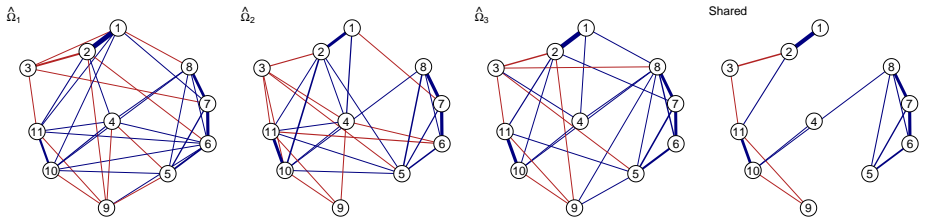
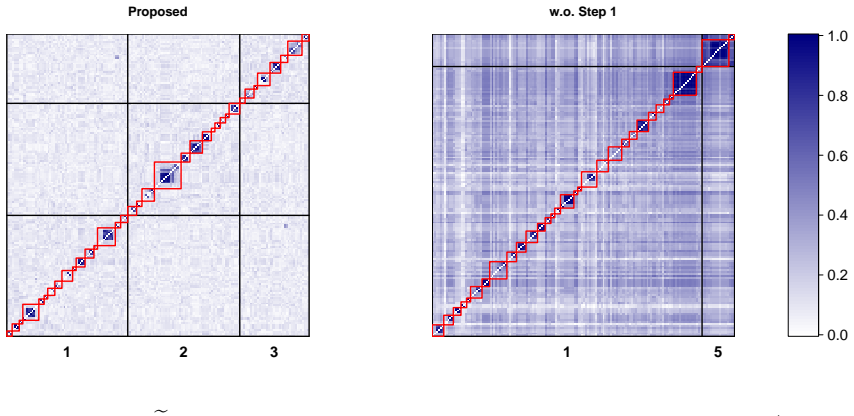
We propose a high-dimensional latent class graphical model for ordinal responses with block-structured local dependence. The model retains the interpretability and parsimony of classical latent class analysis by imposing a shared block partition of variables, while allowing class-specific graphical dependence within each block. We develop a scalable three-step estimator that first recovers latent classes by spectral clustering of a flattened response matrix, then estimates class-specific latent covariance matrices and aggregates them to recover the shared block partition, and finally estimates sparse within-block precision matrices. We establish finite-sample error bounds for clustering, cov
What carries the argument
The shared block partition of variables, recovered by aggregating class-specific covariance estimates to structure class-specific within-block precision matrix estimation.
If this is right
- Finite-sample bounds guarantee end-to-end consistency of clustering, covariance estimation, block recovery, and precision-matrix estimation under high-dimensional scaling.
- The three-step procedure scales to large datasets while recovering latent classes, shared blocks, and dependence graphs.
- Applications demonstrate interpretable local dependence structures in survey and genetic data accounting for latent heterogeneity.
Where Pith is reading between the lines
- The shared block assumption may hold in other categorical data domains such as text or consumer data, allowing similar consistent recovery.
- Adapting the covariance aggregation for block recovery could apply to multi-group models in other fields like finance or biology.
- If the block structure is misspecified, the method might still provide useful approximations for dependence modeling.
Load-bearing premise
There exists a shared block partition of the variables that is identical across all latent classes.
What would settle it
A large-sample dataset where the aggregated covariance-based block partition does not match the true common partition or where clustering accuracy does not improve with more samples would disprove the consistency.
Figures



read the original abstract
Latent class models are central tools for multivariate categorical data from heterogeneous populations, but their standard local-independence assumption is often unrealistic in modern high-dimensional applications. We propose a high-dimensional latent class graphical model for ordinal responses with block-structured local dependence. The model retains the interpretability and parsimony of classical latent class analysis by imposing a shared block partition of variables, while allowing class-specific graphical dependence within each block. We develop a scalable three-step estimator that first recovers latent classes by spectral clustering of a flattened response matrix, then estimates class-specific latent covariance matrices and aggregates them to recover the shared block partition, and finally estimates sparse within-block precision matrices. We establish finite-sample error bounds for clustering, covariance estimation, block recovery, and precision-matrix estimation, yielding end-to-end consistency of all model components under high-dimensional scaling. Simulations demonstrate accurate recovery of latent classes, the shared block partition, and class-specific dependence graphs with scalable computation. Applications to American National Election Studies survey data and HapMap3 genotype data show that the method uncovers interpretable local dependence structures while accounting for latent heterogeneity.
Editorial analysis
A structured set of objections, weighed in public.
Referee Report
Summary. The manuscript proposes high-dimensional latent class graphical models for ordinal responses that relax local independence via block-structured dependence, with a shared block partition across latent classes but class-specific graphs within blocks. A three-step estimator is developed: spectral clustering on flattened responses to recover classes, class-specific covariance estimation followed by aggregation to recover the shared blocks, and sparse within-block precision estimation. Finite-sample error bounds are established for clustering, covariance estimation, block recovery, and precision estimation, which compose to end-to-end consistency under high-dimensional scaling. Simulations and applications to ANES survey data and HapMap3 genotypes illustrate the method.
Significance. If the finite-sample bounds hold and compose as claimed, the work provides a scalable, theoretically grounded extension of latent class analysis that incorporates interpretable local dependence while preserving parsimony through the shared-block assumption. This is relevant for heterogeneous high-dimensional categorical data in social science and genomics. The end-to-end consistency result and the explicit handling of error propagation across the three steps are strengths; the applications demonstrate practical utility in uncovering dependence structures.
minor comments (2)
- The high-dimensional scaling assumptions (relations among n, p, number of classes, and block sizes) should be stated more explicitly when the finite-sample bounds are introduced, to clarify the regime under which end-to-end consistency holds.
- Notation for the shared block partition and its recovery via aggregation could be introduced with a small illustrative diagram or table early in the methods section for improved readability.
Simulated Author's Rebuttal
We thank the referee for the positive summary, significance assessment, and recommendation of minor revision for our manuscript on high-dimensional latent class graphical models with shared block structure. No major comments are provided in the report, so we have no specific points requiring point-by-point response or revision at this stage.
Circularity Check
No significant circularity detected
full rationale
The described three-step procedure (spectral clustering on flattened responses, class-specific covariance estimation with aggregation for shared blocks, then within-block precision estimation) is supported by finite-sample error bounds that compose to end-to-end consistency under high-dimensional scaling. The shared-block assumption is stated explicitly as a modeling choice rather than derived, and the bounds address error propagation across stages without any quoted reduction of target quantities to fitted parameters by construction. No self-citations are invoked as load-bearing uniqueness theorems, no ansatzes are smuggled, and no renaming of known results occurs. The derivation chain remains self-contained.
Axiom & Free-Parameter Ledger
axioms (1)
- domain assumption There exists a shared block partition of the variables that is identical across latent classes
Reference graph
Works this paper leans on
-
[1]
The Annals of Statistics , volume=
Estimating multivariate latent-structure models , author=. The Annals of Statistics , volume=. 2016 , publisher=
2016
-
[2]
Psychometrika , volume=
Local dependence latent structure models , author=. Psychometrika , volume=. 1972 , publisher=
1972
-
[3]
Biometrics , volume=
Bayesian approaches to modeling the conditional dependence between multiple diagnostic tests , author=. Biometrics , volume=. 2001 , publisher=
2001
-
[4]
Annals of statistics , volume=
High dimensional variable selection , author=. Annals of statistics , volume=
-
[5]
Node-based learning of multiple
Mohan, Karthik and London, Palma and Fazel, Maryam and Witten, Daniela and Lee, Su-In , journal=. Node-based learning of multiple. 2014 , publisher=
2014
-
[6]
Statistics & Probability Letters , volume=
A finite mixture model for the clustering of mixed-mode data , author=. Statistics & Probability Letters , volume=. 1988 , publisher=
1988
-
[7]
Advances in neural information processing systems , volume=
Stability approach to regularization selection (stars) for high dimensional graphical models , author=. Advances in neural information processing systems , volume=
-
[8]
Extended
Chen, Jiahua and Chen, Zehua , journal=. Extended. 2008 , publisher=
2008
-
[9]
Annals of statistics , volume=
On blockwise and reference panel-based estimators for genetic data prediction in high dimensions , author=. Annals of statistics , volume=
-
[10]
Extended
Barber, Rina and Drton, Mathias , journal=. Extended
-
[11]
Information and Inference: A Journal of the IMA , volume=
Detecting planted partition in sparse multilayer networks , author=. Information and Inference: A Journal of the IMA , volume=. 2024 , publisher=
2024
-
[12]
Proceedings of the 5th annual ACM web science conference , pages=
Producing a unified graph representation from multiple social network views , author=. Proceedings of the 5th annual ACM web science conference , pages=
-
[13]
Proceedings of the National Academy of Sciences , volume=
Dynamic reconfiguration of human brain networks during learning , author=. Proceedings of the National Academy of Sciences , volume=. 2011 , publisher=
2011
-
[14]
Biometrics , pages=
The effect of conditional dependence on the evaluation of diagnostic tests , author=. Biometrics , pages=. 1985 , publisher=
1985
-
[15]
Journal of Machine Learning Research , volume=
Joint structural estimation of multiple graphical models , author=. Journal of Machine Learning Research , volume=
-
[16]
IEEE Transactions on Information Theory , volume=
Community detection with contextual multilayer networks , author=. IEEE Transactions on Information Theory , volume=. 2023 , publisher=
2023
-
[17]
The Annals of Statistics , volume=
Spectral and matrix factorization methods for consistent community detection in multi-layer networks , author=. The Annals of Statistics , volume=. 2020 , publisher=
2020
-
[18]
Biometrics , pages=
Random effects models in latent class analysis for evaluating accuracy of diagnostic tests , author=. Biometrics , pages=. 1996 , publisher=
1996
-
[19]
Studies in social psychology in world war II Vol
The logical and mathematical foundation of latent structure analysis , author=. Studies in social psychology in world war II Vol. IV: Measurement and prediction , pages=. 1950 , publisher=
1950
-
[20]
Applied latent class analysis , volume=
Latent class cluster analysis , author=. Applied latent class analysis , volume=
-
[21]
Structural Equation Modeling: A Multidisciplinary Journal , volume=
A guide to detecting and modeling local dependence in latent class analysis models , author=. Structural Equation Modeling: A Multidisciplinary Journal , volume=. 2022 , publisher=
2022
-
[22]
Biometrika , volume=
Joint estimation of multiple graphical models , author=. Biometrika , volume=. 2011 , publisher=
2011
-
[23]
Bioinformatics , volume=
A new haplotype block detection method for dense genome sequencing data based on interval graph modeling of clusters of highly correlated SNPs , author=. Bioinformatics , volume=. 2018 , publisher=
2018
-
[24]
Science , volume=
The structure of haplotype blocks in the human genome , author=. Science , volume=. 2002 , publisher=
2002
-
[25]
Psychometrika , volume=
Estimation of the correlation coefficient in contingency tables with possibly nonmetrical characters , author=. Psychometrika , volume=. 1964 , publisher=
1964
-
[26]
The Annals of Statistics , number =
Regularized rank-based estimation of high-dimensional nonparanormal graphical models , author=. The Annals of Statistics , number =
-
[27]
High-dimensional semiparametric
Liu, Han and Han, Fang and Yuan, Ming and Lafferty, John and Wasserman, Larry , journal=. High-dimensional semiparametric. 2012 , publisher=
2012
-
[28]
, author=
The nonparanormal: Semiparametric estimation of high dimensional undirected graphs. , author=. Journal of Machine Learning Research , volume=
-
[29]
Journal of the american statistical association , volume=
Concomitant-variable latent-class models , author=. Journal of the american statistical association , volume=. 1988 , publisher=
1988
-
[30]
Traag, Vincent A and Waltman, Ludo and Van Eck, Nees Jan , journal=. From. 2019 , publisher=
2019
-
[31]
Proceedings of the National Academy of Sciences , volume=
Resolution limit in community detection , author=. Proceedings of the National Academy of Sciences , volume=. 2007 , publisher=
2007
-
[32]
Psychometrika , volume=
Robust estimation of polychoric correlation , author=. Psychometrika , volume=. 2026 , publisher=
2026
-
[33]
arXiv preprint arXiv:2602.21572 , year=
Goodness-of-Fit Tests for Latent Class Models with Ordinal Categorical Data , author=. arXiv preprint arXiv:2602.21572 , year=
-
[34]
Bioinformatics , volume=
Approximately independent linkage disequilibrium blocks in human populations , author=. Bioinformatics , volume=
-
[35]
Mathematical contributions to the theory of evolution.—VII
I. Mathematical contributions to the theory of evolution.—VII. On the correlation of characters not quantitatively measurable , author=. Philosophical Transactions of the Royal Society of London. Series A , volume=. 1900 , publisher=
1900
-
[36]
Biometrika , volume=
Sparse semiparametric canonical correlation analysis for data of mixed types , author=. Biometrika , volume=. 2020 , publisher=
2020
-
[37]
Journal of Educational and Behavioral Statistics , volume=
Inferential methods for the tetrachoric correlation coefficient , author=. Journal of Educational and Behavioral Statistics , volume=. 2005 , publisher=
2005
-
[38]
Foundations and Trends in Machine Learning , volume=
Spectral methods for data science: A statistical perspective , author=. Foundations and Trends in Machine Learning , volume=. 2021 , publisher=
2021
-
[39]
2018 , publisher=
High-dimensional probability: An introduction with applications in data science , author=. 2018 , publisher=
2018
-
[40]
, author=
Eigenvalues of several tridiagonal matrices. , author=. Applied Mathematics E-Notes [electronic only] , volume=. 2005 , publisher=
2005
-
[41]
Journal of the Royal Statistical Society Series B: Statistical Methodology , volume=
Robust causal structure learning with some hidden variables , author=. Journal of the Royal Statistical Society Series B: Statistical Methodology , volume=. 2019 , publisher=
2019
-
[42]
2020 , publisher=
Latent class analysis , author=. 2020 , publisher=
2020
-
[43]
Organizational Research Methods , volume=
Latent class procedures: Applications to organizational research , author=. Organizational Research Methods , volume=. 2011 , publisher=
2011
-
[44]
Model selection and estimation in the
Yuan, Ming and Lin, Yi , journal=. Model selection and estimation in the. 2007 , publisher=
2007
-
[45]
Frontiers in Psychology , volume=
Detecting conditional dependence using flexible Bayesian latent class analysis , author=. Frontiers in Psychology , volume=. 2020 , publisher=
2020
-
[46]
2013 , publisher=
Hierarchical item response models for cognitive diagnosis , author=. 2013 , publisher=
2013
-
[47]
Journal of the American Statistical Association , volume=
Deep discrete encoders: Identifiable deep generative models for rich data with discrete latent layers , author=. Journal of the American Statistical Association , volume=. 2026 , publisher=
2026
-
[48]
Sociological Methods & Research , volume=
Latent structure models with direct effects between indicators: local dependence models , author=. Sociological Methods & Research , volume=. 1988 , publisher=
1988
-
[49]
Bioinformatics , volume=
Haploview: analysis and visualization of LD and haplotype maps , author=. Bioinformatics , volume=. 2005 , publisher=
2005
-
[50]
Graphical model selection for
Frot, Benjamin and Jostins, Luke and McVean, Gilean , journal=. Graphical model selection for. 2019 , publisher=
2019
-
[51]
Parrilo and Alan S
Venkat Chandrasekaran and Pablo A. Parrilo and Alan S. Willsky , title =. The Annals of Statistics , number =. 2012 , doi =
2012
-
[52]
High-dimensional covariance estimation by minimizing ℓ 1-penalized log-determinant divergence , author=
-
[53]
Journal of Statistical Mechanics: Theory and Experiment , volume=
Fast unfolding of communities in large networks , author=. Journal of Statistical Mechanics: Theory and Experiment , volume=
-
[54]
Physical review e , volume=
Detecting communities using asymptotical surprise , author=. Physical review e , volume=. 2015 , publisher=
2015
-
[55]
Journal of Classification , volume=
Comparing partitions , author=. Journal of Classification , volume=. 1985 , publisher=
1985
-
[56]
Journal of multivariate analysis , volume=
Comparing clusterings—an information based distance , author=. Journal of multivariate analysis , volume=. 2007 , publisher=
2007
-
[57]
Machine learning , volume=
An experimental comparison of model-based clustering methods , author=. Machine learning , volume=. 2001 , publisher=
2001
-
[58]
Psychometrika , volume=
Estimating finite mixtures of ordinal graphical models , author=. Psychometrika , volume=. 2022 , publisher=
2022
-
[59]
Journal of Computational and Graphical Statistics , volume=
Copula graphical models for heterogeneous mixed data , author=. Journal of Computational and Graphical Statistics , volume=. 2024 , publisher=
2024
-
[60]
Journal of the American Statistical Association , volume=
Degree-heterogeneous Latent Class Analysis for high-dimensional discrete data , author=. Journal of the American Statistical Association , volume=. 2025 , publisher=
2025
-
[61]
Psychometrika , author=
Spectral Clustering with Likelihood Refinement for High-dimensional Latent Class Recovery , DOI=. Psychometrika , author=. 2026 , pages=
2026
-
[62]
Social Psychology of Education , volume=
Differences in students’ school motivation: A latent class modelling approach , author=. Social Psychology of Education , volume=. 2015 , publisher=
2015
-
[63]
Nature , volume=
Integrating common and rare genetic variation in diverse human populations , author=. Nature , volume=
-
[64]
BioMed Research International , volume=
Clique-based clustering of correlated SNPs in a gene can improve performance of gene-based multi-bin linear combination test , author=. BioMed Research International , volume=. 2015 , publisher=
2015
-
[65]
Psychometrika , volume=
Maximum likelihood estimation of multivariate polyserial and polychoric correlation coefficients , author=. Psychometrika , volume=. 1987 , publisher=
1987
-
[66]
(No Title) , year=
Latent structure analysis , author=. (No Title) , year=
-
[67]
R package version , volume=
Package ‘polycor’ , author=. R package version , volume=
-
[68]
Psychometrika , volume=
Maximum likelihood estimation of the polychoric correlation coefficient , author=. Psychometrika , volume=. 1979 , publisher=
1979
-
[69]
arXiv preprint arXiv:2502.02580 , year=
Minimax-Optimal Dimension-Reduced Clustering for High-Dimensional Nonspherical Mixtures , author=. arXiv preprint arXiv:2502.02580 , year=
-
[70]
Psychometrika , volume=
A general structural equation model with dichotomous, ordered categorical, and continuous latent variable indicators , author=. Psychometrika , volume=. 1984 , publisher=
1984
-
[71]
Rothman and Peter J
Adam J. Rothman and Peter J. Bickel and Elizaveta Levina and Ji Zhu , title =. Electronic Journal of Statistics , number =. 2008 , URL =
2008
-
[72]
Psychometrika , volume=
Who belongs in the family? , author=. Psychometrika , volume=. 1953 , publisher=
1953
-
[73]
The annals of applied statistics , volume=
Network exploration via the adaptive LASSO and SCAD penalties , author=. The annals of applied statistics , volume=
-
[74]
Journal of computational and applied mathematics , volume=
Silhouettes: a graphical aid to the interpretation and validation of cluster analysis , author=. Journal of computational and applied mathematics , volume=. 1987 , publisher=
1987
-
[75]
Strategic management journal , volume=
The application of cluster analysis in strategic management research: an analysis and critique , author=. Strategic management journal , volume=. 1996 , publisher=
1996
-
[76]
Metrika , pages=
Bayesian finite mixtures of ising models , author=. Metrika , pages=. 2024 , publisher=
2024
-
[77]
Psychometrika , volume=
Copula functions for residual dependency , author=. Psychometrika , volume=. 2007 , publisher=
2007
-
[78]
Psychometrika , volume=
A boundary mixture approach to violations of conditional independence , author=. Psychometrika , volume=. 2011 , publisher=
2011
-
[79]
Psychometrika , volume=
Robust measurement via a fused latent and graphical item response theory model , author=. Psychometrika , volume=. 2018 , publisher=
2018
-
[80]
Biostatistics , volume=
Sparse inverse covariance estimation with the graphical lasso , author=. Biostatistics , volume=. 2008 , publisher=
2008
discussion (0)
Sign in with ORCID, Apple, or X to comment. Anyone can read and Pith papers without signing in.