Quadratic Gauge Transformation
Pith reviewed 2026-06-30 05:27 UTC · model grok-4.3
The pith
A quadratic dimensionless gauge transformation preserves the invariance of the Lagrangian in complex scalar, Abelian, and non-Abelian field theories.
A machine-rendered reading of the paper's core claim, the machinery that carries it, and where it could break.
Core claim
The central claim is that a quadratic dimensionless gauge transformation can be defined locally such that the actions of complex scalar, Abelian, and non-Abelian theories remain invariant. This invariance establishes the associated conservation laws. The study places the transformation in a physical context where distinct field configurations correspond to identical physical states, and it demonstrates why the covariant derivative is required to keep the transformation consistent under local operations.
What carries the argument
The quadratic dimensionless gauge transformation, which changes the fields in a quadratic manner while keeping the Lagrangian density form-invariant under local symmetry operations.
If this is right
- The covariant derivative must be used to maintain consistent transformation properties under the local symmetry.
- Different field configurations related by the transformation represent the same physical state.
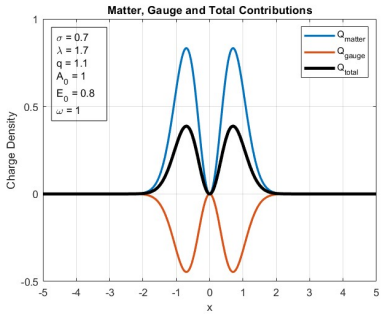
- Graphical analysis of the transformation confirms the invariance for the studied field configurations.
- Conservation laws are obtained directly from the established invariance.
Where Pith is reading between the lines
- The same quadratic form might be tested in other gauge theories beyond the Abelian and non-Abelian cases examined here.
- If the transformation generalizes without extra terms, it could provide an alternative parameterization when building effective models.
- Numerical checks of the derived conservation laws in specific field configurations would give a direct test of the invariance claim.
Load-bearing premise
A quadratic dimensionless gauge transformation can be defined locally and consistently such that the action remains invariant without additional constraints or inconsistencies in the field equations.
What would settle it
An explicit computation of the transformed Lagrangian for the complex scalar theory or an Abelian theory that yields a nonzero difference from the original Lagrangian.
Figures


read the original abstract
Symmetries plays a significant role in understanding the conservation laws in Quantum field theories. Here, we attempted a quadratic type dimensionless gauge transformation to achieve the invariance in QFTs. We have shown the extensive study of invariance of complex scalar, Abelian and Non- Abelian theories and established the conservation laws. We included an explicit graphical analysis to invoke the invariance. This is studied in a physical context, where different field configurations correspond to the same physical state. The necessity of the covariant derivative is studied in detail, highlighting how it ensures consistent transformation under local symmetry operations. The meaning of covariance is clarified as the preservation of the form of physical laws under transformations.
Editorial analysis
A structured set of objections, weighed in public.
Referee Report
Summary. The paper proposes a quadratic dimensionless gauge transformation and claims to demonstrate its invariance properties for the Lagrangians of complex scalar, Abelian, and non-Abelian gauge theories. It derives associated Noether currents establishing conservation laws, verifies that the transformation leaves the action invariant (or changes it by a total derivative), includes explicit transformation rules and plots of field configurations, and discusses the role of the covariant derivative in maintaining covariance under local transformations.
Significance. If the central derivations hold, this would constitute a non-standard extension of gauge symmetry in QFT, potentially yielding new conservation laws beyond the usual linear gauge transformations. The explicit checks across multiple theories and the graphical analysis are strengths that make the claim more concrete and falsifiable.
minor comments (3)
- [Abstract] Abstract, first sentence: grammatical error ('Symmetries plays' should be 'Symmetry plays' or 'Symmetries play').
- The manuscript would benefit from a dedicated section comparing the quadratic transformation to the standard linear gauge transformation, including any differences in the resulting Noether currents.
- Figure captions should explicitly state the field configurations plotted and the parameter values used to demonstrate invariance.
Simulated Author's Rebuttal
We thank the referee for their review and the recommendation of minor revision. The summary provided accurately describes our paper's content regarding the quadratic gauge transformation and its applications to various QFTs. No major comments were listed in the report, so we have no specific points to rebut or revise based on the provided feedback. If there are any minor issues or if the referee has additional comments, we are prepared to address them in a revised version.
Circularity Check
No significant circularity; derivation is constructive and self-contained
full rationale
The manuscript defines an explicit quadratic dimensionless gauge transformation, then directly computes its action on the Lagrangians of complex scalar, Abelian, and non-Abelian theories to verify δL = 0 (or a total derivative) and extracts the associated Noether currents. These steps are forward derivations from the stated transformation rules; the invariance is shown by explicit substitution rather than by presupposing the result or by any self-citation chain. No fitted parameters are relabeled as predictions, no uniqueness theorem is imported from prior self-work, and the covariant derivative is motivated by standard local symmetry requirements without circular redefinition. The graphical analysis simply illustrates the constructed invariance. The central claim therefore rests on independent verification steps that do not reduce to the inputs by construction.
Axiom & Free-Parameter Ledger
Reference graph
Works this paper leans on
-
[1]
Ryder,Quantum Field Theory, Cambridge University Press
L.H. Ryder,Quantum Field Theory, Cambridge University Press
-
[2]
Weinberg,The Quantum Theory of Fields, Vol
S. Weinberg,The Quantum Theory of Fields, Vol. 1, Cambridge University Press
-
[3]
Noether,Invariant Variation Problems, Transport Theory and Statistical Physics
E. Noether,Invariant Variation Problems, Transport Theory and Statistical Physics
-
[4]
Yang and R.L
C.N. Yang and R.L. Mills,Conservation of Isotopic Spin and Isotopic Gauge Invariance, Phys- ical Review
-
[5]
S Baiguera,Aspects of non-relativistic quantum field theories,The European Physical Journal C, 2024
2024
-
[6]
Frolov, A Schwarz,Quantum Mechanics and Quantum Field Theory: Algebraic and Geometric Approaches,Universe, 2023
2023
-
[7]
Jakob Yngvason,The role of type III factors in quantum field theory, Volume 55, Issue 1, February 2005, Pages 135-147
2005
-
[8]
Y Nakayama,Scale invariance vs conformal invariance,Physics Reports, 2015. 13
2015
-
[9]
Forgotten
Konstantinou, G., Moulopoulos, K. The “Forgotten” Pseudomomenta and Gauge Changes in Generalized Landau Level Problems: Spatially Nonuniform Magnetic and Temporally Varying Electric Fields. Int J Theor Phys 56, 1484–1503 (2017)
2017
-
[10]
Ge- ometric squeezing of rotating quantum gases into the lowest Landau level
Valentin Crépel; Ruixiao Yao; Biswaroop Mukherjee; Richard Fletcher; Martin Zwierlein. Ge- ometric squeezing of rotating quantum gases into the lowest Landau level. Comptes Rendus. Physique, CNRS Gold Medal Jean Dalibard, Volume 24 (2023), pp. 241-262
2023
-
[11]
Bunji Sakita,W ∞ gauge transformations and the electromagnetic interactions of electrons in the lowest Landau level,Physics Letter B, Pages: 124-128, Volume 315, Issues 1–2 (1993)
1993
-
[12]
Xiang Li Qianjun He, Zunwei Fu, Recent progress of Littlewood-paley Theory with chirp function https://doi.org/10.48550/arXiv.2605.08562(2026)
work page internal anchor Pith review Pith/arXiv arXiv doi:10.48550/arxiv.2605.08562(2026 2026
-
[13]
Large gauge transformations in double field theory
Hohm, O., Zwiebach, B. Large gauge transformations in double field theory. J. High Energ. Phys. 2013, 75 (2013)
2013
-
[14]
Yuko Kobashi, Akio Sugamoto,Singular Gauge Transformation in Non-Commutative U(2) Gauge Theory, arXiv:hep-th/0407118(2004)
work page internal anchor Pith review Pith/arXiv arXiv 2004
-
[15]
Ho, Pei-Ming , Matsuo, Yutaka. (2012). Note on non-Abelian two-form gauge fields. Journal of High Energy Physics. 2012. 10.1007/JHEP09(2012)075
-
[16]
Aspects of Chern-Simons Theory
Gerald V. Dunne, Aspects of Chern-Simons Theory , arXiv:hep-th/9902115
work page internal anchor Pith review Pith/arXiv arXiv
-
[17]
Castro-Alvaredo and Lucía Santamaría-Sanz,Symmetry-resolved measures in quan- tum field theory: A short review, Modern Physics Letters BVol
Olalla A. Castro-Alvaredo and Lucía Santamaría-Sanz,Symmetry-resolved measures in quan- tum field theory: A short review, Modern Physics Letters BVol. 39, No. 07, 2430002 (2025)
2025
-
[18]
Nakahara,Geometry, Topology and Physics, Taylor & Francis
M. Nakahara,Geometry, Topology and Physics, Taylor & Francis
-
[19]
Hall,Lie Groups, Lie Algebras, and Representations, Springer
B.C. Hall,Lie Groups, Lie Algebras, and Representations, Springer
-
[20]
Georgi,Lie Algebras in Particle Physics, Westview Press
H. Georgi,Lie Algebras in Particle Physics, Westview Press
-
[21]
Jackson,Classical Electrodynamics, Wiley
J.D. Jackson,Classical Electrodynamics, Wiley
-
[22]
Griffiths,Introduction to Elementary Particles, Wiley
griffiths D.J. Griffiths,Introduction to Elementary Particles, Wiley
-
[23]
’t Hooft,Gauge Theories of the Forces Between Elementary Particles, Scientific American
G. ’t Hooft,Gauge Theories of the Forces Between Elementary Particles, Scientific American
-
[24]
Feynman,QED: The Strange Theory of Light and Matter, Princeton University Press
R.P. Feynman,QED: The Strange Theory of Light and Matter, Princeton University Press
-
[25]
Dirac,The Principles of Quantum Mechanics, Oxford University Press
P.A.M. Dirac,The Principles of Quantum Mechanics, Oxford University Press
-
[26]
Yajnik, U.A,Relativistic Quantum Mechanics and Quantum Field Theory, J Indian Inst Sci 105, 43–62 (2025)
2025
-
[27]
Matsumoto , M
T. Matsumoto , M. Kitazawa , Y. Kohno,Classifying topological charge in SU(3) Yang–Mills theory with machine learning, Progress of Theoretical and Experimental Physics, Volume 2021, Issue 2, February 2021, 023D01
2021
-
[28]
Comments on the theory of superconductivity
Valatin, J. G."Comments on the theory of superconductivity". Il Nuovo Cimento. 7 (6): 843–857, March 1958. 14
1958
-
[29]
Topology of the gauge condition and new confinement phases in non-Abelian gauge theories
Hooft, Gerard’T. "Topology of the gauge condition and new confinement phases in non-Abelian gauge theories." Nuclear Physics: B 190, no. 3 (1981): 455-478. 15
1981
discussion (0)
Sign in with ORCID, Apple, or X to comment. Anyone can read and Pith papers without signing in.