Adaptive Eigenvector Continuation for Full-Vector Photonic Waveguide Mode Emulation
Pith reviewed 2026-07-01 02:08 UTC · model grok-4.3
The pith
Adaptive eigenvector continuation emulates full-vector photonic waveguide modes from a reduced basis of modal snapshots with residual monitoring.
A machine-rendered reading of the paper's core claim, the machinery that carries it, and where it could break.
Core claim
An adaptive eigenvector-continuation procedure constructs a reduced basis from selected full-order modal snapshots, solves the projected Maxwell eigenproblem at new query points, reconstructs the fields, and certifies accuracy via the full-operator residual; the same construction supports wavelength sweeps, shared multimode tracking, and geometry variations, establishing the technique as an operator-consistent modal emulator and diagnostic tool.
What carries the argument
Adaptive eigenvector continuation: a reduced basis assembled from full-order modal snapshots that is used to project and solve the Maxwell eigenproblem at new parameter values, with residual monitoring for adaptive enrichment.
If this is right
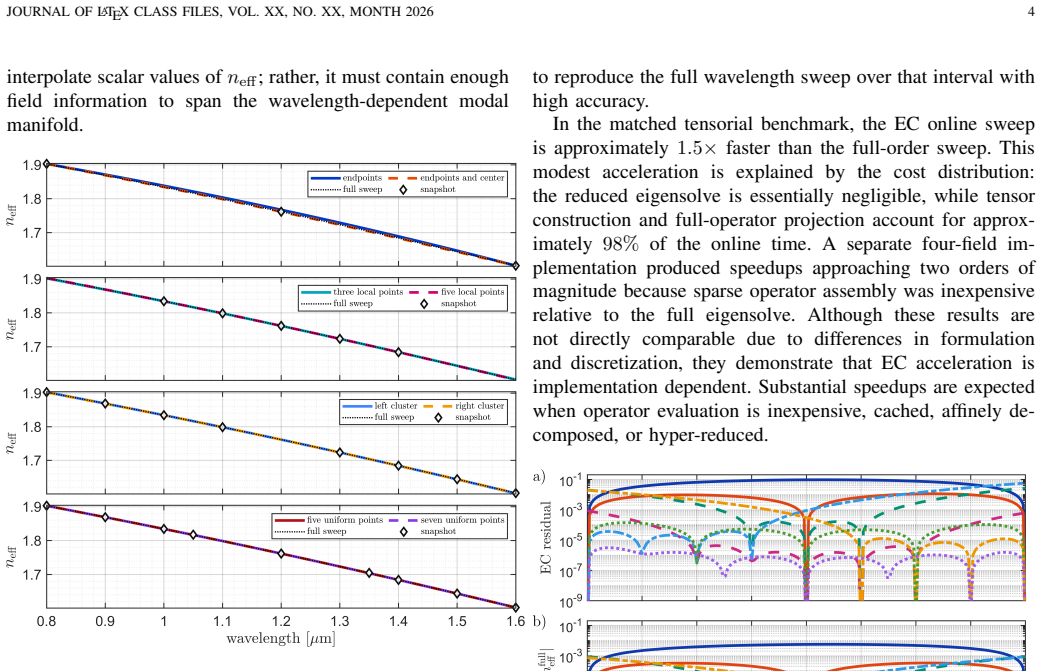
- Well-distributed snapshots reproduce a target modal branch across wavelength with low residual and low effective-index error.
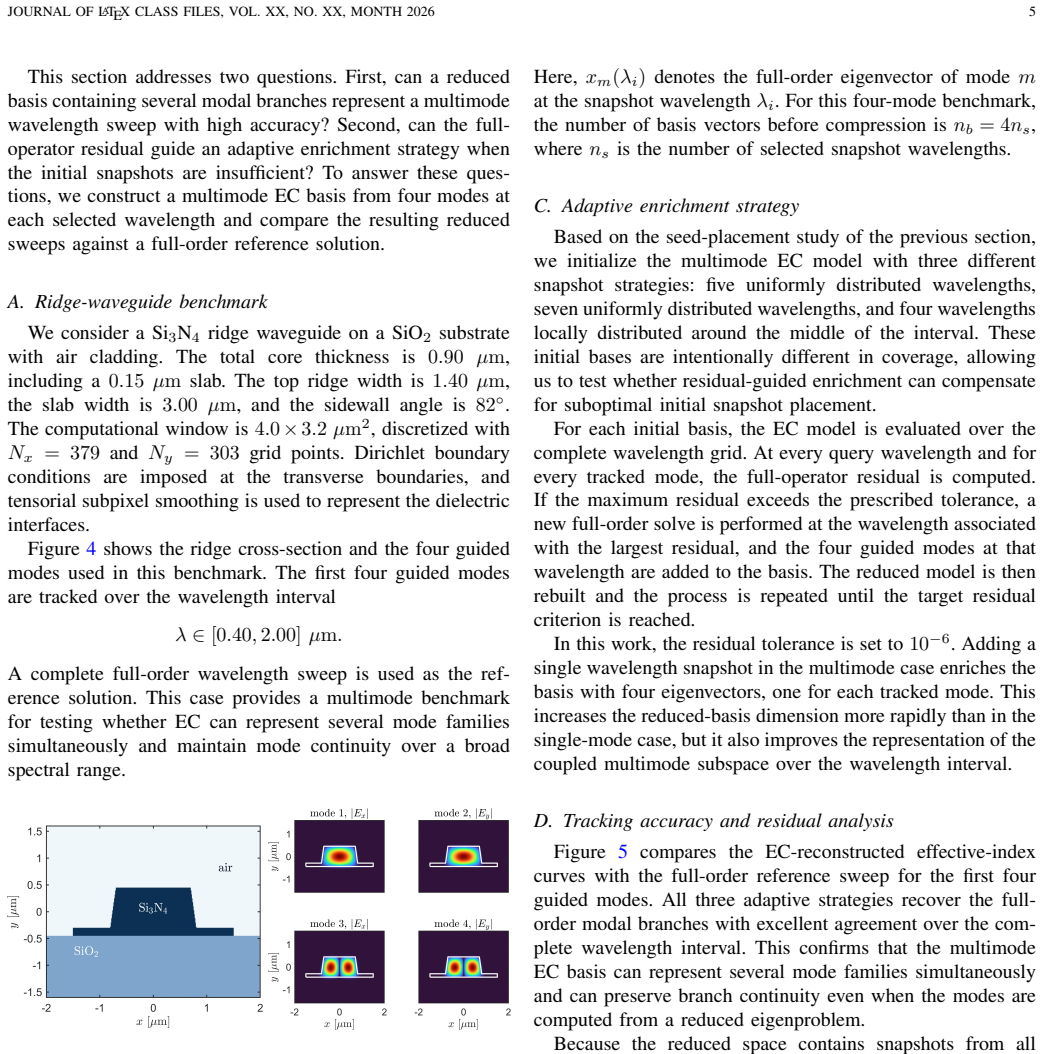
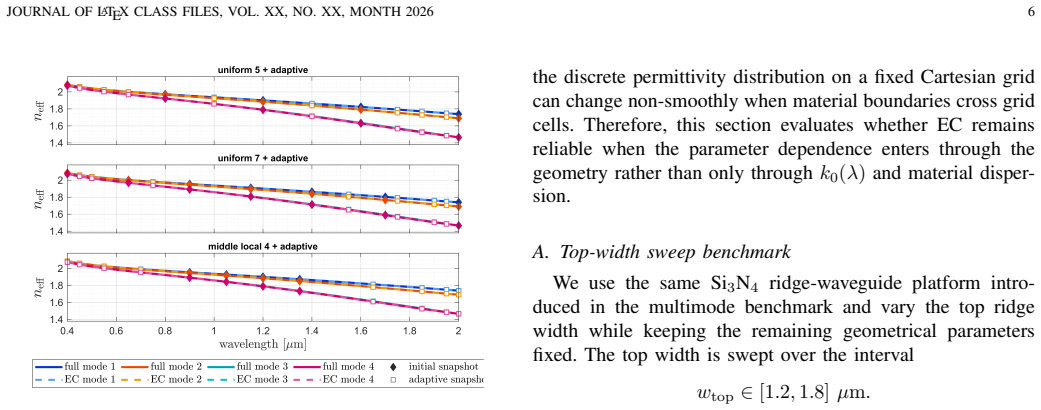
- A single shared basis containing multiple modal families supports broadband tracking without mode jumping.
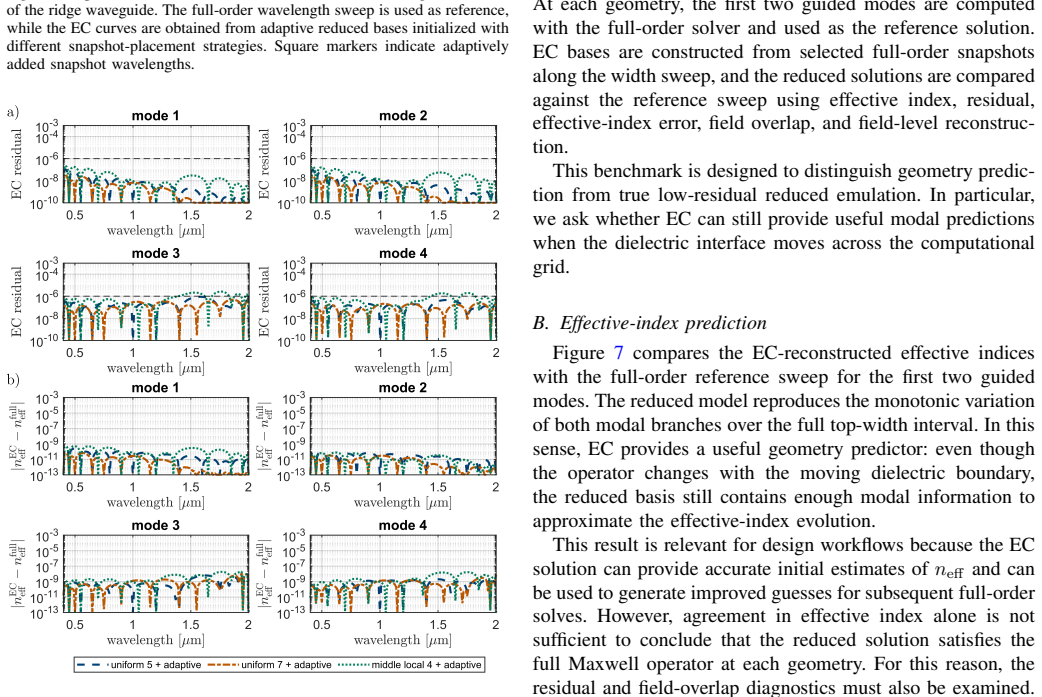
- Residual monitoring detects moving-boundary discretization errors that appear when waveguide geometry changes on a fixed Cartesian grid.
- The same framework supplies both fast emulation and a diagnostic signal for deciding when to add new snapshots.
Where Pith is reading between the lines
- The residual-guided enrichment loop could be inserted inside outer optimization or inverse-design iterations to control cost while maintaining operator consistency.
- Because the method works with the full discrete operator, it may extend naturally to other linear eigenproblems in electromagnetics that share the same discretization.
- The observed grid-induced residual growth under geometry change suggests that adaptive mesh refinement or operator-consistent remeshing would be natural next steps to preserve accuracy.
Load-bearing premise
A small set of snapshot modes remains rich enough to represent the solution at new parameter values, with the residual serving as a reliable indicator of when enrichment is needed.
What would settle it
A parameter point where the reconstructed mode yields a large full-operator residual yet the effective index or field overlap still appears accurate, or vice versa.
Figures


read the original abstract
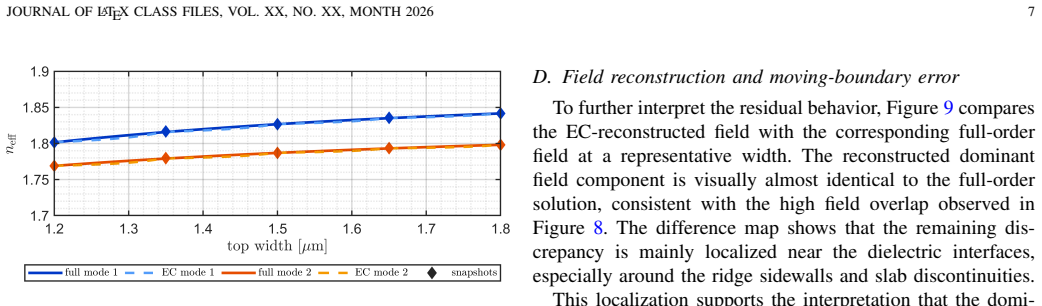
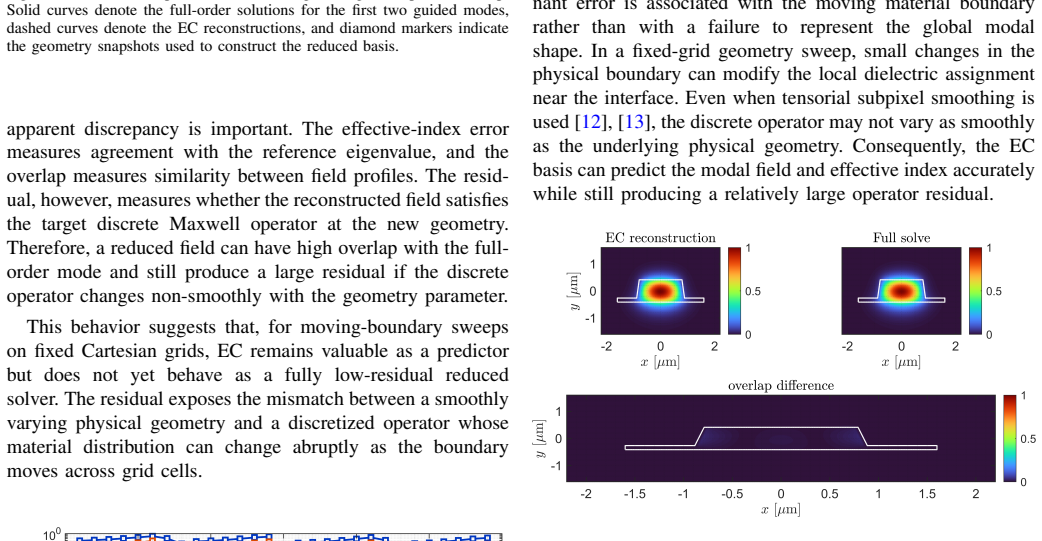
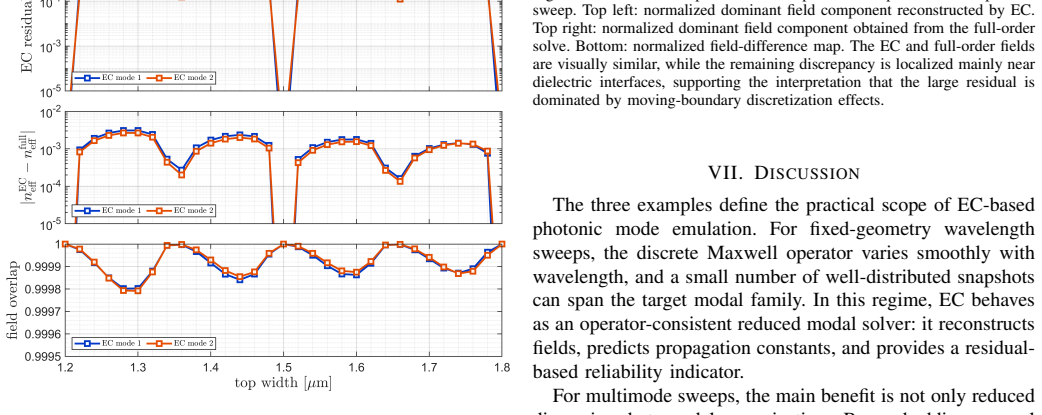
Photonic waveguide design often requires repeated full-vector Maxwell eigenmode solves over wavelength, geometry, and material parameters. We present an adaptive eigenvector-continuation framework for accelerating and stabilizing these modal sweeps. The method constructs a reduced basis from selected full-order modal snapshots, solves projected Maxwell eigenproblems at new query points, reconstructs the modal fields, and monitors accuracy with a full operator residual. We demonstrate three regimes. In fixed-geometry wavelength sweeps of a strip waveguide, well-distributed snapshots reproduce the target modal branch with low residual and low effective-index error. In a multimode ridge waveguide, a shared reduced basis containing several modal families enables robust broadband mode-family tracking and residual-guided adaptive enrichment. In geometry-dependent width sweeps, the method gives accurate effective-index predictions and high field overlap, but the residual reveals moving-boundary errors caused by non-smooth changes of the discrete operator on a fixed Cartesian grid. These results show that adaptive eigenvector continuation is an operator-consistent modal emulator and diagnostic tool for photonic waveguide sweeps.
Editorial analysis
A structured set of objections, weighed in public.
Referee Report
Summary. The manuscript introduces an adaptive eigenvector continuation framework to accelerate full-vector photonic waveguide mode computations over sweeps in wavelength, geometry, and material parameters. A reduced basis is built from selected full-order modal snapshots; projected Maxwell eigenproblems are solved at new query points, fields are reconstructed, and accuracy is monitored via the residual of the full discrete operator. Demonstrations include low-residual wavelength sweeps on a strip waveguide, shared-basis multimode tracking on a ridge waveguide, and geometry width sweeps that yield accurate effective indices and field overlaps but expose residual contributions from fixed-grid moving-boundary artifacts.
Significance. If the residual can be shown to isolate reduced-basis error from discretization artifacts, the method would supply a practical, operator-consistent emulator and diagnostic for repeated modal solves in photonic design, with particular value for broadband and multimode problems.
major comments (2)
- [Abstract] Abstract (geometry-dependent width sweeps paragraph): the claim that the method furnishes an 'operator-consistent modal emulator' whose accuracy is monitored by the full-operator residual is undercut by the explicit statement that the residual 'reveals moving-boundary errors caused by non-smooth changes of the discrete operator on a fixed Cartesian grid.' Because the residual is the sole accuracy diagnostic offered, this confounding prevents the geometry-sweep results from supporting the central consistency claim.
- [Abstract] Abstract (all demonstrations): no derivation of the projected eigenproblem, no statement of the adaptive snapshot-selection criterion, and no tabulated residuals, error bars, or overlap metrics are supplied, so it is impossible to verify that the reported low residuals and field overlaps actually confirm faithful reconstruction of the target continuous-parameter problem.
minor comments (1)
- The abstract refers to 'identified grid issues' without indicating how these are separated from reduced-basis truncation error in the reported diagnostics.
Simulated Author's Rebuttal
We thank the referee for their careful reading and constructive comments on our manuscript. We address each major comment point by point below and propose targeted revisions to improve clarity.
read point-by-point responses
-
Referee: [Abstract] Abstract (geometry-dependent width sweeps paragraph): the claim that the method furnishes an 'operator-consistent modal emulator' whose accuracy is monitored by the full-operator residual is undercut by the explicit statement that the residual 'reveals moving-boundary errors caused by non-smooth changes of the discrete operator on a fixed Cartesian grid.' Because the residual is the sole accuracy diagnostic offered, this confounding prevents the geometry-sweep results from supporting the central consistency claim.
Authors: We agree that the geometry-sweep demonstration highlights a distinction between reduced-basis approximation error and discretization artifacts. The residual is constructed to be exactly consistent with the discrete Maxwell operator on the chosen grid; therefore, when the grid is fixed and the geometry moves, the residual correctly flags the non-smooth operator changes that arise from the discretization itself. This behavior supports rather than undermines the claim of operator consistency, because the emulator reproduces the discrete operator (including its known limitations) without introducing additional projection error. We will revise the abstract to state explicitly that 'operator-consistent' refers to fidelity with respect to the discrete operator and that the geometry-sweep case serves as a diagnostic for grid-induced inconsistencies. This clarification will be added in the revised abstract. revision: yes
-
Referee: [Abstract] Abstract (all demonstrations): no derivation of the projected eigenproblem, no statement of the adaptive snapshot-selection criterion, and no tabulated residuals, error bars, or overlap metrics are supplied, so it is impossible to verify that the reported low residuals and field overlaps actually confirm faithful reconstruction of the target continuous-parameter problem.
Authors: The abstract is a concise summary and therefore omits technical derivations and tabulated data. The projected eigenproblem is derived in Section 2, the residual-based adaptive snapshot-selection criterion (enrichment when the full-operator residual exceeds a prescribed tolerance) is stated in Section 3, and quantitative verification appears in Sections 4–6 together with Figures 2–7, which report residuals, effective-index errors, and overlap metrics (with error bars derived from multiple snapshot configurations). We will add a short clause in the abstract directing readers to these sections and will include a compact table of representative residual and overlap values in the revised manuscript to facilitate immediate verification. revision: partial
Circularity Check
No significant circularity; residual validation is independent
full rationale
The derivation chain constructs a reduced basis from full-order snapshots, projects the eigenproblem, and validates reconstruction accuracy via a residual computed directly from the full discrete Maxwell operator at query points. This residual is not fitted to the reduced solution nor defined in terms of the continuation method itself; it functions as an external monitor. No self-citations are load-bearing, no parameters are fitted then relabeled as predictions, and no ansatz or uniqueness result is smuggled in. The geometry-sweep residual discussion explicitly flags discretization artifacts rather than concealing them, confirming the validation step does not collapse to the method's own inputs.
Axiom & Free-Parameter Ledger
Reference graph
Works this paper leans on
-
[1]
Tailored anomalous group-velocity dispersion in silicon channel waveguides,
A. C. Turner, C. Manolatou, B. S. Schmidt, M. Lipson, M. A. Foster, J. E. Sharping, and A. L. Gaeta, “Tailored anomalous group-velocity dispersion in silicon channel waveguides,”Opt. Express, vol. 14, no. 10, pp. 4357–4362, 2006
2006
-
[2]
Supercontinuum generation in photonic crystal fiber,
J. M. Dudley, G. Genty, and S. Coen, “Supercontinuum generation in photonic crystal fiber,”Rev. Mod. Phys., vol. 78, pp. 1135–1184, 2006
2006
-
[3]
Engineered photon-pair generation by four-wave mixing in asymmetric coupled waveguides
R. J. A. Francis-Jones, T. A. Wright, A. V . Gorbach, and P. J. Mosley, “Engineered photon-pair generation by four-wave mixing in asymmetric coupled waveguides,”arXiv preprint arXiv:1809.10494, 2018
work page internal anchor Pith review Pith/arXiv arXiv 2018
-
[4]
Tunable four-wave mixing light source based on photonic crystal fibers with vari- able chromatic dispersion,
L. Velázquez-Ibarra, A. Díez, E. Silvestre, and M. V . Andrés, “Tunable four-wave mixing light source based on photonic crystal fibers with vari- able chromatic dispersion,”Journal of Lightwave Technology, vol. 37, no. 22, pp. 5722–5726, 2019
2019
-
[5]
Quarteroni, A
A. Quarteroni, A. Manzoni, and F. Negri,Reduced Basis Methods for Partial Differential Equations. Springer, 2015
2015
-
[6]
Reduced basis approxima- tion and a posteriori error estimation for affinely parametrized elliptic coercive partial differential equations,
G. Rozza, D. B. P. Huynh, and A. T. Patera, “Reduced basis approxima- tion and a posteriori error estimation for affinely parametrized elliptic coercive partial differential equations,”Archives of Computational Meth- ods in Engineering, vol. 15, pp. 229–275, 2008
2008
-
[7]
Eigenvector continuation with subspace learning,
D. Frame, R. He, I. Ipsen, D. Lee, D. Lee, and E. Rrapaj, “Eigenvector continuation with subspace learning,”Phys. Rev. Lett., vol. 121, p. 032501, Jul 2018
2018
-
[8]
Collo- quium: Eigenvector continuation and projection-based emulators,
T. Duguet, A. Ekström, R. J. Furnstahl, S. König, and D. Lee, “Collo- quium: Eigenvector continuation and projection-based emulators,”Rev. Mod. Phys., vol. 96, p. 031002, Aug 2024
2024
-
[9]
Vector finite difference modesolver for anisotropic dielectric waveguides,
A. B. Fallahkhair, K. S. Li, and T. E. Murphy, “Vector finite difference modesolver for anisotropic dielectric waveguides,”Journal of Lightwave Technology, vol. 26, no. 11, pp. 1423–1431, 2008
2008
-
[10]
Reduced basis approximation for Maxwell’s eigenvalue problem and parameter-dependent domains,
M. Kappesser, A. Ziegler, and S. Schöps, “Reduced basis approximation for Maxwell’s eigenvalue problem and parameter-dependent domains,” IEEE Transactions on Magnetics, vol. 60, no. 3, pp. 1–7, 2024
2024
-
[11]
Convergence of eigenvector continuation,
A. Sarkar and D. Lee, “Convergence of eigenvector continuation,”Phys. Rev. Lett., vol. 126, p. 032501, Jan 2021
2021
-
[12]
Improving accuracy by subpixel smoothing in the finite-difference time-domain method,
A. Farjadpour, D. Roundy, A. Rodriguez, M. Ibanescu, P. Bermel, J. D. Joannopoulos, S. G. Johnson, and G. Burr, “Improving accuracy by subpixel smoothing in the finite-difference time-domain method,”Optics Letters, vol. 31, no. 20, pp. 2972–2974, 2006
2006
-
[13]
Perturbation theory for anisotropic dielectric interfaces, and application to subpixel smoothing of discretized numerical methods,
C. Kottke, A. Farjadpour, and S. G. Johnson, “Perturbation theory for anisotropic dielectric interfaces, and application to subpixel smoothing of discretized numerical methods,”Physical Review E, vol. 77, p. 036611, 2008
2008
discussion (0)
Sign in with ORCID, Apple, or X to comment. Anyone can read and Pith papers without signing in.