GRAPE: Graph-Augmented Prototype Explanations for Interactive Medical Image Diagnosis
Pith reviewed 2026-07-01 01:47 UTC · model grok-4.3
The pith
GRAPE combines graph attention, safety checks, and text-based anchoring to overcome independence, unsafe feedback, and retraining limits in prototype medical image classifiers.
A machine-rendered reading of the paper's core claim, the machinery that carries it, and where it could break.
Core claim
GRAPE is a unified architecture that addresses three clinical limitations of prototype-based medical image classifiers: independent findings, unsafe feedback amplification, and full retraining for new findings. It does so through graph attention for co-occurrence, a concept-mismatch safety check, and open-vocabulary prototype anchoring aligned to clinical text, as shown by performance gains on TBX11K and NIH ChestX-ray14 datasets.
What carries the argument
Graph-Augmented Prototype Explanations (GRAPE) with its Graph Attention Task Head, Concept-Mismatch Safety Check, and Open-Vocabulary Prototype Anchoring mechanism.
If this is right
- Graph attention modeling of concept co-occurrence raises macro-F1 by 13.8 points on TBX11K.
- The safety check detects 85% of erroneous annotations compared to 51% for MC-Dropout.
- A new finding can be added from a single labeled image without retraining other components.
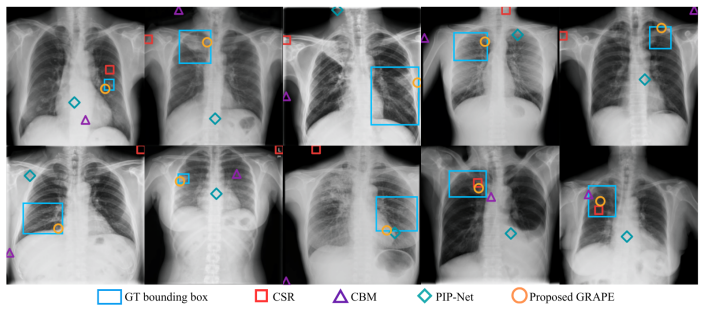
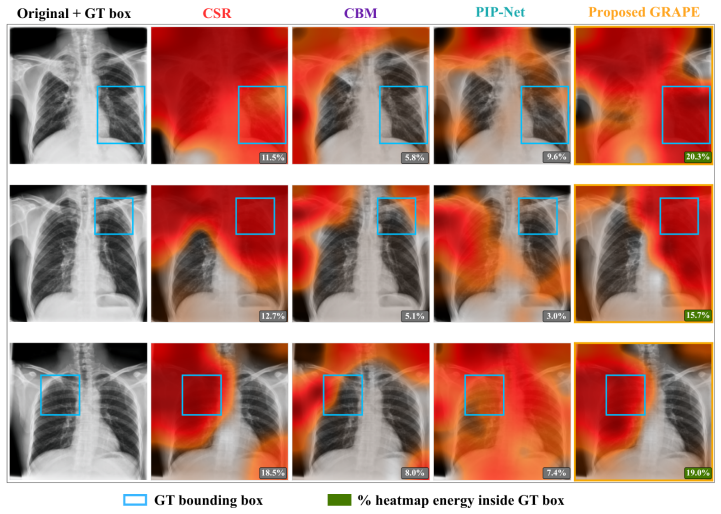
- Prototype localization improves 2.6 times over end-to-end baselines on TBX11K.
- The full system adds only 1 ms latency at interactive batch sizes.
Where Pith is reading between the lines
- The safety mechanism could extend to other interactive AI systems where user input might be erroneous.
- Single-example addition via text might enable rapid adaptation in other vision tasks with descriptive labels.
- The approach suggests prototype methods could support continuous learning in medical imaging without full retraining cycles.
Load-bearing premise
A single labeled image aligned with text is sufficient to add a new finding without loss of performance on prior findings, and the safety check generalizes to other error types.
What would settle it
An experiment adding multiple new findings one by one from single images and checking if performance on the original findings remains stable, or applying the safety check to annotation errors different from those in the TBX11K tests.
Figures

read the original abstract
Prototype-based medical image classifiers present three clinical limitations: they treat findings as independent, silently amplify unsafe physician feedback, and require full retraining whenever a new finding is needed. We present GRAPE (Graph-Augmented Prototype Explanations), a unified architecture that addresses all three challenges. First, a Graph Attention Task Head models anatomical concept co-occurrence, boosting macro-F1 by +13.8,pp over the prototype baseline on TBX11K. Second, a Concept-Mismatch Safety Check - the first such mechanism in prototype-based medical classifiers - warns when the model's dominant finding inside a doctor-drawn region conflicts with the claimed label, catching 85% of erroneous annotations versus 51% for MC-Dropout with no extra inference cost. Third, Open-Vocabulary Prototype Anchoring aligns visual prototypes to clinical text, allowing a new finding to be added from a single labeled image without modifying any other component. On NIH ChestX-ray14, one Effusion example recovers full-supervision localization accuracy; on TBX11K, prototype maps achieve 2.6x better lesion localization than end-to-end baselines. All three capabilities add only +1~ms latency at interactive batch size. The project page is https://github.com/KurbanIntelligenceLab/GRAPE.
Editorial analysis
A structured set of objections, weighed in public.
Referee Report
Summary. The paper proposes GRAPE, a unified prototype-based architecture for medical image diagnosis that incorporates (1) a Graph Attention Task Head to model anatomical concept co-occurrence, (2) a Concept-Mismatch Safety Check to detect label errors in physician feedback, and (3) Open-Vocabulary Prototype Anchoring to add new findings from a single labeled image via text alignment without retraining. It reports +13.8 pp macro-F1 on TBX11K, 85% erroneous annotation detection (vs. 51% MC-Dropout), single-image Effusion addition on NIH ChestX-ray14 recovering full-supervision localization, 2.6x better lesion localization, and +1 ms latency.
Significance. If the empirical claims hold under rigorous verification, GRAPE would represent a meaningful advance in making prototype-based classifiers clinically viable by jointly handling co-occurrence, safety, and incremental adaptation with negligible overhead. The low-latency interactive setting and explicit safety mechanism are particularly relevant to deployment constraints in medical imaging.
major comments (2)
- [Abstract] Abstract (Open-Vocabulary Prototype Anchoring paragraph): the central claim that a new finding can be added from one labeled image 'without modifying any other component' and without harming prior performance is load-bearing for the unified-architecture argument, yet the manuscript reports only that the new Effusion prototype recovers localization accuracy; no before/after macro-F1, per-class accuracy, or localization metrics are supplied for the original 13 findings on NIH or TBX11K. In a shared embedding space this omission leaves the no-interference guarantee unverified.
- [Abstract] Abstract (Graph Attention Task Head paragraph): the +13.8 pp macro-F1 gain is presented as evidence that modeling co-occurrence addresses the independence limitation, but the abstract supplies neither the exact baseline prototype model, ablation isolating the graph component, nor statistical significance tests, rendering the magnitude and attribution of the gain difficult to evaluate.
minor comments (2)
- [Abstract] Abstract: '+13.8,pp' contains a typographical error (comma instead of space).
- [Abstract] Abstract: the phrase 'the first such mechanism in prototype-based medical classifiers' is an absolute claim that would benefit from a brief literature qualifier or footnote.
Simulated Author's Rebuttal
We thank the referee for the constructive comments on the abstract. We address each major comment below.
read point-by-point responses
-
Referee: [Abstract] Abstract (Open-Vocabulary Prototype Anchoring paragraph): the central claim that a new finding can be added from one labeled image 'without modifying any other component' and without harming prior performance is load-bearing for the unified-architecture argument, yet the manuscript reports only that the new Effusion prototype recovers localization accuracy; no before/after macro-F1, per-class accuracy, or localization metrics are supplied for the original 13 findings on NIH or TBX11K. In a shared embedding space this omission leaves the no-interference guarantee unverified.
Authors: We agree that the no-interference claim requires explicit verification. The current manuscript reports recovery of localization accuracy for the added Effusion prototype but does not supply before/after metrics for the original findings. We will add these comparisons (macro-F1, per-class accuracy, and localization metrics on the original 13 findings before and after addition) to the revised manuscript and update the abstract to reference the no-degradation result. revision: yes
-
Referee: [Abstract] Abstract (Graph Attention Task Head paragraph): the +13.8 pp macro-F1 gain is presented as evidence that modeling co-occurrence addresses the independence limitation, but the abstract supplies neither the exact baseline prototype model, ablation isolating the graph component, nor statistical significance tests, rendering the magnitude and attribution of the gain difficult to evaluate.
Authors: The abstract identifies the gain as over 'the prototype baseline' (defined in Section 3.2 as the standard prototype classifier). Ablations isolating the graph attention component and statistical significance tests appear in Table 2 and Section 4.2. We will revise the abstract to add a brief clause referencing these supporting results for improved clarity. revision: partial
Circularity Check
No derivation chain present; claims are empirical
full rationale
The provided manuscript text and abstract contain no equations, derivations, or first-principles steps. All central claims (macro-F1 gains, safety-check rates, single-image prototype addition) are presented as experimental outcomes on TBX11K and NIH ChestX-ray14. No self-definitional relations, fitted inputs renamed as predictions, or load-bearing self-citations appear. The architecture is described at the level of components and results, making the paper self-contained against external benchmarks with no circular reduction possible.
discussion (0)
Sign in with ORCID, Apple, or X to comment. Anyone can read and Pith papers without signing in.