Phonon-induced pseudogap phase in TiSe₂
Pith reviewed 2026-07-01 03:34 UTC · model grok-4.3
The pith
The normal phase of TiSe₂ is a phonon-induced pseudogap phase driven by strong CDW fluctuations from electron-phonon coupling.
A machine-rendered reading of the paper's core claim, the machinery that carries it, and where it could break.
Core claim
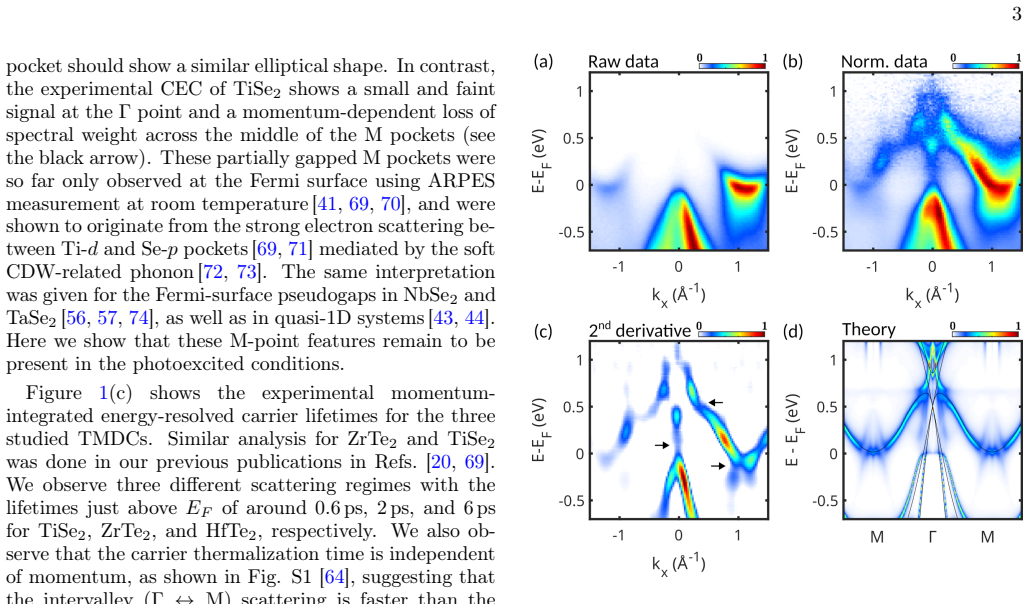
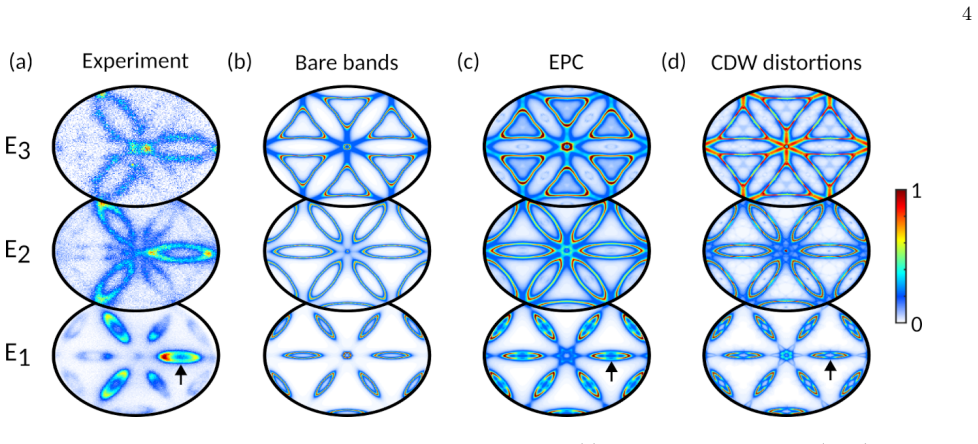
In the strongly coupled regime realized by TiSe₂, soft-phonon-induced thermal fluctuations generate momentum-dependent suppression of spectral weight that forms pseudogaps reaching up to 1 eV above the Fermi level, establishing the normal phase as a phonon-induced pseudogap phase governed by strong CDW fluctuations.
What carries the argument
soft-phonon-induced thermal fluctuations that produce momentum-dependent suppression of spectral weight
If this is right
- The normal state of TiSe₂ cannot be treated as a simple Fermi liquid but must incorporate strong CDW fluctuations.
- The TiSe₂ phase diagram contains an extended pseudogap regime between the high-temperature metal and the ordered CDW phase.
- Other TMDCs in the strong electron-phonon coupling regime are expected to display analogous phonon-induced pseudogaps.
- Time-resolved photoemission can directly track the temperature evolution of these fluctuation-induced features.
Where Pith is reading between the lines
- The same fluctuation mechanism may set the energy scale that controls the CDW transition temperature itself.
- Pseudogap signatures could appear in transport or optical data of TiSe₂ and related compounds even without long-range order.
- Doping or pressure studies that weaken the electron-phonon coupling should close the pseudogap and restore conventional metallic behavior.
Load-bearing premise
The observed momentum-dependent suppression of spectral weight is caused by soft-phonon-induced thermal fluctuations rather than disorder, surface effects, or experimental artifacts.
What would settle it
ARPES spectra taken on TiSe₂ at temperatures well above the CDW transition that show no momentum-dependent pseudogap, or ab initio calculations that include only static lattice effects and reproduce the measured suppression equally well.
Figures

read the original abstract
To comprehend quantum ordered states, such as charge density waves (CDW), in layered transition metal dichalcogenides (TMDCs), it is essential to uncover their underlying normal states. Here, we use time- and angle-resolved extreme ultraviolet photoemission spectroscopy and ab initio electron-phonon calculations to perform excited state band mapping of three prototypical 1T TMDCs, i.e., TiSe$_2$, HfTe$_2$, and ZrTe$_2$, at room temperature. The results reveal the profound impact of strong electron-phonon-induced thermal fluctuations on the normal-phase electronic structure. Specifically, in the moderate electron-phonon coupling regime, as in HfTe$_2$ and ZrTe$_2$, thermal fluctuations only lead to small spectral broadening and band renormalization. In the strongly coupled case, exemplified by TiSe$_2$, we observe soft-phonon-induced, momentum-dependent suppression of spectral weight, i.e., pseudogaps - extending up to 1 eV above the Fermi level. Our work establishes the normal phase of TiSe$_2$ as a phonon-induced pseudogap phase governed by strong CDW fluctuations, thereby uncovering previously missing aspects of the TiSe$_2$ phase diagram, with broader implications for other TMDCs in the strong electron-phonon coupling regime.
Editorial analysis
A structured set of objections, weighed in public.
Referee Report
Summary. The manuscript reports time- and angle-resolved extreme ultraviolet photoemission spectroscopy combined with ab initio electron-phonon calculations on the normal state (room temperature) of 1T-TiSe₂, HfTe₂, and ZrTe₂. It claims that moderate e-ph coupling in HfTe₂ and ZrTe₂ produces only modest spectral broadening and band renormalization, whereas strong coupling in TiSe₂ produces soft-phonon-driven thermal fluctuations that cause a momentum-dependent suppression of spectral weight (pseudogap) extending ~1 eV above E_F. The central conclusion is that the normal phase of TiSe₂ is a phonon-induced pseudogap phase governed by strong CDW fluctuations.
Significance. If the causal attribution to soft-phonon fluctuations is robust, the result would clarify previously missing aspects of the TiSe₂ phase diagram and indicate how strong e-ph coupling modifies the normal state in other TMDCs. The combination of tr-EUV-ARPES with ab initio calculations is a methodological strength.
major comments (2)
- [Results and Discussion (TiSe₂ data)] The central claim that the observed momentum-dependent spectral-weight suppression is produced by soft-phonon-induced thermal fluctuations (rather than surface reconstruction, matrix-element effects, or static disorder) is load-bearing, yet the manuscript provides no explicit experimental controls (e.g., defect-density series, bulk-versus-surface sensitivity comparison, or temperature sweep across the known CDW transition) to exclude these alternatives. This omission leaves the interpretation vulnerable.
- [Ab initio calculations and comparison] The abstract and main text contrast TiSe₂ with HfTe₂/ZrTe₂ on the basis of e-ph coupling strength, but quantitative metrics (e.g., extracted Eliashberg function or mode-specific linewidths) that would make this distinction falsifiable are not shown in sufficient detail to support the regime classification.
minor comments (1)
- Notation for the pseudogap extent (energy range above E_F) should be defined consistently between text and figures.
Simulated Author's Rebuttal
We thank the referee for the positive assessment of our work's significance and for the constructive comments. We address each major comment below.
read point-by-point responses
-
Referee: [Results and Discussion (TiSe₂ data)] The central claim that the observed momentum-dependent spectral-weight suppression is produced by soft-phonon-induced thermal fluctuations (rather than surface reconstruction, matrix-element effects, or static disorder) is load-bearing, yet the manuscript provides no explicit experimental controls (e.g., defect-density series, bulk-versus-surface sensitivity comparison, or temperature sweep across the known CDW transition) to exclude these alternatives. This omission leaves the interpretation vulnerable.
Authors: We acknowledge that the central interpretation would be strengthened by additional controls. The manuscript already uses HfTe₂ and ZrTe₂ as material controls, as these compounds share the 1T structure and surface termination but lack the soft CDW phonon mode and exhibit only modest broadening. The tr-EUV-ARPES measurements employ higher photon energies than conventional ARPES, conferring greater bulk sensitivity. In the revised manuscript we will add an explicit paragraph in the discussion section addressing why surface reconstruction, matrix-element effects, and static disorder are unlikely to produce the observed momentum-dependent suppression extending to 1 eV; this argument will be based on the material comparison and the ab initio results. A dedicated defect-density series and a full temperature sweep across the CDW transition were not part of the present study, which focuses on the room-temperature normal state. revision: partial
-
Referee: [Ab initio calculations and comparison] The abstract and main text contrast TiSe₂ with HfTe₂/ZrTe₂ on the basis of e-ph coupling strength, but quantitative metrics (e.g., extracted Eliashberg function or mode-specific linewidths) that would make this distinction falsifiable are not shown in sufficient detail to support the regime classification.
Authors: We agree that the regime distinction would be more rigorous with quantitative metrics. The revised manuscript and supplementary information will include the calculated Eliashberg spectral functions α²F(ω) for all three compounds, the total and mode-resolved electron-phonon coupling constants λ, and the phonon-mode-specific linewidths. These additions will make the stronger coupling (particularly to the soft modes) in TiSe₂ directly comparable and falsifiable. revision: yes
Circularity Check
No circularity: experimental observations and ab initio calculations remain independent of the interpretive claim
full rationale
The paper reports room-temperature EUV-ARPES spectra for TiSe2, HfTe2 and ZrTe2 together with separate ab initio electron-phonon calculations. The central claim (momentum-dependent spectral-weight suppression in TiSe2 as a phonon-induced pseudogap) is an interpretation of these two data sources; it does not contain any equation that defines a fitted parameter from a subset of the data and then re-uses that parameter as a “prediction,” nor any self-citation that supplies a uniqueness theorem or ansatz required for the result. No self-definitional loop, fitted-input-called-prediction, or load-bearing self-citation is present in the abstract or the described derivation chain. The work is therefore self-contained against external benchmarks and receives the default non-circularity score.
Axiom & Free-Parameter Ledger
Reference graph
Works this paper leans on
-
[1]
Morosan, H
E. Morosan, H. W. Zandbergen, B. S. Dennis, J. W. G. Bos, Y. Onose, T. Klimczuk, A. P. Ramirez, N. P. Ong, and R. J. Cava, Superconductivity in cuxtise2, Nature Physics2, 544 (2006)
2006
-
[2]
Sipos, A
B. Sipos, A. F. Kusmartseva, A. Akrap, H. Berger, L. Forró, and E. Tutiš, From mott state to supercon- ductivity in 1t-tas2, Nature Materials7, 960–965 (2008)
2008
-
[3]
Nakata, K
Y. Nakata, K. Sugawara, A. Chainani, H. Oka, C. Bao, S. Zhou, P.-Y. Chuang, C.-M. Cheng, T. Kawakami, Y. Saruta, T. Fukumura, S. Zhou, T. Takahashi, and T. Sato, Robust charge-density wave strengthened by electron correlations in monolayer 1t-tase2 and 1t-nbse2, Nature Communications12, 5873 (2021)
2021
-
[4]
Ishioka, Y
J. Ishioka, Y. H. Liu, K. Shimatake, T. Kurosawa, K. Ichimura, Y. Toda, M. Oda, and S. Tanda, Chi- ral charge-density waves, Phys. Rev. Lett.105, 176401 (2010)
2010
-
[5]
M. Ren, F. Cheng, Y. Zhao, M. Gu, Q. Cheng, B. Yan, Q. Liu, X. Ma, Q. Xue, and C.-L. Song, Chiral charge density wave and backscattering-immune orbital texture in monolayer 1t-tite2, Nano Letters23, 10081 (2023)
2023
-
[6]
F. J. Di Salvo, D. E. Moncton, and J. V. Waszczak, Electronic properties and superlattice formation in the semimetaltise 2, Phys. Rev. B14, 4321 (1976)
1976
-
[7]
Rossnagel, On the origin of charge-density waves in select layered transition-metal dichalcogenides, Journal of Physics: Condensed Matter23, 213001 (2011)
K. Rossnagel, On the origin of charge-density waves in select layered transition-metal dichalcogenides, Journal of Physics: Condensed Matter23, 213001 (2011)
2011
-
[8]
Cercellier, C
H. Cercellier, C. Monney, F. Clerc, C. Battaglia, L. De- spont, M. G. Garnier, H. Beck, P. Aebi, L. Patthey, H. Berger, and L. Forró, Evidence for an excitonic in- sulator phase in1t−tise 2, Phys. Rev. Lett.99, 146403 (2007)
2007
-
[9]
Kogar, M
A. Kogar, M. S. Rak, S. Vig, A. A. Husain, F. Flicker, Y. I. Joe, L. Venema, G. J. MacDougall, T. C. Chiang, E. Fradkin, J. van Wezel, and P. Abbamonte, Signatures of exciton condensation in a transition metal dichalco- genide, Science358, 1314 (2017)
2017
-
[10]
Q.Gao, Y.-h.Chan, Y.Wang, H.Zhang, P.Jinxu, S.Cui, Y. Yang, Z. Liu, D. Shen, Z. Sun, J. Jiang, T. C. Chiang, and P. Chen, Evidence of high-temperature exciton con- densation in a two-dimensional semimetal, Nature Com- munications14, 994 (2023)
2023
-
[11]
Y. Song, C. Jia, H. Xiong, B. Wang, Z. Jiang, K. Huang, J. Hwang, Z. Li, C. Hwang, Z. Liu, D. Shen, J. A. Sobota, P. Kirchmann, J. Xue, T. P. Devereaux, S.-K. Mo, Z.-X. Shen, and S. Tang, Signatures of the exciton gas phase and its condensation in monolayer 1t-zrte2, Nature Com- munications14, 1116 (2023)
2023
-
[12]
Gao, Y.-h
Q. Gao, Y.-h. Chan, P. Jiao, H. Chen, S. Yin, K. Tang- prapha, Y. Yang, X. Li, Z. Liu, D. Shen, S. Jiang, and P. Chen, Observation of possible excitonic charge density waves and metal–insulator transitions in atomically thin semimetals, Nature Physics20, 597 (2024)
2024
-
[13]
P. Chen, Y. H. Chan, X. Y. Fang, Y. Zhang, M. Y. Chou, S. K. Mo, Z. Hussain, A. V. Fedorov, and T. C. Chiang, Charge density wave transition in single-layer titanium diselenide, Nature Communications6, 8943 (2015). 7
2015
-
[14]
A. F. Kusmartseva, B. Sipos, H. Berger, L. Forró, and E. Tutiš, Pressure induced superconductivity in pristine 1t−tise2, Phys. Rev. Lett.103, 236401 (2009)
2009
-
[15]
Yang, Y.-J
L.-N. Yang, Y.-J. Xu, Q.-Y. Li, Y.-X. Meng, Y.-F. Zhao, andS.-C.Li,Coexistenceofthechargedensitywavestate and linearly dispersed energy band in 1t-zrte2 monolayer, Applied Physics Letters120, 073105 (2022)
2022
-
[16]
Aminalragia-Giamini, J
S. Aminalragia-Giamini, J. Marquez-Velasco, P. Tsipas, D. Tsoutsou, G. Renaud, and A. Dimoulas, Molecular beam epitaxy of thin hfte2 semimetal films, 2D Materials 4, 015001 (2016)
2016
-
[17]
Muhammad, B
Z. Muhammad, B. Zhang, H. Lv, H. Shan, Z. u. Rehman, S. Chen, Z. Sun, X. Wu, A. Zhao, and L. Song, Transition from semimetal to semiconductor in zrte2 induced by se substitution, ACS Nano14, 835 (2020)
2020
-
[18]
Fragkos, P
S. Fragkos, P. Tsipas, E. Xenogiannopoulou, Y. Panayio- tatos, and A. Dimoulas, Type-iii dirac fermions in hfxzr1- xte2 topological semimetal candidate, J. Appl. Phys. 129, 075104 (2021)
2021
-
[19]
M.-Q. Ren, S. Han, J.-Q. Fan, L. Wang, P. Wang, W. Ren, K. Peng, S. Li, S.-Z. Wang, F.-W. Zheng, P. Zhang, F. Li, X. Ma, Q.-K. Xue, and C.-L. Song, Semi- conductor–metal phase transition and emergent charge density waves in 1t-zrx2 (x = se, te) at the two- dimensional limit, Nano Letters22, 476 (2022)
2022
-
[20]
Fragkos, E
S. Fragkos, E. Symeonidou, E. Lasserre, B. Fabre, D. Descamps, S. Petit, P. Tsipas, Y. Mairesse, A. Di- moulas,andS.Beaulieu,Excitedstatebandmappingand ultrafast nonequilibrium dynamics in topological dirac semimetal 1t-zrte2, Nano Letters24, 13397 (2024)
2024
-
[21]
P. C. Klipstein, D. R. P. Guy, E. A. Marseglia, J. I. Meakin, R. H. Friend, and A. D. Yoffe, Electronic prop- erties of hfte2, Journal of Physics C: Solid State Physics 19, 4953 (1986)
1986
-
[22]
Nakata, K
Y. Nakata, K. Sugawara, A. Chainani, K. Yamauchi, K. Nakayama, S. Souma, P.-Y. Chuang, C.-M. Cheng, T. Oguchi, K. Ueno, T. Takahashi, and T. Sato, Dimen- sionality reduction and band quantization induced by potassium intercalation in1t−hfte 2, Phys. Rev. Mater. 3, 071001 (2019)
2019
-
[23]
El Youbi, S
Z. El Youbi, S. W. Jung, S. Mukherjee, M. Fanciulli, J. Schusser, O. Heckmann, C. Richter, J. Minár, K. Hri- covini, M. D. Watson, and C. Cacho, Bulk and surface electronic states in the dosed semimetallichfte 2, Phys. Rev. B101, 235431 (2020)
2020
-
[24]
Tsipas, P
P. Tsipas, P. Pappas, E. Symeonidou, S. Fragkos, C. Zacharaki, E. Xenogiannopoulou, N. Siannas, and A. Dimoulas, Epitaxial hfte2 dirac semimetal in the 2d limit, APL Materials9, 101103 (2021)
2021
-
[25]
G. Li, W. Z. Hu, D. Qian, D. Hsieh, M. Z. Hasan, E. Morosan, R. J. Cava, and N. L. Wang, Semimetal- to-semimetal charge density wave transition in1t−tise2, Phys. Rev. Lett.99, 027404 (2007)
2007
-
[26]
J. C. E. Rasch, T. Stemmler, B. Müller, L. Dudy, and R. Manzke,1t−tise2: Semimetal or semiconductor?, Phys. Rev. Lett.101, 237602 (2008)
2008
-
[27]
Bianco, M
R. Bianco, M. Calandra, and F. Mauri, Electronic and vibrational properties oftise2 in the charge-density-wave phase from first principles, Phys. Rev. B92, 094107 (2015)
2015
-
[28]
Hellgren, J
M. Hellgren, J. Baima, R. Bianco, M. Calandra, F. Mauri, and L. Wirtz, Critical role of the exchange in- teraction for the electronic structure and charge-density- wave formation intise 2, Phys. Rev. Lett.119, 176401 (2017)
2017
-
[29]
Novko, Z
D. Novko, Z. Torbatian, and I. Lončarić, Electron corre- lations rule the phonon-driven instability in single-layer tise2, Phys. Rev. B106, 245108 (2022)
2022
-
[30]
Hellgren, L
M. Hellgren, L. Baguet, M. Calandra, F. Mauri, and L. Wirtz, Electronic structure oftise2 from a quasi-self- consistentG 0W0 approach, Phys. Rev. B103, 075101 (2021)
2021
-
[31]
Acharya, D
S. Acharya, D. Pashov, A. N. Rudenko, M. Rösner, M. van Schilfgaarde, and M. I. Katsnelson, Importance of charge self-consistency in first-principles description of strongly correlated systems, npj Computational Materi- als7, 208 (2021)
2021
-
[32]
Pashov, R
D. Pashov, R. E. Larsen, M. D. Watson, S. Acharya, and M. van Schilfgaarde, TiSe2 is a band insulator created by lattice fluctuations, not an excitonic insulator, npj Computational Materials11, 152 (2025)
2025
-
[33]
Fluctuation-driven multi-step charge density wave transition in monolayer TiSe$_2$
L. Benić, D. Novko, and I. Lončarić, Fluctuation-driven multi-step charge density wave transition in monolayer tise2 (2026), arXiv:2604.20355 [cond-mat.mtrl-sci]
work page internal anchor Pith review Pith/arXiv arXiv 2026
-
[34]
Knowles, B
P. Knowles, B. Yang, T. Muramatsu, O. Moulding, J. Buhot, C. J. Sayers, E. Da Como, and S. Friedemann, Fermi surface reconstruction and electron dynamics at the charge-density-wave transition intise 2, Phys. Rev. Lett.124, 167602 (2020)
2020
-
[35]
N. G. Stoffel, S. D. Kevan, and N. V. Smith, Experimen- tal band structure of 1t-tise2 in the normal and charge- density-wave phases, Phys. Rev. B31, 8049 (1985)
1985
-
[36]
Rossnagel, L
K. Rossnagel, L. Kipp, and M. Skibowski, Charge- density-wave phase transition in1t−tise 2 :excitonic insulator versus band-type jahn-teller mechanism, Phys. Rev. B65, 235101 (2002)
2002
-
[37]
T. E. Kidd, T. Miller, M. Y. Chou, and T.-C. Chiang, Electron-hole coupling and the charge density wave tran- sition intise 2, Phys. Rev. Lett.88, 226402 (2002)
2002
-
[38]
M. D. Watson, O. J. Clark, F. Mazzola, I. Marković, V. Sunko, T. K. Kim, K. Rossnagel, and P. D. C. King, Orbital- andk z-selective hybridization of se4pand ti3d states in the charge density wave phase oftise2, Phys. Rev. Lett.122, 076404 (2019)
2019
-
[39]
J. F. Zhao, H. W. Ou, G. Wu, B. P. Xie, Y. Zhang, D. W. Shen, J. Wei, L. X. Yang, J. K. Dong, M. Arita, H. Na- matame, M. Taniguchi, X. H. Chen, and D. L. Feng, Evo- lution of the electronic structure of1t−cu xtise2, Phys. Rev. Lett.99, 146401 (2007)
2007
-
[40]
M. M. May, C. Brabetz, C. Janowitz, and R. Manzke, Charge-density-wave phase of1t−tise 2: The influence of conduction band population, Phys. Rev. Lett.107, 176405 (2011)
2011
-
[41]
Jaouen, B
T. Jaouen, B. Hildebrand, M.-L. Mottas, M. Di Gio- vannantonio, P. Ruffieux, M. Rumo, C. W. Nicholson, E. Razzoli, C. Barreteau, A. Ubaldini, E. Giannini, F. Vanini, H. Beck, C. Monney, and P. Aebi, Phase sep- aration in the vicinity of fermi surface hot spots, Phys. Rev. B100, 075152 (2019)
2019
-
[42]
Forró, M
K.Velebit, P.Popčević, I.Batistić, M.Eichler, H.Berger, L. Forró, M. Dressel, N. Barišić, and E. Tutiš, Scattering- dominated high-temperature phase of1t−TiSe2: An op- tical conductivity study, Phys. Rev. B94, 075105 (2016)
2016
-
[43]
P. A. Lee, T. M. Rice, and P. W. Anderson, Fluctuation effects at a peierls transition, Phys. Rev. Lett.31, 462 (1973)
1973
-
[44]
R. H. McKenzie, Microscopic theory of the pseudogap and peierls transition in quasi-one-dimensional materials, 8 Phys. Rev. B52, 16428 (1995)
1995
-
[45]
Boschini, M
F. Boschini, M. Zonno, and A. Damascelli, Time-resolved arpes studies of quantum materials, Rev. Mod. Phys.96, 015003 (2024)
2024
-
[46]
Rohwer, S
T. Rohwer, S. Hellmann, M. Wiesenmayer, C. Sohrt, A. Stange, B. Slomski, A. Carr, Y. Liu, L. Miaja-Avila, M. Kallaene, S. Mathias, L. Kipp, K. Rossnagel, and M. Bauer, Collapse of long-range charge order tracked by time-resolved photoemission at high momenta, Na- ture471, 490 (2011)
2011
-
[47]
Monney, M
C. Monney, M. Puppin, C. W. Nicholson, M. Hoesch, R. T. Chapman, E. Springate, H. Berger, A. Magrez, C. Cacho, R. Ernstorfer, and M. Wolf, Revealing the role of electrons and phonons in the ultrafast recovery of charge density wave correlations in1t−tise 2, Phys. Rev. B94, 165165 (2016)
2016
-
[48]
Cheng, A
Y. Cheng, A. Zong, J. Li, W. Xia, S. Duan, W. Zhao, Y. Li, F. Qi, J. Wu, L. Zhao,et al., Light-induced dimen- sion crossover dictated by excitonic correlations, Nature communications13, 963 (2022)
2022
-
[49]
Huber, Y
M. Huber, Y. Lin, N. Dale, R. Sailus, S. Tongay, R. A. Kaindl, and A. Lanzara, Mapping the dispersion of the occupied and unoccupied band structure in photoexcited 1t-tise2, Journal of Physics and Chemistry of Solids168, 110740 (2022)
2022
-
[50]
S. Duan, Y. Cheng, W. Xia, Y. Yang, C. Xu, F. Qi, C. Huang, T. Tang, Y. Guo, W. Luo, D. Qian, D. Xi- ang, J. Zhang, and W. Zhang, Optical manipulation of electronic dimensionality in a quantum material, Nature 595, 239 (2021)
2021
-
[51]
S. Duan, W. Xia, C. Huang, S. Wang, L. Gu, H. Liu, D. Xiang, D. Qian, Y. Guo, and W. Zhang, Ultra- fast switching from the charge density wave phase to a metastable metallic state in1t−tise 2, Phys. Rev. Lett. 130, 226501 (2023)
2023
-
[52]
Huber, Y
M. Huber, Y. Lin, G. Marini, L. Moreschini, C. Jozwiak, A. Bostwick, M. Calandra, and A. Lanzara, Ultrafast cre- ation of a light-induced semimetallic state in strongly ex- cited 1t-tise2, Science Advances10, eadl4481 (2024)
2024
-
[53]
Drube, I
W. Drube, I. Schäfer, G. Karschnick, and M. Skibowski, Inverse photoemission study of the conduction bands in tise2, Phys. Rev. B30, 6248(R) (1984)
1984
-
[54]
M. D. Watson, A. M. Beales, and P. D. C. King, On the origin of the anomalous peak in the resistivity oftise2, Phys. Rev. B99, 195142 (2019)
2019
-
[55]
R. D. H. Hinlopen, O. N. Moulding, W. R. Broad, J. Buhot, F. Bangma, A. McCollam, J. Ayres, C. J. Say- ers, E. D. Como, F. Flicker, J. van Wezel, and S. Friede- mann, Lifshitz transition enabling superconducting dome around a charge-order critical point, Science Advances 10, eadl3921 (2024)
2024
-
[56]
S. V. Borisenko, A. A. Kordyuk, A. N. Yaresko, V. B. Zabolotnyy, D. S. Inosov, R. Schuster, B. Büchner, R. Weber, R. Follath, L. Patthey, and H. Berger, Pseu- dogap and charge density waves in two dimensions, Phys. Rev. Lett.100, 196402 (2008)
2008
-
[57]
S. V. Borisenko, A. A. Kordyuk, V. B. Zabolotnyy, D. S. Inosov, D. Evtushinsky, B. Büchner, A. N. Yaresko, A. Varykhalov, R. Follath, W. Eberhardt, L. Patthey, and H. Berger, Two energy gaps and fermi-surface “arcs” innbse 2, Phys. Rev. Lett.102, 166402 (2009)
2009
-
[58]
S. J. Moon, Y. S. Lee, A. A. Schafgans, A. V. Chubukov, S. Kasahara, T. Shibauchi, T. Terashima, Y. Matsuda, M. A. Tanatar, R. Prozorov, A. Thaler, P. C. Can- field, S. L. Bud’ko, A. S. Sefat, D. Mandrus, K. Segawa, Y. Ando, and D. N. Basov, Infrared pseudogap in cuprate and pnictide high-temperature superconductors, Phys. Rev. B90, 014503 (2014)
2014
-
[59]
C. Chen, X. Chen, W. Tang, Z. Li, S. Wang, S. Ding, Z. Kang, C. Jozwiak, A. Bostwick, E. Rotenberg, M. Hashimoto, D. Lu, J. P. C. Ruff, S. G. Louie, R. J. Birgeneau, Y. Chen, Y. Wang, and Y. He, Role of electron-phononcouplinginexcitonicinsulatorcandidate ta2nise5, Phys. Rev. Res.5, 043089 (2023)
2023
-
[60]
H. Liu, S. Duan, X. Liu, Z. Liu, S. Wang, L. Gu, J. Huang, W. Yang, J. Liu, D. Qian, Y. Guo, and W. Zhang, Fluctuated lattice-driven charge density wave far above the condensation temperature in kagome su- perconductor kv3sb5, Science Bulletin70, 1211 (2025)
2025
-
[61]
Comby, D
A. Comby, D. Rajak, D. Descamps, S. Petit, V. Blanchet, Y. Mairesse, J. Gaudin, and S. Beaulieu, Ultrafast polarization-tunable monochromatic extreme ultravio- let source at high-repetition-rate, Journal of Optics24, 084003 (2022)
2022
-
[62]
Fragkos, Q
S. Fragkos, Q. Courtade, O. Tkach, J. Gaudin, D. Descamps, G. Barrette, S. Petit, G. Schonhense, Y. Mairesse, and S. Beaulieu, Time- and polarization- resolved extreme ultraviolet momentum microscopy, Re- view of Scientific Instruments96, 115201 (2025)
2025
-
[63]
Tkach, S
O. Tkach, S. Fragkos, D. Biswas, J. Liu, O. Fedchenko, Y. Lytvynenko, S. Babenkov, D. Zimmer, Q. L. Nguyen, S. Chernov, D. Kutnyakhov, M. Scholz, N. Wind, A. Gloskovskii, F. Pressacco, J. Dilling, L. Bruckmeier, M. Heber, L. Wenthaus, G. Brenner, D. Puntel, P. E. Majchrzak, D. Liu, F. Scholz, J. A. Sobota, J. D. Ko- ralek, G. Dakovski, A. Mehta, N. Sirica...
2026
-
[64]
See Supplemental Material at [URL], for experimental and computational details, momentum-dependent life- time analysis, EPC matrix elements, and more details on excited-state band mapping of all three 1T-TMDCs
-
[65]
Giannozzi, O
P. Giannozzi, O. Andreussi, T. Brumme, O. Bunau, M. Buongiorno Nardelli, M. Calandra, R. Car, C. Cavaz- zoni, D. Ceresoli, M. Cococcioni, N. Colonna, I. Carn- imeo, A. Dal Corso, S. de Gironcoli, P. Delugas, R. A. DiStasio, A. Ferretti, A. Floris, G. Fratesi, G. Fugallo, R. Gebauer, U. Gerstmann, F. Giustino, T. Gorni, J. Jia, M. Kawamura, H.-Y. Ko, A. Ko...
2017
-
[66]
Baroni, S
S. Baroni, S. de Gironcoli, A. Dal Corso, and P. Gi- annozzi, Phonons and related crystal properties from density-functional perturbation theory, Rev. Mod. Phys. 73, 515 (2001)
2001
-
[67]
H. Lee, S. Poncé, K. Bushick, S. Hajinazar, J. Lafuente- Bartolome, J. Leveillee, C. Lian, J.-M. Lihm, F. Macheda, H. Mori, H. Paudyal, W. H. Sio, S. Tiwari, M. Zacharias, X. Zhang, N. Bonini, E. Kioupakis, E. R. 9 Margine, and F. Giustino, Electron–phonon physics from first principles using the epw code, npj Computational Materials9, 156 (2023)
2023
-
[68]
Giustino, Electron-phonon interactions from first prin- ciples, Rev
F. Giustino, Electron-phonon interactions from first prin- ciples, Rev. Mod. Phys.89, 015003 (2017)
2017
-
[69]
S. Fragkos, H. Orio, N. Girotto Erhardt, A. Jabed, S. Sasi, Q. Courtade, M. P. T. Masilamani, M. Ünzel- mann, F. Diekmann, B. Hildebrand, D. Descamps, S. Pe- tit, F. Boschini, J. Minár, Y. Mairesse, F. Reinert, K. Rossnagel, D. Novko, S. Beaulieu, and J. Schusser, Electron-phonon-dominated charge-density-wave fluctu- ations in TiSe2 accessed by ultrafast ...
-
[70]
Pillo, J
T. Pillo, J. Hayoz, H. Berger, F. Lévy, L. Schlapbach, and P. Aebi, Photoemission of bands above the fermi level: The excitonic insulator phase transition in1t−tise 2, Phys. Rev. B61, 16213 (2000)
2000
-
[71]
Yoshiyama, Y
H. Yoshiyama, Y. Takaoka, N. Suzuki, and K. Motizuki, Effects on lattice fluctuations on the charge-density-wave transition in transition-metal dichalcogenides, Journal of Physics C: Solid State Physics19, 5591 (1986)
1986
-
[72]
Weber, S
F. Weber, S. Rosenkranz, J.-P. Castellan, R. Osborn, G. Karapetrov, R. Hott, R. Heid, K.-P. Bohnen, and A. Alatas, Electron-phonon coupling and the soft phonon mode intise 2, Phys. Rev. Lett.107, 266401 (2011)
2011
-
[73]
M. Holt, P. Zschack, H. Hong, M. Y. Chou, and T.-C. Chiang, X-ray studies of phonon softening intise2, Phys. Rev. Lett.86, 3799 (2001)
2001
-
[74]
E. Z. Kuchinskii, I. A. Nekrasov, and M. V. Sadovskii, Electronic structure of two-dimensional hexagonal dise- lenides: Charge density waves and pseudogap behavior, Journal of Experimental and Theoretical Physics114, 671 (2012)
2012
-
[75]
Caruso and D
F. Caruso and D. Novko, Ultrafast dynamics of elec- trons and phonons: from the two-temperature model to the time-dependent boltzmann equation, Advances in Physics: X7, 2095925 (2022)
2022
-
[76]
J. S. Zhou, L. Monacelli, R. Bianco, I. Errea, F. Mauri, and M. Calandra, Anharmonicity and doping melt the charge density wave in single-layer tise2, Nano Letters 20, 4809 (2020)
2020
-
[77]
Benić, F
L. Benić, F. Grasselli, C. Ben Mahmoud, D. Novko, and I. Lončarić, Machine learning model for efficient non- thermal tuning of the charge density wave in monolayer nbse2, Journal of Chemical Theory and Computation21, 8130 (2025)
2025
-
[78]
Porer, U
M. Porer, U. Leierseder, J.-M. Ménard, H. Dachraoui, L. Mouchliadis, I. E. Perakis, U. Heinzmann, J. Dem- sar, K. Rossnagel, and R. Huber, Non-thermal separation of electronic and structural orders in a persisting charge density wave, Nature Materials13, 857 (2014)
2014
-
[79]
M. V. Sadovskii, Pseudogap in high-temperature super- conductors, Physics-Uspekhi44, 515 (2001)
2001
-
[80]
Fragkos, R
S. Fragkos, R. Sant, C. Alvarez, A. Bosak, P. Tsipas, D. Tsoutsou, H. Okuno, G. Renaud, and A. Dimoulas, Room temperature commensurate charge density wave in epitaxial strained tite2 multilayer films, Advanced Mate- rials Interfaces6, 1801850 (2019)
2019
discussion (0)
Sign in with ORCID, Apple, or X to comment. Anyone can read and Pith papers without signing in.