FRB20250613A: a remarkable repeating FRB with apparent millisecond-timescale scattering variations
Pith reviewed 2026-07-02 07:56 UTC · model grok-4.3
The pith
FRB20250613A's scattering, polarization, and millisecond variations indicate a progenitor in the dense stellar wind of a Be star binary companion.
A machine-rendered reading of the paper's core claim, the machinery that carries it, and where it could break.
Core claim
The central claim is that the combination of rapid scattering variance, day-scale polarimetric changes, preferred 6.8 ms burst component separations, and especially the millisecond-scale variations in propagation effects are best explained by non-linear plasma effects from the FRB emission itself acting on a nearby turbulent screen, all consistent with the progenitor being embedded in the dense stellar wind of a Be star binary companion.
What carries the argument
The mechanism is the interpretation of millisecond-separated burst components showing different scattering and propagation properties as evidence for non-linear plasma effects driven by the high field strength of the FRB emission rather than geometric changes through a static screen.
If this is right
- The FRB source resides inside a dense stellar wind that supplies the required turbulent magneto-ionised material.
- Be star binaries are expected to be relatively common in low-mass, low-metallicity galaxies matching the FRB host.
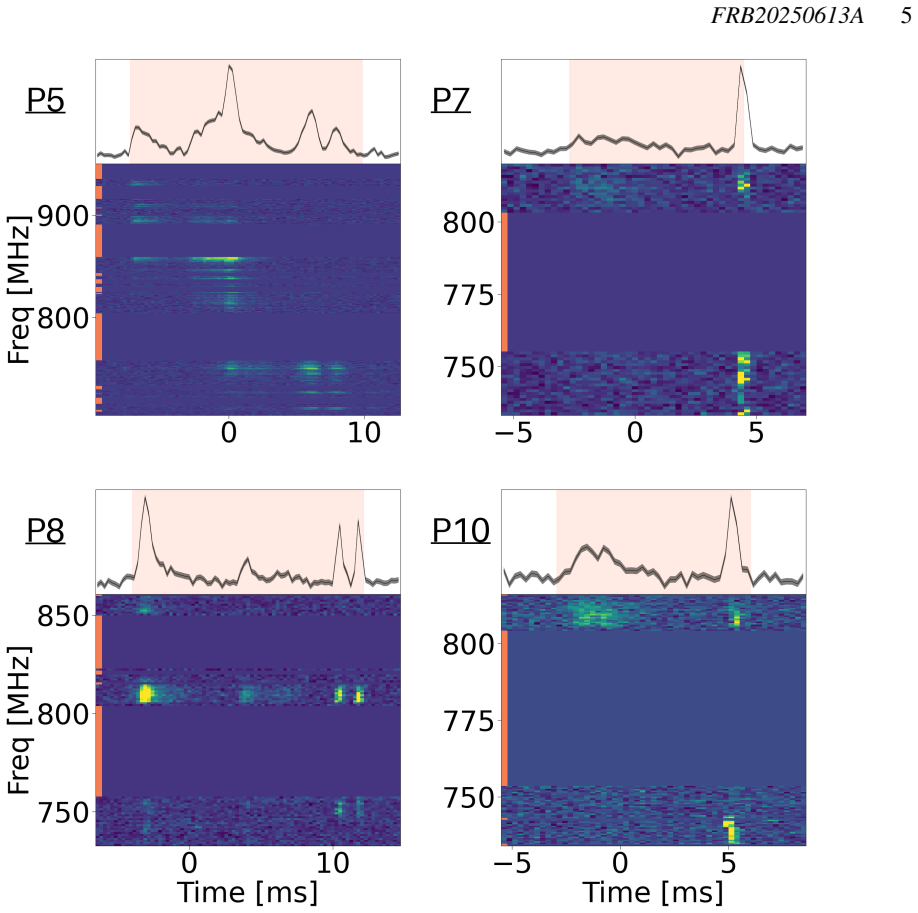
- Multi-component bursts carry an intrinsic emission-mechanism preference for separations near 6.8 ms.
- The circum-burst environment must be highly dynamic on timescales from milliseconds to months.
Where Pith is reading between the lines
- Similar millisecond-scale propagation variations could appear in other repeating FRBs located in comparable environments.
- Multi-wavelength monitoring might reveal periodic signatures from the binary orbit or wind density changes.
- The non-linear plasma response could serve as a probe of emission-region magnetic field strengths in future high-time-resolution observations.
Load-bearing premise
That variations in scattering and other effects between burst components only milliseconds apart cannot arise from sightline changes through any static screen and must instead be produced by non-linear plasma responses to the FRB's own emission.
What would settle it
A model of a static turbulent screen that fully reproduces the observed millisecond-scale differences in scattering and polarization without requiring non-linear effects, or host-galaxy observations showing no Be star or wind signatures at the FRB location.
Figures



read the original abstract
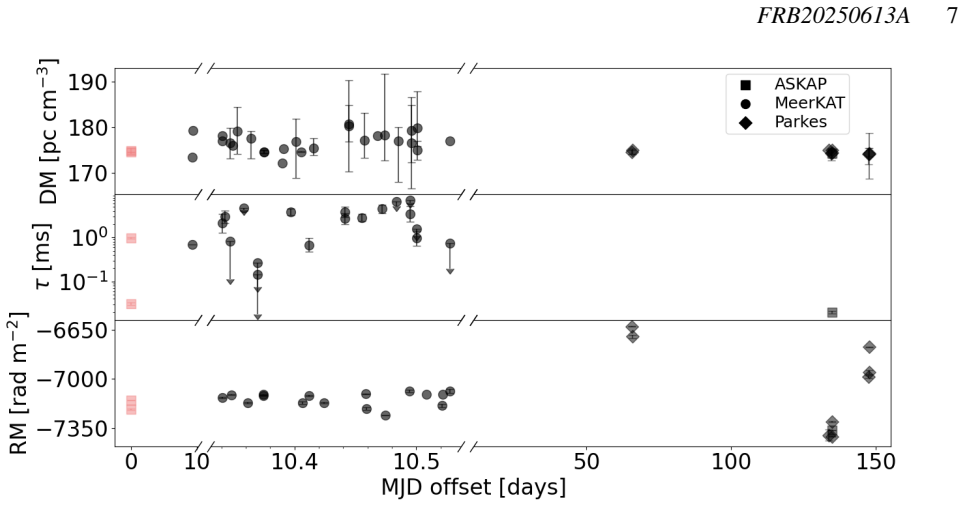
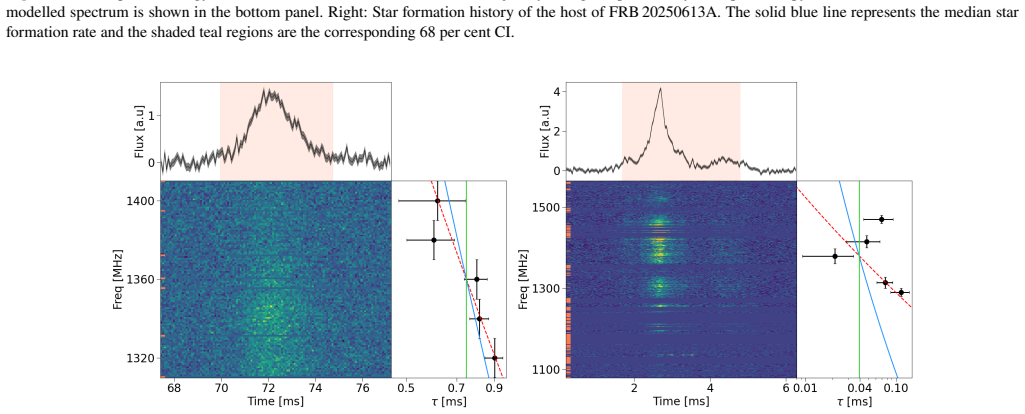
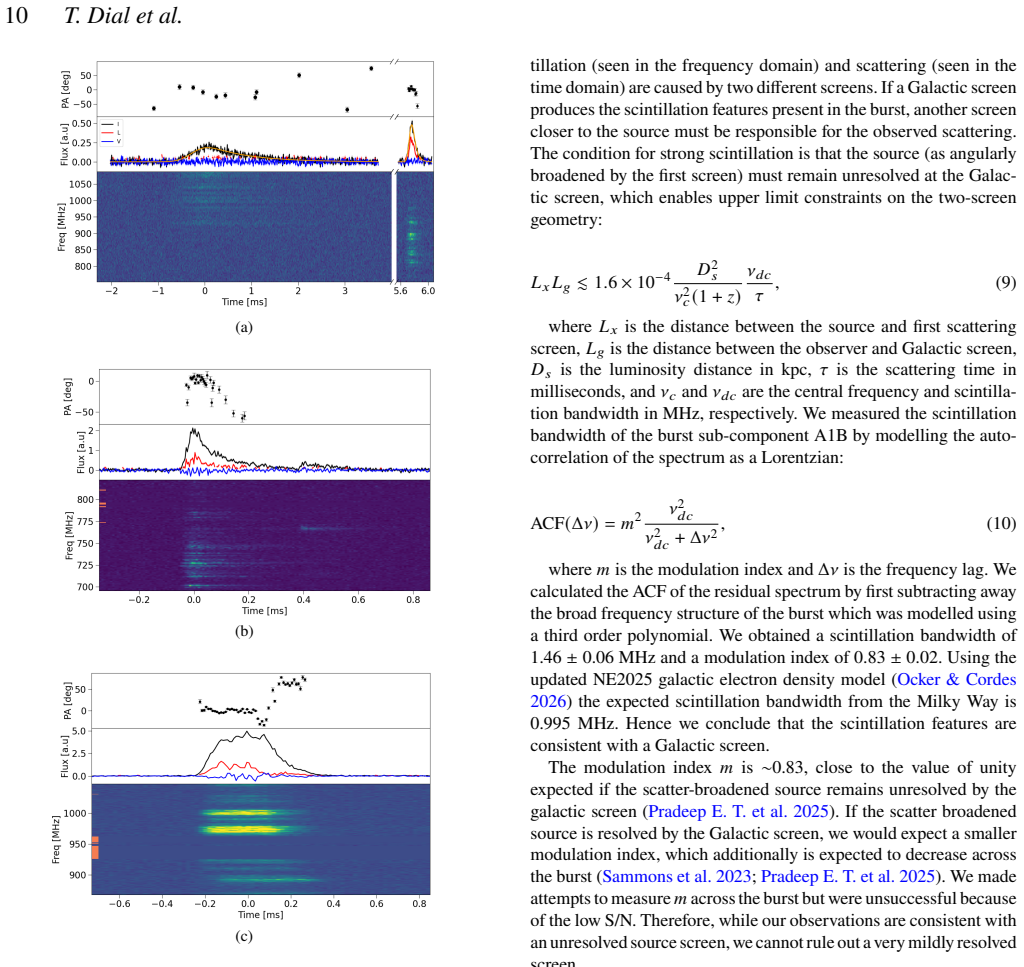
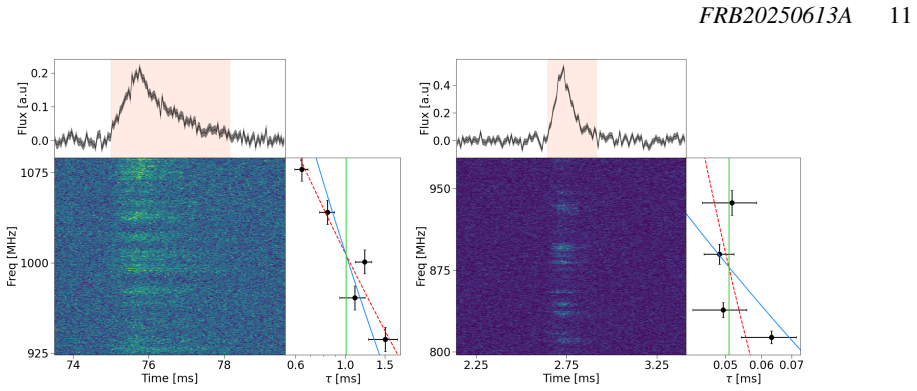
FRB20250613A is a repeating FRB discovered by the Australian SKA Pathfinder and localised to a low-metallicity dwarf galaxy at a redshift of $z = 0.0987 \pm 0.0001$. FRB 20250613A exhibits a plethora of exotic features that likely overlay the imprint of the circum-burst environment on some intrinsic features of the source. Here we perform a comprehensive analysis of bursts detected by ASKAP, MeerKAT, and the Murriyang Parkes radio telescopes. Bursts during the MeerKAT epoch show a large apparent variance in scattering on timescales of minutes to hours. Polarimetric analysis of the full sample shows spectral depolarisation with variability on timescales of days and changes in rotation measure of $\sim$ 300 rad m$^{-2}$ over days to months. This suggests a highly turbulent magneto-ionised environment. We find significant preference for separations of $\sim$6.8$\pm$0.8 ms in multi-component bursts that we suggest is likely intrinsic to the burst emission mechanism. Finally, we find that a subset of bursts exhibit variations in these propagation effects on burst components separated by just milliseconds, that are difficult to explain by changing sightlines, but plausibly due to non-linear plasma effects in the circum-burst environment caused by the high field strength of the FRB emission. These properties, which demand a nearby turbulent screen of material, are all consistent with the FRB progenitor being embedded in the dense stellar wind of a Be star binary companion, objects which are relatively plentiful in low-mass and low-metallicity galaxies like the FRB20250613A host.
Editorial analysis
A structured set of objections, weighed in public.
Referee Report
Summary. The paper reports multi-telescope (ASKAP, MeerKAT, Parkes) observations of the repeating FRB20250613A, localized to a low-metallicity dwarf galaxy at z=0.0987. It documents minute-to-hour apparent scattering variations during the MeerKAT epoch, day-scale spectral depolarisation, RM changes of ~300 rad m^{-2}, a statistically preferred ~6.8 ms separation in multi-component bursts interpreted as intrinsic, and millisecond-scale variations in propagation effects between burst components. These are interpreted as requiring a nearby turbulent screen with non-linear plasma effects, consistent with the progenitor residing in the dense wind of a Be-star binary companion.
Significance. If the central environmental diagnosis holds, the result would link a repeating FRB to a Be-star companion system in a low-metallicity host, adding to progenitor models since such binaries are relatively common in dwarf galaxies. The multi-telescope dataset and reported RM variability constitute new observational constraints on magneto-ionic environments around FRBs. However, the interpretive step from the data to a 'nearby turbulent screen' and non-linear effects rests on an untested assertion about static-screen geometry.
major comments (2)
- [abstract (final paragraph)] Abstract, final paragraph: The claim that millisecond-scale variations in scattering and other propagation effects 'are difficult to explain by changing sightlines' through a static screen (and therefore require non-linear plasma effects) is presented without any quantitative propagation modeling. No phase-screen calculation, ray-tracing simulation, or turbulence-spectrum analysis is referenced to demonstrate that differential paths at the observed 6.8 ms component separation and reported angular scales cannot reproduce the minute-to-hour apparent scattering changes. This assertion is load-bearing for the 'demand a nearby turbulent screen' conclusion and the subsequent Be-star wind interpretation.
- [multi-component bursts analysis] The section discussing multi-component bursts and the 6.8 ms separation: While a statistical preference for ~6.8±0.8 ms separations is reported, the manuscript provides no error budget, Monte Carlo test of selection effects, or comparison against simulated burst populations to establish that this preference is intrinsic rather than an artifact of scattering or detection thresholds.
minor comments (1)
- [abstract] The abstract states the host is a 'low-metallicity dwarf galaxy' but provides no quantitative metallicity value or reference to the measurement method; this detail should be added for reproducibility.
Simulated Author's Rebuttal
We thank the referee for their constructive and detailed review of our manuscript. We address each major comment below and have revised the paper accordingly to strengthen the presentation of our results and interpretations.
read point-by-point responses
-
Referee: [abstract (final paragraph)] Abstract, final paragraph: The claim that millisecond-scale variations in scattering and other propagation effects 'are difficult to explain by changing sightlines' through a static screen (and therefore require non-linear plasma effects) is presented without any quantitative propagation modeling. No phase-screen calculation, ray-tracing simulation, or turbulence-spectrum analysis is referenced to demonstrate that differential paths at the observed 6.8 ms component separation and reported angular scales cannot reproduce the minute-to-hour apparent scattering changes. This assertion is load-bearing for the 'demand a nearby turbulent screen' conclusion and the subsequent Be-star wind interpretation.
Authors: We agree that the manuscript would be strengthened by quantitative support for the claim that a static screen cannot readily reproduce the observed variations. In the revised version we have added an order-of-magnitude geometric calculation in the discussion section showing that the transverse velocities or screen distances needed to produce millisecond-scale changes via differential sightlines are unphysical for any plausible static screen location. We have also cited relevant phase-screen literature. However, a full ray-tracing or turbulence-spectrum simulation lies beyond the scope of this primarily observational work; we have therefore softened the abstract language from 'demand' to 'strongly suggest' a nearby screen. This is a partial revision. revision: partial
-
Referee: [multi-component bursts analysis] The section discussing multi-component bursts and the 6.8 ms separation: While a statistical preference for ~6.8±0.8 ms separations is reported, the manuscript provides no error budget, Monte Carlo test of selection effects, or comparison against simulated burst populations to establish that this preference is intrinsic rather than an artifact of scattering or detection thresholds.
Authors: We thank the referee for highlighting this omission. The revised manuscript now includes a full error budget for the 6.8 ms separation that incorporates both measurement uncertainty and the effects of scattering. We have also added a Monte Carlo test that injects synthetic multi-component bursts into the observed noise and scattering conditions and recovers the separation distribution; the test confirms that the observed preference is not produced by selection or detection biases. These additions appear in a new subsection of the methods and are summarized in the results. revision: yes
Circularity Check
No significant circularity; observational interpretation stands on new data
full rationale
The paper reports new multi-telescope observations of FRB20250613A and interprets scattering variations, RM changes, and component separations as evidence for a nearby turbulent screen consistent with a Be-star wind. No derivation chain reduces a claimed prediction or uniqueness result to a fitted input or self-citation by construction. The assertion that ms-scale variations are 'difficult to explain by changing sightlines' is an interpretive judgment, not a self-referential equation or parameter fit. External benchmarks (standard Be-star properties, telescope data) remain independent of the paper's own outputs.
Axiom & Free-Parameter Ledger
axioms (2)
- domain assumption Scattering, depolarisation, and rotation-measure variations are produced by propagation through magneto-ionised plasma
- domain assumption The source is localised to a low-metallicity dwarf galaxy at z = 0.0987
invented entities (1)
-
Be star binary companion
no independent evidence
Reference graph
Works this paper leans on
-
[1]
High-Mass X-ray binaries in the Small Magellanic Cloud
High-mass X-ray binaries in the Small Magellanic Cloud. , keywords =. doi:10.1051/0004-6361/201527326 , archivePrefix =. 1511.00445 , primaryClass =
work page internal anchor Pith review Pith/arXiv arXiv doi:10.1051/0004-6361/201527326
-
[2]
Catalogue of Be/X-ray binary systems in the Small Magellanic Cloud: X-ray, optical & IR properties
Catalogue of Be/X-ray binary systems in the Small Magellanic Cloud: X-ray, optical and IR properties. , keywords =. doi:10.1093/mnras/stv1283 , archivePrefix =. 1506.01920 , primaryClass =
work page internal anchor Pith review Pith/arXiv arXiv doi:10.1093/mnras/stv1283
-
[3]
Population synthesis of Be X-ray binaries: metallicity dependence of total X-ray outputs. , keywords =. doi:10.1093/mnras/stad3475 , archivePrefix =. 2308.06154 , primaryClass =
-
[4]
The Metallicity Dependence of the High-mass X-Ray Binary Luminosity Function. , keywords =. doi:10.3847/1538-4357/abcec1 , archivePrefix =. 2011.09476 , primaryClass =
-
[5]
Metallicity dependence of HMXB populations
Metallicity dependence of high-mass X-ray binary populations. , keywords =. doi:10.1051/0004-6361/201525617 , archivePrefix =. 1505.05483 , primaryClass =
work page internal anchor Pith review Pith/arXiv arXiv doi:10.1051/0004-6361/201525617
-
[6]
Searching for the spectral depolarization of ASKAP one-off FRB sources. , keywords =. doi:10.1093/mnras/stad3437 , archivePrefix =. 2308.14387 , primaryClass =
-
[7]
A depolarization census of ASKAP fast radio bursts. , keywords =. doi:10.1093/mnras/staf1997 , archivePrefix =. 2503.19749 , primaryClass =
-
[8]
Extremely band-limited repetition from a fast radio burst source. , keywords =. doi:10.1093/mnras/staa3436 , archivePrefix =. 2009.01214 , primaryClass =
-
[9]
An ultra-wide bandwidth (704 to 4 032 MHz) receiver for the Parkes radio telescope. , keywords =. doi:10.1017/pasa.2020.2 , archivePrefix =. 1911.00656 , primaryClass =
-
[10]
Faraday Rotation Measure Synthesis
Faraday rotation measure synthesis. , keywords =. doi:10.1051/0004-6361:20052990 , archivePrefix =. astro-ph/0507349 , primaryClass =
work page internal anchor Pith review Pith/arXiv arXiv doi:10.1051/0004-6361:20052990
-
[11]
system description , author=
Australian square kilometre array pathfinder: I. system description , author=. Publications of the Astronomical Society of Australia , volume=. 2021 , publisher=
2021
-
[12]
Publications of the Astronomical Society of Australia , volume=
The commensal real-time ASKAP fast-transients (CRAFT) survey , author=. Publications of the Astronomical Society of Australia , volume=. 2010 , publisher=
2010
-
[13]
Publications of the Astronomical Society of Australia , volume=
The commensal real-time ASKAP fast transient incoherent-sum survey , author=. Publications of the Astronomical Society of Australia , volume=. 2025 , publisher=
2025
-
[14]
Astronomy and Computing , pages=
CELEBI: The CRAFT Effortless Localisation and Enhanced Burst Inspection pipeline , author=. Astronomy and Computing , pages=. 2023 , publisher=
2023
-
[15]
Monthly Notices of the Royal Astronomical Society , volume=
FRB 20230708A, a quasi-periodic FRB with unique temporal-polarimetric morphology , author=. Monthly Notices of the Royal Astronomical Society , volume=. 2025 , publisher=
2025
-
[16]
The Astrophysical Journal , volume=
Calculation and Uncertainty of Fast Radio Burst Structure Based on Smoothed Data , author=. The Astrophysical Journal , volume=. 2023 , publisher=
2023
-
[17]
Monthly Notices of the Royal Astronomical Society , volume=
DYNESTY: a dynamic nested sampling package for estimating Bayesian posteriors and evidences , author=. Monthly Notices of the Royal Astronomical Society , volume=. 2020 , publisher=
2020
-
[18]
The Astrophysical Journal Supplement Series , volume=
BILBY: A user-friendly Bayesian inference library for gravitational-wave astronomy , author=. The Astrophysical Journal Supplement Series , volume=. 2019 , publisher=
2019
-
[19]
RM-Tools: Rotation measure (RM) synthesis and Stokes QU-fitting
-
[20]
Science , volume=
Magnetic field reversal in the turbulent environment around a repeating fast radio burst , author=. Science , volume=. 2023 , publisher=
2023
-
[21]
Nature , volume=
An extreme magneto-ionic environment associated with the fast radio burst source FRB 121102 , author=. Nature , volume=. 2018 , publisher=
2018
-
[22]
Publications of the Astronomical Society of Australia , volume=
High-time-resolution properties of 35 fast radio bursts detected by the Commensal Real-time ASKAP Fast Transients survey , author=. Publications of the Astronomical Society of Australia , volume=. 2025 , publisher=
2025
-
[23]
Monthly Notices of the Royal Astronomical Society , volume=
| V|: new insight into the circular polarization of radio pulsars , author=. Monthly Notices of the Royal Astronomical Society , volume=. 2003 , publisher=
2003
-
[24]
Monthly Notices of the Royal Astronomical Society , volume=
Pulsar polarization: a broad-band population view with the Parkes Ultra-Wideband receiver , author=. Monthly Notices of the Royal Astronomical Society , volume=. 2023 , publisher=
2023
-
[25]
Astronomy & Astrophysics , volume=
Faraday rotation measure synthesis , author=. Astronomy & Astrophysics , volume=. 2005 , publisher=
2005
-
[26]
Monthly Notices of the Royal Astronomical Society , volume=
Scattering variability detected from the circumsource medium of FRB 20190520B , author=. Monthly Notices of the Royal Astronomical Society , volume=. 2023 , publisher=
2023
-
[27]
The Astrophysical Journal , volume=
Low-frequency, wideband study of an active repeater, FRB 20240114A, with the GMRT , author=. The Astrophysical Journal , volume=. 2025 , publisher=
2025
-
[28]
Cambridge observing handbooks for research astronomers
Handbook of pulsar astronomy , author=. 2005 , series="Cambridge observing handbooks for research astronomers", publisher=
2005
-
[29]
Science , volume=
Frequency-dependent polarization of repeating fast radio bursts—implications for their origin , author=. Science , volume=. 2022 , publisher=
2022
-
[30]
The Astrophysical Journal Letters , volume=
Temporal Evolution of Depolarization and Magnetic Field of Fast Radio Burst 20201124A , author=. The Astrophysical Journal Letters , volume=. 2023 , publisher=
2023
-
[31]
The Astrophysical Journal Supplement Series , volume=
The first CHIME/FRB fast radio burst catalog , author=. The Astrophysical Journal Supplement Series , volume=. 2021 , publisher=
2021
-
[32]
Monthly Notices of the Royal Astronomical Society , volume=
On the depolarization of discrete radio sources by Faraday dispersion , author=. Monthly Notices of the Royal Astronomical Society , volume=. 1966 , publisher=
1966
-
[33]
The Astrophysical Journal , volume=
A large-scale magneto-ionic fluctuation in the local environment of periodic fast radio burst source FRB 20180916B , author=. The Astrophysical Journal , volume=. 2023 , publisher=
2023
-
[34]
Monthly Notices of the Royal Astronomical Society , volume=
MeerKAT discovery of a hyperactive repeating fast radio burst source , author=. Monthly Notices of the Royal Astronomical Society , volume=. 2025 , publisher=
2025
-
[35]
Monthly Notices of the Royal Astronomical Society , volume=
A sample of fast radio bursts discovered and localized with MeerTRAP at the MeerKAT telescope , author=. Monthly Notices of the Royal Astronomical Society , volume=. 2023 , publisher=
2023
-
[36]
Giant pulse characteristics of PSR J0540- 6919 , author=
The Thousand-Pulsar-Array programme on MeerKAT--III. Giant pulse characteristics of PSR J0540- 6919 , author=. Monthly Notices of the Royal Astronomical Society , volume=. 2021 , publisher=
2021
-
[37]
The Astrophysical Journal , volume=
A CHIME/FRB study of burst rate and morphological evolution of the periodically repeating FRB 20180916B , author=. The Astrophysical Journal , volume=. 2023 , publisher=
2023
-
[38]
Monthly Notices of the Royal Astronomical Society , volume=
Propagation effects at low frequencies seen in the LOFAR long-term monitoring of the periodically active FRB 20180916B , author=. Monthly Notices of the Royal Astronomical Society , volume=. 2024 , publisher=
2024
-
[39]
The Astrophysical Journal Letters , volume=
Rotation measure evolution of the repeating fast radio burst source FRB 121102 , author=. The Astrophysical Journal Letters , volume=. 2021 , publisher=
2021
-
[40]
Science , volume=
A sudden change and recovery in the magnetic environment around a repeating fast radio burst , author=. Science , volume=. 2026 , publisher=
2026
-
[41]
Nature , volume=
A fast radio burst source at a complex magnetized site in a barred galaxy , author=. Nature , volume=. 2022 , publisher=
2022
-
[42]
The Astrophysical Journal Letters , volume=
A Milliarcsecond Localization Associates FRB 20190417A with a Compact Persistent Radio Source and an Extreme Magnetoionic Environment , author=. The Astrophysical Journal Letters , volume=. 2025 , publisher=
2025
-
[43]
Nature , volume=
A bimodal burst energy distribution of a repeating fast radio burst source , author=. Nature , volume=. 2021 , publisher=
2021
-
[44]
The Astrophysical Journal , volume=
Statistical and Temporal Analysis of Multicomponent Burst Clusters from the Repeating FRB 20190520B , author=. The Astrophysical Journal , volume=. 2025 , publisher=
2025
-
[45]
Burst morphology , author=
FAST observations of an extremely active episode of FRB 20201124A: I. Burst morphology , author=. Research in Astronomy and Astrophysics , volume=. 2022 , publisher=
2022
-
[46]
The Astrophysical Journal , volume=
FAST observations of FRB 20220912A: burst properties and polarization characteristics , author=. The Astrophysical Journal , volume=. 2023 , publisher=
2023
-
[47]
arXiv preprint arXiv:2507.14707 , year=
The magnetar model's energy crisis for a prolific repeating fast radio burst source , author=. arXiv preprint arXiv:2507.14707 , year=
-
[48]
FAST observations of an extremely active episode of FRB 20201124A. II. Energy distribution , author=. Research in Astronomy and Astrophysics , volume=. 2022 , publisher=
2022
-
[49]
Nature , volume=
A census of baryons in the Universe from localized fast radio bursts , author=. Nature , volume=. 2020 , publisher=
2020
-
[50]
The Astrophysical Journal Supplement Series , volume=
An overview of chime, the canadian hydrogen intensity mapping experiment , author=. The Astrophysical Journal Supplement Series , volume=. 2022 , publisher=
2022
-
[51]
The Astronomical Journal , volume=
CHIME/FRB outriggers: KKO station system and commissioning results , author=. The Astronomical Journal , volume=. 2024 , publisher=
2024
-
[52]
The Astrophysical Journal , volume=
CHIME/FRB Outriggers: Design Overview , author=. The Astrophysical Journal , volume=. 2025 , publisher=
2025
-
[53]
Publications of the Astronomical Society of Australia , volume=
The CRAFT coherent (CRACO) upgrade I: System description and results of the 110-ms radio transient pilot survey , author=. Publications of the Astronomical Society of Australia , volume=. 2025 , publisher=
2025
-
[54]
The Astrophysical Journal Letters , volume=
Deep synoptic array science: discovery of the host galaxy of FRB 20220912A , author=. The Astrophysical Journal Letters , volume=. 2023 , publisher=
2023
-
[55]
The Astrophysical Journal Supplement Series , volume=
The Second CHIME/FRB Catalog of Fast Radio Bursts , author=. The Astrophysical Journal Supplement Series , volume=. 2026 , publisher=
2026
-
[56]
The Astrophysical Journal , volume=
Polarization properties of 128 nonrepeating fast radio bursts from the first CHIME/FRB baseband catalog , author=. The Astrophysical Journal , volume=. 2024 , publisher=
2024
-
[57]
The Astrophysical Journal Letters , volume=
A universal break in energy functions of three hyperactive repeating fast radio bursts , author=. The Astrophysical Journal Letters , volume=. 2025 , publisher=
2025
-
[58]
The Astrophysical Journal Letters , volume=
Fast radio bursts from the inspiral of double neutron stars , author=. The Astrophysical Journal Letters , volume=. 2016 , publisher=
2016
-
[59]
Nature , volume=
A fast radio burst associated with a Galactic magnetar , author=. Nature , volume=. 2020 , publisher=
2020
-
[60]
2020 , author=
A bright millisecond-duration radio burst from a Galactic magnetar , journal=. 2020 , author=
2020
-
[61]
Publications of the Astronomical Society of Australia , volume=
The MeerKAT telescope as a pulsar facility: System verification and early science results from MeerTime , author=. Publications of the Astronomical Society of Australia , volume=. 2020 , publisher=
2020
-
[62]
Publications of the Astronomical Society of Australia , volume=
PSRCHIVE and PSRFITS: an open approach to radio pulsar data storage and analysis , author=. Publications of the Astronomical Society of Australia , volume=. 2004 , publisher=
2004
-
[63]
Monthly Notices of the Royal Astronomical Society , volume=
FETCH: A deep-learning based classifier for fast transient classification , author=. Monthly Notices of the Royal Astronomical Society , volume=. 2020 , publisher=
2020
-
[64]
Monthly Notices of the Royal Astronomical Society , volume=
Radio observations of PSR B1259—63 around periastron , author=. Monthly Notices of the Royal Astronomical Society , volume=. 1996 , publisher=
1996
-
[65]
Monthly Notices of the Royal Astronomical Society , volume=
The 1997 periastron passage of the binary pulsar PSR B1259--63 , author=. Monthly Notices of the Royal Astronomical Society , volume=. 2001 , publisher=
1997
-
[66]
Monthly Notices of the Royal Astronomical Society , volume=
Stellar wind and stellar disc models of dispersion and rotation measure variations in the PSR B1259--63/SS2883 binary system , author=. Monthly Notices of the Royal Astronomical Society , volume=. 1995 , publisher=
1995
-
[67]
The Astrophysical Journal , volume=
Constraints on the geometry of circumstellar envelopes: optical interferometric and spectropolarimetric observations of seven Be stars , author=. The Astrophysical Journal , volume=
-
[68]
The Astronomy and Astrophysics Review , volume=
Classical Be stars: Rapidly rotating B stars with viscous Keplerian decretion disks , author=. The Astronomy and Astrophysics Review , volume=. 2013 , publisher=
2013
-
[69]
Nature Communications , volume=
Repeating fast radio burst 20201124A originates from a magnetar/Be star binary , author=. Nature Communications , volume=. 2022 , publisher=
2022
-
[70]
The Astrophysical Journal , volume=
Rotation measure variations and reversals of repeating FRBs in massive binary systems , author=. The Astrophysical Journal , volume=. 2023 , publisher=
2023
-
[71]
The Astrophysical Journal Letters , volume=
The Disk Precession in a Be Star--Magnetar Binary and its Application to the Rotation Measure of FRB 20201124A , author=. The Astrophysical Journal Letters , volume=. 2026 , publisher=
2026
-
[72]
II-Polarization of individual pulses , author=
Observations of pulsar radio emission. II-Polarization of individual pulses , author=. Astrophysical Journal, vol. 196, Feb. 15, 1975, pt. 1, p. 83-102. , volume=
1975
-
[73]
Astrophysical Journal, Part 1 (ISSN 0004-637X), vol
Wave propagation in pulsar magnetospheres-Refraction of rays in the open flux zone , author=. Astrophysical Journal, Part 1 (ISSN 0004-637X), vol. 302, March 1, 1986, p. 138-162. Research supported by the University of California. , volume=
1986
-
[74]
Reviews of Modern Physics , volume=
The physics of fast radio bursts , author=. Reviews of Modern Physics , volume=. 2023 , publisher=
2023
-
[75]
The Astrophysical Journal Letters , volume=
Fast radio bursts as strong waves interacting with the ambient medium , author=. The Astrophysical Journal Letters , volume=. 2020 , publisher=
2020
-
[76]
The Astrophysical Journal , volume=
Simple analytical approximations for treatment of inverse Compton scattering of relativistic electrons in the blackbody radiation field , author=. The Astrophysical Journal , volume=. 2014 , publisher=
2014
-
[77]
The European Physical Journal A , volume=
Perspectives on laser-plasma physics in the relativistic transparency regime , author=. The European Physical Journal A , volume=. 2023 , publisher=
2023
-
[78]
Overview of the DESI Legacy Imaging Surveys
Overview of the DESI Legacy Imaging Surveys. , keywords =. doi:10.3847/1538-3881/ab089d , archivePrefix =. 1804.08657 , primaryClass =
work page internal anchor Pith review Pith/arXiv arXiv doi:10.3847/1538-3881/ab089d
-
[79]
Probabilistic Association of Transients to their Hosts (PATH). , keywords =. doi:10.3847/1538-4357/abe8d2 , archivePrefix =. 2102.10627 , primaryClass =
-
[80]
The Goodman spectrograph. Ground-based Instrumentation for Astronomy , year = 2004, editor =. doi:10.1117/12.550069 , adsurl =
discussion (0)
Sign in with ORCID, Apple, or X to comment. Anyone can read and Pith papers without signing in.