Mobile Base Station Positioning in Smart Ports Based on Kriged Sparse Measurements and Obstacle Inference
Pith reviewed 2026-07-02 04:57 UTC · model grok-4.3
The pith
Sparse radio measurements can reconstruct radio environment maps and infer cuboidal obstacles to optimize mobile base station positioning in smart ports.
A machine-rendered reading of the paper's core claim, the machinery that carries it, and where it could break.
Core claim
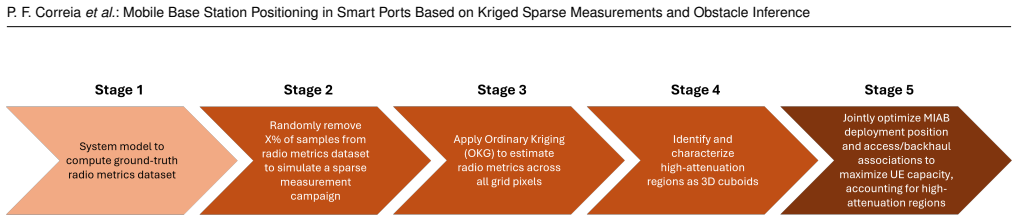
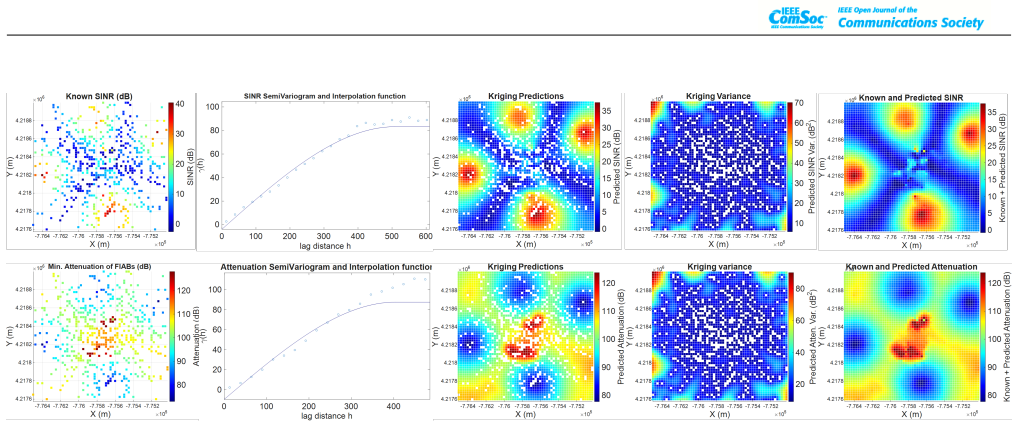
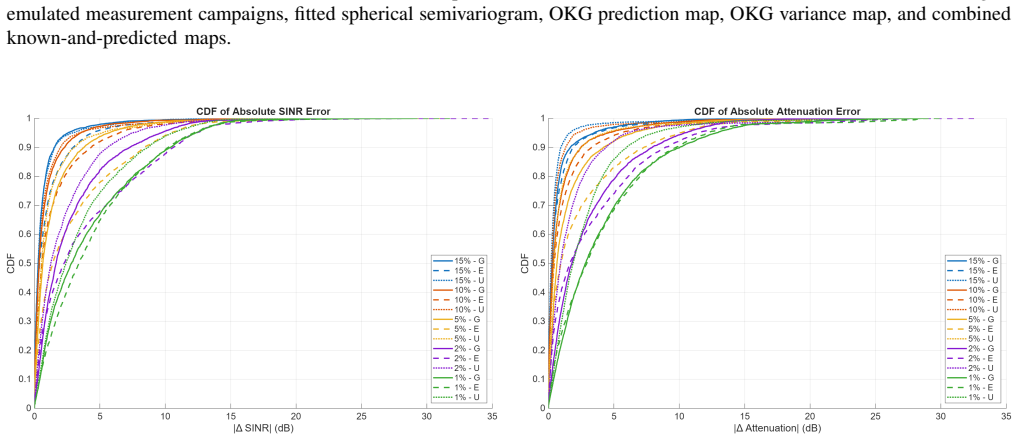
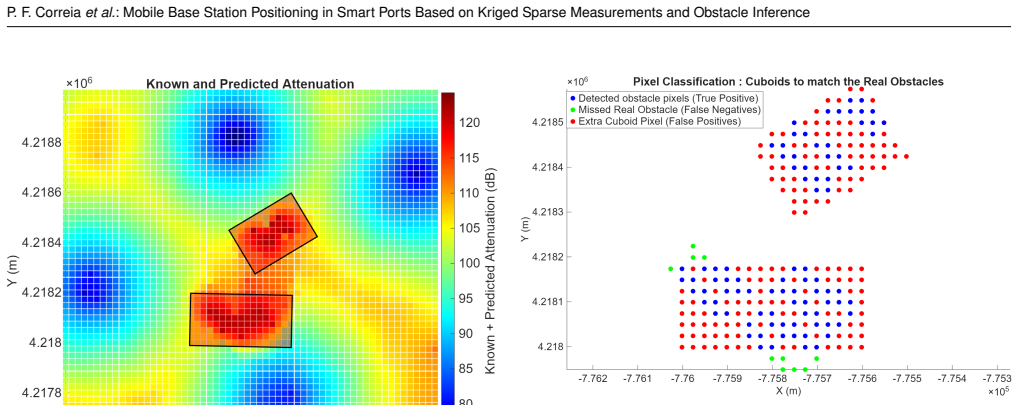
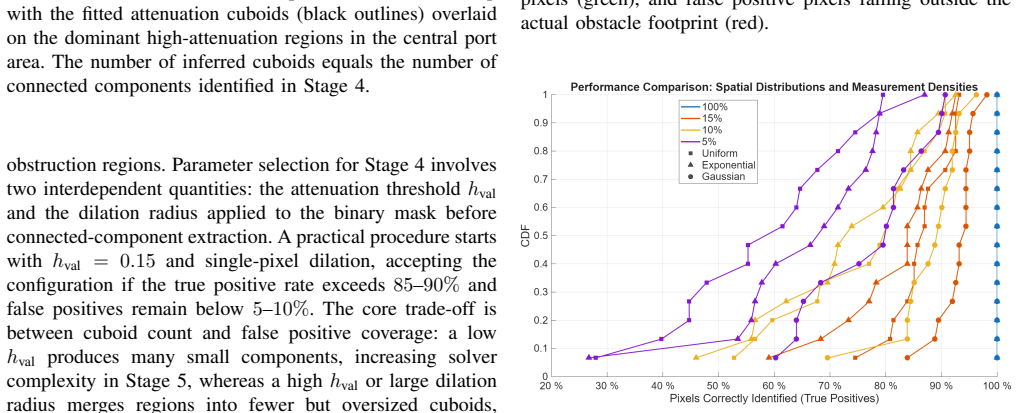
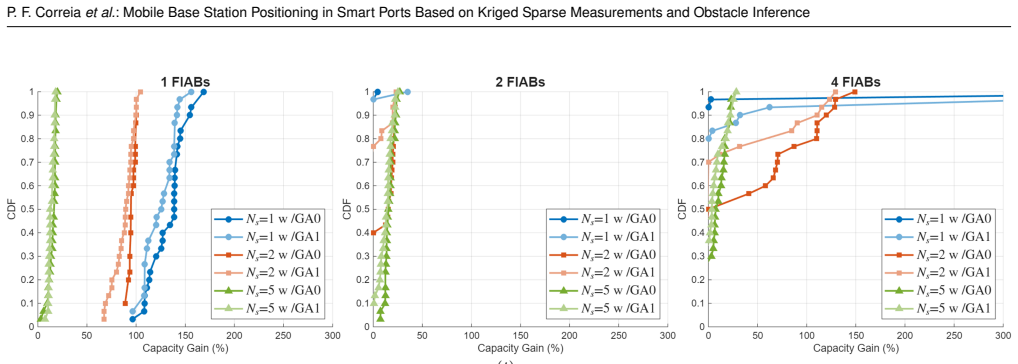
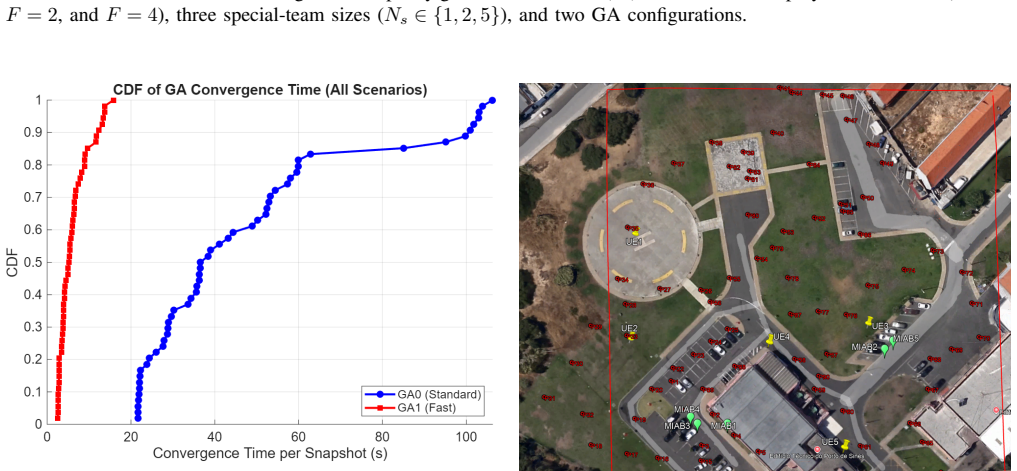
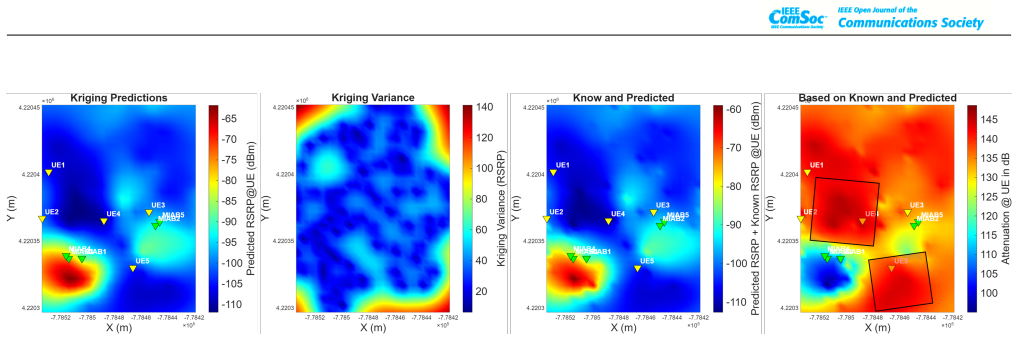
Ordinary kriging reconstructs reference signal received power and signal-to-interference-plus-noise ratio fields from 15 percent spatial samples with prediction errors below 3 dB at the 90th percentile; dominant attenuation regions in the resulting map are then represented by compact cuboidal blockage models that achieve over 85 percent true-positive coverage; these abstractions feed a backhaul-aware genetic-algorithm optimizer that determines mobile base-station locations, user associations, and backhaul selections, producing capacity gains reaching 150 percent in sparse deployments while converging in 5-15 seconds per snapshot.
What carries the argument
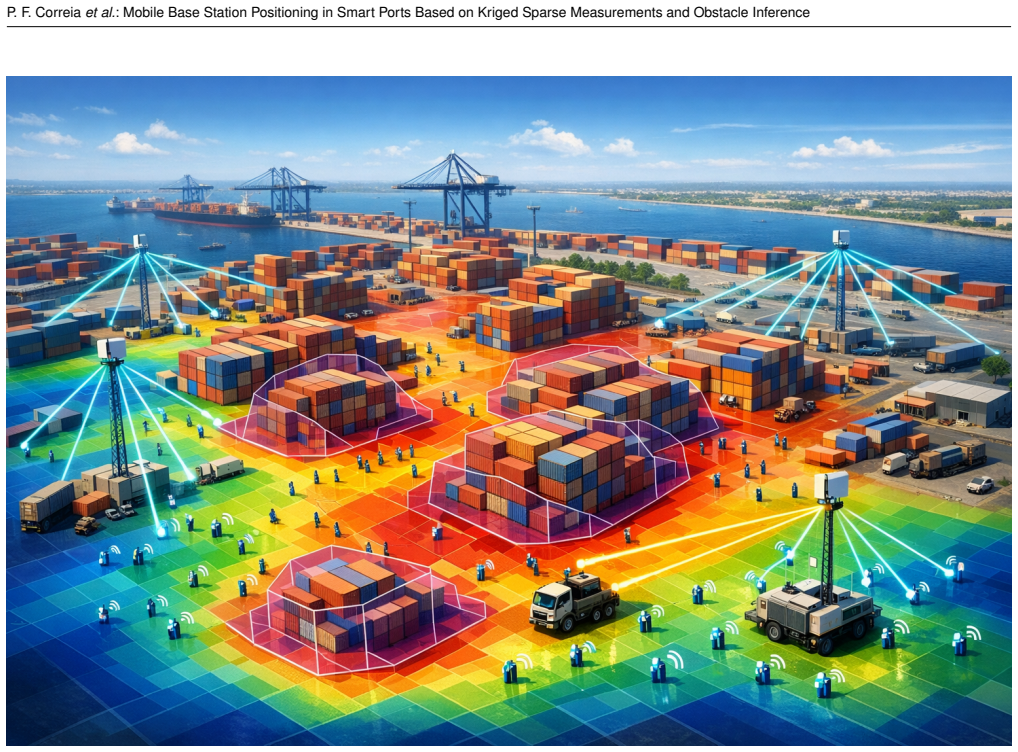
The DOCKING framework that converts kriged radio environment maps into cuboidal obstacle abstractions for backhaul-aware MIAB placement optimization.
If this is right
- REM reconstruction achieves prediction errors below 3 dB at the 90th percentile using only 15% spatial sampling.
- Obstacle characterization exceeds 85% true-positive coverage.
- Capacity gains reach 150% in sparse deployments.
- A fast Genetic Algorithm converges within 5-15 s per network snapshot.
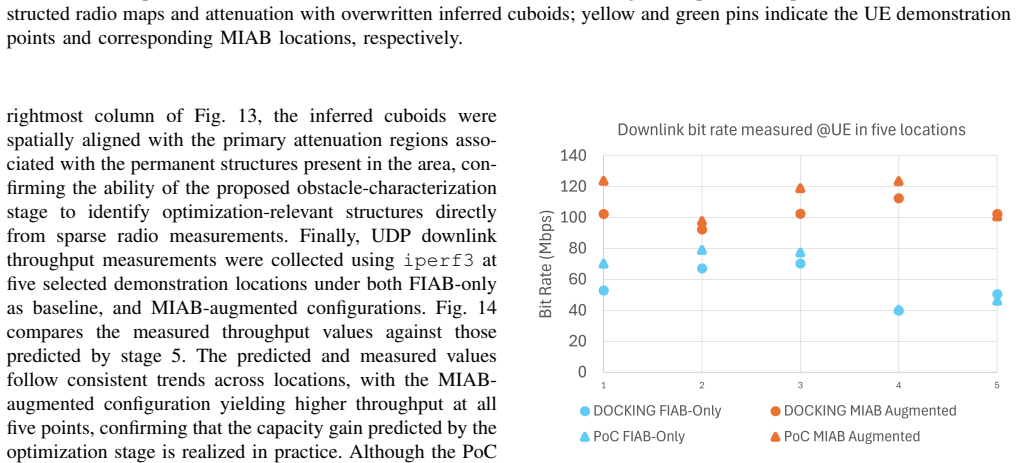
- Field measurements produce throughput trends consistent with the optimization predictions.
Where Pith is reading between the lines
- The same kriging-plus-cuboid pipeline could be tested in other obstruction-heavy industrial sites such as warehouses or rail yards.
- Periodic re-kriging from ongoing user reports might allow the framework to track slowly moving container stacks without new drive tests.
- Replacing the genetic algorithm with a faster heuristic could make the optimizer suitable for larger networks while preserving the reported accuracy.
- Adding a small number of dedicated sensors at known locations might tighten the cuboid fits beyond what radio measurements alone achieve.
Load-bearing premise
That dominant attenuation regions identified in the kriged REM can be adequately represented by compact cuboidal blockage models without access to actual geometry databases or detailed propagation physics.
What would settle it
A side-by-side comparison of the inferred cuboidal models against laser-scanned three-dimensional geometry of the same port area, or a controlled measurement campaign that records actual user throughput before and after the optimizer's suggested placements under known sampling densities.
Figures

read the original abstract
Smart-port wireless networks suffer from dynamic radio blockage caused by container stacks and industrial structures, challenging efficient mobile integrated access and backhaul (MIAB) deployment. Existing approaches rely on obstacle maps, geometry information, or computationally intensive propagation models that limit adaptability. This paper presents DOCKING, a radio environment map (REM)-driven framework that converts sparse radio measurements into optimization-ready obstacle representations for MIAB deployment. The framework infers propagation-relevant obstacle abstractions from reconstructed REMs, eliminating the need for obstacle-geometry databases while relying only on known network parameters and sparse measurements. Reference signal received power (RSRP) and signal-to-interference-plus-noise ratio (SINR) observations are reconstructed using Ordinary Kriging (OKG), and dominant attenuation regions are approximated by compact cuboidal blockage models. The inferred geometry feeds a backhaul-aware optimization that determines MIAB placement, user equipment (UE) association, and backhaul selection. Under realistic smart-port conditions, REM reconstruction achieves prediction errors below 3 dB at the 90th percentile using only 15% spatial sampling, while obstacle characterization exceeds 85% true-positive coverage. Capacity gains reach 150% in sparse deployments, and a fast Genetic Algorithm converges within 5-15 s per network snapshot. A field campaign using real measurements validates the workflow, showing throughput trends consistent with optimization predictions. Results demonstrate that sparse radio measurements provide sufficient environmental awareness for practical obstacle-aware MIAB deployment in obstruction-prone industrial environments.
Editorial analysis
A structured set of objections, weighed in public.
Referee Report
Summary. The paper proposes DOCKING, a framework for mobile integrated access and backhaul (MIAB) positioning in smart ports. It reconstructs radio environment maps (REMs) from sparse RSRP/SINR measurements via Ordinary Kriging, infers compact cuboidal blockage models from dominant attenuation regions without using geometry databases, and feeds these into a backhaul-aware optimizer (using a genetic algorithm) for MIAB placement, UE association, and backhaul selection. Key claims include REM prediction errors below 3 dB at the 90th percentile with 15% spatial sampling, obstacle characterization with >85% true-positive coverage, capacity gains up to 150% in sparse deployments, and validation via a field campaign showing throughput trends consistent with optimizer outputs.
Significance. If the obstacle-inference step can be rigorously validated against independent geometry references, the approach would offer a practical, database-free method for adaptive MIAB deployment in dynamic, obstruction-heavy industrial settings. The combination of kriging-based REM reconstruction with cuboidal abstraction and optimization is a reasonable engineering contribution, though the core novelty rests on the unverified fidelity of the cuboidal models.
major comments (2)
- [Abstract] Abstract: The central claim of 'obstacle characterization exceeds 85% true-positive coverage' lacks a defined ground-truth reference or independent geometry database for computing true positives, as the method explicitly avoids such databases. The field-campaign validation only reports consistency between measured throughput trends and optimizer outputs, which does not directly test the cuboidal abstraction fidelity and could be explained by other model components (path-loss exponents, association rules). This is load-bearing for the paper's main contribution.
- [Abstract] Abstract: Reported performance figures (prediction errors below 3 dB at 90th percentile, 150% capacity gains) are presented without any description of error-bar methodology, data-exclusion criteria, number of Monte-Carlo runs, or statistical tests, preventing verification of the quantitative claims from the available text.
minor comments (1)
- [Abstract] The abstract mentions 'realistic smart-port conditions' and 'a field campaign using real measurements' but provides no details on the measurement campaign scale, equipment, or exact locations, which would aid reproducibility.
Simulated Author's Rebuttal
We thank the referee for the constructive feedback on our manuscript. The comments highlight important aspects of validation clarity that we will address through revisions. We respond to each major comment below.
read point-by-point responses
-
Referee: [Abstract] Abstract: The central claim of 'obstacle characterization exceeds 85% true-positive coverage' lacks a defined ground-truth reference or independent geometry database for computing true positives, as the method explicitly avoids such databases. The field-campaign validation only reports consistency between measured throughput trends and optimizer outputs, which does not directly test the cuboidal abstraction fidelity and could be explained by other model components (path-loss exponents, association rules). This is load-bearing for the paper's main contribution.
Authors: We agree that the abstract claim requires explicit clarification on the ground-truth reference used for the true-positive metric. The 85% figure derives from controlled simulation experiments in which synthetic cuboidal obstacles with known positions serve as ground truth for direct comparison against inferred models; the operational method itself uses only radio measurements and does not require geometry databases. The field campaign supplies complementary end-to-end validation through throughput consistency. We will revise the abstract and insert a concise description of the simulation-based validation protocol (including how true positives are defined) into the manuscript to make this distinction unambiguous. revision: yes
-
Referee: [Abstract] Abstract: Reported performance figures (prediction errors below 3 dB at 90th percentile, 150% capacity gains) are presented without any description of error-bar methodology, data-exclusion criteria, number of Monte-Carlo runs, or statistical tests, preventing verification of the quantitative claims from the available text.
Authors: We acknowledge that the abstract and results presentation omit the requested statistical details. The reported figures aggregate outcomes from repeated Monte-Carlo trials across varied sampling densities and port layouts; error bars reflect standard deviation across trials, with no data points excluded beyond standard outlier filtering for measurement noise. We will revise the abstract and expand the evaluation section to state the number of Monte-Carlo runs, the precise error-bar methodology, data-exclusion rules, and any hypothesis tests applied. revision: yes
Circularity Check
No significant circularity in derivation chain
full rationale
The paper describes a workflow of applying standard Ordinary Kriging to sparse RSRP/SINR measurements to reconstruct a REM, then approximating attenuation regions as cuboidal models for input to a backhaul-aware optimizer. Reported metrics (kriging error, true-positive coverage, capacity gains) are presented as outcomes of this pipeline evaluated on field data, with no equations or steps shown that reduce a claimed prediction or result to a fitted input or self-citation by construction. The derivation remains self-contained against the external benchmarks of measurement-based reconstruction and optimization performance.
Axiom & Free-Parameter Ledger
invented entities (1)
-
compact cuboidal blockage models
no independent evidence
Reference graph
Works this paper leans on
-
[1]
6G wireless systems: vision, requirements, challenges, insights, and opportunities,
H. Tataria, M. Shafi, A. F. Molisch, M. Dohler, H. Sj ¨oland, and F. Tufvesson, “6G wireless systems: vision, requirements, challenges, insights, and opportunities,”Proceedings of the IEEE, vol. 109, no. 7, pp. 1166–1199, Jul. 2021, doi: 10.1109/JPROC.2021.3061701. VOLUME , 13 P . F . Correiaet al.: Mobile Base Station Positioning in Smart Ports Based on ...
-
[2]
Scaling-up 5G adoption in smart ports: barriers and enablers,
A. Potter, Y . Wang, and M. Naim, “Scaling-up 5G adoption in smart ports: barriers and enablers,”Maritime Policy & Management, vol. 52, no. 4, pp. 517–534, 2025, doi: 10.1080/03088839.2024.2399524
-
[3]
Customized industrial networks: network slicing trial at Hamburg seaport,
P. Rost, M. Breitbach, H. Roreger, B. Erman, C. Mannweiler, R. Miller, and I. Viering, “Customized industrial networks: network slicing trial at Hamburg seaport,”IEEE Wireless Communications, vol. 25, no. 5, pp. 48–55, Oct. 2018, doi: 10.1109/MWC.2018.1800045
-
[4]
A survey on 5G coverage improvement techniques: issues and future challenges,
C. Sudhamani, M. Roslee, J. J. Tiang, and A. Ur Rehman, “A survey on 5G coverage improvement techniques: issues and future challenges,” Sensors, vol. 23, no. 4, Art. no. 2356, 2023, doi: 10.3390/s23042356
-
[5]
Evaluation of radio communication links of 4G systems,
M. Ayad, R. Alkanhel, K. Saoudi, M. Benziane, S. Medjedoub, and S. S. M. Ghoneim, “Evaluation of radio communication links of 4G systems,”Sensors, vol. 22, no. 10, Art. no. 3923, 2022, doi: 10.3390/s22103923
-
[6]
H. Xia, S. Zha, J. Huang, and J. Liu, “Radio environment map construction by adaptive ordinary Kriging algorithm based on affin- ity propagation clustering,”International Journal of Distributed Sensor Networks, vol. 16, no. 5, pp. 1–14, May 2020, doi: 10.1177/1550147720922484
-
[8]
Kriging- based 3-D spectrum awareness for radio dynamic zones using aerial spectrum sensors,
S. J. Maeng, O. Ozdemir, I. G ¨uvenc ¸, and M. L. Sichitiu, “Kriging- based 3-D spectrum awareness for radio dynamic zones using aerial spectrum sensors,”IEEE Sensors Journal, vol. 24, no. 6, pp. 9044– 9058, 2024, doi: 10.1109/JSEN.2024.3357430
-
[9]
An experimental comparison of ordinary and universal kriging and inverse distance weighting,
D. Zimmerman, C. Pavlik, A. Ruggles, and M. P. Armstrong, “An experimental comparison of ordinary and universal kriging and inverse distance weighting,”Mathematical Geology, vol. 31, no. 4, pp. 375– 390, 1999, doi: 10.1023/A:1007586507433
-
[10]
Ordinary kriging interpolation for indoor 3D REM,
P. Maiti and D. Mitra, “Ordinary kriging interpolation for indoor 3D REM,”Journal of Ambient Intelligence and Humanized Computing, vol. 14, pp. 13285–13299, 2023, doi: 10.1007/s12652-022-03784-2
-
[11]
On integrated access and backhaul net- works: current status and potentials,
C. Madapatha, B. Makki, C. Fang, O. Teyeb, E. Dahlman, M.-S. Alouini, and T. Svensson, “On integrated access and backhaul net- works: current status and potentials,”IEEE Open Journal of the Com- munications Society, vol. 1, pp. 1374–1389, 2020, doi: 10.1109/OJ- COMS.2020.3022529
work page doi:10.1109/oj- 2020
-
[12]
NR; Study on integrated access and backhaul,
3GPP, “NR; Study on integrated access and backhaul,” 3GPP TR 38.874 V16.0.0, Jan. 2019
2019
-
[13]
NR; User equipment (UE) procedures in idle and RRC inactive states,
3GPP, “NR; User equipment (UE) procedures in idle and RRC inactive states,” 3GPP TS 38.304 Release 17, 2023
2023
-
[14]
Paving the way toward mo- bile IAB: problems, solutions and challenges,
V . F. Monteiro, F. R. M. Lima, D. C. Moreira, D. A. Sousa, T. F. Maciel, B. Makki, and H. Hannu, “Paving the way toward mo- bile IAB: problems, solutions and challenges,”IEEE Open Journal of the Communications Society, vol. 3, pp. 2347–2379, 2022, doi: 10.1109/OJCOMS.2022.3224576
-
[15]
Resource manage- ment for 5G NR integrated access and backhaul: a semi-centralized approach,
M. Pagin, T. Zugno, M. Polese, and M. Zorzi, “Resource manage- ment for 5G NR integrated access and backhaul: a semi-centralized approach,”IEEE Transactions on Wireless Communications, vol. 21, no. 2, pp. 753–767, 2022, doi: 10.1109/TWC.2021.3098967
-
[16]
Image-based obstacle detection methods for the safe navigation of unmanned vehicles: a review,
S. Badrloo, M. Varshosaz, S. Pirasteh, and J. Li, “Image-based obstacle detection methods for the safe navigation of unmanned vehicles: a review,”Remote Sensing, vol. 14, no. 15, Art. no. 3824, 2022, doi: 10.3390/rs14153824
-
[17]
Joint modeling of received power, mean delay, and delay spread for wideband radio channels,
A. Bharti, R. Adeogun, X. Cai, W. Fan, F.-X. Briol, L. Clavier, and T. Pedersen, “Joint modeling of received power, mean delay, and delay spread for wideband radio channels,”IEEE Transactions on Antennas and Propagation, vol. 69, no. 8, pp. 4871–4882, 2021, doi: 10.1109/TAP.2021.3060099
-
[18]
Analysis and simulation of a fair queueing algorithm,
A. Demers, S. Keshav, and S. Shenker, “Analysis and simulation of a fair queueing algorithm,”ACM SIGCOMM Comput. Commun. Rev., vol. 19, no. 4, pp. 1–12, Aug. 1989, doi: 10.1145/75247.75248
-
[20]
Positioning of a next generation mobile cell to maximise aggregate network capacity,
P. F. Correia, A. Coelho, and M. Ricardo, “Positioning of a next generation mobile cell to maximise aggregate network capacity,” in Proc. EAI Int. Conf. Simulation Tools and Techniques (SIMUTools), A. A. Juan, J.-L. Guisado-Lizar, M.-J. Mor´on-Fern´andez, and E. Perez- Bernabeu, Eds. Cham, Switzerland: Springer, 2025, pp. 341–356, doi: 10.1007/978-3-031-8...
-
[21]
Soille,Morphological Image Analysis: Principles and Applications, 2nd ed
P. Soille,Morphological Image Analysis: Principles and Applications, 2nd ed. Berlin, Germany: Springer, 2004, doi: 10.1007/978-3-662- 05088-0
-
[22]
Factory 5G: A review of industry-centric features and deployment options,
A. Mahmood, S. F. Abedin, T. Sauter, M. Gidlund, and K. Landern ¨as, “Factory 5G: A review of industry-centric features and deployment options,”IEEE Industrial Electronics Magazine, vol. 16, no. 2, pp. 24–34, Jun. 2022, doi: 10.1109/MIE.2022.3149209
-
[23]
DeepREM: Deep-learning- based radio environment map estimation from sparse measurements,
A. Chaves-Villota and C. A. Viteri-Mera, “DeepREM: Deep-learning- based radio environment map estimation from sparse measurements,” IEEE Access, vol. 11, pp. 48697–48714, May 2023, doi: 10.1109/AC- CESS.2023.3277248
work page doi:10.1109/ac- 2023
-
[24]
3D spec- trum awareness for radio dynamic zones using Kriging and ma- trix completion,
M. Rahman, S. J. Maeng, I. G ¨uvenc ¸, and C.-W. Wong, “3D spec- trum awareness for radio dynamic zones using Kriging and ma- trix completion,” in Proc. IEEE Int. Symp. Dyn. Spectrum Access Netw. (DySPAN), Washington, DC, USA, 2024, pp. 439–446. doi: 10.1109/DySPAN60163.2024.10632739
-
[25]
C. Madapatha, B. Makki, A. Muhammad, E. Dahlman, M.-S. Alouini, and T. Svensson, “On topology optimization and routing in integrated access and backhaul networks: a genetic algorithm-based approach,” IEEE Open Journal of the Communications Society, vol. 2, pp. 2273– 2291, Sep. 2021, doi: 10.1109/OJCOMS.2021.3114669
-
[26]
An integrated access and backhaul approach to sustainable dense small cell network planning,
A. Al-Dhuhouri, T. Ratnarajah, and M. Sellathurai, “An integrated access and backhaul approach to sustainable dense small cell network planning,”Information, vol. 15, no. 1, Art. no. 19, Dec. 2023, doi: 10.3390/info15010019
-
[27]
Taylor & Francis Group
Li, Likun and Yu, Kun.Application of Improved HF-DBSCAN Algo- rithm in Analyzing Complex Trajectory Data of Wi-Fi Users in Smart Campus. Taylor & Francis Group
-
[28]
M. Lalak and D. Wierzbicki, “Methodology of detection and clas- sification of selected aviation obstacles based on UA V dense image matching,”IEEE Journal of Selected Topics in Applied Earth Ob- servations and Remote Sensing, vol. 15, pp. 1869–1883, 2022, doi: 10.1109/JSTARS.2022.3142208
-
[29]
Sur- face extraction and boundary detection based on DBSCAN clustering in 3D point clouds,
H. Chen, T. Xie, M. L. Menhas, B. Ahmad, H. Huang, and Q. Li, “Sur- face extraction and boundary detection based on DBSCAN clustering in 3D point clouds,” inProc. IEEE 16th International Conference on Electronic Measurement & Instruments (ICEMI), Harbin, China, Aug. 2023, pp. 11–15, doi: 10.1109/ICEMI59194.2023.10270157
-
[30]
G. H. Golub and C. F. Van Loan, ”Matrix Computations,” 4th ed. Baltimore, MD, USA: Johns Hopkins Univ. Press, 2013. P AULO FURTADO CORREIAreceived the de- gree in Electrical and Computer Engineering from Instituto Superior T´ecnico (IST), Lisbon, Portugal, in 1991. He is currently pursuing his Ph.D. in Telecommunications at the University of Porto, conduc...
2013
discussion (0)
Sign in with ORCID, Apple, or X to comment. Anyone can read and Pith papers without signing in.