The Mid-Infrared Transmission Spectrum of the Temperate Sub-Neptune TOI-270 d
Pith reviewed 2026-07-02 05:35 UTC · model grok-4.3
The pith
JWST MIRI observations of TOI-270 d show excess mid-infrared absorption beyond CH4 and CO2.
A machine-rendered reading of the paper's core claim, the machinery that carries it, and where it could break.
Core claim
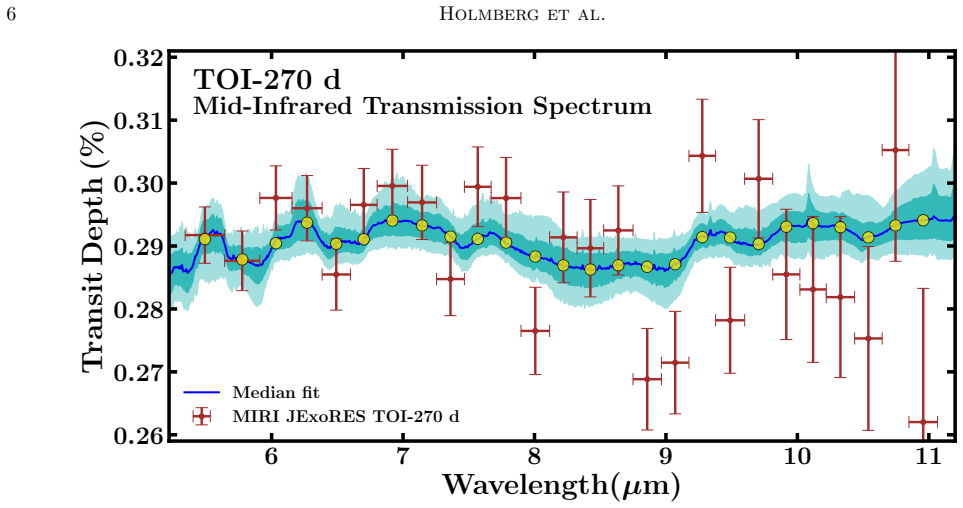
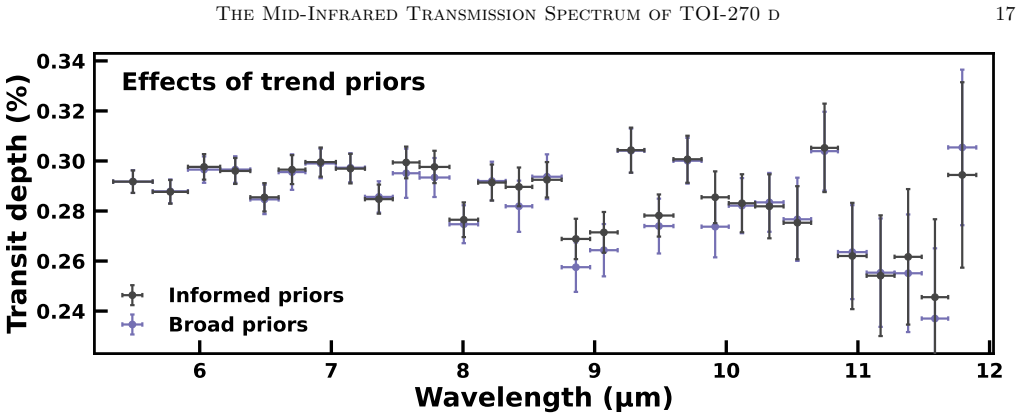
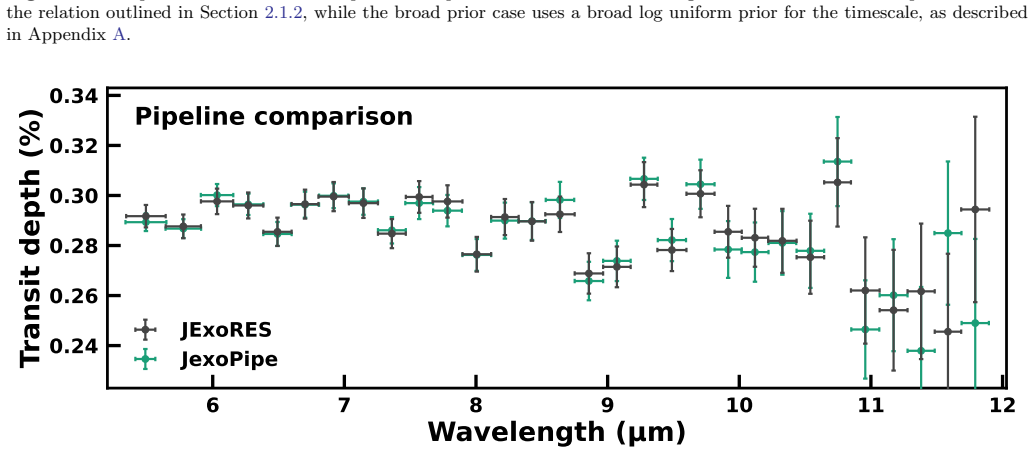
The MIRI transmission spectrum of TOI-270 d exhibits notable evidence of molecular features, favouring the presence of atmospheric absorption at ln B = 2.8-5.3 when comparing physically plausible models with and without molecular line absorption. The data show excess absorption beyond what could be attributed to CH4 and CO2 detected previously, in line with recent near-infrared results.
What carries the argument
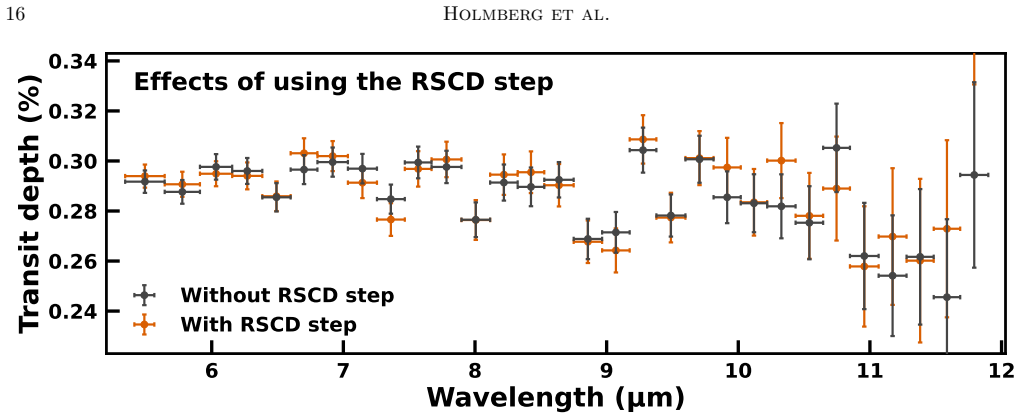
The empirical relation between detector settling timescale and flux, used to model spectral light curves and extract the transmission spectrum.
If this is right
- Additional trace molecules beyond CH4 and CO2 are present in the atmosphere of TOI-270 d.
- Mid-infrared data from MIRI can identify atmospheric features inaccessible in the near-infrared.
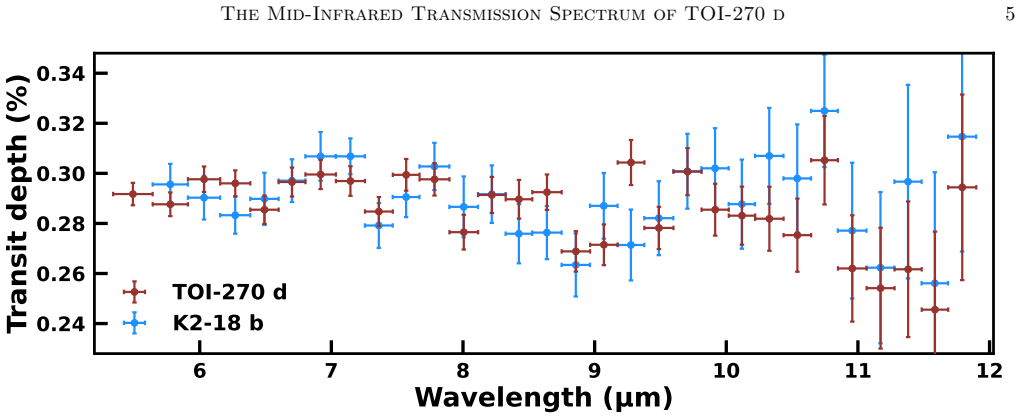
- The spectrum of TOI-270 d can be directly compared to that of K2-18 b to assess shared or distinct atmospheric properties.
- Follow-up observations are required to confirm the identity of the additional absorbers.
Where Pith is reading between the lines
- Confirmation of candidate complex molecules would suggest disequilibrium chemistry or photochemical production in the atmosphere.
- The detector-settling correction method could be applied to other MIRI datasets to increase measurement precision across sub-Neptune targets.
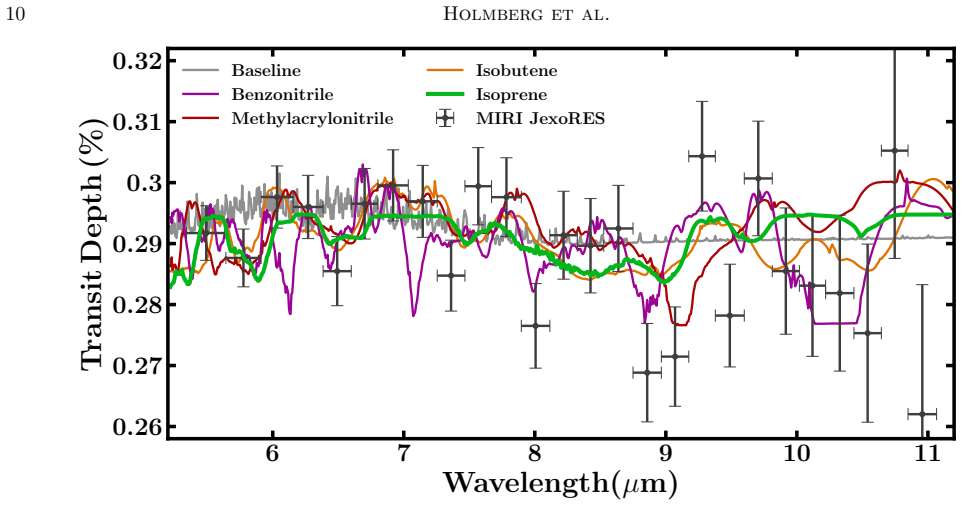
- Excess mid-IR absorption may indicate carbon-bearing species more complex than simple hydrocarbons or CO2.
Load-bearing premise
The new empirical relation between detector settling timescale and flux accurately models the spectral light curves without introducing unaccounted systematics.
What would settle it
A higher-precision MIRI observation that matches a model containing only CH4 and CO2 with no residual excess absorption.
Figures



read the original abstract
Observations of temperate sub-Neptunes with JWST have ushered in a new era for atmospheric characterization of small exoplanets. In particular, the MIRI instrument provides a unique opportunity to search for molecules that are not easily accessible in the near-infrared, as demonstrated by recent mid-infrared observations of K2-18 b. In this work, we present the first mid-infrared transmission spectrum of TOI-270 d observed using the JWST MIRI LRS (5-12 $\mu$m) instrument. By leveraging archival MIRI LRS data, we establish a new empirical relation between the detector settling timescale and the flux, which helps accurately model the spectral light curves and improve the precision of the transmission spectrum. We find that there is notable evidence of molecular features in the MIRI transmission spectrum of TOI-270 d, favouring the presence of atmospheric absorption at $\ln B$ = 2.8-5.3 when comparing physically plausible atmospheric models with and without molecular line absorption. The data show excess absorption beyond what could be attributed to CH$_4$ and CO$_2$ detected previously, in line with recent near-infrared results. Through an agnostic search for 203 species, we identify several candidate trace molecules, most of which are complex molecules, evaluate their physical plausibility, and compare them against inferences from near-infrared observations. We also compare the MIRI spectrum of TOI-270 d to that of K2-18 b and find that random or systematic noise is unlikely to explain these observations. Future follow-up observations are necessary to definitively identify the additional absorbers beyond CH$_4$ and CO$_2$. These observations demonstrate the unique capability of JWST MIRI for atmospheric characterisation of temperate sub-Neptunes.
Editorial analysis
A structured set of objections, weighed in public.
Referee Report
Summary. The paper presents the first JWST MIRI LRS (5-12 μm) transmission spectrum of the temperate sub-Neptune TOI-270 d. By deriving a new empirical relation between detector settling timescale and flux from archival MIRI LRS data, the authors model the spectral light curves, extract the transmission spectrum, and report notable evidence for molecular absorption (ln B = 2.8-5.3) in comparisons of physically plausible atmospheric models with and without line absorption. The spectrum shows excess absorption beyond prior CH4 and CO2 detections; an agnostic search over 203 species identifies candidate trace molecules (mostly complex), which are evaluated for plausibility and compared to NIR results. The MIRI spectrum is also compared to that of K2-18 b.
Significance. If the empirical correction and resulting spectrum are robust, the work provides the first mid-IR constraints on a temperate sub-Neptune, complements existing NIR data on TOI-270 d, and demonstrates MIRI LRS utility for such targets. The model-comparison framework and candidate-molecule search could help guide future observations if the extraction systematics are fully characterized.
major comments (2)
- [Abstract / data modeling] Abstract and data-modeling section: The new empirical relation between detector settling timescale and flux is the load-bearing step that produces the reported transmission spectrum and ln B values. The manuscript provides no functional form, list of archival visits used for derivation, fitting procedure, or independent validation (e.g., held-out visits, comparison to standard JWST pipeline reduction without the relation, or residual diagnostics). Without these, it is impossible to assess whether the relation introduces or removes systematics that affect the model evidence.
- [Results] Results section: The reported ln B = 2.8-5.3 range favoring molecular absorption is presented without accompanying details on the atmospheric-model priors, the exact functional form of the forward models, the treatment of error bars on the extracted spectrum, or the data-exclusion criteria. These omissions prevent evaluation of whether the evidence values are driven by the data or by modeling choices.
minor comments (2)
- [Abstract] The abstract states that random or systematic noise is unlikely to explain the observations relative to K2-18 b, but does not specify the quantitative test or metric used for this statement.
- [Abstract] Notation for the Bayesian evidence (ln B) should be defined on first use and the reference model made explicit.
Simulated Author's Rebuttal
We thank the referee for their detailed and constructive report. The two major comments correctly identify areas where additional methodological detail is needed to allow independent assessment of the empirical correction and the reported model evidence. We will revise the manuscript accordingly.
read point-by-point responses
-
Referee: [Abstract / data modeling] Abstract and data-modeling section: The new empirical relation between detector settling timescale and flux is the load-bearing step that produces the reported transmission spectrum and ln B values. The manuscript provides no functional form, list of archival visits used for derivation, fitting procedure, or independent validation (e.g., held-out visits, comparison to standard JWST pipeline reduction without the relation, or residual diagnostics). Without these, it is impossible to assess whether the relation introduces or removes systematics that affect the model evidence.
Authors: We agree that the current manuscript does not supply the full set of details required for independent evaluation. In the revised version we will add: (i) the explicit functional form of the empirical relation, (ii) the complete list of archival MIRI LRS visits used to derive it, (iii) the fitting procedure and any regularization or outlier handling, and (iv) validation tests including held-out visits, comparison to the standard JWST pipeline reduction, and residual diagnostics. These additions will be placed in a dedicated subsection of the data-modeling section. revision: yes
-
Referee: [Results] Results section: The reported ln B = 2.8-5.3 range favoring molecular absorption is presented without accompanying details on the atmospheric-model priors, the exact functional form of the forward models, the treatment of error bars on the extracted spectrum, or the data-exclusion criteria. These omissions prevent evaluation of whether the evidence values are driven by the data or by modeling choices.
Authors: We will expand the results and methods sections to include the requested information: the full set of atmospheric-model priors, the precise functional form and assumptions of the forward models (including how molecular opacities are incorporated), the treatment of the extracted-spectrum uncertainties (including any inflation or covariance), and the data-exclusion criteria together with the rationale. This will make clear how the ln B values were computed and allow readers to judge the robustness of the evidence. revision: yes
Circularity Check
No significant circularity; empirical correction from archival data is independent of target spectrum and model comparisons
full rationale
The paper extracts the MIRI transmission spectrum of TOI-270 d by first deriving an empirical detector-settling relation from separate archival MIRI LRS data, then applying that relation to model the target light curves. The reported ln B = 2.8-5.3 values and candidate molecule identifications arise from subsequent Bayesian model comparisons and an agnostic search over 203 species performed on the extracted spectrum. These quantities are not equivalent by construction to the archival fit; the relation is external to the TOI-270 d dataset, and no self-citation, self-definitional loop, or fitted-input-renamed-as-prediction is present in the derivation chain. The analysis remains self-contained against external benchmarks.
Axiom & Free-Parameter Ledger
Reference graph
Works this paper leans on
-
[2]
The atmospheric composition of TOI-270 d
-
[3]
JWST COMPASS: The First Near- to Mid-infrared Transmission Spectrum of the Hot Super-Earth L 168-9 b. , keywords =. doi:10.3847/1538-3881/ad8eb5 , archivePrefix =. 2411.03154 , primaryClass =
-
[4]
Spectroscopic Time Series Performance of the Mid-infrared Instrument on the JWST. , keywords =. doi:10.1088/1538-3873/acbc49 , archivePrefix =. 2211.16123 , primaryClass =
-
[5]
Debris Disks Can Contaminate Mid-infrared Exoplanet Spectra: Evidence for a Circumstellar Debris Disk around Exoplanet Host WASP-39. , keywords =. doi:10.3847/2041-8213/ad4649 , archivePrefix =. 2406.02305 , primaryClass =
-
[6]
Sulfur dioxide in the mid-infrared transmission spectrum of WASP-39b. , keywords =. doi:10.1038/s41586-024-07040-9 , archivePrefix =. 2407.07965 , primaryClass =
-
[7]
Magma ocean interactions can explain JWST observations of the sub-Neptune TOI-270 d. arXiv e-prints , keywords =. doi:10.48550/arXiv.2510.07367 , archivePrefix =. 2510.07367 , primaryClass =
-
[8]
K2-18b Does Not Meet the Standards of Evidence for Life. , keywords =. doi:10.3847/1538-3881/ae0338 , archivePrefix =. 2508.05961 , primaryClass =
-
[9]
Investigating aerosols as a way to reconcile K2-18 b JWST MIRI and NIRISS/NIRSpec observations. arXiv e-prints , keywords =. doi:10.48550/arXiv.2509.13932 , archivePrefix =. 2509.13932 , primaryClass =
-
[10]
Hints of a Sulfur-rich Atmosphere around the 1.6 R _ Super-Earth L98-59 d from JWST NIRspec G395H Transmission Spectroscopy. , keywords =. doi:10.3847/2041-8213/ad73d1 , archivePrefix =. 2408.15855 , primaryClass =
-
[11]
Evidence for a Volcanic Atmosphere on the Sub-Earth L 98-59 b. , keywords =. doi:10.3847/2041-8213/adaf22 , archivePrefix =. 2501.18680 , primaryClass =
-
[12]
TOI-421 b: A Hot Sub-Neptune with a Haze-free, Low Mean Molecular Weight Atmosphere. , keywords =. doi:10.3847/2041-8213/adcd76 , archivePrefix =. 2501.01498 , primaryClass =
-
[13]
A reflective, metal-rich atmosphere for GJ 1214b from its JWST phase curve. , keywords =. doi:10.1038/s41586-023-06159-5 , archivePrefix =. 2305.06240 , primaryClass =
-
[14]
JWST/NIRISS Reveals the Water-rich ``Steam World'' Atmosphere of GJ 9827 d. , keywords =. doi:10.3847/2041-8213/ad6f00 , archivePrefix =. 2410.03527 , primaryClass =
-
[15]
Biogenic Sulfur Gases as Biosignatures on Temperate Sub-Neptune Waterworlds. , keywords =. doi:10.3847/2041-8213/ad3801 , archivePrefix =. 2403.14805 , primaryClass =
-
[16]
Astrobiology , volume =
Zhan, Zhuchang and Seager, Sara and Petkowski, Janusz Jurand and Sousa-Silva, Clara and Ranjan, Sukrit and Huang, Jingcheng and Bains, William , title =. Astrobiology , volume =. 2021 , doi =
2021
-
[17]
Evidence for sulfur chemistry in the atmosphere of the warm sub-Neptune TOI-270 d. arXiv e-prints , keywords =. doi:10.48550/arXiv.2504.13039 , archivePrefix =. 2504.13039 , primaryClass =
-
[18]
The Challenges of Detecting Gases in Exoplanet Atmospheres. arXiv e-prints , keywords =. doi:10.48550/arXiv.2504.21788 , archivePrefix =. 2504.21788 , primaryClass =
-
[19]
Research Notes of the American Astronomical Society , keywords =
Are There Spectral Features in the MIRI/LRS Transmission Spectrum of K2-18b?. Research Notes of the American Astronomical Society , keywords =. doi:10.3847/2515-5172/add881 , archivePrefix =. 2504.15916 , primaryClass =
-
[20]
The HITRAN2020 molecular spectroscopic database. , keywords =. doi:10.1016/j.jqsrt.2021.107949 , adsurl =
-
[21]
Nasedkin, Evert and Mollière, Paul and Blain, Doriann , title =. 2024 , publisher =. doi:10.21105/joss.05875 , url =
-
[22]
petitRADTRANS: a Python radiative transfer package for exoplanet characterization and retrieval
petitRADTRANS. A Python radiative transfer package for exoplanet characterization and retrieval. , keywords =. doi:10.1051/0004-6361/201935470 , archivePrefix =. 1904.11504 , primaryClass =
work page internal anchor Pith review Pith/arXiv arXiv doi:10.1051/0004-6361/201935470 1904
-
[23]
A benchmark JWST near-infrared spectrum for the exoplanet WASP-39 b. Nature Astronomy , keywords =. doi:10.1038/s41550-024-02292-x , archivePrefix =. 2407.13893 , primaryClass =
-
[24]
Characterising TOI-732 b and c: New insights into the M-dwarf radius and density valley. , keywords =. doi:10.1051/0004-6361/202348180 , archivePrefix =. 2311.12577 , primaryClass =
-
[25]
Uniform Reanalysis of JWST MIRI 15 m Exoplanet Eclipse Observations Using Frame-normalized Principal Component Analysis. , keywords =. doi:10.3847/2041-8213/adee0d , archivePrefix =. 2507.02052 , primaryClass =
-
[26]
New Constraints on DMS and DMDS in the Atmosphere of K2-18 b from JWST MIRI. , keywords =. doi:10.3847/2041-8213/adc1c8 , archivePrefix =. 2504.12267 , primaryClass =
-
[27]
Research in Astronomy and Astrophysics , keywords =
From Solar System to Exoplanets: What can we learn from Planetary Spectroscopy?. Research in Astronomy and Astrophysics , keywords =. doi:10.1088/1674-4527/ac97d1 , adsurl =
-
[28]
Proceedings of the National Academy of Science , keywords =
Exoplanet secondary atmosphere loss and revival. Proceedings of the National Academy of Science , keywords =. doi:10.1073/pnas.2006177117 , archivePrefix =. 2006.02589 , primaryClass =
-
[29]
Instrument Overview and in-Flight Performance
The Near Infrared Imager and Slitless Spectrograph for the James Webb Space Telescope -- I. Instrument Overview and in-Flight Performance. arXiv e-prints , keywords =. doi:10.48550/arXiv.2306.03277 , archivePrefix =. 2306.03277 , primaryClass =
-
[30]
Thermochemical and Photochemical Kinetics in Cooler Hydrogen-dominated Extrasolar Planets: A Methane-poor GJ436b?. , keywords =. doi:10.1088/0004-637X/738/1/32 , archivePrefix =. 1104.3183 , primaryClass =
work page internal anchor Pith review Pith/arXiv arXiv doi:10.1088/0004-637x/738/1/32
-
[31]
Community Report from the Biosignatures Standards of Evidence Workshop. arXiv e-prints , keywords =. doi:10.48550/arXiv.2210.14293 , archivePrefix =. 2210.14293 , primaryClass =
-
[32]
Possible microwave absorption by H _ 2 S gas in Uranus' and Neptune's atmospheres. , keywords =. doi:10.1016/0019-1035(91)90020-T , adsurl =
-
[33]
Evidence for the depletion of ammonia in the Uranus atmosphere. , keywords =. doi:10.1016/0019-1035(78)90120-3 , adsurl =
-
[34]
Overcoming the limitations of the energy-limited approximation for planet atmospheric escape
Overcoming the Limitations of the Energy-limited Approximation for Planet Atmospheric Escape. , keywords =. doi:10.3847/2041-8213/aae586 , archivePrefix =. 1810.06920 , primaryClass =
work page internal anchor Pith review Pith/arXiv arXiv doi:10.3847/2041-8213/aae586 2041
-
[35]
Grid of upper atmosphere models for 1-40 M _ planets: application to CoRoT-7 b and HD 219134 b,c. , keywords =. doi:10.1051/0004-6361/201833737 , archivePrefix =. 1809.06645 , primaryClass =
work page internal anchor Pith review Pith/arXiv arXiv doi:10.1051/0004-6361/201833737
-
[36]
Narrow Loophole for H _ 2 -Dominated Atmospheres on Habitable Rocky Planets around M Dwarfs. , keywords =. doi:10.3847/2041-8213/acd0b4 , archivePrefix =. 2304.13659 , primaryClass =
-
[37]
Efficient, uninformative sampling of limb darkening coefficients for two-parameter laws
Efficient, uninformative sampling of limb darkening coefficients for two-parameter laws. , keywords =. doi:10.1093/mnras/stt1435 , archivePrefix =. 1308.0009 , primaryClass =
work page internal anchor Pith review Pith/arXiv arXiv doi:10.1093/mnras/stt1435
-
[38]
Detection of atmospheric haze on an extrasolar planet: the 0.55-1.05 m transmission spectrum of HD 189733b with the HubbleSpaceTelescope. , keywords =. doi:10.1111/j.1365-2966.2008.12852.x , archivePrefix =. 0712.1374 , primaryClass =
-
[39]
Confirmation of sub-solar metallicity for WASP-77Ab from JWST thermal emission spectroscopy. arXiv e-prints , keywords =. doi:10.48550/arXiv.2305.07753 , archivePrefix =. 2305.07753 , primaryClass =
-
[40]
A JWST transmission spectrum of a nearby Earth-sized exoplanet. arXiv e-prints , keywords =. doi:10.48550/arXiv.2301.04191 , archivePrefix =. 2301.04191 , primaryClass =
-
[41]
Martel and Michael Radica and Jason Rowe and Néstor Espinoza and Arpita Roy and Joseph C
Loïc Albert and David Lafrenière and Doyon, René and Étienne Artigau and Kevin Volk and Paul Goudfrooij and André R. Martel and Michael Radica and Jason Rowe and Néstor Espinoza and Arpita Roy and Joseph C. Filippazzo and Antoine Darveau-Bernier and Geert Jan Talens and Anand Sivaramakrishnan and Chris J. Willott and Alexander W. Fullerton and Stephanie L...
-
[42]
The high-energy environment and atmospheric escape of the mini-Neptune K2-18 b. , keywords =. doi:10.1051/0004-6361/201937327 , archivePrefix =. 2001.04532 , primaryClass =
-
[43]
Chemical Physics Letters , year = 2005, month = oct, volume =
Rate parameters and branching ratios for the multiple-channel reaction of dimethyl sulfide DMS with atomic H. Chemical Physics Letters , year = 2005, month = oct, volume =. doi:10.1016/j.cplett.2005.08.084 , adsurl =
-
[44]
Atmospheric Chemistry & Physics , year = 2004, month = sep, volume =
Evaluated kinetic and photochemical data for atmospheric chemistry: Volume I - gas phase reactions of O _ x , HO _ x , NO _ x and SO _ x species. Atmospheric Chemistry & Physics , year = 2004, month = sep, volume =. doi:10.5194/acp-4-1461-2004 , adsurl =
-
[45]
Dimethyl sulfide and dimethyl sulfoxide and their oxidation in the atmosphere. Chem. Rev. , volume =
-
[46]
Oceanic phytoplankton, atmospheric sulphur, cloud albedo and climate. , keywords =. doi:10.1038/326655a0 , adsurl =
-
[47]
Nature Reviews Earth and Environment , year = 2023, month = jun, volume =
The biogeochemistry of marine dimethylsulfide. Nature Reviews Earth and Environment , year = 2023, month = jun, volume =. doi:10.1038/s43017-023-00428-7 , adsurl =
-
[48]
Early Release Science of the exoplanet WASP-39b with JWST NIRISS. , keywords =. doi:10.1038/s41586-022-05674-1 , archivePrefix =. 2211.10493 , primaryClass =
-
[49]
Awesome SOSS: transmission spectroscopy of WASP-96b with NIRISS/SOSS. , keywords =. doi:10.1093/mnras/stad1762 , archivePrefix =. 2305.17001 , primaryClass =
-
[50]
Space Telescopes and Instrumentation 2012: Optical, Infrared, and Millimeter Wave , editor =
Ren. Space Telescopes and Instrumentation 2012: Optical, Infrared, and Millimeter Wave , editor =. 2012 , doi =
2012
-
[51]
Exoplanet spectroscopy with JWST NIRISS: diagnostics and case studies. , keywords =. doi:10.1093/mnras/stad1580 , archivePrefix =. 2306.04676 , primaryClass =
-
[52]
Nested Sampling. Bayesian Inference and Maximum Entropy Methods in Science and Engineering: 24th International Workshop on Bayesian Inference and Maximum Entropy Methods in Science and Engineering , year = 2004, editor =. doi:10.1063/1.1835238 , adsurl =
-
[53]
Feroz, F. and Hobson, M. P. and Bridges, M. , title = ". Monthly Notices of the Royal Astronomical Society , volume =. 2009 , month =. doi:10.1111/j.1365-2966.2009.14548.x , url =
-
[54]
spotrod: a semi-analytic model for transits of spotted stars
SPOTROD: a semi-analytic model for transits of spotted stars. , keywords =. doi:10.1093/mnras/stu1061 , archivePrefix =. 1407.4465 , primaryClass =
work page internal anchor Pith review Pith/arXiv arXiv doi:10.1093/mnras/stu1061
-
[55]
How stellar activity affects the size estimates of extrasolar planets
How stellar activity affects the size estimates of extrasolar planets. , keywords =. doi:10.1051/0004-6361/200912454 , archivePrefix =. 0906.3604 , primaryClass =
work page internal anchor Pith review Pith/arXiv arXiv doi:10.1051/0004-6361/200912454
-
[56]
Hubble Space Telescope transmission spectroscopy of the exoplanet HD 189733b: high-altitude atmospheric haze in the optical and near-ultraviolet with STIS. , keywords =. doi:10.1111/j.1365-2966.2011.19142.x , archivePrefix =. 1103.0026 , primaryClass =
-
[57]
ACCESS: A featureless optical transmission spectrum for WASP-19b from Magellan/IMACS
ACCESS: a featureless optical transmission spectrum for WASP-19b from Magellan/IMACS. , keywords =. doi:10.1093/mnras/sty2691 , archivePrefix =. 1807.10652 , primaryClass =
work page internal anchor Pith review Pith/arXiv arXiv doi:10.1093/mnras/sty2691
-
[58]
SExtractor: Software for source extraction. , keywords =. doi:10.1051/aas:1996164 , adsurl =
-
[59]
The 2013 Release of Cloudy. , keywords =. doi:10.48550/arXiv.1302.4485 , archivePrefix =. 1302.4485 , primaryClass =
work page internal anchor Pith review Pith/arXiv arXiv doi:10.48550/arxiv.1302.4485 2013
-
[60]
Astropy: A Community Python Package for Astronomy
doi:10.1051/0004-6361/201322068 , Eid =. arXiv , Author =:1307.6212 , Journal =
work page internal anchor Pith review Pith/arXiv arXiv doi:10.1051/0004-6361/201322068
-
[61]
The Astropy Project: Building an inclusive, open-science project and status of the v2.0 core package
The Astropy Project: Building an Open-science Project and Status of the v2.0 Core Package. , keywords =. doi:10.3847/1538-3881/aabc4f , archivePrefix =. 1801.02634 , primaryClass =
work page internal anchor Pith review Pith/arXiv arXiv doi:10.3847/1538-3881/aabc4f
-
[62]
The Astropy Project: Sustaining and Growing a Community-oriented Open-source Project and the Latest Major Release (v5.0) of the Core Package. apj , keywords =. doi:10.3847/1538-4357/ac7c74 , archivePrefix =. 2206.14220 , primaryClass =
work page internal anchor Pith review Pith/arXiv arXiv doi:10.3847/1538-4357/ac7c74
-
[63]
The effect of stellar limb darkening values on the accuracy of the planet radii derived from photometric transit observations. , keywords =. doi:10.1051/0004-6361/201219888 , archivePrefix =. 1212.2372 , primaryClass =
work page internal anchor Pith review Pith/arXiv arXiv doi:10.1051/0004-6361/201219888
-
[64]
Early Release Science of the exoplanet WASP-39b with JWST NIRSpec PRISM. , keywords =. doi:10.1038/s41586-022-05677-y , archivePrefix =. 2211.10487 , primaryClass =
-
[65]
Identification of carbon dioxide in an exoplanet atmosphere. , keywords =. doi:10.1038/s41586-022-05269-w , archivePrefix =. 2208.11692 , primaryClass =
-
[66]
Publications of the Astronomical Society of the Pacific , author =
batman :. Publications of the Astronomical Society of the Pacific , author =. 2015 , pages =. doi:10.1086/683602 , language =
work page internal anchor Pith review doi:10.1086/683602 2015
-
[67]
Early Release Science of the exoplanet WASP-39b with JWST NIRSpec G395H. , keywords =. doi:10.1038/s41586-022-05591-3 , archivePrefix =. 2211.10488 , primaryClass =
-
[68]
An optimal extraction algorithm for. Publications of the Astronomical Society of the Pacific , author =. 1986 , pages =. doi:10.1086/131801 , language =
-
[69]
Coulombe, Louis-Philippe and Benneke, Björn and Challener, Ryan and Piette, Anjali A. A. and Wiser, Lindsey S. and Mansfield, Megan and MacDonald, Ryan J. and Beltz, Hayley and Feinstein, Adina D. and Radica, Michael and Savel, Arjun B. and Santos, Leonardo A. Dos and Bean, Jacob L. and Parmentier, Vivien and Wong, Ian and Rauscher, Emily and Komacek, Tha...
-
[70]
and Stevenson, Kevin B
Moran, Sarah E. and Stevenson, Kevin B. and Sing, David K. and MacDonald, Ryan J. and Kirk, James and Lustig-Yaeger, Jacob and Peacock, Sarah and Mayorga, L. C. and Bennett, Katherine A. and López-Morales, Mercedes and May, E. M. and Rustamkulov, Zafar and Valenti, Jeff A. and Redai, Jéa I. Adams and Alam, Munazza K. and Batalha, Natasha E. and Fu, Guangw...
-
[71]
and Fu, G
Lustig-Yaeger, J. and Fu, G. and May, E. M. and Ceballos, K. N. Ortiz and Moran, S. E. and Peacock, S. and Stevenson, K. B. and López-Morales, M. and MacDonald, R. J. and Mayorga, L. C. and Sing, D. K. and Sotzen, K. S. and Valenti, J. A. and Adams, J. and Alam, M. K. and Batalha, N. E. and Bennett, K. A. and Gonzalez-Quiles, J. and Kirk, J. and Kruse, E....
-
[72]
emcee :. Publications of the Astronomical Society of the Pacific , author =. 2013 , pages =. doi:10.1086/670067 , language =
-
[73]
Monthly Notices of the Royal Astronomical Society , author =
Limb darkening and exoplanets: testing stellar model atmospheres and identifying biases in transit parameters , volume =. Monthly Notices of the Royal Astronomical Society , author =. 2015 , pages =. doi:10.1093/mnras/stv744 , language =
-
[74]
and Crida, Aurélien and Guillot, Tristan and Lunine, Jonathan I
Atreya, Sushil K. and Crida, Aurélien and Guillot, Tristan and Lunine, Jonathan I. and Madhusudhan, Nikku and Mousis, Olivier , year=. The Origin and Evolution of Saturn, with Exoplanet Perspective , DOI=. Saturn in the 21st Century , publisher=
-
[75]
Planetary Radii across Five Orders of Magnitude in Mass and Stellar Insolation: Application to Transits. , keywords =. doi:10.1086/512120 , archivePrefix =. astro-ph/0612671 , primaryClass =
work page internal anchor Pith review Pith/arXiv arXiv doi:10.1086/512120
-
[76]
Habitability of Exoplanet Waterworlds
Habitability of Exoplanet Waterworlds. , keywords =. doi:10.3847/1538-4357/aad6e0 , archivePrefix =. 1801.00748 , primaryClass =
work page internal anchor Pith review Pith/arXiv arXiv doi:10.3847/1538-4357/aad6e0
-
[77]
American Scientist , year = 1959, month = sep, volume =
Occurrence of Life in the Universe. American Scientist , year = 1959, month = sep, volume =
1959
-
[78]
Atmospheric Circulation of Eccentric Hot Neptune GJ436b
Atmospheric Circulation of Eccentric Hot Neptune GJ436b. , keywords =. doi:10.1088/0004-637X/720/1/344 , archivePrefix =. 1007.2942 , primaryClass =
work page internal anchor Pith review Pith/arXiv arXiv doi:10.1088/0004-637x/720/1/344
-
[79]
Phase Curves of Hot Neptune LTT 9779b Suggest a High-metallicity Atmosphere. , keywords =. doi:10.3847/2041-8213/abbc71 , archivePrefix =. 2010.12745 , primaryClass =
-
[80]
, year = 2007, month = nov, volume =
Mass radius curve for extrasolar Earth-like planets and ocean planets. , year = 2007, month = nov, volume =. doi:10.1016/j.icarus.2007.04.006 , adsurl =
-
[81]
On the radius of habitable planets
On the radius of habitable planets. , keywords =. doi:10.1051/0004-6361/201322293 , archivePrefix =. 1311.3039 , primaryClass =
work page internal anchor Pith review Pith/arXiv arXiv doi:10.1051/0004-6361/201322293
discussion (0)
Sign in with ORCID, Apple, or X to comment. Anyone can read and Pith papers without signing in.