Automatic detection of solar filament oscillations I: Multi-scale spectral pipeline
Pith reviewed 2026-07-02 05:21 UTC · model grok-4.3
The pith
An automated multi-scale pipeline detects four times more solar filament oscillations than manual catalogs in GONG H-alpha data.
A machine-rendered reading of the paper's core claim, the machinery that carries it, and where it could break.
Core claim
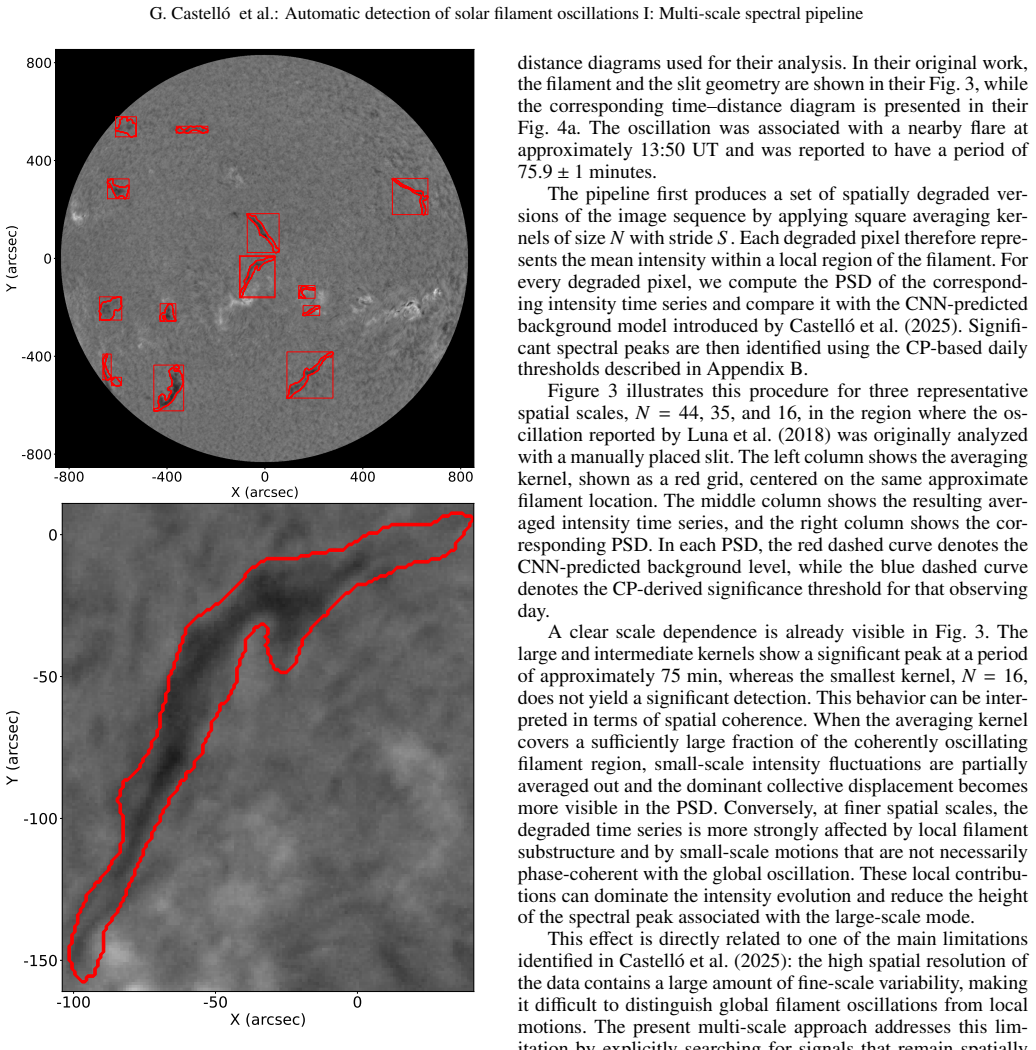
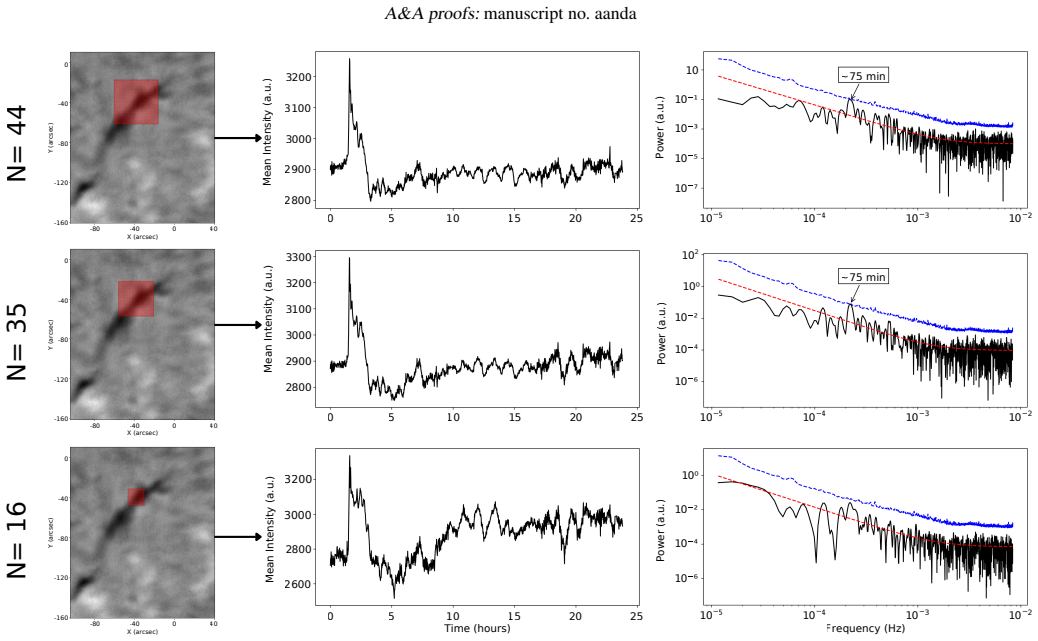
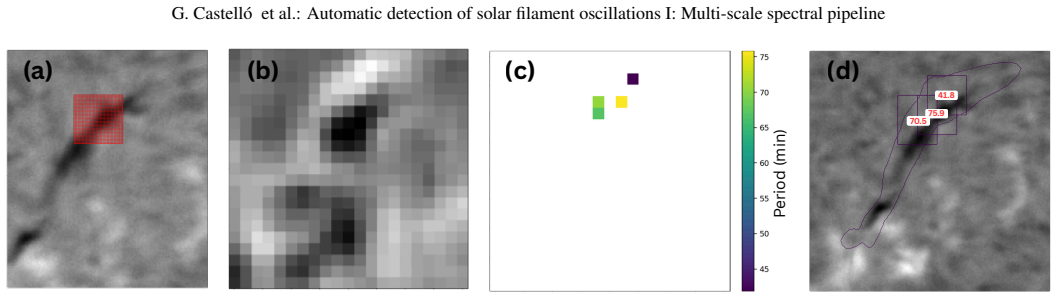
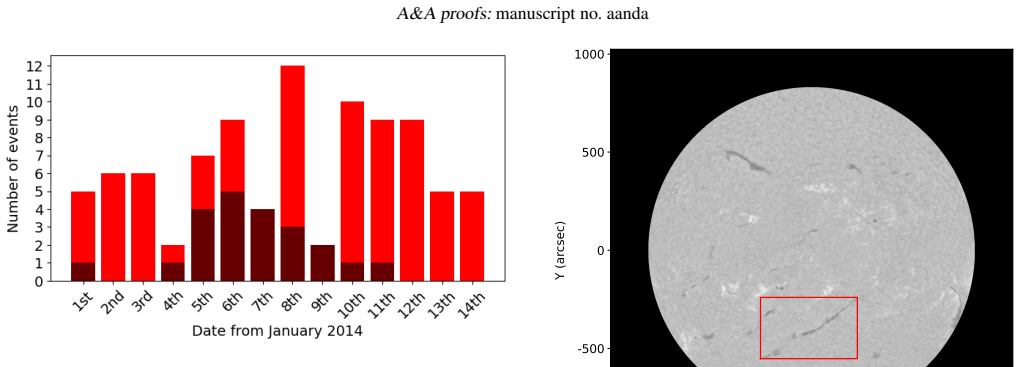
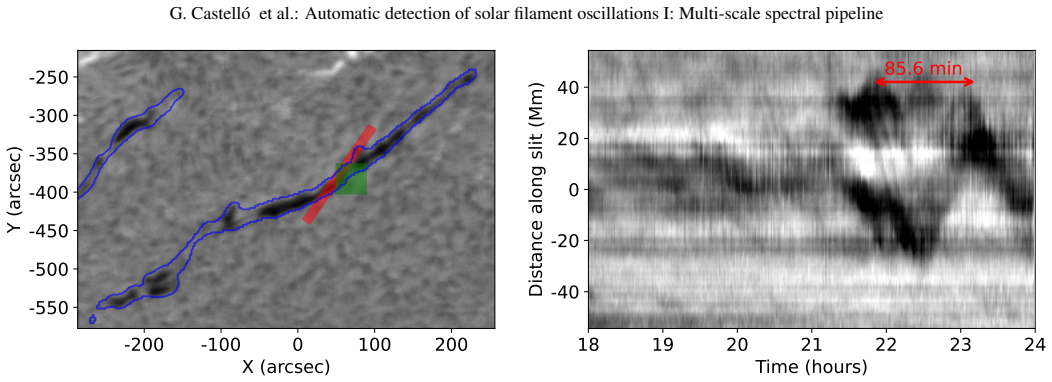
The pipeline recovers several events from the manual GONG catalog and identifies 91 oscillatory events in the first two weeks of January 2014, compared with 22 non-duplicate events in the corresponding manual catalog, with detected periods ranging from about 20 to 126 min; it also detects previously unreported oscillations, including an event on 13 January 2014 with a period of approximately 86 min that is independently confirmed using a conventional time-distance diagram.
What carries the argument
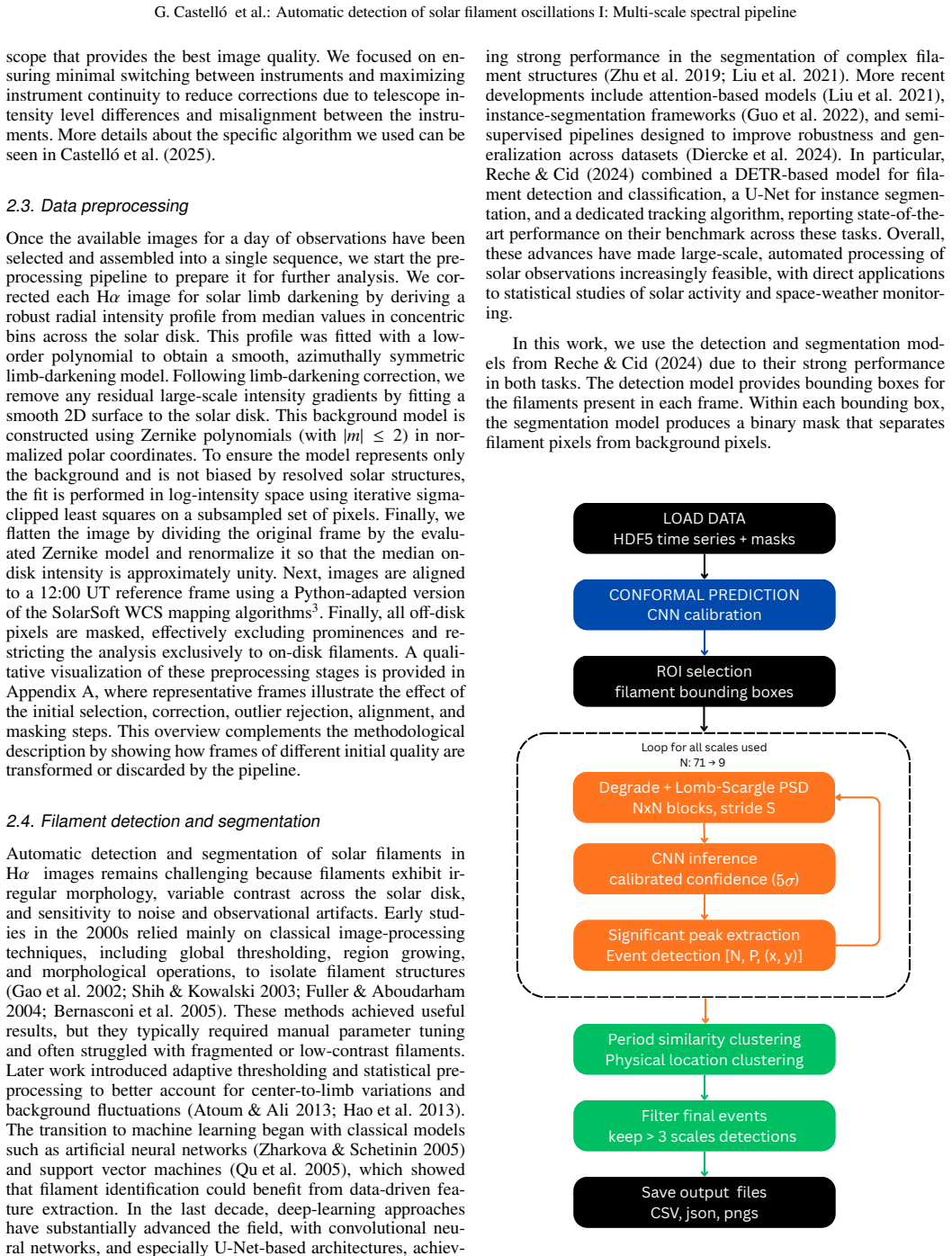
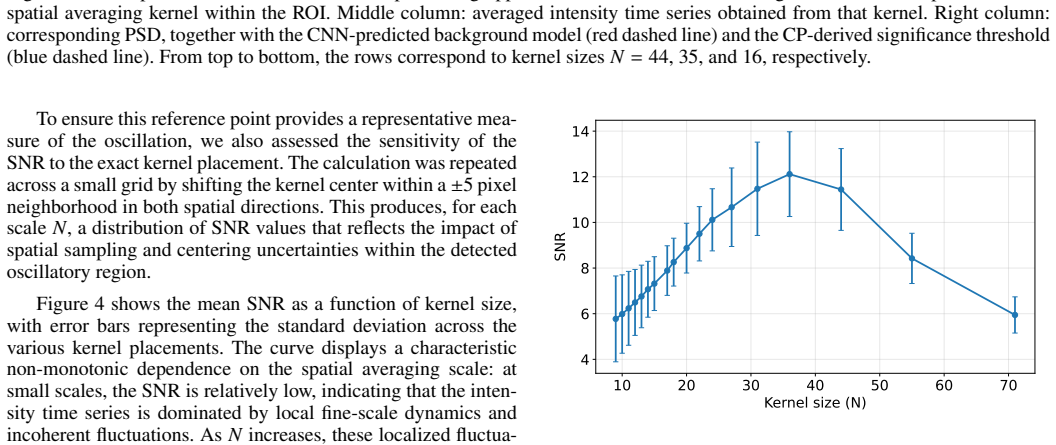
Multi-scale spectral analysis followed by clustering and retention of only those oscillatory signals supported across at least four spatial scales.
If this is right
- The method supplies a reproducible alternative to manual slit-based searches for long archives.
- It preferentially selects coherent filament-scale oscillations over local intensity fluctuations.
- The same pipeline can be applied to extended GONG intervals spanning the solar cycle.
- Detection sensitivity increases while maintaining a focus on spatially extended signals.
Where Pith is reading between the lines
- The same multi-scale consistency test could be tested on other instruments or wavelengths to check whether it generalizes beyond H-alpha GONG data.
- If the four-scale threshold is relaxed or tightened, the catalog size and purity trade-off can be measured directly against manual labels.
- Running the pipeline on the full GONG archive would produce the first large, uniformly selected sample of filament oscillation periods for statistical comparison with theoretical models of prominence magnetic structure.
Load-bearing premise
Requiring oscillatory signals to appear significant at four or more spatial scales is enough to separate genuine filament-scale oscillations from local pixel noise.
What would settle it
Independent time-distance diagrams or velocity maps for a substantial fraction of the 69 additional events show no coherent oscillatory motion at the reported periods.
Figures
read the original abstract
Solar filament oscillations provide important diagnostics of prominence magnetic structure and stability, but their detection in long H\alpha archives has traditionally relied on visual inspection, manually placed slits, and time--distance diagrams. We present an automatic pipeline for detecting spatially coherent filament oscillations in GONG H\alpha image sequences. The method combines image preprocessing and coalignment, deep-learning-based filament detection and segmentation, multi-scale spatial averaging, Lomb--Scargle spectral analysis, convolutional-neural-network background estimation, empirical calibration of significance thresholds, and clustering of candidate detections in period and space. Only oscillations supported across at least four spatial scales are retained, reducing sensitivity to local pixel-scale intensity fluctuations. The pipeline recovers several events from the manual GONG catalog of Luna et al. (2018), including the 1 January 2014 oscillation with a period of approximately 76 min. Applied to the first two weeks of January 2014, it identifies 91 oscillatory events, compared with 22 non-duplicate events in the corresponding manual catalog, with detected periods ranging from about 20 to 126 min. It also detects previously unreported oscillations, including an event on 13 January 2014 with a period of approximately 86 min that is independently confirmed using a conventional time--distance diagram. These results demonstrate that automated filament segmentation, multi-scale spectral analysis, and calibrated significance testing can provide a reproducible and scalable alternative to manual slit-based searches. The pipeline substantially increases detection sensitivity while preferentially selecting coherent filament-scale oscillations, enabling future statistical studies over extended GONG intervals and across the solar cycle.
Editorial analysis
A structured set of objections, weighed in public.
Referee Report
Summary. The manuscript presents an automatic pipeline for detecting solar filament oscillations in GONG Hα image sequences. The method combines image preprocessing, deep-learning filament segmentation, multi-scale spatial averaging, Lomb-Scargle spectral analysis, CNN background estimation, empirical significance calibration, and clustering, retaining only oscillations supported across at least four spatial scales. Applied to the first two weeks of January 2014, the pipeline recovers known events from the Luna et al. (2018) manual catalog (including the ~76 min event on 1 January 2014), detects 91 events (periods ~20-126 min) versus 22 non-duplicate manual events, and identifies a new ~86 min event on 13 January 2014 that is independently confirmed via time-distance diagram. The authors conclude that the approach provides a reproducible, scalable alternative to manual slit-based searches with substantially increased sensitivity to coherent filament-scale oscillations.
Significance. If the multi-scale retention step can be shown through controlled tests to effectively suppress false positives while preserving true filament oscillations, this pipeline would enable systematic statistical studies of filament oscillations over long archives and the solar cycle, moving the field beyond labor-intensive manual methods. The recovery of catalogued events plus independent confirmation of a new detection are positive indicators of utility, and the emphasis on reproducibility is a clear strength.
major comments (2)
- [Abstract and Methods] Abstract and Methods (multi-scale retention and clustering step): The claim that the pipeline 'preferentially selecting coherent filament-scale oscillations' and substantially increases detection sensitivity rests on retaining only signals supported across ≥4 spatial scales after Lomb-Scargle analysis and CNN subtraction. No quantitative validation is reported (e.g., false-positive rates measured on synthetic non-oscillatory filaments, quiet-Sun control fields, or injection-recovery tests on non-event intervals), leaving the residual false-positive rate after this filter unquantified. This is load-bearing for interpreting the 91 vs. 22 event comparison and the sensitivity increase.
- [Results] Results (event statistics and catalog comparison): The manuscript reports recovery of several events from Luna et al. (2018) and 91 total detections versus 22 non-duplicate manual events, but does not specify the exact overlap, how 'non-duplicate' is defined, or whether the multi-scale filter was applied uniformly to both the test interval and any calibration data. This detail is needed to assess whether the sensitivity gain is robust or influenced by post-hoc choices.
minor comments (2)
- [Abstract] Abstract: 'time--distance diagrams' uses a double dash; a single en-dash would be more conventional.
- Consider adding a summary table of detected events (period, date, spatial scale support, comparison to manual catalog) to improve readability of the results.
Simulated Author's Rebuttal
We thank the referee for their constructive comments, which highlight key areas for strengthening the validation and clarity of our results. We address each point below and will revise the manuscript to incorporate the requested details and tests.
read point-by-point responses
-
Referee: [Abstract and Methods] Abstract and Methods (multi-scale retention and clustering step): The claim that the pipeline 'preferentially selecting coherent filament-scale oscillations' and substantially increases detection sensitivity rests on retaining only signals supported across ≥4 spatial scales after Lomb-Scargle analysis and CNN subtraction. No quantitative validation is reported (e.g., false-positive rates measured on synthetic non-oscillatory filaments, quiet-Sun control fields, or injection-recovery tests on non-event intervals), leaving the residual false-positive rate after this filter unquantified. This is load-bearing for interpreting the 91 vs. 22 event comparison and the sensitivity increase.
Authors: We agree that the manuscript would benefit from explicit quantitative validation of the multi-scale filter's false-positive suppression. While the current results are supported by recovery of known events from Luna et al. (2018) and independent time-distance confirmation of a new detection, these do not fully quantify residual false positives. In revision we will add injection-recovery tests: synthetic oscillatory signals will be injected into non-event filament intervals and quiet-Sun control fields, and the fraction retained after the ≥4-scale requirement will be reported to calibrate the false-positive rate. revision: yes
-
Referee: [Results] Results (event statistics and catalog comparison): The manuscript reports recovery of several events from Luna et al. (2018) and 91 total detections versus 22 non-duplicate events in the corresponding manual catalog, but does not specify the exact overlap, how 'non-duplicate' is defined, or whether the multi-scale filter was applied uniformly to both the test interval and any calibration data. This detail is needed to assess whether the sensitivity gain is robust or influenced by post-hoc choices.
Authors: We will expand the Results section to report the exact number of recovered Luna et al. events (with their periods and dates), define 'non-duplicate' as detections whose spatial centroid and period do not match any manual event within the adopted matching tolerances, and state that the multi-scale retention criterion (≥4 scales) and all other pipeline parameters were fixed prior to analysis and applied uniformly to the full two-week interval. No post-hoc tuning occurred. revision: yes
Circularity Check
No significant circularity; empirical pipeline choices remain independent of outputs
full rationale
The paper describes an automated detection pipeline using segmentation, multi-scale averaging, Lomb-Scargle analysis, CNN background subtraction, and a retention rule requiring support across at least four scales. These are presented as methodological choices with empirical calibration of thresholds, but the provided text contains no equations or self-citations that reduce the detected oscillations or the central claim to quantities defined in terms of the fitted parameters or inputs by construction. Results are reported via recovery of known events and independent confirmation of new detections, keeping the derivation self-contained against external benchmarks.
Axiom & Free-Parameter Ledger
free parameters (1)
- significance thresholds =
empirically calibrated
axioms (1)
- standard math Lomb-Scargle periodogram validity for detecting periods in time series from image sequences
Reference graph
Works this paper leans on
-
[1]
Fast Bayesian spectral analysis using convolutional neural networks: Applications to GONG H solar data. , keywords =. 2025 , month =. doi:10.1051/0004-6361/202452928 , archivePrefix =. 2501.12743 , primaryClass =
-
[2]
Zhang, Q. M. and Chen, P. F. and Xia, C. and Keppens, R. , month = jun, year =. Observations and simulations of longitudinal oscillations of an active region prominence , volume =. , publisher =. doi:10.1051/0004-6361/201218786 , abstract =
-
[3]
Luna, M and Karpen, J , year =. Large-. , publisher =. doi:10.1088/2041-8205/750/1/L1 , abstract =
-
[4]
Ansel, Jason and Yang, Edward and He, Horace and Gimelshein, Natalia and Jain, Animesh and Voznesensky, Michael and Bao, Bin and Bell, Peter and Berard, David and Burovski, Evgeni and Chauhan, Geeta and Chourdia, Anjali and Constable, Will and Desmaison, Alban and DeVito, Zachary and Ellison, Elias and Feng, Will and Gong, Jiong and Gschwind, Michael and ...
-
[5]
2015 , eprint=
Deep Residual Learning for Image Recognition , author=. 2015 , eprint=
2015
-
[6]
Prominence oscillations , volume =. Living Rev. Sol. Phys. , author =. 2018 , note =. doi:10.1007/s41116-018-0012-6 , abstract =
-
[7]
, author =. 2018 , note =. doi:10.3847/1538-4365/aabde7 , number =
-
[8]
The. , author =. 2011 , note =. doi:10.1007/s11207-011-9776-8 , abstract =
-
[9]
The. , author =. 1994 , note =. doi:10.1007/BF00680444 , abstract =
-
[10]
Detection of ultra-long-period oscillations in an. , author =. 2004 , note =. doi:10.1051/0004-6361:200400083 , abstract =
-
[11]
Ultra-long-period. , author =. 2009 , note =. doi:10.1088/0004-637X/700/2/1658 , abstract =
-
[12]
Ultra. , author =. 2016 , note =. doi:10.1007/s11207-016-1021-z , abstract =
-
[13]
doi:10.3847/1538-4357/ab4f7a , url =
The SunPy Project: Open Source Development and Status of the Version 1.0 Core Package , journal =. doi:10.3847/1538-4357/ab4f7a , url =
-
[14]
Manuel Guizar-Sicairos and Samuel T. Thurman and James R. Fienup , journal =. Efficient subpixel image registration algorithms , volume =. 2008 , url =. doi:10.1364/OL.33.000156 , abstract =
-
[15]
Development of an Automatic Filament Disappearance Detection System. , keywords =. 2002 , month =. doi:10.1023/A:1013851808367 , adsurl =
-
[16]
Automatic Extraction of Filaments in H Solar Images. , keywords =. 2003 , month =. doi:10.1023/B:SOLA.0000013052.34180.58 , adsurl =
-
[17]
and Aboudarham, J
Fuller, N. and Aboudarham, J. Automatic Detection of Solar Filaments Versus Manual Digitization. Knowledge-Based Intelligent Information and Engineering Systems. 2004
2004
-
[18]
Advanced Automated Solar Filament Detection And Characterization Code: Description, Performance, And Results. , keywords =. 2005 , month =. doi:10.1007/s11207-005-2766-y , adsurl =
-
[19]
Automated Algorithms for Detecting Solar Filaments in H-Alpha Solar Images and Detecting Their Spines , volume =
Atoum, Ibrahim and Ali, Maaruf , year =. Automated Algorithms for Detecting Solar Filaments in H-Alpha Solar Images and Detecting Their Spines , volume =. Int. J. Astron. Astrophys. , doi =
-
[20]
Developing an Advanced Automated Method for Solar Filament Recognition and Its Scientific Application to a Solar Cycle of MLSO H Data. , keywords =. 2013 , month =. doi:10.1007/s11207-013-0285-9 , archivePrefix =. 1303.6367 , primaryClass =
work page internal anchor Pith review Pith/arXiv arXiv doi:10.1007/s11207-013-0285-9 2013
-
[21]
Filament Recognition In Solar Images With The Neural Network Technique , volume =
Zharkova, Valentina and Schetinin, Vitaly , year =. Filament Recognition In Solar Images With The Neural Network Technique , volume =. , doi =
-
[22]
Automatic Solar Filament Detection Using Image Processing Techniques. , keywords =. 2005 , month =. doi:10.1007/s11207-005-5780-1 , adsurl =
-
[23]
Solar Filament Recognition Based on Deep Learning. , keywords =. 2019 , month =. doi:10.1007/s11207-019-1517-4 , archivePrefix =. 1909.06580 , primaryClass =
-
[24]
Solar Filament Segmentation Based on Improved U-Nets. , keywords =. 2021 , month =. doi:10.1007/s11207-021-01920-3 , adsurl =
-
[25]
Solar-Filament Detection and Classification Based on Deep Learning. , keywords =. 2022 , month =. doi:10.1007/s11207-022-02019-z , adsurl =
-
[26]
A universal method for solar filament detection from H observations using semi-supervised deep learning. , keywords =. 2024 , month =. doi:10.1051/0004-6361/202348314 , archivePrefix =. 2402.15407 , primaryClass =
-
[27]
Solar filament detection, classification, and tracking with deep learning. Proceedings of SPAICE2024: The First Joint European Space Agency / IAA Conference on AI in and for Space , year =. doi:10.5281/zenodo.13885513 , adsurl =
-
[28]
Automatic detection technique for solar filament oscillations in GONG data. , keywords =. doi:10.1051/0004-6361/202244181 , archivePrefix =. 2209.05087 , primaryClass =
-
[29]
Study of Global Photospheric and Chromospheric Flows Using Local Correlation Tracking and Machine Learning Methods I: Methodology and Uncertainty Estimates. , keywords =. doi:10.1007/s11207-023-02158-x , adsurl =
-
[30]
Shang, Zhen-Hong and Mu, Si-Yu and Ji, Kai-Fan and Qiang, Zhen-Ping , title =. Res. Astron. Astrophys. , abstract =. 2023 , month =. doi:10.1088/1674-4527/accbaf , url =
-
[31]
A Practical Guide to Wavelet Analysis. Bull. Am. Meteorol. Soc. , year =. doi:10.1175/1520-0477(1998)079<0061:APGTWA>2.0.CO;2 , adsurl =
-
[32]
Understanding the Lomb-Scargle Periodogram
Understanding the Lomb-Scargle Periodogram. , keywords =. 2018 , month =. doi:10.3847/1538-4365/aab766 , archivePrefix =. 1703.09824 , primaryClass =
work page internal anchor Pith review Pith/arXiv arXiv doi:10.3847/1538-4365/aab766 2018
-
[33]
Physics of Solar Prominences: II - Magnetic Structure and Dynamics
Physics of Solar Prominences: II Magnetic Structure and Dynamics. , keywords =. doi:10.1007/s11214-010-9628-0 , archivePrefix =. 1001.1635 , primaryClass =
work page internal anchor Pith review Pith/arXiv arXiv doi:10.1007/s11214-010-9628-0
-
[34]
Fleshing out the magnetic skeleton
Solar prominences: theory and models. Fleshing out the magnetic skeleton. Living Rev. Sol. Phys. , keywords =. doi:10.1007/s41116-018-0016-2 , adsurl =
-
[35]
Oscillations in Quiescent Solar Prominences Observations and Theory (Invited Review). , keywords =. doi:10.1023/A:1014915428440 , adsurl =
-
[36]
Large Amplitude Oscillations in Prominences
Large Amplitude Oscillations in Prominences. , keywords =. doi:10.1007/s11214-009-9583-9 , archivePrefix =. 0910.4059 , primaryClass =
work page internal anchor Pith review Pith/arXiv arXiv doi:10.1007/s11214-009-9583-9
-
[37]
Filament Oscillations and Moreton Waves Associated with EIT Waves. , keywords =. doi:10.1086/420838 , adsurl =
-
[38]
Periodic Motion Along Solar Filaments. , keywords =. doi:10.1007/s11207-006-0126-1 , adsurl =
-
[39]
Large amplitude oscillatory motion along a solar filament
Large amplitude oscillatory motion along a solar filament. , keywords =. 2007 , month =. doi:10.1051/0004-6361:20077668 , archivePrefix =. 0707.1752 , primaryClass =
work page internal anchor Pith review Pith/arXiv arXiv doi:10.1051/0004-6361:20077668 2007
-
[40]
Simultaneous Transverse Oscillations of a Prominence and a Filament and Longitudinal Oscillation of Another Filament Induced by a Single Shock Wave. , keywords =. 2014 , month =. doi:10.1088/0004-637X/795/2/130 , archivePrefix =. 1409.1304 , primaryClass =
work page internal anchor Pith review Pith/arXiv arXiv doi:10.1088/0004-637x/795/2/130 2014
-
[41]
Large-amplitude longitudinal oscillations in a solar filament
Large-amplitude Longitudinal Oscillations in a Solar Filament. , keywords =. 2017 , month =. doi:10.3847/1538-4357/aa73d2 , archivePrefix =. 1705.04820 , primaryClass =
work page internal anchor Pith review Pith/arXiv arXiv doi:10.3847/1538-4357/aa73d2 2017
-
[42]
Study of the excitation of large-amplitude oscillations in a prominence by nearby flares. , keywords =. 2024 , month =. doi:10.1051/0004-6361/202450869 , archivePrefix =. 2410.10223 , primaryClass =
-
[43]
A Precursor to Solar Prominence Eruptions: Detection and Analysis of EUV Prominence Oscillations. , keywords =. 2024 , month =. doi:10.3847/1538-4357/ad8e3c , adsurl =
-
[44]
Investigation of Prominence Oscillations with High-Resolution Observations from the New Vacuum Solar Telescope. Universe , keywords =. 2025 , month =. doi:10.3390/universe11120401 , adsurl =
-
[45]
Tibshirani and Larry Wasserman , title =
Jing Lei and Max G’Sell and Alessandro Rinaldo and Ryan J. Tibshirani and Larry Wasserman , title =. JASA , volume =. 2018 , publisher =. doi:10.1080/01621459.2017.1307116 , URL =
-
[46]
2005 , publisher =
Algorithmic Learning in a Random World , author =. 2005 , publisher =
2005
-
[47]
Conformalized Quantile Regression
Conformalized Quantile Regression. arXiv e-prints , keywords =. 2019 , month =. doi:10.48550/arXiv.1905.03222 , archivePrefix =. 1905.03222 , primaryClass =
work page internal anchor Pith review Pith/arXiv arXiv doi:10.48550/arxiv.1905.03222 2019
-
[48]
Conformal prediction bands for multivariate functional data , journal =
Jacopo Diquigiovanni and Matteo Fontana and Simone Vantini , keywords =. Conformal prediction bands for multivariate functional data , journal =. 2022 , issn =. doi:https://doi.org/10.1016/j.jmva.2021.104879 , url =
discussion (0)
Sign in with ORCID, Apple, or X to comment. Anyone can read and Pith papers without signing in.