Searching for the elusive CH2+ with the James Webb Space Telescope. Another carbocation to constrain astrochemical networks
Pith reviewed 2026-07-02 08:32 UTC · model grok-4.3
The pith
JWST observations set an upper limit on excited CH2+ close to or below photodissociation region model predictions.
A machine-rendered reading of the paper's core claim, the machinery that carries it, and where it could break.
Core claim
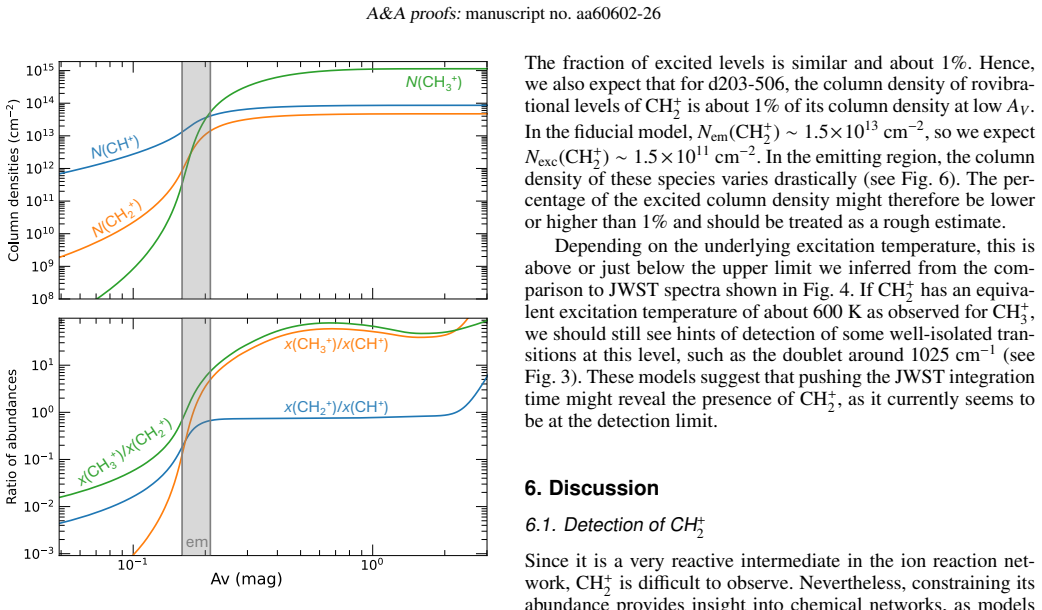
The central claim is that the nondetection of CH2+ in JWST spectra of the externally irradiated disk d203-506 yields an upper limit on its excited column density that is either slightly above or below the value predicted by thermochemical models of photodissociation regions, once the model spectra at assumed excitation temperatures are compared to the data.
What carries the argument
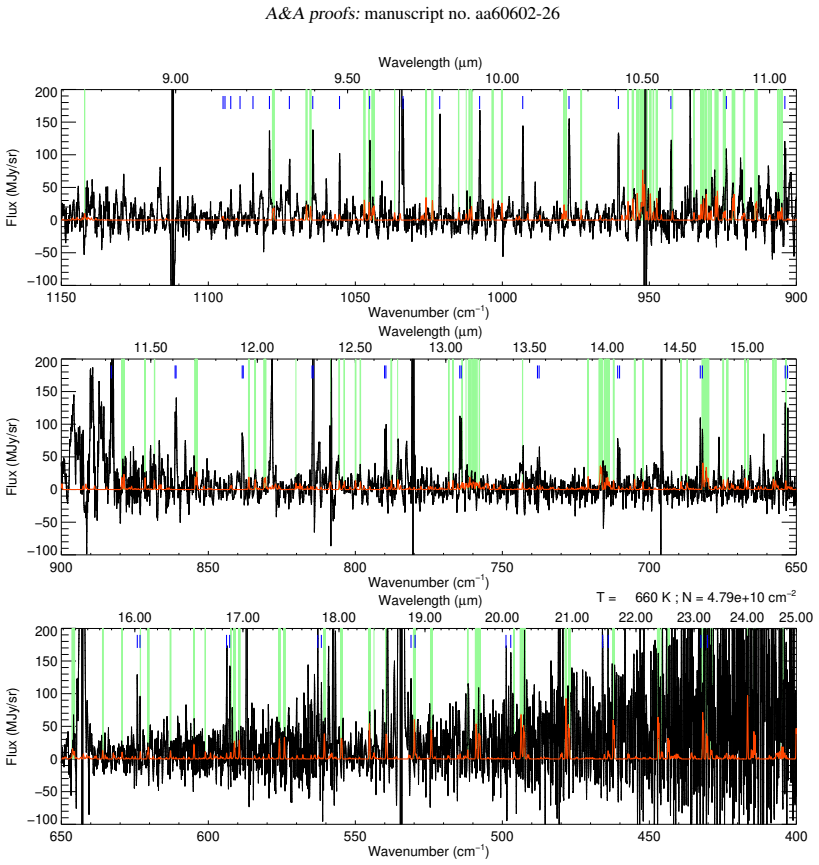
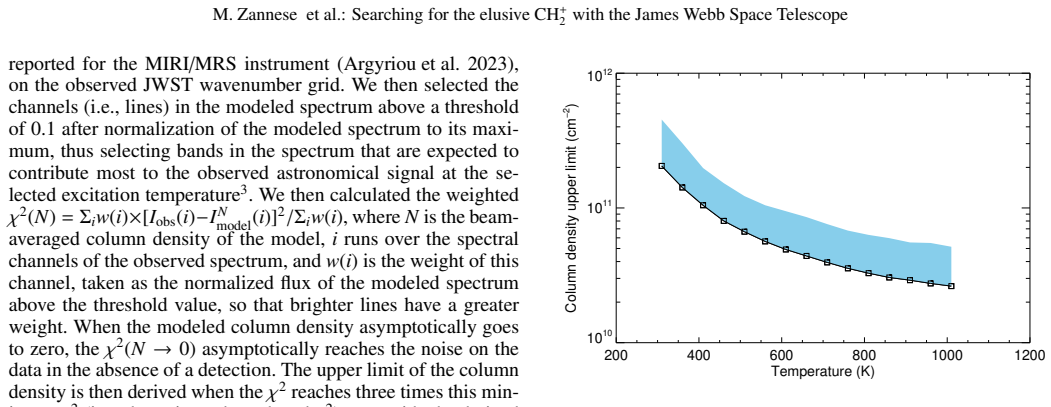
Calculated CH2+ rovibrational emission spectra at different excitation temperatures, used to derive observational upper limits by direct comparison to JWST spectra and to thermochemical abundance predictions.
If this is right
- The abundance of CH2+ in photodissociation regions must lie at or below current thermochemical model values under the shared excitation assumption.
- A tabulated list of transitions is now available for targeted searches in other sources that show CH3+.
- Nondetections in additional CH3+-bearing objects can map the conditions under which CH2+ remains below detectable thresholds.
- Tighter observational bounds on this intermediate will directly limit the allowed rates and branching ratios in hydrocarbon formation pathways.
Where Pith is reading between the lines
- If the temperature assumption holds across multiple sources, modelers can reduce the allowed range of ion-neutral reaction rates in irradiated disks.
- Deeper or higher-resolution spectra of the same target, or observations of regions with higher predicted column densities, would be the next direct test.
- Similar upper-limit exercises on the next missing carbocation in the sequence would close the observational gap in the network.
Load-bearing premise
CH2+ experiences similar excitation temperatures to the already-detected CH+ and CH3+ in the same region.
What would settle it
A clear detection of one or more tabulated CH2+ lines in the JWST spectrum of d203-506 at a strength implying an excited column density well above the reported upper limit.
Figures
read the original abstract
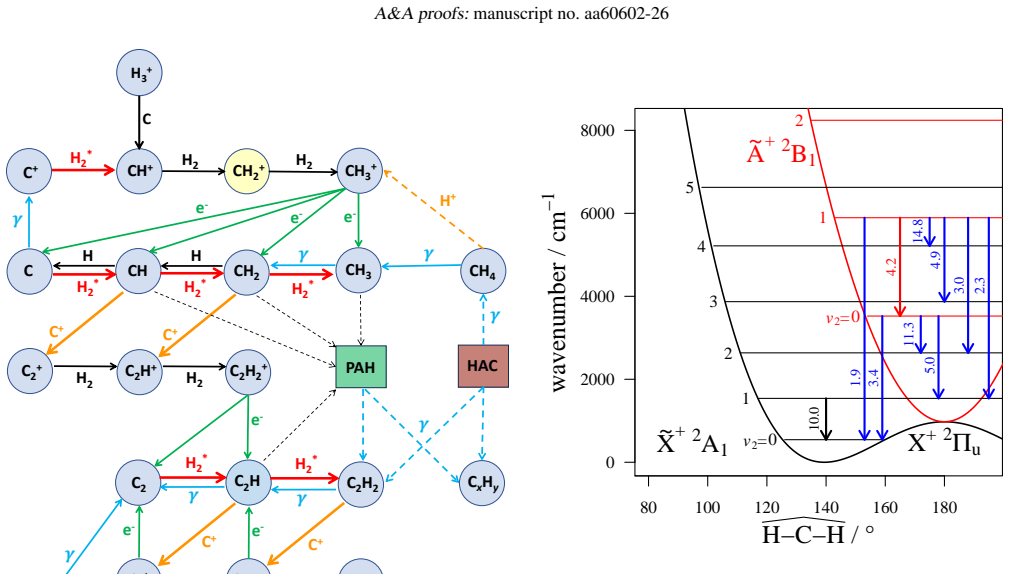
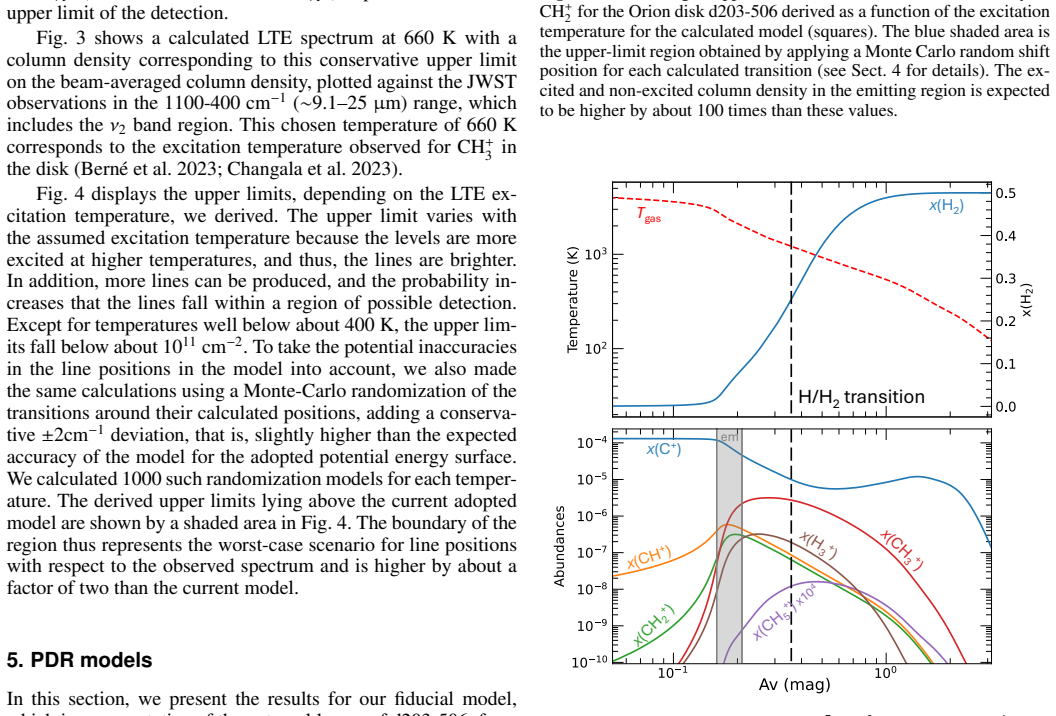
Carbocations are key species in interstellar chemistry, providing entry points for building larger hydrocarbons. CH+, and more recently, CH3+, have been detected. Other carbocations await detection to provide a comprehensive view of the astrochemical network that is at work in the interstellar medium. We search for CH2+ in objects in which CH3+ was detected and evaluate the most favorable conditions for detecting the elusive CH2+ reactive cation. We calculated the CH2+ rotational and rovibrational transitions expected to contribute in the mid- to far-infrared, focusing on the lower-energy rovibrational levels. We then calculated CH2+ infrared emission spectra at different excitation temperatures and compared them to JWST spectra of the externally irradiated disk d203-506 in Orion, where CH+ and CH3+ have already been detected. We used thermochemical models to predict the abundance and spatial morphology of CH2+ to better understand its nondetection. The comparison to JWST spectra allowed us to provide excitation-temperature-dependent upper limits to the excited column density. These are several times lower than those detected for CH+ and CH3+ in their excited states. Based on model calculations for photodissociation regions and assuming similar excitation temperatures, the upper limit derived from observations and CH2+ model spectrum is either slightly above or below the column density expected from models of photodissociation regions. We provide a list of tabulated transitions to allow the community to search for this carbocation in future observations as CH2+ is key in providing observational constraints on astrochemical models.
Editorial analysis
A structured set of objections, weighed in public.
Referee Report
Summary. The manuscript calculates CH2+ rotational and rovibrational transitions in the mid- to far-infrared, generates model emission spectra at varying excitation temperatures, compares these to JWST spectra of the externally irradiated disk d203-506 (where CH+ and CH3+ are detected) to derive Tex-dependent upper limits on the excited-state column density of CH2+, and employs thermochemical PDR models to predict its abundance and morphology. It concludes that the observational upper limit is either slightly above or below the model-predicted column density (assuming similar Tex to CH+ and CH3+), provides a tabulated list of transitions, and discusses prospects for future detection to constrain astrochemical networks.
Significance. If the upper limits hold and the excitation assumption is validated, the work supplies a useful observational constraint on an intermediate carbocation in PDR chemistry and supplies tabulated transitions as a community resource. The direct spectral comparison approach for the nondetection is independent of the models, which is a strength.
major comments (2)
- [Abstract and model-comparison section] Abstract and model-comparison section: the headline claim that the JWST-derived upper limit is 'either slightly above or below' the PDR-model column density rests on the assumption that CH2+ shares the same excitation temperature as CH+ and CH3+. No independent steady-state Tex calculation for CH2+ (accounting for its distinct radiative lifetimes or chemical pumping) is reported from the same PDR model, so the numerical comparison's precision is not demonstrated.
- [Methods and results on upper-limit derivation] Methods and results on upper-limit derivation: the Tex-dependent upper limits are obtained by scaling the CH2+ model spectrum to the JWST data of d203-506, but the text provides no explicit error budget, description of continuum subtraction, or quantitative criterion for the nondetection threshold. This makes it impossible to verify that the limits are 'several times lower' than the CH+ and CH3+ values at the stated level of precision.
minor comments (2)
- [Abstract] The abstract states that transitions were calculated 'focusing on the lower-energy rovibrational levels' but does not specify the energy cutoff or list the specific levels retained.
- [Results section] Notation for column densities (e.g., N(CH2+)*) should be defined explicitly on first use in the results section.
Simulated Author's Rebuttal
We thank the referee for their constructive comments on our manuscript. We address each major comment point by point below, indicating where revisions will be incorporated.
read point-by-point responses
-
Referee: [Abstract and model-comparison section] Abstract and model-comparison section: the headline claim that the JWST-derived upper limit is 'either slightly above or below' the PDR-model column density rests on the assumption that CH2+ shares the same excitation temperature as CH+ and CH3+. No independent steady-state Tex calculation for CH2+ (accounting for its distinct radiative lifetimes or chemical pumping) is reported from the same PDR model, so the numerical comparison's precision is not demonstrated.
Authors: We acknowledge that the headline comparison relies on the assumption of similar excitation temperatures, which is explicitly stated in the manuscript when comparing to PDR model predictions. The thermochemical PDR models used focus on abundance and morphology and do not output a separate steady-state Tex for CH2+ (owing to its distinct radiative properties and potential chemical pumping effects). We will revise the abstract and model-comparison section to emphasize this assumption more prominently and to note the lack of an independent Tex calculation from the same PDR model, thereby clarifying the precision of the numerical comparison. revision: partial
-
Referee: [Methods and results on upper-limit derivation] Methods and results on upper-limit derivation: the Tex-dependent upper limits are obtained by scaling the CH2+ model spectrum to the JWST data of d203-506, but the text provides no explicit error budget, description of continuum subtraction, or quantitative criterion for the nondetection threshold. This makes it impossible to verify that the limits are 'several times lower' than the CH+ and CH3+ values at the stated level of precision.
Authors: We agree that additional methodological details are required for full transparency and verifiability. In the revised manuscript we will add an explicit error budget for the derived upper limits, a description of the continuum subtraction applied to the JWST spectra of d203-506, and the quantitative criterion (e.g., residual noise level or S/N threshold) used to define the nondetection. These additions will enable readers to confirm that the CH2+ upper limits are several times lower than the corresponding values for CH+ and CH3+. revision: yes
Circularity Check
No significant circularity; observational upper limits independent of thermochemical predictions
full rationale
The derivation chain begins with calculation of CH2+ rovibrational transitions and emission spectra at varying Tex, followed by direct comparison to JWST spectra of d203-506 to extract Tex-dependent upper limits on excited column density. These limits are obtained from spectral nondetection and are independent of the PDR thermochemical models. The final statement that the upper limit is 'either slightly above or below' the model-expected column density invokes an explicit assumption of similar Tex to CH+ and CH3+, but this does not reduce the result to a self-definitional equivalence, a fitted parameter renamed as prediction, or a load-bearing self-citation chain. No equations or steps in the provided text exhibit the specific reductions required for circularity scores above 0. The central observational constraint remains externally falsifiable.
Axiom & Free-Parameter Ledger
free parameters (1)
- excitation temperature
axioms (1)
- domain assumption The calculated rotational and rovibrational transitions accurately represent the CH2+ spectrum in the mid- to far-infrared.
Reference graph
Works this paper leans on
-
[1]
Anicich , V. G. 1993, Journal of Physical and Chemical Reference Data, 22, 1469
1993
-
[2]
R., et al
Argyriou , I., Glasse , A., Law , D. R., et al. 2023, , 675, A111
2023
-
[3]
2022, , 134, 054301
Bern \'e , O., Habart , \'E ., Peeters , E., et al. 2022, , 134, 054301
2022
-
[4]
2023, , 621, 56
Bern \'e , O., Martin-Drumel , M.-A., Schroetter , I., et al. 2023, , 621, 56
2023
-
[5]
2025, , 995, 67
Bhatt , C., Cami , J., Peeters , E., et al. 2025, , 995, 67
2025
-
[6]
O., van Dishoeck , E
Bruderer , S., Benz , A. O., van Dishoeck , E. F., et al. 2010, , 521, L44
2010
-
[7]
2001, Chemical physics letters, 341, 358
Bunker, P., Chan, M., Kraemer, W., & Jensen, P. 2001, Chemical physics letters, 341, 358
2001
-
[8]
P., Yurchenko, S
Bunker, P., Kraemer, W. P., Yurchenko, S. N., et al. 2007, Molecular Physics, 105, 1369
2007
-
[9]
& Handy, N
Carter, S. & Handy, N. C. 1982, Journal of Molecular Spectroscopy, 95, 9
1982
-
[10]
W., Gonz \'a lez-Alfonso , E., et al
Cernicharo , J., Liu , X. W., Gonz \'a lez-Alfonso , E., et al. 1997, , 483, L65
1997
-
[11]
B., Chen , N
Changala , P. B., Chen , N. L., Le , H. L., et al. 2023, , 680, A19
2023
-
[12]
H., Gans, B., Holzmeier, F., et al
Coudert, L. H., Gans, B., Holzmeier, F., et al. 2018, The Journal of Chemical Physics, 149, 224304
2018
-
[13]
d., Aguado , A., Goicoechea , J
del Mazo-Sevillano , P. d., Aguado , A., Goicoechea , J. R., & Roncero , O. 2024, , 160, 184307
2024
-
[14]
Douglas , A. E. & Herzberg , G. 1941, , 94, 381
1941
-
[15]
2010, , 521, L15
Falgarone , E., Godard , B., Cernicharo , J., et al. 2010, , 521, L15
2010
-
[16]
Fitzpatrick , E. L. & Massa , D. 1990, , 72, 163
1990
-
[17]
Geballe , T. R. 2006, Philosophical Transactions of the Royal Society of London Series A, 364, 3035
2006
-
[18]
Geballe , T. R. & Oka , T. 1996, , 384, 334
1996
-
[19]
R., Le Bourlot , J., Black , J
Goicoechea , J. R., Le Bourlot , J., Black , J. H., et al. 2024, , 689, L4
2024
-
[20]
R., Pety , J., Cuadrado , S., et al
Goicoechea , J. R., Pety , J., Cuadrado , S., et al. 2025 a , , 696, A100
2025
-
[21]
R., Roncero , O., Roueff , E., et al
Goicoechea , J. R., Roncero , O., Roueff , E., et al. 2025 b , , 703, A189
2025
-
[22]
2008, , 688, 306
Goto , M., Usuda , T., Nagata , T., et al. 2008, , 688, 306
2008
-
[23]
Gottfried, J. L. & Oka, T. 2004, The Journal of chemical physics, 121, 11527
2004
-
[24]
& Coudert, L
Gutl\'e , C. & Coudert, L. H. 2012, Journal of Molecular Spectroscopy, 273, 44
2012
-
[25]
2024, , 136, 054302
Henning , T., Kamp , I., Samland , M., et al. 2024, , 136, 054302
2024
-
[26]
2021, Frontiers in Astronomy and Space Sciences, 8, 207
Herbst , E. 2021, Frontiers in Astronomy and Space Sciences, 8, 207
2021
-
[27]
1966, Molecular Spectra and Molecular Structure
Herzberg, G. 1966, Molecular Spectra and Molecular Structure. Vol. III: Electronic Spectra and Electronic Structure of Polyatomic Molecules (Princeton, NJ / New York, USA: D. Van Nostrand Company), volume III of *Molecular Spectra and Molecular Structure*
1966
-
[28]
G., Mazumder, S., & Peterson, K
Hill, J. G., Mazumder, S., & Peterson, K. A. 2010, The Journal of chemical physics, 132
2010
-
[29]
& McCall , B
Indriolo , N. & McCall , B. J. 2012, , 745, 91
2012
-
[30]
R., & McCall , B
Indriolo , N., Oka , T., Geballe , T. R., & McCall , B. J. 2010, , 711, 1338
2010
-
[31]
1995 a , Journal of Molecular Spectroscopy, 172, 194
Jensen, P., Brumm, M., Kraemer, W., & Bunker, P. 1995 a , Journal of Molecular Spectroscopy, 172, 194
1995
-
[32]
P., & Bunker, P
Jensen, P., Brumm, M., Kraemer, W. P., & Bunker, P. R. 1995 b , Journal of Molecular Spectroscopy, 171, 31
1995
-
[33]
2019, Journal of Molecular Spectroscopy, 363, 111172
Jungen, C. 2019, Journal of Molecular Spectroscopy, 363, 111172
2019
-
[34]
1994, Canadian Journal of Physics, 72, 871
Kraemer, W., Jensen, P., & Bunker, P. 1994, Canadian Journal of Physics, 72, 871
1994
-
[35]
2006, , 164, 506
Le Petit , F., Nehm \'e , C., Le Bourlot , J., & Roueff , E. 2006, , 164, 506
2006
-
[36]
Marcus, R. A. 1952 a , J. Chem. Phys., 20, 352
1952
-
[37]
Marcus, R. A. 1952 b , J. Chem. Phys., 20, 355
1952
-
[38]
J., Hinkle , K
McCall , B. J., Hinkle , K. H., Geballe , T. R., et al. 2002, , 567, 391
2002
-
[39]
Miller, W. H. 1987, Chem. Rev., 87, 19
1987
-
[40]
W., Gupta , H., Nagy , Z., et al
Morris , P. W., Gupta , H., Nagy , Z., et al. 2016, , 829, 15
2016
-
[41]
A., Dartois , E., Habart , E., et al
Naylor , D. A., Dartois , E., Habart , E., et al. 2010, , 518, L117
2010
-
[42]
R., Jensen , P., & Kraemer , W
Osmann , G., Bunker , P. R., Jensen , P., & Kraemer , W. P. 1997, Chemical Physics, 225, 33
1997
-
[43]
2024, A&Ap, 685, A74
Peeters , E., Habart , E., Bern \'e , O., et al. 2024, A&Ap, 685, A74
2024
-
[44]
R., Glenn , J., et al
Rangwala , N., Maloney , P. R., Glenn , J., et al. 2014, , 788, 147
2014
-
[45]
& Peyerimhoff, S
Reuter, W. & Peyerimhoff, S. D. 1992, Chemical Physics, 160, 11
1992
-
[46]
1992, Journal of molecular spectroscopy, 153, 738
R \"o sslein, M., Gabrys, C., Jagod, M.-F., & Oka, T. 1992, Journal of molecular spectroscopy, 153, 738
1992
-
[47]
& Werner, H.-J
Shiozaki, T. & Werner, H.-J. 2011, The Journal of chemical physics, 134
2011
-
[48]
1992, Chemical Reviews, 92, 1473
Smith, D. 1992, Chemical Reviews, 92, 1473
1992
-
[49]
& Yachmenev, A
Solomonik, V. & Yachmenev, A. Y. 2008, Optics and Spectroscopy, 104, 818
2008
-
[50]
2012, , 758, 108
Spinoglio , L., Pereira-Santaella , M., Busquet , G., et al. 2012, , 758, 108
2012
-
[51]
F., M \'e nard , F., Meeus , G., et al
Thi , W. F., M \'e nard , F., Meeus , G., et al. 2011, , 530, L2
2011
-
[52]
C., Pittman , C
Volz , M., Espaillat , C. C., Pittman , C. V., et al. 2026, , 171, 39
2026
-
[53]
W. H. Miller . 1979, J. Am. Chem. Soc., 101
1979
-
[54]
F., Morong , C
Wang , H., Neese , C. F., Morong , C. P., Kleshcheva , M., & Oka , T. 2013, Journal of Physical Chemistry A, 117, 9908
2013
-
[55]
2012, Mol
Werner, H., Knowles, P., Knizia, G., Manby, F., & Sch \"u tz, M. 2012, Mol. Sci, 2, 10
2012
-
[56]
& Knowles , P
Werner , H.-J. & Knowles , P. J. 1988, , 89, 5803
1988
-
[57]
J., et al
Wesson , R., Cernicharo , J., Barlow , M. J., et al. 2010, , 518, L144
2010
-
[58]
& Merkt, F
Willitsch, S. & Merkt, F. 2003, The Journal of chemical physics, 118, 2235
2003
-
[59]
Woon, D. E. & Herbst, E. 2009, ApJ. Sup. Series, 185, 273
2009
-
[60]
2025, , 696, A99
Zannese , M., Tabone , B., Habart , E., et al. 2025, , 696, A99
2025
-
[61]
2024, Nature Astronomy, 8, 577
Zannese , M., Tabone , B., Habart , E., et al. 2024, Nature Astronomy, 8, 577
2024
discussion (0)
Sign in with ORCID, Apple, or X to comment. Anyone can read and Pith papers without signing in.