High-dimensional Embedding Prior for Noisy K-space Domain MRIReconstruction
Pith reviewed 2026-07-02 13:25 UTC · model grok-4.3
The pith
High-dimensional embeddings improve diffusion-based reconstruction of noisy k-space MRI data without changing solvers
A machine-rendered reading of the paper's core claim, the machinery that carries it, and where it could break.
Core claim
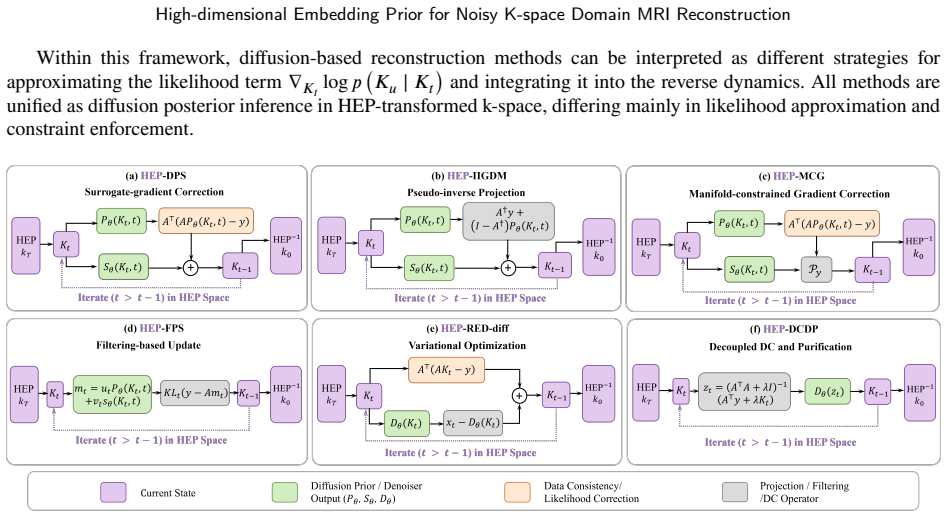
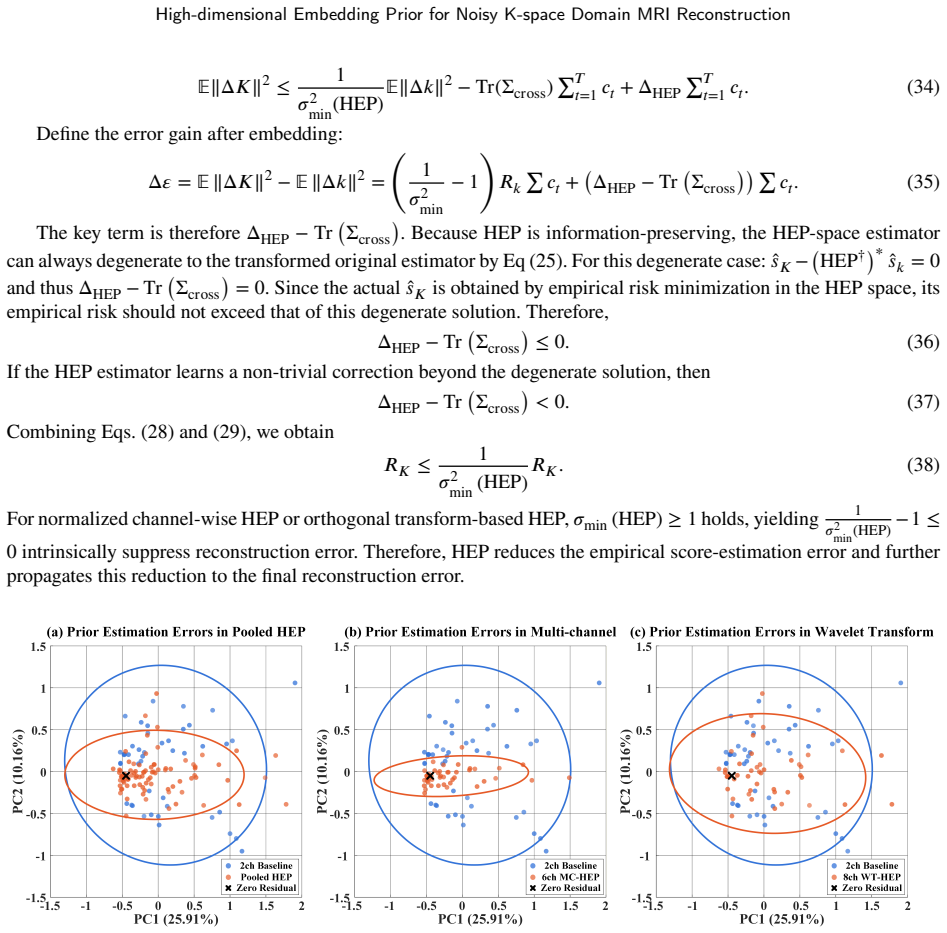
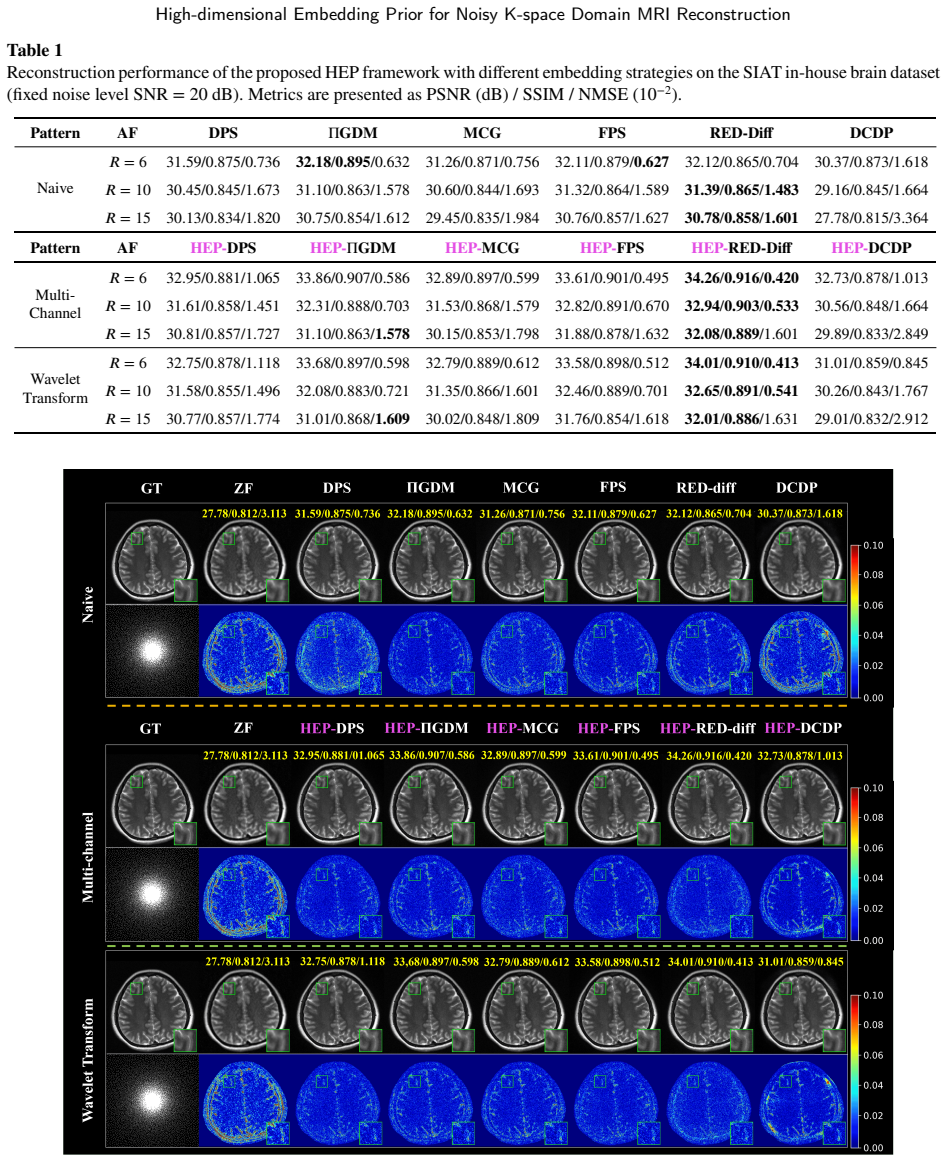
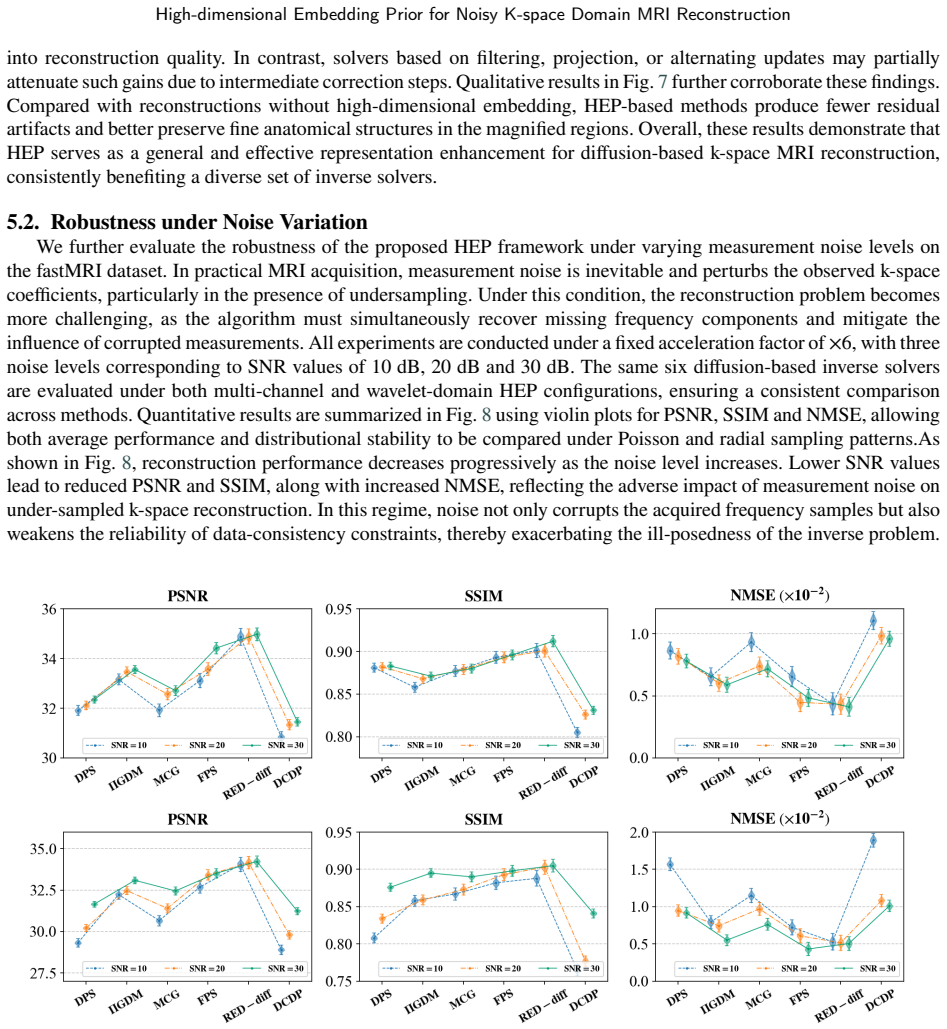
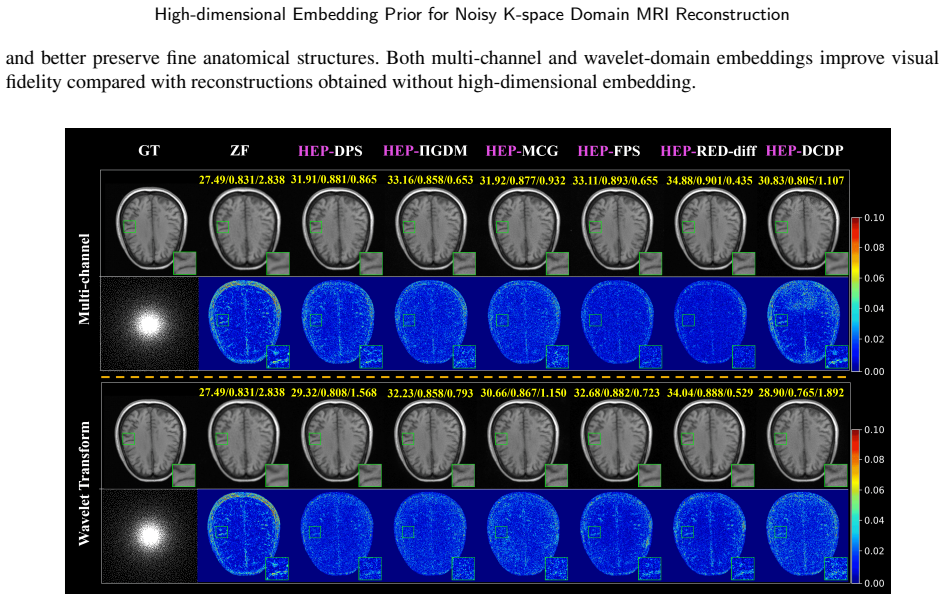
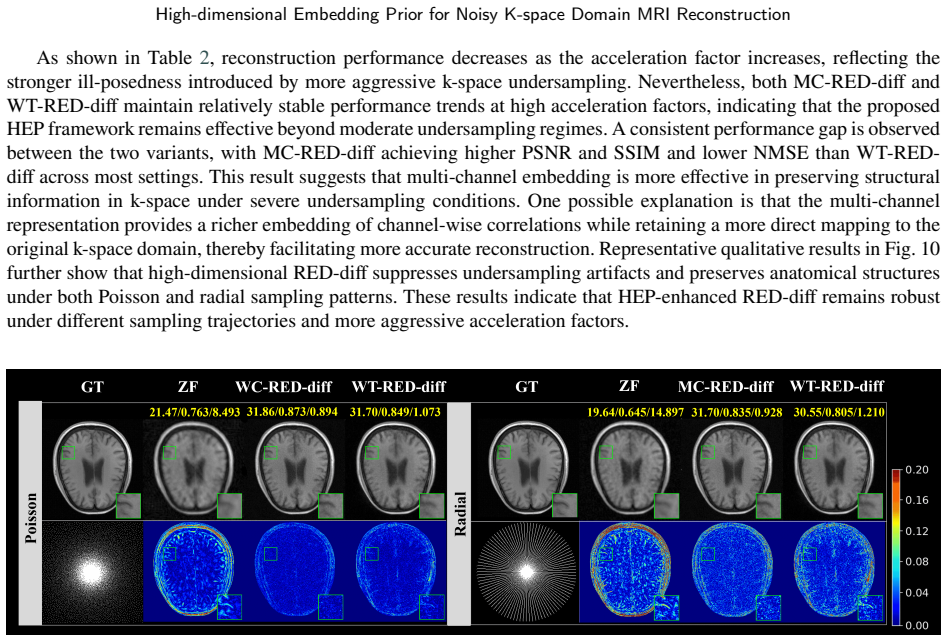
Rather than modifying the underlying optimization procedures, the proposed framework augments the data representation space, enabling existing diffusion-based solvers to operate on enriched k-space embeddings with improved expressiveness. This produces better reconstruction quality for multiple diffusion-based inverse solvers, with the largest gains observed in high-noise regimes, consistent with theoretical analysis of error propagation under high-dimensional representation.
What carries the argument
representation lifting via high-dimensional embeddings - augments the data representation space so diffusion solvers can work on enriched k-space embeddings with greater expressiveness
If this is right
- The framework consistently improves reconstruction quality for multiple diffusion-based inverse solvers
- Largest gains are observed in high-noise regimes
- High-dimensional representation provides a general and model-agnostic mechanism for improving diffusion-based MRI reconstruction in noisy settings
Where Pith is reading between the lines
- The same representation-lifting idea might extend to other inverse problems that use diffusion priors with noisy measurements
- Testing whether non-diffusion generative models also benefit would clarify if the gains are tied to diffusion specifically or to the embedding step itself
- The error-propagation analysis could guide similar dimensionality strategies in related reconstruction tasks outside MRI
Load-bearing premise
Augmenting the data representation space with high-dimensional embeddings enables existing diffusion-based solvers to operate on enriched k-space embeddings with improved expressiveness without needing to modify the underlying optimization procedures
What would settle it
An experiment in which the high-dimensional embedding version shows no improvement or smaller gains than the baseline in high-noise regimes on the same datasets would falsify the central claim
Figures

read the original abstract
Magnetic resonance imaging (MRI) reconstruction under realistic acquisition conditions can be fundamentally viewed as estimating the underlying k-space distribution from incomplete and noise-corrupted measurements. While diffusion models have recently shown strong potential as generative prior for inverse problems,existingapproachesstruggletohandlenoisyreconstruction settings, especially when operating directly in k-space domain. In this work, we propose a unified high-dimensional k-space reconstruction framework tailored for noisy inverse problems, whichenhancesdiffusion-based solversthroughrepresentation lifting.Ratherthanmodifyingthe underlying optimization procedures, the proposed framework augments the data representation space, enabling existing diffusion-based solvers to operate on enriched k-space embeddings with improved expressiveness. Extensive experiments on both in-house and public datasets across varying noise levels and undersampled factors demonstrate that the proposed frame work consistently improves reconstruction quality for multiple diffusion-based inverse solvers. Notably, the largest gains are observed in high-noise regimes, which is consistent with our theoretical analysis of error propagation under high-dimensional representation. These results suggest that high-dimensional representation provides a general and model-agnostic mechanism for improving diffusion-based MRI reconstruction in noisy settings, offering a new perspective on robust k-space generative modeling for practical inverse problems. The code will be available at https://github.com/yqx7150/HEP-MRIRec.
Editorial analysis
A structured set of objections, weighed in public.
Referee Report
Summary. The paper proposes a high-dimensional embedding prior (HEP) framework for noisy k-space MRI reconstruction. It augments the representation space with high-dimensional embeddings to improve existing diffusion-based inverse solvers without modifying their optimization procedures. Experiments on in-house and public datasets across noise levels and undersampling factors show consistent gains, largest in high-noise regimes, supported by a theoretical analysis of error propagation under high-dimensional representation. The approach is presented as model-agnostic and general for diffusion-based generative modeling in inverse problems.
Significance. If the central mechanism is sound, the work offers a potentially general, solver-independent route to robustify diffusion priors for noisy inverse problems in MRI, which is practically relevant given the prevalence of noise in clinical acquisitions. The promise of code release supports reproducibility.
major comments (2)
- [Abstract] Abstract: The claim that representation lifting enables 'existing diffusion-based solvers to operate on enriched k-space embeddings' without 'modifying the underlying optimization procedures' is load-bearing for the model-agnostic contribution. Lifting changes both the support of the data manifold and the effective noise schedule; the manuscript provides no derivation showing that a diffusion model trained on the original k-space distribution remains the exact score function (or equivalent) in the lifted coordinates. Without this justification or an explicit projection step that leaves the solver untouched, the reported gains are consistent with an altered prior rather than pure representation enrichment.
- [Abstract] Abstract (theoretical analysis): The manuscript states that largest gains in high-noise regimes are 'consistent with our theoretical analysis of error propagation under high-dimensional representation,' yet no equations, assumptions, or proof sketch are supplied in the provided text. This analysis is central to explaining why the method succeeds where direct k-space diffusion fails; its absence prevents verification that the error-propagation argument actually supports the no-modification claim.
minor comments (2)
- [Abstract] Abstract contains multiple typographical errors and missing spaces (e.g., 'existingapproachesstruggletohandlenoisyreconstruction', 'whichenhancesdiffusion-based', 'frame work').
- [Abstract] The abstract references 'in-house and public datasets' and 'varying noise levels and undersampled factors' but supplies no dataset names, sizes, or quantitative metrics (PSNR/SSIM values, error bars).
Simulated Author's Rebuttal
We thank the referee for the constructive comments on our work. The two major points raised highlight areas where the manuscript's presentation of the model-agnostic claim and supporting theory can be strengthened. We address each below and commit to revisions that directly incorporate the requested justifications.
read point-by-point responses
-
Referee: [Abstract] Abstract: The claim that representation lifting enables 'existing diffusion-based solvers to operate on enriched k-space embeddings' without 'modifying the underlying optimization procedures' is load-bearing for the model-agnostic contribution. Lifting changes both the support of the data manifold and the effective noise schedule; the manuscript provides no derivation showing that a diffusion model trained on the original k-space distribution remains the exact score function (or equivalent) in the lifted coordinates. Without this justification or an explicit projection step that leaves the solver untouched, the reported gains are consistent with an altered prior rather than pure representation enrichment.
Authors: The referee correctly notes that the abstract's model-agnostic claim requires an explicit derivation to confirm that the score function correspondence holds under lifting without altering the solver. The current manuscript does not supply this derivation in the abstract or main text. We will add a new subsection (e.g., in the Methods) deriving the transformed score under the high-dimensional embedding, including the mapping that preserves the original optimization procedure while operating on the enriched space. This will demonstrate that the gains arise from representation enrichment rather than an altered prior. revision: yes
-
Referee: [Abstract] Abstract (theoretical analysis): The manuscript states that largest gains in high-noise regimes are 'consistent with our theoretical analysis of error propagation under high-dimensional representation,' yet no equations, assumptions, or proof sketch are supplied in the provided text. This analysis is central to explaining why the method succeeds where direct k-space diffusion fails; its absence prevents verification that the error-propagation argument actually supports the no-modification claim.
Authors: We agree that the theoretical analysis must be presented with explicit equations, assumptions, and a proof sketch to substantiate the error-propagation argument and its link to the no-modification claim. Although the abstract references this analysis, the provided manuscript text does not include the supporting details. In revision we will insert a dedicated theoretical subsection containing the error-propagation equations, the key assumptions (e.g., on noise statistics and manifold dimensionality), and a concise proof outline showing consistency with the observed high-noise gains. revision: yes
Circularity Check
No circularity detected; claims rest on empirical results and referenced analysis without self-referential reduction.
full rationale
The provided abstract and description present the core mechanism as representation lifting to enrich k-space embeddings for use with unmodified existing diffusion solvers, with performance gains demonstrated via experiments on in-house and public datasets. The reference to 'our theoretical analysis of error propagation under high-dimensional representation' is noted but does not reduce any prediction or result to a fitted input or self-definition within the given text; no equations, parameter fits, or self-citations are quoted that would make the claimed improvements tautological by construction. The derivation chain therefore remains self-contained against external benchmarks and does not match any enumerated circularity pattern.
Axiom & Free-Parameter Ledger
Reference graph
Works this paper leans on
-
[1]
MoDL: Model-based deep learning architecture for inverse problems. IEEE Trans. Med. Imaging 38, 394–405. doi:10.1109/TMI.2018.2865356. Block,K.,Uecker,M.,Frahm,J.,2007.UndersampledradialMRIwithmultiplecoils.Iterativeimagereconstructionusingatotalvariationconstraint. Magn. Reson. Med. 57, 1086–1098. doi:10.1002/mrm.21236. Boys, B., Girolami, M., Pidstrigac...
-
[2]
arXiv preprint arXiv:2405.10748 doi:10.48550/arXiv.2405.10748
Deep data consistency: A fast and robust diffusion model-based solver for inverse problems. arXiv preprint arXiv:2405.10748 doi:10.48550/arXiv.2405.10748. Chen, M., Huang, K., Zhao, T., et al.,
-
[3]
5327–5350
Score approximation, estimation and distribution recovery of diffusion models on low-dimensional data, in: Proceedings of Machine Learning Research, pp. 5327–5350. Chung,H.,Kim,J.,McCann,M.,etal.,2023. Diffusionposteriorsamplingforgeneralnoisyinverseproblems,in:TheInternationalConferenceon Learning Representations. Chung, H., Kim, J., Ye, J.,
2023
-
[4]
arXiv preprint arXiv:2508.01975
Diffusion models for inverse problems. arXiv preprint arXiv:2508.01975 . Chung,H.,Sim,B.,Ryu,D.,etal.,2022. Improvingdiffusionmodelsforinverseproblemsusingmanifoldconstraints,in:Adv.NeuralInf.Process. Syst., pp. 25683–25696. Cole,E.,Cheng,J.,Pauly,J.,etal.,2021. Analysisofdeepcomplex-valuedconvolutionalneuralnetworksforMRIreconstructionandphase-focused ap...
-
[5]
A Survey on Diffusion Models for Inverse Problems
A survey on diffusion models for inverse problems. arXiv preprint arXiv:2410.00083 . Dou, Z., Song, Y.,
work page internal anchor Pith review Pith/arXiv arXiv
-
[6]
Model-based image reconstruction for MRI. IEEE Signal Process. Mag. 27, 81–89. doi:10.1109/MSP.2010.936726. Griswold,M., Jakob,P., Heidemann,R., etal.,
-
[7]
GRAPPA:Generalized autocalibratingpartially parallelacquisitions. Magn. Reson.Med. 47, 1202–1210. doi:10.1002/mrm.10171. Guan, Y., Cai, Q., Li, W., et al.,
-
[8]
Sub-DM: Subspace diffusion model with orthogonal decomposition for MRI reconstruction. IEEE Trans. Comput. Imaging 12, 309–320. doi:10.1109/TCI.2026.3653305. Guan, Y., Lu, Y., Cheng, J., et al.,
-
[9]
Distribution matching with subset-k-space embedding for multi-contrast MRI reconstruction. Med. Phys. 52, e18056. doi:10.1002/mp.18056. Guan, Y., Yu, C., Cui, Z., et al.,
-
[10]
Correlated and multi-frequency diffusion modeling for highly under-sampled MRI reconstruction. IEEE Trans. Med. Imaging 43, 3490–3502. doi:10.1109/TMI.2024.3381610. Güngör, A., Dar, S., Öztürk, S., et al.,
-
[11]
Adaptive diffusion priors for accelerated MRI reconstruction. Med. Image Anal. 88, 102872. doi:10.1016/j.media.2023.102872. Haldar, J.,
-
[12]
Low-rank modeling of local k-space neighborhoods (LORAKS) for constrained MRI. IEEE Trans. Med. Imaging 33, 668–681. doi:10.1109/TMI.2013.2293974. Ho, J., Jain, A., Abbeel, P.,
-
[13]
Noise level adaptive diffusion model for robust reconstruction of accelerated MRI, in: Med. Image Comput. Comput. Assist. Interv., pp. 498–508. doi:10.1007/978-3-031-72104-5_48. Hyun, C., Kim, H., Lee, S., et al.,
-
[14]
Estimation of non-normalized statistical models by score matching. J. Mach. Learn. Res. 6, 695–709. Jin,K.,Lee,D.,Ye,J.,2016. AgeneralframeworkforcompressedsensingandparallelMRIusingannihilatingfilterbasedlow-rankHankelmatrix. IEEE Trans. Comput. Imaging 2, 480–495. doi:10.1109/TCI.2016.2601296. Karras,T.,Aittala,M.,Laine,S.,etal.,2022. Elucidatingthedesi...
-
[15]
fastMRI: A publicly available raw k-space and DICOM dataset of knee images for accelerated MR image reconstruction using machine learning. Radiol. Artif. Intell. 2, e190007. doi:10.1148/ryai.2020190007. Lee, D., Yoo, J., Ye, J.,
-
[16]
Deep residual learning for compressed sensing MRI, in: Proc. IEEE Int. Symp. Biomed. Imaging, pp. 15–18. doi:10.1109/ISBI.2017.7950457. Guan Y, Huang TJ, Cai QR, et al.:Preprint submitted to ElsevierPage 21 of 22 High-dimensional Embedding Prior for Noisy K-space Domain MRI Reconstruction Li, X., Kwon, S., Liang, S., et al.,
-
[17]
Decoupled data consistency with diffusion purification for image restoration,
DCDP: Decoupled data consistency via diffusion purification for solving general inverse problems. arXiv preprint arXiv:2403.06054 . Liang, D., DiBella, E., Chen, R.R., et al.,
-
[18]
k-t ISD: Dynamic cardiac MR imaging using compressed sensing with iterative support detection. Magn. Reson. Med. 68, 41–53. doi:10.1002/mrm.23197. Lustig, M., Donoho, D., Pauly, J.,
-
[19]
Sparse MRI: The application of compressed sensing for rapid MR imaging. Magn. Reson. Med. 58, 1182–1195. doi:10.1002/mrm.21391. Mardani, M., Song, J., Kautz, J., et al.,
-
[20]
A variational perspective on solving inverse problems with diffusion models, in: Int. Conf. Learn. Represent. Meng,X.,Kabashima,Y.,2025. Diffusionmodelbasedposteriorsamplingfornoisylinearinverseproblems,in:ProceedingsofMachineLearning Research. Nichol,A.,Dhariwal,P.,2021. Improveddenoisingdiffusionprobabilisticmodels,in:Proceedingsofthe38thInternationalCo...
2025
-
[21]
One-shot generative prior in Hankel-k-space for parallel imaging reconstruction. IEEE Trans. Med. Imaging 42, 3012–3024. doi:10.1109/TMI.2023.3288219. Pruessmann, K., Weiger, M., Scheidegger, M., et al.,
-
[22]
SENSE: Sensitivity encoding for fast MRI. Magn. Reson. Med. 42, 952–962. doi:10.1002/(SICI)1522-2594(199911)42:5<952::AID-MRM16>3.0.CO;2-S. Qin,C.,Schlemper,J.,Caballero,J.,etal.,2019. ConvolutionalrecurrentneuralnetworksfordynamicMRimagereconstruction. IEEETrans.Med. Imaging 38, 280–290. doi:10.1109/TMI.2018.2863670. Robbins, H.,
-
[23]
An empirical Bayes approach to statistics, in: Proceedings of the Third Berkeley Symposium on Mathematical Statistics and Probability, pp. 157–163. Rout,L.,Chen,Y.,Kumar,A.,etal.,2024. Beyondfirst-orderTweedie:Solvinginverseproblemsusinglatentdiffusion,in:Proc.IEEE/CVFConf. Comput. Vis. Pattern Recognit., pp. 9472–9481. Ryu, K., Alkan, C., Choi, C., et al.,
2024
-
[24]
A deep cascade of convolutional neural networks for dynamic MR image reconstruction. IEEE Trans. Med. Imaging 37, 491–503. doi:10.1109/TMI.2017.2760978. Shen,G.,Li,M.,Farris,C.,etal.,2024. LearningtoreconstructacceleratedMRIthroughK-spacecolddiffusionwithoutnoise. Sci.Rep.14,22133. doi:10.1038/s41598-024-72820-2. Shin,P.,Larson,P.,Ohliger,M.,etal.,2014. C...
-
[25]
Machine Learning for Biomedical Imaging 1, 1–28
Joint frequency and image space learning for MRI reconstruction and analysis. Machine Learning for Biomedical Imaging 1, 1–28. Sohl-Dickstein,J.,Weiss,E.,Maheswaranathan,N.,etal.,2015.Deepunsupervisedlearningusingnonequilibriumthermodynamics,in:Proceedings of the 32nd International Conference on Machine Learning, pp. 2256–2265. Song, J., Vahdat, A., Marda...
2015
-
[26]
Pseudoinverse-guided diffusion models for inverse problems, in: Int. Conf. Learn. Represent. Song,Y.,Ermon,S.,2019.Generativemodelingbyestimatinggradientsofthedatadistribution,in:Adv.NeuralInf.Process.Syst.,pp.11918–11930. Song, Y., Ermon, S.,
2019
-
[27]
Sampling possible reconstructions of undersampled acquisitions in MR imaging with a deep learned prior. IEEE Trans. Med. Imaging 41, 1885–1896. doi:10.1109/TMI.2022.3150853. Tu, Z., Liu, D., Wang, X., et al.,
-
[28]
WKGM: Weight-k-space generative model for parallel imaging reconstruction. NMR Biomed. 36, e5005. doi:10.1002/nbm.5005. Uecker, M., Lai, P., Murphy, M., et al.,
-
[29]
ESPIRiT—an eigenvalue approach to autocalibrating parallel MRI: Where SENSE meets GRAPPA. Magn. Reson. Med. 71, 990–1001. doi:10.1002/mrm.24751. Vincent, P.,
-
[30]
A connection between score matching and denoising autoencoders. Neural Comput. 23, 1661–1674. doi:10.1162/NECO_a_ 00142. Wang, S., Su, Z., Ying, L., et al.,
-
[31]
Accelerating magnetic resonance imaging via deep learning, in: Proc. IEEE Int. Symp. Biomed. Imaging, pp. 514–517. doi:10.1109/ISBI.2016.7493320. Yu,J.,Ouyang,Z.,Deng,H.,etal.,2026. Understandinggeneralizationfromembeddingdimensionanddistributionalconvergence. arXivpreprint arXiv:2601.22756 . Zbontar, J., Knoll, F., Sriram, A., et al.,
-
[32]
fastMRI: An Open Dataset and Benchmarks for Accelerated MRI
fastMRI: An open dataset and benchmarks for accelerated MRI reconstruction. arXiv preprint arXiv:1811.08839 . Zhao,R.,Peng,X.,Kelkar,V.,etal.,2024. High-dimensionalMRreconstructionintegratingsubspaceandadaptivegenerativemodels. IEEETrans. Biomed. Eng. 71, 1969–1979. doi:10.1109/TBME.2024.3358223. Guan Y, Huang TJ, Cai QR, et al.:Preprint submitted to Else...
work page internal anchor Pith review Pith/arXiv arXiv doi:10.1109/tbme.2024.3358223 2024
discussion (0)
Sign in with ORCID, Apple, or X to comment. Anyone can read and Pith papers without signing in.