REVIEW 2 major objections 4 minor 29 references
Prompt Framing Distorts Count Based Evaluation of LLM Error Detection: Evidence from Numeric Anchoring
T0 review · 2 major / 4 minor · reviewed 2026-08-02 · deepseek-v4-flash
Pith's one-line read Stating the expected error count in a prompt raises count-based F1 by 0.22 while true edit-level detection rises by only 0.04.
desk verdict A well-designed stress test showing prompt-supplied error counts inflate count-based F1 far more than span-level metrics, though the exact magnitude is pipeline-sensitive and the posted abstract overstates the raw gap. read the letter →
The pith
A machine-rendered reading of the paper's core claim, the machinery that carries it, and where it could break.
The reading
What carries the argument
The central mechanism is the prompt-supplied numeric anchor: a single sentence ('This text contains exactly N errors') that the model treats as a target. The count-based F1 metric then scores the model against the very number the prompt provided, so agreement can be placed in the prompt rather than earned by the model. The paper isolates this by comparing Blind, Informed, Anchored, and two Misleading count conditions on identical passages, and corroborates it with an ERRANT-based edit score that measures span-level localization.
What would settle it
Re-run the 83-passage Blind→Anchored experiment with multiple temperature-0 draws per cell through a direct, verifiable API route. If the mean Count-F1 gain no longer exceeds the mean ERRANT F0.5 gain by a margin comparable to the reported 0.218 vs 0.042, or if the bootstrap contrast crosses zero, the central claim fails. A pre-registered replication using the official M2 scorer rather than custom matching would test whether the gap survives standard evaluation tooling.
Extended reading notes
Core claim
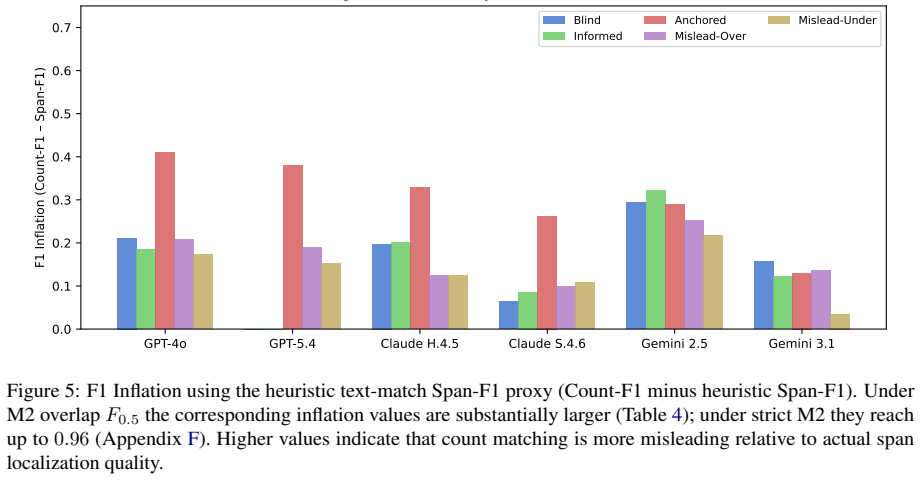
The paper's central discovery is that count-overlap F1 is a compliance metric as much as a detection metric: when a prompt states 'this text has exactly N errors,' the model's reported count tracks N, and Count-F1 approaches 0.99–1.00, while the corresponding improvement in edit-level localization (measured by ERRANT F0.5 against two references) is roughly five times smaller. The quantitative anchor is the Blind→Anchored contrast: on 83 corrected-text passages, Count-F1 rises by 0.218 on average, edit F0.5 by 0.042, with a paired bootstrap contrast above zero for five of six models. The paper frames this as 'F1 Inflation' — the apparent score gain is an artifact of the prompt, not improved d
Load-bearing premise
The central contrast assumes that one temperature-0 inference per cell, delivered through a third-party API proxy, is a faithful sample of each model's behavior, and that treating missing corrected-text blocks as empty predictions does not unfairly tilt the edit-score comparison.
Editorial extensions
If this is right
- LLM proofreading and document-review evaluations should stop putting expected error counts in prompts; doing so turns count metrics into measures of instruction-following.
- Count-F1 and exact-count accuracy should be reported as auxiliary calibration metrics, not as evidence of detection quality.
- Evaluations should pair count metrics with span-aware scores (M2, ERRANT, or equivalent) to avoid inflated conclusions.
- Deployed review systems should monitor how often outputs reproduce counts supplied by users or templates, since this behavior can mask real detection failures.
Reading between the lines
- A natural next experiment is a dose–response curve: varying the supplied count by more than ±2 would show whether the reported count follows the anchor linearly or saturates; the paper's Mislead conditions only test ±2.
- The small count response of the Gemini family may reflect a stronger undercount prior rather than resistance to anchoring; the paper itself flags this confound. A follow-up using balanced priors could separate compliance from prior.
- If the inflation pattern transfers beyond grammar error detection, count-based accuracy in other audit tasks (code-review defect counts, factual error counts) may also be inflated by prompts that state expected numbers.
Signed reviews
Editorial analysis
A structured set of objections, weighed in public.
Referee Report
Summary. ErrorBench tests whether a supplied error count distorts count-based evaluation of LLM error detection. The paper runs six LLMs over five prompt conditions on 123 retained CoNLL-2014 passages (plus an 83-passage corrected-text replication), holding passages fixed while varying the stated count from Blind to Anchored to Mislead-Over/Under. It reports that Mislead-Over versus Mislead-Under moves reported counts by 82–94% of the four-error prompt difference for GPT/Claude models and by only 0.14–0.21 for Gemini models; that Anchored prompts push Count-F1 near 1.0; and that in the replication Blind→Anchored raises Count-F1 by 0.218 on average while a two-reference ERRANT-based edit F0.5 rises by only 0.042, with a paired-bootstrap contrast above zero for five of six models. The paper concludes that count agreement supplied by the prompt is not evidence of better localization and recommends blind prompts plus span-aware metrics.
Significance. If the empirical estimates hold, this is a useful and practical evaluation-methodology result: it demonstrates a concrete failure mode in count-based LLM proofreading evaluation and gives actionable safeguards. The study has genuine strengths: paired within-passage prompt contrasts, BH correction, a seeded paired bootstrap, a second evaluation path using ERRANT, a documented two-reference sensitivity rule, and an unusually candid Limitations section. The paper is transparent about the custom nature of its span scoring and about missing-output policies. However, the paper's central quantitative claim—that prompt-supplied counts inflate Count-F1 without commensurate localization gains—depends on an edit-scoring pipeline whose model-level conclusions are not fully corroborated by the paper's own alternative pipeline. The manuscript therefore needs a targeted rescoring or a substantial tempering of the claim, but the underlying evaluation-design warning is defensible.
major comments (2)
- [§4.6, Table 12, Limitations] The load-bearing estimate—Blind→Anchored raises Count-F1 by 0.218 but edit F0.5 by only 0.042—uses a custom exact-tuple matcher with per-sentence higher-F0.5 reference selection, explicitly 'not the official M2 max-match procedure.' Exact-tuple matching is stricter than official ERRANT/M2 alignment and could miss Anchored-condition edits that match a reference under max-match scoring. The paper's own description-derived pipeline (Table 10) already disagrees at the model level: for Claude Sonnet 4.6, Blind→Anchored changes Count-F1 by +0.235 and overlap F0.5 by +0.232, i.e., essentially no inflation gap. Please rescore the 83-passage outputs with official ERRANT multi-reference scoring and report model-level contrasts, or restrict the abstract's 'without commensurate localization' claim to the custom scoring pipeline.
- [§A.5, Table 13] Missing corrected-text blocks are scored as empty predictions, and this policy is strongly asymmetric for Gemini 2.5: 23/83 Blind cells are missing but 44/83 Anchored cells are missing. This mechanically lowers Anchored edit F0.5 for that model, inflating both its count-vs-edit contrast and the six-model average reported in the abstract. The bootstrap contrast for Gemini 2.5 (+0.156, CI [0.080, 0.240]) may be partly an artifact of this asymmetry. Please report the average and per-model contrasts with Gemini 2.5 excluded, and/or with missing blocks treated as missing rather than empty, to show the headline +0.218/+0.042 gap is not driven by the asymmetric omission pattern.
minor comments (4)
- [Introduction] 'whicherrors' is missing a space ('which errors').
- [§4.5, Table 4 caption] The caption reads 'M2F0.5' but the metric is 'description-derived M2-style'; adding 'description-derived' avoids implying the official CoNLL-2014 M2 scorer.
- [§4.2] The sentence 'The high count is repeated exactly in 93–100% of GPT/Claude outputs and 0% of Gemini outputs' is computed from one temperature-0 inference per cell through a proxy. This should be phrased as 'in this protocol's single-sample outputs' to avoid overstating run-to-run stability.
- [§3.1 / §4.6] 'Path B' is used without definition; define it at first mention (the corrected-text replication) rather than only in the appendix.
Circularity Check
No significant circularity; the definitional role of the prompt is stated openly and the load-bearing empirical contrast is independent.
full rationale
The paper's central claim is an empirical demonstration that Count-F1 can be inflated by supplying the reference count in the prompt. The only definitional relationship is that Count-F1 is scored against N (Section 3.4: 'Count-F1 uses count overlap without span matching: TPi = min(ˆNi, Ni)...') and the Anchored prompt states N (Table 1). The paper explicitly concedes this in §4.1: 'Near-perfect Anchored Count-F1 is partly built into the prompt.' This admission means the definitional component is a transparent premise of the stress test, not a hidden equivalence presented as a prediction. The load-bearing empirical quantity is the Blind→Anchored contrast between Count-F1 (+0.218) and ERRANT-based edit F0.5 (+0.042) in the 83-passage replication (§4.6), which does not reduce to the metric definition. The two-reference exact-tuple scorer and missing-output policy are methodological choices that create correctness risk, but they are not circular: they do not define the outcome in terms of the input. No parameter is fitted and then renamed as a prediction, and no load-bearing self-citation or imported uniqueness theorem appears. The paper is self-contained as an evaluation-failure audit, so circularity score is 0.
Assumptions & free parameters
free parameters (2)
- Anchor offset magnitude (±2) =
N+2 / max(1,N−2)
- Per-sentence higher-F0.5 reference selection =
max over Annotators 0/1, per sentence
assumptions (5)
- domain assumption CoNLL-2014 Annotator 0 counts and gold edits are ground truth for error detection quality
- domain assumption The OpenAI-compatible proxy served the named models (GPT-4o, GPT-5.4, Claude Haiku 4.5, etc.)
- domain assumption One temperature-0 inference per cell is representative of model behavior
- domain assumption Description-derived M2-style tuples and ERRANT edits capture localization quality
- domain assumption Metric-change contrasts (ΔCount-F1 vs Δedit F0.5) are commensurate enough to support 'inflation' claims
invented entities (4)
-
F1 Inflation
independent evidence
-
Anchoring Sensitivity Index (ASI)
independent evidence
-
count–span gap
independent evidence
-
ErrorBench
independent evidence
Cite this review
Pith. "Pith review of Prompt Framing Distorts Count Based Evaluation of LLM Error Detection: Evidence from Numeric Anchoring." pith.science (2026). https://pith.science/paper/7I53SCW7
@misc{pith2026260701240,
  author       = {Pith},
  title        = {Pith review of: Prompt Framing Distorts Count Based Evaluation of LLM Error Detection: Evidence from Numeric Anchoring},
  year         = {2026},
  howpublished = {\url{https://pith.science/paper/7I53SCW7}},
  note         = {Machine review of arXiv:2607.01240}
}
read the original abstract
Count-based F1 is widely used as a proxy for LLM error-detection quality, but this paper shows that it can rise dramatically without a corresponding improvement in span localization, a gap termed F1 Inflation. The paper introduces ErrorBench, a controlled stress-test protocol for prompt-induced count distortion. ErrorBench evaluates six contemporary LLMs under five prompt conditions over 4,290 responses from 143 CoNLL-2014 passages. Under CoNLL-2014 M2-style scoring, anchored prompts produce up to 0.79 points of F1 Inflation, and up to 0.96 under strict matching. A 100-passage replication using the official ERRANT 3.0.0 pipeline and multi-reference scoring reproduces the pattern: averaged over six models, the Blind-to-Anchored prompt shift raises Count-F1 by +0.21 while raising multi-reference ERRANT F0.5 by only +0.04. The study finds larger count responses in highly instruction-compliant GPT/Claude systems and smaller responses in the Gemini family under this stress-test protocol. The findings suggest that LLM proofreading and document-review evaluations should avoid pre-populated error counts and should report span-aware metrics alongside count-based metrics.
Figures


Figures from the paper (8 more)




Reference graph
Works this paper leans on
-
[1]
Proceedings of the Eighteenth Conference on Computational Natural Language Learning: Shared Task , year =
Ng, Hwee Tou and Wu, Siew Mei and Briscoe, Ted and Hadiwinoto, Christian and Susanto, Raymond Hendy and Bryant, Christopher , title =. Proceedings of the Eighteenth Conference on Computational Natural Language Learning: Shared Task , year =
-
[2]
Bryant, Christopher and Felice, Mariano and Andersen,. The. Proceedings of the Fourteenth Workshop on Innovative Use of NLP for Building Educational Applications , year =
-
[3]
Computational Linguistics , year =
Bryant, Christopher and Yuan, Zheng and Qorib, Muhammad Reza and Cao, Hannan and Ng, Hwee Tou and Briscoe, Ted , title =. Computational Linguistics , year =
-
[4]
Proceedings of the 55th Annual Meeting of the Association for Computational Linguistics (Volume 1: Long Papers) , year =
Bryant, Christopher and Felice, Mariano and Briscoe, Ted , title =. Proceedings of the 55th Annual Meeting of the Association for Computational Linguistics (Volume 1: Long Papers) , year =
-
[5]
Claude Haiku 4.5 System Card , year =
-
[6]
Claude Sonnet 4.6 System Card , year =
-
[7]
, title =
Liu, Ryan and Shah, Nihar B. , title =. 2023 , eprint =
2023
-
[8]
and Hu, Jinpeng and Chao, Lidia S
Fang, Tao and Yang, Shu and Lan, Kaixin and Wong, Derek F. and Hu, Jinpeng and Chao, Lidia S. and Zhang, Yue , title =. 2023 , eprint =
2023
Show all 29 references
-
[9]
Humanities and Social Sciences Communications , year =
Checco, Alessandro and Bracciale, Lorenzo and Loreti, Pierpaolo and Pinfield, Stephen and Bianchi, Giuseppe , title =. Humanities and Social Sciences Communications , year =
-
[10]
Proceedings of the 61st Annual Meeting of the Association for Computational Linguistics (Volume 1: Long Papers) , year =
Dycke, Nils and Kuznetsov, Ilia and Gurevych, Iryna , title =. Proceedings of the 61st Annual Meeting of the Association for Computational Linguistics (Volume 1: Long Papers) , year =
-
[11]
Proceedings of the 38th International Conference on Machine Learning , year =
Zhao, Zihao and Wallace, Eric and Feng, Shi and Klein, Dan and Singh, Sameer , title =. Proceedings of the 38th International Conference on Machine Learning , year =
-
[12]
Proceedings of the 60th Annual Meeting of the Association for Computational Linguistics (Volume 1: Long Papers) , year =
Lu, Yao and Bartolo, Max and Moore, Alastair and Riedel, Sebastian and Stenetorp, Pontus , title =. Proceedings of the 60th Annual Meeting of the Association for Computational Linguistics (Volume 1: Long Papers) , year =
-
[13]
Proceedings of the 2022 Conference on Empirical Methods in Natural Language Processing , year =
Min, Sewon and Lyu, Xinxi and Holtzman, Ari and Artetxe, Mikel and Lewis, Mike and Hajishirzi, Hannaneh and Zettlemoyer, Luke , title =. Proceedings of the 2022 Conference on Empirical Methods in Natural Language Processing , year =
2022
-
[14]
Discovering Language Model Behaviors with Model-Written Evaluations , booktitle =
Perez, Ethan and Ringer, Sam and Luko. Discovering Language Model Behaviors with Model-Written Evaluations , booktitle =. 2023 , pages =
2023
-
[15]
and Durmus, Esin and Hatfield-Dodds, Zac and Johnston, Scott R
Sharma, Mrinank and Tong, Meg and Korbak, Tomasz and Duvenaud, David and Askell, Amanda and Bowman, Samuel R. and Durmus, Esin and Hatfield-Dodds, Zac and Johnston, Scott R. and Kravec, Shauna M. and Maxwell, Timothy and McCandlish, Sam and Ndousse, Kamal and Rausch, Oliver an...
-
[16]
Science , year =
Tversky, Amos and Kahneman, Daniel , title =. Science , year =
-
[17]
2024 , howpublished =
2024
-
[18]
2026 , howpublished =
2026
-
[19]
Gemini 2.5 Flash , year =
-
[20]
Psychological Science , year =
Epley, Nicholas and Gilovich, Thomas , title =. Psychological Science , year =
-
[21]
Royal Society Open Science , year =
Macmillan-Scott, Olivia and Musolesi, Mirco , title =. Royal Society Open Science , year =
-
[22]
and Zhang, Xiangliang , title =
Ye, Jiayi and Wang, Yanbo and Huang, Yue and Chen, Dongping and Zhang, Qihui and Moniz, Nuno and Gao, Tian and Geyer, Werner and Huang, Chao and Chen, Pin-Yu and Chawla, Nitesh V. and Zhang, Xiangliang , title =. The Thirteenth International Conference on Learning Representati...
-
[23]
, title =
Nguyen, Jeremy K. , title =. Journal of Behavioral and Experimental Finance , volume =. 2024 , doi =
2024
-
[24]
2025 , eprint =
Huang, Yiming and Bie, Biquan and Na, Zuqiu and Ruan, Weilin and Lei, Songxin and Yue, Yutao and He, Xinlei , title =. 2025 , eprint =
2025
-
[25]
Journal of Computational Social Science , volume =
Lou, Jiaxu and Sun, Yifan , title =. Journal of Computational Social Science , volume =. 2026 , doi =
2026
-
[26]
and Feldman, Naomi H
Owusu, Hillary N. and Feldman, Naomi H. , title =. Proceedings of the 64th Annual Meeting of the Association for Computational Linguistics (Volume 2: Short Papers) , pages =. 2026 , address =. doi:10.18653/v1/2026.acl-short.16 , url =
2026 doi
-
[27]
Gemini 3.1 Pro Preview , year =
-
[28]
Overview of the
Ben Abacha, Asma and Yim, Wen-wai and Fu, Yujuan and Sun, Zhaoyi and Xia, Fei and Yetisgen, Meliha , booktitle =. Overview of the. 2024 , address =. doi:10.18653/v1/2024.clinicalnlp-1.57 , url =
2024 doi
-
[29]
and Alex, Beatrice , booktitle =
Gema, Aryo and Lee, Chaeeun and Minervini, Pasquale and Daines, Luke and Simpson, T. and Alex, Beatrice , booktitle =. 2024 , address =. doi:10.18653/v1/2024.clinicalnlp-1.49 , url =
2024 doi
Reviewed August 2, 2026 · model on record in the stance chip above.
Discussion (0). Continue with ORCID to comment.