CheckRLM: Effective Knowledge-Thought Coherence Checking in Retrieval-Augmented Reasoning
Pith reviewed 2026-07-03 14:23 UTC · model grok-4.3
The pith
CheckRLM extracts factual claims from reasoning chains to detect and correct knowledge inconsistencies via retrieval, preventing error buildup.
A machine-rendered reading of the paper's core claim, the machinery that carries it, and where it could break.
Core claim
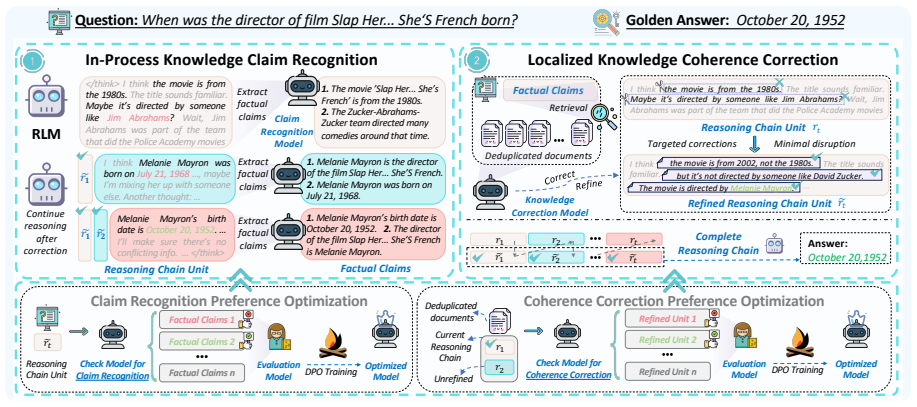
CheckRLM extracts factual claims from the reasoning chain to identify and localize subtle knowledge inconsistencies during inference. Upon detection of errors, a refinement mechanism performs minimal-cost yet precise corrections by leveraging external knowledge, ensuring coherence between the reasoning chain and correct knowledge.
What carries the argument
The CheckRLM framework, which extracts factual claims from the ongoing reasoning chain, localizes mismatches against retrieved knowledge, and applies minimal refinements to restore coherence.
If this is right
- Existing baselines are outperformed on tasks that require long reasoning chains.
- Error accumulation is reduced because inconsistencies are caught and fixed during inference rather than after the fact.
- Computational cost stays lower because corrections target only the mismatched claims instead of regenerating entire chains.
- Reliability improves on knowledge-intensive problems without requiring changes to the underlying model.
Where Pith is reading between the lines
- The same claim-extraction step could be applied to other generation settings where factual drift occurs over multiple sentences.
- Integration with stronger retrieval systems might further reduce the remaining uncorrected errors on edge cases.
- If claim extraction proves brittle on certain reasoning styles, hybrid approaches that also monitor intermediate conclusions could be explored.
Load-bearing premise
Factual claims can be reliably extracted from the reasoning chain and mismatches with external knowledge can be localized and corrected precisely without introducing new inconsistencies or altering the overall path.
What would settle it
A concrete test on a multi-step knowledge task where the system either misses an injected factual error that later invalidates the conclusion or applies a correction that forces a different reasoning branch than the original chain intended.
Figures


read the original abstract
Reasoning Language Models (RLMs) have significantly improved performance on complex tasks by extending the reasoning chain. However, these chains are prone to containing factual errors, particularly in knowledge-intensive tasks. To address this issue, we propose CheckRLM, a framework that improves the reliability of the reasoning process through Retrieval-Augmented Generation (RAG) by timely checking and correcting factual errors. Specifically, CheckRLM extracts factual claims from the reasoning chain to identify and localize subtle knowledge inconsistencies during inference. Upon detection of errors, a refinement mechanism performs minimal-cost yet precise corrections by leveraging external knowledge, ensuring coherence between the reasoning chain and correct knowledge. Extensive experiments demonstrate that CheckRLM substantially outperforms existing baselines, exhibiting a strong capability to mitigate error accumulation in long-horizon reasoning with lower costs. The code and data are available at https://github.com/AI9Stars/CheckRLM.
Editorial analysis
A structured set of objections, weighed in public.
Referee Report
Summary. The manuscript proposes CheckRLM, a RAG-based framework for RLMs that extracts factual claims from reasoning chains, localizes knowledge inconsistencies during inference, and applies minimal-cost corrections via external knowledge to maintain coherence. The central empirical claim is that extensive experiments show substantial outperformance over baselines in mitigating error accumulation for long-horizon reasoning at lower cost; code and data are released.
Significance. If the extraction, localization, and correction steps prove reliable, the approach could reduce factual error propagation in extended reasoning traces while controlling overhead, addressing a practical limitation in knowledge-intensive RLM use cases. Open-sourcing of code and data is a clear strength for reproducibility.
major comments (2)
- [Abstract] Abstract: the claim that 'extensive experiments demonstrate that CheckRLM substantially outperforms existing baselines' supplies no experimental design, baselines, metrics, ablation results, or quantitative findings, so it is impossible to determine whether the data support the stated claim.
- [Method] Method description (implied by abstract): the assumption that factual claims can be reliably extracted from the reasoning chain and that mismatches with external knowledge can be localized and corrected precisely without introducing new inconsistencies is unverified; this extraction step is load-bearing for the error-accumulation mitigation result and is known to be brittle for implicit or multi-hop facts.
Simulated Author's Rebuttal
We thank the referee for the constructive feedback. We address each major comment below and indicate planned revisions to the manuscript.
read point-by-point responses
-
Referee: [Abstract] Abstract: the claim that 'extensive experiments demonstrate that CheckRLM substantially outperforms existing baselines' supplies no experimental design, baselines, metrics, ablation results, or quantitative findings, so it is impossible to determine whether the data support the stated claim.
Authors: We agree that the abstract is high-level and does not enumerate experimental details. The full manuscript contains these in the Experiments section (baselines, metrics such as accuracy and error reduction, ablations, and quantitative results). We will revise the abstract to incorporate brief references to key quantitative findings and the experimental scope while respecting length limits. revision: yes
-
Referee: [Method] Method description (implied by abstract): the assumption that factual claims can be reliably extracted from the reasoning chain and that mismatches with external knowledge can be localized and corrected precisely without introducing new inconsistencies is unverified; this extraction step is load-bearing for the error-accumulation mitigation result and is known to be brittle for implicit or multi-hop facts.
Authors: The claim extraction and localization steps are central, and the manuscript reports overall empirical gains from the full pipeline. We acknowledge that a more targeted verification of extraction reliability (especially for implicit or multi-hop facts) is warranted and was not separately quantified. We will add an analysis or ablation evaluating extraction accuracy and its impact on correction quality. revision: yes
Circularity Check
No circularity; empirical framework with no derivations, fitted predictions, or load-bearing self-citations.
full rationale
The paper describes CheckRLM as a procedural RAG-based framework for extracting factual claims from reasoning chains, detecting inconsistencies, and applying minimal corrections. The central claim rests on experimental outperformance rather than any mathematical derivation or first-principles result. No equations appear, no parameters are fitted to subsets of data and then relabeled as predictions, and no self-citation chain is invoked to justify uniqueness or force the method. The extraction and correction steps are presented as engineering choices validated empirically, not as tautological reductions to inputs. This is the common case of a self-contained empirical contribution with no detectable circularity.
Axiom & Free-Parameter Ledger
axioms (2)
- domain assumption Reasoning Language Models generate chains prone to factual errors in knowledge-intensive tasks
- domain assumption Retrieval-augmented generation supplies external knowledge sufficient to detect and correct factual inconsistencies
invented entities (1)
-
CheckRLM framework
no independent evidence
Reference graph
Works this paper leans on
-
[1]
Coordinating search-informed reasoning and reasoning-guided search in claim verification.arXiv preprint arXiv:2506.07528. Gautier Izacard, Patrick Lewis, Maria Lomeli, Lucas Hosseini, Fabio Petroni, Timo Schick, Jane Dwivedi- Yu, Armand Joulin, Sebastian Riedel, and Edouard 9 Grave. 2023. Atlas: Few-shot learning with retrieval augmented language models.J...
-
[2]
ZeroSearch: Incentivize the Search Capability of LLMs without Searching
Direct preference optimization: Your language model is secretly a reward model.Advances in neural information processing systems, 36:53728–53741. Ori Ram, Yoav Levine, Itay Dalmedigos, Dor Muhlgay, Amnon Shashua, Kevin Leyton-Brown, and Yoav Shoham. 2023. In-context retrieval-augmented lan- guage models.Transactions of the Association for Computational Li...
work page internal anchor Pith review Pith/arXiv arXiv 2023
-
[3]
C-Pack: Packed Resources For General Chinese Embeddings
Large language models are better reasoners with self-verification. InFindings of the Association for Computational Linguistics: EMNLP 2023, pages 2550–2575. Shitao Xiao, Zheng Liu, Peitian Zhang, and Niklas Muennighoff. 2023. C-pack: Packaged resources to advance general chinese embedding.Preprint, arXiv:2309.07597. Guangzhi Xiong, Qiao Jin, Xiao Wang, Yi...
work page internal anchor Pith review Pith/arXiv arXiv 2023
-
[4]
Supervising the search process produces reliable and generalizable information-seeking agents
Rag-gym: Optimizing reasoning and search agents with process supervision.arXiv preprint arXiv:2502.13957. An Yang, Anfeng Li, Baosong Yang, Beichen Zhang, Binyuan Hui, Bo Zheng, Bowen Yu, Chang Gao, Chengen Huang, Chenxu Lv, and 1 others
work page internal anchor Pith review Pith/arXiv arXiv
-
[5]
Qwen3 technical report.arXiv preprint arXiv:2505.09388. An Yang, Baosong Yang, Beichen Zhang, Binyuan Hui, Bo Zheng, Bowen Yu, Chengyuan Li, Dayiheng Liu, Fei Huang, Haoran Wei, Huan Lin, Jian Yang, Jian- hong Tu, Jianwei Zhang, Jianxin Yang, Jiaxi Yang, Jingren Zhou, Junyang Lin, Kai Dang, and 22 oth- ers. 2024. Qwen2.5 technical report.arXiv preprint ar...
work page internal anchor Pith review Pith/arXiv arXiv 2024
-
[6]
Shunyu Yao, Jeffrey Zhao, Dian Yu, Nan Du, Izhak Shafran, Karthik R Narasimhan, and Yuan Cao
Tree of thoughts: Deliberate problem solving with large language models.Advances in neural information processing systems, 36:11809–11822. Shunyu Yao, Jeffrey Zhao, Dian Yu, Nan Du, Izhak Shafran, Karthik R Narasimhan, and Yuan Cao. 2022. React: Synergizing reasoning and acting in language models. InThe eleventh international conference on learning repres...
2022
-
[7]
Are reasoning models more prone to halluci- nation?arXiv preprint arXiv:2505.23646. Michihiro Yasunaga, Xinyun Chen, Yujia Li, Panupong Pasupat, Jure Leskovec, Percy Liang, Ed H. Chi, and Denny Zhou. 2024. Large language models as analogical reasoners. InInternational Conference on Learning Representations, volume 2024, pages 17019–17045. Duzhen Zhang, Zh...
-
[8]
If the factual information in the Reasoning Process is correct, only output the original Reasoning Process
-
[9]
If the factual information in the Reasoning Process is incorrect, make the minimal necessary corrections to fix the error without altering the structure or flow of the Reasoning Process
-
[10]
NEVER add any supplementary information from the re- trieved documents
If the retrieved documents do not contain any relevant information, only output the original Reasoning Process. NEVER add any supplementary information from the re- trieved documents. Only correct factual errors when nec- essary. Only give me your modified reasoning process and do not output any other words. Retrieved documents: {refs} Reasoning Process: ...
-
[11]
original think
Examine the “original think” and “refine think” content of each step one by one
-
[12]
original think
If “original think” content contains the key step from the correct reasoning chain, output the correct reasoning step number and -1
-
[13]
refine think
If the “refine think” content contains any key step from the correct reasoning chain, output the correct reasoning step number and the step number of the modified content
-
[14]
Output Rules:
If multiple steps contain the same key step, only record the earliest occurrence. Output Rules:
-
[15]
Correct Reasoning Step Number
Output format: [{“Correct Reasoning Step Number”: “First Modefied Number”}]
-
[16]
Only output the list
Do not include any explanations or additional text. Only output the list. Input: Question: {query} Correct Reasoning Chains: {golden_reasoning_steps} Modification Records: {think_refine_detail} B.5 DPO Evaluation Prompt Knowledge Claim Recognition Evaluation Prompt Task: Evaluate factual claim lists generated based on a Reasoning Process and Question. You...
-
[17]
there is no related information
Relevance: each factual claim in the factual claim list is relevant to the Question and Reasoning Process, note that if there is no factual claim in Reasoning Process, just output [] but not similar sentences such as “there is no related information” or “the reasoning process does not contain any factual claim”
-
[18]
Specificity: each factual claim in the factual claim list is clear, avoiding unclear pronoun
-
[19]
Output Rules:
No redundancy: The correct factual claim list format is just one list of strings, no multiple lists or explanatory Notes. Output Rules:
-
[20]
best_id”: <id of the factual claim list that fully meets all Quality criteria above>, “worst_id
JSON format: {“best_id”: <id of the factual claim list that fully meets all Quality criteria above>, “worst_id”: <id of the factual claim list that violates the most Quality criteria>}
-
[21]
If there is a minimal quality difference between the best factual claim list and the worst factual claim list or there is no worst factual claim, assign the same id to both best_id and worst_id
-
[22]
If no factual claim list meets all the Quality criteria above, return an empty object {}
-
[23]
Do not include any explanations or additional text. Question: {question} Reasoning Process: {reasoning} Generated factual claim lists: {check_responses} 14 Knowledge Coherence Correction Evalua- tion Prompt Task: Evaluate refined reasoning processes based on quality criteria strictly and identify the best and the worst refined reasoning processes. Quality...
-
[24]
the retrieved documents do not contain related information
Structural Integrity: strictly preserves the original rea- soning process structure. Do not add any other supplement information at the end of the original reasoning process, even if the supplement information is right. The refined reasoning process contains negative sentences such as “the retrieved documents do not contain related information” is the worst
-
[25]
Precise Corrections: Only modifies factually incorrect content verified by retrieved documents
-
[26]
According to the retrieved documents
Conciseness: No redundant text in the refined reasoning process, including unnecessary prefixes, explanatory Notes, and continuation after the original reasoning process, such as “According to the retrieved documents”. Output Rules:
-
[27]
best_id”: <id of the refined rea- soning process that fully meets all Evaluation Criteria>, “worst_id
JSON format: {“best_id”: <id of the refined rea- soning process that fully meets all Evaluation Criteria>, “worst_id”: <id of the refined reasoning process that vio- lates the most Quality criteria>}
-
[28]
If there is a minimal quality difference between the best reasoning process and the worst reasoning process or there is no worst refined reasoning process, assign the same id to both best_id and worst_id
-
[29]
If no refined reasoning process meets all Evaluation Criteria above, return an empty object {}
-
[30]
The retrieved documents do not provide any useful information
Do not include any explanations or additional text. Retrieved documents: {refs} Original reasoning process: {think} Generated refined reasoning processes: {refine_responses} C Additional Experimental Results C.1 Overall Performance of CheckRLM The Table 4 presents overall results of various RLMs and recognition and correction models. By combining reasonin...
1968
-
[31]
Alternatively, maybe 1941
Let me see if that’s correct. Alternatively, maybe 1941. Hmm, I might need to double-check. Wait, another way: if the movie was released in 1975, and he was in his 30s then, that would make his birth year around 1940-1945. So 1940 seems right. I think that’s correct. So the answer should beJuly 16, 1940. </think> Factual Claim:
1941
-
[32]
She’s French’
Jim Abrahams is the director of the film ’Slap Her... She’s French’
-
[33]
Slap Her... She’s French
Jim Abrahams was born on July 16, 1940. Refine Output: <think> Okay, I need to find out when the director of the film “Slap Her... She’s French” was born. First, I should figure out who the director of that movie is. Let me recall... I think the movie is from the 2000s. The title sounds familiar. Maybe it’s directed by someone like Jim Abrahams? Wait, Jim...
1940
-
[34]
She’s French’ is from the 1980s
The movie ’Slap Her... She’s French’ is from the 1980s
-
[35]
Slap Her... She’s French
The Zucker-Abrahams-Zucker team directed many comedies around that time. Refine Output: <think> Okay, I need to find out when the director of the film “Slap Her... She’s French” was born. First, I should figure out who the director of that movie is. Let me recall... The movie is from 2002, not the 1980s. The title sounds familiar, but it’s not directed by...
2002
-
[36]
She’S French
Melanie Mayron is the director of the film Slap Her... She’S French
-
[37]
Refine Output:Wait, I thinkMelanie Mayron was born on October 20, 1952
Melanie Mayron was born on July 21, 1968. Refine Output:Wait, I thinkMelanie Mayron was born on October 20, 1952. I should double-check that. Alternatively, maybe I’m mixing her up with someone else. Let me see... Another thought: sometimes people confuse the director with the cast. The film’s cast includes actors like Piper Perabo, but the director is de...
1968
-
[38]
Melanie Mayron’s birth date is October 20, 1952
1952
-
[39]
She’S French is Melanie Mayron
The director of the film Slap Her... She’S French is Melanie Mayron. Refine Output:So, Melanie Mayron’s birth date is October 20, 1952. So the answer should be October 20, 1952. I’ll make sure there’s no conflicting info. Another check: if I remember correctly, she was born in 1952. Yeah, that seems right. So the director’s birth date is 1952-10-20. </thi...
1952
discussion (0)
Sign in with ORCID, Apple, or X to comment. Anyone can read and Pith papers without signing in.