Sobolev stability of the L²-projection on hybrid meshes
Pith reviewed 2026-07-03 07:25 UTC · model grok-4.3
The pith
The L²-projection onto mapped Lagrange finite elements remains stable in Lp and W¹,p norms on hybrid meshes of triangles and convex quadrilaterals from adaptive refinement.
A machine-rendered reading of the paper's core claim, the machinery that carries it, and where it could break.
Core claim
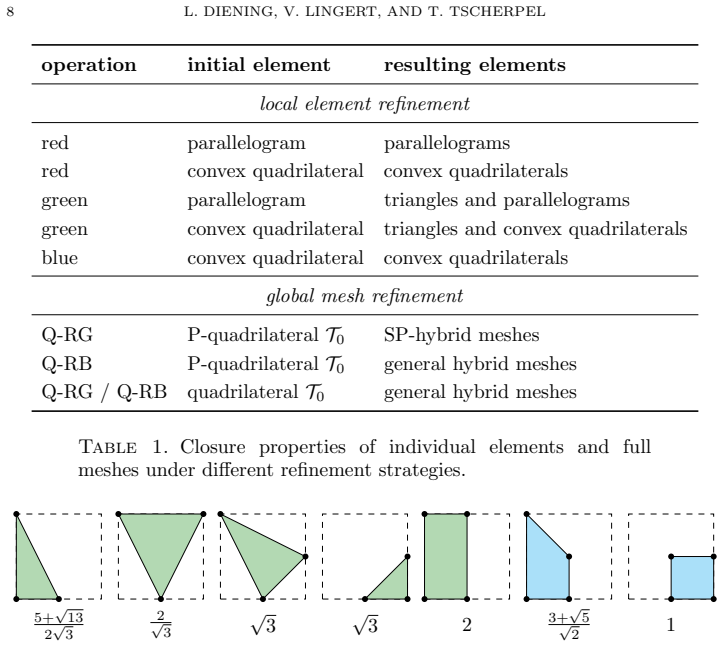
The central claim is that the L²-projection onto mapped Lagrange finite elements on hybrid meshes is Lp- and W¹,p-stable in general, and in particular W¹,²-stable for all tensor-product degrees K greater than or equal to 2 on the two specified quadrilateral refinement patterns. This follows from extending a geometric control technique to arbitrary convex quadrilaterals that arise during adaptive refinement.
What carries the argument
Extension of a geometric technique that controls the constants appearing in the stability estimate for the L²-projection when the elements are general convex quadrilaterals rather than parallelograms.
If this is right
- Standard a priori and a posteriori error estimates for finite element methods carry over directly to adaptively refined hybrid meshes without extra dependence on mesh distortion for degrees K at least 2.
- The projection remains usable inside analyses of nonlinear problems that rely on W¹,p bounds.
- Both Lp and W¹,p stability are obtained, so the result applies to a wider class of estimates than the Sobolev case alone.
- The same meshes can be used for higher-order approximations without loss of the stability property needed for convergence proofs.
Where Pith is reading between the lines
- If the geometric technique extends further, similar stability statements could be checked on three-dimensional hybrid meshes.
- The same control might be reusable for other canonical projections that appear in mixed finite element methods on the same meshes.
- Numerical tests that track the stability constant on a sequence of convex quadrilaterals with increasing aspect ratio would directly test the claimed independence from shape.
Load-bearing premise
The geometric technique that works for parallelograms continues to control the constants when the quadrilaterals become arbitrary convex shapes produced by adaptive refinement.
What would settle it
A concrete family of increasingly distorted convex quadrilaterals together with a fixed polynomial degree K=2 on which the ratio of the W¹,² norm of the projected function to the original function grows without bound.
Figures



read the original abstract
We establish $L^p$- and $W^{1,p}$-stability of the $L^2$-projection onto mapped Lagrange finite elements on hybrid meshes consisting of triangles and convex quadrilaterals arising from adaptive mesh refinement. If $K$ is the (tensor product) degree of polynomials of the discretisation, then we show, in particular, $W^{1,2}$-stability for all $K\geq 2$ for the Q-RG and Q-RB refinements. This extends results by Ali, Funken, and Schmidt (2022) which hold for the range $2 \leq K \leq 9$ for initial meshes consisting of parallelograms. Our proof relies on an extension of the technique by Diening, Storn and Tscherpel (2021) to general convex quadrilaterals.
Editorial analysis
A structured set of objections, weighed in public.
Referee Report
Summary. The manuscript establishes L^p- and W^{1,p}-stability of the L^2-projection onto mapped Lagrange finite elements on hybrid meshes consisting of triangles and convex quadrilaterals arising from adaptive mesh refinement. In particular, it proves W^{1,2}-stability for all K ≥ 2 for the Q-RG and Q-RB refinements by extending the technique of Diening, Storn and Tscherpel (2021) to general convex quadrilaterals, thereby improving on the range 2 ≤ K ≤ 9 obtained by Ali, Funken and Schmidt (2022) for parallelograms.
Significance. If the extension is carried out with uniform control of all constants, the result would provide useful stability guarantees for higher-order elements on adaptively refined hybrid meshes, which are common in practical FEM computations.
major comments (1)
- [Proof of the extension to general convex quadrilaterals (the section containing the adaptation of the 2021 technique)] The central claim of W^{1,2}-stability for K ≥ 2 on general convex quadrilaterals rests on the extension of the Diening-Storn-Tscherpel (2021) argument. On such elements the Jacobian of the bilinear map is non-constant, so the pullbacks of tensor-product polynomials are no longer polynomials and the norm equivalences acquire additional factors. The manuscript must demonstrate explicitly (with mesh-independent bounds) that these factors remain controlled uniformly for the Q-RG and Q-RB families; otherwise the stability constant may depend on the local geometry and the result fails to hold as stated.
minor comments (2)
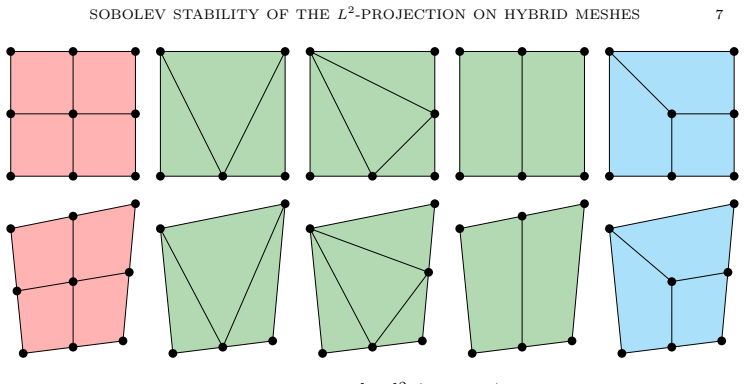
- [Introduction] Clarify the precise definitions of the Q-RG and Q-RB refinement patterns at the beginning of the paper so that the reader can follow the geometric assumptions without searching later sections.
- [Main theorems] Ensure that all constants appearing in the stability estimates are stated to be independent of the mesh size and the local aspect ratios; this is implied but not always written explicitly in the statements.
Simulated Author's Rebuttal
We thank the referee for the careful reading of our manuscript and the constructive feedback. We address the single major comment below.
read point-by-point responses
-
Referee: The central claim of W^{1,2}-stability for K ≥ 2 on general convex quadrilaterals rests on the extension of the Diening-Storn-Tscherpel (2021) argument. On such elements the Jacobian of the bilinear map is non-constant, so the pullbacks of tensor-product polynomials are no longer polynomials and the norm equivalences acquire additional factors. The manuscript must demonstrate explicitly (with mesh-independent bounds) that these factors remain controlled uniformly for the Q-RG and Q-RB families; otherwise the stability constant may depend on the local geometry and the result fails to hold as stated.
Authors: We agree that an explicit verification of the uniform control on the additional factors is required for the claim to be fully rigorous. In extending the Diening–Storn–Tscherpel argument we track the Jacobian contributions arising from the bilinear mapping on convex quadrilaterals and invoke the geometric properties of the Q-RG and Q-RB families (convexity preservation together with angle and aspect-ratio bounds inherited from the initial mesh) to obtain K-dependent but mesh-independent constants. Nevertheless, these steps are currently distributed throughout the proof rather than isolated. We will therefore add a dedicated lemma in the revised manuscript that isolates the Jacobian-related equivalence constants and proves their uniformity for the two refinement families. revision: yes
Circularity Check
No circularity; proof provides the claimed extension
full rationale
The manuscript is a mathematical proof paper establishing Sobolev stability by extending a prior technique to convex quadrilaterals with bilinear maps. The abstract explicitly states that the proof consists of this extension, so the derivation chain is self-contained within the present work rather than reducing to an unverified self-citation. No self-definitional loops, fitted parameters renamed as predictions, or ansatzes smuggled via citation appear. The 2021 citation supplies the base technique being extended, which is standard and does not create load-bearing circularity when the extension is proved here. This is the normal, non-circular outcome for a direct proof paper.
Axiom & Free-Parameter Ledger
axioms (2)
- domain assumption The technique by Diening, Storn and Tscherpel (2021) extends to general convex quadrilaterals
- standard math Standard properties of mapped Lagrange finite elements and Sobolev spaces on convex domains
Reference graph
Works this paper leans on
-
[1]
Approximation by finite element functions using local regularization , DOI= "10.1051/m2an/197509R200771", url= "https://doi.org/10.1051/m2an/197509R200771", journal =
-
[2]
Ciarlet.The Finite Element Method for Elliptic Problems
Ciarlet, P. , publisher =. 2002 , isbn =. doi:10.1137/1.9780898719208 , owner =
-
[3]
Interpolatory Subdivision on Open Quadrilateral Nets with Arbitrary Topology , year =
Kobbelt, Leif , journal =. Interpolatory Subdivision on Open Quadrilateral Nets with Arbitrary Topology , year =. doi:10.1111/1467-8659.1530409 , fjournal =
-
[4]
Carstensen, C. , journal =. Merging the. 2002 , issn =. doi:10.1090/S0025-5718-01-01316-3 , fjournal =
-
[5]
Crouzeix, M. and Thom\'ee, V. , journal =. The Stability in. 1987 , number =. doi:10.2307/2007825 , fjournal =
-
[6]
Generalized convexity and optimization , year =
Cambini, Alberto and Martein, Laura , publisher =. Generalized convexity and optimization , year =
-
[7]
Bramble, James H. and Pasciak, Joseph E. and Steinbach, Olaf , journal =. On the stability of the. 2002 , issn =. doi:10.1090/S0025-5718-01-01314-X , fjournal =
-
[8]
and Sherman, Andrew H
Bank, Randolph E. and Sherman, Andrew H. and Weiser, Alan , booktitle =. Refinement algorithms and data structures for regular local mesh refinement , year =
-
[9]
An adaptive mesh-refining algorithm allowing for an
Carstensen, Carsten , journal =. An adaptive mesh-refining algorithm allowing for an. 2004 , issn =. doi:10.1007/s00365-003-0550-5 , fjournal =
-
[10]
doi:10.1090/mcom/4102 , fjournal =
Diening, Lars and Storn, Johannes and Tscherpel, Tabea , title =. doi:10.1090/mcom/4102 , fjournal =
-
[11]
and Boffi, Daniele and Falk, Richard S
Arnold, Douglas N. and Boffi, Daniele and Falk, Richard S. , journal =. Approximation by quadrilateral finite elements , year =. doi:10.1090/S0025-5718-02-01439-4 , fjournal =
-
[12]
On the finite element method on quadrilateral meshes , year =
Boffi, Daniele , journal =. On the finite element method on quadrilateral meshes , year =. doi:10.1016/j.apnum.2006.03.027 , fjournal =
-
[13]
and Boffi, Daniele and Falk, Richard S
Arnold, Douglas N. and Boffi, Daniele and Falk, Richard S. and Gastaldi, Lucia , journal =. Finite element approximation on quadrilateral meshes , year =. doi:10.1002/cnm.450 , fjournal =
-
[14]
Breit, Dominic and Diening, Lars and Storn, Johannes and Wichmann, J\". IMA J. Numer. Anal. , title =. 2021 , issn =. doi:10.1093/imanum/draa081 , fjournal =
-
[15]
Bramble, J. H. and Xu, J. , journal =. Some estimates for a weighted. 1991 , issn =. doi:10.2307/2008391 , fjournal =
-
[16]
Steinbach, O. , journal =. On the stability of the. 2001 , issn =. doi:10.1007/PL00005449 , fjournal =
-
[17]
Steinbach, O. , journal =. On a generalized. 2002 , issn =. doi:10.1007/s002110100329 , fjournal =
-
[18]
and Heine, Claus-Justus and Siebert, Kunibert G
Gaspoz, Fernando D. and Heine, Claus-Justus and Siebert, Kunibert G. , journal =. Optimal grading of the newest vertex bisection and. 2016 , issn =. doi:10.1093/imanum/drv044 , fjournal =
-
[19]
Gaspoz, F. D. and Heine, C.-J. and Siebert, K. G. , note =. An Alternative Proof of the H^1 -Stability of the L_2 -Projection on Graded Meshes , year =. https://www.f08.uni-stuttgart.de/.content/media/downloads/Mathematik/mathematische_berichte/2019/2019-001.pdf , owner =
2019
-
[20]
Maubach, J. M. , journal =. Local bisection refinement for. 1995 , issn =. doi:10.1137/0916014 , fjournal =
-
[21]
Anisotropic finite elements: local estimates and applications , year =
Apel, Thomas , publisher =. Anisotropic finite elements: local estimates and applications , year =
-
[22]
Adaptive finite element methods on quadrilateral meshes without hanging nodes , year =
Zhao, Xuying and Mao, Shipeng and Shi, Zhongci , journal =. Adaptive finite element methods on quadrilateral meshes without hanging nodes , year =. doi:10.1137/090772022 , fjournal =
-
[23]
Bernardi, C. and Girault, V. , journal =. A local regularization operator for triangular and quadrilateral finite elements , year =. doi:10.1137/S0036142995293766 , fjournal =
-
[24]
and Melenk, J
Apel, T. and Melenk, J. M. , pages =. Interpolation and Quasi-Interpolation in h - and hp - Version Finite Element Spaces , year =. Encyclopedia of Computational Mechanics Second Edition , doi =
-
[25]
Faustmann, Markus and Marcati, Carlo and Melenk, Jens Markus and Schwab, Christoph , journal =. Exponential convergence of. 2023 , issn =. doi:10.1137/22M152493X , fjournal =
-
[26]
Ivan G. Graham and Euan A. Spence , title =. 2025 , archiveprefix =. doi:10.48550/arXiv.2501.15976 , url =
work page internal anchor Pith review Pith/arXiv arXiv doi:10.48550/arxiv.2501.15976 2025
-
[27]
Ern, A. and Guermond, J.-L. , publisher =. Finite elements. 2021 , isbn =. doi:10.1007/978-3-030-56341-7 , pages =
-
[28]
Ali, Mazen and Funken, Stefan A and Schmidt, Anja , journal =. H^. 2022 , issn =. doi:10.1093/imanum/drab048 , publisher =
-
[29]
Boman, Mats , journal =. Estimates for the. 2006 , issn =. doi:10.1007/s10543-006-0062-3 , fjournal =
-
[30]
and Yserentant, Harry , journal =
Bank, Randolph E. and Yserentant, Harry , journal =. On the. 2014 , issn =. doi:10.1007/s00211-013-0562-4 , fjournal =
-
[31]
Diening, Lars and Storn, Johannes and Tscherpel, Tabea , journal =. On the. 2021 , issn =. doi:10.1137/20M1358013 , fjournal =
-
[32]
Adaptive Finite Element Methods for Parabolic Problems
Eriksson, Kenneth and Johnson, Claes , journal =. Adaptive Finite Element Methods for Parabolic Problems. 1995 , issn =. doi:10.1137/0732033 , fjournal =
-
[33]
Ridgway and Zhang, Shangyou , journal =
Scott, L. Ridgway and Zhang, Shangyou , journal =. Finite element interpolation of nonsmooth functions satisfying boundary conditions , year =. doi:10.2307/2008497 , fjournal =
-
[34]
Traxler, C. T. , journal =. An algorithm for adaptive mesh refinement in. 1997 , issn =. doi:10.1007/BF02684475 , fjournal =
-
[35]
Tantardini, Francesca and Veeser, Andreas , journal =. The. 2016 , issn =. doi:10.1137/140996811 , fjournal =
-
[36]
Knupp, Patrick M. , journal =. Algebraic mesh quality metrics , year =. doi:10.1137/S1064827500371499 , fjournal =
discussion (0)
Sign in with ORCID, Apple, or X to comment. Anyone can read and Pith papers without signing in.