The D_(s1)(2460) and other open-charm 1^+ states in relativistic chiral effective field theory
Pith reviewed 2026-07-03 09:26 UTC · model grok-4.3
The pith
The D_s1(2460) is a bound-state pole from an SU(3) triplet while the D1(2430) arises from two poles in different multiplets.
A machine-rendered reading of the paper's core claim, the machinery that carries it, and where it could break.
Core claim
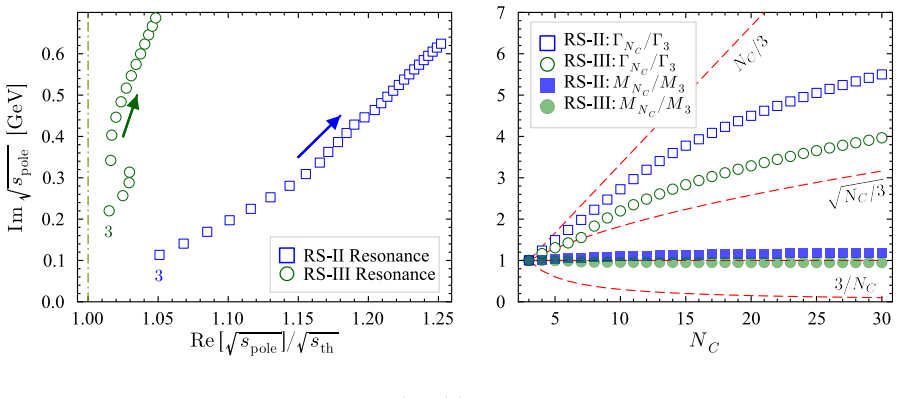
Within the relativistic formalism, the D_s1(2460) can be identified with a bound state pole, while the D1(2430) corresponds to the interplay of two poles: a lower one on the second Riemann sheet and a higher one on the third Riemann sheet. The D_s1(2460) and the lower D1(2430) pole originate from the same flavor SU(3) triplet, whereas the higher D1(2430) pole belongs to the SU(3) sextet. All these states are not of q-bar q nature, as they flow to complex infinity in the large N_C limit.
What carries the argument
Relativistic U(3) chiral effective field theory potentials up to next-to-leading order, whose analytic continuation yields pole positions on the complex energy plane that are then assigned to SU(3) flavor multiplets.
If this is right
- Scattering lengths are predicted for all relevant S- and P-wave elastic channels.
- The D_s1(2460) and lower D1(2430) pole share a common SU(3) origin.
- The states move to complex infinity in the large-N_C limit and therefore cannot be conventional quark-antiquark mesons.
- The results supply quantitative benchmarks for future lattice QCD and femtoscopic measurements.
Where Pith is reading between the lines
- The same relativistic framework can be applied to other open-charm or bottom sectors to test whether analogous pole patterns appear.
- The SU(3) triplet and sextet assignments suggest partner states that could be searched for in production experiments.
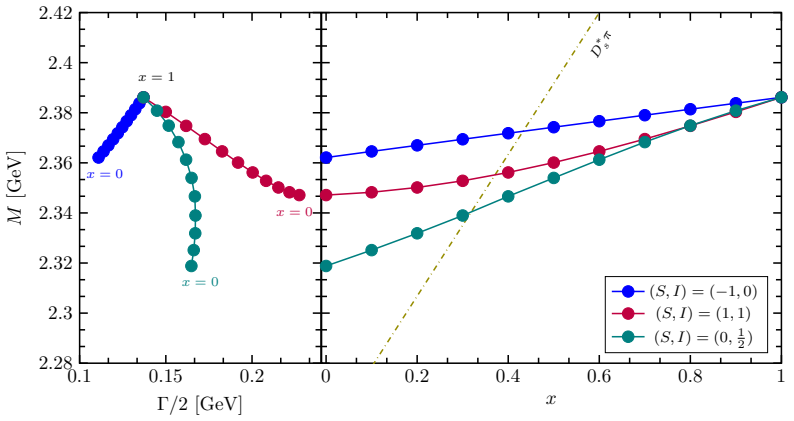
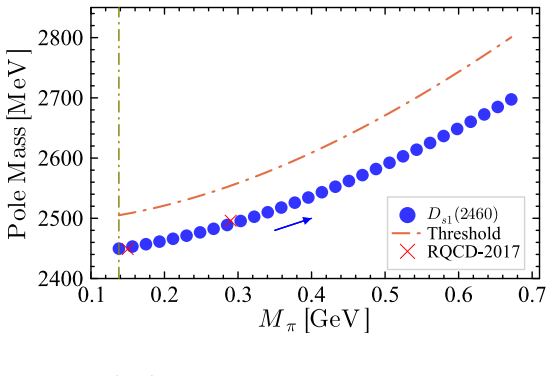
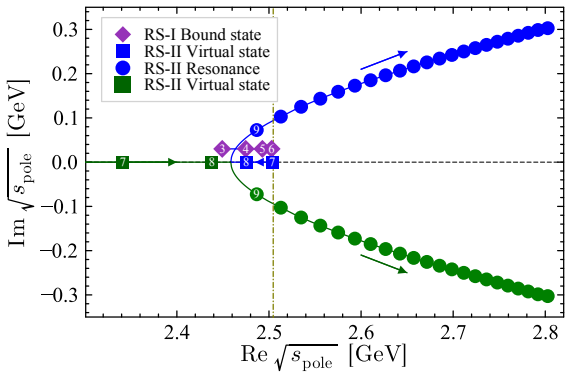
- If the large-N_C flow to infinity persists, the states are composite and their couplings to conventional channels should be suppressed.
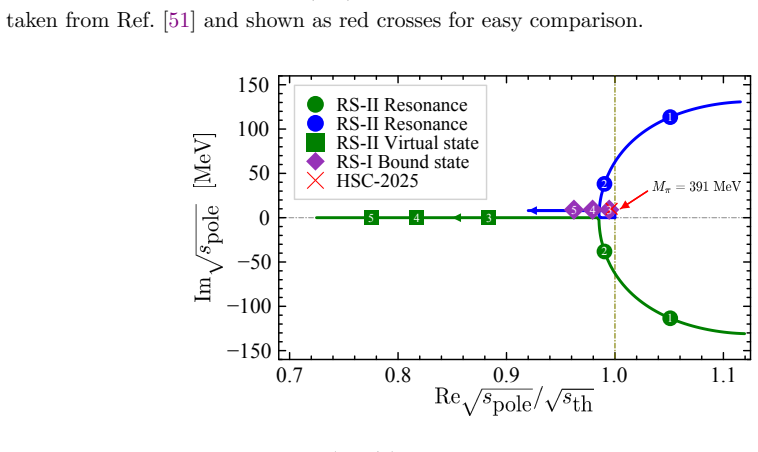
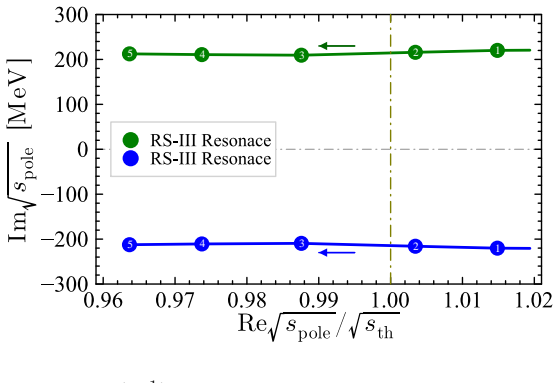
Load-bearing premise
Low-energy constants estimated from heavy quark spin symmetry are accurate enough to fix the next-to-leading-order potentials without any additional parameters adjusted to charm-sector data.
What would settle it
A lattice QCD result for the I=1/2 D* pi S-wave scattering length at the physical pion mass that lies well outside the range predicted by the potentials would falsify the pole assignments.
Figures
read the original abstract
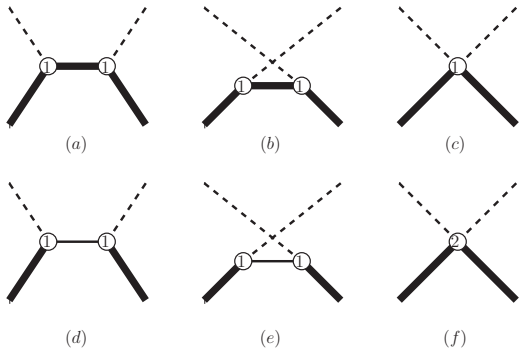
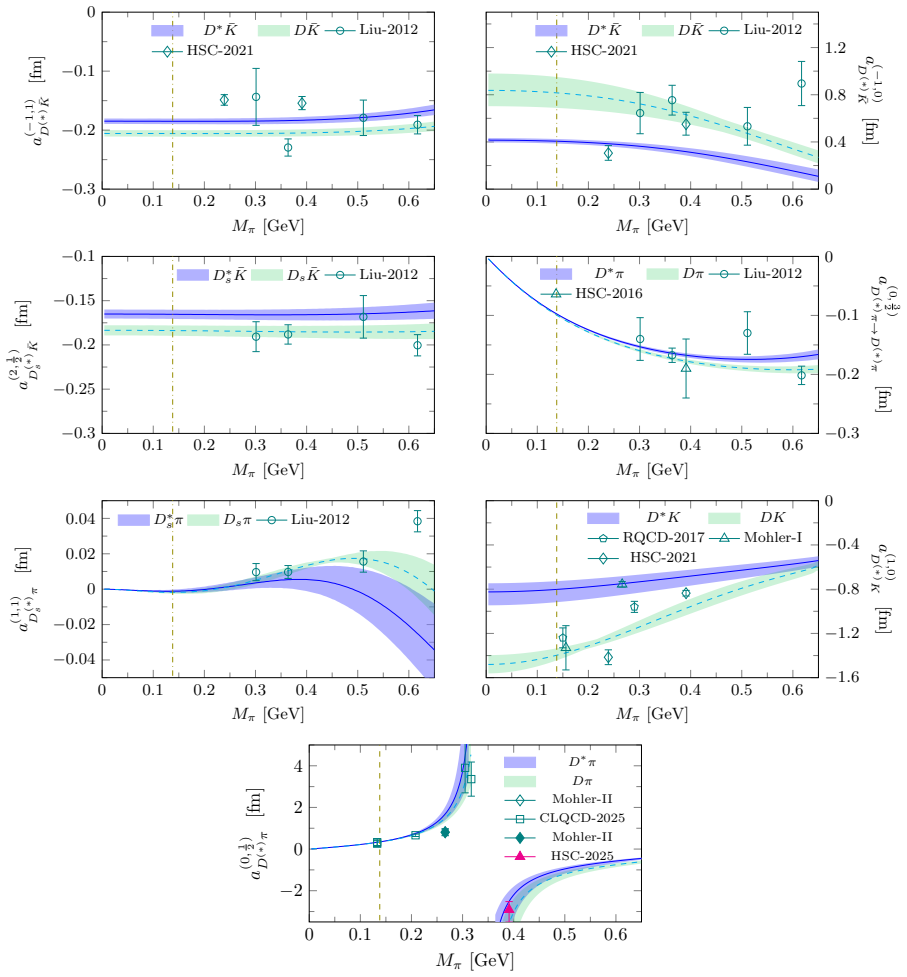
We derive the pertinent chiral potentials for charmed vector meson interactions with light pseudoscalar bosons in a relativistic U(3) chiral effective field theory up to next-to-leading order. Predictions for the $S$- and $P$-wave scattering lengths are obtained for all the relevant elastic channels. A comparison with the most recent -- and currently the sole -- lattice QCD data on the $S$-wave $I=1/2$ $D^\ast\pi$ scattering length at a pion mass of $391$~MeV reveals good agreement, thereby validating the estimation of low energy constants via heavy quark spin symmetry. Within the relativistic formalism, we confirm that the $D_{s1}(2460)$ can be identified with a bound state pole, while the $D_1(2430)$ corresponds to the interplay of two poles: a lower one on the second Riemann sheet and a higher one on the third Riemann sheet. We show that the $D_{s1}(2460)$ and the lower $D_1(2430)$ pole originate from the same flavor SU(3) triplet, whereas the higher $D_1(2430)$ pole belongs to the SU(3) sextet. All these states are not of $\bar{q}q$ nature, as they flow to complex infinity in the large $N_C$ limit. Our results provide quantitative benchmarks for future lattice QCD and femtoscopic studies.
Editorial analysis
A structured set of objections, weighed in public.
Referee Report
Summary. The manuscript derives relativistic U(3) chiral effective field theory potentials up to NLO for charmed vector meson-light pseudoscalar interactions. It obtains predictions for S- and P-wave scattering lengths in elastic channels, validates the HQSS-determined NLO LECs against the single available lattice datum (I=1/2 D*π S-wave scattering length at m_π=391 MeV), and identifies the D_s1(2460) as a bound-state pole while the D1(2430) arises from a lower pole on the second Riemann sheet and a higher pole on the third. The D_s1(2460) and lower D1(2430) pole are assigned to the same SU(3) triplet, the higher D1(2430) pole to the sextet; all states are shown to be non-qqbar by flowing to complex infinity in the large-N_C limit. The results supply benchmarks for lattice and femtoscopic studies.
Significance. If the results hold, the work supplies quantitative, parameter-free (via HQSS) predictions and a clear dynamical-generation interpretation for the open-charm 1+ states, together with concrete benchmarks for lattice QCD and femtoscopy. The relativistic formalism, explicit SU(3) multiplet assignments, and large-N_C decoupling analysis constitute genuine strengths that go beyond conventional non-relativistic treatments. The direct comparison to the available lattice point further supports the approach when the LEC determination is independent.
major comments (2)
- [Abstract and LEC determination section] Abstract and LEC determination section: All NLO low-energy constants are fixed exclusively by heavy-quark spin symmetry relations with no additional parameters tuned to charm-sector data. The manuscript must demonstrate explicitly that these HQSS relations are not themselves calibrated on the D_s1(2460) or D1(2430) states; otherwise the pole identifications and SU(3) assignments reduce to consistency checks rather than independent predictions.
- [Lattice comparison paragraph] Lattice comparison paragraph: Validation rests on agreement with one lattice datum at unphysical m_π=391 MeV. The stability of the reported pole positions, Riemann-sheet assignments, and SU(3) classifications under reasonable variations of the LECs or under chiral extrapolation to the physical point must be quantified, as this directly affects the load-bearing claims.
minor comments (2)
- Tabulate all predicted S- and P-wave scattering lengths (including channels without lattice data) for direct use in future comparisons.
- Clarify the precise definition of the Riemann sheets employed for the two D1(2430) poles to avoid ambiguity in the analytic-structure discussion.
Simulated Author's Rebuttal
We thank the referee for the careful reading of our manuscript and the constructive comments. The positive assessment of the work's significance is appreciated. We respond to each major comment below, indicating where revisions will be made to strengthen the presentation.
read point-by-point responses
-
Referee: [Abstract and LEC determination section] Abstract and LEC determination section: All NLO low-energy constants are fixed exclusively by heavy-quark spin symmetry relations with no additional parameters tuned to charm-sector data. The manuscript must demonstrate explicitly that these HQSS relations are not themselves calibrated on the D_s1(2460) or D1(2430) states; otherwise the pole identifications and SU(3) assignments reduce to consistency checks rather than independent predictions.
Authors: We agree that explicit demonstration is necessary to establish the predictive character of the results. The NLO LECs are obtained from HQSS relations applied to the bottom sector and light-meson interactions, drawing on values reported in the literature that are independent of the D_s1(2460) and D1(2430) pole positions. In the revised manuscript we will add a dedicated paragraph (and accompanying table) in the LEC determination section that traces the origin of each constant to its source reference or calculation, confirming that none were adjusted using the states under discussion. This will make clear that the pole identifications and SU(3) assignments remain genuine predictions. revision: yes
-
Referee: [Lattice comparison paragraph] Lattice comparison paragraph: Validation rests on agreement with one lattice datum at unphysical m_π=391 MeV. The stability of the reported pole positions, Riemann-sheet assignments, and SU(3) classifications under reasonable variations of the LECs or under chiral extrapolation to the physical point must be quantified, as this directly affects the load-bearing claims.
Authors: We concur that stability analysis strengthens the claims. A complete chiral extrapolation to the physical point lies outside the present scope, as it would require additional higher-order counterterms and further lattice input not currently available. However, we will include a new subsection that quantifies the sensitivity of the pole positions, Riemann sheets, and SU(3) assignments to variations of the LECs within the uncertainties allowed by the HQSS relations. This will provide a concrete measure of robustness for the reported results. revision: partial
Circularity Check
No significant circularity; derivation self-contained via external lattice validation
full rationale
The paper fixes all NLO LECs through heavy-quark spin symmetry relations (a standard external symmetry) without any additional parameters tuned to charm-sector data or the target poles. Scattering lengths computed from these potentials are compared to an independent lattice QCD result at unphysical pion mass (m_π=391 MeV), providing external validation. Pole positions, Riemann-sheet assignments, SU(3) multiplet structure, and large-N_C flow are then obtained by solving the relativistic Bethe-Salpeter equation with the fixed potentials. No step reduces by construction to a fit on the same observables, and the lattice benchmark lies outside the physical charm data, satisfying the criterion for a self-contained derivation.
Axiom & Free-Parameter Ledger
free parameters (1)
- NLO low-energy constants
axioms (2)
- domain assumption Heavy-quark spin symmetry holds sufficiently well to relate the relevant low-energy constants across channels
- domain assumption The relativistic U(3) chiral Lagrangian up to NLO captures the dominant dynamics for D* P scattering near threshold
Reference graph
Works this paper leans on
-
[1]
The two-point one-loop functiong i(s) in Eq
(see Table I), the above matrix equation (44) reduces to simple algebraic equation. The two-point one-loop functiong i(s) in Eq. (45) is defined by [22] gi(s) =i Z d4k (2π)4 1 [k2 −M 2 P ∗ i +iε][(k+P) 2 −M 2 ϕi +iε] , withs≡P 2 andεan infinitesimal positive number.g i(s) collects unitary cuts generated by the two-particle intermediate states, i.e.,P ∗ i ...
2008
-
[2]
D∗ s K→D ∗ s K −0.17(1)−0.17(1) −0.14 (0, 3
-
[3]
D∗π→D ∗π −0.10(1)−0.10(1) −0.13−i3.6×10 −4 (1,1) D∗ s π→D ∗ s π −0.001(1)−0.004(1) −0.039 D∗K→D ∗K 0.01(1) +i0.07(1) 0.01(1) +i0.05(1) −0.022 +i0.10 (1,0) D∗K→D ∗K −0.86+0.09 −0.14 −0.85+0.09 −0.14 0.76−i5.2×10 −6 D∗ s η→D ∗ s η −0.22(1) +i0.04(1)−0.22(1) +i0.04(1) 0.18 +i0.19 D∗ s η′ →D ∗ s η′ −0.24(2) +i0.03(1)−0.26(2) +i0.04(1) - (0, 1
-
[4]
CT” and “CT+Ex
D∗π→D ∗π 0.35(1) 0.36 +0.01 −0.02 0.27−i3.6×10 −4 D∗η→D ∗η −0.03(2) +i0.04(1)−0.05(2) +i0.04(1) 0.051 +i0.094 D∗ s ¯K→D ∗ s ¯K −0.12(3) +i0.18 +0.04 −0.03 −0.14+0.03 −0.02 +i0.16 +0.04 −0.03 0.35 +i0.27 D∗η′ →D ∗η′ −0.16(2) +i0.01(1)−0.16(2) +i0.01(1) - Our predictions for theS-wave scattering lengths are given in Table IV, where the errors are obtained b...
-
[5]
Their values are determined, by using the physical masses as inputs, to be: ˚MK = 486.3 MeV, ˚MD∗ = 2003.5 MeV, ˚MD∗s = 2111.6 MeV
˚M 2 K are the masses ofK,D ∗ andD ∗ s mesons in the limit ofM π →0, or equivalently, ˆm→0. Their values are determined, by using the physical masses as inputs, to be: ˚MK = 486.3 MeV, ˚MD∗ = 2003.5 MeV, ˚MD∗s = 2111.6 MeV. In addition, we use Eq. (8) to extrapolate theη/η ′ masses and their mixing angleθ, withM 0 = 835.7 MeV taken from Ref. [77]. The pre...
2003
-
[6]
6 |Tii|2 1 : D∗ s π 2 : D∗K 0 1 2 |T12|2 12
-
[7]
2 2. 3 2. 4 2. 5 2. 6 2. 7− 20 − 10 0 10 √ s [GeV] δi [Degree] 1 2
-
[8]
2 2. 3 2. 4 2. 5 2. 6 2. 7
-
[9]
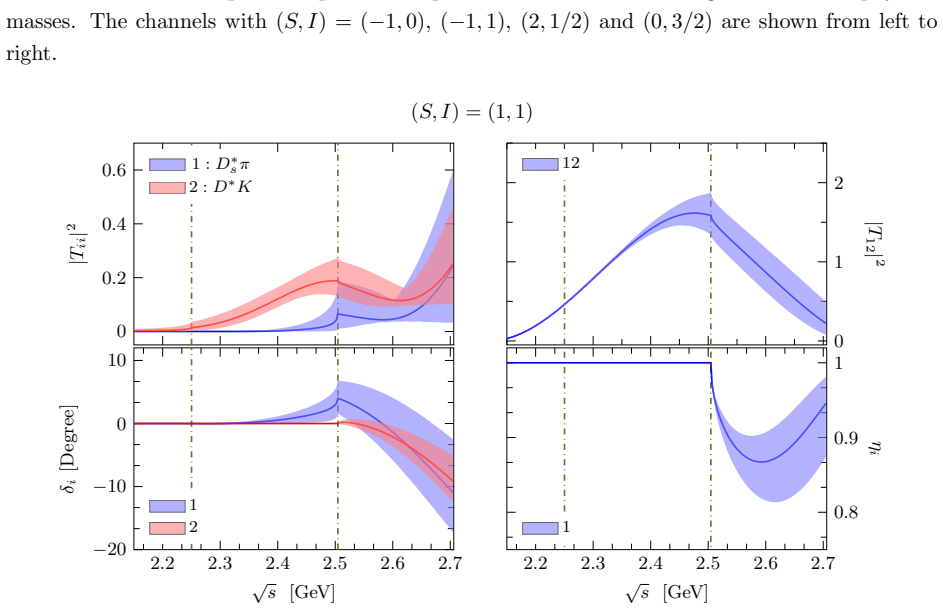
9 1 √ s [GeV] ηi 1 (S, I) = (1 ,1) FIG. 4. Moduli of amplitude squared, phase shifts and inelasticity for the (1,1) coupled channels at physical masses. theTmatrix using the following formulae ηi =|1 + 2iρ iTii|, δ i = Arg 1−η i 2i +ρ iTii .(56) 19 0 5 10 15 20 |Tii|2 1 : D∗ K 2 : D∗ s η 3 : D∗ s η′ 0
-
[10]
6 2. 8 3 3. 2 − 50 0 50 √ s [GeV] δi [Degree] 1 2 3
-
[11]
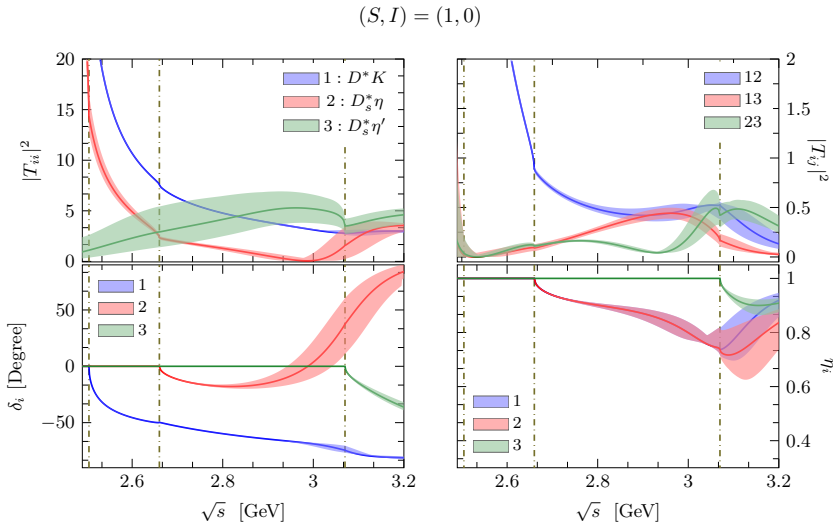
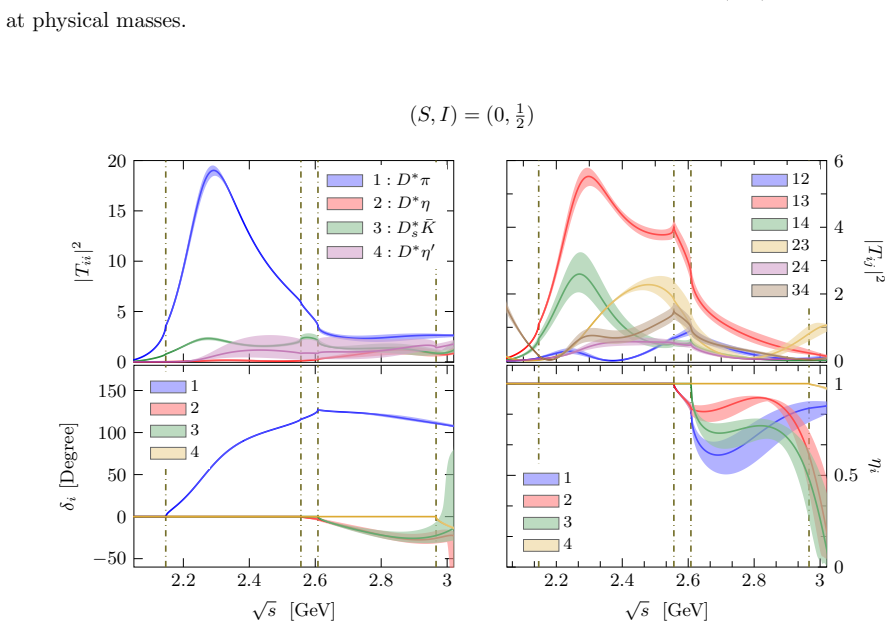
8 1 √ s [GeV] ηi 1 2 3 (S, I) = (1 ,0) FIG. 5. Moduli of amplitude squared, phase shifts and inelasticity for the (1,0) coupled channels at physical masses. 0 5 10 15 20 |Tii|2 1 : D∗ π 2 : D∗ η 3 : D∗ s ¯K 4 : D∗ η′ 0 2 4 6 |Tij|2 12 13 14 23 24 34
-
[12]
2 2. 4 2. 6 2. 8 3 − 50 0 50 100 150 √ s [GeV] δi [Degree] 1 2 3 4
-
[13]
2 2. 4 2. 6 2. 8 3 0
-
[14]
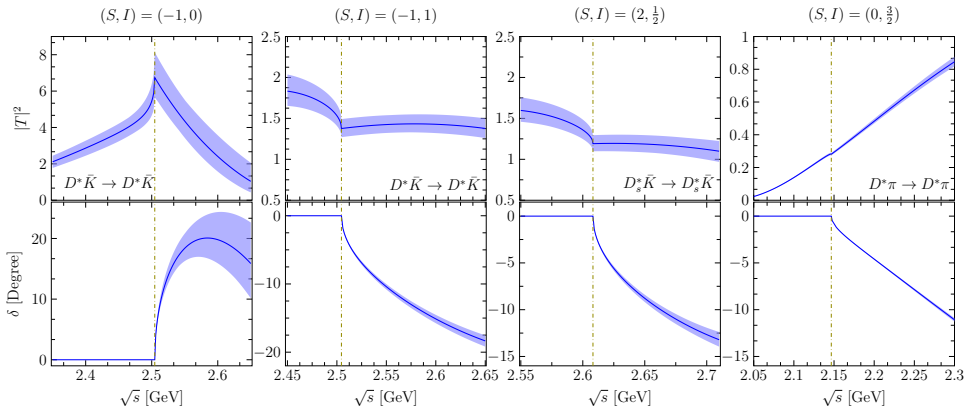
5 1 √ s [GeV] ηi 1 2 3 4 (S, I) = (0 , 1 2 ) FIG. 6. Moduli of amplitude squared, phase shifts and inelasticity for the (0,1/2) coupled channels at physical masses. 20 The moduli of amplitude squared and phase shifts for the four single-channel processes are shown in Fig. 3. For the coupled channels, namely, (1,1), (1,0) and (0,1/2), we present the moduli...
-
[15]
Furthermore, then-th RS is often labeled using Roman numerals (cf
respectively. Furthermore, then-th RS is often labeled using Roman numerals (cf. Table VI). In addition to the pole positions, the associated residues also possess direct phys- ical interpretations. In the neighborhood of a given poles pole, the unitarized amplitudeT ij admits a Laurent series asT ij =g igj/(s−s pole) +· · ·, whereg i andg j denote its co...
-
[16]
We will verify this in next subsection by carrying out an SU(3) study
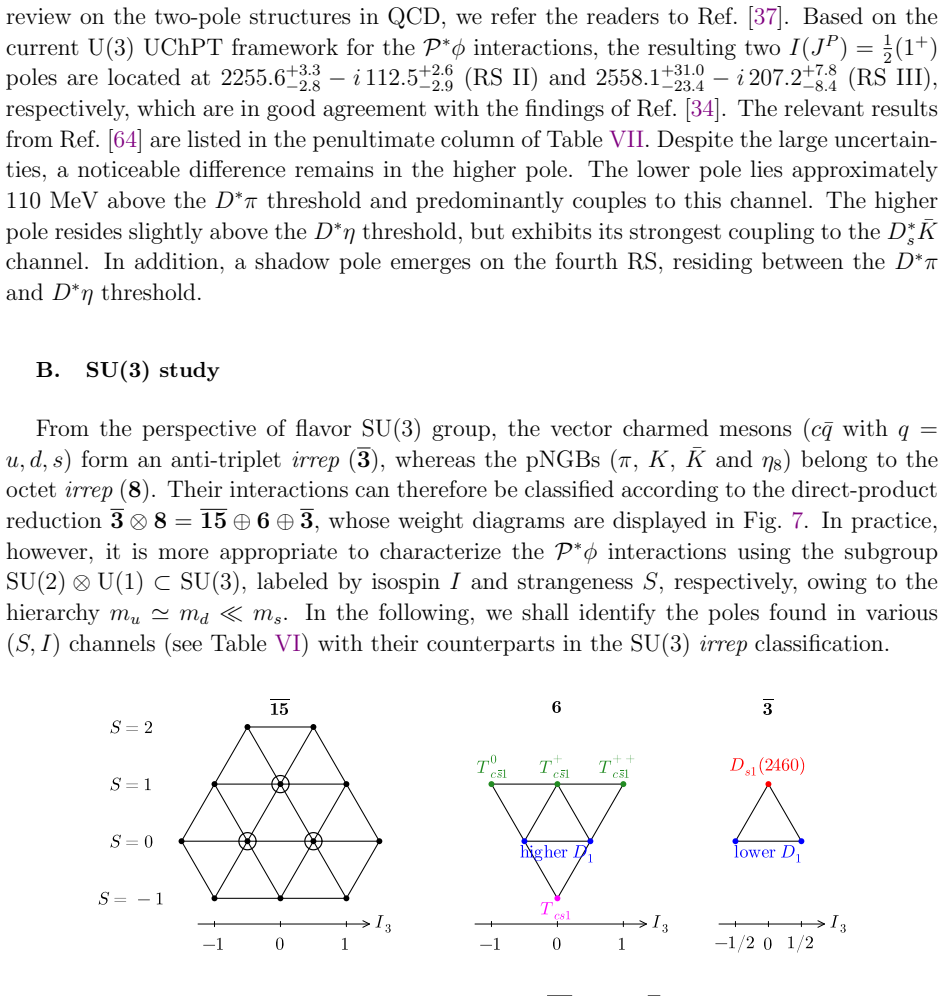
II 2255.6 +3.3 −2.8 −i112.5 +2.6 −2.9 10.3+0.1 −0.1(D∗π) 2.0 +0.3 −0.3(D∗η) 5.2 +0.1 −0.1 (D∗ s ¯K) 4.4 +0.6 −0.6 (D∗η′) III 2558.1 +31.0 −23.4 −i207.2 +7.8 −8.4 5.8+0.1 −0.0 (D∗π) 5.3 +0.4 −0.3(D∗η) 12.2 +0.2 −0.2 (D∗ s ¯K) 2.3 +0.4 −0.3 (D∗η′) IV 2307.1 +16.1 −12.1 −i186.4 +20.9 −14.5 7.4+0.3 −0.4(D∗π) 5.0 +0.2 −0.0(D∗η) 5.0 +0.7 −0.3(D∗ s ¯K) 4.7 +2.3 ...
-
[17]
This pole can be identified with theD s1(2460) state, as its mass is consistent with the PDG average [70] for theD s1(2460) within 1-σuncertainty (see table VII)
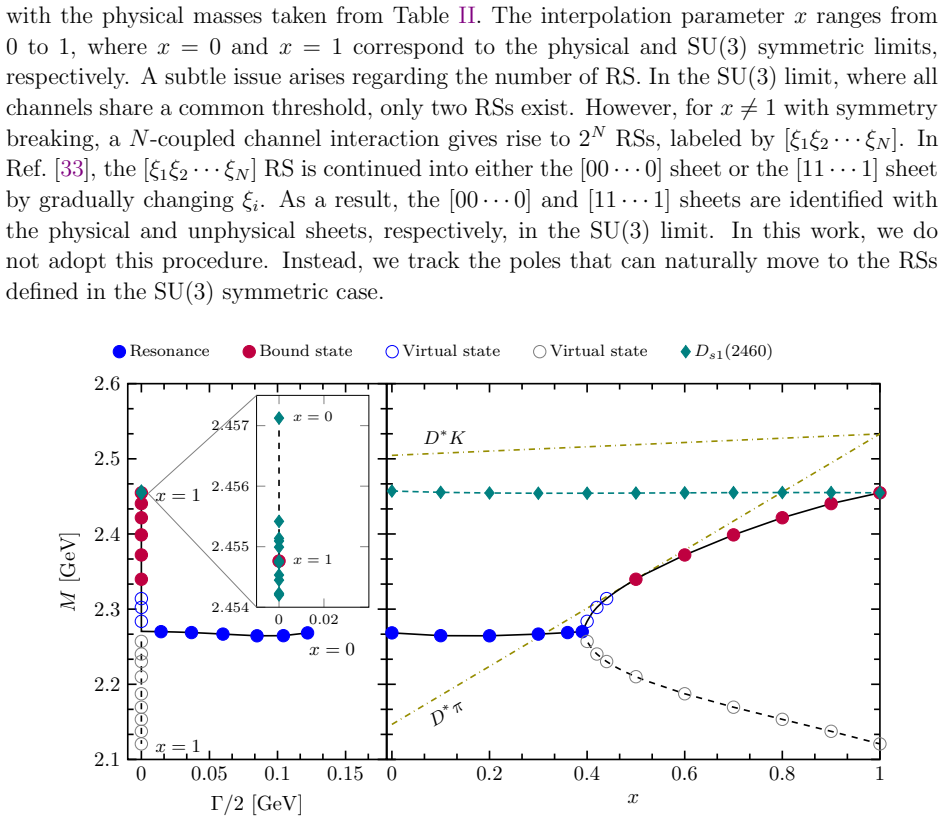
II 2255.6 +3.3 −2.8 −i112.5 +2.6 −2.9 2247+5 −6 −i107 +11 −10 2228−8 +1 −i182 +44 −28 2412(9) +i314(29)III 2558.1 +31.0 −23.4 −i207.2 +7.8 −8.4 2555+47 −30 −i203 +8 −9 2606−30 +23 −i59 +13 −25 For the coupled-channel scattering with (S, I) = (1,0), a bound-state pole, √spole = 2455.2+3.2 −2.7 MeV, appears just below theD ∗Kthreshold and exhibits a strong ...
2025
-
[18]
The numbers within the circular markers indicate the multiples of the physical pion mass
RS-III resonance as a function ofM π. The numbers within the circular markers indicate the multiples of the physical pion mass. The olive dash-dotted vertical line denotes theD ∗ηthreshold. Mπ <288.8 MeV. AtM π = 288.8 MeV, the pair of resonance states falls onto the real axis below theD ∗πthreshold on RS-II and becomes a pair of virtual states. One virtu...
-
[19]
The amplitudesV 1(s, t) andV 2(s, t) include contributions from both contact diagrams and exchange diagrams
+m 2 2(m2 3 + 2m2 4) + 2s2 + 2st+t 2 −(2s+t)Σ ,(B1) where the abbreviation Σ≡m 2 1 +m 2 2 +m 2 3 +m 2 4 is the sum of mass squared. The amplitudesV 1(s, t) andV 2(s, t) include contributions from both contact diagrams and exchange diagrams. ForV 1(s, t), one has V1(s, t) =V c(s, t) + g2 1 12F 2 0 CS M 2 h∗ −s ∆12∆34 +s 2 +s(2t−Σ) + CU (Σ−M 2 h∗ −s−t) t2 +...
-
[20]
+s+ ∆12∆34 s + 4sCS s−M 2 h .(B3) At NLO, theV i=3,4,5(s, t) functions stem solely from the exchange diagrams, which are given by V3(s, t) =− g2 0 6F 2 0 CU√s(Σ−M 2 h −s−t) (∆12 −s) + g2 1 12F 2 0 CU√s(Σ−M 2 h∗ −s−t) × (s−m 2 2)(m2 2 +m 2 4 −2s−t) +m 2 1(m2 2 +m 2 4 + 2s−t) ,(B4) V4(s, t) =− g2 0 6F 2 0 CU√s(Σ−M 2 h −s−t) (∆34 −s) + g2 1 12F 2 0 CU√s(Σ−M ...
-
[21]
Observation of a Narrow Meson Decaying to Ds+pi0 at a Mass of 2.32 GeV/c^2
B. Aubertet al.(BaBar), Observation of a narrow meson decaying toD + s π0 at a mass of 2.32-GeV/c2, Phys. Rev. Lett.90, 242001 (2003), arXiv:hep-ex/0304021
work page internal anchor Pith review Pith/arXiv arXiv 2003
-
[22]
D. Bessonet al.(CLEO), Observation of a narrow resonance of mass 2.46 GeV/c 2 decaying to D∗+ s π0 and confirmation of theD ∗ sJ(2317) state, Phys. Rev. D68, 032002 (2003), [Erratum: Phys.Rev.D 75, 119908 (2007)], arXiv:hep-ex/0305100
work page internal anchor Pith review Pith/arXiv arXiv 2003
-
[23]
Godfrey and N
S. Godfrey and N. Isgur, Mesons in a Relativized Quark Model with Chromodynamics, Phys. Rev. D32, 189 (1985)
1985
-
[24]
Godfrey and R
S. Godfrey and R. Kokoski, The Properties ofPWave Mesons with One Heavy Quark, Phys. Rev. D43, 1679 (1991)
1991
-
[25]
H.-X. Chen, W. Chen, X. Liu, Y.-R. Liu, and S.-L. Zhu, A review of the open charm and open bottom systems, Rept. Prog. Phys.80, 076201 (2017), arXiv:1609.08928 [hep-ph]
work page internal anchor Pith review Pith/arXiv arXiv 2017
-
[26]
F.-K. Guo, C. Hanhart, U.-G. Meißner, Q. Wang, Q. Zhao, and B.-S. Zou, Hadronic molecules, Rev. Mod. Phys.90, 015004 (2018), [Erratum: Rev.Mod.Phys. 94, 029901 (2022)], arXiv:1705.00141 [hep-ph]
work page internal anchor Pith review Pith/arXiv arXiv 2018
- [27]
- [28]
-
[29]
Z.-G. Wang, Review of the QCD sum rules for exotic states, Front. Phys. (Beijing)21, 016300 (2026), arXiv:2502.11351 [hep-ph]
-
[30]
J. M. Linket al.(FOCUS), Measurement of Masses and Widths of Excited Charm Mesons D∗ 2 and Evidence for Broad States, Phys. Lett. B586, 11 (2004), arXiv:hep-ex/0312060
work page internal anchor Pith review Pith/arXiv arXiv 2004
-
[31]
Study of B- => D**0 pi-(D**0 => D(*)+ pi-) decays
K. Abeet al.(Belle), Study ofB − →D ∗∗0π−(D∗∗0 →D (∗)+π−) decays, Phys. Rev. D69, 112002 (2004), arXiv:hep-ex/0307021
work page internal anchor Pith review Pith/arXiv arXiv 2004
-
[32]
J. R. Pel´ aez, From controversy to precision on the sigma meson: a review on the status of the non-ordinaryf 0(500) resonance, Phys. Rept.658, 1 (2016), arXiv:1510.00653 [hep-ph]
work page internal anchor Pith review Pith/arXiv arXiv 2016
- [33]
- [34]
-
[35]
Implications of chiral symmetry on $S$-wave pionic resonances and the scalar charmed mesons
M.-L. Du, F.-K. Guo, and U.-G. Meißner, Implications of chiral symmetry onS-wave pionic resonances and the scalar charmed mesons, Phys. Rev. D99, 114002 (2019), arXiv:1903.08516 [hep-ph]
work page internal anchor Pith review Pith/arXiv arXiv 2019
-
[36]
Burdman and J
G. Burdman and J. F. Donoghue, Union of chiral and heavy quark symmetries, Phys. Lett. B 280, 287 (1992)
1992
-
[37]
Yan, H.-Y
T.-M. Yan, H.-Y. Cheng, C.-Y. Cheung, G.-L. Lin, Y. C. Lin, and H.-L. Yu, Heavy quark symmetry and chiral dynamics, Phys. Rev. D46, 1148 (1992), [Erratum: Phys.Rev.D 55, 5851 (1997)]
1992
-
[38]
M. B. Wise, Chiral perturbation theory for hadrons containing a heavy quark, Phys. Rev. D 45, 2188 (1992)
1992
-
[39]
Gasser and U
J. Gasser and U. G. Meißner, Chiral expansion of pion form factors beyond one loop, Nucl. Phys. B357, 90 (1991)
1991
-
[40]
The inverse amplitude method in Chiral Perturbation Theory
A. Dobado and J. R. Pel´ aez, The Inverse amplitude method in chiral perturbation theory, Phys. Rev. D56, 3057 (1997), arXiv:hep-ph/9604416
work page internal anchor Pith review Pith/arXiv arXiv 1997
-
[41]
J. A. Oller and E. Oset, Chiral symmetry amplitudes in the S wave isoscalar and isovector channels and theσ,f 0(980),a 0(980) scalar mesons, Nucl. Phys. A620, 438 (1997), [Erratum: Nucl.Phys.A 652, 407–409 (1999)], arXiv:hep-ph/9702314
work page internal anchor Pith review Pith/arXiv arXiv 1997
-
[42]
J. A. Oller and E. Oset, N/D description of two meson amplitudes and chiral symmetry, Phys. Rev. D60, 074023 (1999), arXiv:hep-ph/9809337
work page internal anchor Pith review Pith/arXiv arXiv 1999
- [43]
-
[44]
Weinberg, Phenomenological Lagrangians, Physica A96, 327 (1979)
S. Weinberg, Phenomenological Lagrangians, Physica A96, 327 (1979)
1979
-
[45]
Gasser and H
J. Gasser and H. Leutwyler, Chiral Perturbation Theory to One Loop, Annals Phys.158, 142 (1984)
1984
-
[46]
Gasser and H
J. Gasser and H. Leutwyler, Chiral Perturbation Theory: Expansions in the Mass of the Strange Quark, Nucl. Phys. B250, 465 (1985)
1985
-
[47]
E. E. Kolomeitsev and M. F. M. Lutz, On Heavy light meson resonances and chiral symmetry, Phys. Lett. B582, 39 (2004), arXiv:hep-ph/0307133
work page internal anchor Pith review Pith/arXiv arXiv 2004
- [48]
-
[49]
Dynamically Generated Open and Hidden Charm Meson Systems
D. Gamermann, E. Oset, D. Strottman, and M. J. Vicente Vacas, Dynamically generated open and hidden charm meson systems, Phys. Rev. D76, 074016 (2007), arXiv:hep-ph/0612179
work page internal anchor Pith review Pith/arXiv arXiv 2007
-
[50]
M. Altenbuchinger, L. S. Geng, and W. Weise, Scattering lengths of Nambu-Goldstone bosons offDmesons and dynamically generated heavy-light mesons, Phys. Rev. D89, 014026 (2014), arXiv:1309.4743 [hep-ph]
work page internal anchor Pith review Pith/arXiv arXiv 2014
-
[51]
Off-shell effects on the interaction of Nambu-Goldstone bosons and $D$ mesons
M. Altenbuchinger and L.-S. Geng, Off-shell effects on the interaction of Nambu-Goldstone bosons andDmesons, Phys. Rev. D89, 054008 (2014), arXiv:1310.5224 [hep-ph]
work page internal anchor Pith review Pith/arXiv arXiv 2014
-
[52]
New insights into the $D^{*}_{s0}(2317)$ and other charm scalar mesons
Z.-H. Guo, U.-G. Meißner, and D.-L. Yao, New insights into theD ∗ s0(2317) and other charm scalar mesons, Phys. Rev. D92, 094008 (2015), arXiv:1507.03123 [hep-ph]
work page internal anchor Pith review Pith/arXiv arXiv 2015
-
[53]
Two-pole structure of the $D^\ast_0(2400)$
M. Albaladejo, P. Fern´ andez-Soler, F.-K. Guo, and J. Nieves, Two-pole structure of the D∗ 0(2400), Phys. Lett. B767, 465 (2017), arXiv:1610.06727 [hep-ph]
work page internal anchor Pith review Pith/arXiv arXiv 2017
-
[54]
M.-L. Du, M. Albaladejo, P. Fern´ andez-Soler, F.-K. Guo, C. Hanhart, U.-G. Meißner, J. Nieves, and D.-L. Yao, Towards a new paradigm for heavy-light meson spectroscopy, Phys. Rev. D98, 094018 (2018), arXiv:1712.07957 [hep-ph]
work page internal anchor Pith review Pith/arXiv arXiv 2018
-
[55]
J. Luo, B. Wu, P.-P. Shi, and M.-L. Du, Analysis of theD ∗ 0(2300) resonance from lattice QCD under chiral symmetry, (2026), arXiv:2604.18286 [hep-ph]
work page internal anchor Pith review Pith/arXiv arXiv 2026
-
[56]
Revealing the $D_0^*(2300)$ two-pole structure from lattice data and the SU(3) limit
Z. Zhuang, F. G. Dom´ ınguez, and R. Molina, Revealing theD∗ 0(2300) two-pole structure from lattice data and the SU(3) limit, (2026), arXiv:2606.03826 [hep-ph]
work page internal anchor Pith review Pith/arXiv arXiv 2026
-
[57]
U.-G. Meißner, Two-pole structures in QCD: Facts, not fantasy!, Symmetry12, 981 (2020), arXiv:2005.06909 [hep-ph]
-
[58]
F.-K. Guo, C. Hanhart, and U.-G. Meißner, Interactions between heavy mesons and Goldstone bosons from chiral dynamics, Eur. Phys. J. A40, 171 (2009), arXiv:0901.1597 [hep-ph]
work page internal anchor Pith review Pith/arXiv arXiv 2009
-
[59]
L. Liu, K. Orginos, F.-K. Guo, C. Hanhart, and U.-G. Meißner, Interactions of charmed mesons with light pseudoscalar mesons from lattice QCD and implications on the nature of theD ∗ s0(2317), Phys. Rev. D87, 014508 (2013), arXiv:1208.4535 [hep-lat]
work page internal anchor Pith review Pith/arXiv arXiv 2013
-
[60]
Y.-R. Liu, X. Liu, and S.-L. Zhu, Light Pseudoscalar Meson and Heavy Meson Scattering Lengths, Phys. Rev. D79, 094026 (2009), arXiv:0904.1770 [hep-ph]
work page internal anchor Pith review Pith/arXiv arXiv 2009
-
[61]
L. S. Geng, N. Kaiser, J. Martin-Camalich, and W. Weise, Low-energy interactions of Nambu- Goldstone bosons withDmesons in covariant chiral perturbation theory, Phys. Rev. D82, 054022 (2010), arXiv:1008.0383 [hep-ph]
work page internal anchor Pith review Pith/arXiv arXiv 2010
-
[62]
One-loop analysis of the interactions between charmed mesons and Goldstone bosons
D.-L. Yao, M.-L. Du, F.-K. Guo, and U.-G. Meißner, One-loop analysis of the interactions between charmed mesons and Goldstone bosons, JHEP11, 058, arXiv:1502.05981 [hep-ph]
work page internal anchor Pith review Pith/arXiv arXiv
-
[63]
Study of open-charm $0^+$ states in unitarized chiral effective theory with one-loop potentials
M.-L. Du, F.-K. Guo, U.-G. Meißner, and D.-L. Yao, Study of open-charm 0 + states in unitarized chiral effective theory with one-loop potentials, Eur. Phys. J. C77, 728 (2017), arXiv:1703.10836 [hep-ph]
work page internal anchor Pith review Pith/arXiv arXiv 2017
-
[64]
B.-L. Huang, Z.-Y. Lin, and S.-L. Zhu, Light pseudoscalar meson and heavy meson scattering lengths toO(p 4) in heavy meson chiral perturbation theory, Phys. Rev. D105, 036016 (2022), arXiv:2112.13702 [hep-ph]
- [65]
-
[66]
T. Isken, X.-Y. Guo, Y. Heo, C. L. Korpa, and M. F. M. Lutz, Triangle and box diagrams in coupled-channel systems from the chiral Lagrangian, Phys. Rev. D109, 034032 (2024), arXiv:2309.09695 [hep-ph]
-
[67]
Chiral Lagrangians for mesons with a single heavy quark
S.-Z. Jiang, Y.-R. Liu, and Q.-H. Yang, Chiral Lagrangians for mesons with a single heavy quark, Phys. Rev. D99, 074018 (2019), arXiv:1901.09479 [hep-ph]
work page internal anchor Pith review Pith/arXiv arXiv 2019
-
[68]
$D_{s0}^*(2317)$ Meson and $D$-Meson-Kaon Scattering from Lattice QCD
D. Mohler, C. B. Lang, L. Leskovec, S. Prelovsek, and R. M. Woloshyn,D ∗ s0(2317) Me- son andD-Meson-Kaon Scattering from Lattice QCD, Phys. Rev. Lett.111, 222001 (2013), arXiv:1308.3175 [hep-lat]
work page internal anchor Pith review Pith/arXiv arXiv 2013
- [69]
-
[70]
G. Moir, M. Peardon, S. M. Ryan, C. E. Thomas, and D. J. Wilson, Coupled-ChannelDπ, DηandD s ¯KScattering from Lattice QCD, JHEP10, 011, arXiv:1607.07093 [hep-lat]
work page internal anchor Pith review Pith/arXiv arXiv
-
[71]
G. S. Bali, S. Collins, A. Cox, and A. Sch¨ afer, Masses and decay constants of theD ∗ s0(2317) andD s1(2460) fromN f = 2 lattice QCD close to the physical point, Phys. Rev. D96, 074501 (2017), arXiv:1706.01247 [hep-lat]
work page internal anchor Pith review Pith/arXiv arXiv 2017
- [72]
- [73]
-
[74]
Aspects of the low-energy constants in the chiral Lagrangian for charmed mesons
M.-L. Du, F.-K. Guo, U.-G. Meißner, and D.-L. Yao, Aspects of the low-energy constants in the chiral Lagrangian for charmed mesons, Phys. Rev. D94, 094037 (2016), arXiv:1610.02963 [hep-ph]
work page internal anchor Pith review Pith/arXiv arXiv 2016
-
[75]
D. L. Yao, P. Fern´ andez-Soler, M. Albaladejo, F. K. Guo, and J. Nieves, Heavy-to-light scalar form factors from Muskhelishvili–Omn` es dispersion relations, Eur. Phys. J. C78, 310 (2018), arXiv:1803.03171 [hep-ph]
work page internal anchor Pith review Pith/arXiv arXiv 2018
-
[76]
N. Lang and D. J. Wilson (Hadron Spectrum), Axial-VectorD 1 Hadrons inD ∗πScattering from QCD, Phys. Rev. Lett.129, 252001 (2022), arXiv:2205.05026 [hep-ph]
-
[77]
$D_1$ and $D_2$ resonances in coupled-channel scattering amplitudes from lattice QCD
N. Lang and D. J. Wilson (Hadron Spectrum),D 1 andD 2 resonances in coupled-channel scattering amplitudes from lattice QCD, JHEP07, 060, arXiv:2502.04232 [hep-lat]
work page internal anchor Pith review Pith/arXiv arXiv
-
[78]
Isgur and M
N. Isgur and M. B. Wise, Spectroscopy with heavy quark symmetry, Phys. Rev. Lett.66, 1130 (1991)
1991
-
[79]
Acharyaet al.(ALICE), Studying the interaction between charm and light-flavor mesons, Phys
S. Acharyaet al.(ALICE), Studying the interaction between charm and light-flavor mesons, Phys. Rev. D110, 032004 (2024), arXiv:2401.13541 [nucl-ex]
-
[80]
Pratt, Pion Interferometry of Quark-Gluon Plasma, Phys
S. Pratt, Pion Interferometry of Quark-Gluon Plasma, Phys. Rev. D33, 1314 (1986)
1986
discussion (0)
Sign in with ORCID, Apple, or X to comment. Anyone can read and Pith papers without signing in.