Language Models as Measurement Apparatus for Culture
Pith reviewed 2026-07-03 14:23 UTC · model grok-4.3
The pith
Language models actively constitute the cultural realities they measure rather than passively record them.
A machine-rendered reading of the paper's core claim, the machinery that carries it, and where it could break.
Core claim
The central claim is that NLP work on culture is a material-discursive practice in which the apparatus participates in constituting the cultural reality it measures. Design choices in the model, data, annotation, and evaluation draw contingent boundaries between what is treated as phenomenon and what is treated as instrument. Because language models have already internalized much of the cultural material they later measure, the boundary is entangled from the outset. Case studies of structure, interaction, and deviation in media dialogue, together with examinations of erasure, attunement, and agency, support treating every boundary as a conscious commitment that is at once methodological and
What carries the argument
The measurement apparatus, consisting of the language model together with its data, annotations, and evaluation procedures, which draws contingent boundaries that shape the cultural phenomena observed.
If this is right
- Measurements of cultural structure, interaction, and deviation will always reflect the specific design choices made in the model and data.
- The process of cultural measurement is entangled because the model has already absorbed cultural material before any analysis begins.
- Choices in the apparatus can produce systematic erasure of certain cultural markers or selective attunement to historical material.
- Agentic workflows will involve the apparatus itself exercising agency in how cultural phenomena are delimited and reported.
- Research programs should treat each design boundary as a joint methodological and ethical commitment rather than a neutral technical step.
Where Pith is reading between the lines
- Comparative studies that swap only one component of the apparatus while holding others fixed could reveal how sensitive cultural measurements are to particular design decisions.
- The same logic could be tested in other domains where language models are used for social measurement, such as political attitudes or demographic patterns.
- One direct extension would be to document how different training corpora alter the boundaries drawn around what counts as a cultural deviation.
Load-bearing premise
That the idea of an instrument participating in the reality it measures applies directly to language-model systems without needing additional empirical checks specific to these systems.
What would settle it
If controlled experiments found that changing the model architecture, training data, or annotation scheme produced no measurable differences in the quantified cultural attributes, that would challenge the claim that the apparatus constitutes the reality measured.
Figures
read the original abstract
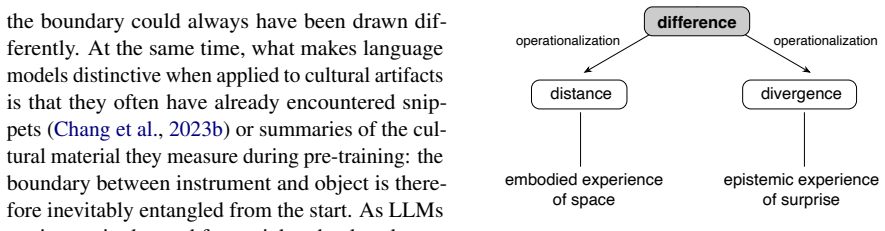
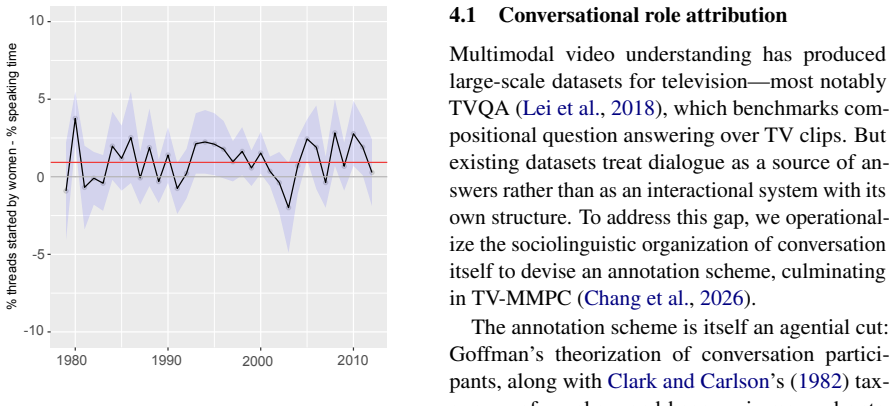
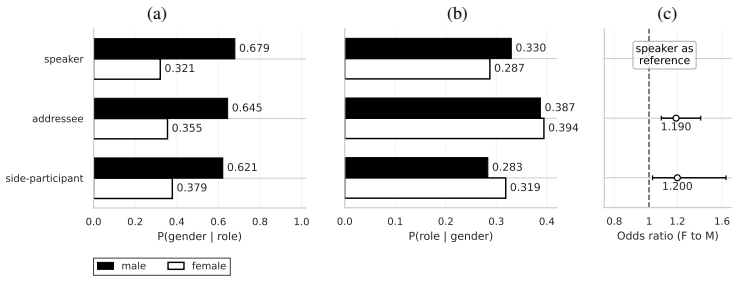
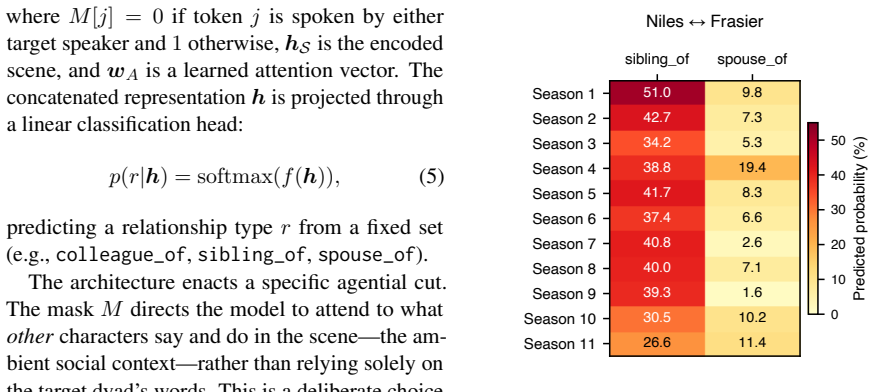
Language models are increasingly used to quantify cultural phenomena, but what makes such measurement distinctively cultural? This paper argues that NLP work on culture is a material-discursive practice: the apparatus -- model, data, annotation, evaluation -- participates in constituting the cultural reality it measures, rather than passively recording it. Drawing on Karen Barad's concept of the agential cut -- the contingent boundary between phenomenon and instrument -- I show that the apparatus's substantive design choices draw such boundaries, and that the boundary is entangled from the start because language models have already internalized much of the cultural material they measure. I illustrate this through three case studies on television and film dialogue (measuring structure, interaction, and deviation) and three examinations of the apparatus itself (erasure of cultural markers, attunement to historical material, and agency in an agentic workflow). This big picture analysis proposes a research program that is theory-driven, empirically rigorous, and culturally contingent, treating each agential cut as a conscious commitment, at once methodological and ethical.
Editorial analysis
A structured set of objections, weighed in public.
Referee Report
Summary. The paper claims that language models used to quantify cultural phenomena are material-discursive practices in which the apparatus (model, data, annotation, evaluation) participates in constituting the cultural reality it measures rather than passively recording it. Drawing on Karen Barad's agential cut, it argues that design choices draw contingent boundaries entangled with internalized cultural material, illustrated via three case studies on TV/film dialogue (structure, interaction, deviation) and three apparatus examinations (erasure of markers, attunement to historical material, agency in workflows). It proposes a theory-driven, empirically rigorous, culturally contingent research program treating each cut as a methodological and ethical commitment.
Significance. If the interpretive framework holds, the paper could promote more reflexive NLP practices on culture by framing measurement choices as constitutive and ethically loaded. It integrates philosophical concepts with domain examples in a way that might encourage theory-driven work, though its significance is constrained by the absence of quantitative benchmarks or falsifiable distinctions that would differentiate the agential-cut account from standard bias analyses.
major comments (2)
- [case studies on television and film dialogue] The three case studies on television and film dialogue (measuring structure, interaction, and deviation) remain interpretive illustrations; they do not isolate a constitutive effect of the agential cut via controlled comparisons, ablation of apparatus components, or tests that would fail under a purely representational account of measurement variance.
- [examinations of the apparatus itself] The three examinations of the apparatus (erasure of cultural markers, attunement to historical material, agency in agentic workflow) apply Barad's framework without providing a technical mapping from specific NLP mechanisms (e.g., tokenization schemes or loss functions) to intra-actions that alter the ontology of the cultural object in a distinguishable manner.
minor comments (1)
- The abstract states the central claim and case-study topics but does not preview any quantitative or formal results, which may leave readers unclear on the empirical rigor promised in the proposed research program.
Simulated Author's Rebuttal
We thank the referee for the detailed and constructive report. The feedback correctly identifies that our case studies and apparatus examinations are primarily interpretive and conceptual rather than providing controlled empirical isolation or fine-grained technical mappings. We address each point below and propose targeted revisions to improve clarity while preserving the paper's theoretical focus on proposing an agential-realist research program.
read point-by-point responses
-
Referee: [case studies on television and film dialogue] The three case studies on television and film dialogue (measuring structure, interaction, and deviation) remain interpretive illustrations; they do not isolate a constitutive effect of the agential cut via controlled comparisons, ablation of apparatus components, or tests that would fail under a purely representational account of measurement variance.
Authors: We agree that the case studies function as interpretive illustrations rather than controlled experiments that isolate constitutive effects through ablations or falsification tests against representational accounts. The manuscript's intent is to ground Barad's agential cut in existing NLP practices on cultural data to motivate a broader research program, not to deliver quantitative differentiation from bias analyses in this work. We will revise the relevant sections to state this illustrative purpose more explicitly and to sketch example future experiments (e.g., ablation of annotation protocols) that could test for distinguishable ontological effects. revision: partial
-
Referee: [examinations of the apparatus itself] The three examinations of the apparatus (erasure of cultural markers, attunement to historical material, agency in agentic workflow) apply Barad's framework without providing a technical mapping from specific NLP mechanisms (e.g., tokenization schemes or loss functions) to intra-actions that alter the ontology of the cultural object in a distinguishable manner.
Authors: The examinations apply the framework at a conceptual level to demonstrate entanglement between apparatus design and cultural material. A detailed technical mapping from mechanisms such as tokenization or loss functions to specific intra-actions would require an engineering-oriented follow-up study outside the current scope. We will add a short forward-looking paragraph acknowledging this gap and indicating how such mappings could be pursued (e.g., by varying tokenizers and tracing effects on cultural marker preservation). revision: partial
Circularity Check
No significant circularity; external philosophical framework applied to interpretive case studies
full rationale
The paper's central argument applies Karen Barad's independently developed philosophical concept of the agential cut to NLP cultural measurement practices and illustrates the point via case studies on television/film dialogue plus apparatus examinations. No equations, fitted parameters, predictions, or self-citations appear in the provided text that would reduce any claim to its own inputs by construction. The derivation remains self-contained because it relies on an external philosophical source rather than a closed loop of the paper's own measurements or prior author results.
Axiom & Free-Parameter Ledger
axioms (1)
- domain assumption Karen Barad's concept of the agential cut applies directly to language-model measurement of culture
Reference graph
Works this paper leans on
-
[1]
Maria Antoniak, Anjalie Field, Jimin Mun, Melanie Walsh, Lauren Klein, and Maarten Sap. 2023. https://doi.org/10.18653/v1/2023.acl-demo.36 Riveter: Measuring power and social dynamics between entities . In Proceedings of the 61st Annual Meeting of the Association for Computational Linguistics (Volume 3: System Demonstrations), pages 377--388, Toronto, Can...
-
[2]
Chang, Allison Cooper, Juishan Hsu, Reina Kushihashi, Madison Mar, Arnav Podichetty, Rachael Samberg, Ipek Nil Sancak, and Yuhan Shao
David Bamman, Kent K. Chang, Allison Cooper, Juishan Hsu, Reina Kushihashi, Madison Mar, Arnav Podichetty, Rachael Samberg, Ipek Nil Sancak, and Yuhan Shao. 2026. https://people.ischool.berkeley.edu/ dbamman/pubs/pdf/chnb.pdf Evaluating multimodal narrative understanding of popular hollywood films . Preprint
2026
-
[3]
David Bamman, Kent K Chang, Li Lucy, and Naitian Zhou. 2024. On classification with large language models in cultural analytics. In Proceedings of the Computational Humanities Research Conference 2024, Aarhus, Denmark
2024
-
[4]
Karen Barad. 2007. Meeting the Universe Halfway: Quantum Physics and the Entanglement of Matter and Meaning. Duke University Press, Durham, NC
2007
-
[5]
Monika Bednarek. 2023. Language and Characterisation in Television Series: A Corpus-informed Approach to the Construction of Social Identity in the Media. John Benjamins Publishing Company
2023
-
[6]
Iz Beltagy, Matthew E Peters, and Arman Cohan. 2020. Longformer: The long-document transformer. arXiv [cs.CL]
2020
-
[7]
Katherine Bode. 2020. Why You Can ’t Model Away Bias . Modern Language Quarterly, 80(3)
2020
-
[8]
John Seely Brown and Paul Duguid. 2000. The Social Life of Information. Harvard Business Review Press, Boston, MA
2000
-
[9]
Judith Butler. 1990. Gender Trouble: Feminism and the Subversion of Identity. Routledge, NY. [ Cassirer(2014 [1923]) ] Cassirer1923-yh Ernst Cassirer. 2014 [1923]. The concept of symbolic form in the construction of the human sciences. In The Warburg Years (1919–1933): Essays on Language, Art, Myth, and Technology. Yale University Press
1990
-
[10]
Chang, Danica Chen, and David Bamman
Kent K. Chang, Danica Chen, and David Bamman. 2023 a . https://doi.org/10.18653/v1/2023.findings-acl.248 Dramatic conversation disentanglement . In Findings of the Association for Computational Linguistics: ACL 2023, pages 4020--4046, Toronto, Canada. Association for Computational Linguistics
-
[11]
Chang, Mackenzie Cramer, Sandeep Soni, and David Bamman
Kent K. Chang, Mackenzie Cramer, Sandeep Soni, and David Bamman. 2023 b . https://doi.org/10.18653/v1/2023.emnlp-main.453 Speak, memory: An archaeology of books known to C hat GPT / GPT -4 . In Proceedings of the 2023 Conference on Empirical Methods in Natural Language Processing, pages 7312--7327, Singapore. Association for Computational Linguistics
-
[12]
Chang, Mackenzie Hanh Cramer, Anna Ho, Ti Ti Nguyen, Yilin Yuan, and David Bamman
Kent K. Chang, Mackenzie Hanh Cramer, Anna Ho, Ti Ti Nguyen, Yilin Yuan, and David Bamman. 2026. https://doi.org/10.18653/v1/2026.eacl-long.349 Multimodal conversation structure understanding . In Proceedings of the 19th Conference of the E uropean Chapter of the A ssociation for C omputational L inguistics (Volume 1: Long Papers) , pages 7437--7458, Raba...
-
[13]
Chang and Simon DeDeo
Kent K. Chang and Simon DeDeo. 2020. Divergence and the complexity of difference in text and culture. Journal of Cultural Analytics, 4(11):1--36
2020
-
[14]
Chang, Anna Ho, and David Bamman
Kent K. Chang, Anna Ho, and David Bamman. 2024. Subversive characters and stereotyping readers: Characterizing queer relationalities with dialogue-based relation extraction. In Proceedings of the Computational Humanities Research Conference 2024, Aarhus, Denmark
2024
-
[15]
Yu Ying Chiu, Liwei Jiang, Bill Yuchen Lin, Chan Young Park, Shuyue Stella Li, Sahithya Ravi, Mehar Bhatia, Maria Antoniak, Yulia Tsvetkov, Vered Shwartz, and Yejin Choi. 2025. https://doi.org/10.18653/v1/2025.acl-long.1247 C ultural B ench: A robust, diverse and challenging benchmark for measuring LM s' cultural knowledge through human- AI red-teaming . ...
-
[16]
Clark and Thomas B
Herbert H. Clark and Thomas B. Carlson. 1982. Hearers and speech acts. Language, 58(2)
1982
-
[17]
John M Clum. 1999. Something for the Boys . St. Martin's Press, New York
1999
-
[18]
Jonathan Culpeper. 2001. Language and Characterisation: People in Plays and Other Texts. Longman
2001
-
[19]
Cristian Danescu-Niculescu-Mizil and Lillian Lee. 2011. Chameleons in Imagined Conversations: A New Approach to Understanding Coordination of Linguistic Style in Dialogs . In Proceedings of the 2nd Workshop on Cognitive Modeling and Computational Linguistics , pages 76--87, Portland, Oregon, USA. Association for Computational Linguistics
2011
-
[20]
Jacob Devlin, Ming-Wei Chang, Kenton Lee, and Kristina Toutanova. 2019. https://doi.org/10.18653/v1/N19-1423 BERT : Pre-training of deep bidirectional transformers for language understanding . In Proceedings of the 2019 Conference of the North A merican Chapter of the Association for Computational Linguistics: Human Language Technologies, Volume 1 (Long a...
-
[21]
James E. Dobson. 2025. Beyond computational formalism or, architecture matters. Journal of Cultural Analytics, 10(3)
2025
-
[22]
Micha Elsner and Eugene Charniak. 2008. You Talking to Me? A Corpus and Algorithm for Conversation Disentanglement . In Proceedings of ACL-08 : HLT , pages 834--842, Columbus, Ohio. Association for Computational Linguistics
2008
-
[23]
Susan Ervin-Tripp. 1964. An analysis of the interaction of language, topic, and listener . American anthropologist, 66(6\_PART2):86--102
1964
-
[24]
Nikhil Garg, Londa Schiebinger, Dan Jurafsky, and James Zou. 2018. Word embeddings quantify 100 years of gender and ethnic stereotypes. Proceedings of the National Academy of Sciences, 115(16)
2018
-
[25]
Clifford Geertz. 1973. Interpretation of Cultures. Basic Books, New York, NY
1973
-
[26]
Gemini Team , Rohan Anil, Sebastian Borgeaud, Jean-Baptiste Alayrac, Jiahui Yu, Radu Soricut, Johan Schalkwyk, Andrew M Dai, Anja Hauth, Katie Millican, David Silver, Melvin Johnson, Ioannis Antonoglou, Julian Schrittwieser, Amelia Glaese, Jilin Chen, Emily Pitler, Timothy Lillicrap, Angeliki Lazaridou, and 1331 others. 2023. Gemini: A family of highly ca...
2023
-
[27]
Gemma Team , Thomas Mesnard, Cassidy Hardin, Robert Dadashi, Surya Bhupatiraju, Shreya Pathak, Laurent Sifre, Morgane Rivière, Mihir Sanjay Kale, Juliette Love, Pouya Tafti, Léonard Hussenot, Pier Giuseppe Sessa, Aakanksha Chowdhery, Adam Roberts, Aditya Barua, Alex Botev, Alex Castro-Ros, Ambrose Slone, and 89 others. 2024. Gemma: Open models based on ge...
2024
-
[28]
Charles Goodwin. 1981. Conversational organization: Interaction between speakers and hearers . Academic Press
1981
-
[29]
Aaron Grattafiori, Abhimanyu Dubey, Abhinav Jauhri, Abhinav Pandey, Abhishek Kadian, Ahmad Al-Dahle, Aiesha Letman, Akhil Mathur, Alan Schelten, Alex Vaughan, Amy Yang, Angela Fan, Anirudh Goyal, Anthony Hartshorn, Aobo Yang, Archi Mitra, Archie Sravankumar, Artem Korenev, Arthur Hinsvark, and 542 others. 2024. The llama 3 herd of models. arXiv [cs.AI]
2024
-
[30]
David M Halperin. 2002. How to Do the History of Homosexuality . Univ. of Chicago Press, Chicago
2002
-
[31]
Andrew Halterman and Katherine A Keith. 2025. What is a protest anyway? codebook conceptualization is still a first-order concern in LLM -era classification. arXiv [cs.CL]
2025
-
[32]
Hamilton, Jure Leskovec, and Dan Jurafsky
William L. Hamilton, Jure Leskovec, and Dan Jurafsky. 2016. https://doi.org/10.18653/v1/P16-1141 Diachronic word embeddings reveal statistical laws of semantic change . In Proceedings of the 54th Annual Meeting of the Association for Computational Linguistics (Volume 1: Long Papers), pages 1489--1501, Berlin, Germany. Association for Computational Linguistics
-
[33]
Agnes Weiyun He and Vimala Herman. 1998. Dramatic discourse: Dialogue as interaction in plays . Language, 74(2):384
1998
-
[34]
David L. Hirst. 1979. Comedy of Manners. Methuen, London
1979
-
[35]
hooks, bell . 1992. Black Looks: Race and Representation. South End Press
1992
-
[36]
Jyun-Yu Jiang, Francine Chen, Yan-Ying Chen, and Wei Wang. 2018. Learning to Disentangle Interleaved Conversational Threads with a Siamese Hierarchical Network and Similarity Ranking . In Proceedings of the 2018 Conference of the North A merican Chapter of the Association for Computational Linguistics: Human Language Technologies, Volume 1 (Long Papers) ,...
2018
-
[37]
Cody Kommers, Drew Hemment, Maria Antoniak, Joel Z Leibo, Hoyt Long, Emily Robinson, and Adam Sobey. 2025. Meaning is not a metric: Using LLMs to make cultural context legible at scale. arXiv [cs.CL]
2025
-
[38]
Sarah Kozloff. 2000. Overhearing Film Dialogue . University of California Press
2000
-
[39]
Kozlowski, Matt Taddy, and James A
Austin C. Kozlowski, Matt Taddy, and James A. Evans. 2019. The geometry of culture: Analyzing the meanings of class through word embeddings. American Sociological Review, 84(5)
2019
-
[40]
Jonathan K Kummerfeld, Sai R Gouravajhala, Joseph J Peper, Vignesh Athreya, Chulaka Gunasekara, Jatin Ganhotra, Siva Sankalp Patel, Lazaros C Polymenakos, and Walter Lasecki. 2019. A Large-Scale Corpus for Conversation Disentanglement
2019
-
[41]
Robin Tolmach Lakoff and Deborah Tannen. 1984. Conversational strategy and metastrategy in a pragmatic theory: The example of Scenes from a Marriage . Semiotica, 49(3-4):323--346
1984
-
[42]
Jie Lei, Licheng Yu, Mohit Bansal, and Tamara L. Berg. 2018. TVQA : Localized, compositional video question answering. In Proceedings of the 2018 Conference on Empirical Methods in Natural Language Processing. Association for Computational Linguistics
2018
-
[43]
Gonz \'a lez, Manuel Montes, Hugo Jair Escalante, and Thamar Solorio
Adrian Pastor L \'o pez-Monroy, Fabio A. Gonz \'a lez, Manuel Montes, Hugo Jair Escalante, and Thamar Solorio. 2018. Early text classification using multi-resolution concept representations. In Proceedings of the 2018 Conference of the North A merican Chapter of the Association for Computational Linguistics: Human Language Technologies, Volume 1 (Long Pap...
2018
-
[44]
Li Lucy, Divya Tadimeti, and David Bamman. 2022. Discovering differences in the representation of people using contextualized semantic axes. In Proceedings of the 2022 Conference on Empirical Methods in Natural Language Processing. Association for Computational Linguistics
2022
-
[45]
Alex Mallen, Akari Asai, Victor Zhong, Rajarshi Das, Daniel Khashabi, and Hannaneh Hajishirzi. 2023. https://doi.org/10.18653/v1/2023.acl-long.546 When not to trust language models: Investigating effectiveness of parametric and non-parametric memories . In Proceedings of the 61st Annual Meeting of the Association for Computational Linguistics (Volume 1: L...
-
[46]
Enrique Manjavacas Arevalo and Lauren Fonteyn. 2021. M ac BERT h: Development and evaluation of a historically pre-trained language model for E nglish (1450--1950). In Proceedings of the Workshop on Natural Language Processing for Digital Humanities, pages 23--36
2021
-
[47]
Gerald Mast. 1975. The Comic Mind: Comedy and the Movies. Bobbs-Merrill, Indianapolis
1975
-
[48]
Robert McKee. 2016. Dialogue: The art of verbal action for page, stage, and screen . Hachette UK
2016
-
[49]
Tess McNulty and Laura Alice Chapot. 2025. Computation and form, reconsidered. Journal of Cultural Analytics, 10(3)
2025
-
[50]
Franco Moretti. 2013. Operationalizing: or, the function of measurement in modern literary theory. New Left Review, 84:103--119
2013
-
[51]
Sik H Ng and James J Bradac. 1993. Power in Language: Verbal Communication and Social Influence . SAGE Publications
1993
-
[52]
Andrew Piper. 2016. There will be numbers. Journal of cultural analytics
2016
-
[53]
Andrew Piper. 2017. Think small: On literary modeling. PMLA, 132(3):651--658
2017
-
[54]
Kay Richardson. 2010. Television Dramatic Dialogue: A Sociolinguistic Study . Oxford University Press
2010
-
[55]
Marjorie Rosen. 1973. Popcorn Venus; Women, Movies and the American Dream. Coward, McCann and Geoghegan
1973
-
[56]
Harvey Sacks, Emanuel A Schegloff, and Gail Jefferson. 1974. A Simplest Systematics for the Organization of Turn-Taking for Conversation . Language, 50(4):696--735
1974
-
[57]
Maarten Sap, Marcella Cindy Prasettio, Ari Holtzman, Hannah Rashkin, and Yejin Choi. 2017. Connotation frames of power and agency in modern films. In Proceedings of the 2017 Conference on Empirical Methods in Natural Language Processing, pages 2329--2334. Association for Computational Linguistics
2017
-
[58]
Eve Kosofsky Sedgwick. 2003. Touching Feeling . Duke University Press
2003
-
[59]
Ted Underwood. 2019. Distant Horizons: Digital Evidence and Literary Change. University of Chicago Press, Chicago, IL
2019
-
[60]
Feder Cooper, Angelina Wang, Chad Atalla, Solon Barocas, Su Lin Blodgett, Alexandra Chouldechova, Emily Corvi, P
Hanna Wallach, Meera Desai, A. Feder Cooper, Angelina Wang, Chad Atalla, Solon Barocas, Su Lin Blodgett, Alexandra Chouldechova, Emily Corvi, P. Alex Dow, Jean Garcia-Gathright, Alexandra Olteanu, Nicholas J Pangakis, Stefanie Reed, Emily Sheng, Dan Vann, Jennifer Wortman Vaughan, Matthew Vogel, Hannah Washington, and Abigail Z. Jacobs. 2025. https://proc...
2025
-
[61]
Kaitlyn Zhou, Haishan Gao, Sarah Li Chen, Dan Edelstein, Dan Jurafsky, and Chen Shani. 2025 a . https://doi.org/10.18653/v1/2025.naacl-long.299 Rethinking word similarity: Semantic similarity through classification confusion . In Proceedings of the 2025 Conference of the Nations of the Americas Chapter of the Association for Computational Linguistics: Hum...
-
[62]
Naitian Zhou, David Bamman, and Isaac L. Bleaman. 2025 b . https://doi.org/10.18653/v1/2025.acl-long.1256 Culture is not trivia: Sociocultural theory for cultural NLP . In Proceedings of the 63rd Annual Meeting of the Association for Computational Linguistics (Volume 1: Long Papers), pages 25869--25886, Vienna, Austria. Association for Computational Linguistics
-
[63]
Rongxin Zhu, Jey Han Lau, and Jianzhong Qi. 2021. Findings on Conversation Disentanglement . In Proceedings of the The 19th Annual Workshop of the Australasian Language Technology Association , pages 1--11, Online. Australasian Language Technology Association
2021
discussion (0)
Sign in with ORCID, Apple, or X to comment. Anyone can read and Pith papers without signing in.