Probabilistic Memory for Trustworthy Edge Intelligence
Pith reviewed 2026-07-03 03:32 UTC · model grok-4.3
The pith
Probabilistic memory stores distribution parameters and samples Gaussians directly at native memory bandwidth.
A machine-rendered reading of the paper's core claim, the machinery that carries it, and where it could break.
Core claim
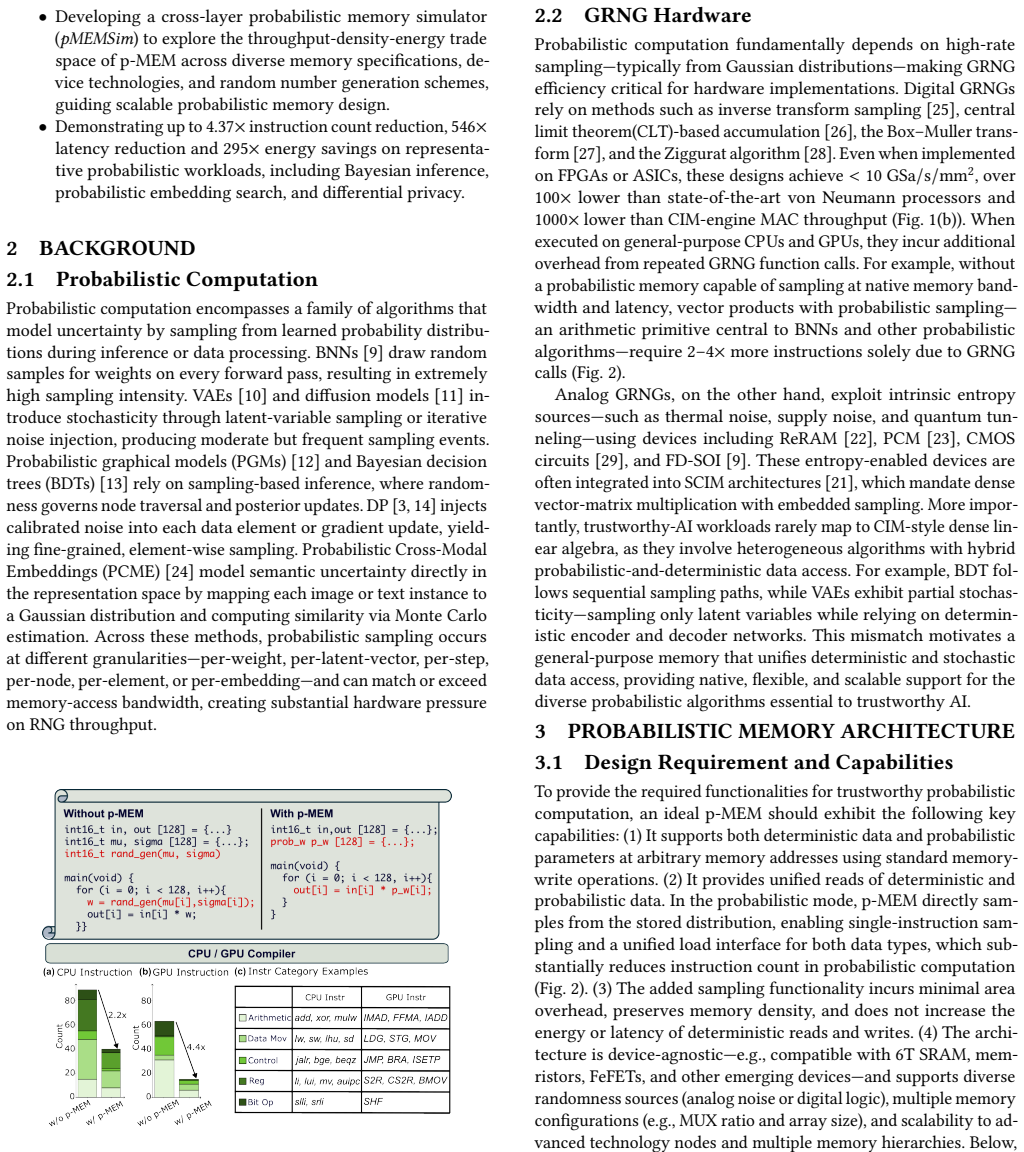
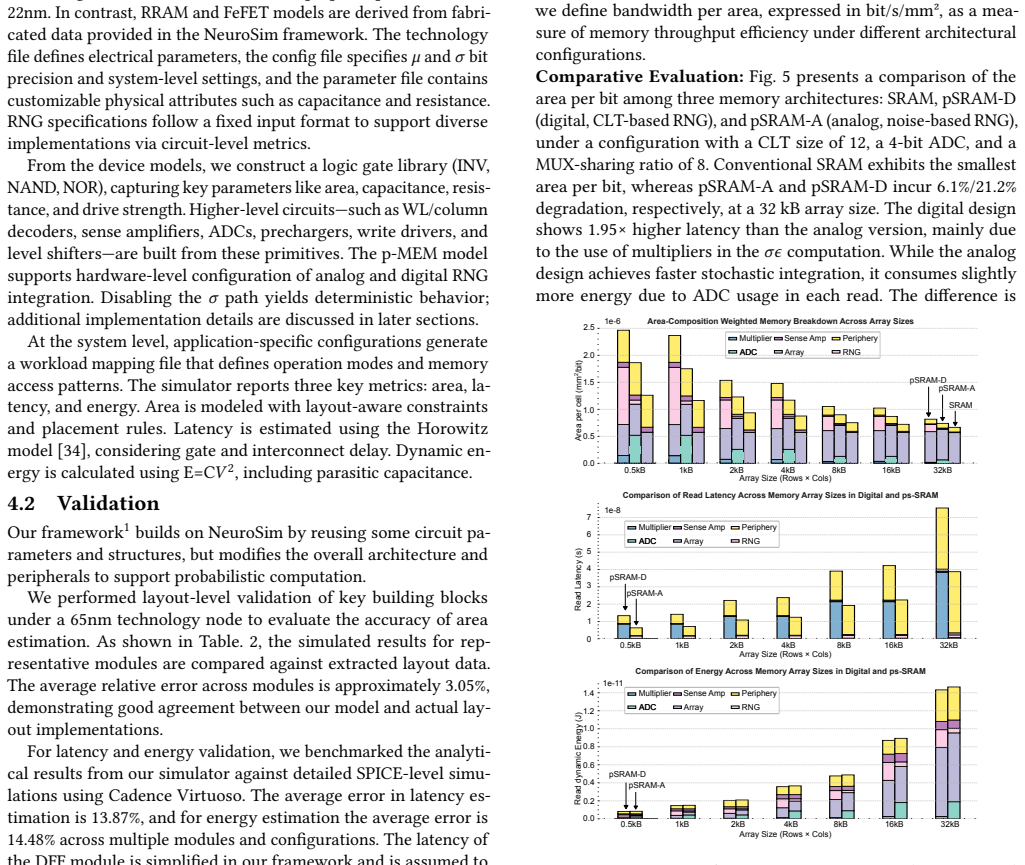
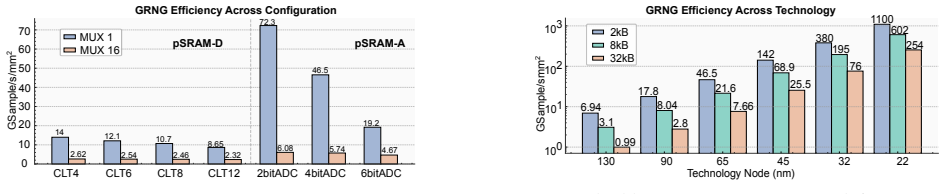
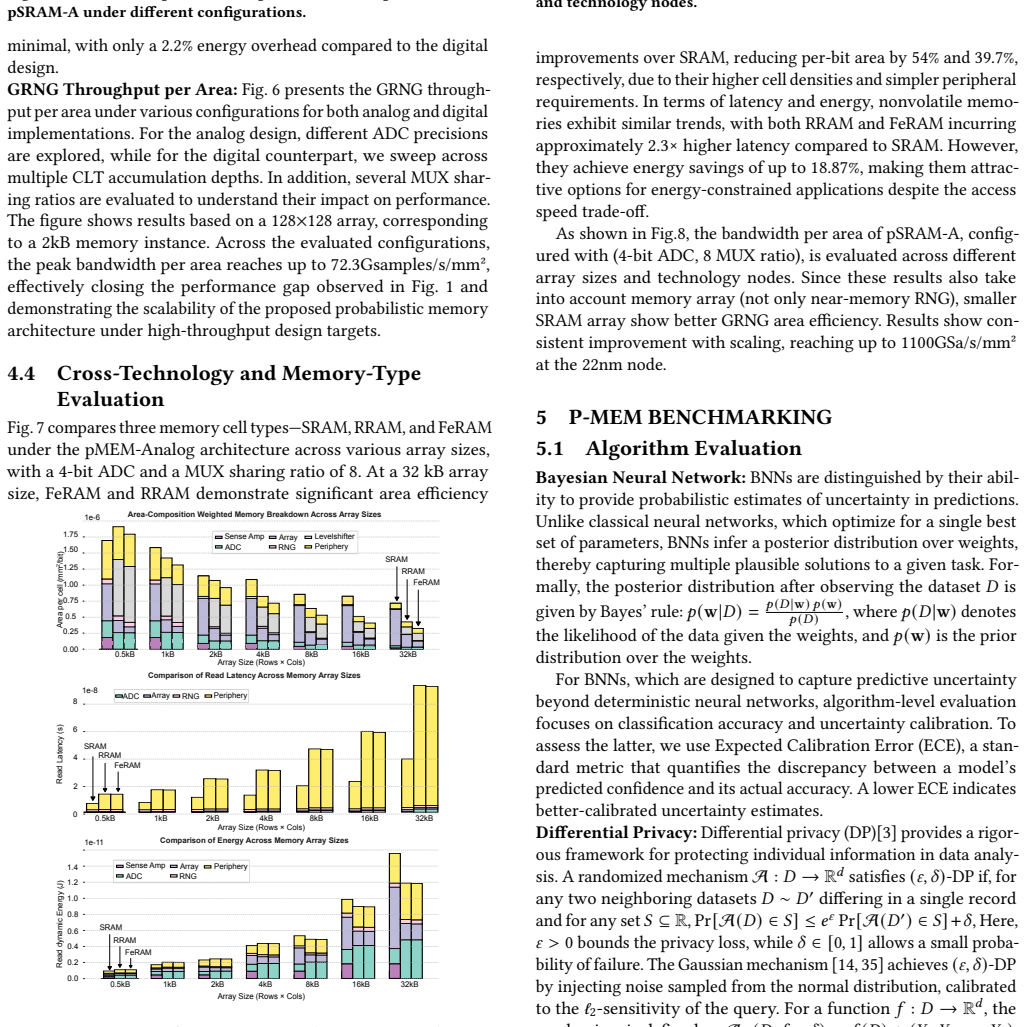
p-MEM is a unified memory primitive that stores distribution parameters and samples directly at the native memory bandwidth, where deterministic data becomes the zero-variance special case. Using a layout-validated simulator, p-MEM achieves more than 1000 GSa/s/mm² GRNG throughput including memory-array access. Integrated into CPU/GPU systems it reduces instruction count by up to 2.19x/4.37x, sampling latency by 562x/3.45x, and energy by 295.5x/3.53x for Bayesian neural network workloads.
What carries the argument
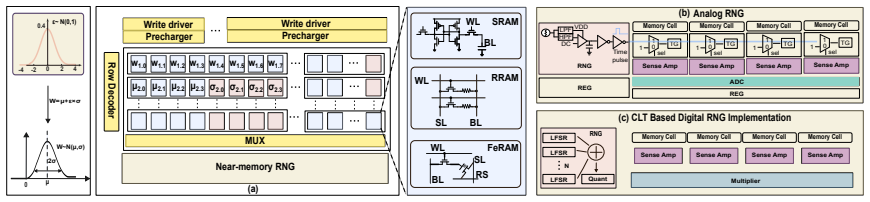
p-MEM, a memory array that stores mean and standard deviation parameters and performs on-array Gaussian sampling at native bandwidth.
Load-bearing premise
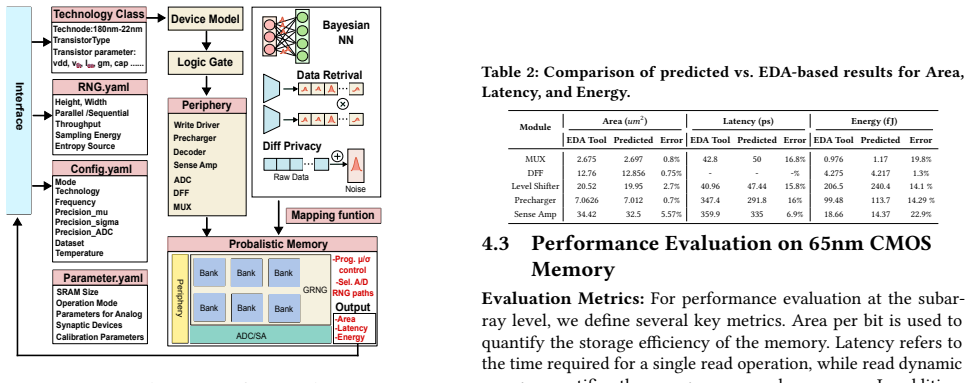
The layout-validated simulator accurately captures real silicon behavior for the chosen device technologies, memory specifications, and technology nodes without unmodeled parasitics or fabrication variations.
What would settle it
Fabricate a p-MEM test chip in one of the simulated technology nodes and measure its actual GRNG throughput, latency, and energy against the simulator predictions under identical workload conditions.
Figures
read the original abstract
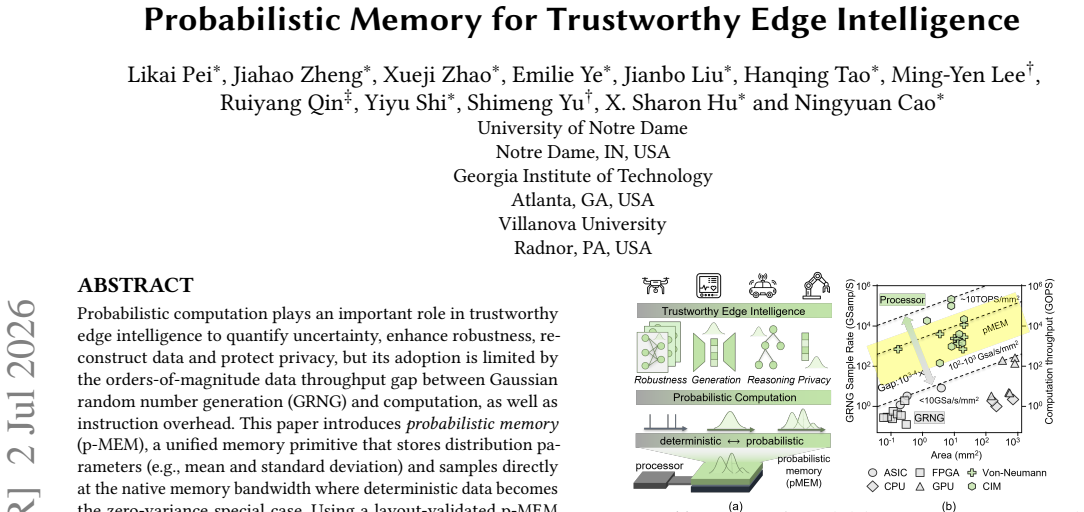
Probabilistic computation plays an important role in trustworthy edge intelligence to quantify uncertainty, enhance robustness, reconstruct data, and protect privacy, but its adoption is limited by the orders-of-magnitude data throughput gap between Gaussian random number generation (GRNG) and computation, as well as instruction overhead. This paper introduces probabilistic memory (p-MEM), a unified memory primitive that stores distribution parameters, such as mean and standard deviation, and samples directly at the native memory bandwidth, where deterministic data becomes the zero-variance special case. Using a layout-validated p-MEM simulator, we comprehensively explore device choices, memory specifications, and technology nodes, showing that p-MEM can achieve more than 1000 GSa/s/mm^2 GRNG throughput, including memory-array access. Integrated into CPU/GPU systems, p-MEM reduces instruction count by up to 2.19x/4.37x, sampling latency by 562x/3.45x, and energy by 295.5x/3.53x for Bayesian neural network workloads, providing a scalable hardware substrate for trustworthy probabilistic AI.
Editorial analysis
A structured set of objections, weighed in public.
Referee Report
Summary. The paper introduces probabilistic memory (p-MEM) as a unified memory primitive that stores distribution parameters (e.g., mean and standard deviation) and performs direct sampling at native memory bandwidth, treating deterministic data as the zero-variance case. Using a layout-validated p-MEM simulator, it explores device choices, memory specifications, and technology nodes to claim >1000 GSa/s/mm² GRNG throughput (including array access). When integrated into CPU/GPU systems, p-MEM yields up to 2.19×/4.37× instruction count reduction, 562×/3.45× sampling latency reduction, and 295.5×/3.53× energy reduction for Bayesian neural network workloads.
Significance. If the simulator results translate to silicon, p-MEM would offer a scalable hardware substrate for trustworthy probabilistic edge AI by closing the GRNG throughput gap. A strength is the comprehensive parameter exploration across devices, specs, and nodes using layout validation; no machine-checked proofs or parameter-free derivations are present.
major comments (1)
- [p-MEM simulator and integration results sections] The headline claims (>1000 GSa/s/mm² throughput and the 2.19–562× integrated speedups) are generated exclusively by the authors' layout-validated simulator. Layout validation confirms geometric/electrical correctness but does not capture process variation, mismatch, temperature-dependent leakage, or interconnect parasitics that appear post-fabrication; this assumption is load-bearing for all quantitative results.
minor comments (1)
- [Abstract] Abstract does not include error bars, sensitivity analysis on device parameters, or direct silicon baseline comparisons for the largest speedups.
Simulated Author's Rebuttal
We thank the referee for highlighting the scope of our simulator validation. We agree that layout validation provides geometric and electrical correctness but does not model post-fabrication effects, and we will revise the manuscript to explicitly address this limitation and its implications for the quantitative claims.
read point-by-point responses
-
Referee: [p-MEM simulator and integration results sections] The headline claims (>1000 GSa/s/mm² throughput and the 2.19–562× integrated speedups) are generated exclusively by the authors' layout-validated simulator. Layout validation confirms geometric/electrical correctness but does not capture process variation, mismatch, temperature-dependent leakage, or interconnect parasitics that appear post-fabrication; this assumption is load-bearing for all quantitative results.
Authors: We acknowledge that the reported throughput and speedup figures are derived from a layout-validated simulator that ensures geometric and electrical fidelity at the cell and array level but omits post-silicon phenomena including process variation, device mismatch, temperature-dependent leakage, and interconnect parasitics. These omissions mean the numbers represent idealized pre-fabrication performance. In the revised manuscript we will (1) add a new subsection under Evaluation that enumerates these assumptions, (2) qualify all headline metrics as upper-bound estimates under nominal conditions, and (3) include a brief sensitivity discussion based on published variation models for the explored device technologies. This revision directly addresses the concern while preserving the value of the comprehensive pre-silicon design-space exploration. revision: yes
Circularity Check
No circularity: performance claims rest on simulator outputs, not self-referential equations or citations
full rationale
The paper's headline throughput and speedup numbers are produced by running the authors' layout-validated p-MEM simulator across device choices and nodes. No equations, fitted parameters, or self-citations are shown that would make any claimed quantity equivalent to its own inputs by construction. The work does not invoke prior self-authored uniqueness theorems, smuggle ansatzes, or rename known results as new derivations. The simulator is treated as an external evaluation tool rather than a definitional loop, satisfying the criteria for a self-contained (non-circular) result.
Axiom & Free-Parameter Ledger
axioms (1)
- domain assumption The simulator's device models and layout validation faithfully represent fabricated silicon behavior across the explored technology nodes.
invented entities (1)
-
probabilistic memory (p-MEM)
no independent evidence
Reference graph
Works this paper leans on
-
[1]
A Survey on Trustworthy Edge Intelligence: From Security and Reliability to Transparency and Sustainability.IEEE Communications Surveys & Tutorials, 27(3):1729–1757, June 2025
Xiaojie Wang, Beibei Wang, Yu Wu, Zhaolong Ning, Song Guo, and Fei Richard Yu. A Survey on Trustworthy Edge Intelligence: From Security and Reliability to Transparency and Sustainability.IEEE Communications Surveys & Tutorials, 27(3):1729–1757, June 2025
2025
-
[2]
Enciso, Boyang Cheng, Jianbo Liu, Steven Davis, Zhenge Jia, Michael Niemier, Yiyu Shi, X
Likai Pei, Yifan Qin, Zephan M. Enciso, Boyang Cheng, Jianbo Liu, Steven Davis, Zhenge Jia, Michael Niemier, Yiyu Shi, X. Sharon Hu, and Ningyuan Cao. To- wards uncertainty-quantifiable biomedical intelligence: Mixed-signal compute-in- entropy for bayesian neural networks. In2024 IEEE/ACM International Conference On Computer Aided Design (ICCAD), 2024
2024
-
[3]
Privacy-by-Sensing with Time-domain Differentially-Private Compressed Sensing
Jianbo Liu, Boyang Cheng, Pengyu Zeng, Steven Davis, Muya Chang, and Ningyuan Cao. Privacy-by-Sensing with Time-domain Differentially-Private Compressed Sensing. In2023 Design, Automation & Test in Europe Conference & Exhibition (DATE), pages 1–6, April 2023
2023
-
[4]
15.3 A 65nm Uncertainty-Quantifiable Ventricular Arrhythmia Detection Engine with \mathbf1.75\boldsymbol\mu\mathbfJ Per Inference
Jianbo Liu, Zephan Enciso, Boyang Cheng, Likai Pei, Steven Davis, Yifan Qin, Zhenge Jia, Xiaobo Sharon Hu, Yiyu Shi, and Ningyuan Cao. 15.3 A 65nm Uncertainty-Quantifiable Ventricular Arrhythmia Detection Engine with \mathbf1.75\boldsymbol\mu\mathbfJ Per Inference. In2025 IEEE International Solid-State Circuits Conference (ISSCC), volume 68, pages 1–3, Fe...
2025
-
[5]
Ahmed Abdelrazik, Mahmoud Eldesouky, Ibrahim Antoun, Edward Y. M. Lau, Abdulmalik Koya, Zakariyya Vali, Safiyyah A. Suleman, James Donaldson, and G. André Ng. Wearable Devices for Arrhythmia Detection: Advancements and Clinical Implications.Sensors (Basel, Switzerland), 25(9):2848, April 2025
2025
-
[6]
Metwally, Dalia Perelman, Heyjun Park, Yue Wu, Alokkumar Jha, Seth Sharp, Alessandra Celli, Ekrem Ayhan, Fahim Abbasi, Anna L
Ahmed A. Metwally, Dalia Perelman, Heyjun Park, Yue Wu, Alokkumar Jha, Seth Sharp, Alessandra Celli, Ekrem Ayhan, Fahim Abbasi, Anna L. Gloyn, Tracey McLaughlin, and Michael P. Snyder. Prediction of metabolic subphenotypes of type 2 diabetes via continuous glucose monitoring and machine learning.Nature Biomedical Engineering, 9(8):1222–1239, August 2025
2025
-
[7]
Diaz C, Patricio Colmegna, Elliot Pryor, and Marc D
Jenny L. Diaz C, Patricio Colmegna, Elliot Pryor, and Marc D. Breton. A Performance-Based Adaptation Index for Automated Insulin Delivery Systems. Journal of Diabetes Science and Technology, page 19322968251315499, February 2025
2025
-
[8]
Huili Yu, Kevin Meier, Matthew Argyle, and Randal W. Beard. Cooperative Path Planning for Target Tracking in Urban Environments Using Unmanned Air and Ground Vehicles.IEEE/ASME Transactions on Mechatronics, 20(2):541–552, April 2015
2015
-
[9]
Towards Uncertainty- aware Robotic Perception via Mixed-signal BNN Engine Leveraging Probabilistic Quantum Tunneling
Likai Pei, Yu Zhou, Xingtian Wang, Xueji Zhao, Wanxin Huang, Boyang Cheng, Halid Mulaosmanovic, Stefan Duenkel, Dominik Kleimaier, Sven Beyer, Kai Ni, Mengxue Hou, Michael Niemier, and Ningyuan Cao. Towards Uncertainty- aware Robotic Perception via Mixed-signal BNN Engine Leveraging Probabilistic Quantum Tunneling. In2025 62nd ACM/IEEE Design Automation C...
2025
-
[10]
Kingma and Max Welling
Diederik P. Kingma and Max Welling. Auto-Encoding Variational Bayes, Decem- ber 2022
2022
-
[11]
Denoising diffusion probabilistic models
Jonathan Ho, Ajay Jain, and Pieter Abbeel. Denoising diffusion probabilistic models. InProceedings of the 34th International Conference on Neural Information Processing Systems, NIPS ’20, pages 6840–6851, Red Hook, NY, USA, December
-
[12]
Curran Associates Inc
-
[13]
Adaptive Computation and Machine Learning Series
Daphne Koller and Nir Friedman.Probabilistic Graphical Models: Principles and Techniques. Adaptive Computation and Machine Learning Series. MIT Press, Cambridge, MA, USA, July 2009
2009
-
[14]
An Explainable Bayesian Decision Tree Algorithm.Frontiers in Applied Mathematics and Statistics, 7, March 2021
Giuseppe Nuti, Lluís Antoni Jiménez Rugama, and Andreea-Ingrid Cross. An Explainable Bayesian Decision Tree Algorithm.Frontiers in Applied Mathematics and Statistics, 7, March 2021
2021
-
[15]
The Algorithmic Foundations of Differential Privacy.Found
Cynthia Dwork and Aaron Roth. The Algorithmic Foundations of Differential Privacy.Found. Trends Theor. Comput. Sci., 9(3-4):211–407, August 2014
2014
-
[16]
In-Situ Privacy via Mixed-Signal Perturbation and Hardware-Secure Data Reversibility
Steven Davis, Jianbo Liu, Boyang Cheng, Muya Chang, and Ningyuan Cao. In-Situ Privacy via Mixed-Signal Perturbation and Hardware-Secure Data Reversibility. IEEE Transactions on Circuits and Systems I: Regular Papers, 71(6):2538–2549, June 2024
2024
-
[17]
Stochastic Mixed- Signal Circuit Design for In-Sensor Privacy
Ningyuan Cao, Jianbo Liu, Boyang Cheng, and Muya Chang. Stochastic Mixed- Signal Circuit Design for In-Sensor Privacy. InProceedings of the 41st IEEE/ACM International Conference on Computer-Aided Design, ICCAD ’22, pages 1–9, New York, NY, USA, December 2022. Association for Computing Machinery
2022
-
[18]
Enciso, Boyang Cheng, Likai Pei, Jianbo Liu, Steven Davis, Michael Niemier, and Ningyuan Cao
Zephan M. Enciso, Boyang Cheng, Likai Pei, Jianbo Liu, Steven Davis, Michael Niemier, and Ningyuan Cao. A 65 nm Bayesian Neural Network Accelerator with 360 fJ/Sample In-Word GRNG for AI Uncertainty Estimation, January 2025
2025
-
[19]
Richard Dorrance, Deepak Dasalukunte, Hechen Wang, Renzhi Liu, and Brent R. Carlton. An Energy-Efficient Bayesian Neural Network Accelerator With CiM and a Time-Interleaved Hadamard Digital GRNG Using 22-nm FinFET.IEEE Journal of Solid-State Circuits, 58(10):2826–2838, October 2023
2023
-
[20]
20.1 NVE: A 3nm 23.2TOPS/W 12b-Digital-CIM-Based Neural Engine for High-Resolution Visual- Quality Enhancement on Smart Devices
Ming-En Shih, Shih-Wei Hsieh, Ping-Yuan Tsai, Ming-Hung Lin, Pei-Kuei Tsung, En-Jui Chang, Jenwei Liang, Shu-Hsin Chang, Chung-Lun Huang, You-Yu Nian, Zhe Wan, Sushil Kumar, Cheng-Xin Xue, Gajanan Jedhe, Hidehiro Fujiwara, Haruki Mori, Chih-Wei Chen, Po-Hua Huang, Chih-Feng Juan, Chung-Yi Chen, Tsung-Yao Lin, Ch Wang, Chih-Cheng Chen, and Kevin Jou. 20.1 ...
2024
-
[21]
23.8 An 88.36TOPS/W Bit-Level-Weight-Compressed Large-Language-Model Accelerator with Cluster-Aligned INT-FP-GEMM and Bi-Dimensional Workflow Reformulation
Yubin Qin, Yang Wang, Jiachen Wang, Zhiwei Lin, Yushu Zhao, Shaojun Wei, Yang Hu, and Shouyi Yin. 23.8 An 88.36TOPS/W Bit-Level-Weight-Compressed Large-Language-Model Accelerator with Cluster-Aligned INT-FP-GEMM and Bi-Dimensional Workflow Reformulation. In2025 IEEE International Solid-State Circuits Conference (ISSCC), volume 68, pages 420–422, February 2025
2025
-
[22]
A 65-nm Digital Stochastic Compute-in-Memory CNN Processor With 8-bit Precision.IEEE Journal of Solid-State Circuits, 60(10):3749–3761, October 2025
Jiyue Yang, Tianmu Li, Wojciech Romaszkan, Puneet Gupta, and Sudhakar Pa- marti. A 65-nm Digital Stochastic Compute-in-Memory CNN Processor With 8-bit Precision.IEEE Journal of Solid-State Circuits, 60(10):3749–3761, October 2025
2025
-
[23]
ReRAM-Based Pseudo-True Random Number Genera- tor With High Throughput and Unpredictability Characteristics.IEEE Transac- tions on Electron Devices, 68(4):1593–1597, April 2021
Po-Hao Tseng, Ming-Hsiu Lee, Yu-Hsuan Lin, Hsiang-Lan Lung, Keh-Chung Wang, and Chih-Yuan Lu. ReRAM-Based Pseudo-True Random Number Genera- tor With High Throughput and Unpredictability Characteristics.IEEE Transac- tions on Electron Devices, 68(4):1593–1597, April 2021
2021
-
[24]
Self-Heating Phase- Change Memory-Array Demonstrator for True Random Number Generation
Enrico Piccinini, Rossella Brunetti, and Massimo Rudan. Self-Heating Phase- Change Memory-Array Demonstrator for True Random Number Generation. IEEE Transactions on Electron Devices, 64(5):2185–2192, May 2017
2017
-
[25]
Probabilistic embeddings for cross-modal retrieval
Sanghyuk Chun, Seong Joon Oh, Rafael Sampaio De Rezende, Yannis Kalantidis, and Diane Larlus. Probabilistic embeddings for cross-modal retrieval. InProceed- ings of the IEEE/CVF conference on computer vision and pattern recognition, pages 8415–8424, 2021
2021
-
[26]
Mervin E. Muller. An Inverse Method for The Generation of Random Normal Deviates on Large-Scale Computers.Mathematical Tables and Other Aids to Computation, 12(63):167–174, 1958
1958
-
[27]
Revisiting Central Limit Theorem: Accurate Gaussian Random Number Generation in VLSI.IEEE Transactions on Very Large Scale Integration (VLSI) Systems, 23(5):842–855, May 2015
Jamshaid Sarwar Malik, Ahmed Hemani, Jameel Nawaz Malik, Ben Silmane, and Nasirud Din Gohar. Revisiting Central Limit Theorem: Accurate Gaussian Random Number Generation in VLSI.IEEE Transactions on Very Large Scale Integration (VLSI) Systems, 23(5):842–855, May 2015
2015
-
[28]
G. E. P. Box and Mervin E. Muller. A Note on the Generation of Random Normal Deviates.The Annals of Mathematical Statistics, 29(2):610–611, June 1958
1958
-
[29]
The Ziggurat Method for Generating Random Variables.Journal of Statistical Software, 5:1–7, October 2000
George Marsaglia and Wai Wan Tsang. The Ziggurat Method for Generating Random Variables.Journal of Statistical Software, 5:1–7, October 2000
2000
-
[30]
Practical True Random Number Generator Using CMOS Image Sensor Dark Noise.IEEE Access, 7:91407–91413, 2019
Byung Kwon Park, Hojoong Park, Yong-Su Kim, Ju-Sung Kang, Yongjin Yeom, Changhui Ye, Sung Moon, and Sang-Wook Han. Practical True Random Number Generator Using CMOS Image Sensor Dark Noise.IEEE Access, 7:91407–91413, 2019
2019
-
[31]
Massey Jr
Frank J. Massey Jr. The Kolmogorov-Smirnov Test for Goodness of Fit.Journal of the American Statistical Association, 46(253):68–78, March 1951
1951
-
[32]
On Chi-Squared Goodness-of-Fit Test for Normality
Mikhail Nikulin, Léo Gerville-Réache, and Xuan Quang Tran. On Chi-Squared Goodness-of-Fit Test for Normality. InStatistical Models and Methods for Relia- bility and Survival Analysis, chapter 14, pages 213–227. John Wiley & Sons, Ltd, 2013
2013
-
[33]
Neu- roSim Simulator for Compute-in-Memory Hardware Accelerator: Validation and Benchmark.Frontiers in Artificial Intelligence, 4, June 2021
Anni Lu, Xiaochen Peng, Wantong Li, Hongwu Jiang, and Shimeng Yu. Neu- roSim Simulator for Compute-in-Memory Hardware Accelerator: Validation and Benchmark.Frontiers in Artificial Intelligence, 4, June 2021
2021
-
[34]
Predictive technology model for nano-cmos design exploration.ACM Journal on Emerging Technologies in Computing Systems (JETC), 3(1):1–es, 2007
Wei Zhao and Yu Cao. Predictive technology model for nano-cmos design exploration.ACM Journal on Emerging Technologies in Computing Systems (JETC), 3(1):1–es, 2007
2007
-
[35]
Xiangyu Dong, Cong Xu, Yuan Xie, and Norman P. Jouppi. Nvsim: A circuit- level performance, energy, and area model for emerging nonvolatile memory. IEEE Transactions on Computer-Aided Design of Integrated Circuits and Systems, 31(7):994–1007, 2012
2012
-
[36]
Lee, Kobbi Nissim, Sofya Raskhod- nikova, and Adam Smith
Shiva Prasad Kasiviswanathan, Homin K. Lee, Kobbi Nissim, Sofya Raskhod- nikova, and Adam Smith. What Can We Learn Privately?, February 2010
2010
-
[37]
Learning multiple layers of features from tiny images
Alex Krizhevsky. Learning multiple layers of features from tiny images. Technical report, University of Toronto, 2009
2009
-
[38]
Mobilenets: Effi- cient convolutional neural networks for mobile vision applications
Andrew G Howard, Menglong Zhu, Bo Chen, Dmitry Kalenichenko, Weijun Wang, Tobias Weyand, Marco Andreetto, and Hartwig Adam. Mobilenets: Effi- cient convolutional neural networks for mobile vision applications. InProceedings of the IEEE conference on computer vision and pattern recognition. IEEE, 2017
2017
-
[39]
Msr-vtt: A large video description dataset for bridging video and language
Jun Xu, Tao Mei, Ting Yao, and Yong Rui. Msr-vtt: A large video description dataset for bridging video and language. In2016 IEEE Conference on Computer Vision and Pattern Recognition (CVPR), pages 5288–5296, 2016
2016
-
[40]
Imagebind: One embedding space to bind them all
Rohit Girdhar, Alaaeldin El-Nouby, Zhuang Liu, Mannat Singh, Kalyan Vasudev Alwala, Armand Joulin, and Ishan Misra. Imagebind: One embedding space to bind them all. InProceedings of the IEEE/CVF conference on computer vision and pattern recognition, pages 15180–15190, 2023. 8
2023
discussion (0)
Sign in with ORCID, Apple, or X to comment. Anyone can read and Pith papers without signing in.