Interpretation-Oriented Cloud Removal via Observation-Anchored Residual Flow with Geo-Contextual Alignment
Pith reviewed 2026-07-03 14:51 UTC · model grok-4.3
The pith
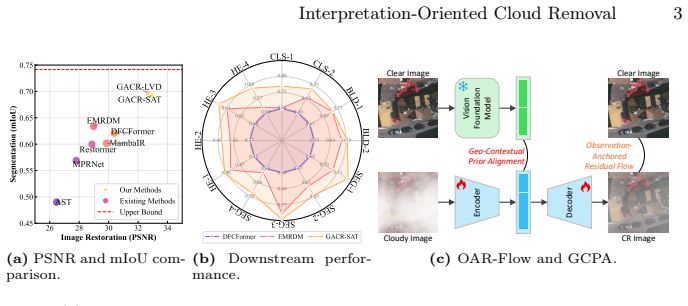
Geo-Anchored Cloud Removal anchors reconstruction to the cloudy observation and a vision foundation model semantic manifold to preserve structures for downstream interpretation.
A machine-rendered reading of the paper's core claim, the machinery that carries it, and where it could break.
Core claim
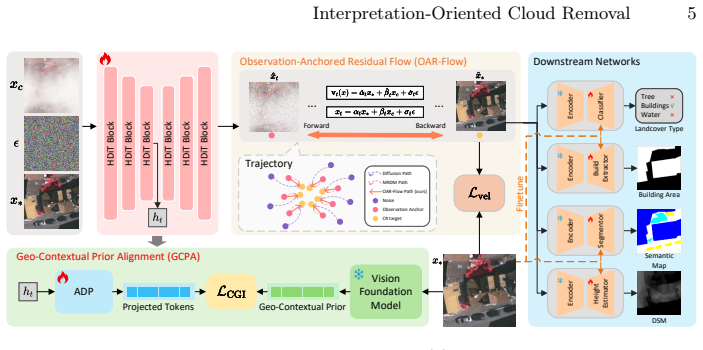
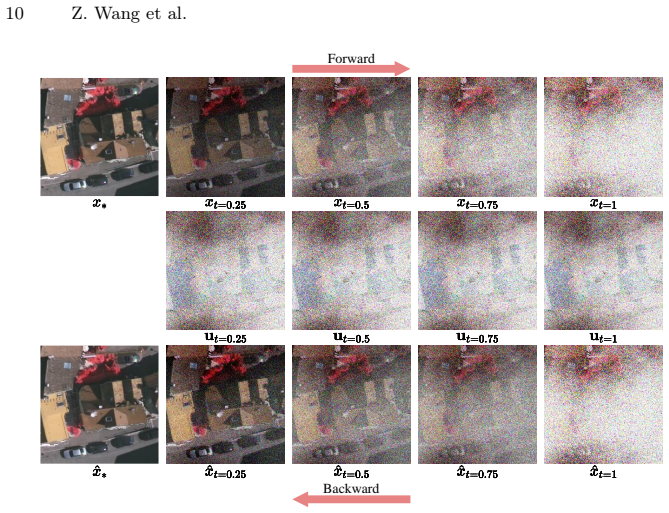
GACR jointly ensures faithful reconstruction and robust interpretability by incorporating Observation-Anchored Residual Flow, which reformulates cloud removal as a physically grounded residual inversion anchored to the cloudy observation rather than pure noise, and Geo-Contextual Prior Alignment, which constrains the generative trajectory to the semantic manifold induced by a Vision Foundation Model, thereby strictly maintaining the spatial-semantic integrity of complex landscapes.
What carries the argument
Observation-Anchored Residual Flow (OAR-Flow) as a residual inversion anchored to the cloudy observation, paired with Geo-Contextual Prior Alignment (GCPA) that projects outputs onto a vision foundation model semantic manifold.
If this is right
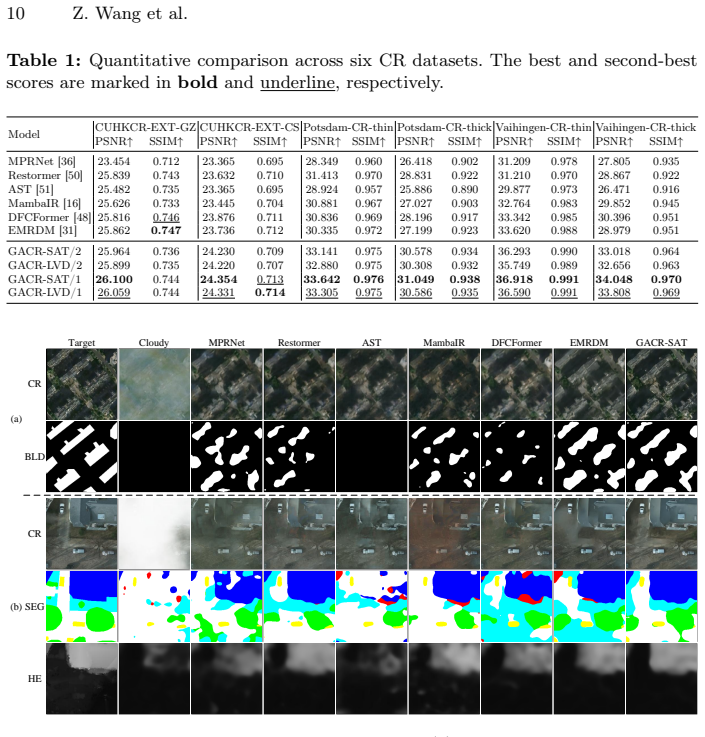
- GACR yields superior reconstruction quality on six cloud removal datasets.
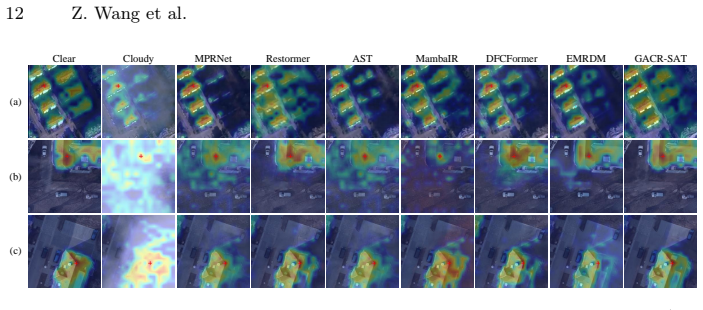
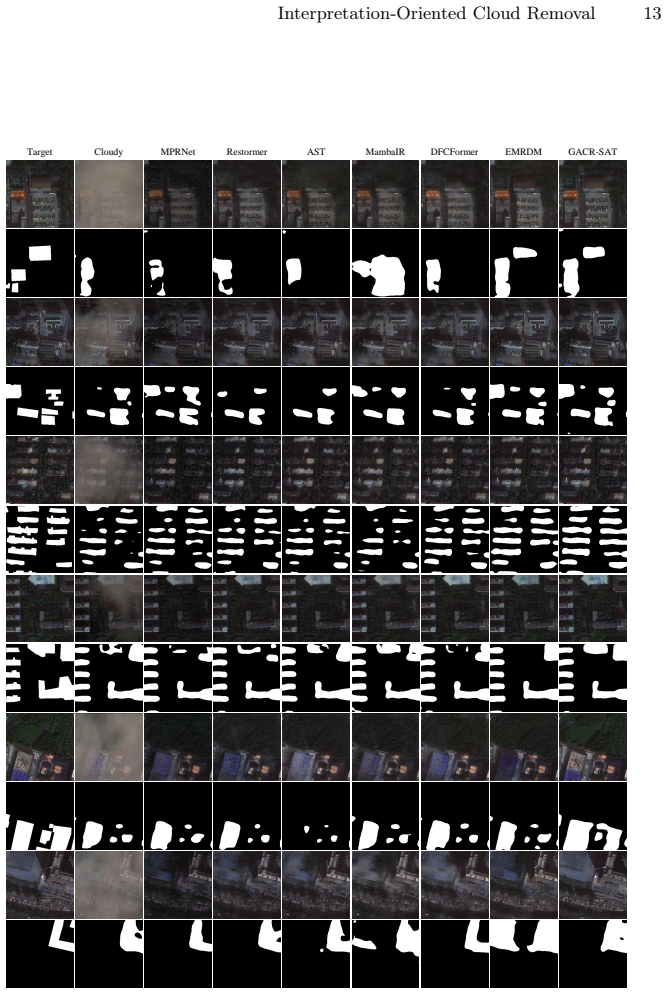
- The method improves accuracy across twelve downstream tasks including semantic segmentation and change detection.
- Anchoring the flow to the observation produces faster and more stable reconstruction than noise-initialized diffusion.
- Geo-contextual alignment eliminates semantic drift that would otherwise affect interpretation pipelines.
- The framework balances visual fidelity with interpretability in a single end-to-end process.
Where Pith is reading between the lines
- The same anchoring-plus-alignment pattern could be tested on related restoration problems such as haze removal or sensor-gap filling in remote sensing.
- Performance may vary with the choice of vision foundation model, suggesting controlled swaps of the model backbone to measure sensitivity.
- If downstream gains hold, operational remote-sensing pipelines could replace separate cloud-removal and interpretation stages with a single constrained model.
Load-bearing premise
The semantic manifold induced by a vision foundation model accurately represents the true spatial-semantic structures of landscapes and constraining reconstruction to it will not introduce new biases or errors.
What would settle it
A controlled experiment on any of the six CR datasets in which GACR outputs produce lower accuracy than a non-aligned baseline on one or more of the twelve downstream tasks, or in which land-cover labels extracted from GACR images systematically differ from ground-truth labels in ways not explained by the original cloud cover.
Figures
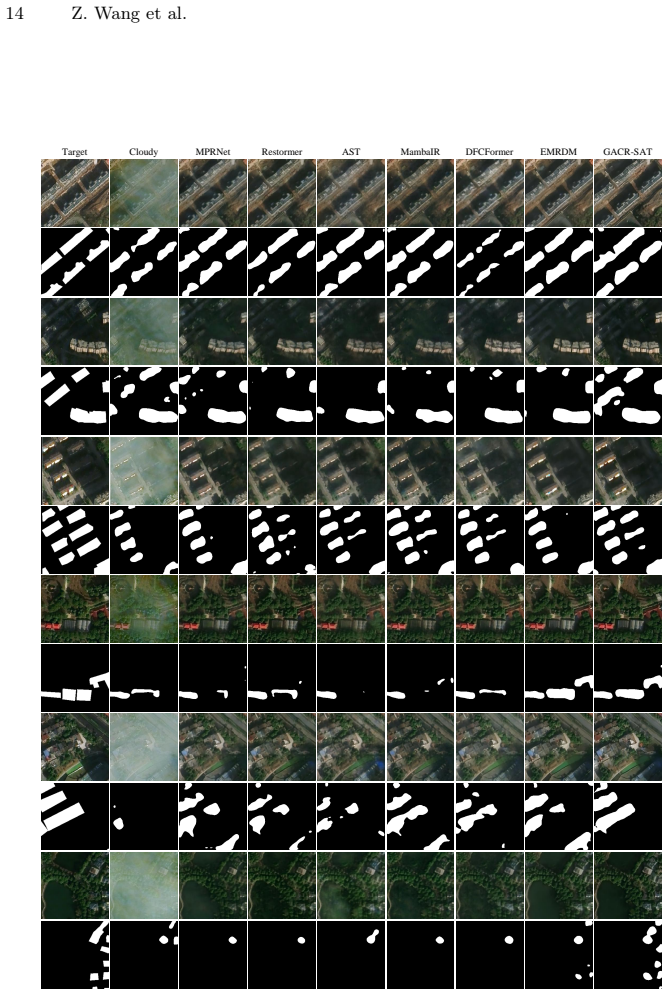
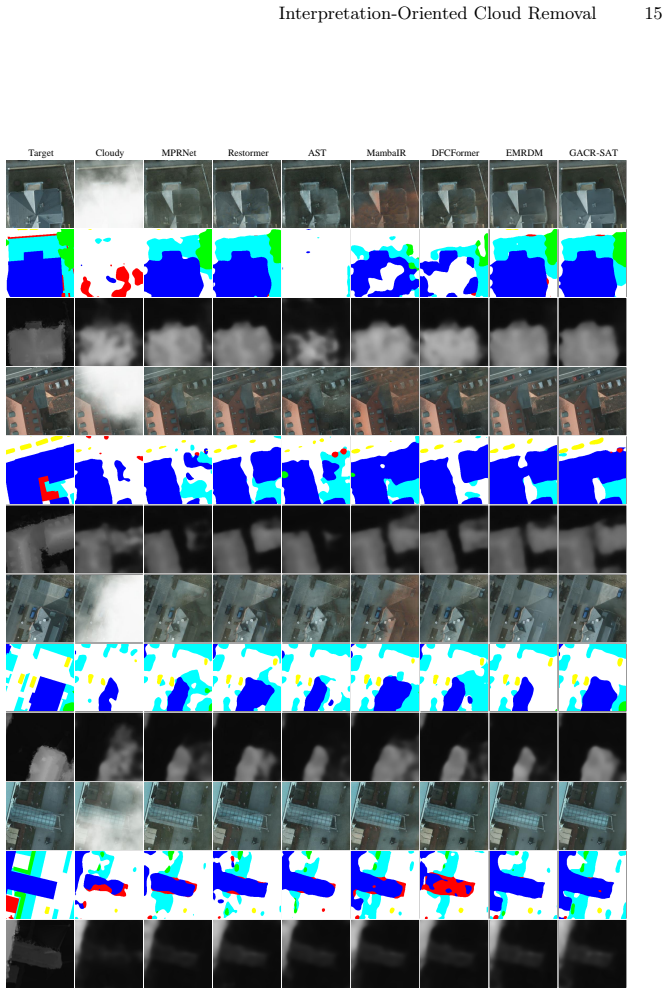
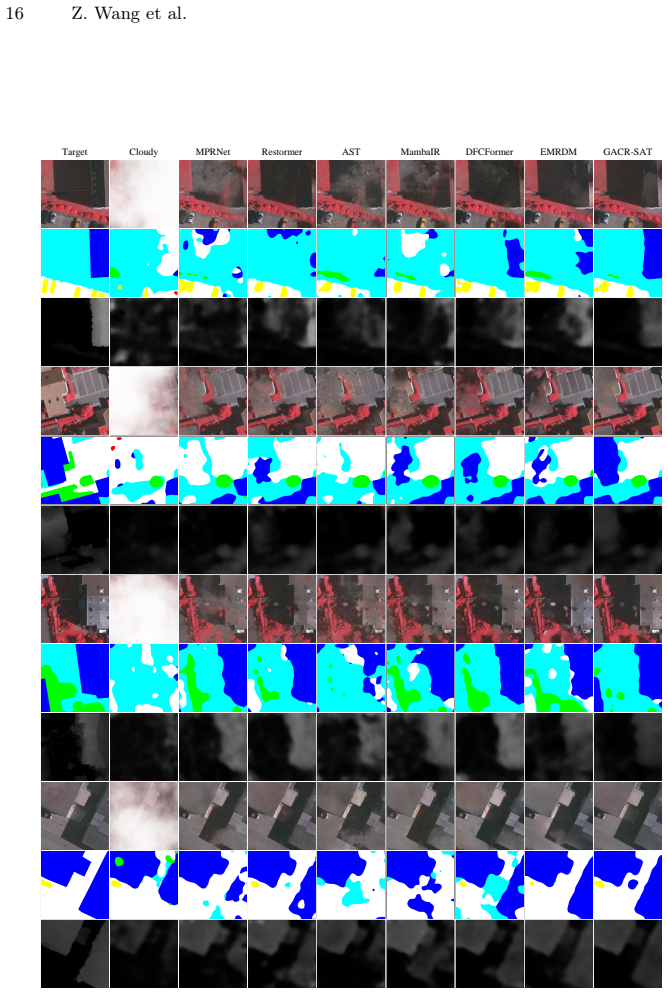
read the original abstract
Cloud removal (CR) is essential for optical remote sensing, serving as a prerequisite for reliable downstream interpretation, such as semantic segmentation and change detection. However, existing CR approaches often prioritize visual realism while overlooking their impact on subsequent analytical tasks, leading to semantic drift and degraded downstream performance. To address this issue, we propose Geo-Anchored Cloud Removal (GACR), a unified framework that jointly ensures faithful reconstruction and robust interpretability. At its core, GACR incorporates Observation-Anchored Residual Flow (OAR-Flow), which reformulates CR as a physically grounded residual inversion process. By anchoring the generative trajectory to the cloudy observation rather than pure noise, OAR-Flow enables fast, stable, and faithful reconstruction. To further preserve semantic structures critical for downstream interpretation, GACR integrates Geo-Contextual Prior Alignment (GCPA) to constrain the reconstruction within a semantic manifold induced by a Vision Foundation Model (VFM). Consequently, GACR strictly maintains the spatial-semantic integrity of complex landscapes. Extensive experiments across six CR datasets and twelve downstream tasks demonstrate that GACR produces superior reconstruction quality while consistently improving downstream task accuracy. The code is available at https://github.com/wzy6055/GACR.
Editorial analysis
A structured set of objections, weighed in public.
Referee Report
Summary. The paper proposes Geo-Anchored Cloud Removal (GACR), a framework for cloud removal in optical remote sensing. It introduces Observation-Anchored Residual Flow (OAR-Flow) to reformulate the task as a residual inversion anchored to the cloudy observation, and Geo-Contextual Prior Alignment (GCPA) to constrain outputs to a semantic manifold induced by a Vision Foundation Model (VFM) in order to preserve spatial-semantic structures for downstream tasks. The abstract states that experiments across six CR datasets and twelve downstream tasks show superior reconstruction quality and consistent gains in downstream accuracy; code is released at a GitHub link.
Significance. If the quantitative claims hold and the VFM manifold is shown to be appropriate, the work could meaningfully advance interpretation-oriented cloud removal by jointly targeting visual fidelity and downstream task performance. Explicit code release is a positive for reproducibility.
major comments (2)
- [Abstract] Abstract: the central claim of 'superior reconstruction quality while consistently improving downstream task accuracy' across six CR datasets and twelve downstream tasks is stated without any quantitative metrics, baselines, ablation results, or error bars. This absence is load-bearing because the headline contribution rests on these empirical improvements.
- [Method (GCPA)] GCPA description (method section): the claim that constraining reconstruction to the VFM-induced semantic manifold 'strictly maintains the spatial-semantic integrity of complex landscapes' is load-bearing for the interpretation-oriented contribution, yet no analysis demonstrates that the chosen VFM embeddings remain well-calibrated or invariant under the spectral and textural statistics of the target multispectral remote-sensing datasets (domain shift from natural-image pretraining).
minor comments (1)
- [Abstract] Abstract and introduction: the description of OAR-Flow as a 'physically grounded residual inversion process' would benefit from an explicit equation or diagram showing how the anchoring to the cloudy observation differs from standard diffusion or flow baselines.
Simulated Author's Rebuttal
We thank the referee for the constructive feedback on our manuscript. We address each major comment below and outline the revisions we will make to strengthen the presentation of our empirical claims and the justification for GCPA.
read point-by-point responses
-
Referee: [Abstract] Abstract: the central claim of 'superior reconstruction quality while consistently improving downstream task accuracy' across six CR datasets and twelve downstream tasks is stated without any quantitative metrics, baselines, ablation results, or error bars. This absence is load-bearing because the headline contribution rests on these empirical improvements.
Authors: We agree that the abstract would benefit from highlighting key quantitative results to support the central claim. The full manuscript already contains the supporting evidence (Tables 1–4 report PSNR/SSIM gains of 1.2–3.8 dB over baselines across the six datasets, with downstream mIoU/F1 improvements of 2.1–7.4% on the twelve tasks, including error bars from three runs). We will revise the abstract to include concise quantitative highlights (e.g., “average +2.7 dB PSNR and +4.3% downstream accuracy”) while preserving its length constraints. revision: yes
-
Referee: [Method (GCPA)] GCPA description (method section): the claim that constraining reconstruction to the VFM-induced semantic manifold 'strictly maintains the spatial-semantic integrity of complex landscapes' is load-bearing for the interpretation-oriented contribution, yet no analysis demonstrates that the chosen VFM embeddings remain well-calibrated or invariant under the spectral and textural statistics of the target multispectral remote-sensing datasets (domain shift from natural-image pretraining).
Authors: The referee correctly identifies that we provide no explicit calibration or invariance analysis of the VFM embeddings under multispectral domain shift. Our empirical results (consistent downstream gains across six datasets) serve as indirect evidence that the manifold remains useful, but this does not constitute a direct demonstration of calibration. We will revise the manuscript to (i) soften the wording from “strictly maintains” to “helps preserve”, (ii) add a dedicated paragraph in the discussion section acknowledging the natural-image pretraining domain gap, and (iii) include a qualitative visualization of embedding nearest-neighbor consistency on remote-sensing patches. No new quantitative calibration experiments will be added at this stage. revision: partial
Circularity Check
No circularity; derivation is self-contained via new components and empirical validation
full rationale
The paper introduces OAR-Flow as a reformulation of cloud removal into a residual inversion anchored to observations and GCPA as a constraint to a VFM-induced semantic manifold. No equations, fitted parameters, or self-citations are presented that reduce the central claims (reconstruction quality and downstream gains) to inputs by construction. The claims rest on experiments across six CR datasets and twelve downstream tasks rather than tautological redefinitions or load-bearing self-citations. This is the normal case of an independent proposal.
Axiom & Free-Parameter Ledger
Reference graph
Works this paper leans on
-
[1]
Stochastic Interpolants: A Unifying Framework for Flows and Diffusions
Albergo,M.S.,Boffi,N.M.,Vanden-Eijnden,E.:Stochasticinterpolants:Aunifying framework for flows and diffusions. arXiv preprint arXiv:2303.08797 (2023)
work page internal anchor Pith review Pith/arXiv arXiv 2023
-
[2]
In: The Eleventh International Conference on Learning Representations (2023)
Albergo, M.S., Vanden-Eijnden, E.: Building normalizing flows with stochastic in- terpolants. In: The Eleventh International Conference on Learning Representations (2023)
2023
-
[3]
In: European Conference on Computer Vision
Astruc, G., Gonthier, N., Mallet, C., Landrieu, L.: Omnisat: Self-supervised modal- ity fusion for earth observation. In: European Conference on Computer Vision. pp. 409–427. Springer (2024)
2024
-
[4]
local climate zone (LCZ) map accuracy assessments should account for land cover physical characteristics that affect the local thermal environment
Bechtel, B., Demuzere, M., Stewart, I.D.: A weighted accuracy measure for land cover mapping: Comment on johnson et al. local climate zone (LCZ) map accuracy assessments should account for land cover physical characteristics that affect the local thermal environment. remote sens. 2019, 11, 2420. Remote Sensing12(11), 1769 (2020)
2019
-
[5]
ISPRS Annals of the Photogrammetry, Remote Sensing and Spatial Information Sciences4, 5–11 (2018)
Bermudez, J.D., Happ, P.N., Oliveira, D.A.B., Feitosa, R.Q.: SAR to optical image synthesis for cloud removal with generative adversarial networks. ISPRS Annals of the Photogrammetry, Remote Sensing and Spatial Information Sciences4, 5–11 (2018)
2018
-
[6]
In: Proceedings of the Computer Vision and Pattern Recognition Conference
Chen, I., Chen, W.T., Liu, Y.W., Chiang, Y.C., Kuo, S.Y., Yang, M.H., et al.: Unirestore: Unified perceptual and task-oriented image restoration model using diffusion prior. In: Proceedings of the Computer Vision and Pattern Recognition Conference. pp. 17969–17979 (2025)
2025
-
[7]
In: International Conference on Machine Learning (2024)
Crowson, K., Baumann, S.A., Birch, A., Abraham, T.M., Kaplan, D.Z., Shippole, E.: Scalable high-resolution pixel-space image synthesis with hourglass diffusion transformers. In: International Conference on Machine Learning (2024)
2024
-
[8]
Remote Sensing15(17), 4138 (2023)
Czerkawski, M., Atkinson, R., Michie, C., Tachtatzis, C.: Satellitecloudgenerator: controllable cloud and shadow synthesis for multi-spectral optical satellite images. Remote Sensing15(17), 4138 (2023)
2023
-
[9]
Advances in neural information processing systems35, 2406–2422 (2022) 16 Z
De Bortoli, V., Mathieu, E., Hutchinson, M., Thornton, J., Teh, Y.W., Doucet, A.: Riemannian score-based generative modelling. Advances in neural information processing systems35, 2406–2422 (2022) 16 Z. Wang et al
2022
-
[10]
IEEE Transactions on Geoscience and Remote Sensing60, 1–14 (2022)
Ebel, P., Xu, Y., Schmitt, M., Zhu, X.X.: SEN12MS-CR-TS: A remote-sensing data set for multimodal multitemporal cloud removal. IEEE Transactions on Geoscience and Remote Sensing60, 1–14 (2022)
2022
-
[11]
In: Proceedings of the IEEE conference on computer vision and pattern recognition workshops
Enomoto, K., Sakurada, K., Wang, W., Fukui, H., Matsuoka, M., Nakamura, R., Kawaguchi, N.: Filmy cloud removal on satellite imagery with multispectral con- ditional generative adversarial nets. In: Proceedings of the IEEE conference on computer vision and pattern recognition workshops. pp. 48–56 (2017)
2017
-
[12]
In: Proceedings of the Computer Vision and Pattern Recognition Conference
Feng,C.,Chen,Z.,Holynski,A.,Efros,A.A.,Owens,A.:GPSasacontrolsignalfor image generation. In: Proceedings of the Computer Vision and Pattern Recognition Conference. pp. 2766–2778 (2025)
2025
-
[13]
Communications of the ACM63(11), 139–144 (2020)
Goodfellow, I., Pouget-Abadie, J., Mirza, M., Xu, B., Warde-Farley, D., Ozair, S., Courville, A., Bengio, Y.: Generative adversarial networks. Communications of the ACM63(11), 139–144 (2020)
2020
-
[14]
In: IGARSS 2018-2018 IEEE International Geoscience and Remote Sensing Symposium
Grohnfeldt, C., Schmitt, M., Zhu, X.: A conditional generative adversarial network to fuse SAR and multispectral optical data for cloud removal from Sentinel-2 im- ages. In: IGARSS 2018-2018 IEEE International Geoscience and Remote Sensing Symposium. pp. 1726–1729. IEEE (2018)
2018
-
[15]
Gu, Y., Meng, Y., Ji, J., Sun, X.: ACL: Activating capability of linear attention for imagerestoration.In:ProceedingsoftheComputerVisionandPatternRecognition Conference. pp. 17913–17923 (2025)
2025
-
[16]
In: European Conference on Computer Vision
Guo, H., Li, J., Dai, T., Ouyang, Z., Ren, X., Xia, S.T.: MambaIR: A simple baseline for image restoration with state-space model. In: European Conference on Computer Vision. pp. 222–241. Springer (2024)
2024
-
[17]
In: Proceedings of the IEEE/CVF Conference on Computer Vision and Pattern Recognition
Guo, X., Lao, J., Dang, B., Zhang, Y., Yu, L., Ru, L., Zhong, L., Huang, Z., Wu, K., Hu, D., et al.: Skysense: A multi-modal remote sensing foundation model towards universal interpretation for earth observation imagery. In: Proceedings of the IEEE/CVF Conference on Computer Vision and Pattern Recognition. pp. 27672–27683 (2024)
2024
-
[18]
IEEE transactions on pattern analysis and machine intelligence33(12), 2341–2353 (2010)
He, K., Sun, J., Tang, X.: Single image haze removal using dark channel prior. IEEE transactions on pattern analysis and machine intelligence33(12), 2341–2353 (2010)
2010
-
[19]
Advances in neural information processing systems33, 6840–6851 (2020)
Ho, J., Jain, A., Abbeel, P.: Denoising diffusion probabilistic models. Advances in neural information processing systems33, 6840–6851 (2020)
2020
-
[20]
In: International Conference on Machine Learning (2024)
Huh, M., Cheung, B., Wang, T., Isola, P.: The platonic representation hypothesis. In: International Conference on Machine Learning (2024)
2024
-
[21]
Jeong, J., Han, S., Kim, J., Kim, S.J.: Latent space super-resolution for higher- resolutionimagegenerationwithdiffusionmodels.In:ProceedingsoftheComputer Vision and Pattern Recognition Conference. pp. 2355–2365 (2025)
2025
-
[22]
ISPRS Journal of Photogrammetry and Remote Sensing214, 179–192 (2024)
Jin, X., He, J., Xiao, Y., Lihe, Z., Liao, X., Li, J., Yuan, Q.: RFE-VCR: Reference- enhanced transformer for remote sensing video cloud removal. ISPRS Journal of Photogrammetry and Remote Sensing214, 179–192 (2024)
2024
-
[23]
Advances in neural information processing systems35, 26565–26577 (2022)
Karras,T.,Aittala,M.,Aila,T.,Laine,S.:Elucidatingthedesignspaceofdiffusion- based generative models. Advances in neural information processing systems35, 26565–26577 (2022)
2022
-
[24]
IEEE transactions on geoscience and remote sensing51(7), 3826–3852 (2013)
King, M.D., Platnick, S., Menzel, W.P., Ackerman, S.A., Hubanks, P.A.: Spatial and temporal distribution of clouds observed by modis onboard the terra and aqua satellites. IEEE transactions on geoscience and remote sensing51(7), 3826–3852 (2013)
2013
-
[25]
Auto-Encoding Variational Bayes
Kingma, D.P., Welling, M.: Auto-encoding variational bayes. arXiv preprint arXiv:1312.6114 (2013) Interpretation-Oriented Cloud Removal 17
work page internal anchor Pith review Pith/arXiv arXiv 2013
-
[26]
IEEE Transactions on Geo- science and Remote Sensing58(4), 2865–2879 (2019)
Li, W., Li, Y., Chan, J.C.W.: Thick cloud removal with optical and SAR imagery via convolutional-mapping-deconvolutional network. IEEE Transactions on Geo- science and Remote Sensing58(4), 2865–2879 (2019)
2019
-
[27]
ISPRS Journal of Photogrammetry and Remote Sensing188, 89– 108 (2022)
Li, Z., Shen, H., Weng, Q., Zhang, Y., Dou, P., Zhang, L.: Cloud and cloud shadow detection for optical satellite imagery: Features, algorithms, validation, and prospects. ISPRS Journal of Photogrammetry and Remote Sensing188, 89– 108 (2022)
2022
-
[28]
In: The Eleventh International Conference on Learning Representations (2023)
Lipman, Y., Chen, R.T.Q., Ben-Hamu, H., Nickel, M., Le, M.: Flow matching for generative modeling. In: The Eleventh International Conference on Learning Representations (2023)
2023
-
[29]
IEEE Transactions on Multimedia (2025)
Liu, J., Pan, B., Shi, Z.: CR-Famba: A frequency-domain assisted mamba for thin cloud removal in optical remote sensing imagery. IEEE Transactions on Multimedia (2025)
2025
-
[30]
In: The Eleventh International Conference on Learning Representations (2023)
Liu, X., Gong, C., Liu, Q.: Flow straight and fast: Learning to generate and transfer data with rectified flow. In: The Eleventh International Conference on Learning Representations (2023)
2023
-
[31]
In: Proceedings of the Computer Vision and Pattern Recognition Conference
Liu, Y., Li, W., Guan, J., Zhou, S., Zhang, Y.: Effective cloud removal for remote sensing images by an improved mean-reverting denoising model with elucidated design space. In: Proceedings of the Computer Vision and Pattern Recognition Conference. pp. 17851–17861 (2025)
2025
-
[32]
Advances in neural information processing systems35, 5775–5787 (2022)
Lu, C., Zhou, Y., Bao, F., Chen, J., Li, C., Zhu, J.: DPM-solver: A fast ODE solver for diffusion probabilistic model sampling in around 10 steps. Advances in neural information processing systems35, 5775–5787 (2022)
2022
-
[33]
International Conference on Machine Learning (2023)
Luo, Z., Gustafsson, F.K., Zhao, Z., Sjölund, J., Schön, T.B.: Image restoration with mean-reverting stochastic differential equations. International Conference on Machine Learning (2023)
2023
-
[34]
In: European Conference on Computer Vision
Ma, N., Goldstein, M., Albergo, M.S., Boffi, N.M., Vanden-Eijnden, E., Xie, S.: SiT: Exploring flow and diffusion-based generative models withscalable interpolant transformers. In: European Conference on Computer Vision. pp. 23–40. Springer (2024)
2024
-
[35]
IEEE Journal of Selected Topics in Applied Earth Observa- tions and Remote Sensing16, 4999–5012 (2023)
Ma, X., Huang, Y., Zhang, X., Pun, M.O., Huang, B.: Cloud-EGAN: Rethinking cyclegan from a feature enhancement perspective for cloud removal by combining cnn and transformer. IEEE Journal of Selected Topics in Applied Earth Observa- tions and Remote Sensing16, 4999–5012 (2023)
2023
-
[36]
In: Proceedings of the IEEE/CVF Winter Conference on Applications of Computer Vision
Mehri, A., Ardakani, P.B., Sappa, A.D.: MPRNet: Multi-path residual network for lightweight image super resolution. In: Proceedings of the IEEE/CVF Winter Conference on Applications of Computer Vision. pp. 2704–2713 (2021)
2021
-
[37]
In: International conference on machine learning
Nichol, A.Q., Dhariwal, P.: Improved denoising diffusion probabilistic models. In: International conference on machine learning. pp. 8162–8171. PMLR (2021)
2021
-
[38]
IEEE Trans- actions on Geoscience and Remote Sensing (2025)
Pan, L., Song, X., Xie, F., Zhang, X., Ji, H., Shi, Z.: M3-CR: Multi-scale multi- branch Mamba for SAR-assisted optical image thick cloud removal. IEEE Trans- actions on Geoscience and Remote Sensing (2025)
2025
-
[39]
Peebles,W.,Xie,S.:Scalablediffusionmodelswithtransformers.In:Proceedingsof the IEEE/CVF international conference on computer vision. pp. 4195–4205 (2023)
2023
-
[40]
In: Proceedings of the IEEE/CVF conference on computer vision and pattern recognition
Rombach, R., Blattmann, A., Lorenz, D., Esser, P., Ommer, B.: High-resolution image synthesis with latent diffusion models. In: Proceedings of the IEEE/CVF conference on computer vision and pattern recognition. pp. 10684–10695 (2022)
2022
-
[41]
Remote Sensing Ap- plications: Society and Environment p
Silva, L.H.F.P., Mari, J.F., Escarpinati, M.C., Backes, A.R.: Cloud removal with compact diffusion models: A residual block-based approach. Remote Sensing Ap- plications: Society and Environment p. 101680 (2025) 18 Z. Wang et al
2025
-
[42]
Siméoni, O., Vo, H.V., Seitzer, M., Baldassarre, F., Oquab, M., Jose, C., Khalidov, V., Szafraniec, M., Yi, S., Ramamonjisoa, M., et al.: DINOv3 (2025)
2025
-
[43]
In: IGARSS 2018-2018 IEEE International Geoscience and Remote Sensing Symposium
Singh, P., Komodakis, N.: Cloud-Gan: Cloud removal for sentinel-2 imagery using a cyclic consistent generative adversarial networks. In: IGARSS 2018-2018 IEEE International Geoscience and Remote Sensing Symposium. pp. 1772–1775. IEEE (2018)
2018
-
[44]
Denoising Diffusion Implicit Models
Song, J., Meng, C., Ermon, S.: Denoising diffusion implicit models. arXiv:2010.02502 (October 2020)
work page internal anchor Pith review Pith/arXiv arXiv 2010
-
[45]
In: Interna- tional Conference on Learning Representations (2021)
Song, Y., Sohl-Dickstein, J., Kingma, D.P., Kumar, A., Ermon, S., Poole, B.: Score- based generative modeling through stochastic differential equations. In: Interna- tional Conference on Learning Representations (2021)
2021
-
[46]
IEEE Transactions on Geoscience and Remote Sensing62, 1–14 (2024)
Sui, J., Ma, Y., Yang, W., Zhang, X., Pun, M.O., Liu, J.: Diffusion enhancement for cloud removal in ultra-resolution remote sensing imagery. IEEE Transactions on Geoscience and Remote Sensing62, 1–14 (2024)
2024
-
[47]
In: Proceedings of the Computer Vision and Pattern Recogni- tion Conference
Wang, C., Guo, L., Fu, Z., Yang, S., Cheng, H., Kot, A.C., Wen, B.: Reconciling stochastic and deterministic strategies for zero-shot image restoration using diffu- sion model in dual. In: Proceedings of the Computer Vision and Pattern Recogni- tion Conference. pp. 23207–23216 (2025)
2025
-
[48]
IEEE Journal of Selected Topics in Applied Earth Observations and Remote Sensing18, 24531– 24545 (2025)
Wang, Z., Ma, X., Pun, M.O.: Downstream task-aware cloud removal for very-high- resolution remote sensing images: An information loss perspective. IEEE Journal of Selected Topics in Applied Earth Observations and Remote Sensing18, 24531– 24545 (2025)
2025
-
[49]
In: Proceedings of the Computer Vision and Pattern Recognition Conference
Yang, H., Bulat, A., Hadji, I., Pham, H.X., Zhu, X., Tzimiropoulos, G., Martinez, B.: FAM diffusion: Frequency and attention modulation for high-resolution im- age generation with stable diffusion. In: Proceedings of the Computer Vision and Pattern Recognition Conference. pp. 2459–2468 (2025)
2025
-
[50]
In: Proceedings of the IEEE/CVF conference on computer vision and pattern recognition
Zamir, S.W., Arora, A., Khan, S., Hayat, M., Khan, F.S., Yang, M.H.: Restormer: Efficient transformer for high-resolution image restoration. In: Proceedings of the IEEE/CVF conference on computer vision and pattern recognition. pp. 5728–5739 (2022)
2022
-
[51]
Zhou, S., Chen, D., Pan, J., Shi, J., Yang, J.: Adapt or perish: Adaptive sparse transformerwithattentivefeaturerefinementforimagerestoration.In:Proceedings of the IEEE/CVF Conference on Computer Vision and Pattern Recognition. pp. 2952–2963 (2024)
2024
-
[52]
In: Proceedings of the Computer Vision and Pattern Recognition Conference
Zhu, Q., Lao, J., Ji, D., Luo, J., Wu, K., Zhang, Y., Ru, L., Wang, J., Chen, J., Yang, M., et al.: Skysense-O: Towards open-world remote sensing interpreta- tion with vision-centric visual-language modeling. In: Proceedings of the Computer Vision and Pattern Recognition Conference. pp. 14733–14744 (2025)
2025
-
[53]
IEEE geoscience and remote sensing magazine5(4), 8–36 (2017)
Zhu, X.X., Tuia, D., Mou, L., Xia, G.S., Zhang, L., Xu, F., Fraundorfer, F.: Deep learning in remote sensing: A comprehensive review and list of resources. IEEE geoscience and remote sensing magazine5(4), 8–36 (2017)
2017
-
[54]
IEEE Journal of Selected Topics in Applied Earth Observations and Remote Sensing14, 3811–3823 (2021)
Zi, Y., Xie, F., Zhang, N., Jiang, Z., Zhu, W., Zhang, H.: Thin cloud removal for multispectral remote sensing images using convolutional neural networks com- bined with an imaging model. IEEE Journal of Selected Topics in Applied Earth Observations and Remote Sensing14, 3811–3823 (2021)
2021
-
[55]
Zou, X., Li, K., Xing, J., Zhang, Y., Wang, S., Jin, L., Tao, P.: DiffCR: A fast conditional diffusion framework for cloud removal from optical satellite images. IEEE Transactions on Geoscience and Remote Sensing62, 1–14 (2024) Interpretation-Oriented Cloud Removal 1 Supplementary Material A Proof of the probability flow ODE with the velocity. In this par...
2024
-
[56]
The downstream part provides annotations for six land-cover types based on the LCZ standard [4]. Since the dataset provides unsliced, large-scale images, it enables flexible and customizable alignment for experimental comparison. To support our building extraction task, we manually annotated building regions using the CVAT tool. The annotated regions used...
discussion (0)
Sign in with ORCID, Apple, or X to comment. Anyone can read and Pith papers without signing in.