Learning Adaptive Coarse Spaces Using Transferable Neural Network Models for Linear and Nonlinear Overlapping Domain Decomposition Methods
Reviewed by Pith T0 review T1 audit T2 compute T3 formal T4 kernel 2026-07-08 11:30 UTCglm-5.2pith:ZFVAF5OKrecord.jsonopen to challenge →
The pith
Neural Networks Trained on Simple Diffusion Replace Expensive Eigenvalue Solves
A machine-rendered reading of the paper's core claim, the machinery that carries it, and where it could break.
Core claim
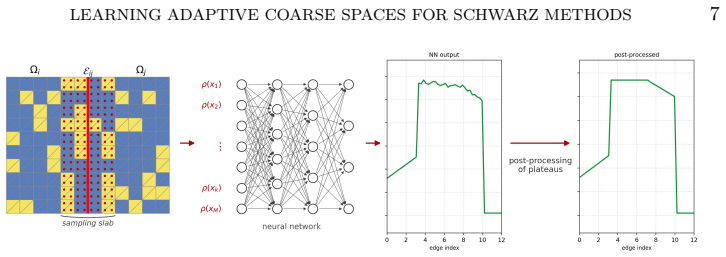
The core object is the LAGDSW coarse space: a learned replacement for the adaptive GDSW coarse space in overlapping Schwarz methods. It is constructed by sampling coefficient values in a slab around each interface edge, feeding them to a classifier that determines the number of adaptive constraints needed, then feeding them to regression networks that predict the constraint shapes. A plateau post-processing step then enforces constant-valued regions in the predictions. The authors demonstrate that this pipeline, trained exclusively on 36,000 linear scalar diffusion instances with coefficient contrast 1e6, produces coarse spaces that keep iteration counts low for linear elasticity (with a rig
What carries the argument
Two-stage neural network pipeline (regression + classification) with sign-invariant MSE loss, slab-based sampling, and plateau post-processing
If this is right
- If the transferability claim holds broadly, solvers for heterogeneous PDEs could avoid eigenvalue computations entirely, reducing setup time by the roughly 50% that eigenvalue construction currently costs in parallel implementations.
- The plateau post-processing discovery suggests that the geometric structure of coarse basis functions matters more for convergence than their exact numerical values, which could inform non-machine-learning approximations as well.
- The classifier-based approach to selecting the number of constraints per edge could be applied to other adaptive domain decomposition methods beyond AGDSW, such as FETI-DP or BDDC.
- The deterioration of the lifted coarse space for elasticity at extreme coefficient jumps (1e6) identifies a boundary where scalar-to-vector lifting fails, motivating either problem-specific training or hybrid approaches that fall back to eigenvalue solves on difficult edges.
Where Pith is reading between the lines
- The fact that networks trained on striped coefficient patterns generalize to dual-phase steel microstructures suggests that the relevant features for constraint prediction are local geometric features of the coefficient field near edges, not global problem structure.
- The success of the sign-invariant loss function implies that the coarse space only needs to span the right subspace, not reproduce specific eigenvectors, which raises the question of whether simpler surrogate methods (e.g., geometric heuristics) might partially substitute for neural networks.
- The failure of the lifting heuristic for elasticity at high contrast suggests that vector-valued problems have coarse modes that cannot be decomposed into scalar modes multiplied by rigid body motions, pointing to a structural limitation of the lifting approach rather than a limitation of the learning.
- If the plateau structure is truly the load-bearing feature, one could test whether a purely geometric plateau-detection algorithm on the coefficient field, without any neural network, already captures most of the robustness.
Load-bearing premise
The heuristic lifting of scalar learned constraints to the elasticity system assumes that multiplying scalar constraints by rigid body modes yields a robust coarse space, but the paper itself states there is no theory supporting this, and the authors' own experiments show it deteriorates at large coefficient jumps where the eigenvalue-based approach remains robust.
What would settle it
Show that for a broad class of realistic elasticity microstructures with coefficient jumps of 1e6 or higher, the lifted LAGDSW coarse space consistently requires significantly more iterations than AGDSW or fails to converge, demonstrating that the scalar-to-vector transfer is not reliable for extreme contrasts.
Figures


read the original abstract
Domain decomposition methods have been established as efficient and parallel scalable iterative solvers and preconditioners for the solution of large-scale systems arising from the discretization of partial differential equations. In particular, overlapping Schwarz methods have been successfully applied to a wide range of linear and nonlinear problems. However, for problems with highly heterogeneous coefficients, standard domain decomposition methods typically suffer from deteriorating convergence rates. Robustness with respect to the coefficient contrast can be achieved by enriching the coarse space with adaptively selected constraints obtained from local generalized eigenvalue problems. The construction of these adaptive coarse spaces, however, can account for a significant part of the overall computing time. In the present work, machine learning techniques are employed to reduce this part of the computing time in the context of the adaptive Generalized Dryja-Smith-Widlund (AGDSW) coarse space. A two-stage approach is proposed in which regression neural networks are used to predict the adaptive coarse basis functions, while a classification neural network is employed to predict the number of basis functions required to ensure robustness. As a consequence, adaptive coarse spaces can be set up in the online phase without solving any eigenvalue problem. Particular attention is paid to problem-specific aspects, including sign-invariant loss functions and post-processing strategies to significantly improve the predicted constraints. The proposed approach is first investigated for scalar diffusion problems with high coefficient contrasts and is subsequently transferred, without retraining, to problems of linear elasticity and to nonlinear $p$-Laplace problems, also within a nonlinear Schwarz framework.
Editorial analysis
A structured set of objections, weighed in public.
Referee Report
Summary. The paper proposes a two-stage machine learning approach to replace eigenvalue solves in the construction of AGDSW-type adaptive coarse spaces for overlapping Schwarz methods. Regression neural networks predict adaptive coarse basis functions, and a classification network predicts the number of constraints needed per edge. The approach is trained exclusively on linear scalar diffusion data and then transferred without retraining to linear elasticity (via a lifting heuristic) and nonlinear p-Laplace problems (within both Newton-Krylov-Schwarz and nonlinear Schwarz frameworks). The numerical experiments are extensive, covering scaling in subdomain count, subdomain size, coefficient contrast, and different PDE types, and include honest reporting of failure cases.
Significance. The paper makes a substantial contribution to the intersection of domain decomposition methods and machine learning. The two-stage regression-plus-classification approach that fully eliminates eigenvalue solves in the online phase is a clear advance over prior work. The sign-invariant MSE loss and plateau post-processing are well-motivated, problem-aware design choices. The transferability to nonlinear Schwarz methods (p-Laplace) without retraining is a genuinely new and valuable result. The extensive numerical studies, including Pareto front plots of coarse space size versus iteration count, provide a thorough and honest assessment. The paper also ships a clear, reproducible description of all hyperparameters and training data generation procedures.
major comments (2)
- The headline transferability claim to linear elasticity is stated without sufficient qualification. The abstract states that the networks are 'transferred, without retraining, to problems of linear elasticity,' but Section 5.2 explicitly notes 'there is no theory that supports the assumption that a lifted adaptive coarse space is robust for elasticity problems,' and Fig. 18 (bottom, E_high=2.1e8) shows LAGDSW deteriorating significantly while AGDSW-slab remains robust. Crucially, Fig. 19 demonstrates that this is not a neural network quality issue: even exact scalar AGDSW-slab constraints, when lifted, fail to span the same coarse space as directly computed elasticity AGDSW-slab. This means the limitation is fundamental to the lifting approach, not to the NN. The abstract and introduction should explicitly qualify the elasticity transferability claim as conditional on 'realistic' (moder-
- Section 5.2, Remark: The lifting heuristic multiplies scalar learned constraints by rigid body modes [1,0], [0,1], and [-y,x]. The paper is transparent that this lacks theoretical support and shows it fails for extreme contrasts. However, the central claim of transferability to elasticity depends on this heuristic. The paper should more clearly delineate which elasticity modes cannot be represented as scalar constraints times rigid body modes (the 'important modes' mentioned in the Remark), and whether these are modes involving coupling between displacement components or modes with spatial structure not capturable by any scalar function. A brief discussion of what the elasticity eigenvalue problem captures that the lifted scalar problem cannot would strengthen the paper's honesty and utility.
minor comments (8)
- Section 5.2: The rigid body mode for rotation is written as [-x, y] in one place and [-y, x] in another. Please use a consistent convention throughout.
- Section 4.1: 'epsilon_abs = 0.024 for the second constraint, epsilon_abs = 0.034 for the third one, and finally epsilon_abs = 0.071 for the third.' The last value should presumably be for the fourth constraint, not the third.
- Section 4.3.2: The median of 123.75 for 1600 subdomains is reported, but it is unclear if this refers to PCG iterations or coarse constraints per subdomain. Please clarify.
- Section 2.1: The sentence beginning 'The problem of stationary diffusion, is' has a formatting issue (missing space).
- Figures 9, 12, 15, 16, 18, 19, 26, 27, 28: The Pareto front plots would benefit from larger axis labels and markers for readability in the current format.
- Section 3.2: The training data generation uses H/h=10 mapped to H/h=20, but the sampling grid has 40 points per row. The relationship between these resolutions should be stated more explicitly.
- The paper would benefit from a brief discussion of computational timing: how much faster is the NN-based coarse space construction compared to solving the eigenvalue problems? This is the primary motivation but no runtime comparison is provided in the numerical results.
- Section 6.2: The statement that LAGDSW with k=3 'often fails to converge' for nonlinear Schwarz is attributed to the coarse space being too large. This claim would be stronger with supporting evidence or a reference to the specific failure cases.
Simulated Author's Rebuttal
We thank the referee for the careful reading and the constructive assessment. Both major comments concern the transferability claim to linear elasticity and the lifting heuristic. We agree that the abstract and introduction overstate the elasticity results and will revise accordingly. We also agree that a more detailed discussion of which elasticity modes cannot be represented by lifted scalar constraints would strengthen the paper and will add it.
read point-by-point responses
-
Referee: The headline transferability claim to linear elasticity is stated without sufficient qualification. The abstract states that the networks are 'transferred, without retraining, to problems of linear elasticity,' but Section 5.2 explicitly notes 'there is no theory that supports the assumption that a lifted adaptive coarse space is robust for elasticity problems,' and Fig. 18 (bottom, E_high=2.1e8) shows LAGDSW deteriorating significantly while AGDSW-slab remains robust. Crucially, Fig. 19 demonstrates that this is not a neural network quality issue: even exact scalar AGDSW-slab constraints, when lifted, fail to span the same coarse space as directly computed elasticity AGDSW-slab. This means the limitation is fundamental to the lifting approach, not to the NN. The abstract and introduction should explicitly qualify the elasticity transferability claim as conditional on 'realistic' (moder[
Authors: The referee is correct on all points. The abstract and introduction currently overstate the elasticity transferability claim by omitting the qualification that the body of the paper makes clear. As the referee observes, and as our own Figure 19 demonstrates, the limitation is fundamental to the lifting heuristic itself, not to the neural network predictions: even exact scalar AGDSW-slab constraints, when lifted via rigid body modes, fail to span the same coarse space as directly computed elasticity AGDSW-slab. We will revise the abstract to explicitly qualify the elasticity claim as conditional on realistic coefficient contrasts and to note that the lifting approach is a heuristic without theoretical guarantees. Specifically, we will change the relevant sentence to indicate that the networks are transferred to linear elasticity 'using a lifting heuristic that is effective for realistic coefficient contrasts but lacks theoretical guarantees and deteriorates for extreme contrasts.' We will make a corresponding revision in the introduction, replacing the current unqualified statement that the same networks 'can also be used for the system of linear elasticity with almost no loss in efficiency' with a statement that accurately reflects the Section 5.3 findings: the approach works well for physically realistic jumps (e.g., E_high/E_low = 1000, as in dual-phase steels) but deteriorates for extreme contrasts, and that this limitation is inherent to the lifting approach rather than the learned predictions. revision: yes
-
Referee: Section 5.2, Remark: The lifting heuristic multiplies scalar learned constraints by rigid body modes [1,0], [0,1], and [-y,x]. The paper is transparent that this lacks theoretical support and shows it fails for extreme contrasts. However, the central claim of transferability to elasticity depends on this heuristic. The paper should more clearly delineate which elasticity modes cannot be represented as scalar constraints times rigid body modes (the 'important modes' mentioned in the Remark), and whether these are modes involving coupling between displacement components or modes with spatial structure not capturable by any scalar function. A brief discussion of what the elasticity eigenvalue problem captures that the lifted scalar problem cannot would strengthen the paper's honesty and utility.
Authors: We agree that this discussion would strengthen the paper and will add it. The key distinction is as follows. The lifted scalar approach constructs, from each scalar edge constraint l, three vector-valued constraints: l*[1,0], l*[0,1], and l*[-y,x]. This means the spatial profile of each displacement component is always proportional to the same scalar function l (up to the rigid body mode factor). The elasticity eigenvalue problem, by contrast, solves a generalized eigenvalue problem on the full vector-valued stiffness matrix and can produce eigenvectors where the x- and y-displacement components have genuinely different spatial profiles — i.e., modes with coupling between displacement components that cannot be decomposed as a single scalar function times a rigid body mode. For moderate coefficient contrasts, the dominant adaptive modes are well-approximated by lifted scalar constraints, which is why the heuristic works. For extreme contrasts with complicated microstructures, the elasticity eigenvalue problem captures modes where the two displacement components respond differently to the heterogeneous coefficient structure, and these cannot be represented by any scalar function multiplied by a rigid body mode. We will add a paragraph to Section 5.2 (Remark) making this explicit, clarifying that the unrepresentable modes are precisely those involving component-wise coupling with spatial structure not capturable by any single scalar function. revision: yes
Circularity Check
No significant circularity found. The derivation is self-contained against external benchmarks.
full rationale
The paper's central claim—that neural networks trained on scalar diffusion eigenvalue data can predict adaptive coarse basis functions replacing eigenvalue solves—is validated against external benchmarks: PCG iteration counts and condition numbers on independently generated coefficient distributions, compared against the exact AGDSW/AGDSW-slab method. The training data (36,000 eigenvalue problem solutions on smart-random coefficient fields) is generated separately from the test data (different random distributions, different subdomain counts, different PDEs). The predictions are not tautologically forced by the training: the networks predict constraint shapes, which are then post-processed, lifted (for elasticity), and embedded into a Schwarz preconditioner whose convergence is measured independently. The self-citations to [14, 22, 23, 38] establish prior ML frameworks for FETI-DP/BDDC but are not load-bearing for the present paper's claims, which are validated by the numerical experiments within this paper. The Section 5.2 lifting heuristic for elasticity is explicitly acknowledged as unsupported by theory and shown by the paper's own data (Fig. 18–19) to fail for extreme contrasts—this is a correctness limitation, not circularity. The condition number bounds in Section 2.4 cite [11, 12, 29] (co-authored by Klawonn), but these are standard AGDSW theory results used as background, not as the basis for the paper's novel claims. No step in the derivation chain reduces to its inputs by construction.
Axiom & Free-Parameter Ledger
free parameters (4)
- k (number of regression networks) =
3
- epsilon_abs (post-processing threshold) =
0.024, 0.034, 0.071
- tol (eigenvalue tolerance) =
0.01
- Neural network hyperparameters =
3 hidden layers, {150,100,80} neurons, 5% dropout, GeLU, Adam, lr=0.001
axioms (4)
- domain assumption The AGDSW condition number bound kappa <= C(1 + 1/tol)^2 holds for the problems considered.
- domain assumption Mirrored (sign-flipped) adaptive constraints are equally robust for the Schwarz method.
- ad hoc to paper Noise in plateaus of adaptive constraints is more detrimental to convergence than noise outside plateaus.
- ad hoc to paper Scalar adaptive constraints can be lifted to elasticity by multiplication with rigid body modes.
invented entities (2)
-
LAGDSW coarse space
independent evidence
-
Sign-invariant MSE loss function
independent evidence
Reference graph
Works this paper leans on
-
[1]
SIAM Journal on Scientific Computing , volume =
Heinlein, Alexander and Klawonn, Axel and Knepper, Jascha and Rheinbach, Oliver , title =. SIAM Journal on Scientific Computing , volume =. 2019 , doi =
work page 2019
-
[2]
Machine Learning in adaptive overlapping domain decomposition methods
Alexander Heinlein and Axel Klawonn and Martin Lanser and Janine Weber. Machine Learning in adaptive overlapping domain decomposition methods. 2020
work page 2020
-
[3]
Dohrmann and Axel Klawonn and Olof B
Clark R. Dohrmann and Axel Klawonn and Olof B. Widlund , title =. SIAM Journal on Numerical Analysis , volume =. 2008 , doi =
work page 2008
-
[4]
Dohrmann and Axel Klawonn and Olof B
Clark R. Dohrmann and Axel Klawonn and Olof B. Widlund , title =. Domain Decomposition Methods in Science and Engineering XVII , series =. 2008 , doi =
work page 2008
-
[5]
SIAM Journal on Scientific Computing , volume =
Heinlein, Alexander and Klawonn, Axel and Knepper, Jascha and Rheinbach, Oliver , title =. SIAM Journal on Scientific Computing , volume =
-
[6]
Domain Decomposition Methods in Science and Engineering XXIV , series =
Alexander Heinlein and Axel Klawonn and Jascha Knepper and Oliver Rheinbach , title =. Domain Decomposition Methods in Science and Engineering XXIV , series =. 2018 , doi =
work page 2018
- [7]
-
[8]
Domain Decomposition Methods - Algorithms and Theory
Andrea Toselli and Olof Widlund. Domain Decomposition Methods - Algorithms and Theory
-
[9]
Klawonn, Axel and Lanser, Martin and Rheinbach, Oliver , TITLE =. SIAM J. Sci. Comput. , FJOURNAL =. 2015 , NUMBER =
work page 2015
-
[10]
Klawonn, Axel and Rheinbach, Oliver , TITLE =. SIAM J. Sci. Comput. , FJOURNAL =. 2006 , NUMBER =
work page 2006
-
[11]
Klawonn, Axel and Lanser, Martin and Rheinbach, Oliver and Uran, Matthias , TITLE =. SIAM J. Sci. Comput. , FJOURNAL =. 2017 , NUMBER =
work page 2017
-
[12]
Numerical Linear Algebra with Applications , volume =
Charbel Farhat and Michel Lesoinne and Kendall Pierson , title =. Numerical Linear Algebra with Applications , volume =. 2000 , doi =
work page 2000
-
[13]
International Journal for Numerical Methods in Engineering , volume =
Charbel Farhat and Michel Lesoinne and Patrick Le Tallec and Kendall Pierson and Daniel Rixen , title =. International Journal for Numerical Methods in Engineering , volume =. 2001 , doi =
work page 2001
-
[14]
Axel Klawonn and Maksymilian Dryja and Olof B. Widlund , title =. SIAM Journal on Numerical Analysis , volume =. 2002 , doi =
work page 2002
-
[15]
Axel Klawonn and Olof B. Widlund , title =. Communications on Pure and Applied Mathematics , volume =. 2006 , doi =
work page 2006
-
[16]
Clark R. Dohrmann , title =. SIAM Journal on Scientific Computing , volume =. 2003 , doi =
work page 2003
-
[17]
Jan Mandel and Clark R. Dohrmann , title =. Numerical Linear Algebra with Applications , volume =. 2003 , doi =
work page 2003
-
[18]
Smith and Hong Zhang and Jianjun Li , title =
Stefano Zampini and Xiao-Chuan Tu and Jed Brown and Barry F. Smith and Hong Zhang and Jianjun Li , title =. Domain Decomposition Methods in Science and Engineering XXIII , series =. 2017 , doi =
work page 2017
-
[19]
SIAM Journal on Scientific Computing , volume =
Alexander Heinlein and Axel Klawonn and Oliver Rheinbach , title =. SIAM Journal on Scientific Computing , volume =. 2016 , doi =
work page 2016
- [20]
-
[21]
Abstract Robust Coarse Spaces for Systems of
Nicole Spillane and Victor Dolean and Pierre-Henri Tournier and Fr. Abstract Robust Coarse Spaces for Systems of. Numerische Mathematik , volume =. 2014 , doi =
work page 2014
-
[22]
Petter E. Bj. Analysis of a Spectral Harmonically Enriched Multiscale Coarse Space for Two-Level. SIAM Journal on Scientific Computing , volume =. 2018 , doi =
work page 2018
-
[23]
Adaptive Coarse Space Selection in the
Jan Mandel and Bed. Adaptive Coarse Space Selection in the. Domain Decomposition Methods in Science and Engineering XVII , series =
-
[24]
Clemens Pechstein and Clark R. Dohrmann , title =. Electronic Transactions on Numerical Analysis , volume =. 2017 , url =
work page 2017
-
[25]
SIAM Journal on Scientific Computing , volume =
Alexander Heinlein and Axel Klawonn and Jascha Knepper and Oliver Rheinbach , title =. SIAM Journal on Scientific Computing , volume =. 2019 , doi =
work page 2019
-
[26]
Electronic Transactions on Numerical Analysis , volume =
Axel Klawonn and Patrick Radtke and Oliver Rheinbach , title =. Electronic Transactions on Numerical Analysis , volume =. 2016 , url =
work page 2016
-
[27]
Xiao-Chuan Cai and David E. Keyes , title =. SIAM Journal on Scientific Computing , volume =. 2002 , doi =
work page 2002
-
[28]
Gander and Walid Kheriji and Felix Kwok and Roland Masson , title =
Victor Dolean and Martin J. Gander and Walid Kheriji and Felix Kwok and Roland Masson , title =. SIAM Journal on Scientific Computing , volume =. 2016 , doi =
work page 2016
-
[29]
SIAM Journal on Scientific Computing , volume =
Axel Klawonn and Martin Lanser and Oliver Rheinbach , title =. SIAM Journal on Scientific Computing , volume =. 2014 , doi =
work page 2014
-
[30]
International Journal for Multiscale Computational Engineering , volume =
Julien Pebrel and Christian Rey and Pierre Gosselet , title =. International Journal for Multiscale Computational Engineering , volume =. 2008 , doi =
work page 2008
-
[31]
SIAM Journal on Scientific Computing , volume =
Alexander Heinlein and Martin Lanser , title =. SIAM Journal on Scientific Computing , volume =. 2020 , doi =
work page 2020
-
[32]
SIAM Journal on Scientific Computing , volume =
Alexander Heinlein and Axel Klawonn and Martin Lanser , title =. SIAM Journal on Scientific Computing , volume =. 2023 , doi =
work page 2023
-
[33]
Distributed physics informed neural network for data-efficient solution to partial differential equations , author=. arXiv preprint arXiv:1907.08967 , year=
work page internal anchor Pith review Pith/arXiv arXiv 1907
-
[34]
Burrows, Steven and Frochte, J \"o rg and V \"o lske, Michael and Torres, Ana Bel \'e n Mart \'i nez and Stein, Benno. Learning Overlap Optimization for Domain Decomposition Methods. Advances in Knowledge Discovery and Data Mining. 2013
work page 2013
-
[35]
Proceedings of the IEEE 12th international conference on computer vision , pages=
What is the best multi-stage architecture for object recognition? , author=. Proceedings of the IEEE 12th international conference on computer vision , pages=. 2009 , organization=
work page 2009
-
[36]
Neural Networks: Tricks of the trade , pages=
Early stopping-but when? , author=. Neural Networks: Tricks of the trade , pages=. 1998 , publisher=
work page 1998
-
[37]
Engineering Analysis with Boundary Elements , volume=
Mesh-free radial basis function network methods with domain decomposition for approximation of functions and numerical solution of Poisson's equations , author=. Engineering Analysis with Boundary Elements , volume=. 2002 , publisher=
work page 2002
-
[38]
Rectified linear units improve restricted
Nair, Vinod and Hinton, Geoffrey E , Booktitle =. Rectified linear units improve restricted
-
[39]
He, Kaiming and Zhang, Xiangyu and Ren, Shaoqing and Sun, Jian , booktitle=
-
[40]
The annals of mathematical statistics , pages=
A stochastic approximation method , author=. The annals of mathematical statistics , pages=. 1951 , publisher=
work page 1951
-
[41]
Optimization methods for large-scale machine learning , author=. SIAM Review , volume=. 2018 , publisher=
work page 2018
-
[42]
Visualizing the Loss Landscape of Neural Nets
Visualizing the loss landscape of neural nets , author=. arXiv preprint arXiv:1712.09913 , year=
work page internal anchor Pith review Pith/arXiv arXiv
-
[43]
Deep sparse rectifier neural networks , Year =
Glorot, Xavier and Bordes, Antoine and Bengio, Yoshua , Booktitle =. Deep sparse rectifier neural networks , Year =
-
[44]
Goodfellow, Ian and Bengio, Yoshua and Courville, Aaron , Publisher =. Deep learning , Year =
-
[45]
Bottou, L. 13. Optimization for machine learning , pages=. 2011 , publisher=
work page 2011
-
[46]
Baker, Nathan and Alexander, Frank and Bremer, Timo and Hagberg, Aric and Kevrekidis, Yannis and Najm, Habib and Parashar, Manish and Patra, Abani and Sethian, James and Wild, Stefan and Willcox, Karen , doi =
-
[47]
Hendrycks, Dan and Gimpel, Kevin , journal=
-
[48]
Fast and Accurate Deep Network Learning by Exponential Linear Units (ELUs)
Clevert, Djork-Arn. arXiv preprint arXiv:1511.07289 , year=
work page internal anchor Pith review Pith/arXiv arXiv
-
[49]
Advances in neural information processing systems , pages=
Self-normalizing neural networks , author=. Advances in neural information processing systems , pages=
-
[50]
Bishop, Christopher M. , year=
- [51]
- [52]
-
[53]
Adam: A method for stochastic optimization , Year =
Kingma, Diederik P and Ba, Jimmy , Journal =. Adam: A method for stochastic optimization , Year =
-
[54]
The Marginal Value of Adaptive Gradient Methods in Machine Learning
The marginal value of adaptive gradient methods in machine learning , author=. arXiv preprint arXiv:1705.08292 , year=
work page internal anchor Pith review Pith/arXiv arXiv
-
[55]
Bollapragada, Raghu and Nocedal, Jorge and Mudigere, Dheevatsa and Shi, Hao-Jun and Tang, Ping Tak Peter , booktitle=. A progressive batching. 2018 , organization=
work page 2018
-
[56]
Byrd, Richard H. and Hansen, Samantha L. and Nocedal, Jorge and Singer, Yoram , journal=. A. 2016 , publisher=
work page 2016
-
[57]
Berahas, Albert S. and Tak. A robust multi-batch. Optimization Methods and Software , volume=. 2020 , publisher=
work page 2020
-
[58]
and Nocedal, Jorge and Schnabel, Robert B
Byrd, Richard H. and Nocedal, Jorge and Schnabel, Robert B. , journal=. Representations of quasi-. 1994 , publisher=
work page 1994
- [59]
-
[60]
SIAM Journal on Scientific Computing , volume=
A limited memory algorithm for bound constrained optimization , author=. SIAM Journal on Scientific Computing , volume=. 1995 , publisher=
work page 1995
-
[61]
Hinton, Geoffrey and Srivastava, Nitish and Swersky, Kevin , journal=. Lecture 6a:. 2012 , note=
work page 2012
-
[62]
Computer Methods in Applied Mechanics and Engineering , volume=
Triangular and quadrilateral surface mesh quality optimization using local parametrization , author=. Computer Methods in Applied Mechanics and Engineering , volume=. 2004 , publisher=
work page 2004
-
[63]
Adaptive subgradient methods for online learning and stochastic optimization , Volume =
Duchi, John and Hazan, Elad and Singer, Yoram , Journal =. Adaptive subgradient methods for online learning and stochastic optimization , Volume =
-
[64]
Understanding Machine Learning , Year =
Shalev-Shwartz, Shai and Ben-David, Shai , Publisher =. Understanding Machine Learning , Year =
-
[65]
Pedregosa, F. and Varoquaux, G. and Gramfort, A. and Michel, V. and Thirion, B. and Grisel, O. and Blondel, M. and Prettenhofer, P. and Weiss, R. and Dubourg, V. and Vanderplas, J. and Passos, A. and Cournapeau, D. and Brucher, M. and Perrot, M. and Duchesnay, E. , journal=. Scikit-learn: Machine Learning in
-
[66]
Machine learning refined: foundations, algorithms, and applications , author=. 2020 , publisher=
work page 2020
- [67]
-
[68]
Introduction to Machine Learning with Python: A Guide for Data Scientists , Year =
M. Introduction to Machine Learning with Python: A Guide for Data Scientists , Year =
-
[69]
Deep Domain Decomposition Method: Elliptic Problems
Deep Domain Decomposition Method: Elliptic Problems , author=. arXiv preprint arXiv:2004.04884 , year=
work page internal anchor Pith review Pith/arXiv arXiv 2004
-
[70]
Li, Ke and Tang, Kejun and Wu, Tianfan and Liao, Qifeng , journal=. 2019 , publisher=
work page 2019
-
[71]
Journal of Computa- tional physics378, 686–707 (2019) https: //doi.org/10.1016/j.jcp.2018.10.045
Raissi, M. AND Perdikaris, P. AND Karniadakis, George E. , TITLE =. Journal of Computational Physics , FJOURNAL =. 2019 , NUMBER =. doi:10.1016/j.jcp.2018.10.045 , URL =
-
[72]
The Journal of Machine Learning Research , volume=
Automatic differentiation in machine learning: a survey , author=. The Journal of Machine Learning Research , volume=. 2017 , publisher=
work page 2017
-
[73]
E, Weinan and Yu, Bing , journal=. The. 2018 , publisher=
work page 2018
-
[74]
Kharazmi, Ehsan and Zhang, Zhongqiang and Karniadakis, George Em , journal=. hp-
-
[75]
Large-scale Neural Solvers for Partial Differential Equations
Large-scale Neural Solvers for Partial Differential Equations , author=. arXiv preprint arXiv:2009.03730 , year=
work page internal anchor Pith review Pith/arXiv arXiv 2009
-
[76]
Outrageously Large Neural Networks: The Sparsely-Gated Mixture-of-Experts Layer
Outrageously large neural networks: The sparsely-gated mixture-of-experts layer , author=. arXiv preprint arXiv:1701.06538 , year=
work page internal anchor Pith review Pith/arXiv arXiv
-
[77]
Conditional Computation in Neural Networks for faster models
Conditional computation in neural networks for faster models , author=. arXiv preprint arXiv:1511.06297 , year=
work page internal anchor Pith review Pith/arXiv arXiv
-
[78]
Meng, Xuhui and Li, Zhen and Zhang, Dongkun and Karniadakis, George Em , journal=. 2020 , publisher=
work page 2020
-
[79]
Xu, Rui and Zhang, Dongxiao and Rong, Miao and Wang, Nanzhe , journal=. Weak
-
[80]
Computer Methods in Applied Mechanics and Engineering , volume =
Machine learning in cardiovascular flows modeling: Predicting arterial blood pressure from non-invasive. Computer Methods in Applied Mechanics and Engineering , volume =. 2020 , issn =. doi:https://doi.org/10.1016/j.cma.2019.112623 , url =
discussion (0)
Sign in with ORCID, Apple, or X to comment. Anyone can read and Pith papers without signing in.